

The most at-risk regions in the world for high-impact heatwaves
Open accessThe DOI matches its Crossref record; 45 of the 45 references it cites were found in a registry or an index.
Abstract
Heatwaves are becoming more frequent under climate change and can lead to thousands of excess deaths. Adaptation to extreme weather events often occurs in response to an event, with communities learning fast following unexpectedly impactful events. Using extreme value statistics, here we show where regional temperature records are statistically likely to be exceeded, and therefore communities might be more at-risk. In 31% of regions examined, the observed daily maximum temperature record is exceptional. Climate models suggest that similar behaviour can occur in any region. In some regions, such as Afghanistan and parts of Central America, this is a particular problem - not only have they the potential for far more extreme heatwaves than experienced, but their population is growing and increasingly exposed because of limited healthcare and energy resources. We urge policy makers in vulnerable regions to consider if heat action plans are sufficient for what might come.
Overview
The claims and statistics of this paper haven’t been checked yet.
Free: it reads the open-access text and checks the first 5 claims that cite a source we can check. Create a free account to check every claim.
Integrity signals
Registry
Cites
Statistics
Figures
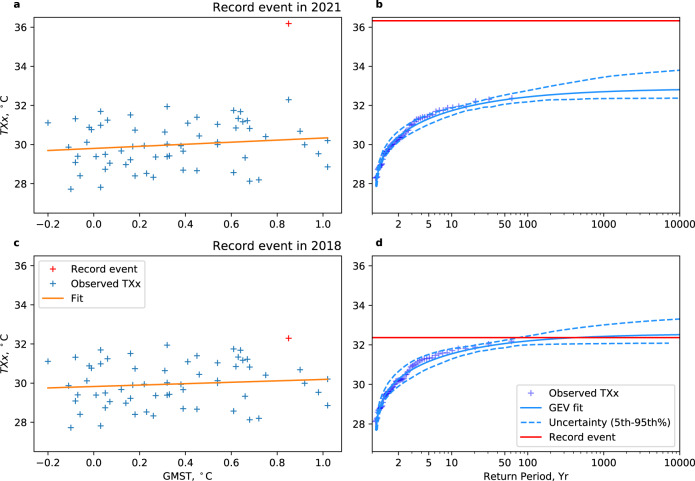
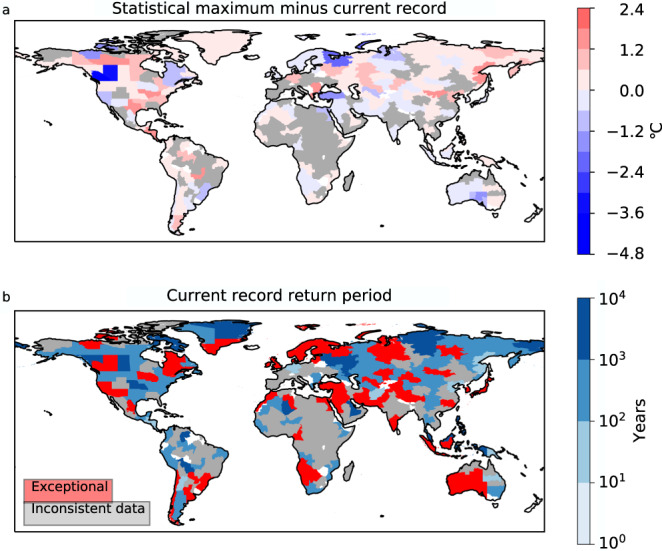
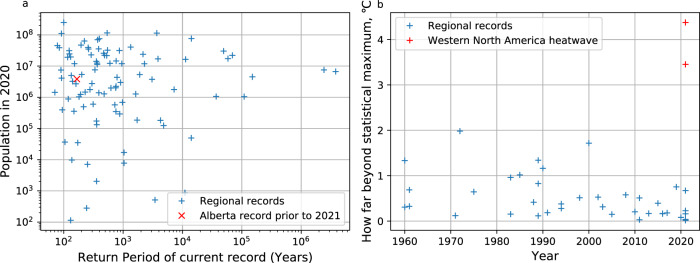
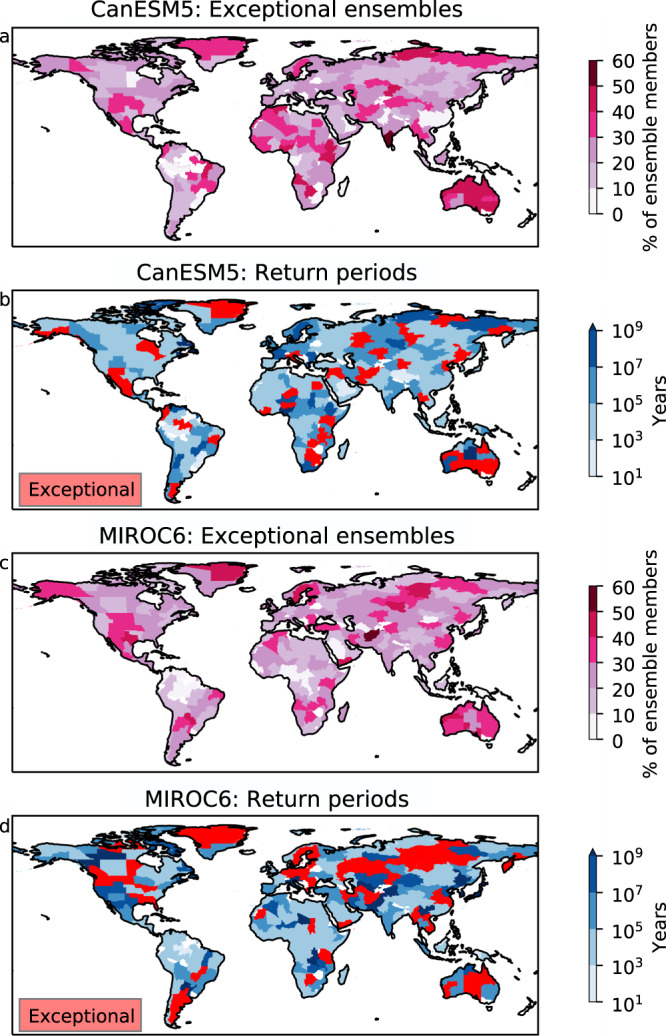
Verification
Claims the paper makes
The claims and statistics of this paper haven’t been checked yet.
Free: it reads the open-access text and checks the first 5 claims that cite a source we can check. Create a free account to check every claim.
Claims other papers make about this one
Each is checked against this paper’s own text: does it say what the citing paper says it does?
The source backs part of the claim, not all of it — or backs it for a different population, condition or comparison.
In the citing paper
“Hot extremes are becoming more frequent, intense, and longer because of anthropogenic climate change (Dunn et al., 2020), with heatwaves being their most common manifestation (Barriopedro et al., 2023;Thompson et al., 2023).”
From Artificial intelligence for climate prediction of extremes: State of the art, challenges, and future perspectives (2024) · cites this paper as Thompson et al., 2023
Experimental — accuracy not yet measured
Self-check
Percentages, sums and reported differences re-computed from the paper’s own numbers.
The self-check needs the paper’s full text.
Citations
Cites
Hersbach, H., Bell, B., Berrisford, P., Hirahara, S., Horányi, A., Muñoz‐Sabater, J., Nicolas, J., Peubey, C., Radu, R., Schepers, D., et al. (2020) · Quarterly Journal of the Royal Meteorological Society · doi:10.1002/qj.3803 · Cited by 31,882
An Introduction to Statistical Modeling of Extreme Values
Coles, S. (2001) · Springer Series in Statistics · doi:10.1007/978-1-4471-3675-0 · Cited by 7,352
The JRA-55 Reanalysis: General Specifications and Basic Characteristics
KOBAYASHI, S., OTA, Y., HARADA, Y., EBITA, A., MORIYA, M., ONODA, H., ONOGI, K., KAMAHORI, H., KOBAYASHI, C., ENDO, H., et al. (2015) · Journal of the Meteorological Society of Japan. Ser. II · doi:10.2151/jmsj.2015-001 · Cited by 4,760
Global surface temperature change
Hansen, J., Ruedy, R., Sato, M., & Lo, K. (2010) · Reviews of Geophysics · doi:10.1029/2010rg000345 · Cited by 3,081
Weather and Climate Extreme Events in a Changing Climate
(2023) · Climate Change 2021 – The Physical Science Basis · doi:10.1017/9781009157896.013 · Cited by 1,784
On the measurement of heat waves
Perkins, S. E., & Alexander, L. V. (2013) · Journal of Climate · doi:10.1175/jcli-d-12-00383.1 · Cited by 1,432
The Canadian Earth System Model version 5 (CanESM5.0.3)
Swart, N. C., Cole, J. N. S., Kharin, V. V., Lazare, M., Scinocca, J. F., Gillett, N. P., Anstey, J., Arora, V., Christian, J. R., Hanna, S., et al. (2019) · Geoscientific Model Development · doi:10.5194/gmd-12-4823-2019 · Cited by 1,386
An adaptability limit to climate change due to heat stress
Sherwood, S. C., & Huber, M. (2010) · Proceedings of the National Academy of Sciences · doi:10.1073/pnas.0913352107 · Cited by 1,236
Consistent geographical patterns of changes in high-impact European heatwaves
Fischer, E. M., & Schär, C. (2010) · Nature Geoscience · doi:10.1038/ngeo866 · Cited by 1,201
Global dimming and brightening: A review
Wild, M. (2009) · Journal of Geophysical Research: Atmospheres · doi:10.1029/2008jd011470 · Cited by 1,129
Research works printed but not linked: 1
- Gessner C Fischer EM Beyerle U Knutti R Very rare heat extremes: quantifying and understanding using ensemble reinitialization J. Clim. 2021 34 6619 6634
Cited by
Items 201–247 of 247
Wang, L., Rohli, R. V., Lin, Q., Zhou, Y., Dong, S., Song, S., Liu, Q., & Yan, X. (2025) · Weather and Climate Extremes · doi:10.1016/j.wace.2025.100838
Three billion urban residents can avoid unprecedented future heat
Lewis, H., & Harrington, L. (2026) · Climatic Change · doi:10.1007/s10584-026-04176-7
Wang, C., & Meng, J. (2026) · Applied Geography · doi:10.1016/j.apgeog.2026.104142
Heat stress and heatwave trends across Türkiye (1975–2024) using the Extended Heat Index
Tosun, E., & Güllü, G. (2026) · Climate Services · doi:10.1016/j.cliser.2026.100735
Heredia, O., Viedma, O., Kittel, T. G. F., & Hernández, H. V. (2026) · City and Environment Interactions · doi:10.1016/j.cacint.2026.100502
Thresholds of Heat Extremes Inducing Productivity Loss Over Arid Central AsiaPreprint
Ma, P., Yu, X., Zheng, J., Liu, L., Li, C., Ma, L., Xu, L., & Zhang, Y. (2024) · SSRN Electronic Journal · doi:10.2139/ssrn.4873317
Maximum Likelihood and Calibrating Prior Prediction Reliability Bias Reference Charts
Jewson, S. P. (2025) · Stats · doi:10.3390/stats8040109
Wei, D. O. N. G., Qi-Feng, Q. I. A. N., Jia, X.-J., & Ruo-Wen, Y. A. N. G. (2026) · Advances in Climate Change Research · doi:10.1016/j.accre.2026.08.010
Wang, L., Chen, J., Han, Z., Du, H., Zhao, S., Hua, L., Wang, J., Liu, H., & Li, X. (2026) · Atmosphere · doi:10.3390/atmos17090863
Roemer, F. E., Fischer, E. M., Noyelle, R., & Knutti, R. (2026) · Weather and Climate Dynamics · doi:10.5194/wcd-7-1919-2026
Mortality during heatwaves in Spain, 2015–2025: heat metrics, patterns and future risks
García-García, D., León-Gómez, I., Pérez-Marín, L., & Gómez‐Barroso, D. (2026) · Environment International · doi:10.1016/j.envint.2026.110561
Focus on health-centred climate solutions
Shen, J., Cai, W., Dhimal, M., Hamilton, I., Hartinger, S. M., Zhang, C., & Zhang, Y. (2025) · Environmental Research Letters · doi:10.1088/1748-9326/ae1244
Mosca, F. (2026) · SpringerBriefs in applied sciences and technology · doi:10.1007/978-3-032-28039-8_4
Beyond the record: evaluating probabilistic AI weather forecasts deep in the tailPreprint
Velthoven, B. V., Decancq, C., Miralles, D. G., Luca, S., & Mortier, T. (2026) · arXiv (Cornell University) · doi:10.48550/arxiv.2610.25545
Concept Papers from the World Climate Research Programme: The Future of Climate Research
Collins, M., Ruhl, J. B., Sharifi, A., Grundmann, R., Zhou, W., Funk, C. C., Renforth, P., & Juhola, S. (2026) · Frontiers research topics · doi:10.3389/978-2-8325-7454-6
Carbon dioxide removal: Perspectives from the social sciences and humanities
(2024) · Frontiers research topics · doi:10.3389/978-2-8325-5156-1
Boukacem, C., Yachi, M., Latifi, O., Amghar, B., Nebdi, H., & Slaoui, A. (2026) · Quantum Information Processing · doi:10.1007/s11128-026-05315-w
Warming, thresholds and extinctions: Lessons from past hyperthermals on land and at sea
Raia, P., Castiglione, S., Girardi, G., & Mondanaro, A. (2026) · Cambridge Prisms Extinction · doi:10.1017/ext.2026.10020
Geographical heterogeneity in temperature-related deaths in Europe
Gualdi, R., & Keivabu, R. C. (2026) · doi:10.4054/mpidr-wp-2026-025
Impact of climate change on human mortality patterns
Gualdi, R. (2026) · AMS Dottorato Institutional Doctoral Theses Repository (University of Bologna) · doi:10.48676/unibo/amsdottorato/13040
Navigating Climate Risk for Resilience: A Roadmap of Research Patterns and Emerging Trends
Rebelo, J., Pereira, H. G., Pinheiro, C. M., & Ribeiro, M. F. (2026) · Business Strategy and the Environment · doi:10.1002/bse.71685
Rainfall relief or humidity havoc? The boon and curse of precipitation during heatwaves
Bhattarai, S., He, C., Sharma, S., Kumar, S., & Talchabhadel, R. (2026) · Natural Hazards · doi:10.1007/s11069-025-07742-x
Sánchez-Benítez, A., Ionita-Scholz, M., Athanase, M., Ma, Q., Goessling, H., & Benítez, A. S. (2026) · doi:10.22541/essoar.15009285/v1
A mesoscale CFD framework for extreme temperature mapping in urban environments
Piazza, A., Bitsuamlak, G., Repetto, M. P., Žužul, J., & Burlando, M. (2026) · Urban Climate · doi:10.1016/j.uclim.2026.102978
Public perceptions, attitudes, and adaptation to heatwaves in Pakistan (PATH)
Ullah, F. (2024) · VUBIR (Vrije Universiteit Brussel)
Löker, B. (2026) · OpenMETU (Middle East Technical University)
Hurricanes that haven’t happened, yet: Identifying unprecedented tropical cyclone scenariosPreprint
Heinrich, D., de Perez, E. C., Archer, L., Bloemendaal, N., Hodges, K. I., Hooker, H., Shepherd, T. G., Sparks, N., Toumi, R., & Stephens, E. (2026) · doi:10.5194/egusphere-2026-2758
Performance‑driven optimization of nature‑based solutions for advancing urban canyon shading
Oneto, G., Mosca, F., Villa, S., & Perini, K. (2026) · Urban forestry & urban greening · doi:10.1016/j.ufug.2026.129457
Nunes, T. F. B., & Carrir, R. D. C. (2025) · doi:10.48209/978-65-5417-541-4
Temas emergentes em arquitetura e engenharias no contexto hospitalar
Pompermaier, J. P. L., & Nunes, T. F. B. (2025) · doi:10.48209/978-65-5417-541-8
JARDINS TERAPÊUTICOS: REFÚGIO VERDE PARA A SAÚDE EM AMBIENTES HOSPITALARES
de Campos, S. B. J., Felisberto, L. L., & Engel, E. R. M. (2025) · doi:10.48209/978-65-5417-541-3
SISTEMAS HOSPITALARES RESILIENTES: UM OLHAR PARA A GESTÃO EM TEMPOS DE INCERTEZA
Pompermaier, J. P. L., & Nunes, T. F. B. (2025) · doi:10.48209/978-65-5417-541-0
Mapping climate change research: a bibliometric and topic modelling analysis
Rebelo, J., Pereira, H. G., Pinheiro, C. M., & Ribeiro, M. F. (2026) · Climatic Change · doi:10.1007/s10584-026-04333-y
Social vulnerability amplifies global inequality in urban heat risk
Lei, X., Meng, Q., Zhao, Q., Luo, M., Zhang, L., & Fang, C. (2026) · Communications Earth & Environment · doi:10.1038/s43247-026-04137-z
imran, A., van Westen, C. J., Jetten, V. G., & van den Bout, B. (2026) · SSRN Electronic Journal · doi:10.2139/ssrn.6215051
Kraulich, F., Pfleiderer, P., Ahmadi, S., Allen, R., Nabat, P., Persad, G. G., Samset, B. H., Wilcox, L. J., & Sippel, S. (2026) · Environmental Research Climate · doi:10.1088/2752-5295/aebb5b
Water Supply Under Conditions of Scarcity and Willingness-to-Pay to Maintain Service Performance
Rulleau, B., & Essafi, L. (2026) · Water Resources Management · doi:10.1007/s11269-026-04824-8
丁, 一. (2024) · SCIENTIA SINICA Terrae · doi:10.1360/n072024-0191
Rainwater Reuse in Smart Buildings
Najjar, M. O. (2026) · Arab Journal for Scientific Publishing · doi:10.36571/ajsp874
Missed Reports of Extreme Heat Events Exacerbate Vulnerability and LossesPreprint
Pan, H., Liang, S., Yang, Y., Ye, Z., Sun, C., Yan, S., Huang, H., Zheng, H. Z., Sogbanmu, T. O., Bennett-Bryan, A., et al. (2026) · Research Square · doi:10.21203/rs.3.rs-9186502/v1
Hydrothermal Controls of Climate Extremes on Maize Yield Across Scales in Hilly Regions
Zhao, Y., Wang, Y., Wang, H., & Wang, Y. (2026) · Atmosphere · doi:10.3390/atmos17060586
Climatologia das Ondas de Calor no Sudeste do Brasil entre 1980-2025
Gomes, I. B. D. S., Reboita, M. S., Nogueira, N. C. D. O., & Carvalho, V. S. B. (2026) · Revista Brasileira de Geografia Física · doi:10.26848/rbgf.v19.02.p600-613
40 °C heat extremes are no longer implausible in the Nordic countries
Rantanen, M., Hyvärinen, O., Laapas, M., Jylhä, K., & Luomaranta, A. (2026) · npj natural hazards. · doi:10.1038/s44304-026-00290-9
Generated storm lifecycles fill the rare-event tail of short rainfall recordsPreprint
Tsao, V., Chaney, N. W., Veveakis, M., & Zaniolo, M. (2026) · arXiv (Cornell University) · doi:10.48550/arxiv.2610.41365
Metadata
- Authors
- Thompson, V., Mitchell, D., Hegerl, G. C., Collins, M., Leach, N. J., & Slingo, J. M.
- Affiliations
- University of Bristol (GB)
- University of Edinburgh (GB)
- University of Exeter (GB)
- University of Oxford (GB)
- Corresponding author
- Thompson, Vikki
- ORCID
- Venue
- Nature Communications
- Published
- 2023-04-25
- Volume
- 14
- Issue
- 1
- Pages
- 2152-2152
- ISSN
- 2041-1723 (ISSN-L)
- PMC
- PMC10130074
- OpenAlex
- W4366983087
- Semantic Scholar
- 3425c46e6182c74ceeb4e940489d79bb0841c5ee
- Cited by
- 197
- References
- 45
- Citations by year
- 2026: 46 · 2025: 75 · 2024: 64 · 2023: 12
- FWCI
- 22.13
- Type
- journal article
- Language
- en
- Open access
- gold
- doi.org
- Licence
- cc-by
- creativecommons.org/licenses/by/4.0 (tdm)
- creativecommons.org/licenses/by/4.0 (vor)
- Locations
- Nature Communications (publishedVersion, cc-by)
- PubMed Central (publishedVersion, cc-by)
- PubMed (publishedVersion)
- Edinburgh Research Explorer (University of Edinburgh) (submittedVersion, cc-by)
- RePEc: Research Papers in Economics (submittedVersion)
- DOAJ (DOAJ: Directory of Open Access Journals) (submittedVersion, cc-by-sa)
- Bristol Research (University of Bristol) (submittedVersion, cc-by)
- Explore Bristol Research (submittedVersion, cc-by)
- Funders
- RCUK | Natural Environment Research Council (NE/S005242/1, NE/L002612/1)
- Topics
- Physical Sciences › Environmental Science › Global and Planetary Change › Climate variability and models
- Physical Sciences › Environmental Science › Health, Toxicology and Mutagenesis › Climate Change and Health Impacts
- Physical Sciences › Environmental Science › Global and Planetary Change › Climate Change and Environmental Impact
- Keywords
- heat waves, climate change adaptation, heat action plans, excess mortality, extreme value statistics, climate model projections, vulnerable areas, population exposure
- MeSH terms
- Afghanistan, Central America, Hot Temperature, Temperature, Climate Change
About these checks
Registry, retraction, Cites and statistics results are computed, not judged, with one exception: a printed reference that no index lists is read once by a model before it counts as a citation error. Claims are extracted by a model and kept only when their quote appears verbatim in the text; each cited source is then checked, with a model’s help, for whether it says what the claim relies on. Those verdicts can be wrong — read the claim’s quote and the cited source before relying on one.
Statistics and arithmetic are recomputed, not judged.
Confidence bands are shown only for fields calibrated on our annotated test set. None is calibrated yet, so no band is shown.
What counts as a claim ›How we measure confidence ›How we check this ›
Are you an author, or do you see a problem with this page? Request a review
Data sources
Bibliographic data: Semantic Scholar, OpenAlex, Crossref.
Contains information from the Semantic Scholar Academic Graph Datasets, made available under the ODC Attribution License (ODC-BY 1.0).
Semantic Scholar’s data is described in: Kinney, R., et al. (2023). The Semantic Scholar Open Data Platform. arXiv:2301.10140.
