

Adaptive bias correction for improved subseasonal forecasting
Open accessThe DOI matches its Crossref record; 48 of the 48 references it cites were found in a registry or an index.
Abstract
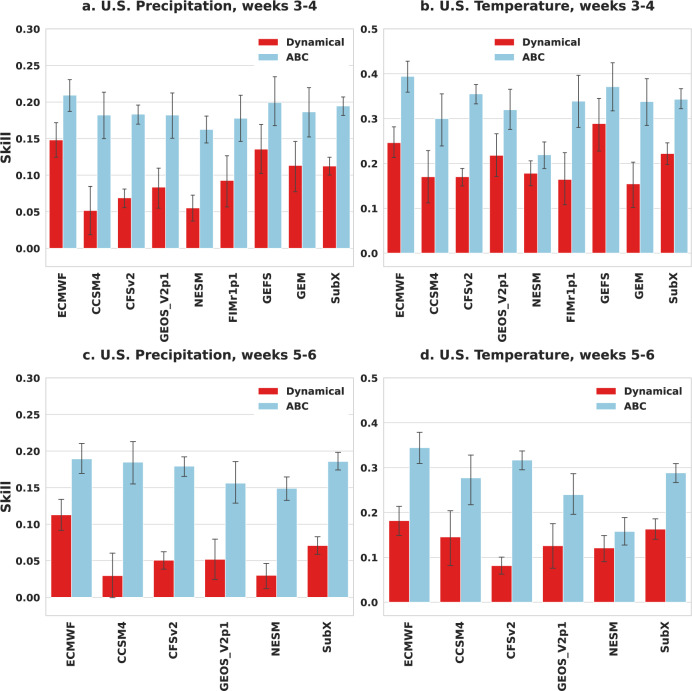
Subseasonal forecasting—predicting temperature and precipitation 2 to 6 weeks ahead—is critical for effective water allocation, wildfire management, and drought and flood mitigation. Recent international research efforts have advanced the subseasonal capabilities of operational dynamical models, yet temperature and precipitation prediction skills remain poor, partly due to stubborn errors in representing atmospheric dynamics and physics inside dynamical models. Here, to counter these errors, we introduce an adaptive bias correction (ABC) method that combines state-of-the-art dynamical forecasts with observations using machine learning. We show that, when applied to the leading subseasonal model from the European Centre for Medium-Range Weather Forecasts (ECMWF), ABC improves temperature forecasting skill by 60–90% (over baseline skills of 0.18–0.25) and precipitation forecasting skill by 40–69% (over baseline skills of 0.11–0.15) in the contiguous U.S. We couple these performance improvements with a practical workflow to explain ABC skill gains and identify higher-skill windows of opportunity based on specific climate conditions.
Overview
The claims and statistics of this paper haven’t been checked yet.
Free: it reads the open-access text and checks the first 5 claims that cite a source we can check. Create a free account to check every claim.
Integrity signals
Registry
Cites
Statistics
Figures
Verification
Claims the paper makes
The claims and statistics of this paper haven’t been checked yet.
Free: it reads the open-access text and checks the first 5 claims that cite a source we can check. Create a free account to check every claim.
Claims other papers make about this one
Each is checked against this paper’s own text: does it say what the citing paper says it does?
The check wasn’t confident either way, so it gives no verdict — never disputed.
In the citing paper
“However, these systems often exhibit considerable biases13–17, particularly in predicting extreme events18.”
From A machine learning model that outperforms conventional global subseasonal forecast models (2024) · cites this paper as [17]
Experimental — accuracy not yet measured
Self-check
Percentages, sums and reported differences re-computed from the paper’s own numbers.
The self-check needs the paper’s full text.
Citations
Cites
The NCEP/NCAR 40-Year Reanalysis Project
Kalnay, E., Kanamitsu, M., Kistler, R., Collins, W., Deaven, D., Gandin, L., Iredell, M., Saha, S., White, G., Woollen, J., et al. (1996) · Bulletin of the American Meteorological Society · doi:10.1175/1520-0477(1996)077<0437:tnyrp>2.0.co;2 · Cited by 28,360 · cited 1×
“For our explanatory variables, we obtained the daily PCs of 10 hPa and 500 hPa stratospheric geopotential height [51] extracted from global 1948-2010 loadings, the daily PCs of sea surface temperature and sea ice concentration [52] using global 1981-2010 loadings, the daily MJO phase [38], and the bimonthly MEI.”
Method"Why Should I Trust You?": Explaining the Predictions of Any Classifier
Ribeiro, M. T., Singh, S., & Guestrin, C. (2016) · Proceedings of the 22nd ACM SIGKDD International Conference on Knowledge Discovery and Data Mining · doi:10.1145/2939672.2939778 · Cited by 17,555
17. A Value for n-Person Games
Shapley, L. S. (1953) · Contributions to the Theory of Games (AM-28), Volume II · doi:10.1515/9781400881970-018 · Cited by 6,950
Locally Weighted Regression: An Approach to Regression Analysis by Local Fitting
Cleveland, W. S., & Devlin, S. J. (1988) · Journal of the American Statistical Association · doi:10.1080/01621459.1988.10478639 · Cited by 5,742
Anomalous collapses of Nares Strait ice arches leads to enhanced export of Arctic sea ice
Moore, G. W. K., Howell, S. E. L., Brady, M., Xu, X., & McNeil, K. (2021) · Nature Communications · doi:10.1038/s41467-020-20314-w · Cited by 5,155
Daily High-Resolution-Blended Analyses for Sea Surface Temperature
Reynolds, R. W., Smith, T. M., Liu, C., Chelton, D. B., Casey, K. S., & Schlax, M. G. (2007) · Journal of Climate · doi:10.1175/2007jcli1824.1 · Cited by 4,335 · cited 1×
“For our explanatory variables, we obtained the daily PCs of 10 hPa and 500 hPa stratospheric geopotential height [51] extracted from global 1948-2010 loadings, the daily PCs of sea surface temperature and sea ice concentration [52] using global 1981-2010 loadings, the daily MJO phase [38], and the bimonthly MEI.”
MethodWheeler, M. C., & Hendon, H. H. (2004) · Monthly Weather Review · doi:10.1175/1520-0493(2004)132<1917:aarmmi>2.0.co;2 · Cited by 2,891 · cited 2×
“For our explanatory variables, we obtained the daily PCs of 10 hPa and 500 hPa stratospheric geopotential height [51] extracted from global 1948-2010 loadings, the daily PCs of sea surface temperature and sea ice concentration [52] using global 1981-2010 loadings, the daily MJO phase [38], and the bimonthly MEI.”
MethodThe quiet revolution of numerical weather prediction
Bauer, P., Thorpe, A., & Brunet, G. (2015) · Nature · doi:10.1038/nature14956 · Cited by 2,729 · cited 2×
“Dynamical models have shown increasing skill in accurately forecasting the weather [32], but they still contain systematic biases that compound on subseasonal time scales and suppress forecast skill [33, 34, 35, 36].”
(2014) · Climate Change 2013 – The Physical Science Basis · doi:10.1017/cbo9781107415324.020 · Cited by 1,629
Assessing objective techniques for gauge‐based analyses of global daily precipitation
Chen, M., Shi, W., Xie, P., Silva, V. B. S., Kousky, V. E., Wayne Higgins, R., & Janowiak, J. E. (2008) · Journal of Geophysical Research: Atmospheres · doi:10.1029/2007jd009132 · Cited by 1,250 · cited 1×
“As ground-truth measurements, we extracted daily gridded observations of average 2-meter temperature in ◦C [47] and precipitation in mm [48, 49, 50].”
MethodA Gauge-Based Analysis of Daily Precipitation over East Asia
Xie, P., Chen, M., Yang, S., Yatagai, A., Hayasaka, T., Fukushima, Y., & Liu, C. (2007) · Journal of Hydrometeorology · doi:10.1175/jhm583.1 · Cited by 1,138 · cited 1×
“As ground-truth measurements, we extracted daily gridded observations of average 2-meter temperature in ◦C [47] and precipitation in mm [48, 49, 50].”
MethodWolter, K., & Timlin, M. S. (2011) · International Journal of Climatology · doi:10.1002/joc.2336 · Cited by 1,126
Measuring the strength of ENSO events: How does 1997/98 rank?
Wolter, K., & Timlin, M. S. (1998) · Weather · doi:10.1002/j.1477-8696.1998.tb06408.x · Cited by 1,123
The Subseasonal to Seasonal (S2S) Prediction Project Database
Vitart, F., Ardilouze, C., Bonet, A., Brookshaw, A., Chen, M., Codorean, C., Déqué, M., Ferranti, L., Fucile, E., Fuentes, M., et al. (2017) · Bulletin of the American Meteorological Society · doi:10.1175/bams-d-16-0017.1 · Cited by 1,096 · cited 2×
“Bridging the gap between short-term and seasonal forecasting has been the focus of several recent large-scale research efforts to advance the subseasonal capabilities of operational physics-based models [9, 11, 12].”
BackgroundA global monthly land surface air temperature analysis for 1948–present
Fan, Y., & van den Dool, H. (2008) · Journal of Geophysical Research: Atmospheres · doi:10.1029/2007jd008470 · Cited by 692 · cited 1×
“As ground-truth measurements, we extracted daily gridded observations of average 2-meter temperature in ◦C [47] and precipitation in mm [48, 49, 50].”
MethodPotential applications of subseasonal‐to‐seasonal (S2S) predictions
White, C. J., Carlsen, H., Robertson, A. W., Klein, R. J. T., Lazo, J. K., Kumar, A., Vitart, F., Coughlan de Perez, E., Ray, A. J., Murray, V., et al. (2017) · Meteorological Applications · doi:10.1002/met.1654 · Cited by 456 · cited 1×
“However, many critical applications—including water allocation, wildfire management, and drought and flood mitigation—require subseasonal forecasts, with lead times in between these two extremes [2, 3].”
Windows of Opportunity for Skillful Forecasts Subseasonal to Seasonal and Beyond
Mariotti, A., Baggett, C., Barnes, E. A., Becker, E., Butler, A., Collins, D. C., Dirmeyer, P. A., Ferranti, L., Johnson, N. C., Jones, J., et al. (2020) · Bulletin of the American Meteorological Society · doi:10.1175/bams-d-18-0326.1 · Cited by 312 · cited 3×
“However, there is a growing appreciation that subseasonal forecasts can benefit from selective deployment during “windows of opportunity,” periods defined by observable climate conditions in which specific forecasters are likely to have higher skill [5].”
BackgroundMethodCurrent and Emerging Developments in Subseasonal to Decadal Prediction
Merryfield, W. J., Baehr, J., Batté, L., Becker, E. J., Butler, A. H., Coelho, C. A. S., Danabasoglu, G., Dirmeyer, P. A., Doblas-Reyes, F. J., Domeisen, D. I. V., et al. (2020) · Bulletin of the American Meteorological Society · doi:10.1175/bams-d-19-0037.1 · Cited by 290 · cited 3×
“However, many critical applications—including water allocation, wildfire management, and drought and flood mitigation—require subseasonal forecasts, with lead times beyond 10 days and up to a season [2, 3].”
BackgroundInfluentialThe Subseasonal Experiment (SubX): A Multimodel Subseasonal Prediction Experiment
Pegion, K., Kirtman, B. P., Becker, E., Collins, D. C., LaJoie, E., Burgman, R., Bell, R., DelSole, T., Min, D., Zhu, Y., et al. (2019) · Bulletin of the American Meteorological Society · doi:10.1175/bams-d-18-0270.1 · Cited by 278 · cited 4×
“Bridging the gap between short-term and seasonal forecasting has been the focus of several recent large-scale research efforts which have advanced the subseasonal capabilities of operational physics-based models (Vitart et al., 2017; Pegion et al., 2019; Lang et al., 2020).”
InfluentialBeating the hold-out: bounds for K-fold and progressive cross-validation
Blum, A., Kalai, A., & Langford, J. (1999) · Proceedings of the twelfth annual conference on Computational learning theory · doi:10.1145/307400.307439 · Cited by 265 · cited 2×
“For a collection of target dates, we report average skill using progressive validation (Blum et al., 1999) to mimic operational use.”
Shapley Effects for Global Sensitivity Analysis: Theory and Computation
Song, E., Nelson, B. L., & Staum, J. (2016) · SIAM/ASA Journal on Uncertainty Quantification · doi:10.1137/15m1048070 · Cited by 244 · cited 2×
“Shapley effects [33] are a specific instantiation of the general Shapley value principle, designed for measuring variable importance.”
BackgroundMethodSub‐Seasonal Forecasting With a Large Ensemble of Deep‐Learning Weather Prediction Models
Weyn, J. A., Durran, D. R., Caruana, R., & Cresswell‐Clay, N. (2021) · Journal of Advances in Modeling Earth Systems · doi:10.1029/2021ms002502 · Cited by 227 · cited 2×
“Every configuration with s ∈ {0, 14, 28, 35}, d ∈ {1, 7, 14, 28, 42}, and L = {29} for the weeks 5-6 lead time and L ∈ {{15}, [15, 22], [0, 29], {29}} the weeks 3-4 lead time was considered.”
BackgroundChantry, M., Christensen, H., Dueben, P., & Palmer, T. (2021) · Philosophical Transactions of the Royal Society A: Mathematical, Physical and Engineering Sciences · doi:10.1098/rsta.2020.0083 · Cited by 174 · cited 1×
“These biases arise from the parameterization of key physical processes associated with deep convective cloud systems [10] and translate into rapidly decreasing skill for precipitation forecasts.”
Troccoli, A. (2010) · Meteorological Applications · doi:10.1002/met.184 · Cited by 167 · cited 1×
“Weather forecasts 0 to 10 days ahead and climate forecasts seasons to decades ahead are currently used operationally in decision-making, and the accuracy and reliability of these forecasts has improved consistently in recent decades [1].”
A Machine Learning‐Based Global Atmospheric Forecast Model
Arcomano, T., Szunyogh, I., Pathak, J., Wikner, A., Hunt, B. R., & Ott, E. (2020) · Geophysical Research Letters · doi:10.1029/2020gl087776 · Cited by 154 · cited 1×
“To counter the observed systematic errors of physics-based models on the subseasonal timescale, there have been parallel efforts in recent years to demonstrate the value of machine learning and deep learning methods for improved subseasonal forecasting accuracy [13, 14, 15, 16, 17, 18, 19, 20, 21, 22, 23, 24, 25].”
BackgroundCohen, J., Coumou, D., Hwang, J., Mackey, L., Orenstein, P., Totz, S., & Tziperman, E. (2019) · WIREs Climate Change · doi:10.1002/wcc.567 · Cited by 111 · cited 1×
“To overcome observed systematic errors of physics-based models on the subseasonal timescale, there have been parallel efforts in recent years to demonstrate the value of machine learning and deep learning methods in improving subseasonal forecasting [13, 14, 15, 16, 17, 18, 19, 20, 21, 22, 23].”
Self-citationChanges in the geopotential height at 500 hPa under the influence of external climatic forcings
Christidis, N., & Stott, P. A. (2015) · Geophysical Research Letters · doi:10.1002/2015gl066669 · Cited by 108 · cited 1×
“The 500 hPa geopotential height plays a crucial role in conveying information about the thermal structure of the atmosphere and indicates synoptic circulation changes [35].”
BackgroundDeep learning for bias correction of MJO prediction
Kim, H., Ham, Y. G., Joo, Y. S., & Son, S. W. (2021) · Nature Communications · doi:10.1038/s41467-021-23406-3 · Cited by 92 · cited 3×
“While these works demonstrate the promise of learned models for subseasonal forecasting, they also highlight the complementary strengths of physics- and learning-based approaches and the opportunity to combine those strengths to improve forecasting skill [15, 20, 21, 22].”
BackgroundFritsch, J. M., Hilliker, J., Ross, J., & Vislocky, R. L. (2000) · Weather and Forecasting · doi:10.1175/1520-0434(2000)015<0571:mc>2.0.co;2 · Cited by 87
Evaluation and Bias Correction of S2S Precipitation for Hydrological Extremes
Li, W., Chen, J., Li, L., Chen, H., Liu, B., Xu, C., & Li, X. (2019) · Journal of Hydrometeorology · doi:10.1175/jhm-d-19-0042.1 · Cited by 86 · cited 3×
“In Supplementary Figure A2, we compare ABC with three additional subseasonal debiasing baselines (detailed in Section 4): quantile mapping [30, 26, 27, 28], LOESS debiasing [26], and a recently proposed neural network debiasing scheme trained jointly on temperature”
BackgroundMethodImproving Subseasonal Forecasting in the Western U.S. with Machine Learning
Hwang, J., Orenstein, P., Cohen, J., Pfeiffer, K., & Mackey, L. (2019) · Proceedings of the 25th ACM SIGKDD International Conference on Knowledge Discovery & Data Mining · doi:10.1145/3292500.3330674 · Cited by 85 · cited 5×
“While these works demonstrate the promise of statistical models for subseasonal forecasting, they also highlight the complementary strengths of physics- and learning-based approaches and the opportunity to combine those strengths to improve forecasting skill [15, 20].”
InfluentialSelf-citationMonhart, S., Spirig, C., Bhend, J., Bogner, K., Schär, C., & Liniger, M. A. (2018) · Journal of Geophysical Research: Atmospheres · doi:10.1029/2017jd027923 · Cited by 75 · cited 3×
“In Supplementary Figure A2, we compare ABC with three additional subseasonal debiasing baselines (detailed in Section 4): quantile mapping [30, 26, 27, 28], LOESS debiasing [26], and a recently proposed neural network debiasing scheme trained jointly on temperature”
BackgroundMethodExplaining black box decisions by Shapley cohort refinementPreprint
Mase, M., Owen, A. B., & Seiler, B. B. (2019) · RePEc: Research Papers in Economics · doi:10.48550/arxiv.1911.00467 · Cited by 74
Standard assessments of climate forecast skill can be misleading
Risbey, J. S., Squire, D. T., Black, A. S., DelSole, T., Lepore, C., Matear, R. J., Monselesan, D. P., Moore, T. S., Richardson, D., Schepen, A., et al. (2021) · Nature Communications · doi:10.1038/s41467-021-23771-z · Cited by 64
Zhang, L., Kim, T., Yang, T., Hong, Y. E., & Zhu, Q. (2021) · Journal of Hydrology · doi:10.1016/j.jhydrol.2021.127058 · Cited by 61 · cited 1×
“3 Discussion Dynamical models have shown increasing skill in accurately forecasting the weather [39], but they still contain systematic biases that compound on subseasonal time scales and suppress forecast skill [40, 41, 42, 43].”
Machine learning for weather and climate are worlds apart
Watson-Parris, D. (2021) · Philosophical Transactions of the Royal Society A: Mathematical, Physical and Engineering Sciences · doi:10.1098/rsta.2020.0098 · Cited by 60 · cited 2×
“…learning and deep learning methods in improving subseasonal forecasting (Li et al., 2016; Cohen et al., 2019; Hwang et al., 2019; Arcomano et al., 2020; He et al., 2020; Yamagami & Matsueda, 2020; Wang et al., 2021; Kim et al., 2021; Watson-Parris, 2021; Weyn et al., 2021; Srinivasan et al., 2021).”
Lang, A. L., Pegion, K., & Barnes, E. A. (2020) · Journal of Geophysical Research Atmospheres · doi:10.1029/2019jd031833 · Cited by 58 · cited 1×
“Bridging the gap between short-term and seasonal forecasting has been the focus of several recent large-scale research efforts to advance the subseasonal capabilities of operational physics-based models [9, 11, 12].”
BackgroundLi, L., Schmitt, R. W., Ummenhofer, C. C., & Karnauskas, K. B. (2016) · Journal of Climate · doi:10.1175/jcli-d-15-0520.1 · Cited by 54 · cited 1×
“To counter the observed systematic errors of physics-based models on the subseasonal timescale, there have been parallel efforts in recent years to demonstrate the value of machine learning and deep learning methods for improved subseasonal forecasting accuracy [13, 14, 15, 16, 17, 18, 19, 20, 21, 22, 23, 24, 25].”
BackgroundSub-Seasonal Climate Forecasting via Machine Learning: Challenges, Analysis, and Advances
He, S., Li, X., DelSole, T., Ravikumar, P., & Banerjee, A. (2021) · Proceedings of the AAAI Conference on Artificial Intelligence · doi:10.1609/aaai.v35i1.16090 · Cited by 51
Systematic Errors in Weather and Climate Models: Nature, Origins, and Ways Forward
Zadra, A., Williams, K. D., Frassoni, A., Rixen, M., Adames, Á. F., Berner, J., Bouyssel, F., Casati, B., Christensen, H. M., Ek, M., et al. (2017) · Bulletin of the American Meteorological Society · doi:10.1175/bams-d-17-0287.1 · Cited by 46 · cited 1×
“3 Discussion Dynamical models have shown increasing skill in accurately forecasting the weather [39], but they still contain systematic biases that compound on subseasonal time scales and suppress forecast skill [40, 41, 42, 43].”
BackgroundWoolnough, S. J. (2018) · Elsevier eBooks · doi:10.1016/b978-0-12-811714-9.00005-x · Cited by 44
Developing Subseasonal to Seasonal Climate Forecast Products for Hydrology and Water Management
Baker, S. A., Wood, A. W., & Rajagopalan, B. (2019) · JAWRA Journal of the American Water Resources Association · doi:10.1111/1752-1688.12746 · Cited by 43 · cited 3×
“In Supplementary Figure A2, we compare ABC with three additional subseasonal debiasing baselines (detailed in Section 4): quantile mapping [30, 26, 27, 28], LOESS debiasing [26], and a recently proposed neural network debiasing scheme trained jointly on temperature”
The Role of Sea Ice in Sub-seasonal Predictability
Chevallier, M., Massonnet, F., Goessling, H., Guémas, V., & Jung, T. J. (2018) · Elsevier eBooks · doi:10.1016/b978-0-12-811714-9.00010-3 · Cited by 35 · cited 1×
“Finally, sea ice concentration has a strong impact on surface turbulent heat fluxes and therefore near-surface temperatures [37].”
BackgroundWang, C., Jia, Z., Yin, Z., Liu, F., Lu, G., & Zheng, J. (2021) · Frontiers in Earth Science · doi:10.3389/feart.2021.659310 · Cited by 30 · cited 2×
“…learning and deep learning methods in improving subseasonal forecasting (Li et al., 2016; Cohen et al., 2019; Hwang et al., 2019; Arcomano et al., 2020; He et al., 2020; Yamagami & Matsueda, 2020; Wang et al., 2021; Kim et al., 2021; Watson-Parris, 2021; Weyn et al., 2021; Srinivasan et al., 2021).”
Radiation Belt Slot Region Filling Events: Sustained Energetic Precipitation Into the Mesosphere
Kavanagh, A. J., Cobbett, N., & Kirsch, P. (2018) · Journal of Geophysical Research Space Physics · doi:10.1029/2018ja025890 · Cited by 30
Sources of Subseasonal Skill and Predictability in Wintertime California Precipitation Forecasts
L’Heureux, M. L., Tippett, M. K., & Becker, E. J. (2021) · Weather and Forecasting · doi:10.1175/waf-d-21-0061.1 · Cited by 24 · cited 1×
“, soil moisture or sea ice, and external forcing [4, 7].”
Yamagami, A., & Matsueda, M. (2020) · Geophysical Research Letters · doi:10.1029/2020gl088508 · Cited by 24 · cited 1×
“To counter the observed systematic errors of physics-based models on the subseasonal timescale, there have been parallel efforts in recent years to demonstrate the value of machine learning and deep learning methods for improved subseasonal forecasting accuracy [13, 14, 15, 16, 17, 18, 19, 20, 21, 22, 23, 24, 25].”
BackgroundKim, M., Yoo, C., & Choi, J. H. (2021) · Geophysical Research Letters · doi:10.1029/2021gl093447 · Cited by 7 · cited 2×
“While these works demonstrate the promise of learned models for subseasonal forecasting, they also highlight the complementary strengths of physics- and learning-based approaches and the opportunity to combine those strengths to improve forecasting skill [15, 20, 21, 22].”
Background
Research works printed but not linked: 11
- National Academies of Sciences Engineering and Medicine. in Next Generation Earth System Prediction: Strategies for Subseasonal to Seasonal Forecasts (The National Academies Press, Washington, DC, 2016).
- Vitart F Robertson AW Anderson DL Subseasonal to seasonal prediction project: bridging the gap between weather and climate Bull. World Meteorol. Organ. 2012 61 23
- Srinivasan, V., Khim, J., Banerjee, A. & Ravikumar, P. Subseasonal climate prediction in the western US using Bayesian spatial models. in Proceedings of the Thirty-Seventh Conference on Uncertainty in Artificial Intelligence, ser. Proceedings of Machine Learning Research vol. 161, July 27–30 (eds de Campos, C. & Maathuis, M. H.) 961–970 (PMLR, 2021).
- Panofsky, H. A. & Brier, G. W. in Some Applications of Statistics to Meteorology (Pennsylvania State University Press, University Park, PA, USA, 1968).
- Hersbach H Decomposition of the continuous ranked probability score for ensemble prediction systems Weather Forecast. 2000 15 559 570 10.1175/1520-0434(2000)015<0559:DOTCRP>2.0.CO;2 · DOI · Paper page
- Wolter, K. & Timlin, M. S. Monitoring ENSO in COADS with a seasonally adjusted principal component index. in Proc. of the 17th Climate Diagnostics Workshop 52–57 (1993).
- Dutra E Johannsen F Magnusson L Late spring and summer subseasonal forecasts in the northern hemisphere midlatitudes: biases and skill in the ECMWF model Monthly Weather Rev. 2021 149 2659 2671
- Lundberg, S. M. & Lee, S.-I. A unified approach to interpreting model predictions. in Advances in Neural Information Processing Systems Vol. 30 (eds Guyon, I. et al.) (Curran Associates, Inc., 2017).
- Xie, P., Chen, M. & Shi, W. CPC unified gauge-based analysis of global daily precipitation. in 24th Conf. on Hydrology Vol. 2 (Amer. Meteor. Soc, Atlanta, GA, 2010).
- Wilks, D. S.Statistical Methods in the Atmospheric Sciences, ser. Vol. 100 (International Geophysics. Academic Press, 2011).
- Kingma, D. P. & Ba, J. Adam: a method for stochastic optimization. in 3rd International Conference on Learning Representations, ICLR 2015, San Diego, CA, USA, May 7–9, 2015, Conference Track Proceedings (eds Bengio, Y. & LeCun, Y.) (2015).
Cited by
Materia, S., García, L. P., van Straaten, C., O, S., Mamalakis, A., Cavicchia, L., Coumou, D., de Luca, P., Kretschmer, M., & Donat, M. (2024) · WIREs Climate Change · doi:10.1002/wcc.914 · Cited by 130
“…the dynamical models they correct, relating error characteristics to the weather circumstances under which they occur, thus expanding the physical understanding of extremes that would be limited by only using numerical models (Mouatadid et al., 2023; Silva et al., 2022; van Straaten et al., 2023).”
A machine learning model that outperforms conventional global subseasonal forecast models
Chen, L., Zhong, X., Li, H., Wu, J., Lu, B., Chen, D., Xie, S.-P., Wu, L., Chao, Q., Lin, C., et al. (2024) · Nature Communications · doi:10.1038/s41467-024-50714-1 · Cited by 105
Skillful subseasonal soil moisture drought forecasts with deep learning-dynamic models
Lesinger, K., & Tian, D. (2025) · Nature Communications · doi:10.1038/s41467-025-62761-3 · Cited by 42
“To increase dynamic models (DM) forecast reliability and reduce model biases, post-processing bias-correction techniques are applied to DM forecasts with respect to observations (or reanalysis), which have improved subseasonal forecast skill of temperature, precipitation, windspeed, and organized motion associated wit…”
Global Prediction of Flash Drought Using Machine Learning
Xu, L., Zhang, X., Wu, T., Yu, H., Du, W., Zhang, C., & Chen, N. (2024) · Geophysical Research Letters · doi:10.1029/2024gl111134 · Cited by 31
“…relatively accurate forecasts of precipitation, temperature, winds and other influential factors at least days to weeks in advance, which still faces difficulties in current weather models (Bi et al., 2023; Espeholt et al., 2022; Lam et al., 2023; Lesinger et al., 2024; Mouatadid et al., 2023).”
InfluentialXiong, Z., Zhang, Z., Gui, H., Chen, X., Hu, S., Gao, L., He, Y., Qiu, J., & Xin, Q. (2025) · IEEE Transactions on Geoscience and Remote Sensing · doi:10.1109/tgrs.2025.3543611 · Cited by 28
“The NCEP CFSv2, widely used in global climate prediction, provides meteorological forecasts with a nine-month lead time and a spatial resolution of 0.2 ◦ [46], [47].”
Influential
Metadata
- Authors
- Mouatadid, S., Orenstein, P., Flaspohler, G., Cohen, J., Oprescu, M., Fraenkel, E., & Mackey, L.
- Affiliations
- University of Toronto (CA)
- Instituto Nacional de Matemática Pura e Aplicada (BR)
- Massachusetts Institute of Technology (US)
- Atmospheric and Environmental Research (US)
- Cornell University (US)
- Microsoft Research New England (United States) (US)
- Corresponding author
- Mouatadid, Soukayna
- Mackey, Lester
- ORCID
- Venue
- Nature Communications
- Published
- 2023-06-15
- Volume
- 14
- Issue
- 1
- Pages
- 3482-3482
- ISSN
- 2041-1723 (ISSN-L)
- PMC
- PMC10272189
- OpenAlex
- W4380872517
- Semantic Scholar
- e4cd6ee7cd1ba330b047c123f0819e3687a851d7
- Cited by
- 54
- References
- 48
- Citations by year
- 2026: 21 · 2025: 20 · 2024: 12 · 2023: 1
- FWCI
- 5.96
- Type
- journal article
- Language
- en
- Open access
- gold
- doi.org
- Licence
- cc-by
- creativecommons.org/licenses/by/4.0 (tdm)
- creativecommons.org/licenses/by/4.0 (vor)
- Locations
- Nature Communications (publishedVersion, cc-by)
- PubMed Central (publishedVersion, cc-by)
- PubMed (publishedVersion)
- arXiv (Cornell University) (submittedVersion)
- Open Access Server of the Woods Hole Scientific Community (Woods Hole Scientific Community) (submittedVersion, cc-by)
- DOAJ (DOAJ: Directory of Open Access Journals) (submittedVersion, cc-by-sa)
- NOAA Institutional Repository (submittedVersion, cc-by)
- arXiv (Cornell University) (cc-by)
- Funders
- United States Department of Commerce | National Oceanic and Atmospheric Administration (OAR-WPO -2021-2006592)
- National Science Foundation (PLR-1901352)
- Climate Change AI Innovation grant Microsoft AI for Earth grant
- Topics
- Physical Sciences › Earth and Planetary Sciences › Atmospheric Science › Meteorological Phenomena and Simulations
- Physical Sciences › Environmental Science › Global and Planetary Change › Climate variability and models
- Social Sciences › Decision Sciences › Management Science and Operations Research › Forecasting Techniques and Applications
- Keywords
- subseasonal forecasting, temperature prediction, precipitation forecasting, ECMWF ensemble forecasts, contiguous United States
- MeSH terms
- Climate, Forecasting, Temperature, Weather, Droughts, Floods
About these checks
Registry, retraction, Cites and statistics results are computed, not judged, with one exception: a printed reference that no index lists is read once by a model before it counts as a citation error. Claims are extracted by a model and kept only when their quote appears verbatim in the text; each cited source is then checked, with a model’s help, for whether it says what the claim relies on. Those verdicts can be wrong — read the claim’s quote and the cited source before relying on one.
Statistics and arithmetic are recomputed, not judged.
Confidence bands are shown only for fields calibrated on our annotated test set. None is calibrated yet, so no band is shown.
What counts as a claim ›How we measure confidence ›How we check this ›
Are you an author, or do you see a problem with this page? Request a review
Data sources
Bibliographic data: Semantic Scholar, OpenAlex, Crossref.
Contains information from the Semantic Scholar Academic Graph Datasets, made available under the ODC Attribution License (ODC-BY 1.0).
Semantic Scholar’s data is described in: Kinney, R., et al. (2023). The Semantic Scholar Open Data Platform. arXiv:2301.10140.
