

Quantum simulation of exact electron dynamics can be more efficient than classical mean-field methods
Open accessThe DOI matches its Crossref record; 99 of the 99 references it cites were found in a registry or an index.
Abstract
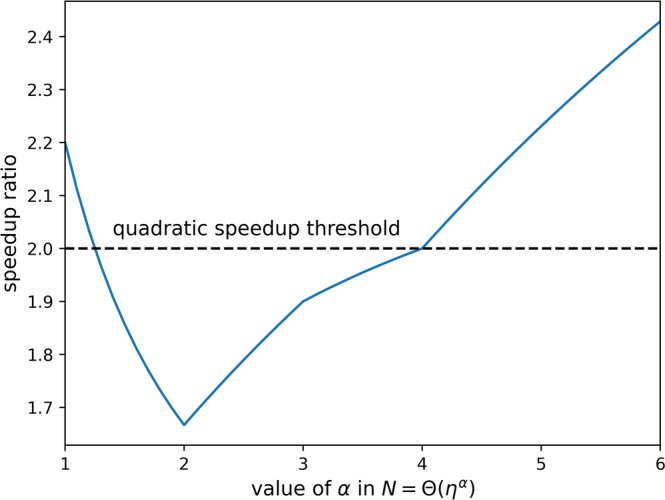
Quantum algorithms for simulating electronic ground states are slower than popular classical mean-field algorithms such as Hartree–Fock and density functional theory but offer higher accuracy. Accordingly, quantum computers have been predominantly regarded as competitors to only the most accurate and costly classical methods for treating electron correlation. However, here we tighten bounds showing that certain first-quantized quantum algorithms enable exact time evolution of electronic systems with exponentially less space and polynomially fewer operations in basis set size than conventional real-time time-dependent Hartree–Fock and density functional theory. Although the need to sample observables in the quantum algorithm reduces the speedup, we show that one can estimate all elements of the k -particle reduced density matrix with a number of samples scaling only polylogarithmically in basis set size. We also introduce a more efficient quantum algorithm for first-quantized mean-field state preparation that is likely cheaper than the cost of time evolution. We conclude that quantum speedup is most pronounced for finite-temperature simulations and suggest several practically important electron dynamics problems with potential quantum advantage.
Overview
The claims and statistics of this paper haven’t been checked yet.
Free: it reads the open-access text and checks the first 5 claims that cite a source we can check. Create a free account to check every claim.
Integrity signals
Registry
Cites
Statistics
Figures
Verification
Claims the paper makes
The claims and statistics of this paper haven’t been checked yet.
Free: it reads the open-access text and checks the first 5 claims that cite a source we can check. Create a free account to check every claim.
Self-check
Percentages, sums and reported differences re-computed from the paper’s own numbers.
The self-check needs the paper’s full text.
Citations
Cites
Particle mesh Ewald: An N ⋅log( N ) method for Ewald sums in large systems
Darden, T., York, D., & Pedersen, L. (1993) · The Journal of Chemical Physics · doi:10.1063/1.464397 · Cited by 30,546
Density-Functional Theory for Time-Dependent Systems
Runge, E., & Gross, E. K. U. (1984) · Physical Review Letters · doi:10.1103/physrevlett.52.997 · Cited by 8,914
Simulating physics with computers
Feynman, R. P. (1982) · International Journal of Theoretical Physics · doi:10.1007/bf02650179 · Cited by 7,691
A hierarchical O(N log N) force-calculation algorithm
Barnes, J., & Hut, P. (1986) · Nature · doi:10.1038/324446a0 · Cited by 3,698
Coupled-cluster theory in quantum chemistry
Bartlett, R. J., & Musiał, M. (2007) · Reviews of Modern Physics · doi:10.1103/revmodphys.79.291 · Cited by 3,343
Lloyd, S. (1996) · Science · doi:10.1126/science.273.5278.1073 · Cited by 3,088 · cited 2×
“Quantum computers were first proposed as tools for dynamics by Feynman1 and later shown to be universal for that purpose by Lloyd et al.2.”
MethodSingle-Reference ab Initio Methods for the Calculation of Excited States of Large Molecules
Dreuw, A., & Head-Gordon, M. (2005) · Chemical Reviews · doi:10.1021/cr0505627 · Cited by 2,722
Insights into Current Limitations of Density Functional Theory
Cohen, A. J., Mori-Sánchez, P., & Yang, W. (2008) · Science · doi:10.1126/science.1158722 · Cited by 2,527
Mardirossian, N., & Head-Gordon, M. (2017) · Molecular Physics · doi:10.1080/00268976.2017.1333644 · Cited by 2,307
Quantum amplitude amplification and estimation
Brassard, G., Høyer, P., Mosca, M., & Tapp, A. (2002) · Contemporary Mathematics · doi:10.1090/conm/305/05215 · Cited by 1,680
Research works printed but not linked: 2
- Jia W Lin L Fast real-time time-dependent hybrid functional calculations with the parallel transport gauge and the adaptively compressed exchange formulation Comput. Phys. Commun. 2019 240 21 29 10.1016/j.cpc.2019.02.009 · DOI
- Wan, K., Huggins, W. J., Lee, J. & Babbush, R. Matchgate shadows for fermionic quantum simulation. Preprint at http://arxiv.org/abs/2207.13723 (2022). · arXiv
Cited by
Quantum Algorithms: A Survey of Applications and End-to-end Complexities
Dalzell, A. M., McArdle, S., Berta, M., Bienias, P., Chen, C.-F., Gilyén, A., Hann, C. T., Kastoryano, M. J., Khabiboulline, E. T., Kubica, A., et al. (2023) · RWTH Publications (RWTH Aachen) · doi:10.18154/rwth-2026-02888 · Cited by 362
Drug design on quantum computers
(2024) · doi:10.1038/s41567-024-02411-5 · Cited by 132
“Recent results have also shown that quantum computers can out-perform classical mean-field methods in simulating electron dynamics 79 .”
Self-citationQuantum Algorithms: A Survey of Applications and End-to-end Complexities
Dalzell, A. M., McArdle, S., Berta, M., Bienias, P., Chen, C.-F., Gilyén, A., Hann, C. T., Kastoryano, M. J., Khabiboulline, E. T., Kubica, A., et al. (2025) · Cambridge University Press eBooks · doi:10.1017/9781009639651 · Cited by 147
Assessing the Benefits and Risks of Quantum ComputersPreprint
Scholten, T. L., Williams, C. J., Moody, D., Mosca, M., Hurley, W. L., Zeng, W. J., Troyer, M., & Gambetta, J. (2024) · arXiv (Cornell University) · doi:10.48550/arxiv.2401.16317 · Cited by 90
Roadmap for warm dense matter physics
Vorberger, J., Graziani, F. R., Riley, D., Baczewski, A., Baraffe, I., Bethkenhagen, M., Blouin, S., Böhme, M., Bönitz, M., Bußmann, M., et al. (2026) · Plasma Physics and Controlled Fusion · doi:10.1088/1361-6587/ae672c · Cited by 47
Self-citationQuantum computation of stopping power for inertial fusion target design
Rubin, N. C., Berry, D. W., Kononov, A., Malone, F. D., Khattar, T., White, A. F., Lee, J., Neven, H., Babbush, R., & Baczewski, A. (2024) · Proceedings of the National Academy of Sciences · doi:10.1073/pnas.2317772121 · Cited by 81
“Here we assume that the initial thermal distribution of the system is well described by a finite-temperature mean-field approach such as thermal Hartree–Fock or Mermin Kohn-Sham DFT [86, 87], which is easy to prepare on a quantum computer [88].”
BackgroundMethodSelf-citationGroup-theoretic error mitigation enabled by classical shadows and symmetries
Zhao, A., & Miyake, A. (2024) · npj Quantum Information · doi:10.1038/s41534-024-00854-5 · Cited by 50
Self-citationA Perspective on Quantum Computing Applications in Quantum Chemistry Using 25–100 Logical Qubits
Alexeev, Y., Batista, V. S., Bauman, N. P., Bertels, L. W., Claudino, D., Dutta, R., Gagliardi, L., Godwin, S., Govind, N., Head‐Gordon, M., et al. (2025) · Journal of Chemical Theory and Computation · doi:10.1021/acs.jctc.5c01038 · Cited by 53
Trajectory sampling and finite-size effects in first-principles stopping power calculations
Kononov, A., Hentschel, T. W., Hansen, S. B., & Baczewski, A. (2023) · npj Computational Materials · doi:10.1038/s41524-023-01157-7 · Cited by 30
Self-citationMultiscale Embedding for Quantum Computing
Weisburn, L. P., Cho, M., Bensberg, M., Meitei, O. R., Reiher, M., & Voorhis, T. V. (2025) · Journal of Chemical Theory and Computation · doi:10.1021/acs.jctc.5c00241 · Cited by 26
Efficient State Preparation for the Quantum Simulation of Molecules in First Quantization
Huggins, W. J., Leimkuhler, O., Stetina, T. F., & Whaley, K. B. (2025) · PRX Quantum · doi:10.1103/prxquantum.6.020319 · Cited by 41
Self-citationExponential Learning Advantages with Conjugate States and Minimal Quantum Memory
King, R., Wan, K., & McClean, J. R. (2024) · PRX Quantum · doi:10.1103/prxquantum.5.040301 · Cited by 17
“…are so efficient, that performing them exactly on a quantum computer can be more efficient than comparable mean-field dynamics on a classical computer, and efficient classical shadows methods have been developed in this setting for understanding chemistry in the context of real-space bases [39].”
BackgroundQuantum information processing with superconducting circuits: A perspective
Wendin, G. P. (2023) · Elsevier eBooks · doi:10.1016/b978-0-323-90800-9.00226-2 · Cited by 14
The Fast for the Curious: How to accelerate fault-tolerant quantum applicationsPreprint
McArdle, S., Dalzell, A. M., Kubica, A., & Brandão, F. G. S. L. (2025) · arXiv (Cornell University) · doi:10.48550/arxiv.2510.26078 · Cited by 15
Yeo, H., Kim, H. E., Sohn, I., & Jeong, K. (2025) · Physical Review Applied · doi:10.1103/physrevapplied.23.054066 · Cited by 14
Cemin, G., Carnazza, F., Andergassen, S., Martius, G., Carollo, F., & Lesanovsky, I. (2024) · Physical Review Applied · doi:10.1103/physrevapplied.21.l041001 · Cited by 17
Quantum Simulation of Nuclear Dynamics in First Quantization
Spagnoli, L., Lissoni, C., & Roggero, A. (2026) · Quantum · doi:10.22331/q-2026-09-02-2200 · Cited by 11
Quantum Simulation of Electronic Structure via Quantum Fast Multipole Method
Berry, D. W., Wan, K., Baczewski, A., Eklund, E. C., Tikku, A., & Babbush, R. (2026) · PRX Quantum · doi:10.1103/b2vn-zf6c · Cited by 13
Self-citationPosition Papers for the ASCR Workshop on Basic Research Needs in Quantum Computing and Networking
Lougovski, P., Parekh, O., Broz, J., Byrd, M., Chembo, Y. K., de Jong, W. A., Figueroa, E. V., Humble, T. S., Larson, J. M., Quiroz, G., et al. (2023) · OSTI OAI (U.S. Department of Energy Office of Scientific and Technical Information) · doi:10.2172/2283320 · Cited by 11
Quantum computing for faster enzyme discovery and engineering
Damborský, J., Kouba, P., Šivic, J., Vasina, M., Bednář, D., & Mazurenko, S. (2025) · Nature Catalysis · doi:10.1038/s41929-025-01410-w · Cited by 11
“Imagine sketching a reaction, converting it into chemical structures, and screening millions of predicted proteins for binders 55 .”
On the Trotter Error in Many-body Quantum Dynamics with Coulomb Potentials
Fang, D., Wu, X., & Soffer, A. (2026) · Communications in Mathematical Physics · doi:10.1007/s00220-026-05593-6 · Cited by 14
“For recent progress on spatial discretizations in the first-and second-quantizations and significant advancements in quantum circuit design for such systems, we refer the reader to, e.g., [5–7, 14, 22, 48, 49].”
Bidart, A., Vaish, P., Kabengele, T., Pang, Y., Liu, Y., & Rubenstein, B. M. (2026) · Annual Review of Physical Chemistry · doi:10.1146/annurev-physchem-082624-084635 · Cited by 10
“[105] presented a tightened Trotter gate count of O ( n 1 / 3 η 7 / 3 t + n 2 / 3 η 4 / 3 t ) o (1) , demonstrating that exact interacting electronic dynamics simulations on a quantum computer can exhibit a quartic speedup over the cost of mean-field dynamics on classical computers O ( n 4 / 3 η 7…”
Feniou, C., Cherfan, C., Zylberman, J., Claudon, B., Piquemal, J., & Giner, E. (2026) · Digital Discovery · doi:10.1039/d6dd00002a · Cited by 7
“In this setting, the wavefunction requires O ( N ) qubits (one per spinorbital), and the gate complexity becomes particularly favorable when the particle number η is in the order of the orbital count [11].”
Majsak, J., McNulty, D., & Oszmaniec, M. (2025) · npj Quantum Information · doi:10.1038/s41534-025-00957-7 · Cited by 15
Comparing Classical and Quantum Ground State Preparation HeuristicsPreprint
Gratsea, K., Kottmann, J. S., Johnson, P. D., & Kunitsa, A. A. (2024) · arXiv (Cornell University) · doi:10.48550/arxiv.2401.05306 · Cited by 7
“If quantum GSP meth-ods offer a better trade-off between performance and resource cost over HF, then the same holds for most other classical chemistry methods [22].”
ResultQuantum Advantage in Computational Chemistry?
Gundlach, H., Sharkey, K. L., Lynch, J., Hazoglou, V., Hsu, K.-C., Dukatz, C., Crane, E., Walczyk, K., Bodziak, M., Galatsanos-Dueck, J., et al. (2025) · IEEE International Conference on Quantum Computing and Engineering (QCE) · doi:10.1109/qce65121.2025.00249 · Cited by 7
“An interesting case is that of simulating electron dynamics where quantum computers have a particularly strong advantage in the Warm Dense Matter Regime [54].”
Optimizing quantum chemistry simulations with a hybrid quantization scheme
Ku, C., Chen, Y., Hu, A., & Hsieh, M.-H. (2026) · Communications Physics · doi:10.1038/s42005-026-02577-9 · Cited by 6
“These calculations involve ground-state preparation, electron non-conserving operators, Hamiltonian inversion, and Hadamard tests.”
InfluentialA differentiable quantum phase estimation algorithm
Castaldo, D., Jahangiri, S., Migliore, A., Arrazola, J. M., & Corni, S. (2024) · Quantum Science and Technology · doi:10.1088/2058-9565/ad69bc · Cited by 8
de Lima, A. M., Teixeira, E. S., Silva, E. D. R. D. A., & Longo, R. L. (2026) · Journal of Computational Chemistry · doi:10.1002/jcc.70289 · Cited by 5
“This has the potential to transform areas such as medicine, materials science, catalysis, and nanotechnology [9, 10].”
Simulating fermions with a digital quantum computer
Chien, R. W., Chiew, M., Harrison, B., Necaise, J., Wang, W., Mudassar, M., McLauchlan, C., Henderson, T. M., Scuseria, G. E., Strelchuk, S., et al. (2026) · Nature Reviews Physics · doi:10.1038/s42254-025-00914-5 · Cited by 12
Real-time time-dependent density functional theory for high-energy density physics
Kononov, A., Nguyen, M., & Baczewski, A. D. (2026) · Physics of Plasmas · doi:10.1063/5.0312253 · Cited by 5
Self-citationGulania, S., Gray, S. K., Alexeev, Y., Peng, B., & Govind, N. (2024) · Electronic Structure · doi:10.1088/2516-1075/ad839b · Cited by 5
“As both TD-HF and TD-DFT share equivalent computational complexities [43], it would be a canonical pathway to add more-electronic correlation via DFT and perform time dynamics using the above algorthim.”
Low-depth phase oracle using a parallel piecewise circuit
Sun, Z., Boyd, G., Cai, Z., Jnane, H., Koczor, B., Meister, R., Minko, R., Pring, B., Benjamin, S. C., & Stamatopoulos, N. (2025) · Physical Review A · doi:10.1103/m32k-7nq2 · Cited by 7
“For this type of function, we can reduce the number of segments by choosing different tolerances in different zones.”
Requirements for building effective Hamiltonians using quantum-enhanced density matrix downfoldingPreprint
Pathak, S., Russo, A., Seritan, S., Magann, A. B., Bobrow, E., Landahl, A. J., & Baczewski, A. (2024) · arXiv (Cornell University) · doi:10.48550/arxiv.2403.01043 · Cited by 4
Self-citationNonunitary Coupled Cluster Enabled by Midcircuit Measurements on Quantum Computers
Fleury, A., Brown, J., Lloyd, E., Hernandez, M., & Kim, I. H. (2024) · Journal of Chemical Theory and Computation · doi:10.1021/acs.jctc.4c00837 · Cited by 4
Recursive algorithm for constructing antisymmetric fermionic states in first quantization mapping
Rule, E., Chernyshev, I. A., Stetcu, I., Carlson, J., & Weiss, R. (2026) · Quantum · doi:10.22331/q-2026-04-08-2056 · Cited by 4
“The cost of sorting-based antisymmetrization methods is governed by the number of integer comparators required by the chosen sorting algo-rithm, with each comparator requiring 8 k + O (1) T -gates [19].”
Heisenberg-limited quantum algorithms for multiple observables estimation
Koizumi, Y., Wada, K., Mizukami, W., & Yoshioka, N. (2026) · Physical Review A · doi:10.1103/wrkp-qd33 · Cited by 4
Stetcu, I. (2026) · Physical Review C · doi:10.48550/arxiv.2512.16138 · Cited by 3
“Most existing antisymmetrization schemes rely on ordered single-particle states [10–12], and some are proba-a bilistic, although the probability of success can be significant.”
Quantum and Artificial Intelligence in Drugs and Pharmaceutics
Matarèse, B. F. E. (2026) · BioChem · doi:10.3390/biochem6010002 · Cited by 2
Brown, J. C. (2024) · Journal of Chemical Theory and Computation · doi:10.1021/acs.jctc.3c01177 · Cited by 2
“Therefore, we use the basis set mentioned in references 2,19,20, which is hypothesized to be quite efficient for quantum chemistry on quantum computers.”
BackgroundMethodInfluentialHybrid quantum algorithm for simulating real-time thermal correlation functions
Eklund, E. C., & Ananth, N. (2026) · Digital Discovery · doi:10.1039/d5dd00381d · Cited by 3
Fast collisional SWAP gate for fermionic atoms in an optical superlattice
Weill, R., Nemirovsky, J., & Sagi, Y. (2026) · Physical Review A · doi:10.1103/8jxf-7br1 · Cited by 1
“In particular, quantum simulations of electronic structures and strongly correlated fermionic phases represent one of the most promising frontiers for demonstrating quantum advantage [12–14].”
Fault-tolerant quantum algorithmsPreprint
Casares, P. A. M. (2023) · arXiv (Cornell University) · doi:10.48550/arxiv.2301.08057 · Cited by 2
Fast-forwarding molecular ground state preparation with optimal control on analog quantum simulators
Castaldo, D., Rosa, M., & Corni, S. (2024) · The Journal of Chemical Physics · doi:10.1063/5.0204618 · Cited by 1
Freshness flavour perception via quantum-inspired and quantum ligand-based virtual screening
Rodríguez-Otero, A., Juane, M. M., Paredes-Ramos, M., Nelen, J., Rentero, A. B., Pérez‐Sánchez, H., Tato, A. G., & Vilariño, J. M. L. (2026) · Scientific Reports · doi:10.1038/s41598-026-66827-0
de Lima, A. M., Silva, E. D. R. D. A., Teixeira, E. S., & Longo, R. L. (2026) · Journal of Molecular Modeling · doi:10.1007/s00894-026-06951-w
Metadata
- Authors
- Babbush, R., Huggins, W. J., Berry, D. W., Ung, S. F., Zhao, A., Reichman, D. R., Neven, H., Baczewski, A. D., & Lee, J.
- Affiliations
- Google (United States) (US)
- Macquarie University (AU)
- Columbia University (US)
- Sandia National Laboratories (US)
- Corresponding author
- Babbush, Ryan
- Lee, Joonho
- ORCID
- Venue
- Nature Communications
- Published
- 2023-07-10
- Volume
- 14
- Issue
- 1
- Pages
- 4058-4058
- ISSN
- 2041-1723 (ISSN-L)
- PMC
- PMC10333266
- OpenAlex
- W4383695264
- Cited by
- 32
- References
- 90
- Citations by year
- 2026: 12 · 2025: 8 · 2024: 10 · 2023: 2
- FWCI
- 3.02
- Type
- journal article
- Language
- en
- Open access
- gold
- doi.org
- Licence
- cc-by
- creativecommons.org/licenses/by/4.0 (tdm)
- creativecommons.org/licenses/by/4.0 (vor)
- Locations
- Nature Communications (publishedVersion, cc-by)
- PubMed Central (publishedVersion, cc-by)
- PubMed (publishedVersion)
- arXiv (Cornell University) (submittedVersion)
- OSTI OAI (U.S. Department of Energy Office of Scientific and Technical Information) (submittedVersion)
- RePEc: Research Papers in Economics (submittedVersion)
- DOAJ (DOAJ: Directory of Open Access Journals) (submittedVersion, cc-by-sa)
- arXiv (Cornell University)
- Funders
- National Science Foundation (NSF PHY 17-48958, NA0003525, DE‐NA0003525, 1748958)
- U.S. Department of Energy (DENA0003525, NSF PHY-1748958, NA0003525)
- National Nuclear Security Administration (NA0003525, contract DE-NA0003525, DENA-0003525)
- Australian Research Council (DP210101367, DP190102633)
- Kavli Institute for Theoretical Physics, University of California, Santa Barbara (1748958, NSF PHY-1748958, PHY-1748958)
- Laboratory Directed Research and Development (NA0003525, DE-NA0003525)
- Sandia National Laboratories (NA0003525, DE‐NA,0003525)
- Topics
- Physical Sciences › Computer Science › Artificial Intelligence › Quantum Computing Algorithms and Architecture
- Physical Sciences › Physics and Astronomy › Atomic and Molecular Physics, and Optics › Quantum many-body systems
- Physical Sciences › Physics and Astronomy › Atomic and Molecular Physics, and Optics › Advanced Chemical Physics Studies
- Keywords
- quantum advantage, time-dependent Hartree-Fock, density functional theory, electron correlation, reduced density matrix, finite-temperature simulation, quantum algorithms, basis set scaling
About these checks
Registry, retraction, Cites and statistics results are computed, not judged, with one exception: a printed reference that no index lists is read once by a model before it counts as a citation error. Claims are extracted by a model and kept only when their quote appears verbatim in the text; each cited source is then checked, with a model’s help, for whether it says what the claim relies on. Those verdicts can be wrong — read the claim’s quote and the cited source before relying on one.
Statistics and arithmetic are recomputed, not judged.
Confidence bands are shown only for fields calibrated on our annotated test set. None is calibrated yet, so no band is shown.
What counts as a claim ›How we measure confidence ›How we check this ›
Are you an author, or do you see a problem with this page? Request a review
Data sources
Bibliographic data: Semantic Scholar, OpenAlex, Crossref.
Contains information from the Semantic Scholar Academic Graph Datasets, made available under the ODC Attribution License (ODC-BY 1.0).
Semantic Scholar’s data is described in: Kinney, R., et al. (2023). The Semantic Scholar Open Data Platform. arXiv:2301.10140.
