

The DOI matches its Crossref record; 47 of the 47 references it cites were found in a registry or an index.
Integrated halide perovskite photoelectrochemical cells with solar-driven water-splitting efficiency of 20.8%
Open accessAbstract
Achieving high solar-to-hydrogen (STH) efficiency concomitant with long-term durability using low-cost, scalable photo-absorbers is a long-standing challenge. Here we report the design and fabrication of a conductive adhesive-barrier (CAB) that translates >99% of photoelectric power to chemical reactions. The CAB enables halide perovskite-based photoelectrochemical cells with two different architectures that exhibit record STH efficiencies. The first, a co-planar photocathode-photoanode architecture, achieved an STH efficiency of 13.4% and 16.3 h to t 60, solely limited by the hygroscopic hole transport layer in the n-i-p device. The second was formed using a monolithic stacked silicon-perovskite tandem, with a peak STH efficiency of 20.8% and 102 h of continuous operation before t 60 under AM 1.5G illumination. These advances will lead to efficient, durable, and low-cost solar-driven water-splitting technology with multifunctional barriers.
Overview
The claims and statistics of this paper haven’t been checked yet.
Run the check — free, no account needed. It reads the open-access text and checks the sources it cites.
Integrity signals
Registry
Cites
Statistics
Figures
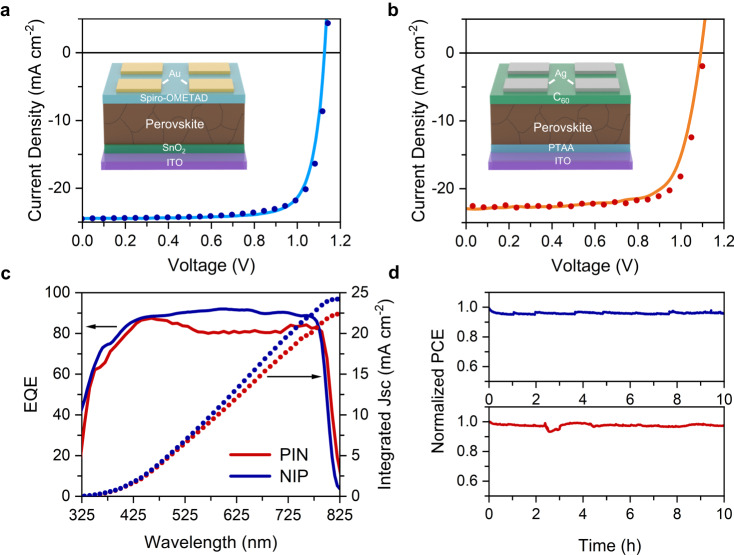
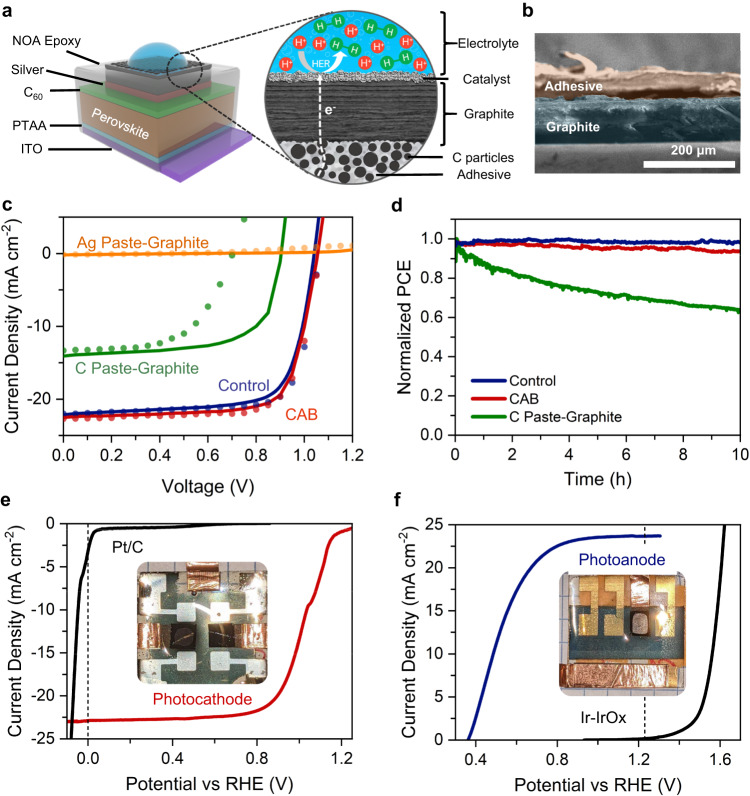
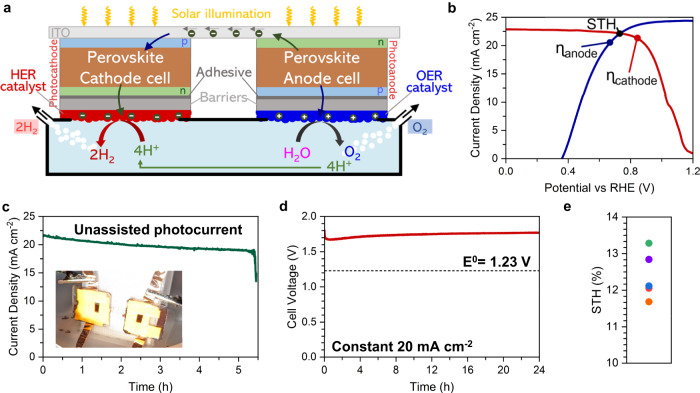
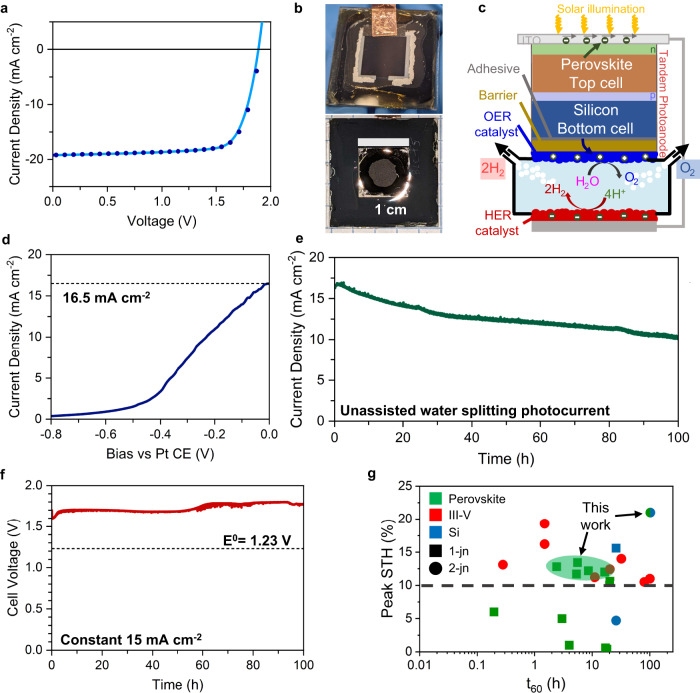
Verification
Claims the paper makes
The claims and statistics of this paper haven’t been checked yet.
Run the check — free, no account needed. It reads the open-access text and checks the sources it cites.
Claims other papers make about this one
Each is checked against this paper’s own text: does it say what the citing paper says it does?
The source backs part of the claim, not all of it — or backs it for a different population, condition or comparison.
In the citing paper
“The high efficiency of a perovskite solar cell (PSC) is associated with a high absorption coefficient, direct bandgap transition, low effective mass, long diffusion length, and relatively high carrier mobility of free electrons and holes.[162,163]”
From Advances in Blue Energy Fuels: Harvesting Energy from Ocean for Self‐Powered Electrolysis (2025) · cites this paper as [163]
Experimental — accuracy not yet measured
Self-check
Percentages, sums and reported differences re-computed from the paper’s own numbers.
The self-check needs the paper’s full text.
Citations
Cites
McCrory, C. C. L., Jung, S., Ferrer, I. M., Chatman, S. M., Peters, J. C., & Jaramillo, T. F. (2015) · Journal of the American Chemical Society · doi:10.1021/ja510442p · Cited by 4,145
Pseudo-halide anion engineering for α-FAPbI3 perovskite solar cells
Jeong, J., Kim, M., Seo, J., Lu, H., Ahlawat, P., Mishra, A., Yang, Y., Hope, M. A., Eickemeyer, F. T., Kim, M., et al. (2021) · Nature · doi:10.1038/s41586-021-03406-5 · Cited by 3,079
Efficient perovskite solar cells via improved carrier management
Yoo, J. J., Seo, G., Chua, M. R., Park, T. G., Lu, Y., Rotermund, F., Kim, Y.-K., Moon, C. S., Jeon, N. J., Correa-Baena, J.-P., et al. (2021) · Nature · doi:10.1038/s41586-021-03285-w · Cited by 2,934
Water photolysis at 12.3% efficiency via perovskite photovoltaics and Earth-abundant catalysts
Luo, J., Im, J.-H., Mayer, M. T., Schreier, M., Nazeeruddin, M. K., Park, N.-G., Tilley, S. D., Fan, H. J., & Grätzel, M. (2014) · Science · doi:10.1126/science.1258307 · Cited by 2,509
A Monolithic Photovoltaic-Photoelectrochemical Device for Hydrogen Production via Water Splitting
Khaselev, O., & Turner, J. A. A. (1998) · Science · doi:10.1126/science.280.5362.425 · Cited by 2,205
Monolithic perovskite/silicon tandem solar cell with >29% efficiency by enhanced hole extraction
Al‐Ashouri, A., Köhnen, E., Li, B., Magomedov, A., Hempel, H., Caprioglio, P., Marquez, J. A., Morales‐Vilches, A. B., Kasparavičius, E., Smith, J. A., et al. (2020) · Science · doi:10.1126/science.abd4016 · Cited by 2,109
Self-citationResearch opportunities to advance solar energy utilization
Lewis, N. S. (2016) · Science · doi:10.1126/science.aad1920 · Cited by 2,081
Khenkin, M., Katz, E. A., Abate, A., Bardizza, G., Berry, J. J., Brabec, C. J., Brunetti, F., Bulović, V., Burlingame, Q. C., Carlo, A. D., et al. (2020) · Nature Energy · doi:10.1038/s41560-019-0529-5 · Cited by 1,821
Self-citationWireless Solar Water Splitting Using Silicon-Based Semiconductors and Earth-Abundant Catalysts
Reece, S. Y., Hamel, J., Sung, K., Jarvi, T. D., Esswein, A. J., Pijpers, J. J. H., & Nocera, D. G. (2011) · Science · doi:10.1126/science.1209816 · Cited by 1,687
Materials for solar fuels and chemicals
Montoya, J. H., Seitz, L. C., Chakthranont, P., Vojvodić, A., Jaramillo, T. F., & Nørskov, J. K. (2016) · Nature Materials · doi:10.1038/nmat4778 · Cited by 1,589
Research works printed but not linked: 1
- US Department of Energy. Advanced Water Splitting Materials Workshop Report. 56 (2016).
Cited by
Sorted by citations
Achievements, challenges, and future prospects for industrialization of perovskite solar cells
Yang, C., Hu, W., Liu, J., Han, C., Gao, Q., Mei, A., Zhou, Y., Guo, F., & Han, H. (2024) · Light Science & Applications · doi:10.1038/s41377-024-01461-x · Cited by 422
Hansora, D., Yoo, J. W., Mehrotra, R., Byun, W. J., Lim, D., Kim, Y. K., Noh, E., Lim, H., Jang, J.-W., Seok, S. I., et al. (2024) · Nature Energy · doi:10.1038/s41560-023-01438-x · Cited by 186
Qureshi, F., & Tahir, M. D. (2024) · International Journal of Hydrogen Energy · doi:10.1016/j.ijhydene.2024.05.039 · Cited by 156
Recent advances in efficient and scalable solar hydrogen production through water splitting
Zheng, Y., Ma, M., & Shao, H. (2023) · Carbon Neutrality · doi:10.1007/s43979-023-00064-6 · Cited by 128
Chemistry of Materials Underpinning Photoelectrochemical Solar Fuel Production
Schichtl, Z. G., Carvalho, O. Q., Tan, J., Saund, S. S., Ghoshal, D., Wilder, L. M., Gish, M. K., Nielander, A. C., Stevens, M. B., & Greenaway, A. L. (2025) · Chemical Reviews · doi:10.1021/acs.chemrev.4c00258 · Cited by 98
Metadata
- Authors
- Fehr, A. M. K., Agrawal, A., Mandani, F., Conrad, C. L., Jiang, Q., Park, S. Y., Alley, O., Li, B., Sidhik, S., Metcalf, I., Botello, C., Young, J. L., Even, J., Blancon, J. C., Deutsch, T. G., Zhu, K., Albrecht, S., Toma, F. M., Wong, M., & Mohite, A. D.
- Affiliations
- Rice University (US)
- National Laboratory of the Rockies (US)
- Lawrence Berkeley National Laboratory (US)
- Helmholtz-Zentrum Berlin für Materialien und Energie (DE)
- Centre National de la Recherche Scientifique (FR)
- Corresponding author
- Wong, Michael
- Mohite, Aditya D.
- ORCID
- Venue
- Nature Communications
- Published
- 2023-06-26
- Volume
- 14
- Issue
- 1
- Pages
- 3797-3797
- ISSN
- 2041-1723 (ISSN-L)
- PMC
- PMC10293190
- OpenAlex
- W4382020723
- Cited by
- 177
- References
- 47
- Citations by year
- 2026: 54 · 2025: 59 · 2024: 54 · 2023: 10
- FWCI
- 8.46
- Type
- journal article
- Language
- en
- Open access
- gold
- doi.org
- Locations
- Nature Communications (publishedVersion, cc-by)
- PubMed Central (publishedVersion, cc-by)
- PubMed (publishedVersion)
- HAL (submittedVersion, cc-by)
- eScholarship (California Digital Library) (submittedVersion, cc-by)
- RePEc: Research Papers in Economics (submittedVersion)
- DOAJ (DOAJ: Directory of Open Access Journals) (submittedVersion, cc-by-sa)
- HZB Repository (Helmholtz-Zentrum Berlin für Materialien und Energie GmbH (HZB)) (submittedVersion, other-oa)
- OSTI OAI (U.S. Department of Energy Office of Scientific and Technical Information) (submittedVersion)
- Funders
- DOE | Office of Energy Efficiency and Renewable Energy (DE-EE0008843)
- Topics
- Physical Sciences › Energy › Renewable Energy, Sustainability and the Environment › Advanced Photocatalysis Techniques
- Physical Sciences › Engineering › Electrical and Electronic Engineering › Perovskite Materials and Applications
- Physical Sciences › Energy › Renewable Energy, Sustainability and the Environment › TiO2 Photocatalysis and Solar Cells
- Keywords
- solar water splitting, solar-to-hydrogen efficiency, device durability
About these checks
Registry, retraction, Cites and statistics results are computed, not judged, with one exception: a printed reference that no index lists is read once by a model before it counts as a citation error. Claims are extracted by a model and kept only when their quote appears verbatim in the text; each cited source is then checked, with a model’s help, for whether it says what the claim relies on. Those verdicts can be wrong — read the claim’s quote and the cited source before relying on one.
Statistics and arithmetic are recomputed, not judged.
Confidence bands are shown only for fields calibrated on our annotated test set. None is calibrated yet, so no band is shown.
What counts as a claim ›How we measure confidence ›How we check this ›
Are you an author, or do you see a problem with this page? Request a review
