

AI-designed NMR spectroscopy RF pulses for fast acquisition at high and ultra-high magnetic fields
Open accessThe DOI matches its Crossref record; 43 of the 43 references it cites were found in a registry or an index; 1 of the 14 sources its claims cite were checked for support.
Abstract
Nuclear magnetic resonance (NMR) spectroscopy is a powerful high-resolution tool for characterizing biomacromolecular structure, dynamics, and interactions. However, the lengthy longitudinal relaxation of the nuclear spins significantly extends the total experimental time, especially at high and ultra-high magnetic field strengths. Although longitudinal relaxation-enhanced techniques have sped up data acquisition, their application has been limited by the chemical shift dispersion. Here we combined an evolutionary algorithm and artificial intelligence to design 1 H and 15 N radio frequency (RF) pulses with variable phase and amplitude that cover significantly broader bandwidths and allow for rapid data acquisition. We re-engineered the basic transverse relaxation optimized spectroscopy experiment and showed that the RF shapes enhance the spectral sensitivity of well-folded proteins up to 180 kDa molecular weight. These RF shapes can be tailored to re-design triple-resonance experiments for accelerating NMR spectroscopy of biomacromolecules at high fields.
Overview
CoChat Summary
TL;DR
Manu et al. use GENETICS-AI to design phase- and amplitude-modulated 1H and 15N RF pulses and incorporate them into a RAPID-TROSY experiment. The new sequence broadens operational bandwidth and improves sensitivity for proteins up to 180 kDa at high magnetic fields, especially at longer interscan delays.
Key findings
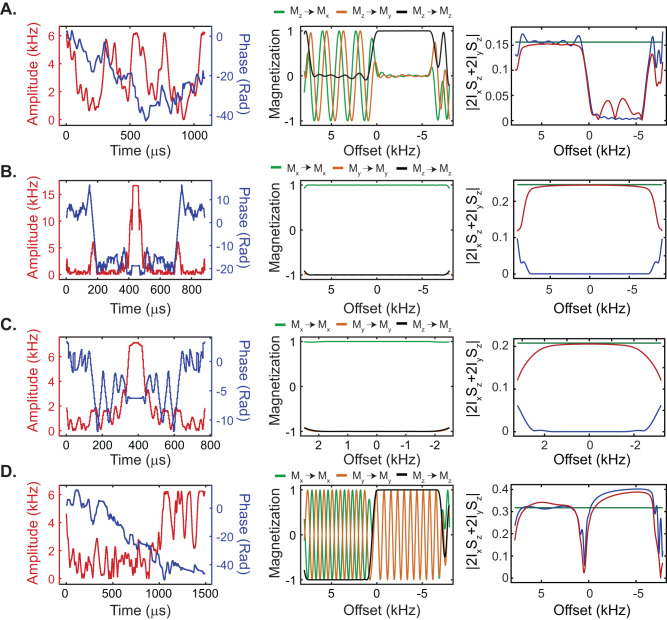
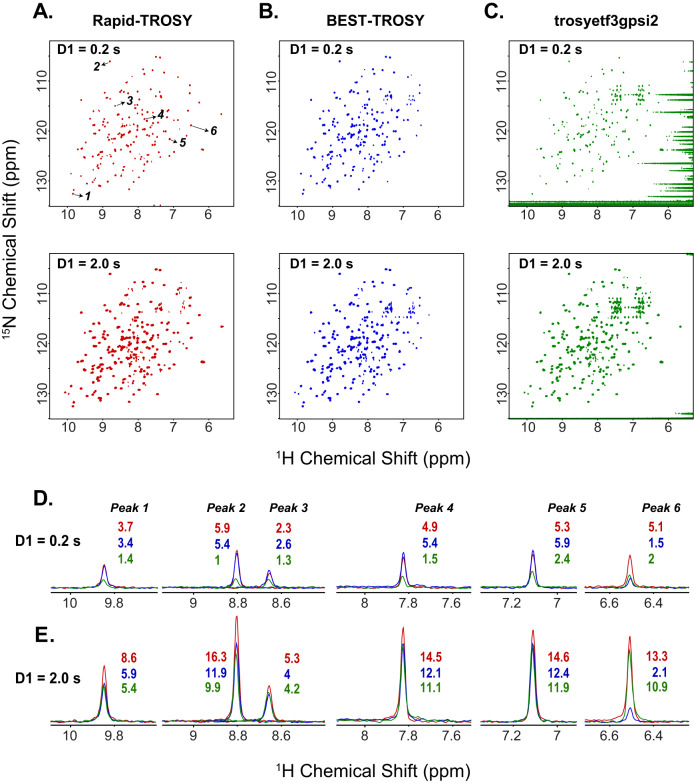
- GENETICS-AI generated four universal spin operations: UA90ev1 (band-selective 90° excitation with chemical shift and J evolution), URev1 (1H refocusing with J evolution), URev2 (15N refocusing with J evolution), and UARev1 (band-selective 180° centered on amides, avoiding water). UA90ev1 selectively excites 0.5–7.5 kHz while leaving water and other protons resonating between 0 and −6.2 kHz unaffected; UARev1 refocuses 0.5–7.5 kHz and avoids water irradiation.
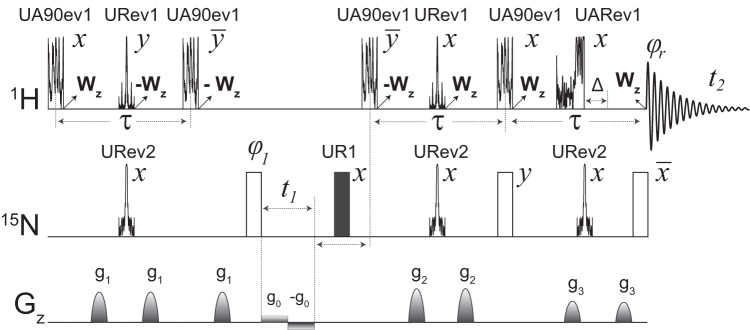
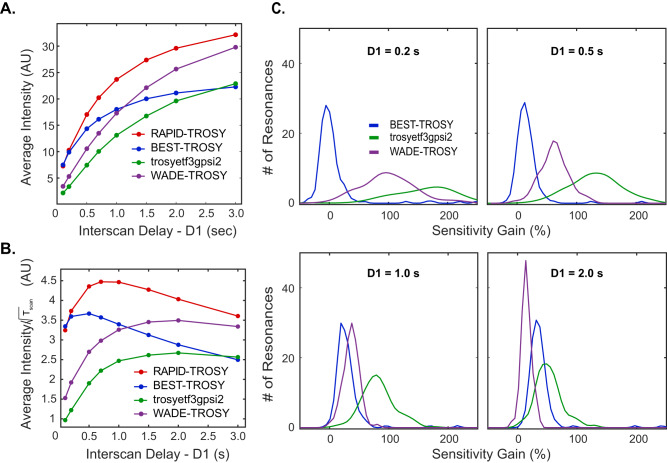
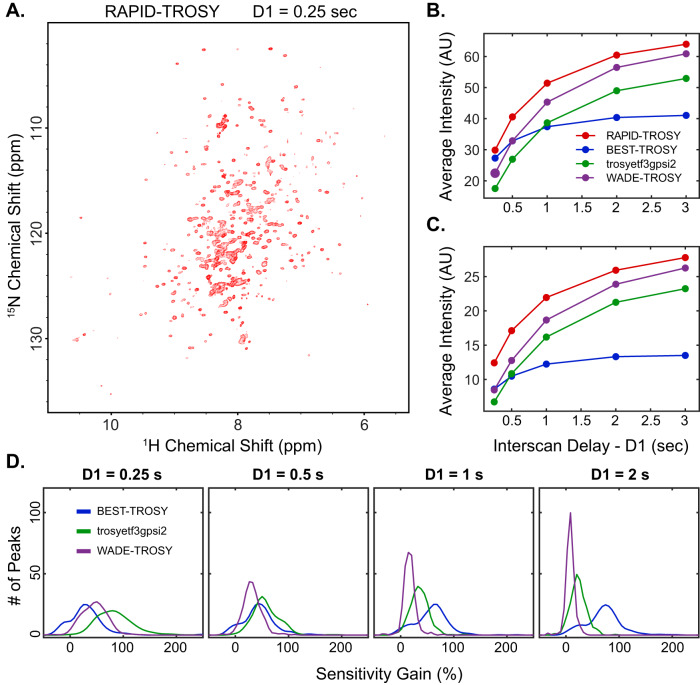
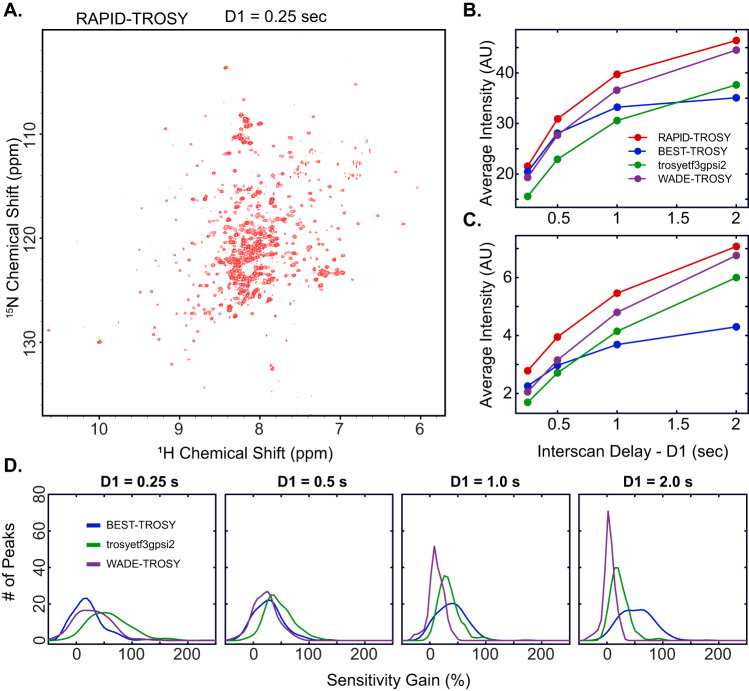
- Re-engineering the [1H,15N] TROSY-HSQC into RAPID-TROSY improved sensitivity. For RKIP (21 kDa, 187 amide peaks), BEST-TROSY and RAPID-TROSY were most sensitive at D1 0.2–0.25 s; RAPID-TROSY became the most sensitive for D1 > 0.3 s, and at D1 > 1.0 s WADE- and RAPID-TROSY outperformed the other two sequences. For MBP (42 kDa, 279 amide peaks; 139 low-intensity peaks) and RIIβ dimer (180 kDa; 244 resolved peaks in buildup, 122 lower-half peaks, and 390 amide resonances in gain distribution), RAPID-TROSY showed the highest average sensitivity over a wide range of interscan delays.
- Simulations with 1 ms pulses and R1/R2 from 0 to 50 s−1 showed performance similar to or better than PC9_90 and REBURP, with minimal relaxation effects; URev1 and URev2 had broader operational bandwidth and more homogeneous amide irradiation than REBURP.
- RAPID-TROSY also showed improved suppression of side-chain amide resonances due to phase cycling and high-fidelity pulse operations.
Methods
- Pulse design and simulations: GENETICS-AI combined an evolutionary algorithm and AI; simulations used Matlab R2022a, single-spin and two-spin systems (J = −92 Hz), offsets from −10 to +10 kHz, and Bloch-equation relaxation with R1/R2 from 0 to 50 s−1.
- Protein samples: U-15N labeled RKIP (21 kDa, 0.3 mM), U-13C,15N labeled MBP (42 kDa, 1 mM), and U-15N labeled RIIβ dimer (180 kDa, 0.25 mM), expressed and purified from E. coli as described.
- NMR spectroscopy: 900 MHz Bruker Avance III with TCI cryoprobe at 300 K; interscan delays varied from 0.2 to 3 s; 2D TROSY-HSQC experiments acquired with 1024 complex points in the direct dimension and 96/160/128 increments for RKIP/MBP/RIIβ, with 16/4/32 scans respectively; processed with NMRPipe and analyzed with NMRFAM-SPARKY.
Limitations
- The paper does not state a dedicated limitations section or explicit limitations.
- Evident from the text: only three proteins were tested (21, 42, and 180 kDa) and all NMR experiments were performed at 900 MHz; RAPID-TROSY was demonstrated for [1H,15N] TROSY-HSQC, while implementation in triple-resonance experiments is proposed but not shown.
- The GENETICS-AI pulses are longer than typical hard pulses; relaxation effects were assessed by simulation with a 1 ms pulse duration, but not exhaustively across all experimental conditions. The RIIβ peak counts also vary across analyses as reported (244 resolved peaks vs. 390 amide resonances in the gain distribution).
Model-written summary. Check it against the paper before relying on it.
Integrity signals
Registry
Cites
Statistics
Figures
Verification
Claims the paper makes
1 Valid · 3 Not valid · 11 Not checked · 64 Own results and interpretations
Every source the paper cites for this claim was checked and supports it.
In the paper
“GENETICS-AI combines an evolutionary algorithm and artificial intelligence (AI) to generate inhomogeneity-compensated high-fidelity RF pulses22.”
§ AI-designed NMR spectroscopy RF pulses for fast acquisition at high and ultra-high magnetic fields > Introduction
What the sources say
- Supportedcites [22] Manu VS Pavuluri K Olivieri C Veglia G High fidelity control of spin ensemble dynamics via artificial intelligence: from quantum computing to NMR spectroscopy and imaging PNAS Nexus 2022 1 133 10.1093/pnasnexus/pgac133 PMC9463062 36106184 source
The 'Architecture of the GENETICS-AI algorithm' subsection (Results and discussion) states verbatim that to design high-fidelity RF pulses the authors 'combined an evolutionary algorithm with AI' into GENETICS-AI, whose neural network (PhaseNET) predicts new RF shapes with specified RF inhomogeneity compensation and operational fidelity. The Experimental section's input module confirms the 'RF amplitude compensation level' parameter, and the MRI/NMR pulse sections report the inhomogeneity-compensated, high-fidelity outputs (e.g. minimum fidelity 0.99 across the BW range). (LLM, conf=0.94)
plainstates a cause- Asserted: passes — The authors put it forward as true.
- Checkable: passes — It can be checked against evidence.
- Load-bearing: passes — The paper’s conclusions depend on it.
- Based: passes — The paper gives a reason why it holds.
- Supported
A result the paper reports from its own data — it cites no other source for it, so there is none to check. The quote shows it is in the paper.
In the paper
“We found that at short D1 values (0.2−0.25 s), the [1H,15N] BEST-TROSY and [1H,15N] RAPID-TROSY experiments are the most sensitive (Fig. 3A).”
§ AI-designed NMR spectroscopy RF pulses for fast acquisition at high and ultra-high magnetic fields > Results > Applications of [1H,15N] RAPID-TROSY to globular proteins and comparison with standard TROSY schemes
plainstates an association- Asserted: passes — The authors put it forward as true.
- Checkable: passes — It can be checked against evidence.
- Load-bearing: passes — The paper’s conclusions depend on it.
- Based: passes — The paper gives a reason why it holds.
A result the paper reports from its own data — it cites no other source for it, so there is none to check. The quote shows it is in the paper.
In the paper
“The URev2 pulse performs a refocusing operation on the 15N channel over the entire operational bandwidth (Fig. 1C).”
§ AI-designed NMR spectroscopy RF pulses for fast acquisition at high and ultra-high magnetic fields > Results > AI-designed phase and amplitude-modulated RF pulses
plainstates a cause- Asserted: passes — The authors put it forward as true.
- Checkable: passes — It can be checked against evidence.
- Load-bearing: passes — The paper’s conclusions depend on it.
- Based: passes — The paper gives a reason why it holds.
A result the paper states — it cites no source for it, so there is none to check. The quote shows it is in the paper.
In the paper
“(c) WADE 1H pulses for minimizing signal losses due to chemical exchange”
§ AI-designed NMR spectroscopy RF pulses for fast acquisition at high and ultra-high magnetic fields > Discussion
plainstates a cause- Asserted: passes — The authors put it forward as true.
- Checkable: passes — It can be checked against evidence.
- Load-bearing: passes — The paper’s conclusions depend on it.
- Based: passes — The paper gives a reason why it holds.
A result the paper reports from its own data — it cites no other source for it, so there is none to check. The quote shows it is in the paper.
In the paper
“Again, the [1H,15N] TROSY-HSQC experiment acquired with a D1 of 0.25 s displays the lowest average intensity for the amide signals (Fig. 5B).”
§ AI-designed NMR spectroscopy RF pulses for fast acquisition at high and ultra-high magnetic fields > Results > Applications of [1H,15N] RAPID-TROSY to globular proteins and comparison with standard TROSY schemes
plainstates an associationSingle case- Asserted: passes — The authors put it forward as true.
- Checkable: passes — It can be checked against evidence.
- Load-bearing: unclear — It is unclear whether the paper’s conclusions depend on it.
- Based: passes — The paper gives a reason why it holds.
41 more claims
Create a free account to see all 79 claims and to verify the 6 references still open.
- It may state two separate claims as one. 29
- Probably not a substantial claim. 10
- The quote only partly states this claim. 1
Claims other papers make about this one
Each is checked against this paper’s own text: does it say what the citing paper says it does?
In the citing paper
“This effort has led to faster, more efficient RF pulses that can be created in a few milliseconds. [26]”
From Artificial Intelligence-Designed Ultra-Low-Power Broadband Universal and Pulses for NMR Spectroscopy: Application to 19F NMR (2026) · cites this paper as [26]
In the citing paper
“The WADE pulses, originally developed for NMR of biomacromolecules, 18,19,22 can be tailored for metabolomic analysis and overcome most of the limitations of the widely used water suppression schemes.”
From Detection of Exchangeable Protons in NMR Metabolomic Analysis Using AI-Designed Water Irradiation Devoid Pulses (2025) · cites this paper as [22]
Self-check
Percentages, sums and reported differences re-computed from the paper’s own numbers.
Each contradiction between two passages listed here was confirmed by an independent check.
Rated minor: it would not touch a result — a value no result rests on, a p-value that stays on the same side of the significance level, or a conflict that is clerical, resolved elsewhere in the paper, or outside its own findings.
In the paper
§ AI-designed NMR spectroscopy RF pulses for fast acquisition at high and ultra-high magnetic fields > Results > Applications of [1H,15N] RAPID-TROSY to globular proteins and comparison with standard TROSY schemes
“B Average intensity of the amide peaks vs. interscan delay for all resolved peaks (244);”
§ AI-designed NMR spectroscopy RF pulses for fast acquisition at high and ultra-high magnetic fields > Results > Applications of [1H,15N] RAPID-TROSY to globular proteins and comparison with standard TROSY schemes
“D Sensitivity gain distribution of RAPID-TROSY for all the resolved 390 amide resonances of RIIβ compared with the other three pulse sequences at different interscan delays.”
Citations
Cites
NMRPipe: A multidimensional spectral processing system based on UNIX pipes
Delaglio, F., Grzesiek, S., Vuister, G., Zhu, G., Pfeifer, J., & Bax, A. (1995) · Journal of Biomolecular NMR · doi:10.1007/bf00197809 · Cited by 15,965
NMR with Proteins and Nucleic Acids
Wüthrich, K. (1986) · Europhysics News · doi:10.1051/epn/19861701011 · Cited by 7,989
Pervushin, K., Riek, R., Wider, G., & Wüthrich, K. (1997) · Proceedings of the National Academy of Sciences · doi:10.1073/pnas.94.23.12366 · Cited by 2,445
NMRFAM-SPARKY: enhanced software for biomolecular NMR spectroscopy
Lee, W., Tonelli, M., & Markley, J. L. (2015) · Bioinformatics · doi:10.1093/bioinformatics/btu830 · Cited by 2,045
Khaneja, N., Reiss, T., Kehlet, C., Schulte-Herbrüggen, T., & Glaser, S. J. (2005) · Journal of Magnetic Resonance · doi:10.1016/j.jmr.2004.11.004 · Cited by 1,854
Band-selective radiofrequency pulses
Geen, H., & Freeman, R. (1991) · Journal of Magnetic Resonance (1969) · doi:10.1016/0022-2364(91)90034-q · Cited by 828 · cited 2×
“For instance, the BEST-type experiments utilize band-selective pulses such as PC9 17 , EBURP-2 18 , REBURP 18 , and r-SNOB 19,20 .”
Schanda, P., Kupče, Ē., & Brutscher, B. (2005) · Journal of Biomolecular NMR · doi:10.1007/s10858-005-4425-x · Cited by 709
Salzmann, M., Pervushin, K., Wider, G., Senn, H., & Wüthrich, K. (1998) · Proceedings of the National Academy of Sciences · doi:10.1073/pnas.95.23.13585 · Cited by 646 · cited 1×
“2) 24 .”
Protein structure determination in living cells by in-cell NMR spectroscopy
Sakakibara, D., Sasaki, A., Ikeya, T., Hamatsu, J., Hanashima, T., Mishima, M., Yoshimasu, M., Hayashi, N., Mikawa, T., Wälchli, M., et al. (2009) · Nature · doi:10.1038/nature07814 · Cited by 379
Facing and Overcoming Sensitivity Challenges in Biomolecular NMR Spectroscopy
Ardenkjaer‐Larsen, J., Boebinger, G. S., Comment, A., Duckett, S., Edison, A. S., Engelke, F., Griesinger, C., Griffin, R. G., Hilty, C., Maeda, H., et al. (2015) · Angewandte Chemie International Edition · doi:10.1002/anie.201410653 · Cited by 351 · cited 1×
“However, as the strength of magnetic fi elds increases, the design of RF pulses and pulse sequences must account for more intense radiation damping, broader chemical shift dispersion, chemical exchange, and fi eld inhomogeneity, phenomena that are accentuated at higher frequencies 7 .”
Emsley, L., & Bodenhausen, G. (1990) · Chemical Physics Letters · doi:10.1016/0009-2614(90)87025-m · Cited by 345 · cited 1×
“For instance, the BEST-type experiments utilize band-selective pulses such as PC9 17 , EBURP-2 18 , REBURP 18 , and r-SNOB 19,20 .”
Speeding Up Three-Dimensional Protein NMR Experiments to a Few Minutes
Schanda, P., Van Melckebeke, H., & Brutscher, B. (2006) · Journal of the American Chemical Society · doi:10.1021/ja062025p · Cited by 325
Short selective pulses for biochemical applications
Kupce, E., Boyd, J., & Campbell, I. D. (1995) · Journal of Magnetic Resonance, Series B · doi:10.1006/jmrb.1995.1049 · Cited by 258 · cited 1×
“For instance, the BEST-type experiments utilize band-selective pulses such as PC9 17 , EBURP-2 18 , REBURP 18 , and r-SNOB 19,20 .”
Solyom, Z., Schwarten, M., Geist, L., Konrat, R., Willbold, D., & Brutscher, B. (2013) · Journal of Biomolecular NMR · doi:10.1007/s10858-013-9715-0 · Cited by 245 · cited 13×
“Applications of [ 1 H, 15 N] RAPID-TROSY to globular proteins and comparison with standard TROSY schemes To test the [ 1 H, 15 N] RAPID-TROSY pulse sequence, we prepared a sample of uniformly (U) 15 N labeled RKIP, a small globular protein of 21 kDa, and compared its amide fi ngerprint spectrum with the corresponding s…”
InfluentialBringing Dynamic Molecular Machines into Focus by Methyl-TROSY NMR
Rosenzweig, R., & Kay, L. E. (2014) · Annual Review of Biochemistry · doi:10.1146/annurev-biochem-060713-035829 · Cited by 236 · cited 1×
“Today, the combination of advanced NMR techniques with high and ultra-high magnetic fi elds as well as deuteration and methyl group isotopic labeling makes it possible to study even larger complexes 4 – 6 .”
Structure and Allostery of the PKA RIIβ Tetrameric Holoenzyme
Zhang, P., Smith-Nguyen, E. V., Keshwani, M. M., Deal, M. S., Kornev, A. P., & Taylor, S. S. (2012) · Science · doi:10.1126/science.1213979 · Cited by 171
Selective excitation in high-resolution NMR
Freeman, R. (1991) · Chemical Reviews · doi:10.1021/cr00007a006 · Cited by 165
Improved 1HN-detected triple resonance TROSY-based experiments
Yang, D., & Kay, L. E. (1999) · Journal of Biomolecular NMR · doi:10.1023/a:1008329230975 · Cited by 147 · cited 11×
“All 2D TROSY-HSQC experiments were acquired with 1024 complex points in the direct dimension and 96 increments in the indirect dimension for RKIP, 160 for MBP, and 128 for the RII β subunit dimer.”
InfluentialProteasome allostery as a population shift between interchanging conformers
Ruschak, A. M., & Kay, L. E. (2012) · Proceedings of the National Academy of Sciences · doi:10.1073/pnas.1213640109 · Cited by 139
UltraSOFAST HMQC NMR and the Repetitive Acquisition of 2D Protein Spectra at Hz Rates
Gal, M., Schanda, P., Brutscher, B., & Frydman, L. (2007) · Journal of the American Chemical Society · doi:10.1021/ja066915g · Cited by 125 · cited 1×
“An alternate approach is to use polarization-enhanced fast-pulsing techniques 9,11 such as Band-selective Excitation Short-Transient (BEST) 12 , SOFAST 13 , and ULTRA-FAST 14,15 methods.”
Wideband Excitation with Polychromatic Pulses
Eriks Kupče, A., & Freeman, R. (1994) · Journal of Magnetic Resonance Series A · doi:10.1006/jmra.1994.1123 · Cited by 115
Conformational Changes in a Photosensory LOV Domain Monitored by Time-Resolved NMR Spectroscopy
Harper, S. M., Neil, L. C., Day, I. J., Hore, P. J., & Gardner, K. H. (2004) · Journal of the American Chemical Society · doi:10.1021/ja038224f · Cited by 96 · cited 1×
“…not possible, nucleic acid analysis 32 , in-cell NMR spectroscopy 33,34 , metabolomics, real-time biochemical processes such as kinetics of aggregation and oligomerization 35,36 , light-activated conformational transitions 37 , as well as drug/ligand screening 38 .”
Schanda, P. (2009) · Progress in Nuclear Magnetic Resonance Spectroscopy · doi:10.1016/j.pnmrs.2009.05.002 · Cited by 94 · cited 2×
“…to achieve selective excitation of amide protons is to replace standard hard pulses in the heteronuclear single quantum coherence (HSQC) or heteronuclear multiple quantum coherence (HMQC) pulse sequences with band-selective pulses 16 for excitation and refocusing operation of the amide protons 11 .”
Suppression of anti-TROSY lines in a sensitivity enhanced gradient selection TROSY scheme
Nietlispach, D. (2005) · Journal of Biomolecular NMR · doi:10.1007/s10858-004-8195-7 · Cited by 85
Protein in-cell NMR spectroscopy at 1.2 GHz
Luchinat, E., Barbieri, L., Cremonini, M., & Banci, L. (2021) · Journal of Biomolecular NMR · doi:10.1007/s10858-021-00358-w · Cited by 84
Tuning the rate of aggregation of hIAPP into amyloid using small-molecule modulators of assembly
Xu, Y., Maya‐Martinez, R., Guthertz, N., Heath, G. R., Manfield, I. W., Breeze, A. L., Sobott, F., Foster, R., & Radford, S. E. (2022) · Nature Communications · doi:10.1038/s41467-022-28660-7 · Cited by 83 · cited 1×
“…not possible, nucleic acid analysis 32 , in-cell NMR spectroscopy 33,34 , metabolomics, real-time biochemical processes such as kinetics of aggregation and oligomerization 35,36 , light-activated conformational transitions 37 , as well as drug/ligand screening 38 .”
Walker, C., Wang, Y., Olivieri, C., Karamafrooz, A., Casby, J., Bathon, K., Calebiro, D., Gao, J., Bernlohr, D. A., Taylor, S. S., et al. (2019) · Science Advances · doi:10.1126/sciadv.aaw9298 · Cited by 71
Self-citationWu, B., Barile, E., De, S. K., Wei, J., Purves, A., & Pellecchia, M. (2015) · Current Topics in Medicinal Chemistry · doi:10.2174/1568026615666150519102459 · Cited by 65
Olivieri, C., Li, G. C., Wang, Y., V.S., M., Walker, C., Kim, J., Camilloni, C., De Simone, A., Vendruscolo, M., Bernlohr, D. A., et al. (2022) · Science Advances · doi:10.1126/sciadv.abo0696 · Cited by 60 · cited 1×
“The RII β puri fi cation procedure was adapted from the murine catalytic subunit (C α ) protocol 40 .”
Self-citationSensitivity-enhanced IPAP-SOFAST-HMQC for fast-pulsing 2D NMR with reduced radiofrequency load
Kern, T., Schanda, P., & Brutscher, B. (2007) · Journal of Magnetic Resonance · doi:10.1016/j.jmr.2007.11.015 · Cited by 58
Boswell, Z. K., & Latham, M. P. (2018) · Biochemistry · doi:10.1021/acs.biochem.8b00953 · Cited by 56 · cited 1×
“Today, the combination of advanced NMR techniques with high and ultra-high magnetic fi elds as well as deuteration and methyl group isotopic labeling makes it possible to study even larger complexes 4 – 6 .”
Development and application of aromatic [13C, 1H] SOFAST-HMQC NMR experiment for nucleic acids
Sathyamoorthy, B., Lee, J., Kimsey, I., Ganser, L. R., & Al-Hashimi, H. (2014) · Journal of Biomolecular NMR · doi:10.1007/s10858-014-9856-9 · Cited by 45
TROSY NMR Spectroscopy of Large Soluble Proteins
Xu, Y., & Matthews, S. J. (2011) · Topics in current chemistry · doi:10.1007/128_2011_228 · Cited by 41 · cited 1×
“However, the development of transverse relaxation optimized spectroscopy (TROSY) 2 gave a new thrust to NMR, enabling the characterization of biological assemblies up to 1 MDa molecular weight 3 .”
Lenard, A. J., Mulder, F. A. A., & Madl, T. (2022) · Progress in Nuclear Magnetic Resonance Spectroscopy · doi:10.1016/j.pnmrs.2022.09.001 · Cited by 39 · cited 1×
“Oneapproachinvolvesdoping the samples with relaxation-enhanced agents, such as paramagnetic ions, that accelerate the longitudinal relaxation of the spin systems, though these agents may broaden the NMR lines and, in some cases, affect the sample ’ s chemistry 10 .”
Olivieri, C., Walker, C., Karamafrooz, A., Wang, Y., Manu, V. S., Porcelli, F., Blumenthal, D. K., Thomas, D. D., Bernlohr, D. A., Simon, S. M., et al. (2021) · Communications Biology · doi:10.1038/s42003-021-01819-6 · Cited by 27 · cited 1×
“Note, the details of this step are reported in the protocols described by Walker et al. 41 . and Olivieri et al. 42 .”
Self-citationManu, V. S., Olivieri, C., Pavuluri, K., & Veglia, G. (2022) · Physical Chemistry Chemical Physics · doi:10.1039/d2cp01744j · Cited by 25 · cited 4×
“For comparison, we included our previously published [ 1 H, 15 N] WADE-TROSY experiment 23 to establish whether the signalintensity increase is due to the water suppression scheme.”
InfluentialSelf-citationManu, V. S., Pavuluri, K., Mullen, M., Garwood, M., & Veglia, G. (2021) · doi:10.21203/rs.3.rs-403351/v1 · Cited by 24
Self-citationSlad, S., Bermel, W., Kümmerle, R., Mathieu, D., & Luy, B. (2022) · Journal of Biomolecular NMR · doi:10.1007/s10858-022-00404-1 · Cited by 23
Ceccon, A., Tugarinov, V., Torricella, F., & Clore, G. M. (2022) · Proceedings of the National Academy of Sciences · doi:10.1073/pnas.2207690119 · Cited by 22 · cited 1×
“…not possible, nucleic acid analysis 32 , in-cell NMR spectroscopy 33,34 , metabolomics, real-time biochemical processes such as kinetics of aggregation and oligomerization 35,36 , light-activated conformational transitions 37 , as well as drug/ligand screening 38 .”
Lee, J., Olivieri, C., Ong, C., Masterson, L. R., Gomes, S., Lee, B.-S., Schaefer, F., Lorenz, K., Veglia, G., & Rosner, M. R. (2022) · Proceedings of the National Academy of Sciences · doi:10.1073/pnas.2121867119 · Cited by 20
Self-citationConcurrent J-evolving refocusing pulses
Ehni, S., Koos, M. R. M., Reinsperger, T., Haller, J. D., Goodwin, D. L., & Luy, B. (2022) · Journal of Magnetic Resonance · doi:10.1016/j.jmr.2022.107152 · Cited by 13 · cited 1×
“Therefore, replacing all RF pulses in a multipulse sequence with equivalent pulse operations with embedded chemical shift and J coupling evolution will signi fi cantly reduce the overall duration of the pulsesequence, minimizing signallosses due to nuclear spin relaxation 31 .”
Artifacts can emerge in spectra recorded with even the simplest of pulse schemes: an HMQC case study
Kay, L. E. (2019) · Journal of Biomolecular NMR · doi:10.1007/s10858-019-00227-7 · Cited by 12 · cited 1×
“Fourth, fi eld inhomogeneity and pulse imper-fections can signi fi cantly impact the sensitivity of the experiments even for simple spin operations 27,28 .”
Rangadurai, A. K., Toyama, Y., & Kay, L. E. (2023) · Journal of Magnetic Resonance · doi:10.1016/j.jmr.2023.107412 · Cited by 8 · cited 1×
“Fourth, fi eld inhomogeneity and pulse imper-fections can signi fi cantly impact the sensitivity of the experiments even for simple spin operations 27,28 .”
Research works printed but not linked: 1
- Ernst, R. R., Bodenhausen, G. & Wokaun, A. Principle of Nuclear Magnetic Resonance, (Claredon Press, 1987).
Cited by
Accelerated Pure Shift NMR Spectroscopy with Deep Learning
Zhan, H., Liu, J., Fang, Q., Chen, X., & Hu, L. (2024) · Analytical Chemistry · doi:10.1021/acs.analchem.3c04007 · Cited by 48
Deep learning and its applications in nuclear magnetic resonance spectroscopy
Luo, Y., Zheng, X., Qiu, M., Gou, Y., Yang, Z., Qu, X., Chen, Z., & Lin, Y. (2025) · Progress in Nuclear Magnetic Resonance Spectroscopy · doi:10.1016/j.pnmrs.2024.101556 · Cited by 45
Intelligent understanding of spectra: from structural elucidation to property design
Feng, S., Huang, M., Li, Y., Cai, A., Yue, X., Wang, S., Chen, L., Jiang, J., & Luo, Y. (2025) · Chemical Society Reviews · doi:10.1039/d4cs01293c · Cited by 32
Noise reduction of nuclear magnetic resonance spectroscopy using lightweight deep neural network
Zhan, H., Fang, Q., Liu, J., Shi, X., Chen, X., Huang, Y., & Chen, Z. (2024) · Acta Physico-Chimica Sinica · doi:10.3866/pku.whxb202310045 · Cited by 30
Zhan, H., Huang, Y., & Chen, Z. (2026) · Applied Physics Reviews · doi:10.1063/5.0277355 · Cited by 22
Metadata
- Authors
- Manu, V. S., Olivieri, C., & Veglia, G.
- Affiliations
- University of Minnesota (US)
- Corresponding author
- Veglia, Gianluigi
- Venue
- Nature Communications
- Published
- 2023-07-12
- Volume
- 14
- Issue
- 1
- Pages
- 4144-4144
- ISSN
- 2041-1723 (ISSN-L)
- PMC
- PMC10338431
- OpenAlex
- W4384025559
- Semantic Scholar
- 6d2d6919db485b426e6e91fd06d0e99cf2c5e23b
- Cited by
- 35
- References
- 43
- Citations by year
- 2026: 11 · 2025: 15 · 2024: 8 · 2023: 1
- FWCI
- 3.07
- Type
- journal article
- Language
- en
- Open access
- gold
- doi.org
- Licence
- cc-by
- creativecommons.org/licenses/by/4.0 (tdm)
- creativecommons.org/licenses/by/4.0 (vor)
- Locations
- Nature Communications (publishedVersion, cc-by)
- PubMed Central (publishedVersion, cc-by)
- PubMed (publishedVersion)
- RePEc: Research Papers in Economics (submittedVersion)
- DOAJ (DOAJ: Directory of Open Access Journals) (submittedVersion, cc-by-sa)
- Funders
- U.S. Department of Health & Human Services | National Institutes of Health (HL144130, GM121735)
- Topics
- Physical Sciences › Chemistry › Spectroscopy › Advanced NMR Techniques and Applications
- Health Sciences › Medicine › Radiology, Nuclear Medicine and Imaging › Advanced MRI Techniques and Applications
- Life Sciences › Biochemistry, Genetics and Molecular Biology › Molecular Biology › Protein Structure and Dynamics
- Keywords
- RF pulse design, NMR spectroscopy, high magnetic fields, ultrahigh magnetic fields, evolutionary algorithms, artificial intelligence, chemical shift dispersion, spectral sensitivity, biological macromolecules, spin-lattice relaxation
- MeSH terms
- Algorithms, Artificial Intelligence, Heart Rate, Magnetic Resonance Spectroscopy, Magnetic Fields
About these checks
Registry, retraction, Cites and statistics results are computed, not judged, with one exception: a printed reference that no index lists is read once by a model before it counts as a citation error. Claims are extracted by a model and kept only when their quote appears verbatim in the text; each cited source is then checked, with a model’s help, for whether it says what the claim relies on. Those verdicts can be wrong — read the claim’s quote and the cited source before relying on one.
A language model drew the claims from the paper on 2026-11-18, under version 3 of the claim definition (model deepseek-v4.1-flash, prompt extract-v3).
A second model labelled each claim on 2026-11-18 (model jev-1.13-20260917, definition revision gold-guideline-v0.2).
Cited sources are checked with a language model’s help (qwen3.8-omni-flash).
Statistics and arithmetic are recomputed, not judged.
Confidence bands are shown only for fields calibrated on our annotated test set. None is calibrated yet, so no band is shown.
What counts as a claim ›How we measure confidence ›How we check this ›
Are you an author, or do you see a problem with this page? Request a review
Data sources
Bibliographic data: Semantic Scholar, OpenAlex, Crossref.
Contains information from the Semantic Scholar Academic Graph Datasets, made available under the ODC Attribution License (ODC-BY 1.0).
Semantic Scholar’s data is described in: Kinney, R., et al. (2023). The Semantic Scholar Open Data Platform. arXiv:2301.10140.
