

Tailoring a local acid-like microenvironment for efficient neutral hydrogen evolution
Open accessThe DOI matches its Crossref record; 59 of the 59 references it cites were found in a registry or an index.
Abstract
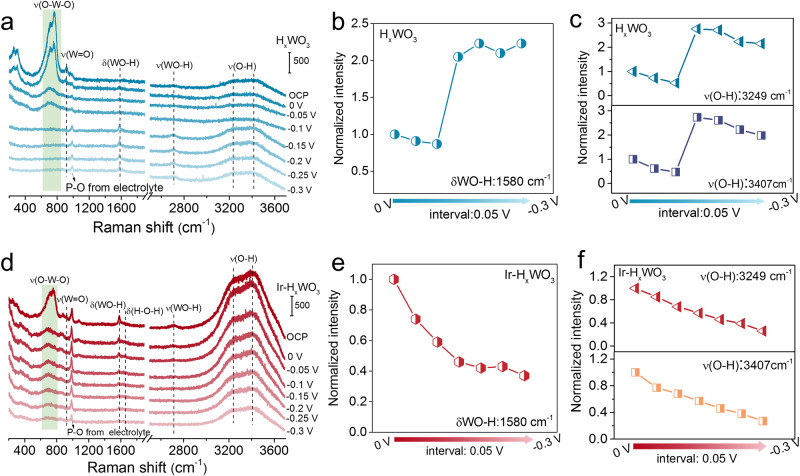
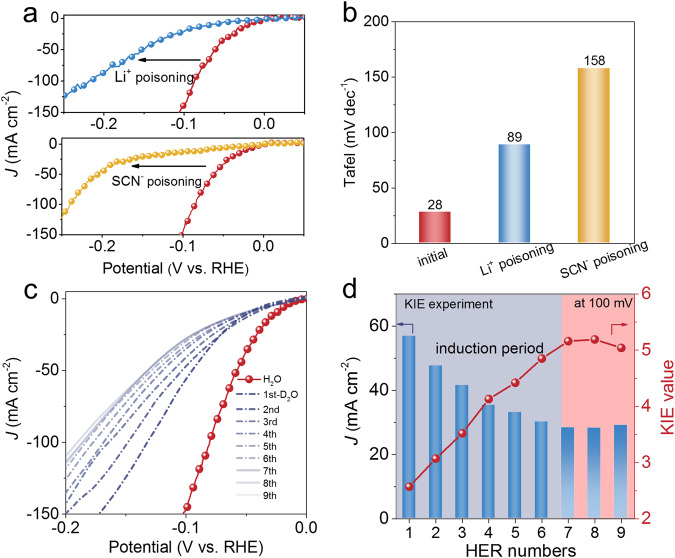
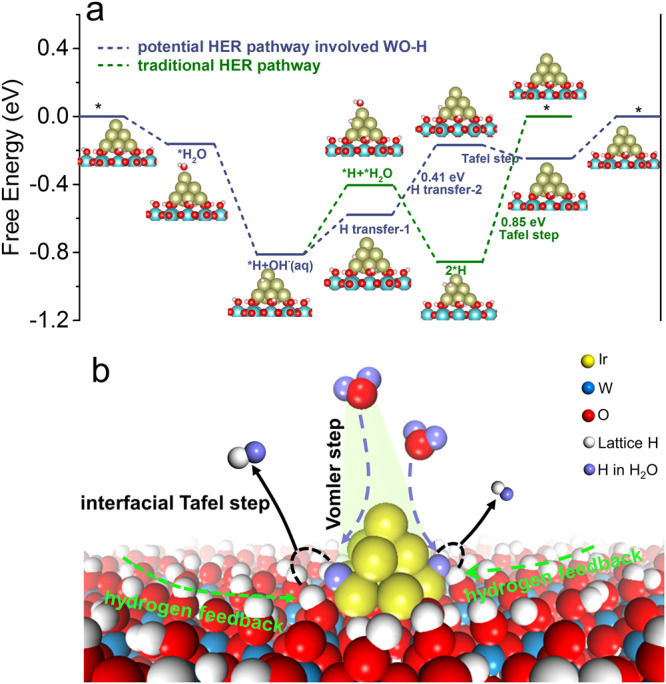
Electrochemical hydrogen evolution reaction in neutral media is listed as the most difficult challenges of energy catalysis due to the sluggish kinetics. Herein, the Ir-H x WO 3 catalyst is readily synthesized and exhibits enhanced performance for neutral hydrogen evolution reaction. H x WO 3 support is functioned as proton sponge to create a local acid-like microenvironment around Ir metal sites by spontaneous injection of protons to WO 3 , as evidenced by spectroscopy and electrochemical analysis. Rationalize revitalized lattice-hydrogen species located in the interface are coupled with H ad atoms on metallic Ir surfaces via thermodynamically favorable Volmer-Tafel steps, and thereby a fast kinetics. Elaborated Ir-H x WO 3 demonstrates acid-like activity with a low overpotential of 20 mV at 10 mA cm −2 and low Tafel slope of 28 mV dec −1 , which are even comparable to those in acidic environment. The concept exemplified in this work offer the possibilities for tailoring local reaction microenvironment to regulate catalytic activity and pathway.
Overview
The claims and statistics of this paper haven’t been checked yet.
Free: it reads the open-access text and checks the first 5 claims that cite a source we can check. Create a free account to check every claim.
Integrity signals
Registry
Cites
Statistics
Figures
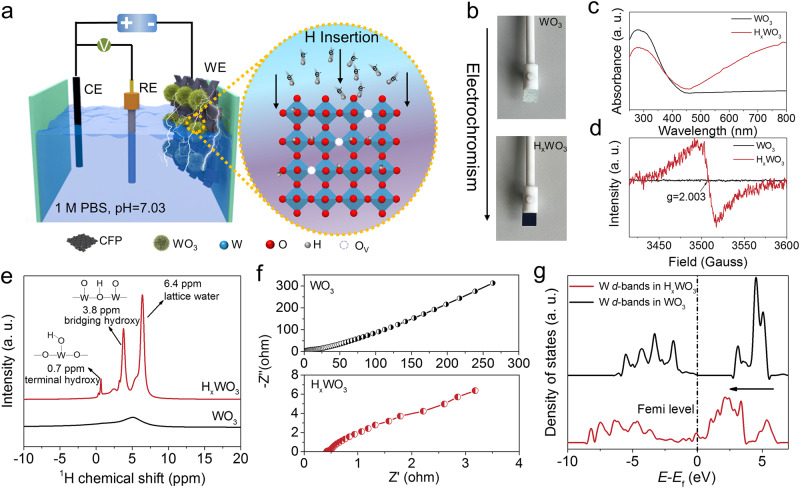
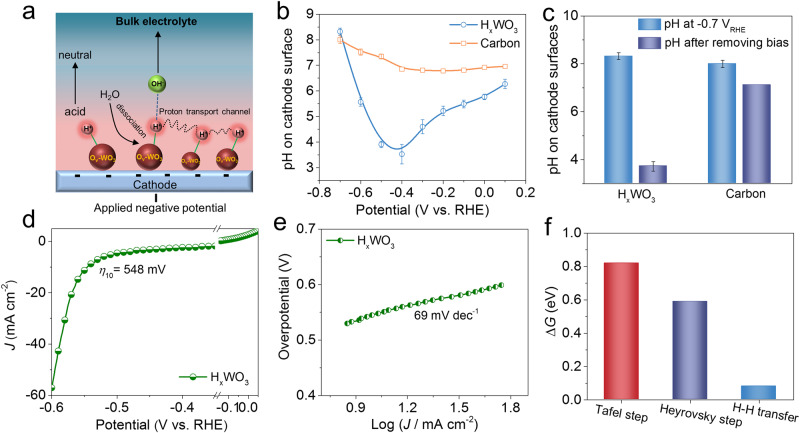
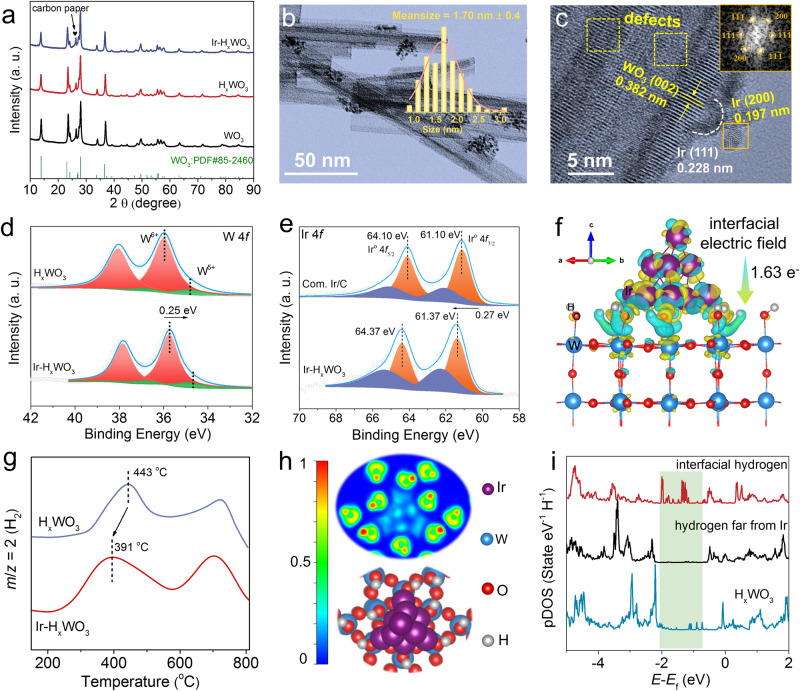
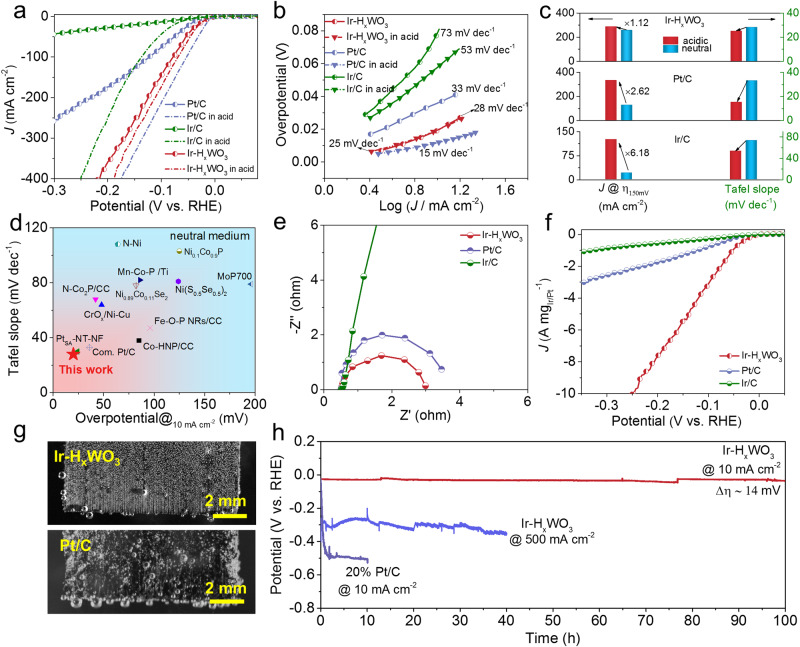
Verification
Claims the paper makes
The claims and statistics of this paper haven’t been checked yet.
Free: it reads the open-access text and checks the first 5 claims that cite a source we can check. Create a free account to check every claim.
Claims other papers make about this one
Each is checked against this paper’s own text: does it say what the citing paper says it does?
The cited source says what the claim attributes to it.
In the citing paper
“Currently, the acid HER pathway typically involves the Volmer step, which generates adsorbed hydrogen intermediates (H*) by electrochemical reduction, generally followed by either the charge-transfer Heyrovsky process () or a Tafel recombination process () to produce H216,17.”
From Pd hydride metallene aerogels with lattice hydrogen participation for efficient hydrogen evolution reaction (2024) · cites this paper as [16]
Self-check
Percentages, sums and reported differences re-computed from the paper’s own numbers.
The self-check needs the paper’s full text.
Citations
Cites
A simple measure of electron localization in atomic and molecular systems
Becke, A. D., & Edgecombe, K. E. (1990) · The Journal of Chemical Physics · doi:10.1063/1.458517 · Cited by 7,145
Sustainable Hydrogen Production
Turner, J. A. (2004) · Science · doi:10.1126/science.1103197 · Cited by 6,602
Alternative energy technologies
Dresselhaus, M. S., & Thomas, I. L. (2001) · Nature · doi:10.1038/35104599 · Cited by 4,894 · cited 1×
“Sustainable electrocatalytic hydrogen evolution reaction (HER) using renewables powered, low-temperature water electrolyzers is promising for the deployment of the hydrogen economy for sustainable energy storage, transportation, and chemical production 1 – 7 .”
Enhancing Hydrogen Evolution Activity in Water Splitting by Tailoring Li + -Ni(OH) 2 -Pt Interfaces
Subbaraman, R., Tripkovic, D., Strmcnik, D., Chang, K.-C., Uchimura, M., Paulikas, A. P., Stamenkovic, V., & Markovic, N. M. (2011) · Science · doi:10.1126/science.1211934 · Cited by 3,135 · cited 1×
“Consequently,even thestate-of-the-artPt-basedcatalyst,showstwoto three orders of magnitude lower activity in neutral/alkaline media as compared to acidic media 14 .”
Recent Advances in Electrocatalytic Hydrogen Evolution Using Nanoparticles
Zhu, J., Hu, L., Zhao, P., Lee, L. Y. S., & Wong, K.-Y. (2020) · Chemical Reviews · doi:10.1021/acs.chemrev.9b00248 · Cited by 3,133
Energy and fuels from electrochemical interfaces
Stamenkovic, V. R., Strmcnik, D., Lopes, P. P., & Markovic, N. M. (2017) · Nature Materials · doi:10.1038/nmat4738 · Cited by 2,030
Chatenet, M., Pollet, B. G., Dekel, D. R., Dionigi, F., Deseure, J., Millet, P., Braatz, R. D., Bazant, M. Z., Eikerling, M., Staffell, I., et al. (2022) · Chemical Society Reviews · doi:10.1039/d0cs01079k · Cited by 2,025
Hydrogen-treated WO3 nanoflakes show enhanced photostability
Wang, G., Ling, Y., Wang, H., Yang, X., Wang, C., Zhang, J. Z., & Li, Y. (2012) · Energy & Environmental Science · doi:10.1039/c2ee03158b · Cited by 766
Dinh, C.-T., Jain, A., de Arquer, F. P. G., De Luna, P., Li, J., Wang, N., Zheng, X., Cai, J., Gregory, B. Z., Voznyy, O., et al. (2018) · Nature Energy · doi:10.1038/s41560-018-0296-8 · Cited by 717
Self-citationImpedance Analysis of Electrochemical Systems
Vivier, V., & Orazem, M. E. (2022) · Chemical Reviews · doi:10.1021/acs.chemrev.1c00876 · Cited by 615
Vibrational spectra of water molecules at quartz/water interfaces
Du, Q., Freysz, E., & Shen, Y. R. (1994) · Physical Review Letters · doi:10.1103/physrevlett.72.238 · Cited by 573
Jin, H., Wang, X., Tang, C., Vasileff, A., Li, L., Slattery, A., & Qiao, S. (2021) · Advanced Materials · doi:10.1002/adma.202007508 · Cited by 538
Strategies for design of electrocatalysts for hydrogen evolution under alkaline conditions
Wang, X., Zheng, Y., Sheng, W., Xu, Z. J., Jaroniec, M., & Qiao, S.-Z. (2020) · Materials Today · doi:10.1016/j.mattod.2019.12.003 · Cited by 533
Fu, H. Q., Zhou, M., Liu, P. F., Liu, P., Yin, H., Sun, K. Z., Yang, H. G., Al-Mamun, M., Hu, P., Wang, H.-F., et al. (2022) · Journal of the American Chemical Society · doi:10.1021/jacs.2c01094 · Cited by 508
Park, J., Lee, S., Kim, H., Cho, A., Kim, S., Ye, Y., Han, J. W., Lee, H., Jang, J. H., & Lee, J. (2019) · Angewandte Chemie International Edition · doi:10.1002/anie.201908122 · Cited by 480
Direct seawater electrolysis by adjusting the local reaction environment of a catalyst
Guo, J., Zheng, Y., Hu, Z., Zheng, C., Mao, J., Du, K., Jaroniec, M., Qiao, S.-Z., & Ling, T. (2023) · Nature Energy · doi:10.1038/s41560-023-01195-x · Cited by 470
Dai, J., Zhu, Y., Chen, Y., Wen, X., Long, M., Wu, X., Hu, Z., Guan, D., Wang, X., Zhou, C., et al. (2022) · Nature Communications · doi:10.1038/s41467-022-28843-2 · Cited by 467 · cited 1×
“Subsequently, molecular hydrogen is produced by either a Tafel recombination step (H ad + H ad → * + H 2 ) or a charge-transfer Heyrovsky step (H ad + H 2 O +e − → * + H 2 +OH − ) 8 – 13 .”
Zhao, D., Sun, K., Cheong, W., Zheng, L., Zhang, C., Liu, S., Cao, X., Wu, K., Pan, Y., Zhuang, Z., et al. (2020) · Angewandte Chemie International Edition · doi:10.1002/anie.201908760 · Cited by 400
Tan, H., Tang, B., Lu, Y., Ji, Q., Lv, L., Duan, H., Li, N., Wang, Y., Feng, S., Li, Z., et al. (2022) · Nature Communications · doi:10.1038/s41467-022-29710-w · Cited by 390
Self-citationWang, X., Xu, C., Jaroniec, M., Zheng, Y., & Qiao, S.-Z. (2019) · Nature Communications · doi:10.1038/s41467-019-12773-7 · Cited by 386
Zhai, L., She, X., Zhuang, L., Li, Y., Ding, R., Guo, X., Zhang, Y., Zhu, Y., Xu, K., Fan, H. J., et al. (2022) · Angewandte Chemie International Edition · doi:10.1002/anie.202116057 · Cited by 343
Wang, J., Liao, T., Wei, Z., Sun, J., Guo, J., & Sun, Z. (2021) · Small Methods · doi:10.1002/smtd.202000988 · Cited by 339
Deng, L., Hu, F., Ma, M., Huang, S., Xiong, Y., Chen, H., Li, L., & Peng, S. (2021) · Angewandte Chemie International Edition · doi:10.1002/anie.202110374 · Cited by 331 · cited 2×
“…substantial progress has been made in promoting the kinetics of the electrode reactions by ameliorating the catalyst materials through various ways, such as introducing oxophilic active elements 21,22 , heterostructure modulating 23,24 , strain engineering 25,26 , nanoscopic con fi nement 27,28 .”
iR Compensation for Electrocatalysis Studies: Considerations and Recommendations
Zheng, W. (2023) · ACS Energy Letters · doi:10.1021/acsenergylett.3c00366 · Cited by 285
Engineering electrocatalyst nanosurfaces to enrich the activity by inducing lattice strain
Maiti, S., Maiti, K., Curnan, M. T., Kim, K., Noh, K.-J., & Han, J. W. (2021) · Energy & Environmental Science · doi:10.1039/d1ee00074h · Cited by 278
Conductive Tungsten Oxide Nanosheets for Highly Efficient Hydrogen Evolution
Zheng, T., Sang, W., He, Z., Wei, Q., Chen, B., Li, H., Cao, C., Huang, R., Yan, X., Pan, B., et al. (2017) · Nano Letters · doi:10.1021/acs.nanolett.7b04430 · Cited by 258 · cited 1×
“3c), which is ascribed to a good deal of surface defects induced by hydrogen intercalation during electrochemical activation 48 .”
Ali, A., Long, F., & Shen, P. K. (2022) · Electrochemical Energy Reviews · doi:10.1007/s41918-022-00136-8 · Cited by 243
Thermal Effects Associated with the Raman Spectroscopy of WO3 Gas-Sensor Materials
Garcia-Sanchez, R. F., Ahmido, T., Casimir, D., Baliga, S., & Misra, P. (2013) · The Journal of Physical Chemistry A · doi:10.1021/jp408303p · Cited by 201
Oxygen vacancy-assisted hydrogen evolution reaction of the Pt/WO 3 electrocatalyst
Tian, H., Cui, X., Zeng, L., Su, L., Song, Y., & Shi, J. (2019) · Journal of Materials Chemistry A · doi:10.1039/c8ta12219a · Cited by 194
Measurement method for carrier concentration in TiO2 via the Mott–Schottky approach
Sellers, M. C. K., & Seebauer, E. G. (2011) · Thin Solid Films · doi:10.1016/j.tsf.2010.10.071 · Cited by 182
Wang, P., Luo, Y., Zhang, G., Chen, Z., Ranganathan, H., Sun, S., & Shi, Z. (2022) · Nano-Micro Letters · doi:10.1007/s40820-022-00860-2 · Cited by 181
Strong Oxide‐Support Interaction over IrO2/V2O5 for Efficient pH‐Universal Water Splitting
Zheng, X., Qin, M., Ma, S., Chen, Y., Ning, H., Yang, R., Mao, S., & Wang, Y. (2022) · Advanced Science · doi:10.1002/advs.202104636 · Cited by 177
Self-citationXu, X., Sun, H., Jiang, S. P., & Shao, Z. (2021) · SusMat · doi:10.1002/sus2.34 · Cited by 165
Enhanced photocatalytic CO2 reduction to methane over WO3·0.33H2O via Mo doping
Wang, H., Zhang, L., Wang, K., Sun, X., & Wang, W. (2019) · Applied Catalysis B: Environmental · doi:10.1016/j.apcatb.2018.11.021 · Cited by 159
Lu, K., Liu, Y., Lin, F., Cordova, I. A., Gao, S., Li, B., Peng, B., Xu, H., Kaelin, J., Coliz, D., et al. (2020) · Journal of the American Chemical Society · doi:10.1021/jacs.0c00241 · Cited by 142
Enhancing the connection between computation and experiments in electrocatalysis
Resasco, J., Abild‐Pedersen, F., Hahn, C., Bao, Z., Koper, M. T. M., & Jaramillo, T. F. (2022) · Nature Catalysis · doi:10.1038/s41929-022-00789-0 · Cited by 140
Intrinsic Defects and H Doping in WO3
Zhu, J., Vasilopoulou, M., Davazoglou, D., Κέννου, Σ., Chroneos, A., & Schwingenschlögl, U. (2017) · Scientific Reports · doi:10.1038/srep40882 · Cited by 138
Modulating the dynamics of Brønsted acid sites on PtWOx inverse catalyst
Fu, J., Liu, S., Zheng, W., Huang, R., Wang, C., Lawal, A., Alexopoulos, K., Liu, S., Wang, Y., Yu, K., et al. (2022) · Nature Catalysis · doi:10.1038/s41929-022-00745-y · Cited by 135
Self-citationZhang, W., Huang, B., Wang, K., Yang, W., Lv, F., Li, N., Chao, Y., Zhou, P., Yang, Y., Li, Y., et al. (2021) · Advanced Energy Materials · doi:10.1002/aenm.202003192 · Cited by 122
Miu, E. V., McKone, J. R., & Mpourmpakis, G. (2022) · Journal of the American Chemical Society · doi:10.1021/jacs.2c00825 · Cited by 113
Zheng, X., Chen, Y., Bao, X., Mao, S., Fan, R., & Wang, Y. (2020) · ACS Catalysis · doi:10.1021/acscatal.0c03355 · Cited by 111
Self-citationWang, P., Luo, Y., Zhang, G., Wu, M., Chen, Z., Sun, S., & Shi, Z. (2022) · Small · doi:10.1002/smll.202105803 · Cited by 109
Kim, T., Roy, S. B., Moon, S., Yoo, S., Choi, H., Parale, V. G., Kim, Y., Lee, J., Jun, S. C., Kang, K., et al. (2022) · ACS Nano · doi:10.1021/acsnano.1c10504 · Cited by 99
Yuan, L., Tang, T., Hu, J., & Wan, L. (2021) · Accounts of Materials Research · doi:10.1021/accountsmr.1c00135 · Cited by 88
Yokoyama, Y., Miyazaki, K., Kondo, Y., Miyahara, Y., Fukutsuka, T., & Abe, T. (2020) · Chemistry Letters · doi:10.1246/cl.190856 · Cited by 83
Xu, J., Zheng, A., Yang, J., Su, Y., Wang, J., Zeng, D., Zhang, M., Ye, C., & Deng, F. (2006) · The Journal of Physical Chemistry B · doi:10.1021/jp0614087 · Cited by 82
Zhu, J.-S., Yang, H., Zhang, W., Mao, Y., Lyu, S.-S., & Chen, J. (2020) · Inorganic Chemistry Frontiers · doi:10.1039/d0qi00124d · Cited by 80
Dvořák, F., Szabová, L., Johánek, V., Camellone, M. F., Stetsovych, V., Vorokhta, M., Tovt, A., Škála, T., Matolínová, I., Tateyama, Y., et al. (2018) · ACS Catalysis · doi:10.1021/acscatal.7b04409 · Cited by 78
Yokoyama, Y., Miyazaki, K., Miyahara, Y., Fukutsuka, T., & Abe, T. (2019) · ChemElectroChem · doi:10.1002/celc.201900759 · Cited by 74
Membrane-less amphoteric decoupled water electrolysis using WO 3 and Ni(OH) 2 auxiliary electrodes
Vanags, M., Kuļikovskis, G., Kostjukovs, J., Jēkabsons, L., Šarakovskis, A., Šmits, K., Bikse, L., & Šutka, A. (2022) · Energy & Environmental Science · doi:10.1039/d1ee03982b · Cited by 72
Li, J., Stenlid, J. H., Ludwig, T., Schlexer, P., & Abild‐Pedersen, F. (2021) · Journal of the American Chemical Society · doi:10.1021/jacs.1c07276 · Cited by 59
Cu Atoms on Nanowire Pd/HyWO3-x Bronzes Enhance the Solar Reverse Water Gas Shift Reaction.
Li, Y.-F., Lu, W., Chen, K., Duchesne, P. N., Jelle, A. A., Xia, M., Wood, T., Ulmer, U., & Ozin, G. (2019) · Journal of the American Chemical Society · doi:10.1021/jacs.9b08030 · Cited by 57
Anomalous Defect Dependence of Thermal Conductivity in Epitaxial WO3 Thin Films
Ning, S., Huberman, S., Ding, Z., Nahm, H., Kim, Y., Kim, H., Chen, G., & Ross, C. A. (2019) · Advanced Materials · doi:10.1002/adma.201903738 · Cited by 54
Direct Electrochemical Protonation of Metal Oxide Particles
Zhu, H., Yang, Q., Liu, D., Du, Y., Yan, S., Gu, M., & Zou, Z. (2021) · Journal of the American Chemical Society · doi:10.1021/jacs.1c04631 · Cited by 51
Pfriem, N., Liu, Y., Zahn, F., Shi, H., Haller, G. L., & Lercher, J. A. (2021) · Journal of the American Chemical Society · doi:10.1021/jacs.1c07203 · Cited by 39
Comparisons of WO 3 reduction to H x WO 3 under thermochemical and electrochemical control
Miu, E. V., & McKone, J. R. (2019) · Journal of Materials Chemistry A · doi:10.1039/c9ta06394c · Cited by 23
Hydrogen in tungsten trioxide by membrane photoemission and density functional theory modeling
Billeter, E. R., Sterzi, A., Sambalova, O., Wick‐Joliat, R., Grazioli, C., Coreno, M., Cheng, Y. Q., Ramirez-Cuesta, A. J., & Borgschulte, A. (2021) · Physical review. B./Physical review. B · doi:10.1103/physrevb.103.205304 · Cited by 23
Boosting neutral hydrogen evolution reaction on iridium by support effect of W18O49
Peng, C., Zhao, W., Kuang, Z., Miller, J. T., & Chen, H. (2021) · Applied Catalysis A General · doi:10.1016/j.apcata.2021.118293 · Cited by 19
Reversible Rapid Hydrogen Doping of WO3 in Non-Acid Solution
Bian, Z., Zhao, J., Cao, H., Dong, Y., & Luo, Z. (2021) · ACS Applied Materials & Interfaces · doi:10.1021/acsami.1c01165 · Cited by 17
Cited by
Zhao, S., Hung, S.-F., Deng, L., Zeng, W.-J., Xiao, T., Li, S., Kuo, C.-H., Chen, H.-Y., Hu, F., & Peng, S. (2024) · Nature Communications · doi:10.1038/s41467-024-46750-6 · Cited by 225
“Membrane electrode assembly (MEA) water electrolysis allows for clean and ef fi cient green hydrogen production 3,4 .”
Microenvironment Engineering of Heterogeneous Catalysts for Liquid-Phase Environmental Catalysis
Zhu, Z.-S., Zhong, S., Cheng, C., Zhou, H., Sun, H., Duan, X., & Wang, S. (2024) · Chemical Reviews · doi:10.1021/acs.chemrev.4c00276 · Cited by 184
Chen, Y., Liu, Y., Li, L., Sakthivel, T., Guo, Z., & Dai, Z. (2024) · Advanced Functional Materials · doi:10.1002/adfm.202401452 · Cited by 162
Isotopic labelling of water reveals the hydrogen transfer route in electrochemical CO2 reduction
Zhang, J., Zhang, C., Wang, M., Mao, Y., Wu, B., Yang, Q., Wang, B. X., Mi, Z., Zhang, M., Ling, N., et al. (2025) · Nature Chemistry · doi:10.1038/s41557-024-01721-8 · Cited by 157
Song, L., Guo, L., Mao, J., Li, Z., Zhu, J., Lai, J., Chi, J., & Wang, L. (2024) · ACS Catalysis · doi:10.1021/acscatal.4c00267 · Cited by 149
Metadata
- Authors
- Zheng, X., Shi, X., Ning, H., Yang, R., Lu, B., Luo, Q., Mao, S., Xi, L., & Wang, Y.
- Affiliations
- State Key Laboratory of Clean Energy Utilization (CN)
- Zhengzhou University (CN)
- Corresponding author
- Wang, Yong
- Venue
- Nature Communications
- Published
- 2023-07-14
- Volume
- 14
- Issue
- 1
- Pages
- 4209-4209
- ISSN
- 2041-1723 (ISSN-L)
- PMC
- PMC10349089
- OpenAlex
- W4384301247
- Cited by
- 247
- References
- 59
- Citations by year
- 2026: 61 · 2025: 102 · 2024: 74 · 2023: 10
- FWCI
- 11.78
- Type
- journal article
- Language
- en
- Open access
- gold
- doi.org
- Licence
- cc-by
- creativecommons.org/licenses/by/4.0 (tdm)
- creativecommons.org/licenses/by/4.0 (vor)
- Locations
- Nature Communications (publishedVersion, cc-by)
- PubMed Central (publishedVersion, cc-by)
- PubMed (publishedVersion)
- RePEc: Research Papers in Economics (submittedVersion)
- DOAJ (DOAJ: Directory of Open Access Journals) (submittedVersion, cc-by-sa)
- Funders
- National Natural Science Foundation of China (2021YFB3801600, 2023C01108, 21872121, 21908189, 2022C01151, 2022C01218)
- Topics
- Physical Sciences › Energy › Renewable Energy, Sustainability and the Environment › Electrocatalysts for Energy Conversion
- Physical Sciences › Energy › Renewable Energy, Sustainability and the Environment › Advanced Photocatalysis Techniques
- Physical Sciences › Energy › Renewable Energy, Sustainability and the Environment › CO2 Reduction Techniques and Catalysts
- Keywords
- iridium catalysts, tungsten oxide support, proton sponge, electrocatalysis, overpotential, Tafel slope, supported metal catalysts
- MeSH terms
- Bandages, Catalysis, Hydrogen, Protons, Genetic Drift
About these checks
Registry, retraction, Cites and statistics results are computed, not judged, with one exception: a printed reference that no index lists is read once by a model before it counts as a citation error. Claims are extracted by a model and kept only when their quote appears verbatim in the text; each cited source is then checked, with a model’s help, for whether it says what the claim relies on. Those verdicts can be wrong — read the claim’s quote and the cited source before relying on one.
Statistics and arithmetic are recomputed, not judged.
Confidence bands are shown only for fields calibrated on our annotated test set. None is calibrated yet, so no band is shown.
What counts as a claim ›How we measure confidence ›How we check this ›
Are you an author, or do you see a problem with this page? Request a review
Data sources
Bibliographic data: Semantic Scholar, OpenAlex, Crossref.
Contains information from the Semantic Scholar Academic Graph Datasets, made available under the ODC Attribution License (ODC-BY 1.0).
Semantic Scholar’s data is described in: Kinney, R., et al. (2023). The Semantic Scholar Open Data Platform. arXiv:2301.10140.
