

The DOI matches its Crossref record; 80 of the 80 references it cites were found in a registry or an index.
A physiological approach for assessing human survivability and liveability to heat in a changing climate
Open accessAbstract
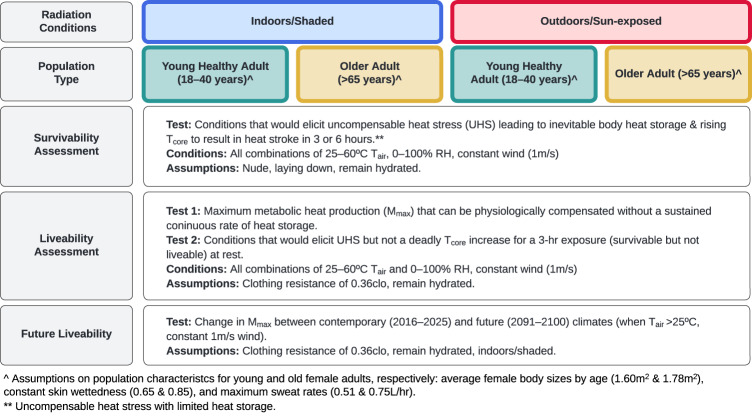
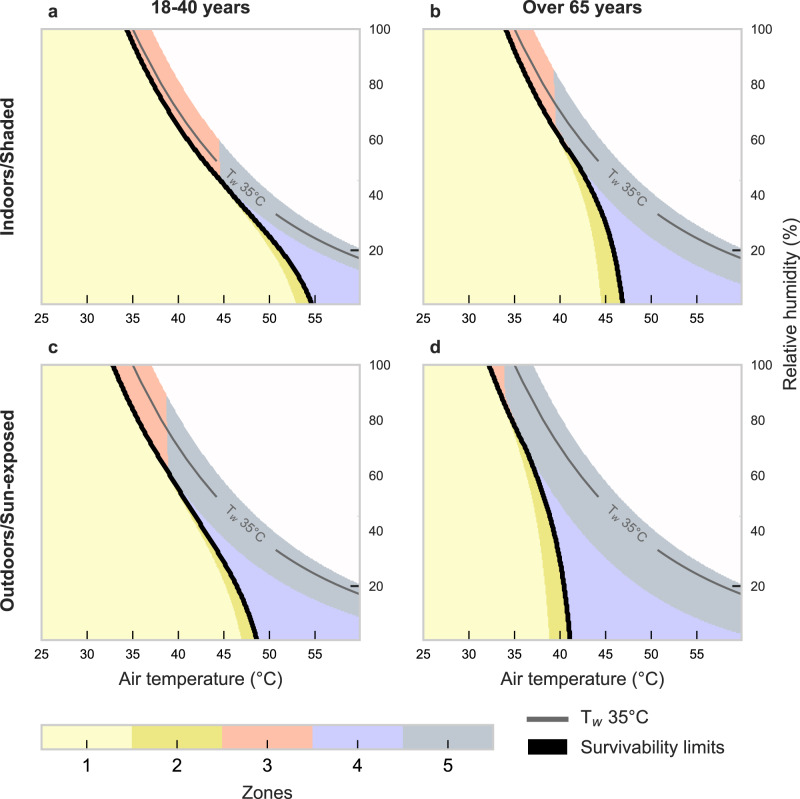
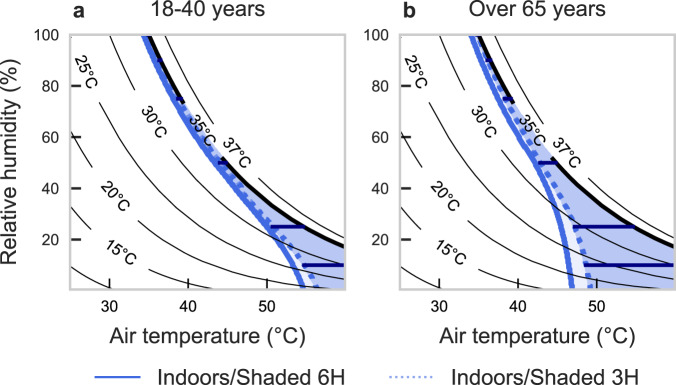
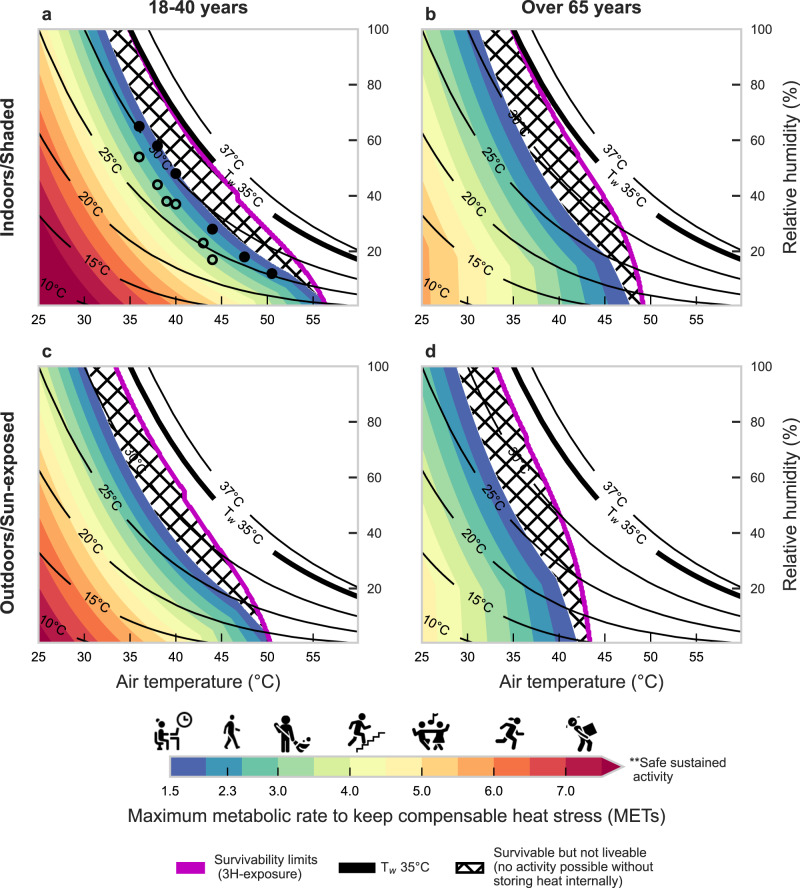
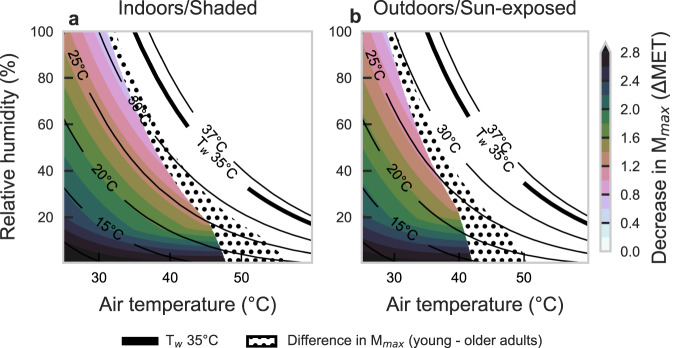
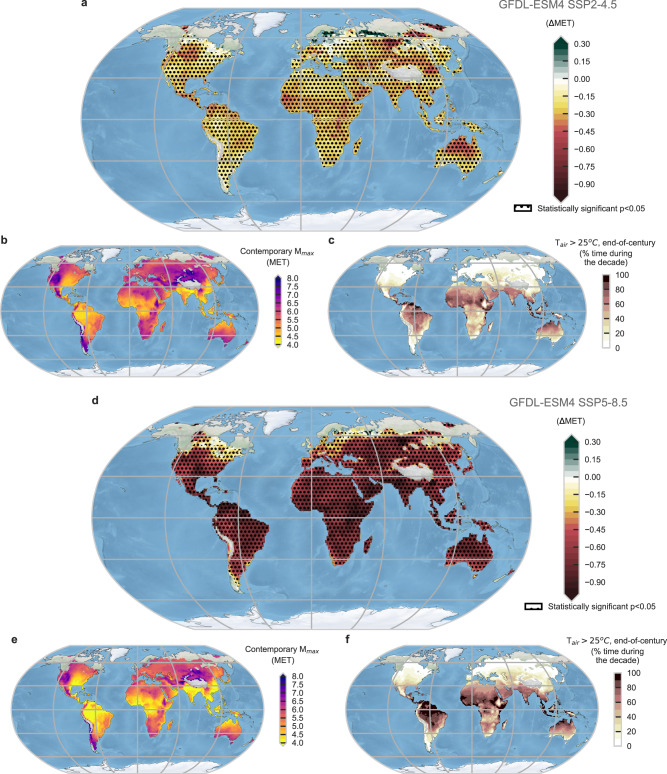
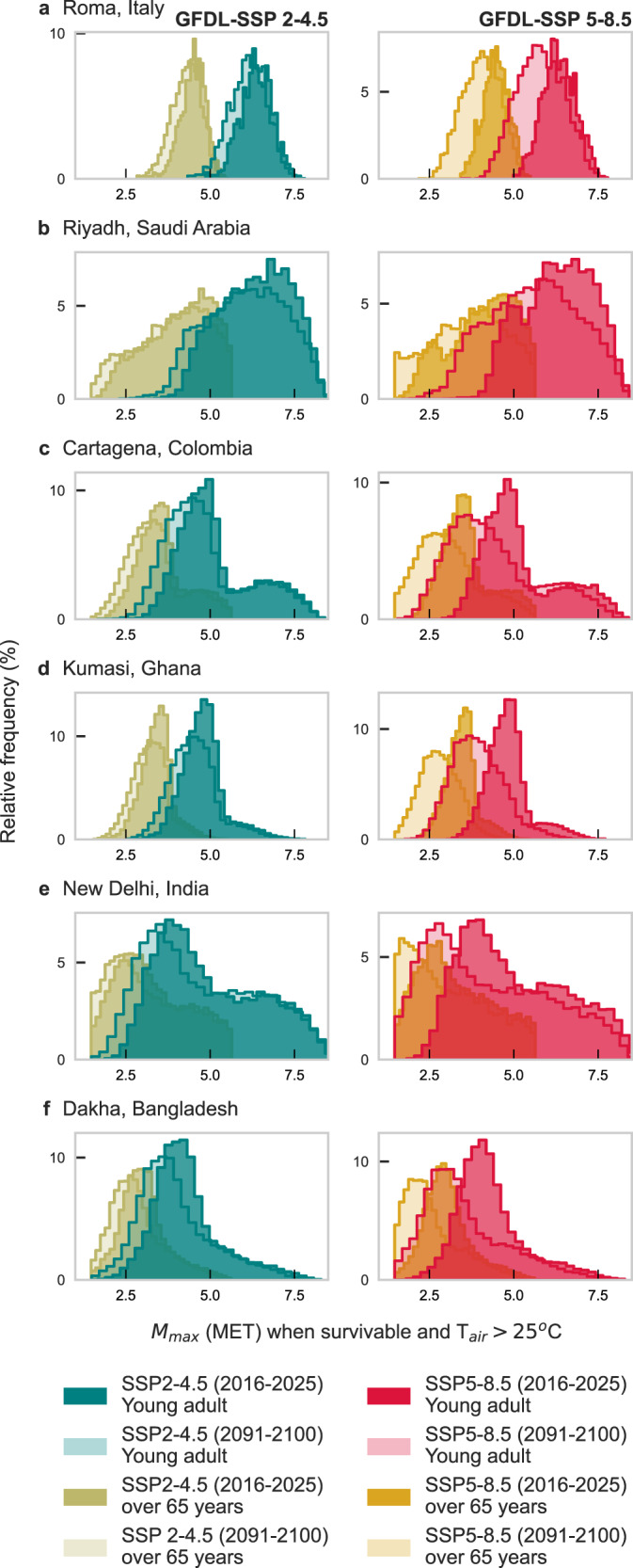
Most studies projecting human survivability limits to extreme heat with climate change use a 35 °C wet-bulb temperature (T w ) threshold without integrating variations in human physiology. This study applies physiological and biophysical principles for young and older adults, in sun or shade, to improve current estimates of survivability and introduce liveability (maximum safe, sustained activity) under current and future climates. Our physiology-based survival limits show a vast underestimation of risks by the 35 °C T w model in hot-dry conditions. Updated survivability limits correspond to T w ~25.8–34.1 °C (young) and ~21.9–33.7 °C (old)—0.9–13.1 °C lower than T w = 35 °C. For older female adults, estimates are ~7.2–13.1 °C lower than 35 °C in dry conditions. Liveability declines with sun exposure and humidity, yet most dramatically with age (2.5–3.0 METs lower for older adults). Reductions in safe activity for younger and older adults between the present and future indicate a stronger impact from aging than warming.
Overview
The claims and statistics of this paper haven’t been checked yet.
Run the check — free, no account needed. It reads the open-access text and checks the sources it cites.
Integrity signals
Registry
Cites
Statistics
Figures
Verification
Claims the paper makes
The claims and statistics of this paper haven’t been checked yet.
Run the check — free, no account needed. It reads the open-access text and checks the sources it cites.
Claims other papers make about this one
Each is checked against this paper’s own text: does it say what the citing paper says it does?
The source backs part of the claim, not all of it — or backs it for a different population, condition or comparison.
In the citing paper
“Air conditioning is an effective technology for reducing heat exposure.185”
From The 2024 report of the Lancet Countdown on health and climate change: facing record-breaking threats from delayed action (2024) · cites this paper as [185]
Experimental — accuracy not yet measured
Self-check
Percentages, sums and reported differences re-computed from the paper’s own numbers.
The self-check needs the paper’s full text.
Citations
Cites
Eyring, V., Bony, S., Meehl, G. A., Senior, C. A., Stevens, B., Stouffer, R. J., & Taylor, K. E. (2016) · Geoscientific Model Development · doi:10.5194/gmd-9-1937-2016 · Cited by 11,981
2011 Compendium of Physical Activities: A Second Update of Codes and MET Values
AINSWORTH, B. E., HASKELL, W. L., HERRMANN, S. D., MECKES, N., BASSETT, D. R., TUDOR-LOCKE, C., GREER, J. L., VEZINA, J., WHITT-GLOVER, M. C., & LEON, A. S. (2011) · Medicine & Science in Sports & Exercise · doi:10.1249/mss.0b013e31821ece12 · Cited by 6,317
Hot weather and heat extremes: health risks
Ebi, K. L., Capon, A., Berry, P., Broderick, C., de Dear, R., Havenith, G., Honda, Y., Kovats, R. S., Ma, W., Malik, A., et al. (2021) · The Lancet · doi:10.1016/s0140-6736(21)01208-3 · Cited by 2,172
Self-citationAn adaptability limit to climate change due to heat stress
Sherwood, S. C., & Huber, M. (2010) · Proceedings of the National Academy of Sciences · doi:10.1073/pnas.0913352107 · Cited by 1,236
Steadman, R. G. (1979) · Journal of applied meteorology · doi:10.1175/1520-0450(1979)018 · Cited by 1,170
Dunne, J. P. P., Horowitz, L. W., Adcroft, A., Ginoux, P. A., Held, I. M., John, J. G., Krasting, J. P., Malyshev, S. L., Naïk, V., Paulot, F., et al. (2020) · Journal of Advances in Modeling Earth Systems · doi:10.1029/2019ms002015 · Cited by 1,091
The emergence of heat and humidity too severe for human tolerance
Raymond, C., Matthews, T. K. R., & Horton, R. (2020) · Science Advances · doi:10.1126/sciadv.aaw1838 · Cited by 875
Heat exposure and cardiovascular health outcomes: a systematic review and meta-analysis
Liu, J., Varghese, B. M., Hansen, A. L., Zhang, Y., Driscoll, T., Morgan, G. G., Dear, K. B. G., Gourley, M., Capon, A. G., & Bi, P. (2022) · The Lancet Planetary Health · doi:10.1016/s2542-5196(22)00117-6 · Cited by 778
Jay, O., Capon, A. G., Berry, P., Broderick, C. R., de Dear, R., Havenith, G., Honda, Y., Kovats, S. R., Ma, W., Malik, A., et al. (2021) · The Lancet · doi:10.1016/s0140-6736(21)01209-5 · Cited by 769
Self-citationFuture temperature in southwest Asia projected to exceed a threshold for human adaptability
Pal, J. S., & Eltahir, E. A. B. (2016) · Nature Climate Change · doi:10.1038/nclimate2833 · Cited by 749
Cited by
Sorted by citations
Romanello, M., Walawender, M., Hsu, S.-C., Moskeland, A., Palmeiro-Silva, Y., Scamman, D., Ali, Z., Ameli, N., Angelova, D., Ayeb-Karlsson, S., et al. (2024) · The Lancet · doi:10.1016/s0140-6736(24)01822-1 · Cited by 897
Self-citationHeat-related mortality in Europe during 2023 and the role of adaptation in protecting health
Gallo, E. S., Quijal-Zamorano, M., Turrubiates, R. F. M., Tonne, C. C., Basagaña, X., Achebak, H., & Ballester, J. (2024) · Nature Medicine · doi:10.1038/s41591-024-03186-1 · Cited by 144
Mortality impacts of the most extreme heat events
Matthews, T. K. R., Raymond, C., Foster, J., Baldwin, J. W., Ivanovich, C. C., Kong, Q., Kinney, P. L., & Horton, R. (2025) · Nature Reviews Earth & Environment · doi:10.1038/s43017-024-00635-w · Cited by 118
Self-citationTen new insights in climate science 2024
Schaeffer, R., Schipper, E. L. F., Ospina, D., Mirazo, P., Alencar, A. A. C., Anvari, M., Artaxo, P. E., Biresselioğlu, M. E., Blome, T., Boeckmann, M., et al. (2025) · One Earth · doi:10.1016/j.oneear.2025.101285 · Cited by 82
Climate change and heat stress resilient outdoor workers: findings from systematic literature review
Habibi, P., Razmjouei, J., Moradi, A., Mahdavi, F., Aliabadi, S. F., & Heydari, A. (2024) · BMC Public Health · doi:10.1186/s12889-024-19212-3 · Cited by 73
Metadata
- Authors
- Vanos, J., Guzman-Echavarria, G., Baldwin, J. W., Bongers, C., Ebi, K. L., & Jay, O.
- Affiliations
- Arizona State University (US)
- Lamont-Doherty Earth Observatory (US)
- The University of Sydney (AU)
- University of Washington (US)
- Corresponding author
- Vanos, Jennifer
- Venue
- Nature Communications
- Published
- 2023-11-29
- Volume
- 14
- Issue
- 1
- Pages
- 7653-7653
- ISSN
- 2041-1723 (ISSN-L)
- PMC
- PMC10687011
- OpenAlex
- W4389141827
- Cited by
- 206
- References
- 80
- Citations by year
- 2026: 72 · 2025: 83 · 2024: 50 · 2023: 1
- FWCI
- 36.76
- Type
- journal article
- Language
- en
- Open access
- gold
- doi.org
- Locations
- Nature Communications (publishedVersion, cc-by)
- PubMed Central (publishedVersion, cc-by)
- PubMed (publishedVersion)
- eScholarship (California Digital Library) (submittedVersion, cc-by)
- RePEc: Research Papers in Economics (submittedVersion)
- DOAJ (DOAJ: Directory of Open Access Journals) (submittedVersion, cc-by-sa)
- Funders
- National Science Foundation (CMMI-2045663)
- Department of Health | National Health and Medical Research Council (2021/GNT2009507)
- Topics
- Health Sciences › Medicine › Physiology (medical) › Thermoregulation and physiological responses
- Physical Sciences › Environmental Science › Health, Toxicology and Mutagenesis › Climate Change and Health Impacts
- Physical Sciences › Environmental Science › Environmental Engineering › Urban Heat Island Mitigation
- Keywords
- wet-bulb temperature, human thermoregulation, climate change, extreme heat, older adults, aging, sun exposure, humidity, physiological limits, heat risk assessment
- MeSH terms
- Aged, Female, Hot Temperature, Humans, Humidity, Temperature, Extreme Heat, Climate Change
About these checks
Registry, retraction, Cites and statistics results are computed, not judged, with one exception: a printed reference that no index lists is read once by a model before it counts as a citation error. Claims are extracted by a model and kept only when their quote appears verbatim in the text; each cited source is then checked, with a model’s help, for whether it says what the claim relies on. Those verdicts can be wrong — read the claim’s quote and the cited source before relying on one.
Statistics and arithmetic are recomputed, not judged.
Confidence bands are shown only for fields calibrated on our annotated test set. None is calibrated yet, so no band is shown.
What counts as a claim ›How we measure confidence ›How we check this ›
Are you an author, or do you see a problem with this page? Request a review
