

TransformEHR: transformer-based encoder-decoder generative model to enhance prediction of disease outcomes using electronic health records
Open accessPublished version of a preprint
The DOI matches its Crossref record; 58 of the 58 references it cites were found in a registry or an index.
Abstract
Deep learning transformer-based models using longitudinal electronic health records (EHRs) have shown a great success in prediction of clinical diseases or outcomes. Pretraining on a large dataset can help such models map the input space better and boost their performance on relevant tasks through finetuning with limited data. In this study, we present TransformEHR, a generative encoder-decoder model with transformer that is pretrained using a new pretraining objective—predicting all diseases and outcomes of a patient at a future visit from previous visits. TransformEHR’s encoder-decoder framework, paired with the novel pretraining objective, helps it achieve the new state-of-the-art performance on multiple clinical prediction tasks. Comparing with the previous model, TransformEHR improves area under the precision–recall curve by 2% ( p < 0.001) for pancreatic cancer onset and by 24% ( p = 0.007) for intentional self-harm in patients with post-traumatic stress disorder. The high performance in predicting intentional self-harm shows the potential of TransformEHR in building effective clinical intervention systems. TransformEHR is also generalizable and can be easily finetuned for clinical prediction tasks with limited data.
Overview
The claims and statistics of this paper haven’t been checked yet.
Free: it reads the open-access text and checks the first 5 claims that cite a source we can check. Create a free account to check every claim.
Integrity signals
Registry
Cites
Statistics
Figures
Verification
Claims the paper makes
The claims and statistics of this paper haven’t been checked yet.
Free: it reads the open-access text and checks the first 5 claims that cite a source we can check. Create a free account to check every claim.
Self-check
Percentages, sums and reported differences re-computed from the paper’s own numbers.
The self-check needs the paper’s full text.
Citations
Cites
Hochreiter, S., & Schmidhuber, J. (1997) · Neural Computation · doi:10.1162/neco.1997.9.8.1735 · Cited by 102,318 · cited 4×
“We compared Trans-formEHR with four strong baseline models: logistic regression, long short-term memory (LSTM) 37 , BERT 22 without pretraining, and BERT 22 pretrained on VHA cohort.”
InfluentialExploring the Limits of Transfer Learning with a Unified Text-to-Text Transformer
Raffel, C., Shazeer, N., Roberts, A., Lee, K., Narang, S., Matena, M., Zhou, Y., Li, W., & Liu, P. J. (2019) · arXiv · doi:10.48550/arxiv.1910.10683 · Cited by 31,859
Pan, S. J., & Yang, Q. (2010) · IEEE Transactions on Knowledge and Data Engineering · doi:10.1109/tkde.2009.191 · Cited by 23,387
Lewis, M., Liu, Y., Goyal, N., Ghazvininejad, M., Mohamed, A., Levy, O., Stoyanov, V., & Zettlemoyer, L. (2020) · Proceedings of the 58th Annual Meeting of the Association for Computational Linguistics · doi:10.18653/v1/2020.acl-main.703 · Cited by 8,821
Lewis, M., Liu, Y., Goyal, N., Ghazvininejad, M., Mohamed, A., Levy, O., Stoyanov, V., & Zettlemoyer, L. (2019) · arXiv · doi:10.48550/arxiv.1910.13461 · Cited by 8,816 · cited 3×
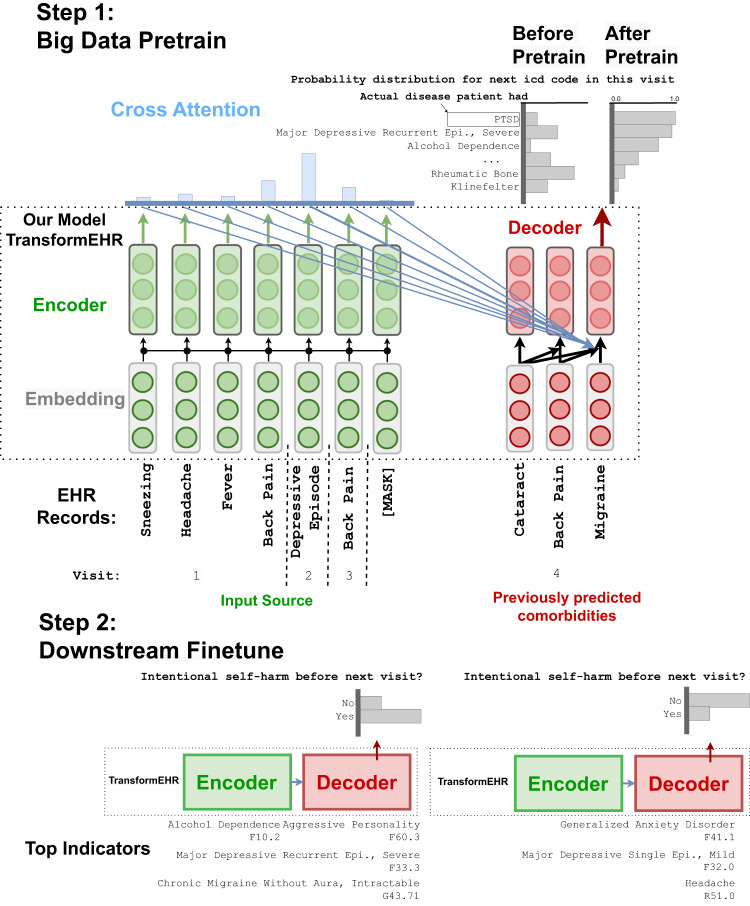
“Although the encoder-decoder framework was originally designed to generate next sentence given previous sentences as context 23,24 , we repurposed the framework for TransformEHR to generate the ICD codes of the next visit given previous EHRs (context).”
Saito, T., & Rehmsmeier, M. (2015) · PLOS ONE · doi:10.1371/journal.pone.0118432 · Cited by 5,309 · cited 1×
“AUPRC is the area under PPV and sensitivity curve, and it has shown to be an effective measure for highly imbalanced binary classi fi cation problems, which include self-harm prediction 35,36 .”
MIMIC-IV, a freely accessible electronic health record dataset
Johnson, A. E. W., Bulgarelli, L., Shen, L., Gayles, A., Shammout, A., Horng, S., Pollard, T. J., Hao, S., Moody, B., Gow, B., et al. (2023) · Scientific Data · doi:10.1038/s41597-022-01899-x · Cited by 3,401
Rajpurkar, P., Chen, E., Banerjee, O., & Topol, E. J. (2022) · Nature Medicine · doi:10.1038/s41591-021-01614-0 · Cited by 3,212
Glypican-1 identifies cancer exosomes and detects early pancreatic cancer
Melo, S. A., Luecke, L. B., Kahlert, C., Fernandez, A. F., Gammon, S. T., Kaye, J., LeBleu, V. S., Mittendorf, E. A., Weitz, J., Rahbari, N., et al. (2015) · Nature · doi:10.1038/nature14581 · Cited by 2,880
Scalable and accurate deep learning with electronic health records
Rajkomar, A., Oren, E., Chen, K., Dai, A. M., Hajaj, N., Hardt, M., Liu, P. J., Liu, X., Marcus, J., Sun, M., et al. (2018) · npj Digital Medicine · doi:10.1038/s41746-018-0029-1 · Cited by 2,648 · cited 1×
“Speci fi c date of each visit is an important feature inpredictive modeling as importanceof predictor in a visit can vary over time 1,25 – 27 .”
Research works printed but not linked: 4
- Vaswani, A. et al. Attention is All you Need. in Advances in Neural Information Processing Systems 30 (eds. Guyon, I. et al.) 5998–6008 (Curran Associates, Inc., 2017).
- Devlin, J., Chang, M.-W., Lee, K. & Toutanova, K. BERT: Pre-training of Deep Bidirectional Transformers for Language Understanding. in Proceedings of the 2019 Conference of the North {A}merican Chapter of the Association for Computational Linguistics: Human Language Technologies 4171–4186 (Association for Computational Linguistics, 2019).
- Pascanu, R., Mikolov, T. & Bengio, Y. On the difficulty of training recurrent neural networks. in International Conference on Machine Learning 1310–1318 (2013).
- Gradus J PTSD and death from suicide Natl Cent. Posttraumatic Stress Disord. 2017 28 1050 1835
Cited by
Large language models for disease diagnosis: a scoping review
Zhou, S., Xu, Z., Zhang, M., Xu, C., Guo, Y., Zhan, Z., Fang, Y., Ding, S., Wang, J., Xu, K., et al. (2025) · npj Artificial Intelligence · doi:10.1038/s44387-025-00011-z · Cited by 122
Learning the natural history of human disease with generative transformers
Shmatko, A., Jung, A. W., Gaurav, K., Brunak, S., Mortensen, L. H., Birney, E., Fitzgerald, T., & Gerstung, M. (2025) · Nature · doi:10.1038/s41586-025-09529-3 · Cited by 110
“Transformer models trained on electronic health records have been used for predicting diagnoses such as pancreatic cancer 26 , self-harm 25 and stroke 24 , as well as non-clinical parameters such as self-esteem 27 .”
The generative era of medical AI
Fahrner, J., Chen, E., Topol, E. J., & Rajpurkar, P. (2025) · Cell · doi:10.1016/j.cell.2025.05.018 · Cited by 145
Simon, B. D., Ozyoruk, K. B., Gelikman, D. G., Harmon, S. A., & Türkbey, B. (2024) · Diagnostic and Interventional Radiology · doi:10.4274/dir.2024.242631 · Cited by 73
“22 Transformers are particularly revolutionary, unlike typical recurrent neural networks, in that they employ a parallelized approach, which allows for scalable computation.”
BackgroundTask-Specific Transformer-Based Language Models in Health Care: Scoping Review
Cho, H. N., Jun, T. J., Kim, Y., Kang, H. J., Ahn, I., Gwon, H., Kim, Y., Seo, H., Choi, H., Kim, M., et al. (2024) · JMIR Medical Informatics · doi:10.2196/49724 · Cited by 107
A multi-center study on the adaptability of a shared foundation model for electronic health records
Guo, L., Fries, J., Steinberg, E., Fleming, S. L., Morse, K., Aftandilian, C. C., Posada, J., Shah, N. H., & Sung, L. (2024) · npj Digital Medicine · doi:10.1038/s41746-024-01166-w · Cited by 120
“Althoughthereisagrowingbodyofworkevaluatingpretrainedmodels acrossdifferenthospitalsystems(GenHPF 21 ,TransformEHR 22 )andtransfer from EHR data to insurance claims (Med-BERT 9 ), prior studies have focusedonprivatefoundationmodels,pretrainedfromscratch,andtherole…”
Yuan, H. (2024) · Health Care Science · doi:10.1002/hcs2.114 · Cited by 37
Mishra, A. K., Chong, B., Arunachalam, S. P., Oberg, A. L., & Majumder, S. (2024) · The American Journal of Gastroenterology · doi:10.14309/ajg.0000000000002870 · Cited by 45
Mohamed, A., AlAleeli, R., & Shaalan, K. F. (2025) · Computers · doi:10.3390/computers14040148 · Cited by 32
Lloret, A. T., Peral, J., Ferrández, A., Auladell, M., & Muñoz, R. (2025) · Sensors · doi:10.3390/s25165179 · Cited by 48
Wind Power Forecasting with Machine Learning Algorithms in Low-Cost Devices
Buestán-Andrade, P.-A., Yagüe, M. P., Sierra-García, J. E., & Santos, M. (2024) · Electronics · doi:10.3390/electronics13081541 · Cited by 26
Nansamba, B., Nabende, J. N., Katumba, A., & Kateete, D. P. (2025) · IEEE Access · doi:10.1109/access.2025.3558878 · Cited by 27
“Transformers have also shown significant promise in disease diagnosis and prognosis [64].”
Photoreceptor metabolic window unveils eye–body interactions
Yang, S., Xin, Z., Cheng, W., Zhong, P., Liu, R., Zhu, Z., Zhu, L. Z., Shang, X., Chen, S., Huang, W., et al. (2025) · Nature Communications · doi:10.1038/s41467-024-55035-x · Cited by 22
“Through multi-headattention, it simultaneously navigates multiple subspaces, comprehensively capturing summarized revelations for systemic health among individual photoreceptor-related metabolites, a capability beyond the reach of conventional neural networks 65 – 67 .”
Akter, S. B., Akter, S., Tuli, M. D., Eisenberg, D., Lotvola, A., Islam, H., Fresneda, J. E., Hüttemann, M., & Pias, T. S. (2024) · Computers in Biology and Medicine · doi:10.1016/j.compbiomed.2024.109413 · Cited by 19
Dick, K., Kaczmarek, E., Ducharme, R., Bowie, A. C., Dingwall‐Harvey, A. L. J., Howley, H. E. A., Hawken, S., WALKER, M. C., & Armour, C. M. (2025) · Scientific Reports · doi:10.1038/s41598-025-90216-8 · Cited by 33
“Transformer models are a new class of DL models that can be trained more efficiently than previous recurrent neural network architectures 25,26 .”
Wang, W., Luo, Y., Xu, Y., Liu, D., Zhou, J., & Shao, P. (2025) · Transportation Research Part E Logistics and Transportation Review · doi:10.1016/j.tre.2025.104136 · Cited by 20
Manzini, E., Vlacho, B., Franch‐Nadal, J., Escudero, J., Génova, A., Reixach, E., Andrés, E., Pizarro, I., Mauricio, D., & Perera-Lluna, A. (2025) · Expert Systems with Applications · doi:10.1016/j.eswa.2025.126876 · Cited by 18
Hou, W., Wang, J., Lin, Q., Wang, X., & Huang, L. (2025) · IEEE Journal of Biomedical and Health Informatics · doi:10.1109/jbhi.2025.3595140 · Cited by 20
“2) Adaptive Masked Language Model (MLM) Module: The MLM pre-training method has been widely established in earlier studies [17], [20].”
Evaluation of trajectory analysis for disease risk assessment: a scoping review
Pollington, F., Denaxas, S., Li, K., Thygesen, J. H., Lyratzopoulos, G., & White, B. (2025) · Journal of the American Medical Informatics Association · doi:10.1093/jamia/ocaf208 · Cited by 17
Yuanyuan, Z., Bensahla, A., Bjelogrlic, M., Zaghir, J., Turbé, H., Bednarczyk, L., Gaudet-Blavignac, C., Ehrsam, J., Marchand‐Maillet, S., & Lovis, C. (2025) · npj Digital Medicine · doi:10.1038/s41746-025-01692-1 · Cited by 22
“Other transformer-based training tasks include next visit code prediction 23,36,45,57 ,medicalcodecategoryprediction 23 ,medication-diagnosis cross prediction 26 , and token replacement detection ELECTRA 58 .”
Predictive Modeling with Temporal Graphical Representation on Electronic Health Records
Chen, J., Yin, C., Wang, Y., & Zhang, P. (2024) · International Joint Conference on Artificial Intelligence · doi:10.24963/ijcai.2024/637 · Cited by 80
Hu, Z., Li, Y., & Han, C. Z. (2024) · Communications Engineering · doi:10.1038/s44172-024-00309-x · Cited by 23
“With the fi rst T denoting transformer, the trans-formerstructure 16,17 isintegratedintoT-GANtoimprovetheaccuracyofthe basic GAN 18 .”
BackgroundSpinazzola, E., Picaud, G., Becchi, S., Pittarello, M., Ricci, E., Chaumont, M., Subsol, G., Pareschi, F., Téot, L., & Secco, J. (2025) · Journal of Clinical Medicine · doi:10.3390/jcm14092943 · Cited by 15
“Other approaches concerns more specific Deep Neural Networks (DNNs) on different predictive medicine applications [10–14].”
Automated classification of clinical diagnoses in electronic health records using transformer
Dai, L., Xu, H., & Zhang, Y. (2025) · PLoS ONE · doi:10.1371/journal.pone.0329963 · Cited by 14
“More recently, transformer-based models leveraging self-attention mechanisms have demonstrated state-of-the-art performance by capturing long-range dependencies in clinical text and enabling parallel processing of sequential data [16].”
Foundation model of electronic medical records for adaptive risk estimation
Renc, P., Grzeszczyk, M. K., Oufattole, N., Goode, D., Jia, Y., Bieganski, S., McDermott, M. B. A., Wąs, J., Samir, A. E., Cunningham, J. W., et al. (2025) · GigaScience · doi:10.1093/gigascience/giaf107 · Cited by 47
“Recent advances in generative machine learning—particularly transformer architectures [14, 15, 16, 17] that under-pin Large Language Models [18, 19]—have unlocked unprecedented capabilities for processing high-dimensional, heterogeneous, time-stamped health data from EHRs [20, 21, 22, 23, 24].”
Redekop, E., Wang, Z., Kulkarni, R., Pleasure, M., Chin, A. T., Hassanzadeh, H. R., Hill, B. L., Emami, M., Speier, W. F., & Arnold, C. W. (2025) · Journal of the American Medical Informatics Association · doi:10.1093/jamia/ocaf160 · Cited by 11
Wang, W., Luo, Y., Jiang, Z., Zhou, J., & Jia, P. (2025) · Energy · doi:10.1016/j.energy.2025.138586 · Cited by 11
A Systematic Review of Topic Modeling Techniques for Electronic Health Records
Mehmood, I., Zahra, Z., Iqbal, S., Qahmash, A., & Hussain, I. (2026) · Healthcare · doi:10.3390/healthcare14020282 · Cited by 11
Learning the natural history of human disease with generative transformersPreprint
Shmatko, A., Jung, A. W., Gaurav, K., Brunak, S., Mortensen, L. H., Birney, E., Fitzgerald, T. W., & Gerstung, M. (2024) · medRxiv · doi:10.1101/2024.06.07.24308553 · Cited by 13
Applications of AI/ML in accelerating the development of pulmonary drug delivery system
Jiang, J., Zhou, Z., Peng, T., Huang, Z., Pan, X., & Wu, C. (2025) · Acta Pharmaceutica Sinica B · doi:10.1016/j.apsb.2025.11.028 · Cited by 7
“More importantly, transformer-based models have been extensively used in drug development processes such as drug discovery, protein structure prediction, drug synthesis prediction, genomic data analysis, and clinical outcome prediction 102 — 106 .”
CURENet: combining unified representations for efficient chronic disease prediction
Dao, C.-T., Phan, T. T., Ding, J.-E., Wu, C., Restrepo, D. S., Luo, D., Zhao, F., Liao, C.-C., Peng, W.-C., Wang, C., et al. (2025) · Health Information Science and Systems · doi:10.1007/s13755-025-00396-w · Cited by 16
Chang, W.-C., Dai, L., & Xu, T. (2025) · International Conference on Artificial Intelligence, Robotics, and Communication (ICAIRC) · doi:10.1109/icairc68035.2025.11385222 · Cited by 14
Towards Reducing Diagnostic Errors with Interpretable Risk Prediction
McInerney, D. J., Dickinson, W., Flynn, L. C., Young, A. C., Young, G. S., van de Meent, J.-W., & Wallace, B. (2024) · Conference of the North American Chapter of the Association for Computational Linguistics: Human Language Technologies (NAACL-HLT) · doi:10.18653/v1/2024.naacl-long.399 · Cited by 8
Contrastive Learning on Medical Intents for Sequential Prescription Recommendation
Moghaddam, A. H., Kerdabadi, M. N., Liu, M., & Yao, Z. (2024) · ACM International Conference on Information and Knowledge Management (CIKM) · doi:10.1145/3627673.3679836 · Cited by 22
Self-attention with temporal prior: can we learn more from the arrow of time?
Kim, K. G., & Lee, B. T. (2024) · Frontiers in Artificial Intelligence · doi:10.3389/frai.2024.1397298 · Cited by 9
“Therefore, the kernel matrices C ( e ) ∈ R T × T and C ( p ) ∈ R T × T can be defined as following: With these matrix versions of kernels, we can rewrite the attention matrix to take advantage of vectorization. b p Where ⊙ denotes element-wise multiplication.”
Big Epidemiology: The Birth, Life, Death, and Resurgence of Diseases on a Global Timescale
Bragazzi, N. L., & Lehr, T. (2024) · Epidemiologia · doi:10.3390/epidemiologia5040047 · Cited by 10
“Other deep learning transformer-based models have been devised that use longitudinal data drawn from electronic health records to predict diseases and their outcomes [155–157].”
Liu, Y., Zhang, Z., Mi, J., Pan, S., Chen, T., Guo, Y. M., He, X., & Bian, J. (2024) · Journal of Biomedical Informatics · doi:10.1016/j.jbi.2025.104851 · Cited by 11
Lilli, L., Santoro, M., Masiello, V., Patarnello, S., Tagliaferri, L., Marazzi, F., & Capocchiano, N. D. (2025) · BMC Medical Informatics and Decision Making · doi:10.1186/s12911-025-02994-w · Cited by 6
Cheng, A., Zhang, Y., Qian, Z., Yuan, X., Yao, S., Ni, W., Zheng, Y., Zhang, H., Lu, Q., & Zhao, Z. (2024) · International Journal of Medical Informatics · doi:10.1016/j.ijmedinf.2024.105567 · Cited by 10
Kurasawa, H., Waki, K., Seki, T., Chiba, A., Fujino, A., Hayashi, K., Nakahara, E., Haga, T., Noguchi, T., & Ohe, K. (2024) · JMIR AI · doi:10.2196/56700 · Cited by 7
“We should devise model designs based on cutting-edge multimodal modeling using the transformer [52-54].”
MethodPark, J. I., Johnson, S., & Pruinelli, L. (2024) · Journal of Nursing Scholarship · doi:10.1111/jnu.13009 · Cited by 7
Multi-Modal Fusion of Routine Care Electronic Health Records (EHR): A Scoping Review
Miled, Z. B., Shebesh, J. A., Su, J., Dexter, P. R., Grout, R. W., & Boustani, M. A. (2025) · Information · doi:10.3390/info16010054 · Cited by 13
Helmy, H., Ibrahim, A., Arabi, M., Sattar, A. H. M. S., & Serag, A. (2025) · Natural Language Processing Journal · doi:10.1016/j.nlp.2025.100182 · Cited by 6
Shalmani, M. A., Khani, M., Taleban, A., Yi, Z., Fink, J. T., Weber, C. E., Lu, Q., & Luo, J. (2026) · Neural Computing and Applications · doi:10.1007/s00521-025-11695-4 · Cited by 7
DOME: Directional medical embedding vectors from Electronic Health Records
Wen, J., Xue, H., Rush, E. N., Panickan, V. A., Cai, T. A., Zhou, D., Ho, Y.-L. A., Costa, L., Begoli, E., Hong, C., et al. (2025) · Journal of Biomedical Informatics · doi:10.1016/j.jbi.2024.104768 · Cited by 6
Liu, Y., Tan, Z. D., Zhang, Z., Wang, S., Guo, J. S., Liu, H., Chen, T., & Bian, J. (2025) · Knowledge-Based Systems · doi:10.1016/j.knosys.2025.114102 · Cited by 6
Liu, T., Lü, L., Wang, Y., Krentz, A. J., & Ćurčin, V. (2025) · JMIR Medical Informatics · doi:10.2196/76659 · Cited by 8
Wu, J., Mei, X., Mao, R., He, K., & Cambria, E. (2025) · Information Fusion · doi:10.1016/j.inffus.2025.103620 · Cited by 12
Yang, Z., Mitra, A., Hu, W., Berlowitz, D. R., & Yu, H. Q. (2025) · Scientific Reports · doi:10.1038/s41598-025-27435-6 · Cited by 7
“2) Are improvements in suicide prediction by SBDH consistent across different machine learning models including an ensemble of traditional machine learning models 14,15 or deep learning generative foundation model 27,28 ?”
Self-citationLi, Q., Li, Z., Song, J., Bao, J., Yang, J., & You, Z. (2025) · Information Fusion · doi:10.1016/j.inffus.2025.103546 · Cited by 7
Emerging anomaly detection techniques for electronic health records: A survey
Bhanja, S. N., Niu, H., Chen, Y., Omitaomu, O. A., Laurio, A., Trickey, A. W., Sampath, V., & Nebeker, J. R. (2026) · Intelligence-Based Medicine · doi:10.1016/j.ibmed.2026.100349 · Cited by 5
Systematic review of foundation models for structured electronic health records
Guo, L. L., Arciniegas, S. E., Yan, A. P., Fries, J., TOMLINSON, G. A., & Sung, L. (2026) · Journal of the American Medical Informatics Association · doi:10.1093/jamia/ocag033 · Cited by 6
Kodati, D., & Dasari, C. M. (2024) · Engineering Applications of Artificial Intelligence · doi:10.1016/j.engappai.2024.109649 · Cited by 5
Mondal, S., Ghosh, T., & Das, A. (2025) · IEEE Access · doi:10.1109/access.2025.3603596 · Cited by 3
Leveraging patients’ longitudinal data to improve the Hospital One-year Mortality Risk
Laribi, H., Raymond, N., Taseen, R., Poenaru, D., & Vallières, M. (2025) · Health Information Science and Systems · doi:10.1007/s13755-024-00332-4 · Cited by 3
“Particularly, Luo et al. [29], Li et al. [30], Yang et al. [31] applied transformer networks to harness diverse information available within patients’ longitudinal EHRs for risk prediction.”
Mao, B., Prasadha, M. K., Xie, Z., He, J., Ghebranious, M., Xu, H., Zhi, D., & Rasmy, L. (2026) · medRxiv · doi:10.64898/2026.04.24.26351503 · Cited by 3
Interventions for Patients with Complex Medical and Social Needs
Balasubramanian, H., Prakash, S., Jafari, A., Mohan, A., & Gopalappa, C. (2024) · doi:10.1287/educ.2024.0279 · Cited by 2
GRU-TV: Time- and Velocity-aware Gated Recurrent Unit for patient representation
Liu, N., Gou, S., Gao, R., Su, B., Liu, W., Park, C., Xing, S., Yuan, J. Y., & Fenster, A. (2025) · Journal of Biomedical Informatics · doi:10.1016/j.jbi.2025.104855 · Cited by 2
Self-citationSatHealth: A Multimodal Public Health Dataset with Satellite-based Environmental Factors
Wang, Y., Wang, P., Yin, C., & Zhang, P. (2025) · ACM SIGKDD Conference on Knowledge Discovery and Data Mining (KDD) · doi:10.1145/3711896.3737440 · Cited by 4
Sun, M., Yang, X., Geng, J., Niu, J., Wang, C., Cui, C., Chen, X., Tang, W., & Zhang, W. (2025) · Neurocomputing · doi:10.1016/j.neucom.2025.130999 · Cited by 3
Alahmari, S., Eltayeb, H. H. E., Abaker, M., Almofarreh, M., Derouez, F. M., Alattas, K. A., Alkhudhayr, H., & Al-Sharafi, A. M. (2026) · Engineering Applications of Artificial Intelligence · doi:10.1016/j.engappai.2025.113692 · Cited by 3
Zhang, Z. Z. Z. Z., Govindarajan, V., Ouyang, X., Yang, J., Alabdullah, B. I., Alammar, S., Por, L. Y., Guo, Q., & Muwei, L. I. (2026) · IEEE Transactions on Consumer Electronics · doi:10.1109/tce.2026.3667507 · Cited by 4
“The multimodal deep learning (MM-DL) framework [20] was developed for obstructive CAD detection by combining ECG signals with clinical variables across multicenter cohorts.”
Generative AI empowered digital twins for advancing precision medicine
Akbarialiabad, H., Safaee, E., Letafati, M., Gong, J., Leachman, S. A., Grada, A. A., Pasdar, A., Janatifar, M., Shakil, F., Bunick, C. G., et al. (2026) · Discover Artificial Intelligence · doi:10.1007/s44163-026-01034-4 · Cited by 3
A Quantum Edge Federated Graph Transformer for Generative and Causal Digital Twin Healthcare
Narne, N. S. R., & Kancharla, G. (2026) · Engineering, Technology & Applied Science Research · doi:10.48084/etasr.16010 · Cited by 1
“Forward models such as TransformEHR [1], HERBERT [29], TECO [30], and Foresight [8] produce better performance than recurrence-based methods in EHR-related risk prediction and disease trajectory modeling.”
Lalor, J. P., Levy, D. A., Jordan, H. S., Hu, W., Smirnova, J. K., & Yu, H. Q. (2024) · Journal of Medical Internet Research · doi:10.2196/49704 · Cited by 7
Self-citationGürfidan, R. (2024) · Applied Sciences · doi:10.3390/app14219697 · Cited by 3
Parallel Nursing: Enhancing Postoperative Nursing With LLM Agent Systems
Qiao, X., Wang, J., Zhang, M., Lin, F., Ye, P., Ni, Q., & Wang, F.-Y. (2025) · IEEE Transactions on Computational Social Systems · doi:10.1109/tcss.2025.3605582 · Cited by 5
Machine Learning and Omic Data for Prediction of Health and Chronic Diseases
Olenik, M., & Dönertaş, H. M. (2025) · Elsevier eBooks · doi:10.1016/b978-0-323-95502-7.00284-0 · Cited by 4
Zhu, Q., Han, J., Yang, S., Xie, Z., Tian, B., Wan, H., & Chai, K. (2025) · Complex & Intelligent Systems · doi:10.1007/s40747-025-01794-z · Cited by 1
Integrin αvβ3-Targeted Therapeutic Strategies in Pancreatic Cancers
Li, Z., Shih, Y.-J., Tsai, C., Wang, C., Wang, W., Wang, K., Whang-Peng, J., Mo, J.-K., & Lin, H. (2025) · IntechOpen eBooks · doi:10.5772/intechopen.1008947 · Cited by 2
Enhancing Antidiabetic Drug Selection Using Transformers: Machine-Learning Model Development
Kurasawa, H., Waki, K., Seki, T., Nakahara, E., Fujino, A., Shiomi, N., Nakashima, H., & Ohe, K. (2025) · JMIR Medical Informatics · doi:10.2196/67748 · Cited by 1
“…improved performance on the fine-tuned task of predicting the onset of pancreatic cancer and intentional self-harm among patients with posttraumatic stress disorder by pretraining on the task of predicting randomly-masked diseases and outcomes in time series of 6.5 million patients [35].”
InfluentialGadd, C., Gokhale, K. M., Acharya, A., Cooper, J., Crowe, F. L., Fitzsimmons, L., Jackson, T., Nirantharakumar, K., Yau, C., Birch, R., et al. (2026) · npj Digital Medicine · doi:10.1038/s41746-026-02709-z · Cited by 7
“Encoder-decoder models (e.g. TransformEHR [43]) support sequence-to-sequence tasks, are similarly trained, and are effective for summarization, question answering, and multi-task learning via prompting.”
Goron, G. M., & Cherecheș, R. M. (2025) · Biomedizinische Technik/Biomedical Engineering · doi:10.1515/bmt-2025-0219 · Cited by 1
“In recent years, arti fi cial intelligence (AI) has emerged as a transformative force in medicine, particularly through its applications in diagnostic imaging [1 – 5], clinical decision support [6 – 10], and patient data analysis [11 – 15].”
John, A., Alhajj, R., & Rokne, J. G. (2025) · Applied Sciences · doi:10.3390/app152412959 · Cited by 3
Tao, R., Li, H., Lu, J., Wang, Y., Zhou, J., & Yu, X. (2026) · Digital Health · doi:10.1177/20552076251408517 · Cited by 2
Leveraging electronic health records for atrial fibrillation cohort generation
Domingo-Aldama, A. G., Prado, M. M., Olea, A. G., Goikoetxea, J., Gojenola, K., & Atutxa, A. (2026) · Health Information Science and Systems · doi:10.1007/s13755-025-00415-w · Cited by 2
Sreenivasan, M., Madhavendranath, S., & Chacko, A. M. (2026) · Biomedical Physics & Engineering Express · doi:10.1088/2057-1976/ae38de · Cited by 3
Makiev, G. G., Самойленко, И. В., Nazarova, V. V., Магомедова, З. Ш., Tryakin, A. A., & Gevorkyan, T. G. (2026) · Cancers · doi:10.3390/cancers18020315 · Cited by 2
Ercan, Ş., & Tanyıldızı, E. (2026) · Fırat Üniversitesi Mühendislik Bilimleri Dergisi · doi:10.35234/fumbd.1727903 · Cited by 1
Deep Learning Technology in Genomics, Radiotherapy, and Ophthalmology for Precision Medicine
Pratap, A., Huang, Y.-J., Chiang, C.-K., Liu, W., Lin, W.-Y., Hsu, H.-C., & Hsiung, P. (2026) · Journal of physiological investigation. · doi:10.4103/ejpi.ejpi-d-25-00069 · Cited by 3
Self-citationSelf-powered intelligence for personalized healthcare
Cai, Y., Kong, Z., Jin, P., Wang, X., Hou, R., Ding, N., Fu, H., Yeatman, E. M., Lee, C., Deng, F., et al. (2026) · National Science Review · doi:10.1093/nsr/nwag317 · Cited by 3
Transformer Models for Enhanced Natural Language Processing in Medical Records Management
Vasani, V. P., Pawar, S., Sowmya, P., Ahamad, S., Sahu, A., & Talele, G. (2024) · International Conference on Technological Advancements in Computational Sciences (ICTACS) · doi:10.1109/ictacs62700.2024.10840744 · Cited by 2
“Copyright © IEEE–2024 ISBN: 979-8-3503-8749-0 This is shown in fig 1.”
InfluentialAdugna, A., Abebaw, D., Abebaw, A., & Jemal, M. (2025) · Frontiers in Artificial Intelligence · doi:10.3389/frai.2025.1521886 · Cited by 3
Chen, B., & Liu, G. (2025) · Applied Sciences · doi:10.3390/app15116054 · Cited by 1
Patient-centered modeling of the breast biopsy experience
Nieto-Alvarez, I., Bojorges-Valdez, E., Lang, E. V., Sharif, M. R., Köber, G., Rohleder, N., & Amft, O. (2025) · Frontiers in Artificial Intelligence · doi:10.3389/frai.2025.1618357 · Cited by 1
“…these challenges, advanced natural language processing (NLP) approaches (Miller et al., 2022) are recommended, including domain-specific training (Yang et al., 2023) in medical terminology, and adaptive context-awareness to account for divergent phrasing (e.g., “Now I’ll punch you” vs. “I’ll…”
Dick, K., Kaczmarek, E., Ducharme, R., Bowie, A. C., Dingwall‐Harvey, A. L. J., Howley, H. E. A., Hawken, S., WALKER, M. C., & Armour, C. M. (2024) · medRxiv · doi:10.1101/2024.07.03.24309684 · Cited by 1
“25,26 By also incorporating an explainable artificial intelligence (XAI) approach when training DL models, model developers and end users (e.g., healthcare practitioners) can gain insight into how various patient characteristics and other factors contribute to model predictions.”
BackgroundMethodJohnning, A., Käll, S., & Kristiansson, E. (2025) · Future Microbiology · doi:10.1080/17460913.2025.2572907 · Cited by 2
McInerney, D. J. (2024) · Digital Repository Service (Northeastern University) · doi:10.17760/d20653001
BARToM: a Transformer-based approach for multimodal electronic health records transformation
Li, R., & Kawakami, E. (2024) · International Conference on Medical and Health Informatics (ICMHI) · doi:10.1145/3673971.3673999
“In [15], researchers provided a generative encoder-decoder model with transformer to predict pancreatic cancer and intentional self-harm among PTSD patients; in [16], a Bidirectional Encoder Representation from Trans-formers (BERT [17])-based model is proposed to predict future diseases only based…”
Yavanamandha, P., Rao, D. S., Lakshumaiah, M., & Kalidindi, A. (2024) · International Conference on Integrated Intelligence and Communication Systems (ICIICS) · doi:10.1109/iciics63763.2024.10860238
“2) TransformEHR: Yang et al. [19] developed a Transform EHR based on DL models for enhanced accuracy in the prediction of diseases using Longitudinal EHRs.”
Fu, C., Zheng, Z., Yin, X., Ge, X., Zeng, X., Zha, L., & Li, Y. (2025) · Research Square · doi:10.21203/rs.3.rs-6776346/v1
Enhancing molecular property prediction by fusing graph and sequence encoder representations
Pillai, S. R., Nair, M. R., Nair, V. G., & Mohan, A. (2025) · Knowledge and Information Systems · doi:10.1007/s10115-025-02514-2
Olaimat, M. A. (2025) · University of North Texas Digital Library (University of North Texas) · doi:10.12794/metadc2443349
Data Driven Disease Dynamics ModelsPreprint
Banushkina, P. V., & Krivov, S. V. (2025) · bioRxiv (Cold Spring Harbor Laboratory) · doi:10.1101/2025.08.01.668106 · Cited by 1
Enhancing healthcare analytics with prompt based probabilistic graphical model
Zhuang, Y., Zhang, J., Liu, S., Wei, B., Zheng, L., Gao, J., Zeng, Z., Xu, J., & He, K. (2025) · iScience · doi:10.1016/j.isci.2025.113417
Mikoláš, P., Huth, F., Bröckel, K. L., Berndt, C., Martini, J., Maicher, B., Marxen, M., Verhees, F. G., Henneberg, P. M., Vogelbacher, C., et al. (2025) · doi:10.2196/preprints.84424
Seidel, A., Steiger, E., von Samson‐Himmelstjerna, F. A., & Kroll, L. E. (2026) · BMC Medical Informatics and Decision Making · doi:10.1186/s12911-026-03733-5 · Cited by 1
“Although numerous BERT-based models have been developed using electronic health records in countries such as the United states (US, e.g. [28], [33], [34], [36], [37]), many healthcare systems, including Germany, do not yet have comparable, customized models.”
Multi-Dimensional Safety Assessments of LLM-Assisted Driving Systems
Hou, C., Wei, H., Han, X., & Zhang, H. (2025) · Annual Conference of the IEEE Industrial Electronics Society (IECON) · doi:10.1109/iecon58223.2025.11221958
Kim, J., Kim, Y.-J., & Kim, K. (2025) · medRxiv · doi:10.1101/2025.11.10.25339886 · Cited by 1
Mabey, P. T., Mustapha, A. Y., Bebeley, S. J., & Mabey, M. (2025) · Occupational Diseases and Environmental Medicine · doi:10.4236/odem.2025.134019
Metadata
- Authors
- Yang, Z., Mitra, A., Liu, W., Berlowitz, D., & Yu, H.
- Affiliations
- University of Massachusetts Amherst (US)
- University of Massachusetts Lowell (US)
- Corresponding author
- Yu, Hong
- Venue
- Nature Communications
- Published
- 2023-11-29
- Volume
- 14
- Issue
- 1
- Pages
- 7857-7857
- ISSN
- 2041-1723 (ISSN-L)
- PMC
- PMC10687211
- OpenAlex
- W4389132345
- Semantic Scholar
- ff93f37cfd41125356a3c8fc1005ac1ef4129bf6
- Cited by
- 158
- References
- 57
- Citations by year
- 2026: 67 · 2025: 64 · 2024: 27
- FWCI
- 14.89
- Type
- journal article
- Language
- en
- Open access
- gold
- doi.org
- Licence
- cc-by
- creativecommons.org/licenses/by/4.0 (tdm)
- creativecommons.org/licenses/by/4.0 (vor)
- Locations
- Nature Communications (publishedVersion, cc-by)
- Research Square (acceptedVersion, cc-by)
- PubMed Central (publishedVersion, cc-by)
- PubMed (publishedVersion)
- RePEc: Research Papers in Economics (submittedVersion)
- DOAJ (DOAJ: Directory of Open Access Journals) (submittedVersion, cc-by-sa)
- Funders
- U.S. Department of Health & Human Services | NIH | National Institute of Mental Health (R01MH125027)
- U.S. Department of Health & Human Services | NIH | National Institute on Drug Abuse (R01DA056470)
- U.S. Department of Health & Human Services | NIH | National Institute on Aging (R01AG080670)
- U.S. Department of Veterans Affairs (I01HX003711)
- Topics
- Physical Sciences › Computer Science › Artificial Intelligence › Machine Learning in Healthcare
- Health Sciences › Medicine › Health Informatics › Artificial Intelligence in Healthcare and Education
- Health Sciences › Health Professions › Health Information Management › Electronic Health Records Systems
- Keywords
- generative models, electronic health records, pre-training objectives, longitudinal clinical data, disease outcome prediction, intentional self-harm, post-traumatic stress disorder
- MeSH terms
- Humans, Pancreatic Neoplasms, Electric Power Supplies, Mental Recall, Stress Disorders, Post-Traumatic, Electronic Health Records
About these checks
Registry, retraction, Cites and statistics results are computed, not judged, with one exception: a printed reference that no index lists is read once by a model before it counts as a citation error. Claims are extracted by a model and kept only when their quote appears verbatim in the text; each cited source is then checked, with a model’s help, for whether it says what the claim relies on. Those verdicts can be wrong — read the claim’s quote and the cited source before relying on one.
Statistics and arithmetic are recomputed, not judged.
Confidence bands are shown only for fields calibrated on our annotated test set. None is calibrated yet, so no band is shown.
What counts as a claim ›How we measure confidence ›How we check this ›
Are you an author, or do you see a problem with this page? Request a review
Data sources
Bibliographic data: Semantic Scholar, OpenAlex, Crossref.
Contains information from the Semantic Scholar Academic Graph Datasets, made available under the ODC Attribution License (ODC-BY 1.0).
Semantic Scholar’s data is described in: Kinney, R., et al. (2023). The Semantic Scholar Open Data Platform. arXiv:2301.10140.
