

A phase 2 randomised controlled trial of mazdutide in Chinese overweight adults or adults with obesity
Open accessThe DOI matches its Crossref record; 22 of the 22 references it cites were found in a registry or an index.
Abstract
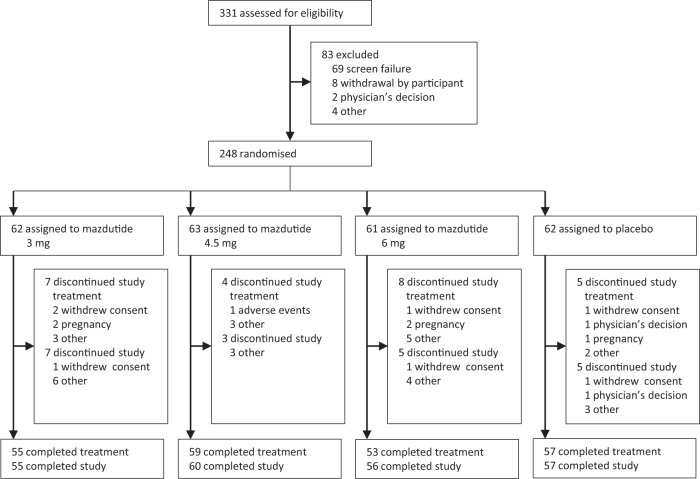
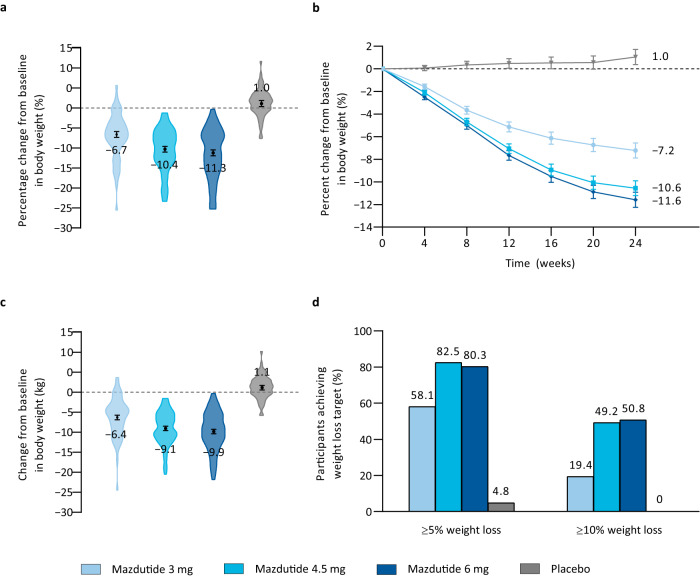
Mazdutide is a once-weekly glucagon-like peptide-1 (GLP-1) and glucagon receptor dual agonist. We evaluated the efficacy and safety of 24-week treatment of mazdutide up to 6 mg in Chinese overweight adults or adults with obesity, as an interim analysis of a randomised, two-part (low doses up to 6 mg and high dose of 9 mg), double-blind, placebo-controlled phase 2 trial (ClinicalTrials.gov, NCT04904913). Overweight adults (body-mass index [BMI] ≥24 kg/m 2 ) accompanied by hyperphagia and/or at least one obesity-related comorbidity or adults with obesity (BMI ≥ 28 kg/m 2 ) were randomly assigned (3:1:3:1:3:1) to once-weekly mazdutide 3 mg, 4.5 mg, 6 mg or matching placebo at 20 hospitals in China. The primary endpoint was the percentage change from baseline to week 24 in body weight. A total of 248 participants were randomised to mazdutide 3 mg ( n = 62), 4.5 mg ( n = 63), 6 mg ( n = 61) or placebo ( n = 62). The mean percentage changes from baseline to week 24 in body weight were −6.7% (SE 0.7) with mazdutide 3 mg, −10.4% (0.7) with 4.5 mg, −11.3% (0.7) with 6 mg and 1.0% (0.7) with placebo, with treatment difference versus placebo ranging from −7.7% to −12.3% (all p < 0.0001). All mazdutide doses were well tolerated and the most common adverse events included diarrhoea, nausea and upper respiratory tract infection. In summary, in Chinese overweight adults or adults with obesity, 24-week treatment with mazdutide up to 6 mg was safe and led to robust and clinically meaningful body weight reduction.
Overview
The claims and statistics of this paper haven’t been checked yet.
Free: it reads the open-access text and checks the first 5 claims that cite a source we can check. Create a free account to check every claim.
Integrity signals
Registry
Cites
Statistics
Figures
Verification
Claims the paper makes
The claims and statistics of this paper haven’t been checked yet.
Free: it reads the open-access text and checks the first 5 claims that cite a source we can check. Create a free account to check every claim.
Claims other papers make about this one
Each is checked against this paper’s own text: does it say what the citing paper says it does?
The cited source says what the claim attributes to it.
In the citing paper
“A phase 2 trial assessing mazdutide 3, 4.5 and 6 mg in a Chinese population with overweight/obesity demonstrates up to 11.3% WL after 24 weeks of treatment compared to 1% weight gain with placebo [70].”
From What is the pipeline for future medications for obesity? (2025) · cites this paper as [70]
The cited source says what the claim attributes to it.
In the citing paper
“Promoted weight reduction in Chinese patients with preobesity or obesity (without diabetes) in a phase 2, randomized, double-blind, placebo-controlled trial.51”
From GLP-1 single, dual, and triple receptor agonists for treating type 2 diabetes and obesity: a narrative review (2024) · cites this paper as [51]
Self-check
Percentages, sums and reported differences re-computed from the paper’s own numbers.
The self-check needs the paper’s full text.
Citations
Cites
Once-Weekly Semaglutide in Adults with Overweight or Obesity
Wilding, J. P. H., Batterham, R. L., Calanna, S., Davies, M., Van Gaal, L. F., Lingvay, I., McGowan, B. M., Rosenstock, J., Tran, M. T. D., Wadden, T. A., et al. (2021) · New England Journal of Medicine · doi:10.1056/nejmoa2032183 · Cited by 5,205 · cited 1×
“While semaglutidedemonstratedrobustbodyweightlossinpeopleofvarious ethnicity 7,15 , clinical evidence supporting the effects of GLP-1-based agents in Chinese overweight adults or adults with obesity remain limited.”
BackgroundTirzepatide Once Weekly for the Treatment of Obesity
Jastreboff, A. M., Aronne, L. J., Ahmad, N. N., Wharton, S., Connery, L., Alves, B., Kiyosue, A., Zhang, S., Liu, B., Bunck, M. C., et al. (2022) · New England Journal of Medicine · doi:10.1056/nejmoa2206038 · Cited by 3,838 · cited 1×
“Tirzepatide, a dual GLP-1 and glucose-dependent insulinotropic polypeptide receptor agonist, showed placebo-adjusted weight reductionof more than20% after 72 weeks of treatment 8 .”
BackgroundEpidemiology and determinants of obesity in China
Pan, X.-F., Wang, L., & Pan, A. (2021) · The Lancet Diabetes & Endocrinology · doi:10.1016/s2213-8587(21)00045-0 · Cited by 1,554 · cited 1×
“SinceChinesepeoplearelikelytohavehigherbodyfatcontentand higher cardiovascular risks than White people at given BMI levels, BMI cut-offs for overweight and obesity in China (24kg/m 2 for overweight and 28kg/m 2 for obesity) are lower than the WHO cut-offs 2 .”
BackgroundEuropean Practical and Patient-Centred Guidelines for Adult Obesity Management in Primary Care
Durrer Schutz, D., Busetto, L., Dicker, D., Farpour-Lambert, N., Pryke, R., Toplak, H., Widmer, D., Yumuk, V., & Schutz, Y. (2019) · Obesity Facts · doi:10.1159/000496183 · Cited by 492
Gorgojo-Martínez, J. J., Mezquita-Raya, P., Carretero-Gómez, J., Castro, A., Cebrián-Cuenca, A., de Torres-Sánchez, A., García-de-Lucas, M. D., Núñez, J., Obaya, J. C., Soler, M. J., et al. (2022) · Journal of Clinical Medicine · doi:10.3390/jcm12010145 · Cited by 358
Kadowaki, T., Isendahl, J., Khalid, U., Lee, S. Y., Nishida, T., Ogawa, W., Tobe, K., Yamauchi, T., & Lim, S. (2022) · The Lancet Diabetes & Endocrinology · doi:10.1016/s2213-8587(22)00008-0 · Cited by 330 · cited 1×
“While semaglutidedemonstratedrobustbodyweightlossinpeopleofvarious ethnicity 7,15 , clinical evidence supporting the effects of GLP-1-based agents in Chinese overweight adults or adults with obesity remain limited.”
BackgroundAmbery, P., Parker, V. E., Stumvoll, M., Posch, M. G., Heise, T., Plum-Moerschel, L., Tsai, L.-F., Robertson, D., Jain, M., Petrone, M., et al. (2018) · The Lancet · doi:10.1016/s0140-6736(18)30726-8 · Cited by 298 · cited 1×
“Indeed, a mean increase in heart rate of 5 – 15 beats per minute was associated with cotadutide 22 , SAR425899 23 , JNJ-64565111 11 , NN1177 9 , BI456906 24 and mazdutide 12,13 .”
BackgroundGarvey, W. T., Mechanick, J. I., Brett, E. M., Garber, A. J., Hurley, D. L., Jastreboff, A. M., Nadolsky, K., Pessah-Pollack, R., & Plodkowski, R. (2016) · Endocrine Practice · doi:10.4158/ep161356.esgl · Cited by 283
Clinical management and treatment of obesity in China
Zeng, Q., Li, N., Pan, X.-F., Chen, L., & Pan, A. (2021) · The Lancet Diabetes & Endocrinology · doi:10.1016/s2213-8587(21)00047-4 · Cited by 269 · cited 1×
“Waistcircumference,withhighcorrelationwithvisceraladiposity, is independently associated with cardiovascular risk 1,17 .”
BackgroundSelf-citationWeight Loss Outcomes Associated With Semaglutide Treatment for Patients With Overweight or Obesity
Ghusn, W., De la Rosa, A., Sacoto, D., Cifuentes, L., Campos, A., Feris, F., Hurtado, M. D., & Acosta, A. (2022) · JAMA Network Open · doi:10.1001/jamanetworkopen.2022.31982 · Cited by 238
Research works printed but not linked: 1
- Rosenstock J Blueher M Schmid B Hoefler J Hennige A Multiple dose-ranging study of the novel glucagon/GLP-1 receptor dual agonist BI 456906 vs placebo and open-label weekly semaglutide reference control in type 2 diabetes. in DIABETOLOGIA 2022 65 S314 S315
Cited by
What is the pipeline for future medications for obesity?
Melson, E., Ashraf, U., Papamargaritis, D., & Davies, M. J. (2025) · International Journal of Obesity · doi:10.1038/s41366-024-01473-y · Cited by 332
“A phase 2 trial assessing mazdutide 3, 4.5 and 6 mg in a Chinese population with overweight/obesity demonstrates up to 11.3% WL after 24 weeks of treatment compared to 1% weight gain with placebo [70].”
InfluentialObesity and cardiovascular disease: An ESC clinical consensus statement
Koskinas, K. C., Van Craenenbroeck, E. M., Antoniades, C., Blüher, M., Gorter, T. M., Hanssen, H., Marx, N., McDonagh, T. A., Mingrone, G., Rosengren, A., et al. (2024) · European Heart Journal · doi:10.1093/eurheartj/ehae508 · Cited by 313
GLP-1-based therapies for diabetes, obesity and beyond
Drucker, D. J. (2025) · Nature Reviews Drug Discovery · doi:10.1038/s41573-025-01183-8 · Cited by 236
Alfaris, N., Waldrop, S., Johnson, V., Boaventura, B., Kendrick, K., & Stanford, F. C. (2024) · EClinicalMedicine · doi:10.1016/j.eclinm.2024.102782 · Cited by 224
Moiz, A., Filion, K. B., Toutounchi, H., Tsoukas, M. A., Yu, O. H. Y., Peters, T. M., & Eisenberg, M. J. (2025) · Annals of Internal Medicine · doi:10.7326/annals-24-01590 · Cited by 149
“Our review included the dual agonists tirzepatide (24), JNJ-64565111 (31), mazdutide (32, 37), and sur-vodutide (33, 38) and the triple agonist retatrutide (35).”
Obesity and cardiovascular disease: an ESC clinical consensus statement
Koskinas, K. C., Craenenbroeck, E. M. V., Antoniades, C. A., Blüher, M., Gorter, T. M., Hanssen, H., Marx, N., McDonagh, T. A., Mingrone, G., Rosengren, A., et al. (2024) · European Journal of Preventive Cardiology · doi:10.1093/eurjpc/zwae279 · Cited by 149
Min, J. S., Jo, S. J., Lee, S., Kim, D. Y., Kim, D. H., Lee, C. B., & Bae, S. K. (2025) · Drug Design Development and Therapy · doi:10.2147/dddt.s506957 · Cited by 133
“205,206 Among the drugs discussed, including US FDA-approved GLP-1 RAs, tirzepatide was reported to achieve the most significant reduction in blood glucose levels.”
Transforming obesity: The advancement of multi-receptor drugs
Kusminski, C. M., Perez-Tilve, D., Müller, T. D., DiMarchi, R. D., Tschöp, M. H., & Scherer, P. E. (2024) · Cell · doi:10.1016/j.cell.2024.06.003 · Cited by 126
GLP-1 physiology in obesity and development of incretin-based drugs for chronic weight management
Holst, J. J. (2024) · Nature Metabolism · doi:10.1038/s42255-024-01113-9 · Cited by 125
“Mazdutide was well tolerated and safe and caused a weight loss of 9.5% in 16 weeks 199 in Chinese individuals with obesity or overweight, and survodutide (Boehringer Ingelheim–Zealand) resulted in dose-related weight loss of up to 17% 200 .”
InfluentialOnce-Weekly Mazdutide in Chinese Adults with Obesity or Overweight
Ji, L., Jiang, H., Bi, Y., Li, H., Tian, J., Liu, D., Zhao, Y., Qiu, W., Huang, C., Chen, L., et al. (2025) · New England Journal of Medicine · doi:10.1056/nejmoa2411528 · Cited by 125
Self-citationNauck, M. A., Tuttle, K. R., Tschöp, M. H., & Blüher, M. (2026) · The Lancet · doi:10.1016/s0140-6736(25)02105-1 · Cited by 123
Emerging pharmacotherapies for obesity: A systematic review
Kokkorakis, M., Chakhtoura, M., Rhayem, C., Al Rifai, J., Ghezzawi, M., Valenzuela-Vallejo, L., & Mantzoros, C. S. (2025) · Pharmacological Reviews · doi:10.1124/pharmrev.123.001045 · Cited by 102
Dual and Triple Incretin-Based Co-agonists: Novel Therapeutics for Obesity and Diabetes
Gutgesell, R. M., Nogueiras, R., Tschöp, M. H., & Müller, T. D. (2024) · Diabetes Therapy · doi:10.1007/s13300-024-01566-x · Cited by 61
Xie, Z., Zheng, G., Liang, Z., Li, M., Deng, W., & Cao, W. (2024) · Metabolism · doi:10.1016/j.metabol.2024.156038 · Cited by 54
Incretin-based therapies for the treatment of obesity-related diseases
Caruso, I., Cignarelli, A., Sorice, G. P., Perrini, S., & Giorgino, F. (2024) · npj Metabolic Health and Disease · doi:10.1038/s44324-024-00030-5 · Cited by 48
“Speci fi cally, the only RCT aiming to investigate the BW lowering ef fi cacy of mazdutide in patients without T2D was limited to Chinese patients and referred to different cut offs for the de fi nition of obesity (BMI ≥ 28 kg/m 2 ) 49 .”
Abdelmalek, M. F., Harrison, S. A., & Sanyal, A. J. (2024) · Diabetes Obesity and Metabolism · doi:10.1111/dom.15524 · Cited by 48
Winther, J. B., & Holst, J. J. (2024) · Diabetes, Obesity and Metabolism · doi:10.1111/dom.15693 · Cited by 47
Madsbad, S., & Holst, J. J. (2025) · Expert Opinion on Investigational Drugs · doi:10.1080/13543784.2025.2472408 · Cited by 43
“In a phase 2 randomized trial with 248 participants (BMI 31.8 kg/m2, 90 kg), the weight loss after 24 weeks with 3 mg was − 6.7%, with 4.5 mg −10.4%, with 6 mg −11.3%, and + 1% with placebo (Table 4) [112].”
InfluentialNovel GLP-1-based Medications for Type 2 Diabetes and Obesity
Son, J. W., le Roux, C. W., Blüher, M., Nauck, M. A., & Lim, S. (2026) · Endocrine Reviews · doi:10.1210/endrev/bnaf036 · Cited by 40
Buckeridge, C., Cobain, S., Bays, H. E., Matsuoka, O., Fukushima, Y., Halstead, P., Tsamandouras, N., Sherry, N., Gorman, D. N., & Saxena, A. R. (2025) · Diabetes Obesity and Metabolism · doi:10.1111/dom.16534 · Cited by 39
Nalisa, D. L., Cuboia, N., Dyab, E., Jackson, I. L., Felix, H. J., Shoki, P., Mubiana, M., Oyedeji-Amusa, M., Azevedo, L., & Jiang, H. (2024) · Frontiers in Endocrinology · doi:10.3389/fendo.2024.1309118 · Cited by 31
Self-citationJiang, Y., Zhu, H., & Gong, F. (2024) · Diabetes Obesity and Metabolism · doi:10.1111/dom.16106 · Cited by 37
“11,98 Survodutide (BI 456906) is a 29-amino-acid peptide optimized to balance the degree of agonism for the human GCG receptor and GLP-1 receptor by introducing various modifications to the human GCG sequence.”
Ji, L., Gao, L., Xue, H., Tian, J., Wang, K., Jiang, H., Huang, C., Lian, Q., Yuan, M., Gao, G., et al. (2025) · The Lancet Diabetes & Endocrinology · doi:10.1016/s2213-8587(25)00141-x · Cited by 35
Self-citationLiu, Z., Yu, S., Jin, X., Sheng, L., Rouzi, M. R. Y., Gao, J., Lü, J., & Lei, T. (2025) · Drug Design Development and Therapy · doi:10.2147/dddt.s559919 · Cited by 35
Recent achievements and future directions of anti-obesity medications
Grandl, G., Novikoff, A., Liu, X., & Müller, T. D. (2024) · The Lancet Regional Health - Europe · doi:10.1016/j.lanepe.2024.101100 · Cited by 33
Dong, W., Bai, J., Yuan, Q., Zhang, Y., Zhang, Y., Zhang, Z., Yang, M., Li, H., Zhao, Z., & Jiang, H. (2025) · EBioMedicine · doi:10.1016/j.ebiom.2025.105791 · Cited by 32
Self-citationPharmacotherapy for Obesity: Recent Updates
Fredrick, T. W., Camilleri, M., & Acosta, A. J. (2025) · Clinical Pharmacology Advances and Applications · doi:10.2147/cpaa.s497904 · Cited by 33
Evolving Approaches for Pharmacological Therapy of Obesity
Chao, A. M., Taylor, S. I., Moore, M., Amaro, A., & Wadden, T. A. (2024) · The Annual Review of Pharmacology and Toxicology · doi:10.1146/annurev-pharmtox-031124-101146 · Cited by 30
Anastasiou, I. A., Argyrakopoulou, G., Dalamaga, Μ., & Kokkinos, A. D. (2025) · Current Obesity Reports · doi:10.1007/s13679-025-00623-1 · Cited by 29
“Improved cardiometabolic risk factors vs placebo were observed after 24 weeks [123].”
Muzurović, E. M., Katsiki, N., Volčanšek, Š., Plescia, F., Rizzo, M., & Mantzoros, C. S. (2026) · Metabolism · doi:10.1016/j.metabol.2026.156494 · Cited by 25
Strategies to Improve the Lipophilicity of Hydrophilic Macromolecular Drugs
Lindner, S., Keim, S., Haddadzadegan, S., Romero, O. F., Zöller, K., Stern, G., Cesi, I., Kafedjiiski, K., & Bernkop‐Schnürch, A. (2025) · Advanced Healthcare Materials · doi:10.1002/adhm.202503721 · Cited by 24
Chetty, A. K., Rafi, E., Bellini, N. J., Buchholz, N., & Isaacs, D. M. (2023) · Endocrine Practice · doi:10.1016/j.eprac.2023.12.010 · Cited by 23
Proglucagon-derived peptides: human physiology and therapeutic potential
Gasbjerg, L. S., Nielsen, C. K., Suppli, M. P., Grøndahl, M. F. G., Holst, J. J., Knop, F. K., Jeppesen, P. B., & Lund, A. (2025) · Physiological Reviews · doi:10.1152/physrev.00057.2024 · Cited by 22
Finan, B., Douros, J. D., Goldwater, R., Hansen, A. M. K., Hjerpsted, J., Hjøllund, K. R., Kankam, M. K., Knerr, P. J., Konkar, A. A., Mowery, S. A., et al. (2025) · Molecular Metabolism · doi:10.1016/j.molmet.2025.102129 · Cited by 21
“JNJ-64565111 showed signi fi cant weight reduction but no improvement in glycemic parameters, while cotadutide demonstrated signi fi cant reductions in both body weight and HbA 1c vs placebo in individuals with T2D and overweight or obesity [14,16,19].”
The effects of anti‐obesity medications on bone metabolism: A critical appraisal
Anastasilakis, A. D., Paccou, J., Palermo, A., & Pοlyzos, S. A. (2025) · Diabetes Obesity and Metabolism · doi:10.1111/dom.16541 · Cited by 21
“89”
Wulff, B. S., Chambers, A. P., Contreras, C. K. O., Kirkeby, K., Rinnov, A. R., Sustarsic, R. K., Østergaard, S., Laabs, J. E., & O'Neil, P. M. (2025) · Obesity · doi:10.1002/oby.24329 · Cited by 19
Król, M., Kupnicka, P., Żychowska, J., Kapczuk, P., Szućko-Kociuba, I., Prajwos, E., & Chlubek, D. (2025) · International Journal of Molecular Sciences · doi:10.3390/ijms26146777 · Cited by 19
“In clinical trials, investigational drugs include Icosema [42,43], Mazdutide [44,45], Orfor-glipron [46], Cagrisema [46,47], Retatrutide [48], Survodutide [49], and TG103 [50].”
The evolving landscape of obesity pharmacotherapy
Petersen, J., Finan, B., Johansen, V. B. I., Müller, T. D., & Clemmensen, C. (2026) · Nature Reviews Drug Discovery · doi:10.1038/s41573-026-01427-1 · Cited by 22
“In a phase II trial, weekly doses of up to 6.0 mg induced a placebo-adjusted weight loss of 12.4% over 24 weeks of treatment 160 .”
InfluentialDeng, B., Ruan, T., Lu, W., Ying, J., Li, S., Zhou, R., & Mu, D. (2024) · Endocrine · doi:10.1007/s12020-024-03857-6 · Cited by 19
Obesity phenotypes and atherogenic dyslipidemias
Choe, H. J., Almas, T., Neeland, I. J., Lim, S. K., & Després, J. (2025) · European Journal of Clinical Investigation · doi:10.1111/eci.70151 · Cited by 18
Recent progress in the pharmacotherapy for obesity
Lu, J., Liu, P., Cai, M., Lv, T., Zhang, M., Yin, K., Cheng, J., & Zhang, G. (2025) · European Journal of Pharmacology · doi:10.1016/j.ejphar.2025.177850 · Cited by 17
Weight Loss Blockbuster Development: A Role for Unimolecular Polypharmacology
Zhou, Q., Li, G., Hang, K., Li, J., Yang, D., & Wang, M. (2024) · The Annual Review of Pharmacology and Toxicology · doi:10.1146/annurev-pharmtox-061324-011832 · Cited by 16
Mazdutide reduces body weight in adults with overweight or obesity: A high‐dose Phase 1 trial
Bhattachar, S., Tham, L. S., Yan, L., Chua, L., Ng, S., Tang, Y., Ibriga, H., Ni, W., Gurbuz, S., Mather, K. J., et al. (2025) · Diabetes Obesity and Metabolism · doi:10.1111/dom.70040 · Cited by 15
Shirley, M. (2025) · Drugs · doi:10.1007/s40265-025-02249-y · Cited by 15
Adipose Tissue, at the Core of the Action of Incretin and Glucagon-Based Anti-Obesity Drugs
Villarroya, F., Peyrou, M., & Giralt, M. (2025) · Current Obesity Reports · doi:10.1007/s13679-025-00660-w · Cited by 15
“Some of these co-agonists have moved into clinical development, where they yield notable improvements in body weight and often improved comor - bidities such as hypertension [90 ] or metabolic dysfunc-tion-associated steatohepatitis [91].”
Li, X., Chen, Z., Zhang, Y., Fan, C., Chen, L., Xu, X., Chang, J., Qiang, W., Jiang, H., & Liu, C. (2025) · Frontiers in Endocrinology · doi:10.3389/fendo.2025.1722245 · Cited by 13
“The results showed that Mazdutide at doses of 3 – 6 mg could signi fi cantly reduce the SUA level after 24 weeks of intervention, and the level decreased by an average of 48.6-72.6 m mol/L compared with the placebo group, which was statistically signi fi cant (78).”
InfluentialSelf-citationOxyntomodulin - past, present and future
Holst, J. J., & ROSENKILDE, M. M. (2025) · Peptides · doi:10.1016/j.peptides.2025.171393 · Cited by 12
“Side effects included diarrhea, nausea and upper respiratory tract infections [66].”
A Mechanistic Rationale for Incretin-Based Therapeutics in the Management of Obesity
Samms, R. J., & Kusminski, C. M. (2024) · Annual Review of Physiology · doi:10.1146/annurev-physiol-022724-105443 · Cited by 12
Alqatari, S. G., Alwaheed, A., Hasan, M. A., Argan, R. A., Alabdullah, M. M., & Shubbar, M. D. A. (2025) · Medicina · doi:10.3390/medicina61071292 · Cited by 11
“…cholesterol, LDL and triglycerides [54] ~14% by week 48 [55] Phase 3 trial [55] Subcutaneous,4–6mg,once weekly Dual GLP-1 and GIP receptor agonist [30] Tirzepatide Reduces blood glucose levels [33] Reduces systolic blood pressure, circulating lipid levels, and waist circumference [33,34] Reduces…”
InfluentialStachteas, P., Nasoufidou, A., Karakasis, P., Koiliari, M., Karagiannidis, E., Koufakis, T., Fragakis, N., & Patoulias, D. (2025) · Reviews in Cardiovascular Medicine · doi:10.31083/rcm39691 · Cited by 11
“In contrast, mazdutide was reportedly well-tolerated across all dosing regimens, although apart from the expected GI symptoms, a higher incidence of upper respiratory tract infections was observed [47].”
InfluentialZhou, Y., Tu, L., Wang, X., Xu, J., Xu, S., Ning, X., Xiong, X., & Zheng, N. (2025) · Journal of Medicinal Chemistry · doi:10.1021/acs.jmedchem.5c01399 · Cited by 10
Luo, Y., Jiang, H., Shi, B., Cai, H., Wang, H., Li, S., Qiu, W., Li, Y., Zhou, R., Deng, H., et al. (2025) · Contemporary Clinical Trials · doi:10.1016/j.cct.2025.108150 · Cited by 10
Self-citationKim, M.-K., & Kim, H. S. (2024) · Biomolecules & Therapeutics · doi:10.4062/biomolther.2024.228 · Cited by 10
Cazac, G.-D., Lăcătușu, C.-M., Grigorescu, E.-D., Foșălău, A.-B., Onofriescu, A., & Mihai, B. M. (2025) · Journal of Clinical Medicine · doi:10.3390/jcm14041042 · Cited by 10
“…the significant weight loss effect demonstrated by the GLORY-1 study (NCT05607680), maz-dutide has been shown to counteract the hyperglycemia induced by GCGR activation by adequately balancing the effects of GLP-1R and GCGR activation, overall reducing HbA1c levels and fasting glucose [102,103].”
Welling, M. S., van Rossum, E. F. C., & van den Akker, E. L. T. (2025) · Endocrine Reviews · doi:10.1210/endrev/bnaf004 · Cited by 9
Focus on Glucagon-like Peptide-1 Target: Drugs Approved or Designed to Treat Obesity
Zhang, J., Wei, J., Lai, W., Sun, J., Bai, Y., Cao, H., Guo, J., & Su, Z. (2025) · International Journal of Molecular Sciences · doi:10.3390/ijms26041651 · Cited by 9
“The GLP-1 and GCG double-receptor agonist, Mazdutide, was found to be effective in reducing body weight and improving blood glucose [57].”
Obesity care in Chinese adults: from evidence to clinical practice
An, J., Jia, Q., Huang, Y., Cao, Y., Duan, Y., Zhang, H., & Li, S. (2025) · Precision Clinical Medicine · doi:10.1093/pcmedi/pbaf036 · Cited by 9
“Mazdu-tide, a once-weekly glucagon-like peptide-1 (GLP-1) and glucagon receptor dual agonist, demonstrated good safety and clinically meaningful body weight reduction in Chinese adults with over-weight and obesity ( − 11.3% compared with 1% in placebo) [ 52 ].”
InfluentialGao, L., Jiang, H. X., Cai, H., Tian, J., Shi, B., Qiu, W., Huang, C., Han, J., Suhe, Z., Pang, S., et al. (2026) · JAMA · doi:10.1001/jama.2026.8142 · Cited by 10
Self-citationNutrient-Stimulating Hormone-Based Therapies for Obesity
Cristancho, C., Kim, D. W., & Apovian, C. M. (2024) · Endocrinology and Metabolism Clinics of North America · doi:10.1016/j.ecl.2024.10.006 · Cited by 8
Park, C., Kim, Y., Raygani, S., & Grunvald, E. L. (2025) · Frontiers in Endocrinology · doi:10.3389/fendo.2025.1630199 · Cited by 7
Hu, Z., Tian, D., Yang, Z., Zhang, J., Zhang, L., Xu, Y., & Lu, X. (2026) · Frontiers in Pharmacology · doi:10.3389/fphar.2026.1754721 · Cited by 7
“The Mazdutide trial also demonstrated that dual agonists could reduce hepatic fat in obese Chinese patients (Ji et al., 2023).”
Self-citationInnovative Glucagon-based Therapies for Obesity
Belay, K. E., Jemal, R. H., & Tuyizere, A. (2024) · Journal of the Endocrine Society · doi:10.1210/jendso/bvae197 · Cited by 8
Camilleri, M. (2024) · The Journal of Physiology · doi:10.1113/jp287535 · Cited by 7
“Dose-related gastrointestinal symptoms (nausea in average 30% and vomiting in average 20% across three dose groups) were mild or moderate in severity, and were more frequent during dose escalation (Ji et al., 2023) Combination of GLP-1RA and GIP-RA.”
Alavi, S. E., Boshrouyeh, R., Raza, A., & Shahmabadi, H. E. (2026) · European Journal of Medicinal Chemistry · doi:10.1016/j.ejmech.2026.118587 · Cited by 6
Incretin-based Agents and Metabolic Dysfunction-associated Steatotic Liver Disease
Muzurović, E. M., Haluzík, M., Horváth, L., Vlacho, B., & Mauricio, D. (2025) · Current Pharmaceutical Design · doi:10.2174/0113816128378484250619080753 · Cited by 5
Hu, W., Gu, M., Li, H., Li, H., Kan, J., Zhang, L., Ding, Q., & Zhu, Y. Z. (2026) · Pharmacological Reviews · doi:10.1016/j.pharmr.2026.100125 · Cited by 5
Self-citationAhmed, I. S., Tapponi, S. L., Manaa, H. M., Soltani, A., Hussein, E. S., Parvaresh, F. A., & Hussain, Z. (2026) · Journal of Obesity · doi:10.1155/jobe/6556057 · Cited by 5
Innovative approaches to the treatment of obesity: from pharmacotherapy to nanomedicine
Romantsova, T. I. (2024) · Obesity and metabolism · doi:10.14341/omet13184 · Cited by 6
Azam, M. H., Azam, M. H., Azam, K., Azam, M. A., Afridi, M. K., Waqas, S. A., Abbas, M. S., Aminpoor, H., & Ahmed, R. (2026) · Diabetes Obesity and Metabolism · doi:10.1111/dom.70643 · Cited by 4
“For waist circumference, three studies were low risk [2, 10, 11], while Ji et al. [14] had concerns in domain 5 for not including waist circumference in their protocol (NCT04904913).”
Ji, L., Jiang, H., Cheng, Z., Li, X., Pang, S., Zhang, Y., Qiu, W., MA, Q., Liu, Z., Wang, Y., et al. (2026) · Med · doi:10.1016/j.medj.2026.101063 · Cited by 4
Self-citationAbulehia, A., Ayesh, H., Ayesh, O., Jaber, D., Asad, T., Itbaisha, A., Abugharbieh, H., Gharbia, R., Abu‐Hilal, L. H., & Leon, B. G. C. (2026) · Endocrinology, Diabetes & Metabolism · doi:10.1002/edm2.70187 · Cited by 3
Larsen, A. T., Melander, S. A., Mohamed, K. E., Petersen, E. A., Benmarce, M., Karsdal, M. A., & Henriksen, K. (2025) · Biomedicine & Pharmacotherapy · doi:10.1016/j.biopha.2025.118388 · Cited by 3
GLP ‐1 Receptor Agonists for Treating Alcohol Use Disorder: A Critical Review
Woo, S., Zhu, G., Castro, C., Phuong, A., Roy, A., Davis, C. N., & Kranzler, H. R. (2026) · Alcoholism Clinical and Experimental Research · doi:10.1111/acer.70312 · Cited by 3
“Mazdutide (a GLP-1 and glucagon dual agonist) produced dose-dependent mean reductions in body weight from baseline to end of treatment in a 24-week, phase 2 clinical trial in 248 patients with overweight or obesity and without T2D (Ji et al. 2023).”
Ayesh, H., Ayesh, S. K., & Niswender, K. D. (2024) · American Journal of Therapeutics · doi:10.1097/mjt.0000000000001756 · Cited by 3
Peptide therapy: new promising therapeutics for acute kidney injury
Hao, H., Bao, F., Wang, Y., Li, N., & Gong, Y. (2025) · Drug Discovery Today · doi:10.1016/j.drudis.2025.104377 · Cited by 3
Self-citationEffects of Tobacco Use on the Macrostructure and Microstructure of Sleep in Patients with OSA
Ji, W., Shi, L., Ji, Z., Zhao, Z., Lin, L., Wang, X., Cheng, J., & Chen, X. (2024) · Nature and Science of Sleep · doi:10.2147/nss.s480116 · Cited by 3
Salagre, D., Mosqueda, C. V. A., Aouichat, S., & Agil, A. (2025) · Pharmaceuticals · doi:10.3390/ph18091247 · Cited by 2
“…particularly in people with related metabolic conditions [120]. have shown encouraging outcomes in promoting weight loss, reducing body mass index, waist circumference, and food intake, increasing energy expenditure, and improving glycemic control in obese and/or overweight subjects [123].”
Kurnikova, I., Chernikova, N. A., Борисовна, З. Н., Ametov, A. S., Dorofeev, A. V., & Ivanova, K. O. (2025) · Endocrinology News Opinions Training · doi:10.33029/2304-9529-2025-14-2-20-28 · Cited by 2
Chan, Z. H., Omar, A. S., Gill, K., Volucke, G., Azhar, M. M., Haleem, S. M., Sia, J. E., Rahman, O. U., Ahmad, M., Shahid, N., et al. (2026) · Cardiology in Review · doi:10.1097/crd.0000000000001209 · Cited by 2
Gan, L., Duan, L., & Zheng, X. (2026) · Pharmaceuticals · doi:10.3390/ph19030371 · Cited by 2
“Mazdutide’s dual-target pharmacology confers superior efficacy compared to single-target GLP-1 agonists in weight reduction, insulin resistance improvement, and lipid metabolism normalization [18–20].”
Ji, L., Gao, L., Dong, R., Yuan, M., Zhao, D., Pang, S., Zhao, J., Zhao, L., & Chen, W. (2026) · Cell Reports Medicine · doi:10.1016/j.xcrm.2026.102743 · Cited by 2
Self-citationAhuja, A., Prasad, S., Manoharan, S., Sen, A., Rana, R., Mody, M., Paras, F., Archita, A., Shaik, S., Mehta, K., et al. (2026) · Cardiovascular Diabetology – Endocrinology Reports · doi:10.1186/s40842-026-00311-6 · Cited by 2
“Across all four included RCTs, URTI rates were consistently reported but occurred at rates comparable to comparator arms without statistically significant excess risk attributable to GLP-1 RA exposure [3, 6, 7, 14].”
InfluentialGLP-1-based combination strategies for weight loss: Multi-target agents and combination therapies
Wang, X., Lin, R., Sun, Q., Xin, X., & Feng, Q. (2026) · Pharmacological Research · doi:10.1016/j.phrs.2026.108331 · Cited by 2
Kushner, P. R., & Michos, E. D. (2026) · Journal of the American Heart Association · doi:10.1161/jaha.126.049727 · Cited by 3
Metformin induces diarrhea in mice under over-eating conditions
Chikama, K., Takemori, H., Mizoguchi, M., Furukawa, S., Terada, K., Ito, M., Hirano, H., Miura, T., Doi, K., Horiya, M., et al. (2025) · Diabetology International · doi:10.1007/s13340-025-00822-0 · Cited by 1
Kaufmann, D., & Schlesinger, N. (2025) · Pharmaceutics · doi:10.3390/pharmaceutics17070865 · Cited by 1
“A randomized, double-blind, placebo-controlled phase 2 study evaluated 24-week administration of mazdutide (3, 4.5, and 6 mg/week) in overweight and obese adults (n = 248) [90].”
InfluentialCheng, W., Chen, Z., Li, P., Zhang, Y., Ma, Y., Liu, P., & Jiang, H. (2025) · Frontiers in Endocrinology · doi:10.3389/fendo.2025.1654506 · Cited by 1
“…blood glucose levels and body weight but also signi fi cantly improves lipid pro fi les, blood pressure, and serum uric acid concentrations, thereby offering a promising therapeutic avenue for the comprehensive management of obesity, type 2 diabetes mellitus (T2DM), and hyperuricemia (10 – 14).”
Self-citationJia, Q., Wang, Y., Li, J., & Gao, Z. (2025) · International Journal of Biology and Life Sciences · doi:10.54097/9576k069 · Cited by 1
Self-citationFasi, M. A. (2026) · Expert Opinion on Therapeutic Patents · doi:10.1080/13543776.2026.2645812 · Cited by 1
“Serious adverse events were rare, and no new safety concerns emerged across trials [18].”
Acute Contractile Effects of Glucagon-like-Peptide-1 Receptor Agonists in the Human Heart
Neumann, J., Kirchhefer, U., Hofmann, B., & Gergs, U. (2026) · Pharmaceutics · doi:10.3390/pharmaceutics18040447 · Cited by 1
“Moreover, mazdutide reduced systolic and diastolic blood pressure [134].”
Next-generation anti-obesity drugs: Mechanisms, molecules, and momentum
Mukheja, Y., Kondepudi, K. K., Chopra, K., & Bishnoi, M. (2026) · Obesity Medicine · doi:10.1016/j.obmed.2026.100701 · Cited by 1
Impact of incretin analogues on lipid and lipoprotein metabolism in obesity and diabetes
Baragetti, A., & Norata, G. D. (2026) · British Journal of Pharmacology · doi:10.1111/bph.70483 · Cited by 2
Xie, J., Yang, Y., Chen, W., (45927), L. W., Weng, S., Lyu, Q., & Cao, G. (2026) · Current Obesity Reports · doi:10.1007/s13679-026-00722-7 · Cited by 1
Patil, M., Piccinini, F., Johnstone, E. K. M., Casari, I., & Falasca, M. (2026) · Bioscience Reports · doi:10.1042/bsr20250114 · Cited by 1
“Among participants with overweight or obesity without diabetes ( n = 248), a 24-week randomised, double-blind, placebo-controlled Phase-2 study (NCT04904913) revealed dose-dependent body-weight reductions of 6.7% (3 mg), 10.4% (4.5 mg), and 11.3% (6 mg) [146].”
InfluentialKamrul-Hasan, A. B. M., Chatterjee, S., Ashraf, H., Nagendra, L., Khalil, I., Hasan, M., Ahsan, A., & Dutta, D. (2026) · Diabetes Obesity and Metabolism · doi:10.1111/dom.71058 · Cited by 1
“Among the 9 included RCTs, four were phase 1 trials [25, 27, 28, 31], two were phase 2 trials [29, 32], and three were phase 3 trials [26, 30, 33] Five trials were conducted among subjects with overweight or obesity but without DM [25, 27–30], whereas four [26, 31–33] included subjects with T2D.”
InfluentialHsia, S. H., Bays, H. E., Billings, L. K., Weideman, A. M., Mather, K. J., Coşkun, T., Haupt, A., Thomas, M. K., Tham, L. S., Calderón, B., et al. (2026) · The Lancet Diabetes & Endocrinology · doi:10.1016/s2213-8587(26)00160-9 · Cited by 1
Zhou, Z., Cheng, Z., Jin, P., Yang, G., Wang, H., Shi, B., Dong, Q., Shi, X., Shi, X., Shu, H., et al. (2026) · Cell Metabolism · doi:10.1016/j.cmet.2026.09.021 · Cited by 1
Self-citationMoiz, A., Filion, K. B., Samuels, A. E., Tsoukas, M. A., Yu, O. H. Y., Peters, T. M., & Eisenberg, M. J. (2026) · Annals of Internal Medicine · doi:10.7326/annals-25-05519
당뇨병 치료의 진화: 관해를 향해가는 혁신적 약물치료와 첨단 관리기기의 결합
Choi, J. H., & Moon, M. K. (2024) · Public Health Weekly Report · doi:10.56786/phwr.2024.17.44.4
Multi‐target Peptides for the Treatment of Metabolic Diseases
Bossart, M., & Heßler, G. (2024) · Wiley eBooks · doi:10.1002/9781394182862.ch20
Metadata
- Authors
- Ji, L., Jiang, H., Cheng, Z., Qiu, W., Liao, L., Zhang, Y., Li, X., Pang, S., Zhang, L., Chen, L., Yang, T., Li, Y., Qu, S., Wen, J., Gu, J., Deng, H., Wang, Y., Li, L., Han-Zhang, H., Ma, Q., & Qian, L.
- Affiliations
- Peking University People's Hospital (CN)
- Henan University of Science and Technology (CN)
- Harbin Medical University (CN)
- Huzhou Central Hospital (CN)
- Shandong Provincial QianFoShan Hospital (CN)
- Jiangxi Pingxiang People's Hospital (CN)
- First Affiliated Hospital of Bengbu Medical College (CN)
- Jinan Central Hospital (CN)
- Second Hospital of Hebei Medical University (CN)
- Tianjin Medical University (CN)
- Jiangsu Province Hospital (CN)
- Tongji University (CN)
- Innovent Biologics (China) (CN)
- Corresponding author
- Ji, Linong
- Qian, Lei
- ORCID
- Venue
- Nature Communications
- Published
- 2023-12-14
- Volume
- 14
- Issue
- 1
- Pages
- 8289-8289
- ISSN
- 2041-1723 (ISSN-L)
- PMC
- PMC10719339
- OpenAlex
- W4389741339
- Semantic Scholar
- b3c56f728da21c2fa97933ee8889d0d4460add2e
- Cited by
- 118
- References
- 22
- Citations by year
- 2026: 42 · 2025: 47 · 2024: 28 · 2023: 1
- FWCI
- 18.31
- Type
- journal article
- Language
- en
- Open access
- gold
- doi.org
- Licence
- cc-by
- creativecommons.org/licenses/by/4.0 (tdm)
- creativecommons.org/licenses/by/4.0 (vor)
- Locations
- Nature Communications (publishedVersion, cc-by)
- PubMed Central (publishedVersion, cc-by)
- PubMed (publishedVersion)
- RePEc: Research Papers in Economics (submittedVersion)
- DOAJ (DOAJ: Directory of Open Access Journals) (submittedVersion, cc-by-sa)
- Funders
- Innovent Biologics, Inc.
- Topics
- Health Sciences › Medicine › Pharmacology (medical) › Pharmacology and Obesity Treatment
- Health Sciences › Medicine › Endocrinology, Diabetes and Metabolism › Diabetes Treatment and Management
- Life Sciences › Neuroscience › Endocrine and Autonomic Systems › Regulation of Appetite and Obesity
- Keywords
- mazdutide, GLP-1 receptor agonists, glucagon receptor agonist, dual agonist, obesity, overweight, weight loss, hyperphagia, obesity-related comorbidities, drug safety, Chinese adults
- MeSH terms
- Adult, Body Weight, Diabetes Mellitus, Type 2, Double-Blind Method, Humans, Hypoglycemic Agents, Obesity, Peptides, Treatment Outcome, Overweight, Glucagon-Like Peptide 1
About these checks
Registry, retraction, Cites and statistics results are computed, not judged, with one exception: a printed reference that no index lists is read once by a model before it counts as a citation error. Claims are extracted by a model and kept only when their quote appears verbatim in the text; each cited source is then checked, with a model’s help, for whether it says what the claim relies on. Those verdicts can be wrong — read the claim’s quote and the cited source before relying on one.
Statistics and arithmetic are recomputed, not judged.
Confidence bands are shown only for fields calibrated on our annotated test set. None is calibrated yet, so no band is shown.
What counts as a claim ›How we measure confidence ›How we check this ›
Are you an author, or do you see a problem with this page? Request a review
Data sources
Bibliographic data: Semantic Scholar, OpenAlex, Crossref.
Contains information from the Semantic Scholar Academic Graph Datasets, made available under the ODC Attribution License (ODC-BY 1.0).
Semantic Scholar’s data is described in: Kinney, R., et al. (2023). The Semantic Scholar Open Data Platform. arXiv:2301.10140.
