

The DOI matches its Crossref record; 50 of the 53 references it cites were found in a registry or an index; 31 of the 40 sources its claims cite were checked for support.
Autonomous artificial intelligence increases screening and follow-up for diabetic retinopathy in youth: the ACCESS randomized control trial
Open accessAbstract
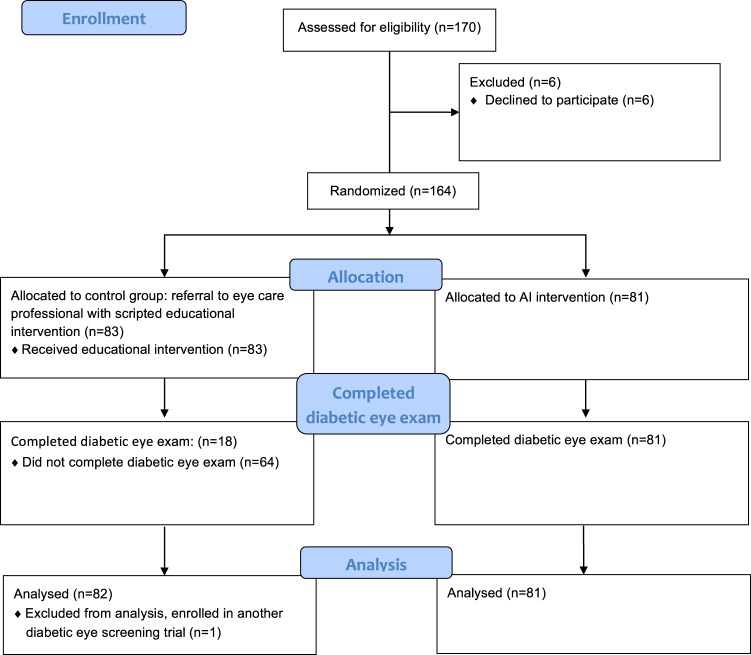
Diabetic retinopathy can be prevented with screening and early detection. We hypothesized that autonomous artificial intelligence (AI) diabetic eye exams at the point-of-care would increase diabetic eye exam completion rates in a racially and ethnically diverse youth population. AI for Children’s diabetiC Eye ExamS (NCT05131451) is a parallel randomized controlled trial that randomized youth (ages 8-21 years) with type 1 and type 2 diabetes to intervention (autonomous artificial intelligence diabetic eye exam at the point of care), or control (scripted eye care provider referral and education) in an academic pediatric diabetes center. The primary outcome was diabetic eye exam completion rate within 6 months. The secondary outcome was the proportion of participants who completed follow-through with an eye care provider if deemed appropriate. Diabetic eye exam completion rate was significantly higher (100%, 95%CI: 95.5%, 100%) in the intervention group ( n = 81) than the control group ( n = 83) (22%, 95%CI: 14.2%, 32.4%)(p < 0.001). In the intervention arm, 25/81 participants had an abnormal result, of whom 64% (16/25) completed follow-through with an eye care provider, compared to 22% in the control arm (p < 0.001). Autonomous AI increases diabetic eye exam completion rates in youth with diabetes.
Overview
AI snapshot
Written from the paper’s full text.
TL;DR
In the ACCESS randomized controlled trial, point-of-care autonomous AI diabetic eye exams achieved 100% diabetic eye exam completion in youth with diabetes versus 22% with scripted eye care provider referral and education. AI also increased follow-through with an eye care provider among those with an abnormal result (64% vs 22%).
Key findings
- Primary outcome: diabetic eye exam completion within 6 months was 100% (95% CI 95.5%, 100%) in the AI arm (n = 81) versus 22% (95% CI 14.2%, 32.4%) in the control arm (n = 83) (p < 0.001); the between-group difference was 78% (95% CI 69%, 87%).
- Secondary outcome: in the AI arm, 25/81 participants had an abnormal “DED present” result, and 16/25 (64%, 95% CI 43%, 81%) completed follow-through with an eye care provider, compared with 22% (95% CI 14%, 32%) in the control arm (p < 0.001); the difference was 42% (95% CI 21%, 63%).
- Retina specialist review of AI images showed estimated sensitivity of 100% and specificity of 78.9%.
- Satisfaction was high: 96% were satisfied with the overall experience, 92.5% with exam length, and 85% of intervention participants said they would choose AI-based eye exams in the future versus 57% for ECP-based exams.
Methods
- Design: pre-registered, hypothesis-driven, prospective parallel randomized controlled trial with 1:1 allocation, conducted at Johns Hopkins Pediatric Diabetes Center at two sites in Baltimore, Maryland; participants enrolled November 24, 2021 through June 6, 2022, with follow-up completed by December 6, 2022.
- Participants: youth with type 1 diabetes (11–21 years) or type 2 diabetes (8–21 years) eligible for diabetic eye disease screening per ADA 2021 guidelines, no known DED, and no diabetic eye exam within the last 6 months; 164 participants randomized (81 intervention, 83 control).
- Intervention and comparator: intervention arm received a 5–10 minute autonomous AI diabetic eye exam without pharmacologic dilation (IDx-DR, Digital Diagnostics); control arm received scripted education and referral to an eye care provider. Primary outcome was documented diabetic eye exam completion within 6 months; secondary outcome was follow-through with an eye care provider. Analysis used Pearson’s chi-squared tests, Wilcoxon rank-sum tests, and two-sample t-tests; sample size of 164 provided 80% power for a 20% difference.
Limitations
- Stated: the autonomous AI used is not FDA-cleared for ages 21 and under, though prior work showed low risk of false negatives; some participants were familiar with autonomous AI from a prior study and may have been more accepting of participation; pharmacologic dilation was not used in this pediatric population, which may not apply to adults where real-world studies show higher rates of insufficient images without dilation.
- Stated: the follow-through disparity analysis comparing those who did and did not complete follow-up after “DED present” was a small subgroup and not statistically significant.
- Evident from the text: the secondary outcome assumes control-arm patients who arrive at an eye care provider for screening remain there for management or treatment if found to have DED; one control participant was excluded from the primary outcome table after being inadvertently enrolled in another eye screening study.
Model-written summary. Check it against the paper before relying on it.
Integrity signals
Registry
Cites
Statistics
Figures
Verification
Claims the paper makes
22 Own method · 17 Own result · 13 Partly supported · 8 Own interpretation · 4 Couldn’t confirm · 4 No basis given · 3 Supported · 2 Sources not found · 1 Not supported · 1 No full text of the sources · accuracy not yet measured
Every source the paper cites for this claim was checked and supports it.
In the paper
“though we showed in a previous study that the risk of false negatives is low30.”
§ Autonomous artificial intelligence increases screening and follow-up for diabetic retinopathy in youth: the ACCESS randomized control trial > Discussion
What the sources say
- Supportedcites [30] Wolf, R. M. et al. The SEE Study: safety, efficacy, and equity of implementing autonomous artificial intelligence for diagnosing diabetic retinopathy in youth. Diabetes Care 44, 781–787 (2021). source
The Conclusions state that false negatives with autonomous AI were much fewer than with the clinician standard-of-care exam. They also say that, in this pediatric sample, the low prevalence of severe retinopathy made a missed vision-threatening case highly unlikely. (LLM, conf=0.90)
plain- Asserted: passes — The authors put it forward as true.
- Checkable: passes — It can be checked against evidence.
- Load-bearing: unclear — It is unclear whether the paper’s conclusions depend on it.
- Based: passes — The paper gives a reason why it holds.
- Supported
The cited sources that could be checked couldn’t confirm or dispute this claim.
In the paper
“A retina specialist review of the AI images (a level 4 reference standard) demonstrated an estimated sensitivity of 100% and specificity of 78.9%33.”
§ Autonomous artificial intelligence increases screening and follow-up for diabetic retinopathy in youth: the ACCESS randomized control trial > Results > Secondary outcomes
What the sources say
- Could not verifycites [33] Abràmoff, M. D. et al. Foundational considerations for artificial intelligence using ophthalmic images. Ophthalmology 129, e14–e32 (2022). sourceExperimental — accuracy not yet measured
The Validation of the Artificial Intelligence System and Nonmaleficence section discusses reference-standard levels I–IV and sensitivity and specificity in general. It does not report a retina specialist review of AI images or the claimed estimates of 100% sensitivity and 78.9% specificity (searched those figures and the review description). (LLM, conf=0.75)
hedged- Asserted: passes — The authors put it forward as true.
- Checkable: passes — It can be checked against evidence.
- Load-bearing: unclear — It is unclear whether the paper’s conclusions depend on it.
- Based: passes — The paper gives a reason why it holds.
- Could not verify
The cited sources support only part of this claim — read each source’s verdict below.
In the paper
“the effectiveness of autonomous AI to increase adherence and follow-up compared to traditional referral has not been evaluated in a rigorously designed randomized trial.”
§ Autonomous artificial intelligence increases screening and follow-up for diabetic retinopathy in youth: the ACCESS randomized control trial > Introduction
What the sources say
- Could not verifycites [25] Ipp, E. et al. Pivotal evaluation of an artificial intelligence system for autonomous detection of referrable and vision-threatening diabetic retinopathy. JAMA Network Open 4, e2134254 (2021). sourceExperimental — accuracy not yet measured
The Methods and Outcome Measures sections (pages not provided) describe this paper as a cross-sectional diagnostic study measuring detection accuracy, not a randomized trial of adherence or follow-up. The Discussion suggests AI screening may improve adherence and enable prompt referrals, but our copy does not say whether any randomized trial has compared those outcomes with traditional referral. Searched for randomized trials, adherence, follow-up, and traditional referral. (LLM, conf=0.74)
- Partly supportedcites [30] Wolf, R. M. et al. The SEE Study: safety, efficacy, and equity of implementing autonomous artificial intelligence for diagnosing diabetic retinopathy in youth. Diabetes Care 44, 781–787 (2021). sourceExperimental — accuracy not yet measured
The Conclusions state that studies assigning patients to AI-based versus traditional screening are needed to determine AI’s effect on adherence. This supports the absence of such a comparison in this pediatric study, but the paper does not establish that no randomized trial exists more broadly or report a trial comparison of follow-up after referral. (LLM, conf=0.83)
- Could not verifycites [32] Verbraak, F. D. et al. Diagnostic accuracy of a device for the automated detection of diabetic retinopathy in a primary care setting. Diabetes Care 42, 651–656 (2019). sourceExperimental — accuracy not yet measured
The Study Design section describes a retrospective diagnostic-accuracy study, and the Conclusions suggest the device could improve screening rates. Neither section addresses whether a randomized trial has evaluated adherence or follow-up against traditional referral; searches for those outcomes and a randomized comparison found no such passage. The fact that this study was not randomized does not establish that no such trial existed. (LLM, conf=0.75)
plain- Asserted: passes — The authors put it forward as true.
- Checkable: passes — It can be checked against evidence.
- Load-bearing: passes — The paper’s conclusions depend on it.
- Based: passes — The paper gives a reason why it holds.
- Could not verify
A result the paper reports from its own data — it cites no other source for it, so there is none to check. The quote shows it is in the paper.
In the paper
“When controlling for these factors in multivariate analysis, only the duration of diabetes remained significantly associated with prior eye exam completion (OR 1.36; 95% CI: 1.0–1.8, p = 0.04)”
§ Autonomous artificial intelligence increases screening and follow-up for diabetic retinopathy in youth: the ACCESS randomized control trial > Results > Baseline patient characteristics
plaincorrelational- Asserted: passes — The authors put it forward as true.
- Checkable: passes — It can be checked against evidence.
- Load-bearing: passes — The paper’s conclusions depend on it.
- Based: passes — The paper gives a reason why it holds.
A result the paper reports from its own data — it cites no other source for it, so there is none to check. The quote shows it is in the paper.
In the paper
“In the intervention arm, 25 participants received a “DED present” output, and received the referral intervention”
- Also stated in: § Abstract · plain
“In the intervention arm, 25/81 participants had an abnormal result”
§ Autonomous artificial intelligence increases screening and follow-up for diabetic retinopathy in youth: the ACCESS randomized control trial > Results > Secondary outcomes
plainn = 81- Asserted: passes — The authors put it forward as true.
- Checkable: passes — It can be checked against evidence.
- Load-bearing: passes — The paper’s conclusions depend on it.
- Based: passes — The paper gives a reason why it holds.
- Also stated in: § Abstract · plain
A result the paper reports from its own data — it cites no other source for it, so there is none to check. The quote shows it is in the paper.
In the paper
“There were no adverse events during the study visits or fundus photography.”
§ Autonomous artificial intelligence increases screening and follow-up for diabetic retinopathy in youth: the ACCESS randomized control trial > Results > Secondary outcomes
plain- Asserted: passes — The authors put it forward as true.
- Checkable: passes — It can be checked against evidence.
- Load-bearing: unclear — It is unclear whether the paper’s conclusions depend on it.
- Based: passes — The paper gives a reason why it holds.
A result the paper reports from its own data — it cites no other source for it, so there is none to check. The quote shows it is in the paper.
In the paper
“There were no statistically significant differences in care-gap closure rates by race, ethnicity, SES, or education.”
§ Autonomous artificial intelligence increases screening and follow-up for diabetic retinopathy in youth: the ACCESS randomized control trial > Results > Primary outcome
plain- Asserted: passes — The authors put it forward as true.
- Checkable: passes — It can be checked against evidence.
- Load-bearing: unclear — It is unclear whether the paper’s conclusions depend on it.
- Based: passes — The paper gives a reason why it holds.
A result the paper reports from its own data — it cites no other source for it, so there is none to check. The quote shows it is in the paper.
In the paper
“of these, 16/25 completed an ECP visit within 6 months, so the follow-through completion rate was 64% (95%CI: 43%, 81%).”
- Also stated in: § Abstract · plain
“of whom 64% (16/25) completed follow-through with an eye care provider”
§ Autonomous artificial intelligence increases screening and follow-up for diabetic retinopathy in youth: the ACCESS randomized control trial > Results > Secondary outcomes
plainn = 25- Asserted: passes — The authors put it forward as true.
- Checkable: passes — It can be checked against evidence.
- Load-bearing: passes — The paper’s conclusions depend on it.
- Based: passes — The paper gives a reason why it holds.
- Also stated in: § Abstract · plain
The paper states this without a source or data behind it here, so there is nothing to check it against. The quote shows it is in the paper.
In the paper
“All images were diagnostic for the AI system (output was either “DED present” or “DED absent”).”
§ Autonomous artificial intelligence increases screening and follow-up for diabetic retinopathy in youth: the ACCESS randomized control trial > Results > Primary outcome
plain- Asserted: passes — The authors put it forward as true.
- Checkable: passes — It can be checked against evidence.
- Load-bearing: passes — The paper’s conclusions depend on it.
- Based: passes — The paper gives a reason why it holds.
The paper states this without a source or data behind it here, so there is nothing to check it against. The quote shows it is in the paper.
In the paper
“Furthermore, sharing a diagnosis of referable disease at the point-of-care was associated with a higher rate of follow-through with eye care providers for management and treatment”
§ Autonomous artificial intelligence increases screening and follow-up for diabetic retinopathy in youth: the ACCESS randomized control trial > Discussion
plaincorrelational- Asserted: passes — The authors put it forward as true.
- Checkable: passes — It can be checked against evidence.
- Load-bearing: passes — The paper’s conclusions depend on it.
- Based: passes — The paper gives a reason why it holds.
- The authors state this as an assumption: Control-arm patients who arrive at the ECP for screening remain at the ECP for management or treatment when found to have DED.
- It may state two separate claims as one. 32
- Probably not a substantial claim. 36
At least one cited source doesn’t support this claim or points to a different paper, and none confirmed it — see the verdicts below.
In the paper
“The regulatory approval of the first diagnostic autonomous AI system for diabetic eye exams was based on a pivotal trial against a prognostic standard, i.e., patient outcome24, showing its safety, efficacy, and lack of racial and ethnic bias for diagnosing DED in adults with diabetes with 87% sensitivity and 91% specificity24.”
§ Autonomous artificial intelligence increases screening and follow-up for diabetic retinopathy in youth: the ACCESS randomized control trial > Introduction
What the sources say
- Disputedcites [24] Abramoff, M. D., Lavin, P. T., Birch, M., Shah, N. & Folk, J. C. Pivotal trial of an autonomous AI-based diagnostic system for detection of diabetic retinopathy in primary care offices. NPJ Digit. Med. 1, 39 (2018). sourceExperimental — accuracy not yet measured
Split into 2 atoms — 0 confirmed, 1 partially supported, 1 disputed, 0 misattributed, 0 unverifiable. Expand the claim to see per-atom verdicts.
Checked by a reasoning model — may be wrong.
plaindirect- Asserted: passes — The authors put it forward as true.
- Checkable: passes — It can be checked against evidence.
- Load-bearing: unclear — It is unclear whether the paper’s conclusions depend on it.
- Based: passes — The paper gives a reason why it holds.
It may state two separate claims as one.
- Disputed
Every source the paper cites for this claim was checked and supports it.
In the paper
“Some of the participants in this study were familiar with autonomous AI diabetic eye exams from our prior study and may have been more accepting of participation in the current study30.”
§ Autonomous artificial intelligence increases screening and follow-up for diabetic retinopathy in youth: the ACCESS randomized control trial > Discussion
What the sources say
- Supportedcites [30] Wolf, R. M. et al. The SEE Study: safety, efficacy, and equity of implementing autonomous artificial intelligence for diagnosing diabetic retinopathy in youth. Diabetes Care 44, 781–787 (2021). source
The Abstract identifies the cited work as a prior study in which youth received autonomous AI diabetic eye exams. The citation identifies that prior study; the suggestion that familiarity may have increased acceptance in the current study is the citing authors’ own inference. (LLM, conf=0.86)
hedgedconditional- Asserted: passes — The authors put it forward as true.
- Checkable: passes — It can be checked against evidence.
- Load-bearing: fails — The paper’s conclusions may not depend on it.
- Based: passes — The paper gives a reason why it holds.
Probably not a substantial claim. The paper’s conclusions may not depend on it.
- Supported
The cited sources support only part of this claim — read each source’s verdict below.
In the paper
“This care gap is a major source of health disparity, with racial and ethnic minorities, and under-resourced communities, having worse outcomes, and a disproportionately higher prevalence of DED2,5–9.”
§ Autonomous artificial intelligence increases screening and follow-up for diabetic retinopathy in youth: the ACCESS randomized control trial > Introduction
What the sources say
- Partly supportedcites [2] Zhang, X. et al. Prevalence of diabetic retinopathy in the United States, 2005-2008. JAMA 304, 649–656 (2010). sourceExperimental — accuracy not yet measured
The Results report higher prevalence of diabetic retinopathy and vision-threatening diabetic retinopathy among non-Hispanic Black and Mexican American individuals with diabetes than among non-Hispanic White individuals (page not provided). The Comment suggests that differences in screening and treatment may contribute, but does not establish the care gap as a major cause. The paper does not report DED prevalence or show worse outcomes in under-resourced communities. (LLM, conf=0.86)
- Partly supportedcites [5] Hill-Briggs, F. et al. Social determinants of health and diabetes: a scientific review. Diabetes Care 44, 258–279 (2020). sourceExperimental — accuracy not yet measured
The Introduction reports higher diabetes risk, complications, and mortality among racial and ethnic minority and low-income populations. The Health Care and Diabetes section documents disparities in care quality, including dilated eye examinations. Neither passage establishes that the care gap causes a higher prevalence of DED in those groups. (LLM, conf=0.86)
- Not checked — no full text of the sourcecites [6] Effect of intensive diabetes treatment on the development and progression of long-term complications in adolescents with insulin-dependent diabetes mellitus: Diabetes Control and Complications Trial. Diabetes Control and Complications Trial Research Group. J. Pediatr. 125, 177–188 (1994). source
- Not checked — no full text of the sourcecites [7] Benoit, S. R., Swenor, B., Geiss, L. S., Gregg, E. W. & Saaddine, J. B. Eye care utilization among insured people with diabetes in the U.S., 2010-2014. Diabetes Care 42, 427–433 (2019). source
- Partly supportedcites [8] Shi, Q., Zhao, Y., Fonseca, V., Krousel-Wood, M. & Shi, L. Racial disparity of eye examinations among the U.S. working-age population with diabetes: 2002-2009. Diabetes Care 37, 1321–1328 (2014). sourceExperimental — accuracy not yet measured
The Conclusions (Summary; page unavailable) report lower eye-examination rates among racial and ethnic minority patients with diabetes, and the Introduction reports higher diabetic-retinopathy prevalence in some minority groups. The paper does not establish that the care gap causes worse outcomes in under-resourced communities, and it does not address DED prevalence if DED means dry eye disease. Its Study Limitations state that the cross-sectional analysis could not establish causality. (LLM, conf=0.86)
- Partly supportedcites [9] Patel, D. et al. Social determinants of health and impact on screening, prevalence, and management of diabetic retinopathy in adults: a narrative review. J. Clin. Med. 11. https://doi.org/10.3390/jcm11237120 (2022). sourceExperimental — accuracy not yet measured
The Introduction and §3.5.2 report worse diabetes-related outcomes and reduced eye-care access among underserved and minority populations. Section 3 reports disproportionately higher prevalence of diabetic retinopathy in some ethnic minority groups. The paper addresses diabetic retinal disease, not DED, so it does not support the claimed higher prevalence of DED. Page numbers were not provided. (LLM, conf=0.88)
plaindirect- Asserted: passes — The authors put it forward as true.
- Checkable: passes — It can be checked against evidence.
- Load-bearing: unclear — It is unclear whether the paper’s conclusions depend on it.
- Based: passes — The paper gives a reason why it holds.
It may state two separate claims as one.
- Partly supported
The cited sources support only part of this claim — read each source’s verdict below.
In the paper
“the majority of the 34 million people with diabetes in the US have a DED screening care gap, due to a lack of access, and education around the need for a diabetic eye exam3,4.”
§ Autonomous artificial intelligence increases screening and follow-up for diabetic retinopathy in youth: the ACCESS randomized control trial > Introduction
What the sources say
- Partly supportedcites [3] Zhang, X. et al. Vision health disparities in the United States by race/ethnicity, education, and economic status: findings from two nationally representative surveys. Am. J. Ophthalmol. 154, S53–62.e51 (2012). sourceExperimental — accuracy not yet measured
The Discussion (Vision Health Disparities and Public Health Implications; page not provided) identifies access and awareness barriers to eye care and says challenges remain in getting people at risk screened for diabetic retinopathy. It does not establish that a majority of the 34 million US residents with diabetes have a diabetic-eye-exam screening gap, or that lack of access and education explain such a gap in that population. (LLM, conf=0.86)
- Not checked — no full text of the sourcecites [4] Hale, N. L., Bennett, K. J. & Probst, J. C. Diabetes care and outcomes: disparities across rural America. J. Community Health 35, 365–374 (2010). source
plaindirect- Asserted: passes — The authors put it forward as true.
- Checkable: passes — It can be checked against evidence.
- Load-bearing: fails — The paper’s conclusions may not depend on it.
- Based: passes — The paper gives a reason why it holds.
Probably not a substantial claim. The paper’s conclusions may not depend on it.
- Partly supported
The cited sources support only part of this claim — read each source’s verdict below.
In the paper
“Autonomous AI allows real-time, point-of-care diagnosis, whether in the primary care, endocrine, or other outpatient setting, can be integrated into the diabetes care workflow, and was included in the ADA standards of care for DED screening in adults as of 202036.”
§ Autonomous artificial intelligence increases screening and follow-up for diabetic retinopathy in youth: the ACCESS randomized control trial > Discussion
What the sources say
- Partly supportedcites [36] American Diabetes Association. Microvascular complications and foot care: standards of medical care in diabetes-2020. Diabetes Care 43, S135–S151 (2020). sourceExperimental — accuracy not yet measured
Split into 2 atoms — 1 confirmed, 1 partially supported, 0 disputed, 0 misattributed, 0 unverifiable. Expand the claim to see per-atom verdicts.
plain- Asserted: passes — The authors put it forward as true.
- Checkable: passes — It can be checked against evidence.
- Load-bearing: fails — The paper’s conclusions may not depend on it.
- Based: passes — The paper gives a reason why it holds.
Probably not a substantial claim. The paper’s conclusions may not depend on it. It may state two separate claims as one.
- Partly supported
The cited sources that could be checked couldn’t confirm or dispute this claim.
In the paper
“it is important to consider pigmentation of the retina that could introduce bias in an AI system for the diabetic eye exam43.”
§ Autonomous artificial intelligence increases screening and follow-up for diabetic retinopathy in youth: the ACCESS randomized control trial > Discussion
What the sources say
- Could not verifycites [43] Abramoff, M., Tarver, E. M., Loyo-Barrios, N., Trujillo, S., Char, D. Considerations for addressing bias in artificial intelligence for health equity. NPJ Digit Med 6, 170 (2023). sourceExperimental — accuracy not yet measured
The Development phase discusses how unrepresentative training data can introduce bias, and the Access and monitoring phases discuss bias in AI-assisted diabetic-retinopathy care. Neither passage addresses retinal pigmentation as a source of bias. Searches for retinal pigmentation, pigment, and retinal-image characteristics found no passage making that connection. (LLM, conf=0.73)
hedgedconditional- Asserted: passes — The authors put it forward as true.
- Checkable: passes — It can be checked against evidence.
- Load-bearing: fails — The paper’s conclusions may not depend on it.
- Based: passes — The paper gives a reason why it holds.
Probably not a substantial claim. The paper’s conclusions may not depend on it.
- Could not verify
The cited sources support only part of this claim — read each source’s verdict below.
In the paper
“However, the 100% care-gap closure rate by autonomous AI in this racially and ethnically diverse pediatric population could have the potential to reduce health disparities for vision loss from diabetes, furthering health equity, and deserves further study42,43.”
§ Autonomous artificial intelligence increases screening and follow-up for diabetic retinopathy in youth: the ACCESS randomized control trial > Discussion
What the sources say
- Partly supportedcites [42] Braveman, P. What are health disparities and health equity? We need to be clear. Public Health Reports (Washington, D.C.: 1974) 129, 5–8 (2014). sourceExperimental — accuracy not yet measured
The passage defining health equity and health disparities says that reducing disparities is evidence of progress toward health equity. It does not address autonomous AI, a 100% care-gap closure rate, or whether that intervention could reduce disparities in diabetes-related vision loss among children. (LLM, conf=0.85)
- Partly supportedcites [43] Abramoff, M., Tarver, E. M., Loyo-Barrios, N., Trujillo, S., Char, D. Considerations for addressing bias in artificial intelligence for health equity. NPJ Digit Med 6, 170 (2023). sourceExperimental — accuracy not yet measured
The Introduction says AI systems may help address health disparities and cites work on autonomous AI for diabetic retinopathy in youth. It does not report a 100% care-gap closure rate or establish that rate in the racially and ethnically diverse pediatric population described in the claim. (LLM, conf=0.84)
hedgedconditional- Asserted: passes — The authors put it forward as true.
- Checkable: passes — It can be checked against evidence.
- Load-bearing: passes — The paper’s conclusions depend on it.
- Based: passes — The paper gives a reason why it holds.
Probably not a substantial claim. It may state two separate claims as one.
- Partly supported
The cited sources support only part of this claim — read each source’s verdict below.
In the paper
“This randomization sequence was created by a statistician unaffiliated with the study to ensure masking to the randomization scheme and was implemented by REDCAP’s randomization software based on the participant’s location52,53.”
§ Autonomous artificial intelligence increases screening and follow-up for diabetic retinopathy in youth: the ACCESS randomized control trial > Methods > Randomization and masking
What the sources say
- Partly supportedcites [52] Harris, P. A. et al. The REDCap consortium: building an international community of software platform partners. J. Biomed. Inform. 95, 103208 (2019). sourceExperimental — accuracy not yet measured
The Phase 5 section says REDCap added a participant-randomization module, supporting the identification of REDCap as randomization software. It does not describe this study’s sequence, an unaffiliated statistician, masking, or randomization based on participant location; searches for those details found no supporting passage. No page number is available in our copy. (LLM, conf=0.88)
- Could not verifycites [53] Harris, P. A. et al. Research electronic data capture (REDCap)–a metadata-driven methodology and workflow process for providing translational research informatics support. J. Biomed. Inform. 42, 377–381 (2009). sourceExperimental — accuracy not yet measured
The Methods section describes REDCap as a system for collecting and managing research data, but does not describe a randomization module or location-based assignment. Searches for a randomization sequence, masking, and assignment by location found no passage addressing those details or the statistician’s role. (LLM, conf=0.76)
plain- Asserted: passes — The authors put it forward as true.
- Checkable: passes — It can be checked against evidence.
- Load-bearing: fails — The paper’s conclusions may not depend on it.
- Based: passes — The paper gives a reason why it holds.
Probably not a substantial claim. The paper’s conclusions may not depend on it. It may state two separate claims as one.
- Partly supported
The cited sources that could be checked couldn’t confirm or dispute this claim.
In the paper
“The autonomous AI system (IDx-DR, Digital Diagnostics, Coralville, Iowa, USA) for diagnosing diabetic eye disease (DED) was US FDA De Novo authorized (“FDA approval”) in 2018 for adults with diabetes15.”
§ Autonomous artificial intelligence increases screening and follow-up for diabetic retinopathy in youth: the ACCESS randomized control trial > Methods > Interventions
What the sources say
- Could not verifycites [15] Bjornstad, P. et al. Long-term complications in youth-onset type 2 diabetes. N. Engl J. Med. 385, 416–426 (2021). sourceExperimental — accuracy not yet measured
The Methods section, “Diabetic Eye Disease” (page not provided), describes fundus photography graded at a centralized reading center, not the IDx-DR system. Searches for IDx-DR, FDA De Novo authorization, and autonomous AI found no passage in our copy addressing the claimed 2018 authorization for adults with diabetes. (LLM, conf=0.77)
plain- Asserted: passes — The authors put it forward as true.
- Checkable: passes — It can be checked against evidence.
- Load-bearing: fails — The paper’s conclusions may not depend on it.
- Based: passes — The paper gives a reason why it holds.
Probably not a substantial claim. The paper’s conclusions may not depend on it.
- Could not verify
The cited sources support only part of this claim — read each source’s verdict below.
In the paper
“The system diagnoses specific levels of diabetic retinopathy and diabetic macular edema (Early Treatment of Diabetic Retinopathy Study level 35 and higher, clinically significant macular edema, and or center-involved macular edema)32,33, referred to as “referable DED”34, that requires further management or treatment by an ophthalmologist or retina specialist.”
§ Autonomous artificial intelligence increases screening and follow-up for diabetic retinopathy in youth: the ACCESS randomized control trial > Methods > Interventions
What the sources say
- Partly supportedcites [32] Verbraak, F. D. et al. Diagnostic accuracy of a device for the automated detection of diabetic retinopathy in a primary care setting. Diabetes Care 42, 651–656 (2019). sourceExperimental — accuracy not yet measured
Split into 2 atoms — 1 confirmed, 1 partially supported, 0 disputed, 0 misattributed, 0 unverifiable. Expand the claim to see per-atom verdicts.
- Could not verifycites [33] Abràmoff, M. D. et al. Foundational considerations for artificial intelligence using ophthalmic images. Ophthalmology 129, e14–e32 (2022). sourceExperimental — accuracy not yet measured
Split into 2 atoms — 0 confirmed, 0 partially supported, 0 disputed, 0 misattributed, 2 unverifiable. Expand the claim to see per-atom verdicts.
- Not matchedcites [34] NCQA. HEDIS Measurement Year 2020 and Measurement Year 2021. Technical Specifications for Health Plans. 2L (NCQA, 2020).
Couldn’t be matched to a paper in Crossref, so it can’t be checked.
plain- Asserted: passes — The authors put it forward as true.
- Checkable: passes — It can be checked against evidence.
- Load-bearing: passes — The paper’s conclusions depend on it.
- Based: passes — The paper gives a reason why it holds.
Probably not a substantial claim.
- Partly supported
The cited sources support only part of this claim — read each source’s verdict below.
In the paper
“In prior studies of youth with diabetes, we demonstrated that the diagnosability of autonomous AI in youth was 97.5%, with 85.7% sensitivity and 79.3% specificity in detecting DED, with no difference in diagnosability across demographic groups30.”
§ Autonomous artificial intelligence increases screening and follow-up for diabetic retinopathy in youth: the ACCESS randomized control trial > Introduction
What the sources say
- Partly supportedcites [30] Wolf, R. M. et al. The SEE Study: safety, efficacy, and equity of implementing autonomous artificial intelligence for diagnosing diabetic retinopathy in youth. Diabetes Care 44, 781–787 (2021). sourceExperimental — accuracy not yet measured
The Results report 97.5% diagnosability, 85.7% sensitivity, and 79.3% specificity in the youth cohort, with no significant effect of race, ethnicity, age, or sex on diagnosability. The sensitivity and specificity, however, are specifically for detecting more-than-mild diabetic retinopathy, not diabetic eye disease broadly. (LLM, conf=0.84)
boosted- Asserted: passes — The authors put it forward as true.
- Checkable: passes — It can be checked against evidence.
- Load-bearing: passes — The paper’s conclusions depend on it.
- Based: passes — The paper gives a reason why it holds.
It may state two separate claims as one.
- Partly supported
The cited sources support only part of this claim — read each source’s verdict below.
In the paper
“Commonly reported barriers to screening include miscommunication regarding the need for a diabetic eye exam, time for an additional doctor’s visit, and transportation barriers17,18.”
§ Autonomous artificial intelligence increases screening and follow-up for diabetic retinopathy in youth: the ACCESS randomized control trial > Introduction
What the sources say
- Not checked — no full text of the sourcecites [17] Thomas, C. G. et al. Racial/ethnic disparities and barriers to diabetic retinopathy screening in youths. JAMA Ophthalmol 139, 791–795 (2021). source
- Partly supportedcites [18] Bruggeman, B. et al. Barriers to retinopathy screening in youth and young adults with type 1 diabetes. Pediatr. Diabetes 22, 469–473 (2021). sourceExperimental — accuracy not yet measured
The Results report missed work or school (20.7%), not thinking an exam was necessary (7.7%), lack of time among other barriers (1.8%), and transportation difficulties (2.2%). The Discussion says lack of a provider recommendation was not common in this population. The paper therefore supports time-related and transportation barriers, but does not establish miscommunication about the need for an exam as a commonly reported barrier. (LLM, conf=0.88)
plain- Asserted: passes — The authors put it forward as true.
- Checkable: passes — It can be checked against evidence.
- Load-bearing: fails — The paper’s conclusions may not depend on it.
- Based: passes — The paper gives a reason why it holds.
Probably not a substantial claim. The paper’s conclusions may not depend on it. It may state two separate claims as one.
The cited sources support only part of this claim — read each source’s verdict below.
In the paper
“In this study, the participant’s eyes were not pharmacologically dilated, as pilot studies found that pharmacologic dilation is unnecessary in youth30.”
§ Autonomous artificial intelligence increases screening and follow-up for diabetic retinopathy in youth: the ACCESS randomized control trial > Methods > Interventions
What the sources say
- Partly supportedcites [30] Wolf, R. M. et al. The SEE Study: safety, efficacy, and equity of implementing autonomous artificial intelligence for diagnosing diabetic retinopathy in youth. Diabetes Care 44, 781–787 (2021). sourceExperimental — accuracy not yet measured
The Research Design and Methods section says, “No pupil dilation was used,” and the paper states that digital fundus photography can be performed without dilation (Abstract; page unavailable). Our copy does not say that pilot studies established pharmacologic dilation was unnecessary in youth, so the stated reason is unsupported. (LLM, conf=0.86)
plain- Asserted: passes — The authors put it forward as true.
- Checkable: passes — It can be checked against evidence.
- Load-bearing: fails — The paper’s conclusions may not depend on it.
- Based: passes — The paper gives a reason why it holds.
Probably not a substantial claim. The paper’s conclusions may not depend on it. It may state two separate claims as one.
- Partly supported
The cited sources support only part of this claim — read each source’s verdict below.
In the paper
“However, only 35-72% of diabetic youth undergo recommended screening exams, with even higher care gap rates in minority and lower socioeconomic background youth10,17.”
§ Autonomous artificial intelligence increases screening and follow-up for diabetic retinopathy in youth: the ACCESS randomized control trial > Introduction
What the sources say
- Partly supportedcites [10] Wang, S. Y. et al. Ophthalmic screening patterns among youths with diabetes enrolled in a large US managed care network. JAMA Ophthalmol 135, 432–438 (2017). sourceExperimental — accuracy not yet measured
The Discussion reports that 42.2% of youths with type 2 diabetes and 64.9% with type 1 diabetes received an eye examination within six years of diagnosis, and identifies lower examination rates among Black, Latino, and less affluent youths. It also cites rates of 35% and 70–72% from prior studies, but the 35% figure measures referrals rather than completed exams, while the 70–72% figure measures examinations around a transition in care rather than adherence to recommended screening. No page numbers are available in our copy. (LLM, conf=0.86)
- Not checked — no full text of the sourcecites [17] Thomas, C. G. et al. Racial/ethnic disparities and barriers to diabetic retinopathy screening in youths. JAMA Ophthalmol 139, 791–795 (2021). source
plaincorrelational- Asserted: passes — The authors put it forward as true.
- Checkable: passes — It can be checked against evidence.
- Load-bearing: passes — The paper’s conclusions depend on it.
- Based: passes — The paper gives a reason why it holds.
It may state two separate claims as one.
- Partly supported
The cited sources that could be checked couldn’t confirm or dispute this claim.
In the paper
“while this particular autonomous AI has been shown not to have racial bias”
§ Autonomous artificial intelligence increases screening and follow-up for diabetic retinopathy in youth: the ACCESS randomized control trial > Discussion
What the sources say
- Could not verifycites [43] Abramoff, M., Tarver, E. M., Loyo-Barrios, N., Trujillo, S., Char, D. Considerations for addressing bias in artificial intelligence for health equity. NPJ Digit Med 6, 170 (2023). sourceExperimental — accuracy not yet measured
The 'Measuring bias in AI systems' section discusses testing diagnostic accuracy across subgroups, and the References list a trial of an autonomous diabetic-retinopathy AI. Neither passage says that this particular AI was tested and found free of racial bias. Searches for 'no racial bias' and race-specific validation results found no such finding in our copy. (LLM, conf=0.72)
plain- Asserted: passes — The authors put it forward as true.
- Checkable: passes — It can be checked against evidence.
- Load-bearing: fails — The paper’s conclusions may not depend on it.
- Based: passes — The paper gives a reason why it holds.
Probably not a substantial claim. The paper’s conclusions may not depend on it.
- Could not verify
The cited sources support only part of this claim — read each source’s verdict below.
In the paper
“We have also shown that this system can be implemented in a multidisciplinary diabetes clinic and has the potential to increase DED screening rates in underserved youth, while also being cost-savings to patients and caregivers30,31.”
§ Autonomous artificial intelligence increases screening and follow-up for diabetic retinopathy in youth: the ACCESS randomized control trial > Introduction
What the sources say
- Supportedcites [30] Wolf, R. M. et al. The SEE Study: safety, efficacy, and equity of implementing autonomous artificial intelligence for diagnosing diabetic retinopathy in youth. Diabetes Care 44, 781–787 (2021). source
The Research Design and Methods describe implementation in a multidisciplinary pediatric diabetes clinic. The Conclusions report improved screening rates, identify minority and lower-income youth as less likely to be screened, and state that AI offers time and cost savings to patients. The paper does not separately quantify caregiver savings, but its discussion of time off work for additional eye-care visits supports the claim’s qualified reference to potential caregiver savings. (LLM, conf=0.88)
- Partly supportedcites [31] Wolf, R. M., Channa, R., Abramoff, M. D. & Lehmann, H. P. Cost-effectiveness of autonomous point-of-care diabetic retinopathy screening for pediatric patients with diabetes. JAMA Ophthalmol. 138, 1063–1069 (2020). sourceExperimental — accuracy not yet measured
The Discussion (page unavailable) says point-of-care screening can be performed in a diabetes clinic, potentially increasing screening and sparing families another visit. The Results (page unavailable) find patient cost savings only when adherence to conventional eye examinations reaches at least 23%; at baseline, modeled patient payments were higher with AI screening. The paper does not establish implementation in a multidisciplinary clinic or specifically assess underserved youth. (LLM, conf=0.85)
hedgedconditional- Asserted: passes — The authors put it forward as true.
- Checkable: passes — It can be checked against evidence.
- Load-bearing: passes — The paper’s conclusions depend on it.
- Based: passes — The paper gives a reason why it holds.
It may state two separate claims as one.
- Supported
Every source the paper cites for this claim was checked and supports it.
In the paper
“The CONSORT requirements for RCT were followed51.”
§ Autonomous artificial intelligence increases screening and follow-up for diabetic retinopathy in youth: the ACCESS randomized control trial > Methods > Trial design
What the sources say
- Supportedcites [51] Schulz, K. F., Altman, D. G. & Moher, D. CONSORT 2010 statement: updated guidelines for reporting parallel group randomised trials. BMJ (Clinical Research ed.) 340, c332 (2010). source
The citation identifies the CONSORT guidance the citing authors say they followed; it is not offered as independent evidence of their compliance. The Intent of CONSORT 2010 section identifies this paper as the statement containing the 25-item checklist and flow diagram for reporting randomised controlled trials. (LLM, conf=0.88)
plain- Asserted: passes — The authors put it forward as true.
- Checkable: passes — It can be checked against evidence.
- Load-bearing: fails — The paper’s conclusions may not depend on it.
- Based: passes — The paper gives a reason why it holds.
Probably not a substantial claim. The paper’s conclusions may not depend on it.
- Supported
The cited sources support only part of this claim — read each source’s verdict below.
In the paper
“The baseline data in this study confirmed these racial, ethnic, and socioeconomic gap closure disparities, similar to other studies demonstrating the wide range of disparities associated with social determinants of health in diabetic retinopathy screening9,41.”
§ Autonomous artificial intelligence increases screening and follow-up for diabetic retinopathy in youth: the ACCESS randomized control trial > Discussion
What the sources say
- Supportedcites [9] Patel, D. et al. Social determinants of health and impact on screening, prevalence, and management of diabetic retinopathy in adults: a narrative review. J. Clin. Med. 11. https://doi.org/10.3390/jcm11237120 (2022). source
Split into 2 atoms — 2 confirmed, 0 partially supported, 0 disputed, 0 misattributed, 0 unverifiable. Expand the claim to see per-atom verdicts.
- Partly supportedcites [41] Lock, L. J., Channa, R., Brennan, M. B., Cao, Y. & Liu, Y. Effect of health system on the association of rurality and level of disadvantage with receipt of diabetic eye screening. BMJ Open Diabetes Res. Care 10. https://doi.org/10.1136/bmjdrc-2022-003174 (2022). sourceExperimental — accuracy not yet measured
Split into 2 atoms — 1 confirmed, 0 partially supported, 0 disputed, 0 misattributed, 0 unverifiable, 1 not checked. Expand the claim to see per-atom verdicts.
plaincorrelational- Asserted: passes — The authors put it forward as true.
- Checkable: passes — It can be checked against evidence.
- Load-bearing: unclear — It is unclear whether the paper’s conclusions depend on it.
- Based: passes — The paper gives a reason why it holds.
It may state two separate claims as one.
- Supported
A result the paper reports from its own data — it cites no other source for it, so there is none to check. The quote shows it is in the paper.
In the paper
“Diabetic eye exam completion rate was significantly higher (100%, 95%CI: 95.5%, 100%) in the intervention group (n = 81) than the control group (n = 83) (22%, 95%CI: 14.2%, 32.4%)(p < 0.001).”
- Also stated in: § Primary outcome · plain
“in the intervention arm, 81/81 (100%) participants completed their diabetic eye exams, so the primary care gap closure rate was 100% (95%CI: 96%, 100%). All images were diagnostic for the AI system (output was either “DED present” or “DED absent”). In the control arm, 18/82 completed the diabetic eye exam within 6 months, so the primary care gap closure rate was 22% (95%CI: 14%, 32%).”
§ Autonomous artificial intelligence increases screening and follow-up for diabetic retinopathy in youth: the ACCESS randomized control trial > Abstract
plaindirectn = 81- Asserted: passes — The authors put it forward as true.
- Checkable: passes — It can be checked against evidence.
- Load-bearing: passes — The paper’s conclusions depend on it.
- Based: passes — The paper gives a reason why it holds.
It may state two separate claims as one.
- Also stated in: § Primary outcome · plain
A result the paper reports from its own data — it cites no other source for it, so there is none to check. The quote shows it is in the paper.
In the paper
“Participants reported a high level of satisfaction with autonomous AI, 92.5% were satisfied with the length of time it took to complete the exam, and 96% were satisfied with the experience.”
§ Autonomous artificial intelligence increases screening and follow-up for diabetic retinopathy in youth: the ACCESS randomized control trial > Results > Secondary outcomes
plain- Asserted: passes — The authors put it forward as true.
- Checkable: passes — It can be checked against evidence.
- Load-bearing: fails — The paper’s conclusions may not depend on it.
- Based: passes — The paper gives a reason why it holds.
Probably not a substantial claim. The paper’s conclusions may not depend on it. It may state two separate claims as one.
A result the paper reports from its own data — it cites no other source for it, so there is none to check. The quote shows it is in the paper.
In the paper
“Those without a prior eye exam were more likely to be Black (p = <0.001), Hispanic (p = 0.02), have household income of less than $50,000 (p = 0.005), Medicaid insurance (p < 0.001), parental education of up to high school completion (p = 0.02), and a shorter duration of diabetes (p < 0.001) in univariate analysis.”
§ Autonomous artificial intelligence increases screening and follow-up for diabetic retinopathy in youth: the ACCESS randomized control trial > Results > Baseline patient characteristics
plaincorrelational- Asserted: passes — The authors put it forward as true.
- Checkable: passes — It can be checked against evidence.
- Load-bearing: unclear — It is unclear whether the paper’s conclusions depend on it.
- Based: passes — The paper gives a reason why it holds.
It may state two separate claims as one.
A result the paper reports from its own data — it cites no other source for it, so there is none to check. The quote shows it is in the paper.
In the paper
“Regarding disparities in ever having a prior diabetic eye exam, 79% of participants reported having had such an exam at some time in the past (but per inclusion criteria, not in the prior 6 months) and 35/164 (21%) did not (i.e., had a care gap).”
§ Autonomous artificial intelligence increases screening and follow-up for diabetic retinopathy in youth: the ACCESS randomized control trial > Results > Baseline patient characteristics
plain- Asserted: passes — The authors put it forward as true.
- Checkable: passes — It can be checked against evidence.
- Load-bearing: unclear — It is unclear whether the paper’s conclusions depend on it.
- Based: passes — The paper gives a reason why it holds.
It may state two separate claims as one.
A result the paper reports from its own data — it cites no other source for it, so there is none to check. The quote shows it is in the paper.
In the paper
“In the control arm, 18 participants visited the ECP, for a follow-through completion rate of 22% (95%CI: 14%, 32%) and none had DED.”
§ Autonomous artificial intelligence increases screening and follow-up for diabetic retinopathy in youth: the ACCESS randomized control trial > Results > Secondary outcomes
plainn = 18- Asserted: passes — The authors put it forward as true.
- Checkable: passes — It can be checked against evidence.
- Load-bearing: passes — The paper’s conclusions depend on it.
- Based: passes — The paper gives a reason why it holds.
It may state two separate claims as one.
A result the paper reports from its own data — it cites no other source for it, so there is none to check. The quote shows it is in the paper.
In the paper
“The difference of 78% (95% CI: 69%, 87%) in gap closure between control and intervention groups was statistically significant (p < 0.001).”
§ Autonomous artificial intelligence increases screening and follow-up for diabetic retinopathy in youth: the ACCESS randomized control trial > Results > Primary outcome
plaindirect- Asserted: passes — The authors put it forward as true.
- Checkable: passes — It can be checked against evidence.
- Load-bearing: passes — The paper’s conclusions depend on it.
- Based: passes — The paper gives a reason why it holds.
It may state two separate claims as one.
A result the paper reports from its own data — it cites no other source for it, so there is none to check. The quote shows it is in the paper.
In the paper
“The difference of 42% (95%CI: 21%, 63%) in follow-through completion rates between control and intervention groups was significant (p < 0.001).”
§ Autonomous artificial intelligence increases screening and follow-up for diabetic retinopathy in youth: the ACCESS randomized control trial > Results > Secondary outcomes
plaindirectn = 25 ·- Asserted: passes — The authors put it forward as true.
- Checkable: passes — It can be checked against evidence.
- Load-bearing: passes — The paper’s conclusions depend on it.
- Based: passes — The paper gives a reason why it holds.
It may state two separate claims as one.
A result the paper reports from its own data — it cites no other source for it, so there is none to check. The quote shows it is in the paper.
In the paper
“Of those who were in the intervention arm, 85% reported they would choose to do the AI-based eye exam in the future, and only 57%, an ECP-based diabetic eye exam (Table 4).”
§ Autonomous artificial intelligence increases screening and follow-up for diabetic retinopathy in youth: the ACCESS randomized control trial > Results > Secondary outcomes
plain- Asserted: passes — The authors put it forward as true.
- Checkable: passes — It can be checked against evidence.
- Load-bearing: unclear — It is unclear whether the paper’s conclusions depend on it.
- Based: passes — The paper gives a reason why it holds.
It may state two separate claims as one.
A result the paper reports from its own data — it cites no other source for it, so there is none to check. The quote shows it is in the paper.
In the paper
“There were differences in diabetes type, race, parental education, and diabetes management characteristics between the two recruitment sites, but glycemic control (measured by hemoglobin A1c) was similar across sites.”
§ Autonomous artificial intelligence increases screening and follow-up for diabetic retinopathy in youth: the ACCESS randomized control trial > Results > Baseline patient characteristics
plain- Asserted: passes — The authors put it forward as true.
- Checkable: passes — It can be checked against evidence.
- Load-bearing: fails — The paper’s conclusions may not depend on it.
- Based: passes — The paper gives a reason why it holds.
Probably not a substantial claim. The paper’s conclusions may not depend on it. It may state two separate claims as one.
A result the paper reports from its own data — it cites no other source for it, so there is none to check. The quote shows it is in the paper.
In the paper
“However, in the intervention arm, follow-through was significantly higher at 64%, as participants with “DED present” results were immediately informed of the diagnosis and provided education.”
§ Autonomous artificial intelligence increases screening and follow-up for diabetic retinopathy in youth: the ACCESS randomized control trial > Discussion
plaindirect- Asserted: passes — The authors put it forward as true.
- Checkable: passes — It can be checked against evidence.
- Load-bearing: passes — The paper’s conclusions depend on it.
- Based: passes — The paper gives a reason why it holds.
It may state two separate claims as one.
What the paper did — it cites no source for this, so there is none to check. The quote shows it is in the paper.
In the paper
“Limitations of the present study are that the autonomous AI used is not FDA-cleared for use in ages 21 and under”
§ Autonomous artificial intelligence increases screening and follow-up for diabetic retinopathy in youth: the ACCESS randomized control trial > Discussion
plain- Asserted: passes — The authors put it forward as true.
- Checkable: passes — It can be checked against evidence.
- Load-bearing: fails — The paper’s conclusions may not depend on it.
- Based: passes — The paper gives a reason why it holds.
Probably not a substantial claim. The paper’s conclusions may not depend on it.
What the paper did — it cites no source for this, so there is none to check. The quote shows it is in the paper.
In the paper
“To test this hypothesis, we designed ACCESS (AI for Childrens’ diabetiC Eye examS Study), a pre-registered, rigorously designed randomized control trial (RCT)”
- Also stated in: § Discussion · plain
“Strengths of the present ACCESS study are its rigorous hypothesis-testing, pre-registered RCT design”
§ Autonomous artificial intelligence increases screening and follow-up for diabetic retinopathy in youth: the ACCESS randomized control trial > Introduction
plain- Asserted: passes — The authors put it forward as true.
- Checkable: passes — It can be checked against evidence.
- Load-bearing: passes — The paper’s conclusions depend on it.
- Based: passes — The paper gives a reason why it holds.
Probably not a substantial claim. It may state two separate claims as one.
- Also stated in: § Discussion · plain
What the paper did — it cites no source for this, so there is none to check. The quote shows it is in the paper.
In the paper
“A mixed multilevel multivariable logistic regression analysis, using the site as a nesting level to account for the clustering of observations, was performed in order to examine the relationship between demographic characteristics and the odds of having a previous diabetic eye exam amongst the entire study cohort, adjusting for known covariates associated with DED and site.”
§ Autonomous artificial intelligence increases screening and follow-up for diabetic retinopathy in youth: the ACCESS randomized control trial > Methods > Data governance
plaincorrelational- Asserted: passes — The authors put it forward as true.
- Checkable: passes — It can be checked against evidence.
- Load-bearing: fails — The paper’s conclusions may not depend on it.
- Based: passes — The paper gives a reason why it holds.
Probably not a substantial claim. The paper’s conclusions may not depend on it.
What the paper did — it cites no source for this, so there is none to check. The quote shows it is in the paper.
In the paper
“At the time of the DSMB meeting on 9/16/2022, all participants had already been enrolled in the trial, and the DSMB determined that there were no safety concerns and the study should continue to completion.”
§ Autonomous artificial intelligence increases screening and follow-up for diabetic retinopathy in youth: the ACCESS randomized control trial > Methods > Data governance
plain- Asserted: passes — The authors put it forward as true.
- Checkable: passes — It can be checked against evidence.
- Load-bearing: fails — The paper’s conclusions may not depend on it.
- Based: passes — The paper gives a reason why it holds.
Probably not a substantial claim. The paper’s conclusions may not depend on it. It may state two separate claims as one.
What the paper did — it cites no source for this, so there is none to check. The quote shows it is in the paper.
In the paper
“Since randomization and study visits occurred at the same time there was little risk of attrition and thus the sample size was not expanded to account for attrition.”
§ Autonomous artificial intelligence increases screening and follow-up for diabetic retinopathy in youth: the ACCESS randomized control trial > Methods > Sample size calculation
plaindirect- Asserted: passes — The authors put it forward as true.
- Checkable: passes — It can be checked against evidence.
- Load-bearing: unclear — It is unclear whether the paper’s conclusions depend on it.
- Based: passes — The paper gives a reason why it holds.
It may state two separate claims as one.
What the paper did — it cites no source for this, so there is none to check. The quote shows it is in the paper.
In the paper
“the tenets of the Declaration of Helsinki were followed”
§ Autonomous artificial intelligence increases screening and follow-up for diabetic retinopathy in youth: the ACCESS randomized control trial > Methods > Trial design
plain- Asserted: passes — The authors put it forward as true.
- Checkable: passes — It can be checked against evidence.
- Load-bearing: fails — The paper’s conclusions may not depend on it.
- Based: passes — The paper gives a reason why it holds.
Probably not a substantial claim. The paper’s conclusions may not depend on it.
What the paper did — it cites no source for this, so there is none to check. The quote shows it is in the paper.
In the paper
“To prevent selection bias and ensure sample size balance between the groups and sites, stratified randomization (by site) was used”
§ Autonomous artificial intelligence increases screening and follow-up for diabetic retinopathy in youth: the ACCESS randomized control trial > Methods > Randomization and masking
plaindirect- Asserted: passes — The authors put it forward as true.
- Checkable: passes — It can be checked against evidence.
- Load-bearing: fails — The paper’s conclusions may not depend on it.
- Based: passes — The paper gives a reason why it holds.
Probably not a substantial claim. The paper’s conclusions may not depend on it. It may state two separate claims as one.
What the paper did — it cites no source for this, so there is none to check. The quote shows it is in the paper.
In the paper
“an independent Data Safety and Monitoring Board was established”
- Also stated in: § Data governance · plain
“an independent Data Safety and Monitoring Board was established to protect the interests of study participants and to preserve the integrity and credibility of the study data”
§ Autonomous artificial intelligence increases screening and follow-up for diabetic retinopathy in youth: the ACCESS randomized control trial > Methods > Trial design
plain- Asserted: passes — The authors put it forward as true.
- Checkable: passes — It can be checked against evidence.
- Load-bearing: fails — The paper’s conclusions may not depend on it.
- Based: passes — The paper gives a reason why it holds.
Probably not a substantial claim. The paper’s conclusions may not depend on it.
- Also stated in: § Data governance · plain
What the paper did — it cites no source for this, so there is none to check. The quote shows it is in the paper.
In the paper
“ACCESS is a hypothesis-driven, pre-registered, prospective parallel, RCT with a 1:1 allocation ratio”
§ Autonomous artificial intelligence increases screening and follow-up for diabetic retinopathy in youth: the ACCESS randomized control trial > Methods > Trial design
plain- Asserted: passes — The authors put it forward as true.
- Checkable: passes — It can be checked against evidence.
- Load-bearing: fails — The paper’s conclusions may not depend on it.
- Based: passes — The paper gives a reason why it holds.
Probably not a substantial claim. The paper’s conclusions may not depend on it. It may state two separate claims as one.
What the paper did — it cites no source for this, so there is none to check. The quote shows it is in the paper.
In the paper
“All parties were masked to the allocation until the participant was randomized in the study, and then all parties were unmasked.”
§ Autonomous artificial intelligence increases screening and follow-up for diabetic retinopathy in youth: the ACCESS randomized control trial > Methods > Randomization and masking
plain- Asserted: passes — The authors put it forward as true.
- Checkable: passes — It can be checked against evidence.
- Load-bearing: fails — The paper’s conclusions may not depend on it.
- Based: passes — The paper gives a reason why it holds.
Probably not a substantial claim. The paper’s conclusions may not depend on it. It may state two separate claims as one.
What the paper did — it cites no source for this, so there is none to check. The quote shows it is in the paper.
In the paper
“To ensure safety and that no cases of disease would be missed, all images were also overread by a board-certified retina specialist.”
§ Autonomous artificial intelligence increases screening and follow-up for diabetic retinopathy in youth: the ACCESS randomized control trial > Methods > Interventions
plain- Asserted: passes — The authors put it forward as true.
- Checkable: passes — It can be checked against evidence.
- Load-bearing: passes — The paper’s conclusions depend on it.
- Based: passes — The paper gives a reason why it holds.
Probably not a substantial claim. It may state two separate claims as one.
The paper states this without a source or data behind it here, so there is nothing to check it against. The quote shows it is in the paper.
In the paper
“With this autonomous AI system, a medical diagnosis is made independently by the system without human oversight.”
§ Autonomous artificial intelligence increases screening and follow-up for diabetic retinopathy in youth: the ACCESS randomized control trial > Methods > Interventions
plain- Asserted: passes — The authors put it forward as true.
- Checkable: passes — It can be checked against evidence.
- Load-bearing: passes — The paper’s conclusions depend on it.
- Based: passes — The paper gives a reason why it holds.
Probably not a substantial claim.
What the paper did — it cites no source for this, so there is none to check. The quote shows it is in the paper.
In the paper
“The study was approved by the Johns Hopkins IRB”
§ Autonomous artificial intelligence increases screening and follow-up for diabetic retinopathy in youth: the ACCESS randomized control trial > Methods > Trial design
plain- Asserted: passes — The authors put it forward as true.
- Checkable: passes — It can be checked against evidence.
- Load-bearing: fails — The paper’s conclusions may not depend on it.
- Based: passes — The paper gives a reason why it holds.
Probably not a substantial claim. The paper’s conclusions may not depend on it.
What the paper did — it cites no source for this, so there is none to check. The quote shows it is in the paper.
In the paper
“as well as the scripted clinical education given to participants above the standard of care in the control arm, to maximize the likelihood of care gap closure in the control arm.”
§ Autonomous artificial intelligence increases screening and follow-up for diabetic retinopathy in youth: the ACCESS randomized control trial > Discussion
plaindirect- Asserted: passes — The authors put it forward as true.
- Checkable: passes — It can be checked against evidence.
- Load-bearing: fails — The paper’s conclusions may not depend on it.
- Based: fails — The paper may give no reason why it holds.
Probably not a substantial claim. The paper’s conclusions may not depend on it. The paper may give no reason why it holds.
A conclusion the paper draws from its own results — it cites no other source for it, so there is none to check. The quote shows it is in the paper.
In the paper
“potentially improving visual outcomes in this vulnerable population and advancing health equity in youth with diabetes”
§ Autonomous artificial intelligence increases screening and follow-up for diabetic retinopathy in youth: the ACCESS randomized control trial > Discussion
hedgedconditional- Asserted: passes — The authors put it forward as true.
- Checkable: passes — It can be checked against evidence.
- Load-bearing: passes — The paper’s conclusions depend on it.
- Based: passes — The paper gives a reason why it holds.
It may state two separate claims as one.
- The authors state this as an assumption: Control-arm patients who arrive at the ECP for screening remain at the ECP for management or treatment when found to have DED.
What the paper did — it cites no source for this, so there is none to check. The quote shows it is in the paper.
In the paper
“participants were randomized in permutated block schedules of 4 and 6”
§ Autonomous artificial intelligence increases screening and follow-up for diabetic retinopathy in youth: the ACCESS randomized control trial > Methods > Randomization and masking
plain- Asserted: passes — The authors put it forward as true.
- Checkable: passes — It can be checked against evidence.
- Load-bearing: fails — The paper’s conclusions may not depend on it.
- Based: passes — The paper gives a reason why it holds.
Probably not a substantial claim. The paper’s conclusions may not depend on it.
In the paper
“If the ETDRS level is 20 or lower and no macular edema is present, appropriate management is to retest in 12 months35.”
§ Autonomous artificial intelligence increases screening and follow-up for diabetic retinopathy in youth: the ACCESS randomized control trial > Methods > Interventions
What the sources say
- Not matchedcites [35] Center for Medicare and Medicaid Services. Proposal to Establish Values for Remote Retinal Imaging (CPT code 92229). Pages 56ff (2021).
Couldn’t be matched to a paper in Crossref, so it can’t be checked.
plain- Asserted: passes — The authors put it forward as true.
- Checkable: passes — It can be checked against evidence.
- Load-bearing: fails — The paper’s conclusions may not depend on it.
- Based: passes — The paper gives a reason why it holds.
Probably not a substantial claim. The paper’s conclusions may not depend on it.
- Not matched
What the paper did — it cites no source for this, so there is none to check. The quote shows it is in the paper.
In the paper
“There were no changes in trial design or outcome after trial commencement.”
§ Autonomous artificial intelligence increases screening and follow-up for diabetic retinopathy in youth: the ACCESS randomized control trial > Methods > Outcomes
plain- Asserted: passes — The authors put it forward as true.
- Checkable: passes — It can be checked against evidence.
- Load-bearing: fails — The paper’s conclusions may not depend on it.
- Based: passes — The paper gives a reason why it holds.
Probably not a substantial claim. The paper’s conclusions may not depend on it. It may state two separate claims as one.
In the paper
“The American Diabetes Association (ADA) and American Academy of Ophthalmology (AAO) recommend DED screening in T1D within 3–5 years of diagnosis and age greater than 11 years, and in T2D at the time of diagnosis in youth16.”
§ Autonomous artificial intelligence increases screening and follow-up for diabetic retinopathy in youth: the ACCESS randomized control trial > Introduction
What the sources say
- Not checked — no full text of the sourcecites [16] American Diabetes Association. Children and adolescents: standards of medical care in diabetes-2021. Diabetes Care 44, S180–s199 (2021). source
plain- Asserted: passes — The authors put it forward as true.
- Checkable: passes — It can be checked against evidence.
- Load-bearing: passes — The paper’s conclusions depend on it.
- Based: passes — The paper gives a reason why it holds.
Probably not a substantial claim. It may state two separate claims as one.
The paper states this without a source or data behind it here, so there is nothing to check it against. The quote shows it is in the paper.
In the paper
“The IDx-DR autonomous AI is not labeled for youth <22 years, as currently no autonomous AI for DED has been cleared for a pediatric population.”
§ Autonomous artificial intelligence increases screening and follow-up for diabetic retinopathy in youth: the ACCESS randomized control trial > Methods > Interventions
plain- Asserted: passes — The authors put it forward as true.
- Checkable: passes — It can be checked against evidence.
- Load-bearing: passes — The paper’s conclusions depend on it.
- Based: fails — The paper may give no reason why it holds.
Probably not a substantial claim. The paper may give no reason why it holds. It may state two separate claims as one.
What the paper did — it cites no source for this, so there is none to check. The quote shows it is in the paper.
In the paper
“ACCESS was pre-registered on ClinicalTrials.gov (NCT05131451).”
§ Autonomous artificial intelligence increases screening and follow-up for diabetic retinopathy in youth: the ACCESS randomized control trial > Methods > Trial design
plain- Asserted: passes — The authors put it forward as true.
- Checkable: passes — It can be checked against evidence.
- Load-bearing: fails — The paper’s conclusions may not depend on it.
- Based: passes — The paper gives a reason why it holds.
Probably not a substantial claim. The paper’s conclusions may not depend on it.
What the paper did — it cites no source for this, so there is none to check. The quote shows it is in the paper.
In the paper
“Within each block, participants were randomized with a 1:1 allocation ratio to the control group and intervention group.”
§ Autonomous artificial intelligence increases screening and follow-up for diabetic retinopathy in youth: the ACCESS randomized control trial > Methods > Randomization and masking
plain- Asserted: passes — The authors put it forward as true.
- Checkable: passes — It can be checked against evidence.
- Load-bearing: passes — The paper’s conclusions depend on it.
- Based: passes — The paper gives a reason why it holds.
Probably not a substantial claim.
What the paper did — it cites no source for this, so there is none to check. The quote shows it is in the paper.
In the paper
“the pre-specified primary outcome was defined as the proportion of participants who completed a documented diabetic eye exam in each arm (“primary care gap closure rate”)”
§ Autonomous artificial intelligence increases screening and follow-up for diabetic retinopathy in youth: the ACCESS randomized control trial > Methods > Outcomes
plain- Asserted: passes — The authors put it forward as true.
- Checkable: passes — It can be checked against evidence.
- Load-bearing: passes — The paper’s conclusions depend on it.
- Based: passes — The paper gives a reason why it holds.
Probably not a substantial claim.
What the paper did — it cites no source for this, so there is none to check. The quote shows it is in the paper.
In the paper
“The pre-specified secondary outcome (“follow-through completion rate”) was defined as the proportion of participants who completed follow-through at the ECP in each arm.”
§ Autonomous artificial intelligence increases screening and follow-up for diabetic retinopathy in youth: the ACCESS randomized control trial > Methods > Outcomes
plain- Asserted: passes — The authors put it forward as true.
- Checkable: passes — It can be checked against evidence.
- Load-bearing: passes — The paper’s conclusions depend on it.
- Based: passes — The paper gives a reason why it holds.
Probably not a substantial claim.
- The authors state this as an assumption: Control-arm patients who arrive at the ECP for screening remain at the ECP for management or treatment when found to have DED.
The paper relies on this without support.
The ACCESS study sample is an adequate representation of youth with diabetes in the U.S. with respect to racial, ethnic, SES, education, and sex distribution.
“The study sample was an adequate representation of youth with diabetes in the U.S. with respect to racial, ethnic, SES, education, and sex distribution, increasing the external validity of our results.”
The authors state this as an assumption.
Control-arm patients who arrive at the ECP for screening remain at the ECP for management or treatment when found to have DED.
“This proportion assumes that control-arm patients who arrive at ECP for screening remain at ECP for management or treatment when found to have DED.”
The authors state this as an assumption.
A 20% difference in DED screening completion rates (care gap closure) would be clinically relevant.
“We assumed that a 20% difference in DED screening completion rates (care gap closure) would be clinically relevant.”
The authors state this as an assumption.
With the educational intervention, screening rates for usual care would be closer to 60% in this study.
“we assumed that with the educational intervention, screening rates for usual care would be closer to 60% in this study”
Claims other papers make about this one
Each is checked against this paper’s own text: does it say what the citing paper says it does?
The cited source doesn’t support the claim as written.
In the citing paper
“Studies comparing AI to routine referral approaches with typically lower baseline rates of uptake (18.7–22.0%) showed the largest effect sizes (+36.7% to +42.0%)13,17, while studies comparing AI to existing manual screening workflows with higher baseline rates of uptake (39.6–77.3%) showed more modest improvements (+11.8% to +19.4%)14,16,18.”
From Referral uptake after diabetic retinopathy screening with artificial intelligence-assisted care pathways: a systematic review and meta-analysis (2026) · cites this paper as [13]
Checked by a reasoning model — may be wrong.
Experimental — accuracy not yet measuredThe cited source doesn’t support the claim as written.
In the citing paper
“Rates of referral uptake across these studies ranged from 55.4%17 to 89.1%16 and effect sizes ranged from +11.8%16 to +42.0%13.”
From Referral uptake after diabetic retinopathy screening with artificial intelligence-assisted care pathways: a systematic review and meta-analysis (2026) · cites this paper as [13]
Checked by a reasoning model — may be wrong.
Experimental — accuracy not yet measuredThe source backs part of the claim, not all of it — or backs it for a different population, condition or comparison.
In the citing paper
“Two years later, Digital Diagnostics filed a 510(k) application for the current version of LumineticsCore based on the previous IDx-DR as predicate device, which was subsequently cleared in May 2021, with the same De Novo special controls in place, which now apply to all 510(k)s.”
From Autonomous Artificial Intelligence in Diabetic Retinopathy Testing—Lessons Learned on Successful Health System Adoption (2026) · cites this paper as [18]
Experimental — accuracy not yet measuredThe source backs part of the claim, not all of it — or backs it for a different population, condition or comparison.
In the citing paper
“Autonomous systems can provide same-visit results and reduce dependence on asynchronous grading, whereas centralized models may support multisite quality assurance and specialist oversight; hybrid models retain human review for selected or uncertain cases (8,10,11,14,17,21).”
From From validation to public health impact: implementing equitable AI-enabled diabetic retinopathy screening (2026) · cites this paper as [21]
Experimental — accuracy not yet measuredThe source backs part of the claim, not all of it — or backs it for a different population, condition or comparison.
In the citing paper
“Autonomous point-of-care, centralized AI or teleophthalmology, and hybrid AI-plus-human grading models should not be ranked universally, because each offers a different balance of immediacy, specialist oversight, infrastructure requirements, and workflow complexity.”
From From validation to public health impact: implementing equitable AI-enabled diabetic retinopathy screening (2026) · cites this paper as [21]
Experimental — accuracy not yet measured
The source backs part of the claim, not all of it — or backs it for a different population, condition or comparison.
In the citing paper
“It should be noted there were two distinct, status quo care pathways: studies providing routine referrals for people with diabetes without prior screening13,17 and manual grading workflows including asynchronous teleophthalmology14–16,18.”
From Referral uptake after diabetic retinopathy screening with artificial intelligence-assisted care pathways: a systematic review and meta-analysis (2026) · cites this paper as [13]
Experimental — accuracy not yet measuredThe source backs part of the claim, not all of it — or backs it for a different population, condition or comparison.
In the citing paper
“Real-world implementation of DR screening with AI-assisted care pathways has accelerated globally since 20208,13–22, yet evidence on clinical and health system outcomes such as referral uptake remains limited.”
From Referral uptake after diabetic retinopathy screening with artificial intelligence-assisted care pathways: a systematic review and meta-analysis (2026) · cites this paper as [13]
Experimental — accuracy not yet measuredThe source backs part of the claim, not all of it — or backs it for a different population, condition or comparison.
In the citing paper
“Scripted education after screening was provided to intervention and comparator groups in the ACCESS RCT by Wolf et al.13.”
From Referral uptake after diabetic retinopathy screening with artificial intelligence-assisted care pathways: a systematic review and meta-analysis (2026) · cites this paper as [13]
Experimental — accuracy not yet measuredThe source backs part of the claim, not all of it — or backs it for a different population, condition or comparison.
In the citing paper
“Wolf et al.‘s ACCESS RCT (n = 108) in a paediatric diabetes centre found AI-assisted screening with targeted referrals achieved 64% uptake (16/25 referrals) versus 22% (18/83) with routine eye care provider referrals, representing a + 42% absolute difference in uptake (95% CI: +21% to +63%, p < 0.001)13.”
From Referral uptake after diabetic retinopathy screening with artificial intelligence-assisted care pathways: a systematic review and meta-analysis (2026) · cites this paper as [13]
Experimental — accuracy not yet measuredThe source backs part of the claim, not all of it — or backs it for a different population, condition or comparison.
In the citing paper
“This system-level transformation yielded large effect sizes ( + 36.7–42.0% absolute improvement in referral uptake)13,17”
From Referral uptake after diabetic retinopathy screening with artificial intelligence-assisted care pathways: a systematic review and meta-analysis (2026) · cites this paper as [13]
Experimental — accuracy not yet measuredThe source backs part of the claim, not all of it — or backs it for a different population, condition or comparison.
In the citing paper
“point-of-care counselling enhances psychological capability13”
From Referral uptake after diabetic retinopathy screening with artificial intelligence-assisted care pathways: a systematic review and meta-analysis (2026) · cites this paper as [13]
Experimental — accuracy not yet measuredThe source backs part of the claim, not all of it — or backs it for a different population, condition or comparison.
In the citing paper
“However, findings from our review suggest the status quo for DR screening involves asynchronous teleophthalmology with delayed feedback of results14–16,18 or no prior screening as was the case in two North American studies by Wolf et al. and Liu et al.13,17.”
From Referral uptake after diabetic retinopathy screening with artificial intelligence-assisted care pathways: a systematic review and meta-analysis (2026) · cites this paper as [13]
Experimental — accuracy not yet measuredThe source backs part of the claim, not all of it — or backs it for a different population, condition or comparison.
In the citing paper
“Thirdly, baseline health system performance appeared to influence the marginal gains, following a law of diminishing returns whereby settings with higher baseline rates of uptake experienced relatively lower effect size14,16,18, in contrast to lower-performing systems with greater margins for improvement13,15,17.”
From Referral uptake after diabetic retinopathy screening with artificial intelligence-assisted care pathways: a systematic review and meta-analysis (2026) · cites this paper as [13]
Experimental — accuracy not yet measuredThe source backs part of the claim, not all of it — or backs it for a different population, condition or comparison.
In the citing paper
“The final study by Wolf et al.13 reported rates of ungradable images of 0%, voiding this limitation.”
From Referral uptake after diabetic retinopathy screening with artificial intelligence-assisted care pathways: a systematic review and meta-analysis (2026) · cites this paper as [13]
Experimental — accuracy not yet measuredThe source backs part of the claim, not all of it — or backs it for a different population, condition or comparison.
In the citing paper
“Third, co-interventions (facilitated follow-up scheduling, text reminders, patient education, grading reports) were implemented alongside AI in most studies13,16–18, precluding attribution of effects to specific pathway components.”
From Referral uptake after diabetic retinopathy screening with artificial intelligence-assisted care pathways: a systematic review and meta-analysis (2026) · cites this paper as [13]
Experimental — accuracy not yet measuredThe source backs part of the claim, not all of it — or backs it for a different population, condition or comparison.
In the citing paper
“First, two studies compared AI-assisted targeted referrals to routine referral pathways for all people with diabetes13,17, in contrast to the remaining four studies whose comparators included manual grading via asynchronous teleophthalmology14–16,18.”
From Referral uptake after diabetic retinopathy screening with artificial intelligence-assisted care pathways: a systematic review and meta-analysis (2026) · cites this paper as [13]
Experimental — accuracy not yet measuredThe cited source says what the claim attributes to it.
In the citing paper
“The ACCESS randomized trial showed that autonomous AI increased diabetic eye exam completion among youth, but also highlighted the need to measure follow-through after abnormal results (21).”
From From validation to public health impact: implementing equitable AI-enabled diabetic retinopathy screening (2026) · cites this paper as [21]
The cited source says what the claim attributes to it.
In the citing paper
“Both RCTs by Mathenge et al.14 and Wolf et al.13 were deemed low risk of bias as per the RoB-2.”
From Referral uptake after diabetic retinopathy screening with artificial intelligence-assisted care pathways: a systematic review and meta-analysis (2026) · cites this paper as [13]
The cited source says what the claim attributes to it.
In the citing paper
“While all studies consistently demonstrate improved referral uptake after AI-assisted DR screening13–18, magnitude of benefit varies substantially from moderate improvements ( + 11.8%)16 to large effects ( + 42.0%)13.”
From Referral uptake after diabetic retinopathy screening with artificial intelligence-assisted care pathways: a systematic review and meta-analysis (2026) · cites this paper as [13]
The cited source says what the claim attributes to it.
In the citing paper
“Several studies included co-interventions alongside AI-assisted DR screening with variable effectiveness13,16–18.”
From Referral uptake after diabetic retinopathy screening with artificial intelligence-assisted care pathways: a systematic review and meta-analysis (2026) · cites this paper as [13]
The cited source says what the claim attributes to it.
In the citing paper
“Firstly, comparator types whereby two studies replaced routine referrals with targeted, AI-assisted referrals13,17 showed greater effect sizes than those studies with a manual grading comparator14–16,18.”
From Referral uptake after diabetic retinopathy screening with artificial intelligence-assisted care pathways: a systematic review and meta-analysis (2026) · cites this paper as [13]
The cited source says what the claim attributes to it.
In the citing paper
“While all studies consistently demonstrate improved referral uptake after AI-assisted DR screening13–18, magnitude of benefit varies substantially from moderate improvements ( + 11.8%)16 to large effects ( + 42.0%)13.”
From Referral uptake after diabetic retinopathy screening with artificial intelligence-assisted care pathways: a systematic review and meta-analysis (2026) · cites this paper as [13]
The cited source says what the claim attributes to it.
In the citing paper
“Wolf et al. reported a + 42.0% improvement in a diabetology clinic screening youth with diabetes13”
From Referral uptake after diabetic retinopathy screening with artificial intelligence-assisted care pathways: a systematic review and meta-analysis (2026) · cites this paper as [13]
The cited source says what the claim attributes to it.
In the citing paper
“In settings where pre-existing workflows included routine referral strategies13,17, AI-assisted DR screening enabled transformation of care pathways by replacing routine referrals with targeted, evidence-based referrals.”
From Referral uptake after diabetic retinopathy screening with artificial intelligence-assisted care pathways: a systematic review and meta-analysis (2026) · cites this paper as [13]
The cited source says what the claim attributes to it.
In the citing paper
“Secondly, co-intervention usage varied across studies, with some utilising automated reminders16, scheduling calls17, or providing patient education alongside AI screening13,18.”
From Referral uptake after diabetic retinopathy screening with artificial intelligence-assisted care pathways: a systematic review and meta-analysis (2026) · cites this paper as [13]
The cited source says what the claim attributes to it.
In the citing paper
“However, larger effect sizes in Wolf et al. ( + 42.0%)13 and Liu et al. ( + 36.7%)17 may reflect simultaneous targeting of multiple behaviour change domains, combining immediate feedback with scheduling support and patient education, or as a consequence of DR care pathway transformation.”
From Referral uptake after diabetic retinopathy screening with artificial intelligence-assisted care pathways: a systematic review and meta-analysis (2026) · cites this paper as [13]
Citations
Cites
Harris, P. A., Taylor, R., Thielke, R., Payne, J., Gonzalez, N., & Conde, J. G. (2009) · Journal of Biomedical Informatics · doi:10.1016/j.jbi.2008.08.010 · Cited by 51,384
The REDCap consortium: building an international community of software platform partners
Harris, P. A., Taylor, R., Minor, B. L., Elliott, V., Fernandez, M., O'Neal, L., McLeod, L., Delacqua, G., Delacqua, F., Kirby, J., et al. (2019) · Journal of Biomedical Informatics · doi:10.1016/j.jbi.2019.103208 · Cited by 24,013
CONSORT 2010 Statement: updated guidelines for reporting parallel group randomised trials
the CONSORT Group, Schulz, K. F., Altman, D. G., & Moher, D. (2010) · BMC Medicine · doi:10.1186/1741-7015-8-18 · Cited by 13,371
CONSORT 2010 Statement: updated guidelines for reporting parallel group randomised trials
Schulz, K. F., Altman, D. G., Moher, D., & for the CONSORT Group (2010) · BMJ · doi:10.1136/bmj.c332 · Cited by 9,329
Social determinants of health and diabetes: A scientific review
Hill-Briggs, F., Adler, N. E., Berkowitz, S. A., Chin, M. H., Gary-Webb, T. L., Navas-Acien, A., Thornton, P. L., & Haire-Joshu, D. (2021) · Diabetes Care · doi:10.2337/dci20-0053 · Cited by 1,732
Abràmoff, M. D., Lavin, P. T., Birch, M., Shah, N., & Folk, J. C. (2018) · npj Digital Medicine · doi:10.1038/s41746-018-0040-6 · Cited by 1,638
Prevalence of Diabetic Retinopathy in the United States, 2005-2008
Zhang, X., Saaddine, J. B., Chou, C.-F., Cotch, M. F., Cheng, Y. J., Geiss, L. S., Gregg, E. W., Albright, A. L., Klein, B. E. K., & Klein, R. (2010) · JAMA · doi:10.1001/jama.2010.1111 · Cited by 1,196
What are Health Disparities and Health Equity? We Need to Be Clear
Braveman, P. (2014) · Public Health Reports® · doi:10.1177/00333549141291s203 · Cited by 860
Dabelea, D., Stafford, J. M., Mayer-Davis, E. J., D’Agostino, R., Dolan, L., Imperatore, G., Linder, B., Lawrence, J. M., Marcovina, S. M., Mottl, A. K., et al. (2017) · JAMA · doi:10.1001/jama.2017.0686 · Cited by 700
Long-term complications in youth-onset type 2 diabetes
TODAY Study Group (2021) · New England Journal of Medicine · doi:10.1056/nejmoa2100165 · Cited by 546
Rajalakshmi, R., Subashini, R., Anjana, R. M., & Mohan, V. (2018) · Eye · doi:10.1038/s41433-018-0064-9 · Cited by 462
11. Microvascular Complications and Foot Care: Standards of Medical Care in Diabetes−2020
American Diabetes Association (2020) · Diabetes Care · doi:10.2337/dc20-s011 · Cited by 460
Considerations for addressing bias in artificial intelligence for health equity
Abràmoff, M. D., Tarver, M. E., Loyo-Berrios, N., Trujillo, S., Char, D., Obermeyer, Z., Eydelman, M. B., Foundational Principles of Ophthalmic Imaging and Algorithmic Interpretation Working Group of the Collaborative Community for Ophthalmic Imaging Foundation, W., & Maisel, W. H. (2023) · npj Digital Medicine · doi:10.1038/s41746-023-00913-9 · Cited by 349
Self-citationLin, D. Y., Blumenkranz, M. S., Brothers, R. J., & Grosvenor, D. (2002) · American Journal of Ophthalmology · doi:10.1016/s0002-9394(02)01522-2 · Cited by 328
13. Children and Adolescents: Standards of Medical Care in Diabetes−2020
American Diabetes Association (2019) · Diabetes Care · doi:10.2337/dc20-s013 · Cited by 287
Zhang, X., Cotch, M. F., Ryskulova, A., Primo, S. A., Nair, P., Chou, C.-F., Geiss, L. S., Barker, L. E., Elliott, A. F., Crews, J. E., et al. (2012) · American Journal of Ophthalmology · doi:10.1016/j.ajo.2011.08.045 · Cited by 277
Takahashi, H., Tampo, H., Arai, Y., Inoue, Y., & Kawashima, H. (2017) · PLoS ONE · doi:10.1371/journal.pone.0179790 · Cited by 259
Ipp, E., Liljenquist, D., Bode, B., Shah, V. N., Silverstein, S., Regillo, C. D., Lim, J. I., Sadda, S., Domalpally, A., Gray, G., et al. (2021) · JAMA Network Open · doi:10.1001/jamanetworkopen.2021.34254 · Cited by 256
13. Children and Adolescents: Standards of Medical Care in Diabetes—2021
American Diabetes Association (2021) · Diabetes Care · doi:10.2337/dc21-s013 · Cited by 223
Kırkızlar, E., Serban, N., Sisson, J. A., Swann, J., Barnes, C. S., & Williams, M. D. (2013) · Ophthalmology · doi:10.1016/j.ophtha.2013.06.029 · Cited by 148
Diabetes Care and Outcomes: Disparities Across Rural America
Hale, N. L., Bennett, K. J., & Probst, J. C. (2010) · Journal of Community Health · doi:10.1007/s10900-010-9259-0 · Cited by 132
Verbraak, F. D., Abramoff, M. D., Bausch, G. C. F., Klaver, C., Nijpels, G., Schlingemann, R. O., & van der Heijden, A. A. (2019) · Diabetes Care · doi:10.2337/dc18-0148 · Cited by 115
Mansberger, S. L., Gleitsmann, K., Gardiner, S. K., Sheppler, C. R., Demirel, S., Wooten, K., & Becker, T. M. (2013) · Telemedicine Journal and e-Health · doi:10.1089/tmj.2012.0313 · Cited by 110
Keenum, Z., McGwin, G., Witherspoon, C. D., Haller, J. A., Clark, M. E., & Owsley, C. J. (2016) · JAMA Ophthalmology · doi:10.1001/jamaophthalmol.2016.3081 · Cited by 110
Wilson, C., Horton, M. B., Cavallerano, J. D., & Aiello, L. M. (2005) · Diabetes Care · doi:10.2337/diacare.28.2.318 · Cited by 100
Eye Care Utilization Among Insured People With Diabetes in the U.S., 2010–2014
Benoit, S. R., Swenor, B., Geiss, L. S., Gregg, E. W., & Saaddine, J. B. (2019) · Diabetes Care · doi:10.2337/dc18-0828 · Cited by 97
Foundational Considerations for Artificial Intelligence Using Ophthalmic Images
Abràmoff, M. D., Cunningham, B., Patel, B., Eydelman, M. B., Leng, T., Sakamoto, T., Blodi, B., Grenon, S. M., Wolf, R. M., Manrai, A. K., et al. (2022) · Ophthalmology · doi:10.1016/j.ophtha.2021.08.023 · Cited by 96
Self-citationRacial Disparity of Eye Examinations Among the U.S. Working-Age Population With Diabetes: 2002–2009
Shi, Q., Zhao, Y., Fonseca, V., Krousel-Wood, M., & Shi, L. (2014) · Diabetes Care · doi:10.2337/dc13-1038 · Cited by 94
Liu, J., Gibson, E., Ramchal, S., Shankar, V., Piggott, K., Sychev, Y., Li, A. S., Rao, P. K., Margolis, T. P., Fondahn, E., et al. (2021) · Ophthalmology Retina · doi:10.1016/j.oret.2020.06.016 · Cited by 88
Wolf, R. M., Channa, R., Abramoff, M. D., & Lehmann, H. P. (2020) · JAMA Ophthalmology · doi:10.1001/jamaophthalmol.2020.3190 · Cited by 87
Self-citationConlin, P. R., Fisch, B. M., CAVALLERANO, A. A., Cavallerano, J. D., Bursell, S., & Aiello, L. M. (2006) · The Journal of Rehabilitation Research and Development · doi:10.1682/jrrd.2005.07.0117 · Cited by 81
Abramoff, M. D., Whitestone, N., Patnaik, J. L., Rich, E., Ahmed, M., Husain, L., Hassan, M. Y., Tanjil, M. S. H., Weitzman, D., Dai, T., et al. (2023) · npj Digital Medicine · doi:10.1038/s41746-023-00931-7 · Cited by 81
Mathenge, W., Whitestone, N., Nkurikiye, J., Patnaik, J. L., Piyasena, P., Uwaliraye, P., Lanouette, G., Kahook, M. Y., Cherwek, D. H., Congdon, N., et al. (2022) · Ophthalmology Science · doi:10.1016/j.xops.2022.100168 · Cited by 80
Bhargava, M., Cheung, C. Y.-L., Sabanayagam, C., Kawasaki, R., Ca, H., Lamoureux, E. L., Chow, W. L., Ee, A., Hamzah, H., Ho, M., et al. (2012) · PubMed · Cited by 72
Telemedicine Improves Eye Examination Rates in Individuals With Diabetes
Davis, R. M., Fowler, S., Bellis, K., Pockl, J., Pakalnis, V. A., & Woldorf, A. (2003) · Diabetes Care · doi:10.2337/diacare.26.8.2476 · Cited by 69
Sosale, B., Sosale, A., Murthy, H., Sengupta, S., & Naveenam, M. (2020) · Indian Journal of Ophthalmology · doi:10.4103/ijo.ijo_1203_19 · Cited by 69
Wolf, R. M., Liu, T. Y. A., Thomas, C., Prichett, L., Zimmer-Galler, I., Smith, K., Abramoff, M. D., & Channa, R. (2021) · Diabetes Care · doi:10.2337/dc20-1671 · Cited by 62
Self-citationBresnick, G., Cuadros, J. A., Khan, M., Fleischmann, S., Wolff, G., Limon, A., Chang, J., Jiang, L., Cuadros, P., & Pedersen, E. R. (2020) · BMJ Open Diabetes Research & Care · doi:10.1136/bmjdrc-2019-001154 · Cited by 59
Ophthalmic Screening Patterns Among Youths With Diabetes Enrolled in a Large US Managed Care Network
Wang, S. Y., Andrews, C. A., Gardner, T. W., Wood, M., Singer, K., & Stein, J. D. (2017) · JAMA Ophthalmology · doi:10.1001/jamaophthalmol.2017.0089 · Cited by 56
Jensen, E. T., Rigdon, J., Rezaei, K. A., SAADDINE, J. B., Lundeen, E. A., Dabelea, D., Dolan, L. M., D’Agostino, R., Klein, R., Meuer, S. M., et al. (2023) · Diabetes Care · doi:10.2337/dc22-2503 · Cited by 55
Racial/Ethnic Disparities and Barriers to Diabetic Retinopathy Screening in Youths
Thomas, C. G., Channa, R., Prichett, L., Liu, T. Y. A., Abramoff, M. D., & Wolf, R. M. (2021) · JAMA Ophthalmology · doi:10.1001/jamaophthalmol.2021.1551 · Cited by 46
Self-citationPatel, D., Ananthakrishnan, A., Lin, T., Channa, R., Liu, T. Y. A., & Wolf, R. M. (2022) · Journal of Clinical Medicine · doi:10.3390/jcm11237120 · Cited by 43
Self-citationCorrelates of Treatment Patterns Among Youth With Type 2 Diabetes
Badaru, A., KLINGENSMITH, G. J., Dabelea, D., Mayer‐Davis, E. J., Dolan, L. M., Lawrence, J. M., Marcovina, S. M., Beavers, D. P., Rodríguez, B. L., Imperatore, G., et al. (2013) · Diabetes Care · doi:10.2337/dc13-1124 · Cited by 34
Channa, R., Wolf, R. M., Abràmoff, M. D., & Lehmann, H. P. (2023) · npj Digital Medicine · doi:10.1038/s41746-023-00785-z · Cited by 32
Self-citationZangalli, C. E. S., Murchison, A. P., Hale, N., Hark, L. A., Pizzi, L. T., Dai, Y., Leiby, B. E., & Haller, J. A. (2014) · American Journal of Medical Quality · doi:10.1177/1062860614552670 · Cited by 28
Redesigning Clinical Pathways for Immediate Diabetic Retinopathy Screening Results
Pedersen, E. R., Cuadros, J. A., Khan, M., Fleischmann, S., Wolff, G. G., Hammel, N., Liu, Y., & Leung, G. (2021) · NEJM Catalyst · doi:10.1056/cat.21.0096 · Cited by 18
Barriers to retinopathy screening in youth and young adults with type 1 diabetes
Bruggeman, B., Zimmerman, C., LaPorte, A., Stalvey, M., Filipp, S. L., Gurka, M. J., Silverstein, J. H., & Jacobsen, L. M. (2021) · Pediatric Diabetes · doi:10.1111/pedi.13171 · Cited by 10
Lock, L. J., Channa, R., Brennan, M. B., Cao, Y., & Liu, Y. (2022) · BMJ Open Diabetes Research & Care · doi:10.1136/bmjdrc-2022-003174 · Cited by 4
Self-citationZhou, P., Eltemsah, L., Bahrainian, M., Prichett, L. M., Liu, T. Y. A., Wolf, R. M., & Channa, R. (2022) · Journal of Diabetes Science and Technology · doi:10.1177/19322968221120240 · Cited by 1
Self-citation
Research works printed but not linked: 2
- Center for Medicare and Medicaid Services. Proposal to Establish Values for Remote Retinal Imaging (CPT code 92229). Pages 56ff (2021).
- Benjamin, L. & Shou, K. V. Predictors for non-diagnostic images in real world deployment of artificial intelligence assisted diabetic retinopathy screening. Investig. Ophthalmol. Vis. Sci. 63, 1157 (2022).
Cited by
Sorted by citations
14. Children and Adolescents: Standards of Care in Diabetes—2025
American Diabetes Association Professional Practice Committee, ElSayed, N. A., McCoy, R. G., Aleppo, G., Balapattabi, K., Beverly, E. A., Briggs Early, K., Bruemmer, D., Echouffo-Tcheugui, J. B., Ekhlaspour, L., et al. (2025) · Diabetes Care · doi:10.2337/dc25-s014 · Cited by 173
Current status and future directions of explainable artificial intelligence in medical imaging
Saw, S. N., Yan, Y. Y., & Ng, K. H. (2024) · European Journal of Radiology · doi:10.1016/j.ejrad.2024.111884 · Cited by 64
The role of agentic artificial intelligence in healthcare: a scoping review
Collaço, B. G., Haider, S. A., Prabha, S., Gomez-Cabello, C. A., Genovese, A., Wood, N. G., Bagaria, S. P., Gopala, N., Tao, C., & Forte, A. J. (2026) · npj Digital Medicine · doi:10.1038/s41746-026-02517-5 · Cited by 83
14. Children and Adolescents: Standards of Care in Diabetes—2026
Bajaj, M. S., McCoy, R. G., Balapattabi, K., Bannuru, R. R., Bellini, N. J., Bennett, A. K., Beverly, E. A., Early, K. B., ChallaSivaKanaka, S., Echouffo-Tcheugui, J. B., et al. (2025) · Diabetes Care · doi:10.2337/dc26-s014 · Cited by 70
Diabetic retinopathy: New concepts of screening, monitoring, and interventions
Sinclair, S. H., & Schwartz, S. J. (2024) · Survey of Ophthalmology · doi:10.1016/j.survophthal.2024.07.001 · Cited by 47
Metadata
- Authors
- Wolf, R. M., Channa, R., Liu, T. Y. A., Zehra, A., Bromberger, L., Patel, D., Ananthakrishnan, A., Brown, E. A., Prichett, L., Lehmann, H. P., & Abramoff, M. D.
- Affiliations
- Johns Hopkins University (US)
- University of Wisconsin–Madison (US)
- Corresponding author
- Wolf, Risa M.
- ORCID
- Venue
- Nature Communications
- Published
- 2024-01-11
- Volume
- 15
- Issue
- 1
- Pages
- 421-421
- ISSN
- 2041-1723 (ISSN-L)
- PMC
- PMC10784572
- OpenAlex
- W4390750599
- Semantic Scholar
- 3cc7bcf909f3c66070bb1236a2efb54fc1493812
- Cited by
- 116
- References
- 53
- Citations by year
- 2026: 34 · 2025: 59 · 2024: 23
- FWCI
- 26.73
- Type
- journal article
- Language
- en
- Open access
- gold
- doi.org
- Locations
- Nature Communications (publishedVersion, cc-by)
- PubMed (publishedVersion)
- PubMed Central (submittedVersion, cc-by)
- RePEc: Research Papers in Economics (submittedVersion)
- DOAJ (DOAJ: Directory of Open Access Journals) (submittedVersion, cc-by-sa)
- Funders
- U.S. Department of Health & Human Services | NIH | National Eye Institute (1 R01 EY033233-01)
- Topics
- Health Sciences › Medicine › Radiology, Nuclear Medicine and Imaging › Retinal Imaging and Analysis
- Health Sciences › Medicine › Ophthalmology › Ophthalmology and Visual Health Research
- Health Sciences › Medicine › Endocrinology, Diabetes and Metabolism › Diabetes Management and Research
- Keywords
- diabetic retinopathy, AI autonomy, diabetic eye examination, youth with diabetes, type 1 diabetes, type 2 diabetes, pediatric diabetes care, racial and ethnic diversity
- MeSH terms
- Adolescent, Artificial Intelligence, Child, Diabetes Mellitus, Type 2, Diabetic Retinopathy, Follow-Up Studies, Humans, Referral and Consultation
About these checks
Registry, retraction, Cites and statistics results are computed, not judged, with one exception: a printed reference that no index lists is read once by a model before it counts as a citation error. Claims are extracted by a model and kept only when their quote appears verbatim in the text; each cited source is then checked, with a model’s help, for whether it says what the claim relies on. Those verdicts can be wrong — read the claim’s quote and the cited source before relying on one.
A language model drew the claims from the paper on 2026-10-13, under version 3 of the claim definition (model deepseek-v4.1-flash, prompt extract-v3).
A second model labelled each claim on 2026-10-13 (model jev-1.13-20260917, definition revision gold-guideline-v0.2).
Cited sources are checked with a language model’s help (gpt-6-sol).
Statistics and arithmetic are recomputed, not judged.
Confidence bands are shown only for fields calibrated on our annotated test set. None is calibrated yet, so no band is shown.
What counts as a claim ›How we measure confidence ›How we check this ›
Are you an author, or do you see a problem with this page? Request a review
