

Alignment of brain embeddings and artificial contextual embeddings in natural language points to common geometric patterns
Open accessThe DOI matches its Crossref record; 57 of the 57 references it cites were found in a registry or an index.
Abstract
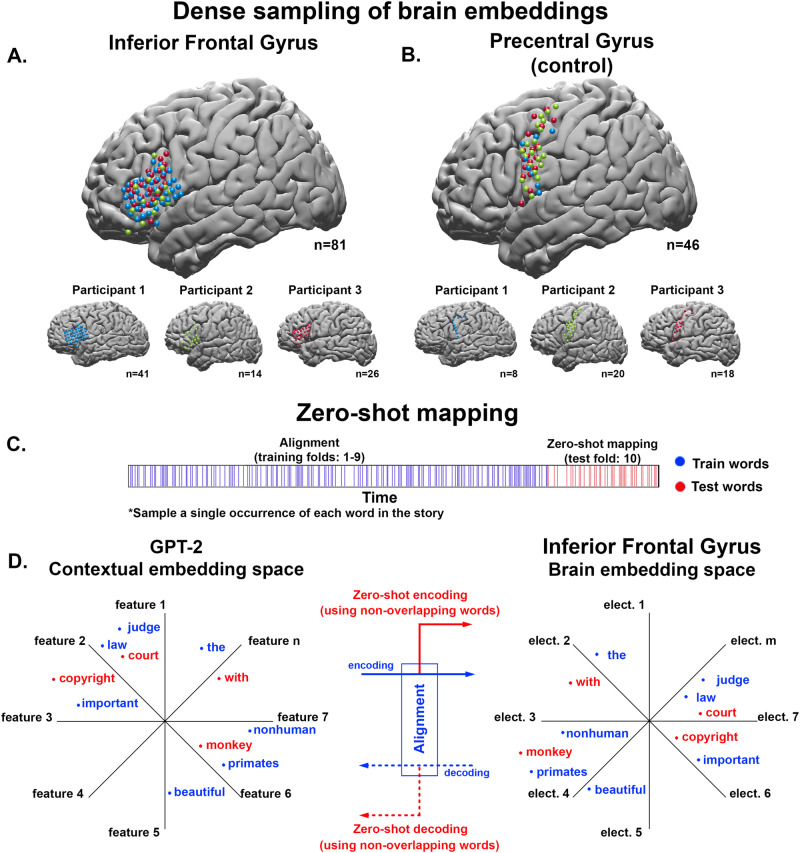
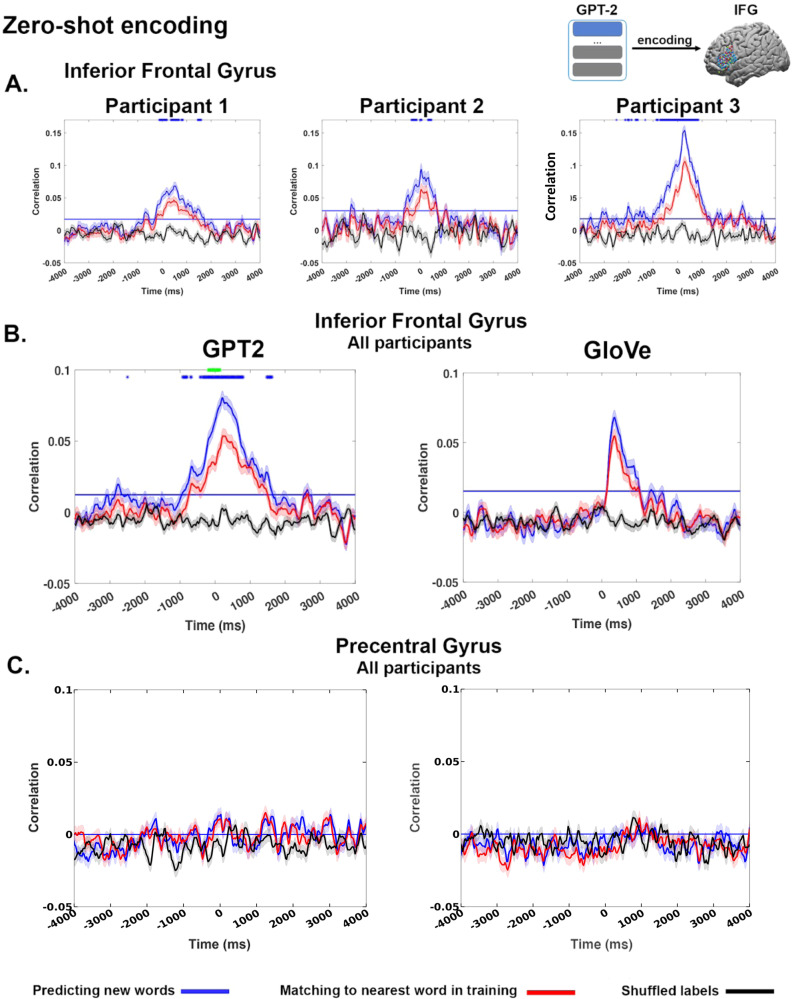
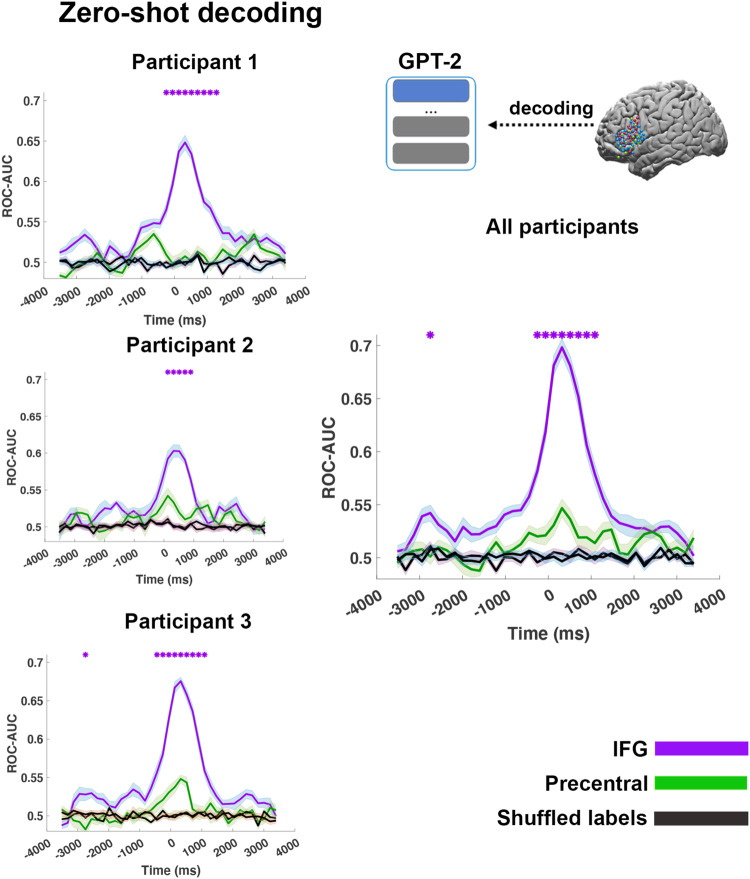
Contextual embeddings, derived from deep language models (DLMs), provide a continuous vectorial representation of language. This embedding space differs fundamentally from the symbolic representations posited by traditional psycholinguistics. We hypothesize that language areas in the human brain, similar to DLMs, rely on a continuous embedding space to represent language. To test this hypothesis, we densely record the neural activity patterns in the inferior frontal gyrus (IFG) of three participants using dense intracranial arrays while they listened to a 30-minute podcast. From these fine-grained spatiotemporal neural recordings, we derive a continuous vectorial representation for each word (i.e., a brain embedding) in each patient. Using stringent zero-shot mapping we demonstrate that brain embeddings in the IFG and the DLM contextual embedding space have common geometric patterns. The common geometric patterns allow us to predict the brain embedding in IFG of a given left-out word based solely on its geometrical relationship to other non-overlapping words in the podcast. Furthermore, we show that contextual embeddings capture the geometry of IFG embeddings better than static word embeddings. The continuous brain embedding space exposes a vector-based neural code for natural language processing in the human brain.
Overview
The claims and statistics of this paper haven’t been checked yet.
Free: it reads the open-access text and checks the first 5 claims that cite a source we can check. Create a free account to check every claim.
Integrity signals
Registry
Cites
Statistics
Figures
Verification
Claims the paper makes
The claims and statistics of this paper haven’t been checked yet.
Free: it reads the open-access text and checks the first 5 claims that cite a source we can check. Create a free account to check every claim.
Claims other papers make about this one
Each is checked against this paper’s own text: does it say what the citing paper says it does?
The cited source says what the claim attributes to it.
In the citing paper
“Studying AI can also advance psychological science (80–82).”
From Evaluating large language models in theory of mind tasks (2024) · cites this paper as [81]
Self-check
Percentages, sums and reported differences re-computed from the paper’s own numbers.
The self-check needs the paper’s full text.
Citations
Cites
Vaswani, A., Shazeer, N., Parmar, N., Uszkoreit, J., Jones, L., Gomez, A. N., Kaiser, L., & Polosukhin, I. (2017) · arXiv · doi:10.48550/arxiv.1706.03762 · Cited by 120,404 · cited 1×
“DLMs — like GPT-2 6 — have capitalized on the trans-former architecture 7 to assign each word in a text a unique, context-sensitive meaning based on the surrounding words within a given contextwindow.”
Controlling the False Discovery Rate: A Practical and Powerful Approach to Multiple Testing
Benjamini, Y., & Hochberg, Y. (1995) · Journal of the Royal Statistical Society Series B: Statistical Methodology · doi:10.1111/j.2517-6161.1995.tb02031.x · Cited by 109,482 · cited 1×
“This procedure was repeated for each lag (321 lags), and we controlled the false discovery rate (FDR) at q =0.01 66 .”
InfluentialGlove: Global Vectors for Word Representation
Pennington, J., Socher, R., & Manning, C. (2014) · Proceedings of the 2014 Conference on Empirical Methods in Natural Language Processing (EMNLP) · doi:10.3115/v1/d14-1162 · Cited by 34,071
Desikan, R. S., Ségonne, F., Fischl, B., Quinn, B. T., Dickerson, B. C., Blacker, D., Buckner, R. L., Dale, A. M., Maguire, R. P., Hyman, B. T., et al. (2006) · NeuroImage · doi:10.1016/j.neuroimage.2006.01.021 · Cited by 13,324
Landauer, T. K., & Dumais, S. T. (1997) · Psychological Review · doi:10.1037/0033-295x.104.2.211 · Cited by 6,282
Distributed and overlapping representations of faces and objects in ventral temporal cortex
Haxby, J. V., Gobbini, M. I., Furey, M. L., Ishai, A., Schouten, J. L., & Pietrini, P. (2001) · Science · doi:10.1126/science.1063736 · Cited by 3,940 · cited 1×
“In the last decades, there has been a gradual shift toward distributed, vector-space representation, such as neural population codes 11 – 14 , multivoxel pattern analysis 15 – 17 , and representational geometry 18 – 20 .”
Neuronal Population Coding of Movement Direction
Georgopoulos, A. P., Schwartz, A. B., & Kettner, R. E. (1986) · Science · doi:10.1126/science.3749885 · Cited by 3,161 · cited 3×
“In the last decades, there has been a gradual shift toward distributed, vector-space representation, such as neural population codes 11 – 14 , multivoxel pattern analysis 15 – 17 , and representational geometry 18 – 20 .”
Beyond mind-reading: multi-voxel pattern analysis of fMRI data
Norman, K. A., Polyn, S. M., Detre, G. J., & Haxby, J. V. (2006) · Trends in Cognitive Sciences · doi:10.1016/j.tics.2006.07.005 · Cited by 2,271
Performance-optimized hierarchical models predict neural responses in higher visual cortex
Yamins, D. L. K., Hong, H., Cadieu, C. F., Solomon, E. A., Seibert, D., & DiCarlo, J. J. (2014) · Proceedings of the National Academy of Sciences · doi:10.1073/pnas.1403112111 · Cited by 1,924 · cited 1×
“…processes natural stimuli: Researchers begantomoveawayfromsimplisticexperimental paradigms tomodel the multidimensional neural responses in real-life contexts 25,26 , posi-tioningdeepneuralnetworksasacomputationalframework forneural processing of naturalistic visual and auditory stimuli 27 – 33 .”
Neuroscience-Inspired Artificial Intelligence
Hassabis, D., Kumaran, D., Summerfield, C., & Botvinick, M. (2017) · Neuron · doi:10.1016/j.neuron.2017.06.011 · Cited by 1,557
Research works printed but not linked: 12
- Fodor, J. A. The Language of Thought (Harvard Univ. Press, 1975).
- Mikolov, T., Sutskever, I., Chen, K., Corrado, G. S. & Dean, J. Distributed representations of words and phrases and their compositionality. In Advances in Neural Information Processing Systems (eds. Burges, C. J. C., Bottou, L., Welling, M., Ghahramani, Z. & Weinberger, K. Q.) (Curran Associates Inc., 2013).
- Radford, A. et al. Language models are unsupervised multitask learners. OpenAI blog 1, 9 (2019).
- Hinton, G. E. Learning distributed representations of concepts. In Proc. Eighth Annual Conference of the Cognitive Science. (ed. Morris, R. G.M.) 46–61 (Erlbaum Associates, 1986).
- Toneva, M. & Wehbe, L. Interpreting and improving natural-language processing (in machines) with natural language-processing (in the brain). In 33rd Conference on Neural Information Processing Systems (NeurIPS 2019). (2019).
- Antonello, R., Turek, J. S., Vo, V. & Huth, A. Low-dimensional structure in the space of language representations is reflected in brain responses. In Advances in Neural Information Processing Systems (eds. Ranzato, M., Beygelzimer, A., Dauphin, Y., Liang, P. S. & Vaughan, J. W.) 8332–8344 (Curran Associates, Inc., 2021).
- Gardenfors, P. Conceptual spaces as a framework for knowledge representation. Mind Matter 2, 9–27 (2004).
- Caucheteux, C., Gramfort, A. & King, J.-R. Disentangling syntax and semantics in the brain with deep networks. In Proceedings of the 38th International Conference on Machine Learning (eds. Meila, M. & Zhang, T.) 1336–1348 (PMLR, 2021).
- Su-Yi Leong, C. & Linzen, T. Language models can learn exceptions to syntactic rules. Preprint at arXiv:2306.05969 (2023). · arXiv
- Antonello, R., Turek, J., Vo, V. A. & Huth, A. G. Low-dimensional structure in the space of language representations is reflected in brain responses. Adv. Neural Inf. Process. Syst. 8332–8344 (2021).
- Hewitt, J. & Manning, C. D. A structural probe for finding syntax in word representations. In Proc. 2019 Conference of the North American Chapter of the association for Computational Linguistics: Human Language Technologies Volume 1 4129–4138 (Association for Computational Linguistics, 2019).
- Goldstein, A. Source data for figures in Nature Communication paper -"Alignment of Brain Embeddings and Artificial Contextual Embeddings in Natural Language Points to Common Geometric Patterns a https://zenodo.org/records/10658831. PMC10980748 38553456
Cited by
Evaluating large language models in theory of mind tasks
Kosinski, M. (2024) · Proceedings of the National Academy of Sciences · doi:10.1073/pnas.2405460121 · Cited by 339
High-level visual representations in the human brain are aligned with large language models
Doerig, A., Kietzmann, T. C., Allen, E., Wu, Y., Naselaris, T., Kay, K., & Charest, I. (2025) · Nature Machine Intelligence · doi:10.1038/s42256-025-01072-0 · Cited by 175
“Given that LLMs have been shown to be good models for predicting brain activities in language areas too 107,108 , another benefit of this code would be that it may allow easy communication with other organisms 109 .”
Evaluating Large Language Models in Theory of Mind Tasks
Kosinski, M. (2023) · arXiv · doi:10.48550/arxiv.2302.02083 · Cited by 339
Zada, Z., Goldstein, A., Michelmann, S., Simony, E., Price, A. R., Hasenfratz, L., Barham, E., Zadbood, A., Doyle, W., Friedman, D. J., et al. (2024) · Neuron · doi:10.1016/j.neuron.2024.06.025 · Cited by 104
Self-citationGoldstein, A., Wang, H., Niekerken, L., Schain, M., Zada, Z., Aubrey, B., Sheffer, T., Nastase, S. A., Gazula, H., Singh, A., et al. (2025) · Nature Human Behaviour · doi:10.1038/s41562-025-02105-9 · Cited by 95
“The second interpretation is that deep language models and the human brain share computational principles for natural language processing 39,40 .”
Self-citationGoldstein, A., Ham, E., Schain, M., Nastase, S. A., Aubrey, B., Zada, Z., Grinstein-Dabush, A., Gazula, H., Feder, A., Doyle, W., et al. (2025) · Nature Communications · doi:10.1038/s41467-025-65518-0 · Cited by 76
Self-citationKozlowski, A. C., & Evans, J. A. (2025) · Sociological Methods & Research · doi:10.1177/00491241251337316 · Cited by 72
Natural language processing models reveal neural dynamics of human conversation
Cai, J., Hadjinicolaou, A. E., Paulk, A. C., Soper, D. J., Xia, T., Wang, A. F., Rolston, J. D., Richardson, R. M., Williams, Z. M., & Cash, S. S. (2025) · Nature Communications · doi:10.1038/s41467-025-58620-w · Cited by 63
Towards decoding individual words from non-invasive brain recordings
d’Ascoli, S., Bel, C., Rapin, J., Banville, H. J., Benchetrit, Y., Pallier, C., & King, J.-R. (2025) · Nature Communications · doi:10.1038/s41467-025-65499-0 · Cited by 77
“Technically,ourdecodingwork fl owoutperformsclassicmethodssuch as linear models 19,30 , EEGNet 22 and BrainModule 17 by a large margin.”
InfluentialDeep learning models to study sentence comprehension in the human brain
Arana, S., Lerousseau, J. P., & Hagoort, P. (2023) · Language Cognition and Neuroscience · doi:10.1080/23273798.2023.2198245 · Cited by 37
Maintenance and transformation of representational formats during working memory prioritization
Pacheco, D., Fellner, M.-C., Kunz, L., Zhang, H., Reinacher, P. C., Roy, C., Brandt, A., Schulze‐Bonhage, A., Yang, L., Wang, S., et al. (2024) · Nature Communications · doi:10.1038/s41467-024-52541-w · Cited by 32
The “Podcast” ECoG dataset for modeling neural activity during natural language comprehension
Zada, Z., Nastase, S. A., Aubrey, B., Jalon, I., Michelmann, S., Wang, H., Hasenfratz, L., Doyle, W., Friedman, D. J., Dugan, P. C., et al. (2025) · Scientific Data · doi:10.1038/s41597-025-05462-2 · Cited by 35
Self-citationApproximating the semantic space: word embedding techniques in psychiatric speech analysis
Palominos, C., He, R., Fröhlich, K., Mülfarth, R. R., Seuffert, S., Sommer, I. E., Homan, P., Kircher, T. T. J., Stein, F., & Hinzen, W. (2024) · Schizophrenia · doi:10.1038/s41537-024-00524-7 · Cited by 33
ProST: spotting propaganda span and technique classification in news articles
Ahmad, P. N., Shah, A. M., Guo, J., & Liu, Y. (2025) · Aslib Journal of Information Management · doi:10.1108/ajim-08-2024-0660 · Cited by 22
A population code for semantics in human hippocampus
Franch, M. C., Mickiewicz, E. A., Belanger, J. L., Joiner, B., Katlowitz, K. A., Zhu, H., Chavez, A. G., Chericoni, A., Goldman, A. M., Krishnan, V., et al. (2026) · Nature Neuroscience · doi:10.1038/s41593-026-02436-4 · Cited by 22
Tikochinski, R., Goldstein, A., Yeshurun, Y., Hasson, U., & Reichart, R. (2023) · Cerebral Cortex · doi:10.1093/cercor/bhad082 · Cited by 14
Self-citationEmergent Modularity in Pre-trained Transformers
Zhang, Z., Zeng, Z., Lin, Y., Xiao, C., Wang, X., Han, X., Liu, Z., Xie, R., Sun, M., & Zhou, J. (2023) · Findings of the Association for Computational Linguistics: ACL (Findings of ACL) · doi:10.18653/v1/2023.findings-acl.250 · Cited by 41
Beyond Markov: Transformers, memory, and attention
Parr, T., Pezzulo, G., & Friston, K. J. (2025) · Cognitive Neuroscience · doi:10.1080/17588928.2025.2484485 · Cited by 18
Animal models of the human brain: Successes, limitations, and alternatives
Kanwisher, N. (2025) · Current Opinion in Neurobiology · doi:10.1016/j.conb.2024.102969 · Cited by 15
Gu, C., Nastase, S. A., Zada, Z., & Li, P. (2025) · npj Science of Learning · doi:10.1038/s41539-025-00337-y · Cited by 57
“The principle of context-speci fi c embedding, a key principle shared by human brains and LLMs, posits that preceding context is actively engaged in word comprehension during language processes 4,5 .”
Self-citationMapping the neuronal building blocks of human language with language models
Cai, J., Kfir, Y., Jamali, M., Huang, H., Kim, Y. J., Cash, S. S., & Williams, Z. M. (2026) · Nature · doi:10.1038/s41586-026-10691-5 · Cited by 11
Aligning brains into a shared space improves their alignment with large language models
Bhattacharjee, A., Zada, Z., Wang, H., Aubrey, B., Doyle, W., Dugan, P. C., Friedman, D. J., Devinsky, O., Flinker, A., Ramadge, P. J., et al. (2025) · Nature Computational Science · doi:10.1038/s43588-025-00900-y · Cited by 14
“These areas both (a) contain more electrodes than other areas and (b) may be most closely entrained to linguistic features of the shared stimulus 6,12 .”
Self-citationTripartite organization of brain state dynamics underlying spoken narrative comprehension
Liu, L., Jiang, J., Li, H., & Ding, G. (2025) · eLife · doi:10.7554/elife.99997.3 · Cited by 8
Hong, Z., Wang, H., Zada, Z., Gazula, H., Turner, D. D., Aubrey, B., Niekerken, L., Doyle, W., Devore, S., Dugan, P. C., et al. (2024) · eLife · doi:10.7554/elife.101204.1 · Cited by 22
Self-citationFlick, G., & Ostrand, R. (2025) · Journal of Speech Language and Hearing Research · doi:10.1044/2025_jslhr-24-00297 · Cited by 7
Tracking Neural Correlates of Contextualized Meanings with Representational Similarity Analysis
Messi, A.-P., & Pylkkänen, L. (2025) · Journal of Neuroscience · doi:10.1523/jneurosci.0409-24.2025 · Cited by 6
Speech Neurophysiology in Realistic Contexts: Big Hype or Big Leap?
Liberto, G. M. D., & Ip, E. Y. J. (2026) · European Journal of Neuroscience · doi:10.1111/ejn.70496 · Cited by 7
“Nonetheless, modern devices developed for hyperscanning minimise those risks, providing automation and control to experimental setups in speech neurophysiology and many other domains (Holmes et al. 2023; Kothe et al. 2025).”
Bruera, A., & Poesio, M. (2024) · PLoS ONE · doi:10.1371/journal.pone.0291099 · Cited by 5
Overlapping Cortical Substrate of Biomechanical Control and Subjective Agency
Veillette, J. P., Chao, A. F., Nith, R., Lopes, P., & Nusbaum, H. C. (2025) · Journal of Neuroscience · doi:10.1523/jneurosci.1673-24.2025 · Cited by 4
Srinivasan, K., Jadon, R., Budda, R., Gollapalli, V. S. T., Chauhan, G. S., & Awotunde, J. B. (2025) · Advances in computational intelligence and robotics book series · doi:10.4018/979-8-3373-1200-2.ch006 · Cited by 4
Individual Differences in Statistical Learning and Semantic Adaptation: An N400 Study
Munding, M., Forgács, B., Lukics, K. S., & Lukács, Á. (2025) · Psychophysiology · doi:10.1111/psyp.70125 · Cited by 6
Brain-model neural similarity reveals abstractive summarization performance
Zhang, Z., Guo, S.-L., Zhou, W. H., Luo, Y., Zhu, Y., Zhang, L., & Li, L. (2025) · Scientific Reports · doi:10.1038/s41598-024-84530-w · Cited by 6
“In terms of semantic representation, 5,6,20 found that the contextual word embeddings of DLMs like GPT-2 can capture the geometric structure of activation in the human brain’s language areas (such as the left Inferior Frontal Gyrus, IFG), outperforming traditional static word embeddings (like…”
Decoding Stumpers: Large Language Models vs. Human Problem-Solvers
Goldstein, A., Havin, M., Reichart, R., & Goldstein, A. (2023) · Findings of the Association for Computational Linguistics: EMNLP (Findings of EMNLP) · doi:10.18653/v1/2023.findings-emnlp.779 · Cited by 8
Self-citationA semantotopic map in human hippocampusPreprint
Mickiewicz, E. A., Franch, M. C., Katlowitz, K. A., Chavez, A. G., Zhu, H., Chericoni, A., Yan, X., Belanger, J. L., Ismail, T., Paulo, D. L., et al. (2025) · bioRxiv (Cold Spring Harbor Laboratory) · doi:10.1101/2025.10.31.685959 · Cited by 6
Are you hallucinated? Insights into large language models
Singh, S., Saha, R., Kumar, G. K., Nayyar, A., & Kim, T.-K. (2025) · ICT Express · doi:10.1016/j.icte.2025.12.011 · Cited by 3
Schneider, F., & Blank, H. (2026) · PLoS Biology · doi:10.1371/journal.pbio.3003588 · Cited by 6
Wang, Y., Xue, T., & Xing-yu, Y. (2025) · Frontiers in Neuroscience · doi:10.3389/fnins.2025.1656519 · Cited by 3
Embeddings for Efficient Literature Screening: A Primer for Life Science Investigators
Galli, C., Cusano, C., Guizzardi, S., Donos, N., & Calciolari, E. (2024) · Metrics · doi:10.3390/metrics1010001 · Cited by 9
“A recent report by Goldstein et al. [41] has provided further insight into the capabilities of transformer-based models, demonstrating that the contextual embeddings generated by these models closely align with the patterns of neural activity observed in human language processing regions, such as…”
Metric Learning Encoding Models: A Multivariate Framework for Interpreting Neural RepresentationsPreprint
Jalouzot, L., Pallier, C., Chemla, E., & Lakretz, Y. (2024) · arXiv (Cornell University) · doi:10.48550/arxiv.2402.11608 · Cited by 4
“In a nutshell, the method learns an optimal metric over a space of theoretical features to best match the geometry of the neural representation space (Goldstein et al., 2024; Brown et al., 2024).”
Quantifying Feature Space Universality Across Large Language Models via Sparse Autoencoders
Lan, M., Torr, P., Meek, A., Khakzar, A., Krueger, D., & Barez, F. (2024) · arXiv · doi:10.48550/arxiv.2410.06981 · Cited by 2
“…studies in neuroscience, as past research has been conducted on measuring the extent of alignment across biological and artificial neural networks [Goldstein et al., 2024], and previous work has also found high-low feature detectors in both vision models [Schubert et al., 2021] and mouse brains…”
Larger language models better align with neural representations of natural language
Hong, Z., Wang, H., Zada, Z., Gazula, H., Turner, D. D., Aubrey, B., Niekerken, L., Doyle, W., Devore, S., Dugan, P. C., et al. (2026) · eLife · doi:10.7554/elife.101204 · Cited by 4
Self-citationBeyond discretization: why cognitive science should embrace continuity
Pietro, I. D., & Viviani, G. (2026) · Frontiers in Psychology · doi:10.3389/fpsyg.2026.1777565 · Cited by 2
“Furthermore, neural recordings reveal that neural populations encode information through continuous “embeddings” rather than discrete classes (Goldstein et al., 2024; Jamali et al., 2024).”
Information-making processes in the speaker’s brain drive human conversationsPreprint
Goldstein, A., Wang, H., Sheffer, T., Lioubashevski, D., Schain, M., Zada, Z., Niekerken, L., Aubrey, B., Nastase, S. A., Taubenfeld, A., et al. (2024) · bioRxiv (Cold Spring Harbor Laboratory) · doi:10.1101/2024.08.27.609946 · Cited by 2
“During speech comprehension before word-onset, information theory demonstrates that listeners actively predict the next word before it is spoken (10, 11).”
Self-citationReading ahead: Localized neural signatures of parafoveal word processing and skipping decisionsPreprint
Flick, G., & Pylkkänen, L. (2025) · bioRxiv (Cold Spring Harbor Laboratory) · doi:10.1101/2025.04.25.650296 · Cited by 1
“…because it has been shown to produce incremental surprisal estimates that correlate with human brain activity during language comprehension and word embeddings that map linearly onto human brain activations (Caucheteux, Gramfort, & King, 2022; Goldstein et al., 2022, Goldstein et al. 2024).”
Formal Properties of Language as Constraints on Neural DynamicsPreprint
Murphy, E. (2026) · arXiv · doi:10.48550/arxiv.2609.14384 · Cited by 2
Predicting Document Relevance from Brain Recordings
Gryshchuk, V., Maistro, M., Lioma, C., & Ruotsalo, T. (2025) · ACM Transactions on Information Systems · doi:10.1145/3766067 · Cited by 1
“…of these studies has been to align the representations learnt by language models with the neural processing of linguistic information in the brain, with the dual objectives of gaining insight into human language processing [24, 31, 69] and improving the performance of decoding models [32, 80, 97].”
Using Artificial Intelligence Systems in Modern Neurobehavioral Research
Apukhtin, K. V., Zolotova, A. E., Leunenko, A. O., Perfilova, V. N., & Kalueff, A. V. (2025) · Journal of Evolutionary Biochemistry and Physiology · doi:10.1134/s0022093025060080 · Cited by 1
“For example, common methods for processing EEG and MEG data are a representational similarity anal(cid:2) ysis (RSA) [71, 72] and a spatially more precise rep(cid:2) resentational dissimilarity component analysis (ReDisCA) [70].”
The Prompting Brain: Neurocognitive Markers of Expertise in Guiding Large Language Models
Al-Khalifa, H. S., Almansour, R., Alhuasini, L. A., Alsaleh, A., Temsah, M.-H., & Alruwaili, A. R. (2025) · IEEE/ACS International Conference on Computer Systems and Applications (AICCSA) · doi:10.1109/aiccsa66935.2025.11315303 · Cited by 1
“The specific seed or target regions connected to the left MTG would be detailed based on the full analysis, but this region is classically involved in language processing, semantic memory, and multimodal integration.”
Kemmerer, D. L., & Dove, G. O. (2026) · Cortex · doi:10.1016/j.cortex.2026.02.008 · Cited by 2
Zhang, Z., Zhou, W. H., Zhang, S., Li, X., Zhang, L., & Li, L. (2026) · Neural Networks · doi:10.1016/j.neunet.2026.108916 · Cited by 1
What drives regressions in reading? Insights from surprisal and saliency from language models
Rego, A. T. L., Melo, A. N., Snell, J., & Meeter, M. (2026) · Cognition · doi:10.1016/j.cognition.2026.106535 · Cited by 1
Computation or Weight Adaptation? Rethinking the Role of Plasticity in Learning
Lior, G., Shalev, Y., Stanovsky, G., & Goldstein, A. (2026) · Cognitive Science · doi:10.1111/cogs.70271 · Cited by 1
Self-citationTripartite organization of brain state dynamics underlying spoken narrative comprehensionPreprint
Liu, L., Jiang, J., Li, H., & Ding, G. (2025) · eLife · doi:10.7554/elife.99997.2 · Cited by 1
Canonical Representational Mapping for Cognitive NeurosciencePreprint
Schottdorf, M., & Michelmann, S. (2025) · bioRxiv (Cold Spring Harbor Laboratory) · doi:10.1101/2025.09.01.673485 · Cited by 1
“In one analysis, we map activations of a large language model (i.e., word-embeddings) onto intracranial Electroencephalography (iEEG) recordings (akin to Goldstein et al. 18 ).”
InfluentialNeural signatures of impaired semantic contextualization in Autism Spectrum DisorderPreprint
Franch, M. C., Katlowitz, K. A., Mickiewicz, E. A., Belanger, J. L., Mathura, R. K., Zhu, H., Yan, X., Ismail, T., Chavez, A. G., Chericoni, A., et al. (2026) · bioRxiv (Cold Spring Harbor Laboratory) · doi:10.64898/2026.03.16.712048 · Cited by 1
“To understand the neural representation of semantics and phonemics, we took an encoding model approach (Huth and Gallant, 2016; Goldstein et al., 2024; Goldstein, Wang, et al., 2023; Tang et al., 2023; Zada et al., 2024) that we and others have adapted for use in single neurons (Franch et al.,…”
Cortical localization and dynamics of elementary mathematical conceptsPreprint
Debray, S., Karami, A., Valério, D., Cauté, M., Pallier, C., & Dehaene, S. (2026) · bioRxiv (Cold Spring Harbor Laboratory) · doi:10.64898/2026.04.30.721827 · Cited by 1
Yang, N., He, R., Homan, P., Sommer, I. E., Staub, D., & Hinzen, W. (2026) · arXiv (Cornell University) · doi:10.48550/arxiv.2605.21049 · Cited by 1
Linguistic structure and probability are jointly encoded in high gamma powerPreprint
Slaats, S., & Hervais‐Adelman, A. (2026) · bioRxiv (Cold Spring Harbor Laboratory) · doi:10.64898/2026.07.21.739808 · Cited by 1
Hong, Z., Wang, H., Zada, Z., Gazula, H., Turner, D., Aubrey, B., Niekerken, L., Doyle, W., Devore, S., Dugan, P., et al. (2024) · doi:10.1101/2024.06.12.598513 · Cited by 1
Self-citationA search for the neural bases of compositionality
Desbordes, T. (2022) · theses.fr (ABES) · doi:10.70675/a2fa0307z6b04z4e78zb9a3z86520bd75e74
Tripartite organization of brain state dynamics underlying spoken narrative comprehensionPreprint
Liu, L., Jiang, J., Li, H., & Ding, G. (2024) · eLife · doi:10.7554/elife.99997.1
Digital dementia and testing of cognitive intervention for degenerating neural networks
Moore, J. A., Vigneshwaran, V., Winder, A. J., Kang, C., Wilms, M., & Forkert, N. D. (2025) · npj Systems Biology and Applications · doi:10.1038/s41540-025-00596-w
Position Paper: Bounded Alignment: What (Not) To Expect From AGI Agents
Minai, A. A. (2025) · International Joint Conference on Neural Networks (IJCNN) · doi:10.1109/ijcnn64981.2025.11228305 · Cited by 1
“While there is a growing body of work showing some correspondence between representations found by deep neural networks and those in the brain [69]–[71], these are typically confined to single modalities.”
Viability of using LLMs as models of human language processing
Murphy, A. (2025) · Nature Computational Science · doi:10.1038/s43588-025-00913-7
Rismawati, R., Ranjan, A., & Sharma, K. (2025) · IGI Global eBooks · doi:10.4018/979-8-3373-2292-6.ch008 · Cited by 1
Bruera, A., & Hartwigsen, G. (2026) · Neurobiology of Language · doi:10.1162/nol.a.244
“…semantic model (Boleda, 2020; Connell & Lynott, 2024; Lenci, 2018) — belonging to a family of computational models that have been shown to excel at capturing cognitive semantic processing (Goldstein et al., 2024; Huth et al., 2016; Lenci et al., 2022; Schrimpf et al., 2021; Tuckute et al., 2024).”
Linking macroscale structure and function in brain-like recurrent neural networksPreprint
Chen, P., Cui, Z., & Constantinidis, C. (2026) · bioRxiv (Cold Spring Harbor Laboratory) · doi:10.64898/2026.02.19.706880
Neuropragmatics: from classical pragmatics to neurocognitive models of pragmatics in dialogue
Cisneros, A. G., Foucart, A., & Brunellière, A. (2026) · Frontiers in Psychology · doi:10.3389/fpsyg.2026.1745034
“Deep learning and artificial neural networks could also aid in the complex modeling of neuropragmatic processing (Goldstein et al., 2024).”
Ohonsi, O. Z., Poturaju, S., Varanasi, S., Janssen, D., & Choa, F. (2026) · Smart Biomedical and Physiological Sensor Technology · doi:10.1117/12.3095133
Ontogenesis of AGI Consciousness in ChatGPT Enabled by an External Control Module
Suvorov, V. V., & Trubnikov, I. (2026) · Lecture notes in networks and systems · doi:10.1007/978-3-032-20749-4_5
Wu, X., Wang, H., Yan, Z., Xiaohan, T., Xu, P., Siok, W. T., Li, P., Gao, J., Lyu, B., & Qin, L. (2026) · Computers in Human Behavior · doi:10.1016/j.chb.2026.109051 · Cited by 1
Self-citationHuman-like sequential sound-to-meaning transfer drives artificial speech comprehensionPreprint
Zhang, S., Li, S., Yang, R., Chen, G., Tian, X., Wang, Q., & Fang, F. (2026) · bioRxiv (Cold Spring Harbor Laboratory) · doi:10.64898/2026.05.13.723203
Zhao, J., & Brennan, J. (2026) · bioRxiv (Cold Spring Harbor Laboratory) · doi:10.64898/2026.05.15.725490
Kumar, A. (2026) · arXiv (Cornell University) · doi:10.48550/arxiv.2606.29792
“Recent work by [Goldstein et al., 2024] shows alignment between language-model embeddings and human neural representations during language processing, and work by [Aw et al., 2023] demonstates that instruction-tuning of LLMs improves alignment between language-model and brain representations.”
Surprisal contributes little beyond contextual embeddings in high-gamma ECoG encodingPreprint
Sakuma, T. (2026) · bioRxiv (Cold Spring Harbor Laboratory) · doi:10.64898/2026.07.10.737662
fMRI Encoding and Decoding with LLMs: Input Embeddings vs. Hidden State Representations
Liu, M., & Kobayashi, I. (2026) · Journal of Advanced Computational Intelligence and Intelligent Informatics · doi:10.20965/jaciii.2026.p1243
High-level prediction of continuous speech during mind-wandering
Chen, G. R., Finkelstein, R., Goldstein, A., Hassin, R. R., & Deouell, L. Y. (2026) · Communications Psychology · doi:10.1038/s44271-026-00518-4
Self-citation日本文化学習教材としての日本アニメへの自動注釈のための生成AIの評価
Mochizuki, H. (2026) · 東京外国語大学論集 · doi:10.15026/0002001863
A structured framework for human–AI resemblance: Evidence, inference and perception
Wang, P., Law, E. L., Zou, L., Jiang, Y., Hertwig, R., PAAS, F. G. W. C., & Laureys, S. (2026) · Physics of Life Reviews · doi:10.1016/j.plrev.2026.09.003
Causal event structure shapes convergent reactivation signatures in human cortex and language modelPreprint
Zhang, Z., Chen, Y., Liu, Q., Zhao, X., Ding, X., Fei, X., Du, J., Bao, Y., Gao, J., Huang, X., et al. (2026) · bioRxiv (Cold Spring Harbor Laboratory) · doi:10.64898/2026.09.28.754904
“Prior work has linked contextual language-model representations to human neural responses [16–18] and identified shared geometric patterns across the two systems [19].”
Metadata
- Authors
- Goldstein, A., Grinstein-Dabush, A., Schain, M., Wang, H., Hong, Z., Aubrey, B., Nastase, S. A., Zada, Z., Ham, E., Feder, A., Gazula, H., Buchnik, E., Doyle, W., Devore, S., Dugan, P., Reichart, R., Friedman, D., Brenner, M., Hassidim, A., Devinsky, O., Flinker, A., & Hasson, U.
- Affiliations
- Hebrew University of Jerusalem (IL)
- Google (Israel) (IL)
- Princeton University (US)
- New York University (US)
- Technion – Israel Institute of Technology (IL)
- Harvard University (US)
- Corresponding author
- Goldstein, Ariel
- ORCID
- Venue
- Nature Communications
- Published
- 2024-03-30
- Volume
- 15
- Issue
- 1
- Pages
- 2768-2768
- ISSN
- 2041-1723 (ISSN-L)
- PMC
- PMC10980748
- OpenAlex
- W4393343917
- Semantic Scholar
- 075ea80d99f6c125c5c795b2335b2251c62a53ce
- Cited by
- 64
- References
- 55
- Citations by year
- 2026: 19 · 2025: 32 · 2024: 13
- FWCI
- 15.55
- Type
- journal article
- Language
- en
- Update notices
- correction (2024-10-01)
- Open access
- gold
- doi.org
- Licence
- cc-by
- creativecommons.org/licenses/by/4.0 (tdm)
- creativecommons.org/licenses/by/4.0 (vor)
- Locations
- Nature Communications (publishedVersion, cc-by)
- PubMed Central (publishedVersion, cc-by)
- PubMed (publishedVersion)
- RePEc: Research Papers in Economics (submittedVersion)
- DOAJ (DOAJ: Directory of Open Access Journals) (submittedVersion, cc-by-sa)
- Funders
- Foundation for the National Institutes of Health (R01MH112566, R01NS109367-01)
- Topics
- Life Sciences › Neuroscience › Cognitive Neuroscience › Neurobiology of Language and Bilingualism
- Physical Sciences › Computer Science › Artificial Intelligence › Topic Modeling
- Social Sciences › Psychology › Developmental and Educational Psychology › Reading and Literacy Development
- Keywords
- contextual embeddings, deep language models, inferior frontal gyrus, embedding space geometry, word embeddings
- MeSH terms
- Brain, Humans, Language, Natural Language Processing, Prefrontal Cortex
About these checks
Registry, retraction, Cites and statistics results are computed, not judged, with one exception: a printed reference that no index lists is read once by a model before it counts as a citation error. Claims are extracted by a model and kept only when their quote appears verbatim in the text; each cited source is then checked, with a model’s help, for whether it says what the claim relies on. Those verdicts can be wrong — read the claim’s quote and the cited source before relying on one.
Statistics and arithmetic are recomputed, not judged.
Confidence bands are shown only for fields calibrated on our annotated test set. None is calibrated yet, so no band is shown.
What counts as a claim ›How we measure confidence ›How we check this ›
Are you an author, or do you see a problem with this page? Request a review
Data sources
Bibliographic data: Semantic Scholar, OpenAlex, Crossref.
Contains information from the Semantic Scholar Academic Graph Datasets, made available under the ODC Attribution License (ODC-BY 1.0).
Semantic Scholar’s data is described in: Kinney, R., et al. (2023). The Semantic Scholar Open Data Platform. arXiv:2301.10140.
