

Alignment of brain embeddings and artificial contextual embeddings in natural language points to common geometric patterns
Open accessThe DOI matches its Crossref record; 57 of the 57 references it cites were found in a registry or an index.
Abstract
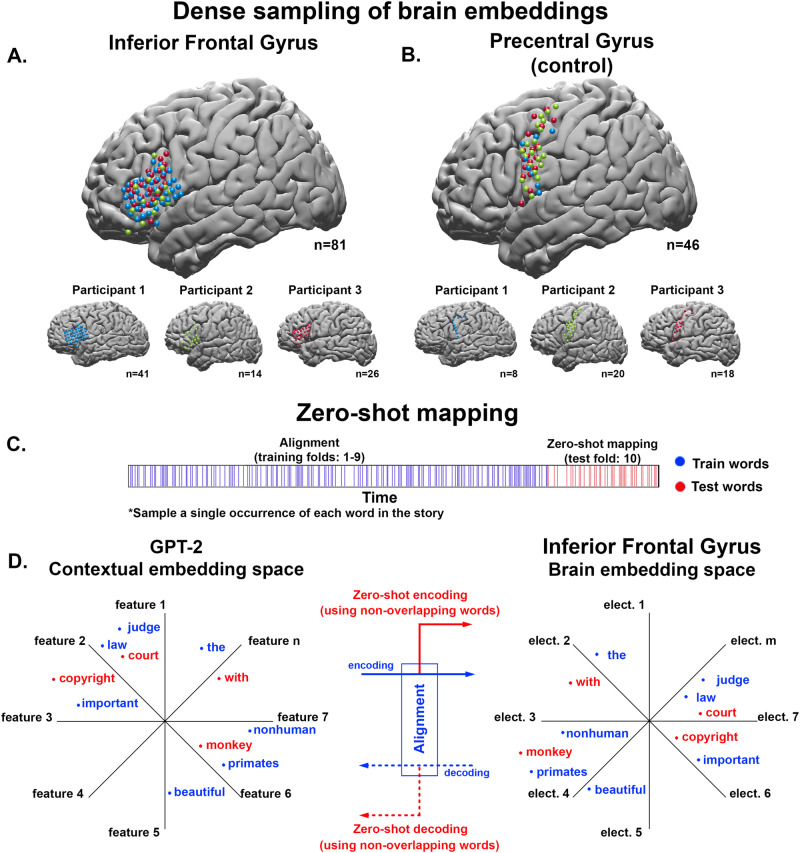
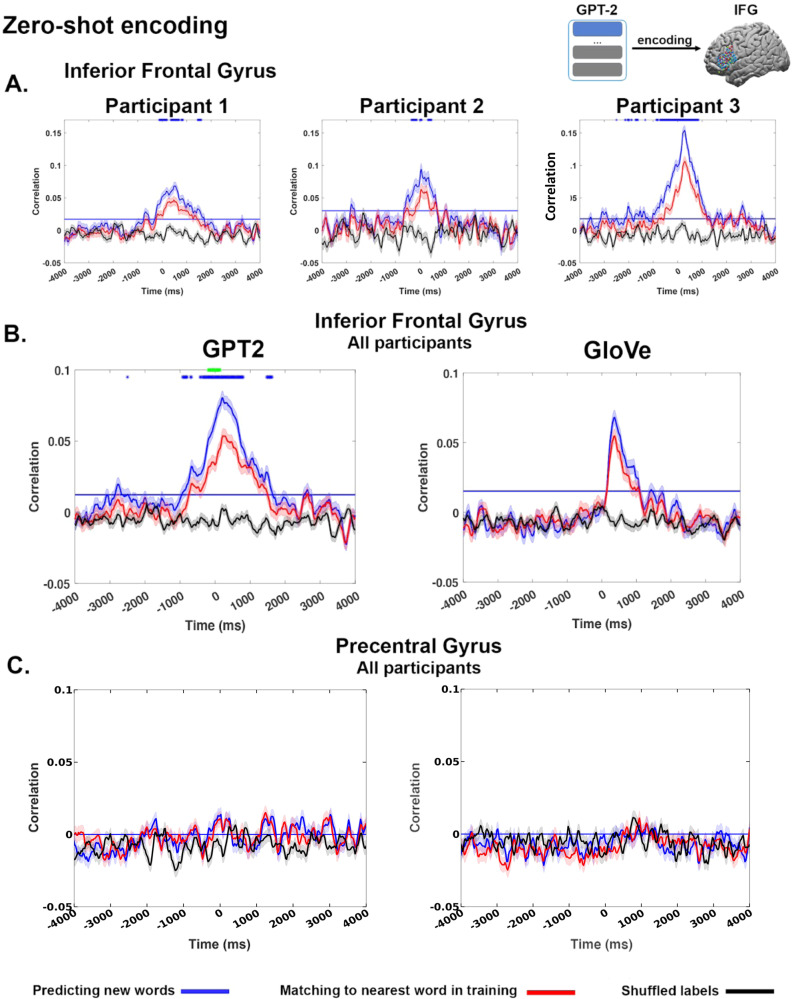
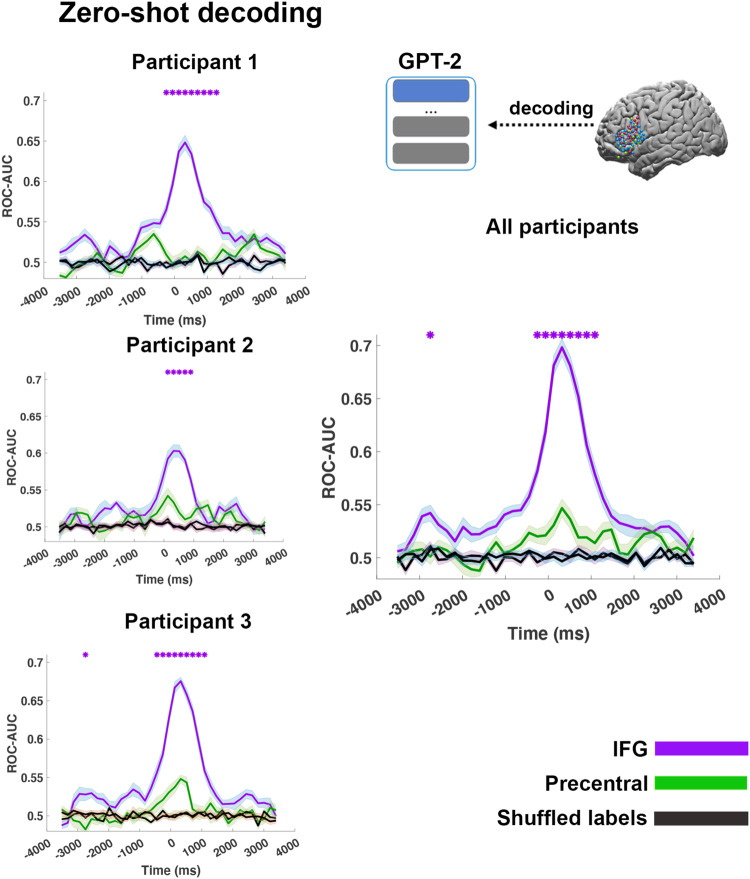
Contextual embeddings, derived from deep language models (DLMs), provide a continuous vectorial representation of language. This embedding space differs fundamentally from the symbolic representations posited by traditional psycholinguistics. We hypothesize that language areas in the human brain, similar to DLMs, rely on a continuous embedding space to represent language. To test this hypothesis, we densely record the neural activity patterns in the inferior frontal gyrus (IFG) of three participants using dense intracranial arrays while they listened to a 30-minute podcast. From these fine-grained spatiotemporal neural recordings, we derive a continuous vectorial representation for each word (i.e., a brain embedding) in each patient. Using stringent zero-shot mapping we demonstrate that brain embeddings in the IFG and the DLM contextual embedding space have common geometric patterns. The common geometric patterns allow us to predict the brain embedding in IFG of a given left-out word based solely on its geometrical relationship to other non-overlapping words in the podcast. Furthermore, we show that contextual embeddings capture the geometry of IFG embeddings better than static word embeddings. The continuous brain embedding space exposes a vector-based neural code for natural language processing in the human brain.
Overview
The claims and statistics of this paper haven’t been checked yet.
Free: it reads the open-access text and checks the first 5 claims that cite a source we can check. Create a free account to check every claim.
Integrity signals
Registry
Cites
Statistics
Figures
Verification
Claims the paper makes
The claims and statistics of this paper haven’t been checked yet.
Free: it reads the open-access text and checks the first 5 claims that cite a source we can check. Create a free account to check every claim.
Claims other papers make about this one
Each is checked against this paper’s own text: does it say what the citing paper says it does?
The cited source says what the claim attributes to it.
In the citing paper
“Studying AI can also advance psychological science (80–82).”
From Evaluating large language models in theory of mind tasks (2024) · cites this paper as [81]
Self-check
Percentages, sums and reported differences re-computed from the paper’s own numbers.
The self-check needs the paper’s full text.
Citations
Cites
Vaswani, A., Shazeer, N., Parmar, N., Uszkoreit, J., Jones, L., Gomez, A. N., Kaiser, L., & Polosukhin, I. (2017) · arXiv · doi:10.48550/arxiv.1706.03762 · Cited by 120,404 · cited 1×
“DLMs — like GPT-2 6 — have capitalized on the trans-former architecture 7 to assign each word in a text a unique, context-sensitive meaning based on the surrounding words within a given contextwindow.”
Controlling the False Discovery Rate: A Practical and Powerful Approach to Multiple Testing
Benjamini, Y., & Hochberg, Y. (1995) · Journal of the Royal Statistical Society Series B: Statistical Methodology · doi:10.1111/j.2517-6161.1995.tb02031.x · Cited by 109,482 · cited 1×
“This procedure was repeated for each lag (321 lags), and we controlled the false discovery rate (FDR) at q =0.01 66 .”
InfluentialGlove: Global Vectors for Word Representation
Pennington, J., Socher, R., & Manning, C. (2014) · Proceedings of the 2014 Conference on Empirical Methods in Natural Language Processing (EMNLP) · doi:10.3115/v1/d14-1162 · Cited by 34,071
Desikan, R. S., Ségonne, F., Fischl, B., Quinn, B. T., Dickerson, B. C., Blacker, D., Buckner, R. L., Dale, A. M., Maguire, R. P., Hyman, B. T., et al. (2006) · NeuroImage · doi:10.1016/j.neuroimage.2006.01.021 · Cited by 13,324
Landauer, T. K., & Dumais, S. T. (1997) · Psychological Review · doi:10.1037/0033-295x.104.2.211 · Cited by 6,282
Distributed and overlapping representations of faces and objects in ventral temporal cortex
Haxby, J. V., Gobbini, M. I., Furey, M. L., Ishai, A., Schouten, J. L., & Pietrini, P. (2001) · Science · doi:10.1126/science.1063736 · Cited by 3,940 · cited 1×
“In the last decades, there has been a gradual shift toward distributed, vector-space representation, such as neural population codes 11 – 14 , multivoxel pattern analysis 15 – 17 , and representational geometry 18 – 20 .”
Neuronal Population Coding of Movement Direction
Georgopoulos, A. P., Schwartz, A. B., & Kettner, R. E. (1986) · Science · doi:10.1126/science.3749885 · Cited by 3,161 · cited 3×
“In the last decades, there has been a gradual shift toward distributed, vector-space representation, such as neural population codes 11 – 14 , multivoxel pattern analysis 15 – 17 , and representational geometry 18 – 20 .”
Beyond mind-reading: multi-voxel pattern analysis of fMRI data
Norman, K. A., Polyn, S. M., Detre, G. J., & Haxby, J. V. (2006) · Trends in Cognitive Sciences · doi:10.1016/j.tics.2006.07.005 · Cited by 2,271
Performance-optimized hierarchical models predict neural responses in higher visual cortex
Yamins, D. L. K., Hong, H., Cadieu, C. F., Solomon, E. A., Seibert, D., & DiCarlo, J. J. (2014) · Proceedings of the National Academy of Sciences · doi:10.1073/pnas.1403112111 · Cited by 1,924 · cited 1×
“…processes natural stimuli: Researchers begantomoveawayfromsimplisticexperimental paradigms tomodel the multidimensional neural responses in real-life contexts 25,26 , posi-tioningdeepneuralnetworksasacomputationalframework forneural processing of naturalistic visual and auditory stimuli 27 – 33 .”
Neuroscience-Inspired Artificial Intelligence
Hassabis, D., Kumaran, D., Summerfield, C., & Botvinick, M. (2017) · Neuron · doi:10.1016/j.neuron.2017.06.011 · Cited by 1,557
Ventral and dorsal pathways for language
Saur, D., Kreher, B. W., Schnell, S., Kümmerer, D., Kellmeyer, P., Vry, M.-S., Umarova, R., Musso, M., Glauche, V., Abel, S., et al. (2008) · Proceedings of the National Academy of Sciences · doi:10.1073/pnas.0805234105 · Cited by 1,553 · cited 1×
“We focus on IFG as it has been positioned as a central hub for language processing, emphasizing semantic and syntactic processing 40,48 – 53 .”
Natural speech reveals the semantic maps that tile human cerebral cortex
Huth, A. G., de Heer, W. A., Griffiths, T. L., Theunissen, F. E., & Gallant, J. L. (2016) · Nature · doi:10.1038/nature17637 · Cited by 1,504 · cited 1×
“Groundbreaking work by Mitchell and colleagues 22 begins to synthesize these parallel developments by using co-occurrence-based semantic vectors (similar to GloVe embeddings) to predict multivoxel patterns of brain activity associated with single words (see also 23,24 ).”
On Broca, brain, and binding: A new framework
Hagoort, P. (2005) · Trends in Cognitive Sciences · doi:10.1016/j.tics.2005.07.004 · Cited by 1,411
Matching Categorical Object Representations in Inferior Temporal Cortex of Man and Monkey
Kriegeskorte, N., Mur, M., Ruff, D. A., Kiani, R., Bodurka, J., Esteky, H., Tanaka, K., & Bandettini, P. A. (2008) · Neuron · doi:10.1016/j.neuron.2008.10.043 · Cited by 1,344 · cited 2×
“In the last decades, there has been a gradual shift toward distributed, vector-space representation, such as neural population codes 11 – 14 , multivoxel pattern analysis 15 – 17 , and representational geometry 18 – 20 .”
BERT Rediscovers the Classical NLP Pipeline
Tenney, I., Das, D., & Pavlick, E. (2019) · Proceedings of the 57th Annual Meeting of the Association for Computational Linguistics · doi:10.18653/v1/p19-1452 · Cited by 1,307
Predicting Human Brain Activity Associated with the Meanings of Nouns
Mitchell, T. M., Shinkareva, S. V., Carlson, A., Chang, K.-M., Malave, V. L., Mason, R. A., & Just, M. A. (2008) · Science · doi:10.1126/science.1152876 · Cited by 1,180 · cited 6×
“Inspired by Mitchell and colleagues 22 , we performed the exact same zero-shot analysis using co-occurrence-based, static (GloVe) word embeddings.”
InfluentialKriegeskorte, N. (2015) · Annual Review of Vision Science · doi:10.1146/annurev-vision-082114-035447 · Cited by 1,093
A deep learning framework for neuroscience
Richards, B. A., Lillicrap, T. P., Beaudoin, P., Bengio, Y., Bogacz, R., Christensen, A., Clopath, C., Costa, R. P., de Berker, A., Ganguli, S., et al. (2019) · Nature Neuroscience · doi:10.1038/s41593-019-0520-2 · Cited by 1,027 · cited 1×
“If symbolic terms encapsulate some aspects of linguistic structure, we anticipate statistical learning-based models will likewise embed these structures 31,32 .”
Guclu, U., & van Gerven, M. A. J. (2015) · Journal of Neuroscience · doi:10.1523/jneurosci.5023-14.2015 · Cited by 961
Enriching the knowledge sources used in a maximum entropy part-of-speech tagger
Toutanova, K., & Manning, C. D. (2000) · Proceedings of the 2000 Joint SIGDAT conference on Empirical methods in natural language processing and very large corpora held in conjunction with the 38th Annual Meeting of the Association for Computational Linguistics - · doi:10.3115/1117794.1117802 · Cited by 939
Representational geometry: integrating cognition, computation, and the brain
Kriegeskorte, N., & Kievit, R. A. (2013) · Trends in Cognitive Sciences · doi:10.1016/j.tics.2013.06.007 · Cited by 911
The Analysis of Proximities: Multidimensional Scaling with an Unknown Distance Function. II
Shepard, R. N. (1962) · Psychometrika · doi:10.1007/bf02289621 · Cited by 911 · cited 1×
“…representations in a multi-dimensional space; for example, the geometric relationships among stimuli in an internal psychological space 45 – 47 ; the geometric relationships among patterns of brain activity 11,17,18 ; and the geometric relationships among embeddings in a neural network…”
Ethayarajh, K. (2019) · Proceedings of the 2019 Conference on Empirical Methods in Natural Language Processing and the 9th International Joint Conference on Natural Language Processing (EMNLP-IJCNLP) · doi:10.18653/v1/d19-1006 · Cited by 841 · cited 1×
“Nonetheless, it is noteworthy that contextual embeddings for the same word in varying contexts exhibit a high degree of similarity 55 .”
Information processing with population codes
Pouget, A., Dayan, P., & Zemel, R. (2000) · Nature Reviews Neuroscience · doi:10.1038/35039062 · Cited by 752
Decoding Neural Representational Spaces Using Multivariate Pattern Analysis
Haxby, J. V., Connolly, A. C., & Guntupalli, J. S. (2014) · Annual Review of Neuroscience · doi:10.1146/annurev-neuro-062012-170325 · Cited by 717 · cited 2×
“In the last decades, there has been a gradual shift toward distributed, vector-space representation, such as neural population codes 11 – 14 , multivoxel pattern analysis 15 – 17 , and representational geometry 18 – 20 .”
(2019) · doi:10.18653/v1/n19-1419 · Cited by 601 · cited 1×
“Indeed, recent work has begun to show how implicit knowledge about syntactic and compositional properties of language is embedded in the contextual representations of deep language models 9,63 .”
Speaker identification on the SCOTUS corpus
Yuan, J., & Liberman, M. (2008) · The Journal of the Acoustical Society of America · doi:10.1121/1.2935783 · Cited by 594
The neural architecture of language: Integrative modeling converges on predictive processing
Schrimpf, M., Blank, I. A., Tuckute, G., Kauf, C., Hosseini, E. A., Kanwisher, N., Tenenbaum, J. B., & Fedorenko, E. (2021) · Proceedings of the National Academy of Sciences · doi:10.1073/pnas.2105646118 · Cited by 517
Sparseness of the neuronal representation of stimuli in the primate temporal visual cortex
Rolls, E. T., & Tovee, M. J. (1995) · Journal of Neurophysiology · doi:10.1152/jn.1995.73.2.713 · Cited by 500
Shared computational principles for language processing in humans and deep language models
Goldstein, A., Zada, Z., Buchnik, E., Schain, M., Price, A., Aubrey, B., Nastase, S. A., Feder, A., Emanuel, D., Cohen, A., et al. (2022) · Nature Neuroscience · doi:10.1038/s41593-022-01026-4 · Cited by 447 · cited 8×
“Together, these results suggest that the brain embedding space within the IFG is inherently contextual 40,56 .”
InfluentialSelf-citationThe Neurobiology of Language Beyond Single Words
Hagoort, P., & Indefrey, P. (2014) · Annual Review of Neuroscience · doi:10.1146/annurev-neuro-071013-013847 · Cited by 407 · cited 1×
“We focus on IFG as it has been positioned as a central hub for language processing, emphasizing semantic and syntactic processing 40,48 – 53 .”
Direct Fit to Nature: An Evolutionary Perspective on Biological and Artificial Neural Networks
Hasson, U., Nastase, S. A., & Goldstein, A. (2020) · Neuron · doi:10.1016/j.neuron.2019.12.002 · Cited by 387
Self-citationRepresentation is representation of similarities
Edelman, S. (1998) · Behavioral and Brain Sciences · doi:10.1017/s0140525x98001253 · Cited by 362
Keep it real: rethinking the primacy of experimental control in cognitive neuroscience
Nastase, S. A., Goldstein, A., & Hasson, U. (2020) · NeuroImage · doi:10.1016/j.neuroimage.2020.117254 · Cited by 344 · cited 1×
“…processes natural stimuli: Researchers begantomoveawayfromsimplisticexperimental paradigms tomodel the multidimensional neural responses in real-life contexts 25,26 , posi-tioningdeepneuralnetworksasacomputationalframework forneural processing of naturalistic visual and auditory stimuli 27 – 33 .”
Self-citationA hierarchy of linguistic predictions during natural language comprehension
Heilbron, M., Armeni, K., Schoffelen, J.-M., Hagoort, P., & de Lange, F. P. (2022) · Proceedings of the National Academy of Sciences · doi:10.1073/pnas.2201968119 · Cited by 343 · cited 1×
“These developments have revealed several computational principles the brain shares with DLMs: the brain incorporates prior context into the meaning of individual words 34,38,40 , spontaneously predicts forthcoming words 40,42 , and computes post-word-onset prediction error signals 40,43 .”
Emergent linguistic structure in artificial neural networks trained by self-supervision
Manning, C. D., Clark, K., Hewitt, J., Khandelwal, U., & Levy, O. (2020) · Proceedings of the National Academy of Sciences · doi:10.1073/pnas.1907367117 · Cited by 339 · cited 2×
“Indeed 8,57 – 60 , succeeded in extracting linguistic information from contextualembeddings.”
Toward a universal decoder of linguistic meaning from brain activation
Pereira, F., Lou, B., Pritchett, B., Ritter, S., Gershman, S. J., Kanwisher, N., Botvinick, M., & Fedorenko, E. (2018) · Nature Communications · doi:10.1038/s41467-018-03068-4 · Cited by 324 · cited 4×
“Groundbreaking work by Mitchell and colleagues 22 begins to synthesize these parallel developments by using co-occurrence-based semantic vectors (similar to GloVe embeddings) to predict multivoxel patterns of brain activity associated with single words (see also 23,24 ).”
InfluentialMachine translation of cortical activity to text with an encoder–decoder framework
Makin, J. G., Moses, D. A., & Chang, E. F. (2020) · Nature Neuroscience · doi:10.1038/s41593-020-0608-8 · Cited by 321
Brains and algorithms partially converge in natural language processing
Caucheteux, C., & King, J.-R. (2022) · Communications Biology · doi:10.1038/s42003-022-03036-1 · Cited by 318
The revolution will not be controlled: natural stimuli in speech neuroscience
Hamilton, L. S., & Huth, A. G. (2020) · Language, Cognition and Neuroscience · doi:10.1080/23273798.2018.1499946 · Cited by 301 · cited 1×
“…processes natural stimuli: Researchers begantomoveawayfromsimplisticexperimental paradigms tomodel the multidimensional neural responses in real-life contexts 25,26 , posi-tioningdeepneuralnetworksasacomputationalframework forneural processing of naturalistic visual and auditory stimuli 27 – 33 .”
Prediction during natural language comprehension
Willems, R. M., Frank, S. L., Nijhof, A. D., Hagoort, P., & van den Bosch, A. (2016) · Cerebral Cortex · doi:10.1093/cercor/bhv075 · Cited by 288 · cited 1×
“These developments have revealed several computational principles the brain shares with DLMs: the brain incorporates prior context into the meaning of individual words 34,38,40 , spontaneously predicts forthcoming words 40,42 , and computes post-word-onset prediction error signals 40,43 .”
Neural population geometry: An approach for understanding biological and artificial neural networks
Chung, S., & Abbott, L. F. (2021) · Current Opinion in Neurobiology · doi:10.1016/j.conb.2021.10.010 · Cited by 270 · cited 2×
“In the last decades, there has been a gradual shift toward distributed, vector-space representation, such as neural population codes 11 – 14 , multivoxel pattern analysis 15 – 17 , and representational geometry 18 – 20 .”
Syntactic Structure from Deep Learning
Linzen, T., & Baroni, M. (2021) · Annual Review of Linguistics · doi:10.1146/annurev-linguistics-032020-051035 · Cited by 202 · cited 1×
“Indeed, recent work has begun to show how implicit knowledge about syntactic and compositional properties of language is embedded in the contextual representations of deep language models 9,63 .”
Lees, R. B., & Chomsky, N. (1957) · Language · doi:10.2307/411160 · Cited by 158
Incorporating Context into Language Encoding Models for fMRI
Jain, S., & Huth, A. G. (2018) · doi:10.1101/327601 · Cited by 155 · cited 2×
“…of (3) using contextual embeddings to understand context-sensitive language processing in the brain: With the recent development of context-sensitive DLMs, we see an explosion of work demonstrating that contextual embeddings better predict brain activity than static embeddings 34 – 41 .”
Francl, A., & McDermott, J. H. (2022) · Nature Human Behaviour · doi:10.1038/s41562-021-01244-z · Cited by 92
Deep language algorithms predict semantic comprehension from brain activity
Caucheteux, C., Gramfort, A., & King, J.-R. (2022) · Scientific Reports · doi:10.1038/s41598-022-20460-9 · Cited by 91 · cited 1×
“To conclude, the alignment between brain embeddings and DLM contextual embeddings, combined with accumulated evidence across recent papers 35,37,38,40,61 suggests that the brain may rely on contextual embeddings to represent natural language.”
Shared functional specialization in transformer-based language models and the human brain
Kumar, S., Sumers, T. R., Yamakoshi, T., Goldstein, A., Hasson, U., Norman, K. A., Griffiths, T. L., Hawkins, R. D., & Nastase, S. A. (2024) · Nature Communications · doi:10.1038/s41467-024-49173-5 · Cited by 86
Self-citationA recurrent circuit implements normalization, simulating the dynamics of V1 activity
Heeger, D. J., & Zemlianova, K. O. (2020) · Proceedings of the National Academy of Sciences · doi:10.1073/pnas.2005417117 · Cited by 84 · cited 1×
“Furthermore, current DLMs rely on the transformer architecture, which is not biologically plausible 62 .”
Neural representational geometry underlies few-shot concept learning
Sorscher, B., Ganguli, S., & Sompolinsky, H. (2022) · Proceedings of the National Academy of Sciences · doi:10.1073/pnas.2200800119 · Cited by 78
Ishkhanyan, B., Lange, V. M., Boye, K., Mogensen, J., Karabanov, A. N., Hartwigsen, G., & Siebner, H. R. (2020) · Frontiers in Psychology · doi:10.3389/fpsyg.2020.00685 · Cited by 77
Semantic Structure in Deep Learning
Pavlick, E. (2022) · Annual Review of Linguistics · doi:10.1146/annurev-linguistics-031120-122924 · Cited by 66 · cited 1×
“ThecontextualembeddingslearnedbyDLMscapture subtle statistical dependencies re fl ecting syntactic, semantic, and pragmatic relationships among words 8 – 10 .”
Obtaining Better Static Word Embeddings Using Contextual Embedding Models
Gupta, P., & Jaggi, M. (2021) · doi:10.18653/v1/2021.acl-long.408 · Cited by 52 · cited 2×
“Apreviousstudysuggested that static word embeddings can be conceived as the average embeddings for a word across all contexts 40,56 .”
Risi, V. D. (2015) · Trends in the history of science · doi:10.1007/978-3-319-12102-4 · Cited by 49
Yang, X. H., Li, H., Lin, N., Zhang, X., Wang, Y., Zhang, Y., Zhang, Q., Zuo, X., & Yang, Y. (2019) · NeuroImage · doi:10.1016/j.neuroimage.2019.116200 · Cited by 40
Shared functional specialization in transformer-based language models and the human brainPreprint
Kumar, S., Sumers, T. R., Yamakoshi, T., et al. (2022) · bioRxiv (Cold Spring Harbor Laboratory) · doi:10.1101/2022.06.08.495348 · Cited by 31
Deep speech-to-text models capture the neural basis of spontaneous speech in everyday conversationsPreprint
Goldstein, A., Wang, H., Niekerken, L., Zada, Z., Aubrey, B., Sheffer, T., Nastase, S. A., Gazula, H., Schain, M., Singh, A., et al. (2023) · bioRxiv (Cold Spring Harbor Laboratory) · doi:10.1101/2023.06.26.546557 · Cited by 23
Self-citation
Research works printed but not linked: 12
- Fodor, J. A. The Language of Thought (Harvard Univ. Press, 1975).
- Mikolov, T., Sutskever, I., Chen, K., Corrado, G. S. & Dean, J. Distributed representations of words and phrases and their compositionality. In Advances in Neural Information Processing Systems (eds. Burges, C. J. C., Bottou, L., Welling, M., Ghahramani, Z. & Weinberger, K. Q.) (Curran Associates Inc., 2013).
- Radford, A. et al. Language models are unsupervised multitask learners. OpenAI blog 1, 9 (2019).
- Hinton, G. E. Learning distributed representations of concepts. In Proc. Eighth Annual Conference of the Cognitive Science. (ed. Morris, R. G.M.) 46–61 (Erlbaum Associates, 1986).
- Toneva, M. & Wehbe, L. Interpreting and improving natural-language processing (in machines) with natural language-processing (in the brain). In 33rd Conference on Neural Information Processing Systems (NeurIPS 2019). (2019).
- Antonello, R., Turek, J. S., Vo, V. & Huth, A. Low-dimensional structure in the space of language representations is reflected in brain responses. In Advances in Neural Information Processing Systems (eds. Ranzato, M., Beygelzimer, A., Dauphin, Y., Liang, P. S. & Vaughan, J. W.) 8332–8344 (Curran Associates, Inc., 2021).
- Gardenfors, P. Conceptual spaces as a framework for knowledge representation. Mind Matter 2, 9–27 (2004).
- Caucheteux, C., Gramfort, A. & King, J.-R. Disentangling syntax and semantics in the brain with deep networks. In Proceedings of the 38th International Conference on Machine Learning (eds. Meila, M. & Zhang, T.) 1336–1348 (PMLR, 2021).
- Su-Yi Leong, C. & Linzen, T. Language models can learn exceptions to syntactic rules. Preprint at arXiv:2306.05969 (2023). · arXiv
- Antonello, R., Turek, J., Vo, V. A. & Huth, A. G. Low-dimensional structure in the space of language representations is reflected in brain responses. Adv. Neural Inf. Process. Syst. 8332–8344 (2021).
- Hewitt, J. & Manning, C. D. A structural probe for finding syntax in word representations. In Proc. 2019 Conference of the North American Chapter of the association for Computational Linguistics: Human Language Technologies Volume 1 4129–4138 (Association for Computational Linguistics, 2019).
- Goldstein, A. Source data for figures in Nature Communication paper -"Alignment of Brain Embeddings and Artificial Contextual Embeddings in Natural Language Points to Common Geometric Patterns a https://zenodo.org/records/10658831. PMC10980748 38553456
Cited by
Evaluating large language models in theory of mind tasks
Kosinski, M. (2024) · Proceedings of the National Academy of Sciences · doi:10.1073/pnas.2405460121 · Cited by 339
High-level visual representations in the human brain are aligned with large language models
Doerig, A., Kietzmann, T. C., Allen, E., Wu, Y., Naselaris, T., Kay, K., & Charest, I. (2025) · Nature Machine Intelligence · doi:10.1038/s42256-025-01072-0 · Cited by 175
“Given that LLMs have been shown to be good models for predicting brain activities in language areas too 107,108 , another benefit of this code would be that it may allow easy communication with other organisms 109 .”
Evaluating Large Language Models in Theory of Mind Tasks
Kosinski, M. (2023) · arXiv · doi:10.48550/arxiv.2302.02083 · Cited by 339
Zada, Z., Goldstein, A., Michelmann, S., Simony, E., Price, A. R., Hasenfratz, L., Barham, E., Zadbood, A., Doyle, W., Friedman, D. J., et al. (2024) · Neuron · doi:10.1016/j.neuron.2024.06.025 · Cited by 104
Self-citationGoldstein, A., Wang, H., Niekerken, L., Schain, M., Zada, Z., Aubrey, B., Sheffer, T., Nastase, S. A., Gazula, H., Singh, A., et al. (2025) · Nature Human Behaviour · doi:10.1038/s41562-025-02105-9 · Cited by 95
“The second interpretation is that deep language models and the human brain share computational principles for natural language processing 39,40 .”
Self-citation
Metadata
- Authors
- Goldstein, A., Grinstein-Dabush, A., Schain, M., Wang, H., Hong, Z., Aubrey, B., Nastase, S. A., Zada, Z., Ham, E., Feder, A., Gazula, H., Buchnik, E., Doyle, W., Devore, S., Dugan, P., Reichart, R., Friedman, D., Brenner, M., Hassidim, A., Devinsky, O., Flinker, A., & Hasson, U.
- Affiliations
- Hebrew University of Jerusalem (IL)
- Google (Israel) (IL)
- Princeton University (US)
- New York University (US)
- Technion – Israel Institute of Technology (IL)
- Harvard University (US)
- Corresponding author
- Goldstein, Ariel
- ORCID
- Venue
- Nature Communications
- Published
- 2024-03-30
- Volume
- 15
- Issue
- 1
- Pages
- 2768-2768
- ISSN
- 2041-1723 (ISSN-L)
- PMC
- PMC10980748
- OpenAlex
- W4393343917
- Cited by
- 64
- References
- 55
- Citations by year
- 2026: 19 · 2025: 32 · 2024: 13
- FWCI
- 15.55
- Type
- journal article
- Language
- en
- Update notices
- correction (2024-10-01)
- Open access
- gold
- doi.org
- Licence
- cc-by
- creativecommons.org/licenses/by/4.0 (tdm)
- creativecommons.org/licenses/by/4.0 (vor)
- Locations
- Nature Communications (publishedVersion, cc-by)
- PubMed Central (publishedVersion, cc-by)
- PubMed (publishedVersion)
- RePEc: Research Papers in Economics (submittedVersion)
- DOAJ (DOAJ: Directory of Open Access Journals) (submittedVersion, cc-by-sa)
- Funders
- Foundation for the National Institutes of Health (R01MH112566, R01NS109367-01)
- Topics
- Life Sciences › Neuroscience › Cognitive Neuroscience › Neurobiology of Language and Bilingualism
- Physical Sciences › Computer Science › Artificial Intelligence › Topic Modeling
- Social Sciences › Psychology › Developmental and Educational Psychology › Reading and Literacy Development
- Keywords
- contextual embeddings, deep language models, inferior frontal gyrus, embedding space geometry, word embeddings
- MeSH terms
- Brain, Humans, Language, Natural Language Processing, Prefrontal Cortex
About these checks
Registry, retraction, Cites and statistics results are computed, not judged, with one exception: a printed reference that no index lists is read once by a model before it counts as a citation error. Claims are extracted by a model and kept only when their quote appears verbatim in the text; each cited source is then checked, with a model’s help, for whether it says what the claim relies on. Those verdicts can be wrong — read the claim’s quote and the cited source before relying on one.
Statistics and arithmetic are recomputed, not judged.
Confidence bands are shown only for fields calibrated on our annotated test set. None is calibrated yet, so no band is shown.
What counts as a claim ›How we measure confidence ›How we check this ›
Are you an author, or do you see a problem with this page? Request a review
Data sources
Bibliographic data: Semantic Scholar, OpenAlex, Crossref.
Contains information from the Semantic Scholar Academic Graph Datasets, made available under the ODC Attribution License (ODC-BY 1.0).
Semantic Scholar’s data is described in: Kinney, R., et al. (2023). The Semantic Scholar Open Data Platform. arXiv:2301.10140.
