

Identifying therapeutic targets for cancer among 2074 circulating proteins and risk of nine cancers
Open accessPublished version of a preprint
The DOI matches its Crossref record; 63 of the 63 references it cites were found in a registry or an index.
Abstract
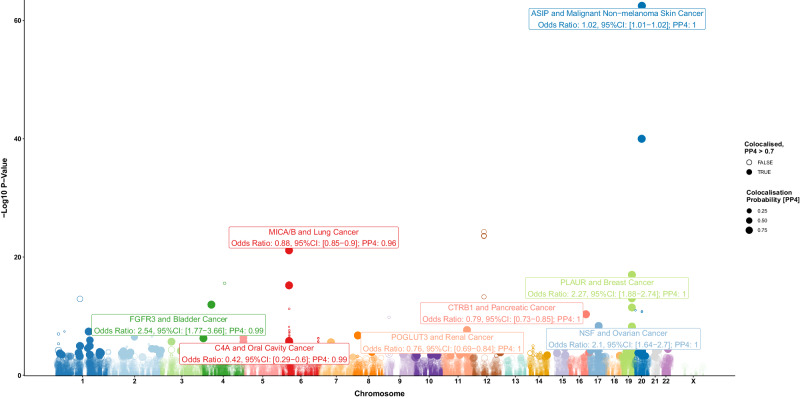
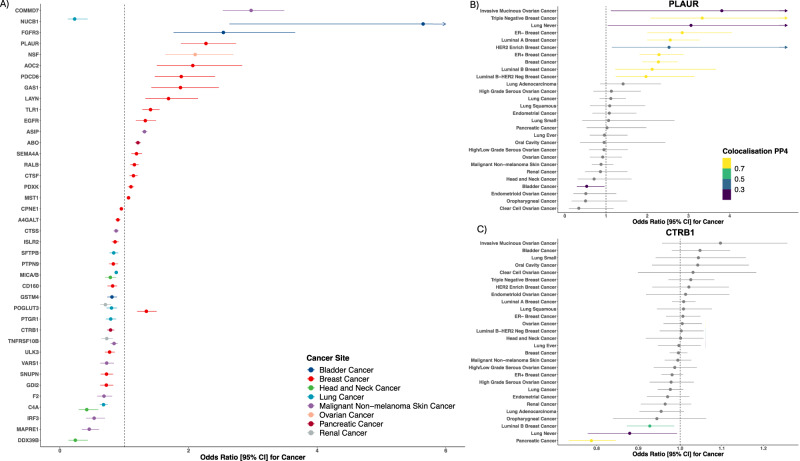
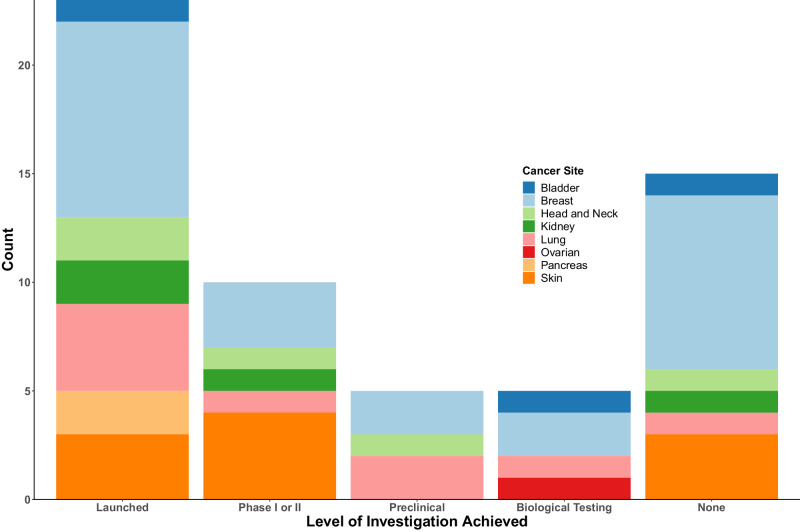
Circulating proteins can reveal key pathways to cancer and identify therapeutic targets for cancer prevention. We investigate 2,074 circulating proteins and risk of nine common cancers (bladder, breast, endometrium, head and neck, lung, ovary, pancreas, kidney, and malignant non-melanoma) using cis protein Mendelian randomisation and colocalization. We conduct additional analyses to identify adverse side-effects of altering risk proteins and map cancer risk proteins to drug targets. Here we find 40 proteins associated with common cancers, such as PLAUR and risk of breast cancer [odds ratio per standard deviation increment: 2.27, 1.88-2.74], and with high-mortality cancers, such as CTRB1 and pancreatic cancer [0.79, 0.73-0.85]. We also identify potential adverse effects of protein-altering interventions to reduce cancer risk, such as hypertension. Additionally, we report 18 proteins associated with cancer risk that map to existing drugs and 15 that are not currently under clinical investigation. In sum, we identify protein-cancer links that improve our understanding of cancer aetiology. We also demonstrate that the wider consequence of any protein-altering intervention on well-being and morbidity is required to interpret any utility of proteins as potential future targets for therapeutic prevention.
Overview
The claims and statistics of this paper haven’t been checked yet.
Free: it reads the open-access text and checks the first 5 claims that cite a source we can check. Create a free account to check every claim.
Integrity signals
Registry
Cites
Statistics
Figures
Verification
Claims the paper makes
The claims and statistics of this paper haven’t been checked yet.
Free: it reads the open-access text and checks the first 5 claims that cite a source we can check. Create a free account to check every claim.
Claims other papers make about this one
Each is checked against this paper’s own text: does it say what the citing paper says it does?
The source backs part of the claim, not all of it — or backs it for a different population, condition or comparison.
In the citing paper
“Key plasma protein databases, such as the UK Biobank Pharma Proteomics Project (UKB-PPP) and deCODE [12,13], offer valuable resources for identifying therapeutic targets and risk factors across various diseases, including cancer [14,15].”
From Identifying novel drug targets for calcific aortic valve disease through Mendelian randomization (2025) · cites this paper as [14]
Experimental — accuracy not yet measured
Self-check
Percentages, sums and reported differences re-computed from the paper’s own numbers.
The self-check needs the paper’s full text.
Citations
Cites
Tissue-based map of the human proteome
Uhlén, M., Fagerberg, L., Hallström, B. M., Lindskog, C., Oksvold, P., Mardinoglu, A., Sivertsson, Å., Kampf, C., Sjöstedt, E., Asplund, A., et al. (2015) · Science · doi:10.1126/science.1260419 · Cited by 15,286 · cited 1×
“GAS1 , which was associated with an increased risk of triple negative breast cancer (TNBC), is an essential co-receptor of hedgehog (Hh) signalling and speci fi cally expressed at high levels in healthy fi broblasts 41,42 .”
BackgroundThe MR-Base platform supports systematic causal inference across the human phenome
Hemani, G., Zheng, J., Elsworth, B., Wade, K. H., Haberland, V., Baird, D., Laurin, C., Burgess, S., Bowden, J., Langdon, R., et al. (2018) · eLife · doi:10.7554/elife.34408 · Cited by 7,959
Self-citationCOSMIC: the Catalogue Of Somatic Mutations In Cancer
Tate, J. G., Bamford, S., Jubb, H. C., Sondka, Z., Beare, D. M., Bindal, N., Boutselakis, H., Cole, C. G., Creatore, C., Dawson, E., et al. (2019) · Nucleic Acids Research · doi:10.1093/nar/gky1015 · Cited by 4,867
Giambartolomei, C., Vukcevic, D., Schadt, E. E., Franke, L., Hingorani, A. D., Wallace, C., & Plagnol, V. (2014) · PLoS Genetics · doi:10.1371/journal.pgen.1004383 · Cited by 4,261 · cited 1×
“All MR associations with p Wald 0.05 were subsequently evaluated for confounding by LD and the probability of a shared causal locus (PP4) between protein concentrations and cancer risk using two approaches: conventional colocalization 18,48 and conditional iterative colocalization 18 .”
MethodInfluentialFinnGen provides genetic insights from a well-phenotyped isolated population
Kurki, M. I., Karjalainen, J., Palta, P., Sipilä, T. P., Kristiansson, K., Donner, K. M., Reeve, M. P., Laivuori, H., Aavikko, M., Kaunisto, M. A., et al. (2023) · Nature · doi:10.1038/s41586-022-05473-8 · Cited by 4,233
Self-citationEffects of a combination of beta carotene and vitamin A on lung cancer and cardiovascular disease
Omenn, G. S., Goodman, G. E., Thornquist, M. D., Balmes, J., Cullen, M. R., Glass, A., Keogh, J. P., Meyskens, F. L., Valanis, B., Williams, J. H., et al. (1996) · New England Journal of Medicine · doi:10.1056/nejm199605023341802 · Cited by 3,638 · cited 1×
“In contrast, efforts to identify targets for the therapeutic prevention of cancer have been less fruitful, hampered by a more complex aetiology and dif fi culty identifying potential targetable aetiological biomarkers 4 .”
BackgroundA census of human cancer genes
Futreal, P. A., Coin, L., Marshall, M., Down, T., Hubbard, T., Wooster, R., Rahman, N., & Stratton, M. R. (2004) · Nature Reviews Cancer · doi:10.1038/nrc1299 · Cited by 3,184 · cited 2×
“Among other processes, EGFR has an established role in cell proliferation, migration and differentiation that facilitates the uncontrolled division of cancer epithelial cells 22 , including those in the mammary glands 20 .”
BackgroundHarbeck, N., Penault-Llorca, F., Cortes, J., Gnant, M., Houssami, N., Poortmans, P., Ruddy, K., Tsang, J., & Cardoso, F. (2019) · Nature Reviews Disease Primers · doi:10.1038/s41572-019-0111-2 · Cited by 3,024 · cited 1×
“Exceptionsincludetherapeuticallytargetingtheoestrogenreceptor(ER) to prevent breast cancer 5 and COX2 to prevent colorectal cancer in high-risk individuals 6 .”
BackgroundTrends in GPCR drug discovery: new agents, targets and indications
Hauser, A. S., Attwood, M. M., Rask-Andersen, M., Schiöth, H. B., & Gloriam, D. E. (2017) · Nature Reviews Drug Discovery · doi:10.1038/nrd.2017.178 · Cited by 2,627 · cited 1×
“Biochemical factors that contribute to a protein ’ s druggability include protein-class (membrane-bound 19,31 , or soluble and secreted ligands 32 , for example), current understanding of its pathophysiology and molecular function, its cellular location, and the presenceofdrugbindingsites.”
BackgroundLarge-scale integration of the plasma proteome with genetics and disease
Ferkingstad, E., Sulem, P., Atlason, B. A., Sveinbjornsson, G., Magnusson, M. I., Styrmisdottir, E. L., Gunnarsdottir, K., Helgason, A., Oddsson, A., Halldorsson, B. V., et al. (2021) · Nature Genetics · doi:10.1038/s41588-021-00978-w · Cited by 1,697
Cited by
Circulating Liquid Biopsy Biomarkers in Glioblastoma: Advances and Challenges
Seyhan, A. A. (2024) · International Journal of Molecular Sciences · doi:10.3390/ijms25147974 · Cited by 100
The role of polysaccharides in immune regulation through gut microbiota: mechanisms and implications
Zhao, T., Wang, C., Liu, Y., Li, B., Shao, M., Zhao, W., & Zhou, C. (2025) · Frontiers in Immunology · doi:10.3389/fimmu.2025.1555414 · Cited by 84
Liu, S., Zhou, Y., Li, G., Zhu, B., Wu, F., Zhou, J., Chen, X., Qin, B., Gao, Y., Wang, F., et al. (2025) · Advanced Science · doi:10.1002/advs.202507167 · Cited by 39
Hong, Y., Li, J., Xu, N., Shu, W., Chen, F., Mi, Y., Geng, H., & Li, Q. (2025) · Frontiers in Immunology · doi:10.3389/fimmu.2025.1604154 · Cited by 18
Adiposity and cancer: systematic review and meta-analysisPreprint
Watts, E. L., Gonzalez-Feliciano, A., Gunter, M. J., Chatterjee, N., & Moore, S. C. (2024) · medRxiv · doi:10.1101/2024.02.16.24302944 · Cited by 13
Identifying novel drug targets for calcific aortic valve disease through Mendelian randomization
Xu, D., Lu, J., Yang, Y., Hu, W., Chen, J., Xue, J., Yang, S., Cao, N., Hu, H., Qian, N., et al. (2025) · Atherosclerosis · doi:10.1016/j.atherosclerosis.2025.119110 · Cited by 10
Xie, M., Bao, M., Dong, X., Wu, L., Liu, L., Zhao, J., Chu, X., Wu, Y., Ji, X., Fang, Y., et al. (2025) · Signal Transduction and Targeted Therapy · doi:10.1038/s41392-025-02252-5 · Cited by 15
“41 The study has some limitations.”
Interstitial Lung Disease and Lung Cancer Associated with a Monoallelic Novel Variant in SFTPB
Wambach, J., Nogee, L. M., Spielberg, D. R., Cole, F. S., Roberts, D. M., Murphy, S. O., & Garcia, C. K. (2025) · American Journal of Respiratory and Critical Care Medicine · doi:10.1164/rccm.202412-2411rl · Cited by 7
Shedding light on the role of complement C4 activation in cancer
Cheung, D., Hassan, M. A., Huynh, T., Feng, X., & Wang, H. (2024) · Human Immunology · doi:10.1016/j.humimm.2024.111226 · Cited by 9
Expanding scope of genetic studies in the era of biobanks
Dutta, D., & Chatterjee, N. (2025) · Human Molecular Genetics · doi:10.1093/hmg/ddaf054 · Cited by 8
Zhao, R., Lu, H., Yuan, H., Chen, S., Xu, K., Zhang, T., Liu, Z., Jiang, Y., Suo, C., & Chen, X. (2025) · International Journal of Cancer · doi:10.1002/ijc.35518 · Cited by 10
“23 Despite these advancements, critical gaps remain.”
Quan, L., Luo, X., Meng, C., Liu, J., Ju, J., Yang, Z., Shuai, Y., Wei, T., Meng, J., & Yuan, P. (2025) · Communications Biology · doi:10.1038/s42003-025-08046-3 · Cited by 5
“Smith-Byrne et al. further explored potential causal linksbetween plasmaproteinsand breastcancerusing two-sample Mendelian randomization (TSMR) and colocalization analysis 16 .”
InfluentialPinto, R., Ferreira, D., Salamanca, P., Miguel, F., Borges, P., Barbosa, C., Costa, V., Lopes, C., Santos, L. L., & Pereira, L. (2025) · Scientific Reports · doi:10.1038/s41598-025-94707-6 · Cited by 5
“In a very recent study, GAS1 was found to be specifically associated with a higher risk of TNBC, probably through the maintenance of a chemotherapy-resistant BCSC phenotypes via paracrine signalling mediated by hedgehog (Hh)-activated cancer associated fibroblasts 59 .”
Liu, S., Su, J., Zhao, H., Bai, R., Zeng, L., Xue, C., Deng, S., Liu, S., Chen, Z., Xu, Z., et al. (2025) · Journal of Gastroenterology · doi:10.1007/s00535-025-02252-w · Cited by 3
Bioinformatics Strategies in Breast Cancer Research
Veneziano, M., Savini, I., Cortellesi, E., Gasperi, V., Gambacurta, A., & Catani, M. V. (2025) · Biomolecules · doi:10.3390/biom15101409 · Cited by 4
“The first study [88] analyzed associations between 2074 circulating proteins and the risk of nine common cancers in a cohort of 337,822 cancer cases.”
Lyu, Z., Si, G., Xing, M., Li, W., Gao, X., Wang, M., Song, F., & Chen, K. (2025) · PLoS Genetics · doi:10.1371/journal.pgen.1011821 · Cited by 3
“Protein S100-A4 (S100A4) was associated with a reduced risk of overall LC in the MR analysis and a decreased risk of LUSC in the population analysis, aligning with Smith-Byrne et al.’s reported protective effect (OR = 0.814) [61].”
InfluentialThe emerging role of high-throughput proteomics in advancing precision medicine
You, J., Deng, Y., Chen, L., Wang, L., Guo, Y., Li, Z.-Y., Feng, J., Yu, Y., & Cheng, W. (2026) · Science Bulletin · doi:10.1016/j.scib.2026.02.054 · Cited by 4
Integrating Mendelian randomization and literature-mined evidence for breast cancer risk factors
Vabistsevits, M., Robinson, T., Elsworth, B., Liu, Y., & Gaunt, T. R. (2025) · Journal of Biomedical Informatics · doi:10.1016/j.jbi.2025.104810 · Cited by 3
Proteomic and Genetic Insights into Ancestry‐Specific Associations in Parkinson's Disease
Lim, W. Y., Foo, J. N., Chew, E. G. Y., Lim, S., Tan, A. H., Hwang, L., MacGregor, S., Rentería, M. E., & Ong, J. (2026) · Movement Disorders · doi:10.1002/mds.70169 · Cited by 1
“Recent evidence indicates that genetic ancestry in fl uences protein expression, accounting for approximately 5% of the variance in circulating biomarkers.”
Tumor Genomics and Liquid Biopsy in Cancer Biology: From Static Snapshots to Dynamic Measurements
Urbini, M. (2026) · Biomolecules · doi:10.3390/biom16030384 · Cited by 1
Automatic Blood Protein Enrichment by Magnetic-COF Polymers
Huang, Y., Lih, T. M., Sun, Z., Jiao, L., Chen, L., & Zhang, H. (2026) · Analytical Chemistry · doi:10.1021/acs.analchem.5c08111 · Cited by 1
Proteogenomics in human populations
Zhai, R., Mälarstig, A., & Shen, X. (2026) · Nature Reviews Genetics · doi:10.1038/s41576-026-00998-4 · Cited by 2
Self-citationMendelian randomization study of the association between cathepsins and melanoma
Wang, W., & Li, J. (2024) · World Academy of Sciences Journal · doi:10.3892/wasj.2024.262
“Serum markers possess advantages, such as easy detection, minimal patient trauma and a low cost, rendering them markedly advantageous for the early screening and follow‑up care of patients with cancer, and they are also a current focus and priority of research (39,40).”
BackgroundLi, S., Wu, S., Jiang, M., Shao, Z., Kong, Y., Guan, Y., Cao, X., & Hao, X. (2025) · Research Square · doi:10.21203/rs.3.rs-5883069/v1
Huang, D., Zhai, J., Yang, M., Xiong, W. G., Wang, H., Bai, Y., Yuan, J., Wang, Q., Zheng, B., Liu, J., et al. (2025) · iMetaOmics. · doi:10.1002/imo2.70032
“These studies identified several novel potential drug targets and biomarkers for breast cancer, such as AOC2 , SPN1 , CD160 , and RALB [17, 18].”
Beckner, M. E. (2025) · bioRxiv (Cold Spring Harbor Laboratory) · doi:10.1101/2025.06.29.662144
Beckner, M. E. (2025) · Biomolecules · doi:10.3390/biom15081177
Leveraging and partitioning polygenic risk scores to identify cancer-related proteinsPreprint
Dutta, D., Zhang, J., Guo, X., Machiela, M. J., Brown, K., Coresh, J., Battle, A. J., Platz, E. A., & Chatterjee, N. (2025) · medRxiv · doi:10.1101/2025.11.23.25340827
Zheng, F., Zeng, Y., Liao, Y.-X., Huang, H., Liu, Y., Jin, L., Chen, J., Zhong, X., Lim, J.-Y., Wu, X., et al. (2026) · Bioorganic Chemistry · doi:10.1016/j.bioorg.2026.109691 · Cited by 1
Zhou, Z., Zhou, L., Qu, C., Fan, C., Qu, H.-H., Li, J., Cheng-xia, W., Wang, W., Bao, X.-H., & Li, J.-Y. (2026) · Cardiovascular Diabetology · doi:10.1186/s12933-026-03273-2
“As a blood-based biomarkers, circulating proteins could function as the direct biological effectors of risk factors from genetic and environmental aspects, as well as the targets for medical intervention [10, 11].”
Wang, C., Sun, B., Chen, S., Kong, W., Yin, Z., Zhong, F., He, Y., Wang, H., Wei, L., Li, J., et al. (2026) · BMC Cancer · doi:10.1186/s12885-026-16635-6
“Although direct targeting of secreted calcium-binding proteins remains technically challenging, emerging therapeutic strategies, including neutralizing antibodies and small-molecule inhibitors, may provide feasible approaches for further translational investigation [43, 44].”
Dutta, D., Zhang, J., Guo, X., Quint, R., Rooney, M. R., Machiela, M. J., Brown, K. M., Coresh, J., Battle, A. J., Platz, E. A., et al. (2026) · Cell Genomics · doi:10.1016/j.xgen.2026.101322
“Smith-Byrne et al. 21 recently applied cis -MR to prioritize putatively causal proteins for nine cancers, leveraging cis -pQTL instruments for plasma proteins measured on Olink and SomaLogic platforms.”
Lee, M. A., Viallon, V., Muller, D. C., Wang, Z., Murphy, N., Yarmolinsky, J. W., Cross, A. J., Ferrari, P., Jakszyn, P. G., Jenab, M., et al. (2026) · medRxiv · doi:10.64898/2026.10.05.26364761
Self-citation
Metadata
- Authors
- Smith-Byrne, K., Hedman, Å., Dimitriou, M., Desai, T., Sokolov, A. V., Schioth, H. B., Koprulu, M., Pietzner, M., Langenberg, C., Atkins, J., Penha, R. C., McKay, J., Brennan, P., Zhou, S., Richards, B. J., Yarmolinsky, J., Martin, R. M., Borlido, J., Mu, X. J., Butterworth, A., Shen, X., Wilson, J., Assimes, T. L., Hung, R. J., Amos, C., Purdue, M., Rothman, N., Chanock, S., Travis, R. C., Johansson, M., & Mälarstig, A.
- Affiliations
- University of Oxford (GB)
- Karolinska Institutet (SE)
- Uppsala University (SE)
- University of Cambridge (GB)
- Queen Mary University of London (GB)
- Centre international de recherche sur le cancer (FR)
- McGill University (CA)
- University of Bristol (GB)
- Pfizer (United States) (US)
- MRC Human Genetics Unit (GB)
- Stanford University (US)
- University of Toronto (CA)
- Baylor College of Medicine (US)
- National Cancer Institute (US)
- Corresponding author
- Smith-Byrne, Karl
- ORCID
- Smith-Byrne, Karl
- Hedman, Åsa
- Dimitriou, Marios
- Desai, Trishna
- Koprulu, Mine
- Pietzner, Maik
- Langenberg, Claudia
- Atkins, Joshua
- Penha, Ricardo Cortez
- McKay, James
- Brennan, Paul
- Zhou, Sirui
- Richards, Brent J.
- Yarmolinsky, James
- Martin, Richard M.
- Borlido, Joana
- Mu, Xinmeng J.
- Butterworth, Adam
- Shen, Xia
- Assimes, Themistocles L.
- Hung, Rayjean J.
- Amos, Christopher
- Purdue, Mark
- Rothman, Nathaniel
- Chanock, Stephen
- Travis, Ruth C.
- Johansson, Mattias
- Mälarstig, Anders
- Venue
- Nature Communications
- Published
- 2024-04-29
- Volume
- 15
- Issue
- 1
- Pages
- 3621-3621
- ISSN
- 2041-1723 (ISSN-L)
- PMC
- PMC11059161
- OpenAlex
- W4396219359
- Cited by
- 33
- References
- 63
- Citations by year
- 2026: 10 · 2025: 19 · 2024: 4
- FWCI
- 8.73
- Type
- journal article
- Language
- en
- Open access
- gold
- doi.org
- Licence
- cc-by
- creativecommons.org/licenses/by/4.0 (tdm)
- creativecommons.org/licenses/by/4.0 (vor)
- Locations
- Nature Communications (publishedVersion, cc-by)
- medRxiv (acceptedVersion, cc-by-nd)
- PubMed Central (publishedVersion, cc-by)
- PubMed (publishedVersion)
- Explore Bristol Research (publishedVersion, cc-by)
- Uppsala University Publications (Uppsala University) (submittedVersion, cc-by)
- Apollo (University of Cambridge) (submittedVersion, cc-by)
- RePEc: Research Papers in Economics (submittedVersion)
- DOAJ (DOAJ: Directory of Open Access Journals) (submittedVersion)
- Edinburgh Research Explorer (University of Edinburgh) (submittedVersion, cc-by)
- Queen Mary Research Online (Queen Mary University of London) (submittedVersion, cc-by)
- Bristol Research (University of Bristol) (submittedVersion, cc-by)
- Funders
- Cancer Research UK (C8221/A29017)
- Topics
- Life Sciences › Biochemistry, Genetics and Molecular Biology › Genetics › Genetic Associations and Epidemiology
- Life Sciences › Biochemistry, Genetics and Molecular Biology › Cancer Research › Cancer Genomics and Diagnostics
- Life Sciences › Biochemistry, Genetics and Molecular Biology › Molecular Biology › Bioinformatics and Genomic Networks
- Keywords
- circulating proteins, cancer risk, therapeutic target, cancer prevention, bladder cancer, breast cancer, pancreatic cancer, kidney cancer, non-melanoma skin cancer, head and neck cancer, endometrial cancer, lung cancer, hypertension, adverse effects, PLAUR
- MeSH terms
- Blood Proteins, Female, Humans, Male, Neoplasms, Risk Factors, Biomarkers, Tumor, Mendelian Randomization Analysis
About these checks
Registry, retraction, Cites and statistics results are computed, not judged, with one exception: a printed reference that no index lists is read once by a model before it counts as a citation error. Claims are extracted by a model and kept only when their quote appears verbatim in the text; each cited source is then checked, with a model’s help, for whether it says what the claim relies on. Those verdicts can be wrong — read the claim’s quote and the cited source before relying on one.
Statistics and arithmetic are recomputed, not judged.
Confidence bands are shown only for fields calibrated on our annotated test set. None is calibrated yet, so no band is shown.
What counts as a claim ›How we measure confidence ›How we check this ›
Are you an author, or do you see a problem with this page? Request a review
Data sources
Bibliographic data: Semantic Scholar, OpenAlex, Crossref.
Contains information from the Semantic Scholar Academic Graph Datasets, made available under the ODC Attribution License (ODC-BY 1.0).
Semantic Scholar’s data is described in: Kinney, R., et al. (2023). The Semantic Scholar Open Data Platform. arXiv:2301.10140.
