

Stretchable glove for accurate and robust hand pose reconstruction based on comprehensive motion data
The DOI matches its Crossref record; 46 of the 46 references it cites were found in a registry or an index.
Abstract
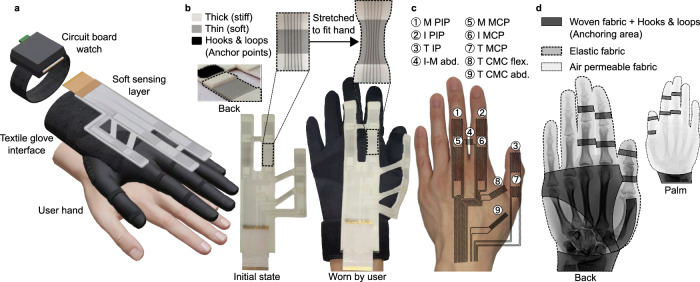
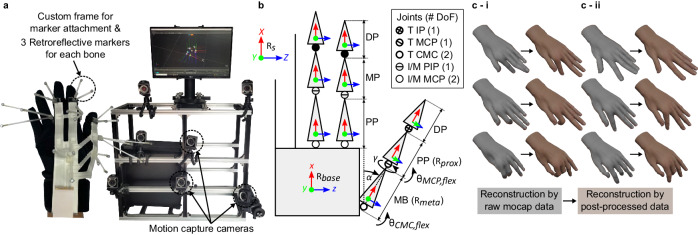
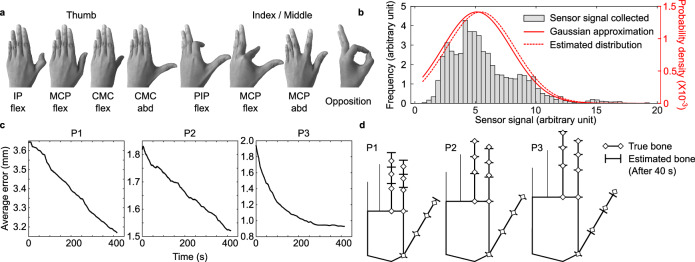
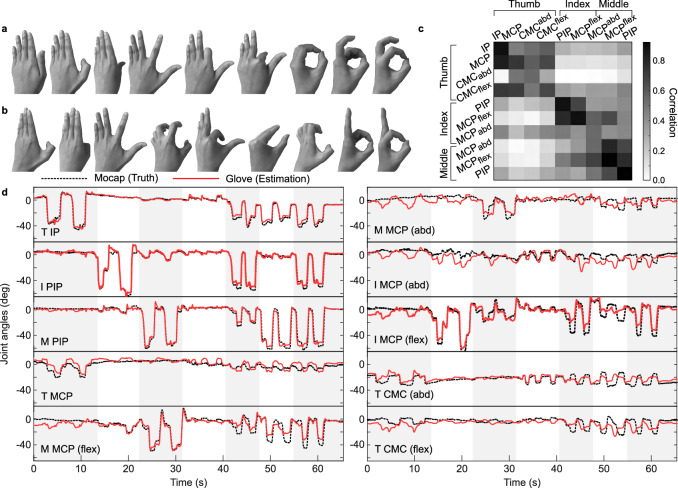
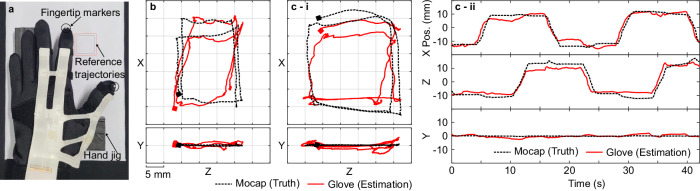
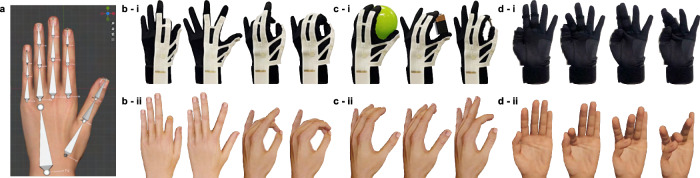
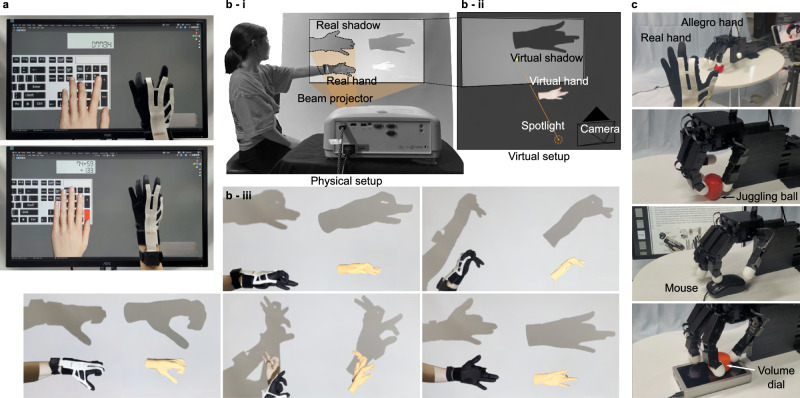
We propose a compact wearable glove capable of estimating both the finger bone lengths and the joint angles of the wearer with a simple stretch-based sensing mechanism. The soft sensing glove is designed to easily stretch and to be one-size-fits-all, both measuring the size of the hand and estimating the finger joint motions of the thumb, index, and middle fingers. The system was calibrated and evaluated using comprehensive hand motion data that reflect the extensive range of natural human hand motions and various anatomical structures. The data were collected with a custom motion-capture setup and transformed into the joint angles through our post-processing method. The glove system is capable of reconstructing arbitrary and even unconventional hand poses with accuracy and robustness, confirmed by evaluations on the estimation of bone lengths (mean error: 2.1 mm), joint angles (mean error: 4.16°), and fingertip positions (mean 3D error: 4.02 mm), and on overall hand pose reconstructions in various applications. The proposed glove allows us to take advantage of the dexterity of the human hand with potential applications, including but not limited to teleoperation of anthropomorphic robot hands or surgical robots, virtual and augmented reality, and collection of human motion data.
Overview
The claims and statistics of this paper haven’t been checked yet.
Free: it reads the open-access text and checks the first 5 claims that cite a source we can check. Create a free account to check every claim.
Integrity signals
Registry
Cites
Statistics
Figures
Verification
Claims the paper makes
The claims and statistics of this paper haven’t been checked yet.
Free: it reads the open-access text and checks the first 5 claims that cite a source we can check. Create a free account to check every claim.
Claims other papers make about this one
Each is checked against this paper’s own text: does it say what the citing paper says it does?
The cited source doesn’t support the claim as written.
In the citing paper
“These on-hand error levels are comparable with those reported by studies with sensors mounted on a wearable glove (Khanna, Oppenheim et al. [11] used electromagnetic sensors and reported a mean root mean square (RMS) error of 6.91 degrees, and Park et al. [9] used liquid metal strain sensors and reported a mean error of 4.61 degrees in calibrated and ~10.5 degrees in non-calibrated applications).”
From A Low-Cost, Accurate, and Easily-Worn E-Skin and IMU Hand Kinematic Measurement System (2026) · cites this paper as [9]
Checked by a reasoning model — may be wrong.
Experimental — accuracy not yet measuredIn the citing paper
“While many hand-tracking technologies have been developed, most are in the form of a glove that can be difficult for people with movement impairments to don/doff and impedes sensation [9,10,11,12,13]”
From A Low-Cost, Accurate, and Easily-Worn E-Skin and IMU Hand Kinematic Measurement System (2026) · cites this paper as [9]
Self-check
Percentages, sums and reported differences re-computed from the paper’s own numbers.
The self-check needs the paper’s full text.
Citations
Cites
Highly Stretchable and Sensitive Strain Sensor Based on Silver Nanowire–Elastomer Nanocomposite
Amjadi, M., Pichitpajongkit, A., Lee, S., Ryu, S., & Park, I. (2014) · ACS Nano · doi:10.1021/nn501204t · Cited by 2,350
On grasp choice, grasp models, and the design of hands for manufacturing tasks
Cutkosky, M. R. (1989) · IEEE Transactions on Robotics and Automation · doi:10.1109/70.34763 · Cited by 1,513
Dickey, M. D., Chiechi, R. C., Larsen, R. J., Weiss, E. A., Weitz, D. A., & Whitesides, G. M. (2008) · Advanced Functional Materials · doi:10.1002/adfm.200701216 · Cited by 1,468
Vision-based hand pose estimation: A review
Erol, A., Bebis, G., Nicolescu, M., Boyle, R. D., & Twombly, X. (2007) · Computer Vision and Image Understanding · doi:10.1016/j.cviu.2006.10.012 · Cited by 866
Design and Fabrication of Soft Artificial Skin Using Embedded Microchannels and Liquid Conductors
Park, Y.-L., Chen, B.-R., & Wood, R. J. (2012) · IEEE Sensors Journal · doi:10.1109/jsen.2012.2200790 · Cited by 776
Self-citationOn Particle Methods for Parameter Estimation in State-Space Models
Kantas, N., Doucet, A., Singh, S. S., Maciejowski, J. M., & Chopin, N. (2015) · Statistical Science · doi:10.1214/14-sts511 · Cited by 593
Cotation clinique de l'opposition et de la contre-opposition du pouce
Kapandji, A. (1986) · Annales de Chirurgie de la Main · doi:10.1016/s0753-9053(86)80053-9 · Cited by 577
Monte Carlo maximum likelihood estimation for non-Gaussian state space models
Durbin, J. (1997) · Biometrika · doi:10.1093/biomet/84.3.669 · Cited by 429
Euler–Rodrigues formula variations, quaternion conjugation and intrinsic connections
Dai, J. S. (2015) · Mechanism and Machine Theory · doi:10.1016/j.mechmachtheory.2015.03.004 · Cited by 367
Gu, X., Zhang, Y., Sun, W., Bian, Y., Zhou, D., & Kristensson, P. O. (2016) · Proceedings of the 2016 CHI Conference on Human Factors in Computing Systems · doi:10.1145/2858036.2858487 · Cited by 327 · cited 1×
“Glove-type soft wearable sensors have an advantage in hand motion sensing over other types of sensing methods as they are not limited by occlusion, strictly controlled environment 11,41 , or bulky and rigid components 42,43 .”
Background
Research works printed but not linked: 22
- Handa, A. et al. Dexpilot: vision-based teleoperation of dexterous robotic hand-arm system. In Proc. IEEE International Conference on Robotics and Automation (ICRA). 9164–9170 (Paris, France, IEEE, 2020). · DOI · Paper page
- Kim, Y., Kim, P. C. W., Selle, R. Shademan, A. & Krieger, A. Experimental evaluation of contact-less hand tracking systems for tele-operation of surgical tasks. In Proc. IEEE International Conference on Robotics and Automation (ICRA). 3502–3509 (Hong Kong, China, IEEE, 2014). · doi:10.1109/icra.2014.6907364
- Connolly J Condell J O’Flynn B Snachez JT Gardiner P IMU sensor-based electronic goniometric glove for clinical finger movement analysis IEEE Sens. J. 2017 18 1273 1281
- Miyata, N., Kouchi, M., Kurihara, T. & Mochimaru, M. Modeling of human hand link structure from optical motion capture data. In Proc. IEEE/RSJ International Conference on Intelligent Robots and Systems (IROS). 2129–2135 (Sendai, Japan, IEEE, 2004). · DOI
- Chossat, J.-B. Tao, Y., Duchaine, V. & Park, Y.-L. Wearable soft artificial skin for hand motion detection with embedded microfluidic strain sensing. In Proc. IEEE International Conference on Robotics and Automation (ICRA). 2568–2573 (Seattle, WA, USA, IEEE, 2015). · DOI · Paper page
- Sarakoglou, I, et al. Hexotrac: A highly under-actuated hand exoskeleton for finger tracking and force feedback. In Proc. IEEE/RSJ International Conference on Robotics and Automation (IROS).1033–1040 (Daejeon, Korea, IEEE, 2016). · doi:10.1109/iros.2016.7759176
- Chen, K.-Y. Patel, S. N. & Keller, S. Finexus: tracking precise motions of multiple fingertips using magnetic sensing. In Proc. 2016 CHI Conference on Human Factors in Computing Systems. 1504–1514 (San Jose, CA, USA, ACM SIGCHI, 2016). · DOI
- Schubert, T. et al. Automatic bone parameter estimation for skeleton tracking in optical motion capture. In Proc. IEEE International Conference on Robotics and Automation (ICRA). 5548–5554 (Stockholm, Sweden, IEEE, 2016). · DOI
- Yuan, S. Ye, Q., Stenger, B., Jain, S. & Kim, T. K. Bighand2. 2m benchmark: hand pose dataset and state of the art analysis. In Proc. IEEE Conference on Computer Vision and Pattern Recognition. 4855–4874 (Honolulu, HI, USA, IEEE, 2017). · DOI · Paper page
- Rhiu, I. & Kim W. Estimation of stature from finger and phalange lengths in a Korean adolescent. J. Physiol. Anthropol. 38, 13 (2019). PMC6805475 31640812 · doi:10.1186/s40101-019-0206-1
- DeMers, D. & Kreutz-Delgado K. Neural Systems for Robotics, Inverse Kinematics of Dextrous Manipulators (Academic Press, Cambridge, 1997). · DOI
- Samadani, A.-A., Kulić, D. & Gorbet, R. Multi-constrained inverse kinematics for the human hand. In Proc. Annual International Conference of the IEEE Engineering in Medicine and Biology Society (EMBC). 6780–6784 (San Diego, CA, USA, IEEE, 2012). 23367486 · doi:10.1109/embc.2012.6347551
- Wise, S. et al. Evaluation of a fiber optic glove for se-automated goniometric measurements. J. Rehabil. Res. Dev. 27, 4 (1990). 2089151 · DOI
- Wetzler, A. Slossberg, R. & Kimmel, R. Rule of thumb: deep derotation for improved fingertip detection. Preprint at https://arxiv.org/abs/1507.05726 (2015). · DOI
- Liu, Q. et al. A new IMMU-based data glove for hand motion capture with optimized sensor layout. Int. J. Intell. Rob. Appl. 3, 19–32 (2019). · DOI
- Hoyet, L. Ryall, K., McDonnell, R. & O’Sullivan, C. Sleight of hand: perception of finger motion from reduced marker sets. In Proc. ACM SIGGRAPH Symposium on Interactive 3D Graphics and Games.79–86 (Costa Mesa, CA, USA, ACM SIGGRAPH, 2012). · DOI
- Supancic, J. S., Rogez, G., Yang, Y., Shotton, J. & Ramanan, D. Depth-based hand pose estimation: data, methods, and challenges. In Proc. IEEE International Conference on Computer Vision. 1868–1876 (Santiago, Chile, IEEE, 2015). · DOI · Paper page
- Stone, J. V. Bayes’ Rule: A Tutorial Introduction to Bayesian Analysis (Sebtel Press, 2013).
- Tilley, A. R. The Measure of Man and Woman: Human Factors in Design (John Wiley & Sons, Hoboken, New Jersey, 2001).
- Ryu HS Choi HS Kim EK A study on the wearing conditions of golf gloves and a proposal for functional glove design J. Korean Home Econ. Assoc. 2004 42 89 101
- Bullock, I. M. Borràs, J. & Dollar, A. M. Assessing assumptions in kinematic hand models: a review. In Proc. IEEE RAS EMBS 10th International Conference on Biomedical Robotics and Biomechatronics (BioRob). 139–146 (Rome, Italy, IEEE, 2012). · DOI
- Lin, J., Wu, U. & Hwang, T. S. Modeling the constraints of human hand motion. In Proc. Workshop on Human Motion. 121–126 (Austin, TX, USA, IEEE, 2000).
Cited by
A Low-Cost, Accurate, and Easily-Worn E-Skin and IMU Hand Kinematic Measurement System
Oppenheim, T., Schlegel, H., Xie, P. Y., Khokhar, Z., & Khanna, P. (2026) · Sensors · doi:10.3390/s26154795
Metadata
- Authors
- Park, M., Park, T., Park, S., Yoon, S. J., Koo, S. H., & Park, Y.-L.
- Venue
- Nature Communications
- Published
- 2024-07-11
- Volume
- 15
- Issue
- 1
- ISSN
- 2041-1723
- PMC
- PMC11237015
- Cited by
- 58
- References
- 46
- Language
- en
- Licence
- creativecommons.org/licenses/by/4.0 (tdm)
- creativecommons.org/licenses/by/4.0 (vor)
- Funders
- National Research Foundation of Korea (RS-2023-00208052)
- Ministry of Trade, Industry and Energy (20008912)
- Ministry of Science, ICT and Future Planning (2021-0-00896)
About these checks
Registry, retraction, Cites and statistics results are computed, not judged, with one exception: a printed reference that no index lists is read once by a model before it counts as a citation error. Claims are extracted by a model and kept only when their quote appears verbatim in the text; each cited source is then checked, with a model’s help, for whether it says what the claim relies on. Those verdicts can be wrong — read the claim’s quote and the cited source before relying on one.
Statistics and arithmetic are recomputed, not judged.
Confidence bands are shown only for fields calibrated on our annotated test set. None is calibrated yet, so no band is shown.
What counts as a claim ›How we measure confidence ›How we check this ›
Are you an author, or do you see a problem with this page? Request a review
Data sources
Bibliographic data: Semantic Scholar, OpenAlex, Crossref.
Contains information from the Semantic Scholar Academic Graph Datasets, made available under the ODC Attribution License (ODC-BY 1.0).
Semantic Scholar’s data is described in: Kinney, R., et al. (2023). The Semantic Scholar Open Data Platform. arXiv:2301.10140.
