

HER2-related biomarkers predict clinical outcomes with trastuzumab deruxtecan treatment in patients with HER2-expressing metastatic colorectal cancer: biomarker analyses of DESTINY-CRC01
Open accessThe DOI matches its Crossref record; 31 of the 31 references it cites were found in a registry or an index.
Abstract
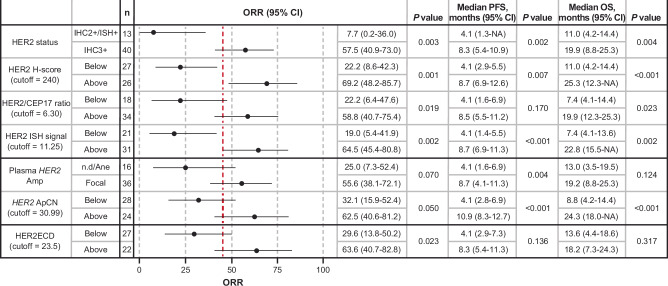
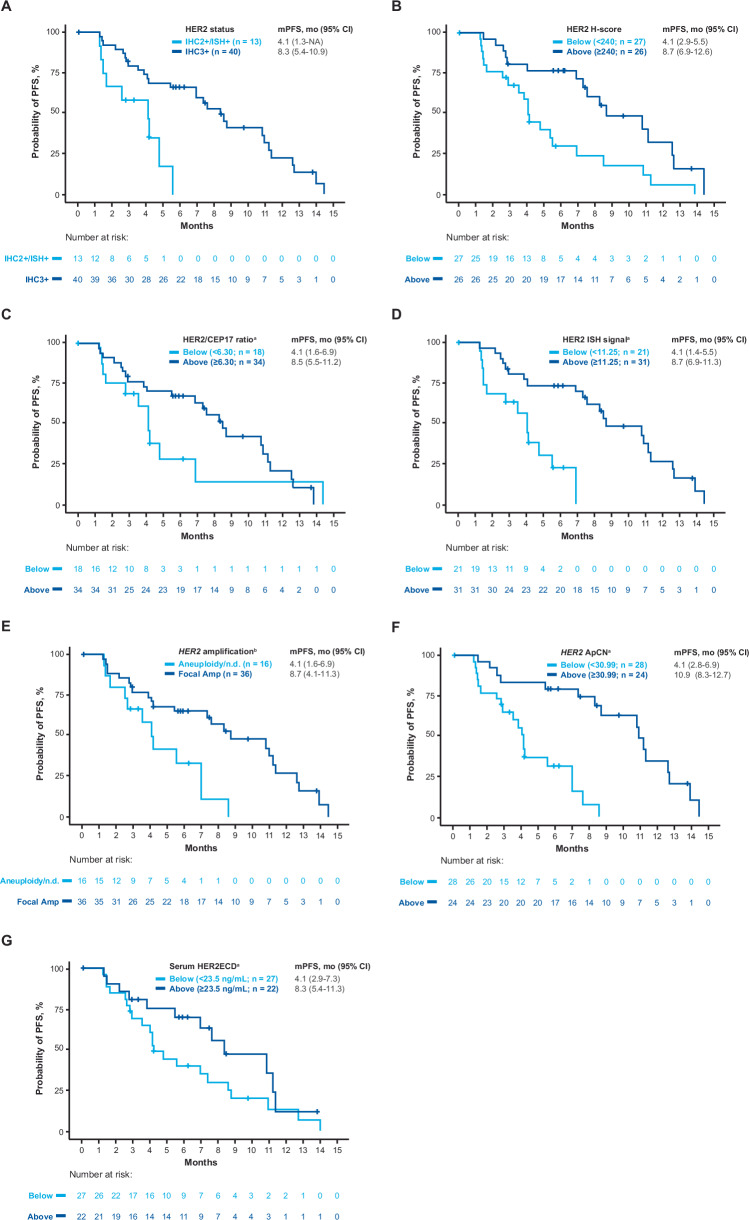
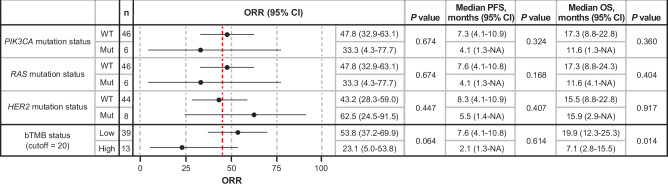
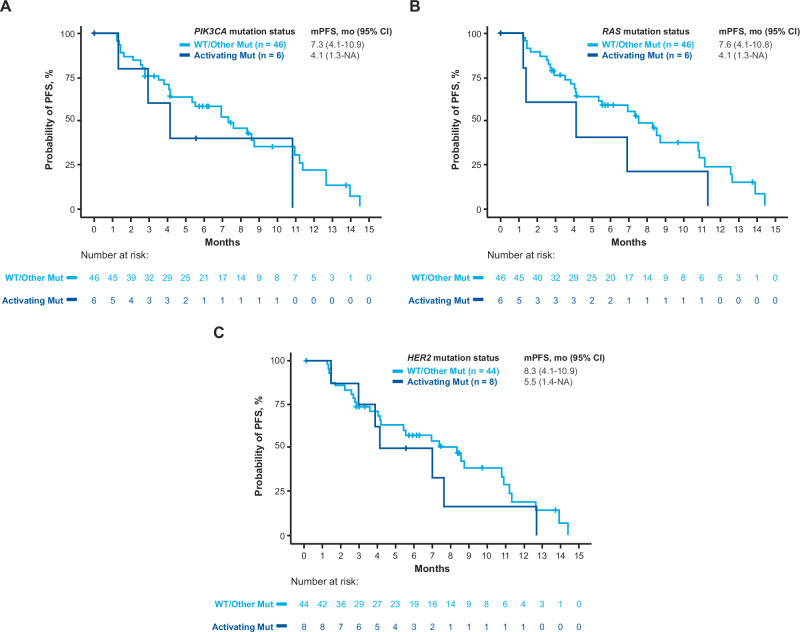
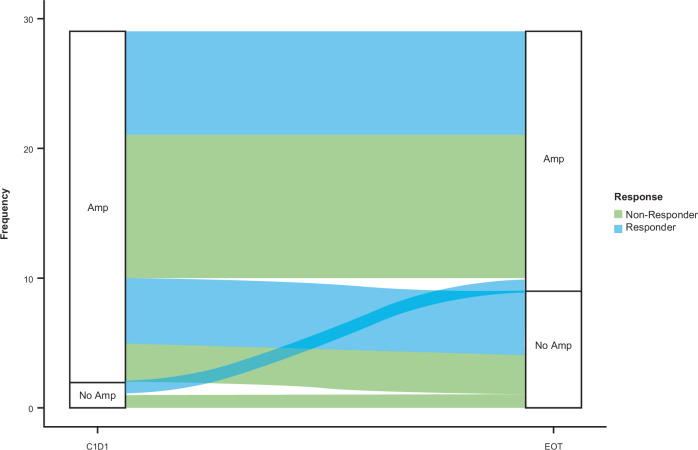
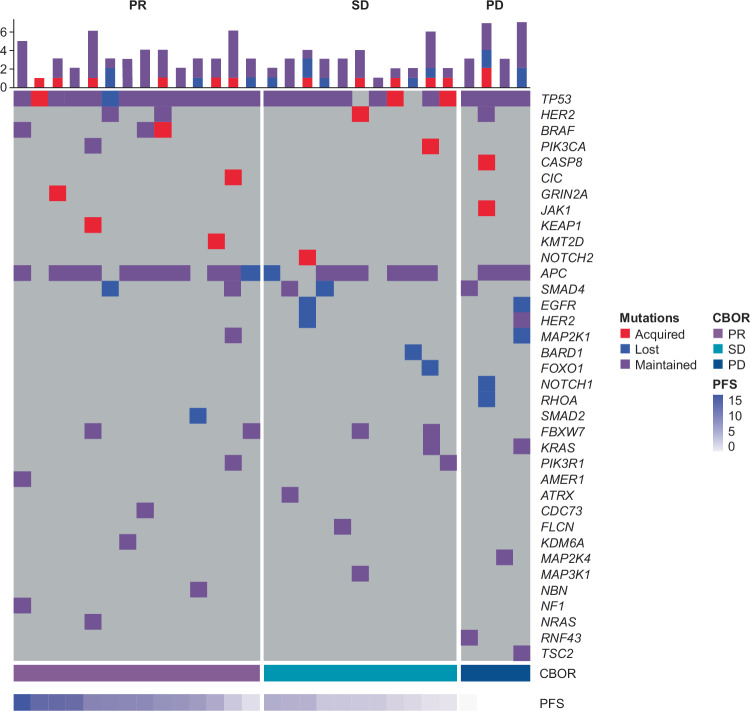
DESTINY-CRC01 (NCT03384940) was a multicentre, open-label, phase 2 study that investigated the safety and efficacy of trastuzumab deruxtecan (T-DXd) in patients with human epidermal growth factor receptor 2 (HER2)-expressing metastatic colorectal cancer (CRC). The present exploratory biomarker analysis aims to investigate relationships between biomarkers and clinical outcomes in patients with HER2-positive (immunohistochemistry [IHC] 3+ or IHC 2+ and in situ hybridization [ISH] positive) Cohort A (N = 53) of DESTINY-CRC01. Higher levels of HER2 biomarkers in baseline tissue and liquid biopsies, including HER2 status (IHC/ISH), HER2/CEP17 ratio, HER2 ISH signals, HER2 H-score, plasma HER2 (ERBB2) amplification status, HER2 adjusted plasma copy number, and HER2 extracellular domain correlate with antitumor activity (indicated by objective response rate, progression-free survival, and overall survival) of T-DXd. Baseline circulating tumor DNA (ctDNA) analysis suggests antitumor activity of T-DXd in patients who had baseline activating RAS, PIK3CA, or HER2 mutations detected in ctDNA. The phase 2 trial, DESTINYCRC01, previously demonstrated durable activity of trastuzumab deruxtecan (T-DXd) in patients with HER2-positive metastatic colorectal cancer refractory to standard treatment. Here, the authors report the exploratory analysis of the DESTINY-CRC01 trial investigating markers of response or resistance to T-DXd.
Overview
The claims and statistics of this paper haven’t been checked yet.
Free: it reads the open-access text and checks the first 5 claims that cite a source we can check. Create a free account to check every claim.
Integrity signals
Registry
Cites
Statistics
Figures
Verification
Claims the paper makes
The claims and statistics of this paper haven’t been checked yet.
Free: it reads the open-access text and checks the first 5 claims that cite a source we can check. Create a free account to check every claim.
Claims other papers make about this one
Each is checked against this paper’s own text: does it say what the citing paper says it does?
The cited source says what the claim attributes to it.
In the citing paper
“Clinical trials such as HERACLES [60], MyPathway [61], DESTINY-CRC01 [59], and MOUNTAINEER [62] have demonstrated significant clinical activity of HER2-targeted therapies in patients with HER2-positive, RAS-wild-type mCRC.”
From Overcoming Resistance to Anti-EGFR Therapies: Mechanisms of Cetuximab and Panitumumab Resistance and Emerging Combination Strategies (2026) · cites this paper as [59]
Self-check
Percentages, sums and reported differences re-computed from the paper’s own numbers.
The self-check needs the paper’s full text.
Citations
Cites
Sung, H., Ferlay, J., Siegel, R. L., Laversanne, M., Soerjomataram, I., Jemal, A., & Bray, F. (2021) · CA: A Cancer Journal for Clinicians · doi:10.3322/caac.21660 · Cited by 108,699
Trastuzumab Deruxtecan in Previously Treated HER2-Low Advanced Breast Cancer
Modi, S., Jacot, W., Yamashita, T., Sohn, J., Vidal, M., Tokunaga, E., Tsurutani, J., Ueno, N. T., Prat, A., Chae, Y. S., et al. (2022) · New England Journal of Medicine · doi:10.1056/nejmoa2203690 · Cited by 2,664
Emergence of KRAS mutations and acquired resistance to anti-EGFR therapy in colorectal cancer
Misale, S., Yaeger, R., Hobor, S., Scala, E., Janakiraman, M., Liska, D., Valtorta, E., Schiavo, R., Buscarino, M., Siravegna, G., et al. (2012) · Nature · doi:10.1038/nature11156 · Cited by 1,889 · cited 1×
“These are likely acquired mutations because all 6 patients had received anti-EGFR antibody therapy (4 cetuximab, 1 panitumumab, 1 cetuximab and panitumumab) prior to T-DXd treat-ment and acquired RAS mutations are a known resistance mechanism to EGFR inhibitors 28 .”
Self-citationCervantes, A., Adam, R., Roselló, S., Arnold, D., Normanno, N., Taïeb, J., Seligmann, J., De Baere, T., Osterlund, P., Yoshino, T., et al. (2023) · Annals of Oncology · doi:10.1016/j.annonc.2022.10.003 · Cited by 1,796 · cited 1×
“Dual HER2 blockade is therefore considered a treatment option for patients with HER2-positive mCRC, especially those with RAS wild-type tumors 17 .”
Self-citationOgitani, Y., Aida, T., Hagihara, K., Yamaguchi, J., Ishii, C., Harada, N., Soma, M., Okamoto, H., Oitate, M., Arakawa, S., et al. (2016) · Clinical Cancer Research · doi:10.1158/1078-0432.ccr-15-2822 · Cited by 1,177 · cited 1×
“…deruxtecan (T-DXd) is an antibody-drug conjugate composed of a humanized immunoglobulin G1 monoclonal antibody speci fi cally targeting HER2, a tetrapeptide-based cleavable linker, and a potent topoisomerase I inhibitor payload; the antibody has the same amino acid sequence as trastuzumab 18,19 .”
Sartore-Bianchi, A., Trusolino, L., Martino, C., Bencardino, K., Lonardi, S., Bergamo, F., Zagonel, V., Leone, F., Depetris, I., Martinelli, E., et al. (2016) · The Lancet Oncology · doi:10.1016/s1470-2045(16)00150-9 · Cited by 1,016 · cited 1×
“Similar fi ndings were previously reported in the HERACLES-A trial of trastuzumab and lapatinib dual-targeted therapy, inwhichpatientswithahigher HER2 copynumberachievedlongerPFS and OS 24 , and patients with a higher HER2 ApCN achieved higher ORR and longer PFS 25 .”
Self-citationOgitani, Y., Hagihara, K., Oitate, M., Naito, H., & Agatsuma, T. (2016) · Cancer Science · doi:10.1111/cas.12966 · Cited by 751 · cited 2×
“The T-DXd bystander effect that kills adjacent tumor and stromal cells, has been described, with no potential overlapping mechanisms of resistance with the HER2 signaling pathway 19,31 .”
Treatment of Metastatic Colorectal Cancer: ASCO Guideline
Morris, V. K., Kennedy, E. B., Baxter, N. N., Benson, A. B., Cercek, A., Cho, M., Ciombor, K. K., Cremolini, C., Davis, A., Deming, D. A., et al. (2023) · Journal of Clinical Oncology · doi:10.1200/jco.22.01690 · Cited by 682
Meric-Bernstam, F., Hurwitz, H., Raghav, K. P. S., McWilliams, R. R., Fakih, M., VanderWalde, A., Swanton, C., Kurzrock, R., Burris, H., Sweeney, C., et al. (2019) · The Lancet Oncology · doi:10.1016/s1470-2045(18)30904-5 · Cited by 573 · cited 14×
“For analysis of single nucleotide variants and insertion/deletion mutations, PIK3CA variants were determined according to published data 34 .”
InfluentialSelf-citationStrickler, J. H., Cercek, A., Siena, S., André, T., Ng, K., Van Cutsem, E., Wu, C., Paulson, A. S., Hubbard, J. M., Coveler, A. L., et al. (2023) · The Lancet Oncology · doi:10.1016/s1470-2045(23)00150-x · Cited by 259 · cited 1×
“15 .”
Self-citation
Cited by
Cancer in a drop: Advances in liquid biopsy in 2024
Borea, R., Saldanha, E. F., Maheswaran, S., Nicolò, E., Singhal, S., Pontolillo, L., de Miguel‐Pérez, D., Venetis, K., Dipasquale, A., Ghazali, N., et al. (2025) · Critical Reviews in Oncology/Hematology · doi:10.1016/j.critrevonc.2025.104776 · Cited by 46
Holz, A., Paul, B., Zapf, A., Pantel, K., & Joosse, S. A. (2025) · Cancer Treatment Reviews · doi:10.1016/j.ctrv.2025.102999 · Cited by 27
Hong, Y., Li, J., Xu, N., Shu, W., Chen, F., Mi, Y., Geng, H., & Li, Q. (2025) · Frontiers in Immunology · doi:10.3389/fimmu.2025.1604154 · Cited by 18
Antibody–Drug Conjugates Powered by Deruxtecan: Innovations and Challenges in Oncology
Jang, J. Y., Kim, D., Lee, N. K., Im, E., & Kim, N. D. (2025) · International Journal of Molecular Sciences · doi:10.3390/ijms26136523 · Cited by 25
Palieri, R., Luca, M. D., Balestra, F., Panzetta, G., Lotesoriere, C., Rizzi, F. R., Ricci, A. D., Mastrogiacomo, R., Curri, M. L., Laghi, L., et al. (2025) · Oncology Reviews · doi:10.3389/or.2025.1702932 · Cited by 17
Liang, S. I., Quandt, Z., Wienke, S., Wang, J., Gordon, S., Barnett, R. M., Masannat, J., Chang, K., Espenschied, C. R., Quinn, K., et al. (2025) · Cancer Research Communications · doi:10.1158/2767-9764.crc-25-0151 · Cited by 23
“Previous studies using genomics-based assays have applied varying MR thresholds, including any decrease, 50% decrease, 90% decrease, and full clearance (12, 13, 19, 27, 35, 36).”
Vaghi, C., Tosi, F., Mauri, G., Bonazzina, E., Amatu, A., Bencardino, K., Piscazzi, D., Roazzi, L., Villa, F., Maggi, M., et al. (2026) · Drugs · doi:10.1007/s40265-025-02253-2 · Cited by 11
“Conversely to trastuzumab–lapatinib, responses were observed regardless of these concurrent mutations, probably suggesting that HER2-directed ADCs and highly selective HER2 tyrosine kinase inhibitors (TKIs) may have the ability to overcome resistance driven by co-occurring genomic alterations [63].”
Self-citationMcNamee, N., Liu, J., Poulos, R. C., Aref, A. T., & Reddel, R. R. (2025) · Clinical Cancer Research · doi:10.1158/1078-0432.ccr-25-3103 · Cited by 14
Agüera-Sánchez, A., Ros, E. P., Martínez‐Martínez, I., & García-Molina, F. (2026) · Journal of Personalized Medicine · doi:10.3390/jpm16010048 · Cited by 11
High, P. C., Liang, Z., Guernsey-Biddle, C., Subramanian, S., Shyu, Y.-M., Aldana, A. M., Toh, Y., & Carmon, K. S. (2025) · Cell Reports Medicine · doi:10.1016/j.xcrm.2025.102363 · Cited by 15
Trastuzumab deruxtecan: Redefining precision oncology across HER2-driven cancers
Jalali, P., Saeed, A., Taher, S., & Saeed, A. (2025) · Critical Reviews in Oncology/Hematology · doi:10.1016/j.critrevonc.2025.105019 · Cited by 8
Masoud, I., Shaer, N. S. H. A., Masoud, A., Jandali, A. A., Aldahash, A., Jabri, A., Alsharif, M., Arshad, F., Arora, I., Khan, M. I., et al. (2026) · International Journal of Molecular Sciences · doi:10.3390/ijms27125196 · Cited by 7
“…provides valuable biological insights, it does not lend itself well to serial assessments in metastatic settings, whereas plasma biomarkers have proven less problematic but have yet to achieve sufficient standardization to compensate for the deficiencies of tissue-guided management [136,139–141].”
InfluentialWang, Y., Hou, Y., Xiong, Z., Lu, L., Zong, Z., Wang, B., Chen, H., Zhang, W., & Zhou, X. (2025) · Cell Reports Methods · doi:10.1016/j.crmeth.2025.101083 · Cited by 9
Siena, S., Chalabi, M., Goodwin, R. A., Osterlund, P. J., Penault-Llorca, F. M., Sartore-Bianchi, A., Starling, N., Stintzing, S., & Tabernero, J. M. (2026) · Cancer Treatment Reviews · doi:10.1016/j.ctrv.2026.103097 · Cited by 4
Self-citationKong, X., Bian, J., Wang, M., Zuo, W., Tang, Q., Sun, M., Qiu, S., & Hu, J. (2025) · American Journal of Cancer Research · doi:10.62347/gmrv6636 · Cited by 4
Evolution of Aptamer Materials Maps Exosomal Surface Proteins at the Nano–Bio Interface
Cao, H., Xu, D., Su, Y., Zhang, C., Bian, S., Yan, X., Li, S., Xuan, H., Long, J., Yao, P., et al. (2026) · Nano Letters · doi:10.1021/acs.nanolett.6c00387 · Cited by 3
Pastor, P. G., Gonzalez, N. S., Salvà, F., Ros, J., Baraibar, I., Rodríguez-Castells, M., de Torres, C. S., García, A., Alcaráz, A., Vaghi, C., et al. (2026) · Genes · doi:10.3390/genes17040460 · Cited by 4
Tokat, Ü. M., Adibi, A., Aydın, E., Bilgiç, Ş. N., Özgü, E., Tutar, O., & Demiray, M. (2025) · Frontiers in Oncology · doi:10.3389/fonc.2024.1484750 · Cited by 2
Henrykowska, G., Bartusik-Aebisher, D., Dynarowicz, K., Ramesh, T. S., Smolak, B., & Aebisher, D. (2026) · Pharmaceuticals · doi:10.3390/ph19071041 · Cited by 1
“Clinical trials such as HERACLES [60], MyPathway [61], DESTINY-CRC01 [59], and MOUNTAINEER [62] have demonstrated significant clinical activity of HER2-targeted therapies in patients with HER2-positive, RAS-wild-type mCRC.”
Ghidini, A., Bukovec, R., Roncari, L., Dottorini, L., & Petrelli, F. (2026) · Critical Reviews in Oncology/Hematology · doi:10.1016/j.critrevonc.2026.105158 · Cited by 2
Wu, S., Cui, R., Zhao, K., Yang, Z., Yi, Z., Cao, W., & Ye, L. (2026) · Journal of Hematology & Oncology · doi:10.1186/s13045-026-01795-6 · Cited by 2
“An exploratory biomarker analysis was conducted on Cohort A (53 patients) from the DESTINY-CRC01 study in metastatic CRC with HER2 expression [125].”
InfluentialLi, X., Chen, Z., Yin, J., Shen, X., & Li, H. (2025) · BMC Cancer · doi:10.1186/s12885-025-14639-2 · Cited by 4
“…circulating tumor DNA (ctDNA) through liquid biopsy technology can detect genetic variations such as HER2 amplification and RAS/BRAF mutation, which can assist in selecting sensitive TKI drugs and formulating combination therapy regimens, providing a basis for personalized treatment [24, 25].”
High, P. C., Cappellino, M. G., Sullivan, S. P., Blackburn, T. A., Guernsey-Biddle, C., Liang, Z., & Carmon, K. S. (2026) · bioRxiv (Cold Spring Harbor Laboratory) · doi:10.64898/2026.06.22.733843 · Cited by 1
Cao, H., Xu, D., Su, Y., Zhang, C., Bian, S., Yan, X., Li, S., Xuan, H., Long, J., Yao, P., et al. (2025) · bioRxiv (Cold Spring Harbor Laboratory) · doi:10.1101/2025.05.28.655095 · Cited by 1
Actionable subgroups (II): HER2+, NTRK/RET/ALK and MSI-H/TMB high
Vivas, C. S., Pena, M. B., Gimeno, D. D., & Rodríguez, J. C. R. (2026) · Revisiones en cáncer · doi:10.20960/revcancer.00135
Repurposing HER2 IHC: Pan-HER2 and Low-HER2
Troxell, M. L. (2026) · Applied immunohistochemistry & molecular morphology · doi:10.1097/pai.0000000000001316 · Cited by 1
HER2 in Metastatic Colorectal Cancer: Diagnostic and Therapeutic Opportunities and Challenges
Zhao-Tao, P. A. N., Feng-Yu, G. A. I., Chen, C., Tong, L. I., & Yan-Ping, Q. I. N. G. (2026) · PROGRESS IN BIOCHEMISTRY AND BIOPHYSICS · doi:10.3724/j.pibb.2025.0480
Sagawa, T., Nagashima, H., & Fujikawa, K. (2026) · Journal of Gastrointestinal Cancer · doi:10.1007/s12029-026-01564-1
“Tumors with IHC 3 + expression appear to derive the most consistent benefit from HER2-directed therapies, especially antibody-drug conjugates [9, 22, 23 ].”
InfluentialHao, W., Liu, Y., Cheng, H., & Hou, M. (2026) · Frontiers in Oncology · doi:10.3389/fonc.2026.1894870
Signorelli, C. (2026) · Cancers · doi:10.3390/cancers18193174
“HER2 amplification/overexpression supports treatment selection, but quantitative expression, ERBB2 copy number, RAS/RAF co-alterations, and spatial or temporal heterogeneity may further influence response and resistance [89,94,95].”
Wan, K., Tang, K., Wang, L., Tian, Q., Zheng, M., Qian, C., & 刘丽梅 (2026) · MedComm · doi:10.1002/mco2.71028
Metadata
- Authors
- Siena, S., Raghav, K., Masuishi, T., Yamaguchi, K., Nishina, T., Elez, E., Rodriguez, J., Chau, I., Di Bartolomeo, M., Kawakami, H., Suto, F., Koga, M., Inaki, K., Kuwahara, Y., Takehara, I., Barrios, D., Kobayashi, K., Grothey, A., & Yoshino, T.
- Affiliations
- University of Milan (IT)
- The University of Texas MD Anderson Cancer Center (US)
- Aichi Cancer Center (JP)
- The Cancer Institute Hospital (JP)
- Shikoku Cancer Center (JP)
- Royal Marsden NHS Foundation Trust (GB)
- Kindai University Hospital (JP)
- Daiichi Sankyo (United States) (US)
- Daiichi-Sankyo (Japan) (JP)
- West Cancer Center (US)
- National Cancer Center Hospital East (JP)
- Corresponding author
- Siena, Salvatore
- ORCID
- Venue
- Nature Communications
- Published
- 2024-11-25
- Volume
- 15
- Issue
- 1
- Pages
- 10213-10213
- ISSN
- 2041-1723 (ISSN-L)
- PMC
- PMC11589615
- OpenAlex
- W4404672172
- Cited by
- 30
- References
- 31
- Citations by year
- 2026: 15 · 2025: 15
- FWCI
- 5.14
- Type
- journal article
- Language
- en
- Update notices
- correction (2025-01-15)
- Open access
- gold
- doi.org
- Licence
- cc-by-nc-nd
- creativecommons.org/licenses/by-nc-nd/4.0 (tdm)
- creativecommons.org/licenses/by-nc-nd/4.0 (vor)
- Locations
- Nature Communications (publishedVersion, cc-by-nc-nd)
- PubMed Central (publishedVersion, cc-by-nc-nd)
- PubMed (publishedVersion)
- Dipòsit Digital de Documents de la UAB (Universitat Autònoma de Barcelona) (submittedVersion, cc-by-nc-nd)
- RePEc: Research Papers in Economics (submittedVersion)
- Archivio Istituzionale della Ricerca (Universita Degli Studi Di Milano) (submittedVersion, other-oa)
- DOAJ (DOAJ: Directory of Open Access Journals) (submittedVersion, cc-by-sa)
- Funders
- Daiichi Sankyo
- Topics
- Health Sciences › Medicine › Oncology › Colorectal Cancer Treatments and Studies
- Health Sciences › Medicine › Oncology › HER2/EGFR in Cancer Research
- Health Sciences › Medicine › Pulmonary and Respiratory Medicine › Lung Cancer Treatments and Mutations
- Keywords
- trastuzumab deruxtecan, HER2/CEP17 ratio, HER2 extracellular domain, circulating tumor DNA, RAS mutations, PIK3CA mutation, HER2 mutation, predictive biomarkers, treatment response, treatment resistance
- MeSH terms
- Trastuzumab, Circulating Tumor DNA, Antineoplastic Agents, Immunological, Progression-Free Survival, Adult, Aged, Camptothecin, Female, Humans, Male, Middle Aged, Neoplasm Metastasis, Biomarkers, Tumor, Colorectal Neoplasms, Treatment Outcome, Receptor, ErbB-2, Erb-b2 Receptor Tyrosine Kinases, Immunoconjugates, Class I Phosphatidylinositol 3-Kinases
About these checks
Registry, retraction, Cites and statistics results are computed, not judged, with one exception: a printed reference that no index lists is read once by a model before it counts as a citation error. Claims are extracted by a model and kept only when their quote appears verbatim in the text; each cited source is then checked, with a model’s help, for whether it says what the claim relies on. Those verdicts can be wrong — read the claim’s quote and the cited source before relying on one.
Statistics and arithmetic are recomputed, not judged.
Confidence bands are shown only for fields calibrated on our annotated test set. None is calibrated yet, so no band is shown.
What counts as a claim ›How we measure confidence ›How we check this ›
Are you an author, or do you see a problem with this page? Request a review
Data sources
Bibliographic data: Semantic Scholar, OpenAlex, Crossref.
Contains information from the Semantic Scholar Academic Graph Datasets, made available under the ODC Attribution License (ODC-BY 1.0).
Semantic Scholar’s data is described in: Kinney, R., et al. (2023). The Semantic Scholar Open Data Platform. arXiv:2301.10140.
