

Pd hydride metallene aerogels with lattice hydrogen participation for efficient hydrogen evolution reaction
Open accessThe DOI matches its Crossref record; 47 of the 47 references it cites were found in a registry or an index; 5 of the 9 sources its claims cite were checked for support.
Abstract
Hydrogen adsorption and desorption in single-phase catalysts often occur at a single catalytic site based on the traditional hydrogen evolution reaction (HER) pathway, which makes it difficult to break the limitation entailed by the Sabatier principle. Herein, β-Pd hydride metallene (β-PdHene) aerogels are synthesized as advanced HER catalysts. A lattice hydrogen-involved mechanism is reported to separate adsorption and desorption sites, which is thermodynamically favorable compared to the traditional reaction pathway. In situ differential electrochemical mass spectrometry and theoretical calculations reveal that lattice hydrogen as additional active sites directly participate in the HER process. Consequently, β-PdHene aerogels exhibit a low overpotential of only 20 mV at 10 mA cm−2 and remarkable HER stability, which are even comparable to commercial Pt/C. Our work opens an avenue to rationally develop highly active HER catalysts, bypassing the design limitations of catalysts under traditional mechanisms. The rational design of hydrogen evolution catalysts is crucial for advancing green energy technologies. Here, the authors report a lattice hydrogen-involved mechanism on β-Pd hydride metallene aerogels, which separate adsorption and desorption sites and thus show enhanced electrocatalytic performance.
Overview
CoChat Summary
TL;DR
β-Pd hydride metallene (β-PdHene) aerogels are reported as HER catalysts in acid, with lattice hydrogen participating as additional active sites to separate adsorption and desorption. They achieve a 20 mV overpotential at 10 mA cm−2 and strong stability, with in situ DEMS and DFT supporting a lattice-hydrogen-involved Volmer–Tafel pathway.
Key findings
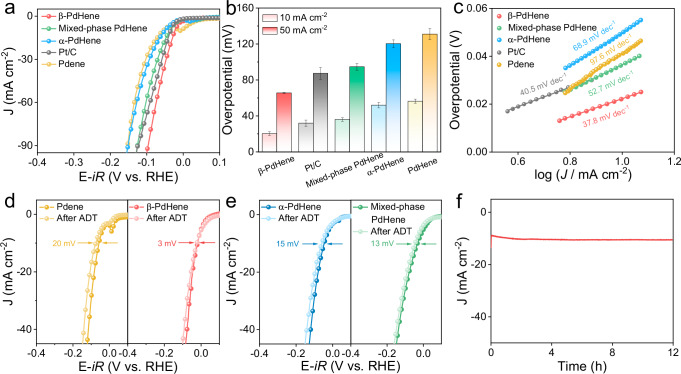
- β-PdHene aerogels show overpotentials of 20 mV at 10 mA cm−2 and 66 mV at 50 mA cm−2, lower than Pdene (56 and 131 mV) and commercial Pt/C (32 and 87 mV); mixed-phase PdHene gives 36 and 95 mV, and α-PdHene gives 52 and 120 mV.
- The Tafel slope of β-PdHene is 37.8 mV dec−1, compared with Pdene (97.6), Pt/C (40.5), mixed-phase PdHene (52.7), and α-PdHene (68.9), indicating fast Volmer–Tafel HER kinetics.
- Stability: after 5000 ADT cycles, β-PdHene shifts by only 3 mV, while Pdene and Pt/C attenuate by 20 mV and 5 mV; α-PdHene and mixed-phase PdHene decrease overpotential by 15 mV and 13 mV. After 12 h CA, β-PdHene shows almost no current-density loss.
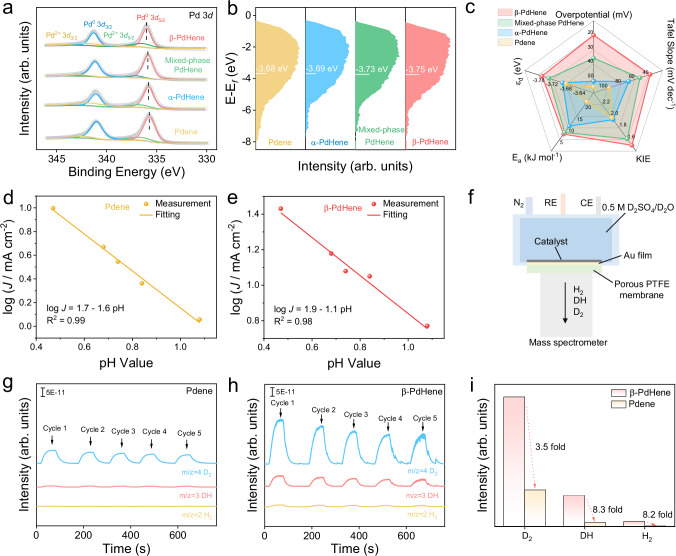
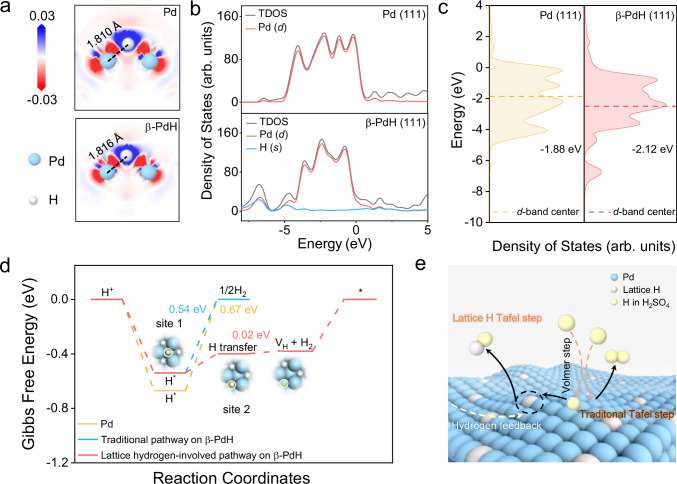
- Isotope-labeled in situ DEMS in 0.5 M D2SO4/D2O shows β-PdHene’s DH and H2 signals are approximately 8.3-fold and 8.2-fold those of Pdene, and D2 is over 3.5-fold; DFT gives a lower energy barrier of 0.02 eV for the lattice-hydrogen-involved pathway, with ΔGH* of −0.54 eV for β-PdH versus −0.67 eV for Pd and εd downshift from −1.88 eV to −2.12 eV.
Methods
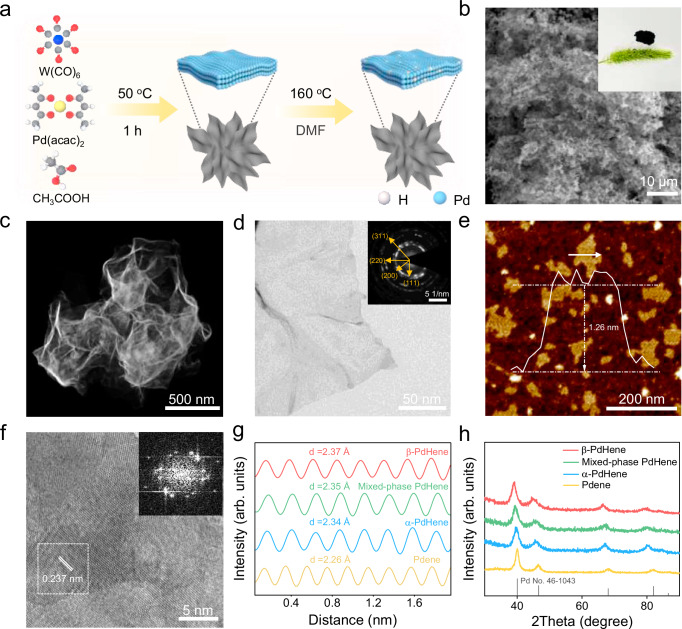
- β-PdHene aerogels were synthesized by a two-step method: CO-mediated gelation to Pdene gels, then solvothermal treatment in DMF at 160 °C for 16 h; α-PdHene and mixed-phase PdHene were made at 120 °C and 140 °C, followed by supercritical CO2 drying. Characterization included XRD, TEM, SEM, AFM, ICP-MS, XPS, and BET.
- HER tests used a three-electrode cell with RDE, SCE reference, graphite counter electrode, and N2-saturated 0.5 M H2SO4; LSV was at 5 mV s−1 and 1600 rpm, with EIS, CA at 20 mV, and ADT over 5000 cycles from −0.05 to 0.05 V vs RHE. Pd loading was 0.14 mgPd cm−2.
- In situ DEMS used 0.5 M D2SO4/D2O, an Au-sputtered PTFE membrane, 0.016 mgPd cm−2 loading, five potentiostatic cycles at −28 mV vs RHE, and m/z 2, 3, and 4 detection. DFT used CASTEP with GGA-PBE, a 4 × 4 (111) slab, 15 Å vacuum, 400 eV cutoff, and 3 × 3 × 1 k-points.
Limitations
- No explicit limitations section is stated in the provided text.
- Evident from the text: HER performance is demonstrated only in acidic media (0.5 M H2SO4 or D2SO4/D2O), with no alkaline or neutral testing reported.
- Evident from the text: the catalyst relies on Pd and a DMF/solvothermal/supercritical CO2 synthesis, and the DFT models use simplified (111) surface slabs, so broader scalability and surface-structure generality are not addressed.
Model-written summary. Check it against the paper before relying on it.
Integrity signals
Registry
Cites
Statistics
Figures
Verification
Claims the paper makes
4 Valid · 0 Not valid · 3 Not checked · 55 Own results and interpretations
Every source the paper cites for this claim was checked and supports it.
In the paper
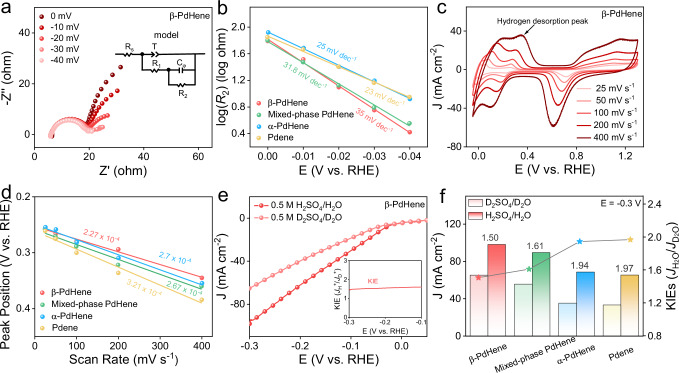
“Owing to the potential-dependent R2 for these electrocatalysts, plotting logR2 vs overpotential and corresponding the EIS-derived Tafel slopes under Ohm’s law can estimate the hydrogen adsorption kinetics30.”
§ Pd hydride metallene aerogels with lattice hydrogen participation for efficient hydrogen evolution reaction > Results > Hydrogen adsorption and desorption behavior of different catalysts
What the sources say
- Supportedcites [30] Li, J. et al. A fundamental viewpoint on the hydrogen spillover phenomenon of electrocatalytic hydrogen evolution. Nat. Commun. 12, 3502 (2021). 34108475 PMC8190308 source
The Results section (‘Evidences for hydrogen spillover in Pt2Ir1/CoP’) explicitly says that potential-dependent R2 can be used to quantify hydrogen adsorption kinetics by plotting log R2 against overpotential and calculating EIS-derived Tafel slopes using Ohm’s law. It then interprets differences in those slopes as differences in adsorption kinetics. (LLM, conf=0.95)
plainstates an association- Asserted: passes — The authors put it forward as true.
- Checkable: passes — It can be checked against evidence.
- Load-bearing: passes — The paper’s conclusions depend on it.
- Based: passes — The paper gives a reason why it holds.
- Supported
A result the paper reports from its own data — it cites no other source for it, so there is none to check. The quote shows it is in the paper.
In the paper
“Moreover, the overpotential of β-PdHene aerogels at different current densities shows a much smaller value than those of mixed-phase PdHene aerogels (η10 = 36 mV, η50 = 95 mV) and α-PdHene (η10 = 52 mV, η50 = 120 mV).”
§ Pd hydride metallene aerogels with lattice hydrogen participation for efficient hydrogen evolution reaction > Results > Electrocatalytic HER performance
plainstates an association- Asserted: passes — The authors put it forward as true.
- Checkable: passes — It can be checked against evidence.
- Load-bearing: passes — The paper’s conclusions depend on it.
- Based: passes — The paper gives a reason why it holds.
A result the paper reports from its own data — it cites no other source for it, so there is none to check. The quote shows it is in the paper.
In the paper
“the KIE value of β-PdHene is 1.50 at −0.3 VRHE”
§ Pd hydride metallene aerogels with lattice hydrogen participation for efficient hydrogen evolution reaction > Results > Hydrogen adsorption and desorption behavior of different catalysts
plain- Asserted: passes — The authors put it forward as true.
- Checkable: passes — It can be checked against evidence.
- Load-bearing: passes — The paper’s conclusions depend on it.
- Based: passes — The paper gives a reason why it holds.
A result the paper reports from its own data — it cites no other source for it, so there is none to check. The quote shows it is in the paper.
In the paper
“β-PdHene owns the lowest εd position based on Eq. 5”
§ Pd hydride metallene aerogels with lattice hydrogen participation for efficient hydrogen evolution reaction > Results > Investigation of the reaction mechanism
plain- Asserted: passes — The authors put it forward as true.
- Checkable: passes — It can be checked against evidence.
- Load-bearing: passes — The paper’s conclusions depend on it.
- Based: passes — The paper gives a reason why it holds.
A result the paper reports from its own data — it cites no other source for it, so there is none to check. The quote shows it is in the paper.
In the paper
“the EIS-derived Tafel slopes of β-PdHene aerogels are significantly increased”
§ Pd hydride metallene aerogels with lattice hydrogen participation for efficient hydrogen evolution reaction > Results > Hydrogen adsorption and desorption behavior of different catalysts
plainstates a cause- Asserted: passes — The authors put it forward as true.
- Checkable: passes — It can be checked against evidence.
- Load-bearing: passes — The paper’s conclusions depend on it.
- Based: passes — The paper gives a reason why it holds.
37 more claims
Create a free account to see all 62 claims and every source verdict.
- Probably not a substantial claim. 6
- It may state two separate claims as one. 14
- The quote only partly states this claim. 1
Citations
Cites
Generalized Gradient Approximation Made Simple
Perdew, J. P., Burke, K., & Ernzerhof, M. (1996) · Physical Review Letters · doi:10.1103/physrevlett.77.3865 · Cited by 215,824
PdMo bimetallene for oxygen reduction catalysis
Luo, M., Zhao, Z., Zhang, Y., Sun, Y., Xing, Y., Lv, F., Yang, Y., Zhang, X., Hwang, S., Qin, Y., et al. (2019) · Nature · doi:10.1038/s41586-019-1603-7 · Cited by 1,461
Self-citationKim, D., Resasco, J., Yu, Y., Asiri, A. M., & Yang, P. (2014) · Nature Communications · doi:10.1038/ncomms5948 · Cited by 1,374 · cited 1×
“The ε d was calculated based on the following Equation 42 – 44 .”
Mechanism of Hydrogen Evolution Reaction on 1T-MoS2 from First Principles
Tang, Q., & Jiang, D.-E. (2016) · ACS Catalysis · doi:10.1021/acscatal.6b01211 · Cited by 865
Hu, Q., Gao, K., Wang, X., Zheng, H., Cao, J., Mi, L., Huo, Q., Yang, H., Liu, J., & He, C. (2022) · Nature Communications · doi:10.1038/s41467-022-31660-2 · Cited by 744
A fundamental viewpoint on the hydrogen spillover phenomenon of electrocatalytic hydrogen evolution
Li, J., Hu, J., Zhang, M., Gou, W., Zhang, S., Chen, Z., Qu, Y., & Ma, Y. (2021) · Nature Communications · doi:10.1038/s41467-021-23750-4 · Cited by 633 · cited 1×
“Owing to the potential-dependent R 2 for these electrocatalysts, plotting log R 2 vs overpotential and corresponding the EIS-derived Tafel slopes under Ohm ’ s law can estimate the hydrogen adsorption kinetics 30 .”
Chen, J., Chen, C., Qin, M., Li, B., Lin, B., Mao, Q., Yang, H., Liu, B., & Wang, Y. (2022) · Nature Communications · doi:10.1038/s41467-022-33007-3 · Cited by 616 · cited 1×
“According to the above catalyst characterization, the (111) surface models of β -PdH and Pd were constructed and the optimized structure is shown in Supplementary Data 1, Supplementary Figs.”
Chen, X., Wang, X.-T., Le, J.-B., Li, S.-M., Wang, X., Zhang, Y.-J., Radjenovic, P., Zhao, Y., Wang, Y.-H., Lin, X.-M., et al. (2023) · Nature Communications · doi:10.1038/s41467-023-41030-1 · Cited by 600
Dai, J., Zhu, Y., Chen, Y., Wen, X., Long, M., Wu, X., Hu, Z., Guan, D., Wang, X., Zhou, C., et al. (2022) · Nature Communications · doi:10.1038/s41467-022-28843-2 · Cited by 467 · cited 1×
“Therefore, plotting the hydrogen desorption peak position vs the scan rate was employed to compare the fi tting slopes, which is logical to quantify the hydrogen desorption kinetics 32 .”
Self-citationPhase-dependent growth of Pt on MoS2 for highly efficient H2 evolution
Shi, Z., Zhang, X., Lin, X., Liu, G., Ling, C., Xi, S., Chen, B., Ge, Y., Tan, C., Lai, Z., et al. (2023) · Nature · doi:10.1038/s41586-023-06339-3 · Cited by 463
Zhu, S., Qin, X., Xiao, F., Yang, S., Xu, Y., Tan, Z., Li, J., Yan, J., Chen, Q., Chen, M., et al. (2021) · Nature Catalysis · doi:10.1038/s41929-021-00663-5 · Cited by 436
Wan, C., Zhang, Z., Dong, J., Xu, M., Pu, H., Baumann, D., Lin, Z., Wang, S., Huang, J., Shah, A. H., et al. (2023) · Nature Materials · doi:10.1038/s41563-023-01584-3 · Cited by 404
Tan, H., Tang, B., Lu, Y., Ji, Q., Lv, L., Duan, H., Li, N., Wang, Y., Feng, S., Li, Z., et al. (2022) · Nature Communications · doi:10.1038/s41467-022-29710-w · Cited by 390
Self-citationZhu, L., Lin, H., Li, Y., Liao, F., Lifshitz, Y., Sheng, M., Lee, S.-T., & Shao, M. (2016) · Nature Communications · doi:10.1038/ncomms12272 · Cited by 351
Liu, G., Zhou, W., Ji, Y., Chen, B., Fu, G., Yun, Q., Chen, S., Lin, Y., Yin, P.-F., Cui, X., et al. (2021) · Journal of the American Chemical Society · doi:10.1021/jacs.1c05856 · Cited by 269
Nanoporous Palladium Hydride for Electrocatalytic N 2 Reduction under Ambient Conditions
Xu, W., Fan, G., Chen, J., Li, J., Zhang, L., Zhu, S., Su, X., Cheng, F., & Chen, J. (2020) · Angewandte Chemie International Edition · doi:10.1002/anie.201914335 · Cited by 262
RhMoS2 Nanocomposite Catalysts with Pt‐Like Activity for Hydrogen Evolution Reaction
Cheng, Y., Lu, S., Liao, F., Liu, L., Li, Y., & Shao, M. (2017) · Advanced Functional Materials · doi:10.1002/adfm.201700359 · Cited by 260
Tailoring a local acid-like microenvironment for efficient neutral hydrogen evolution
Zheng, X., Shi, X., Ning, H., Yang, R., Lu, B., Luo, Q., Mao, S., Xi, L., & Wang, Y. (2023) · Nature Communications · doi:10.1038/s41467-023-39963-8 · Cited by 247
Li, J., Tan, Y., Zhang, M., Gou, W., Zhang, S., Ma, Y., Hu, J., & Qu, Y. (2022) · ACS Energy Letters · doi:10.1021/acsenergylett.1c02769 · Cited by 236
Hydrogen Stabilized RhPdH 2D Bimetallene Nanosheets for Efficient Alkaline Hydrogen Evolution
Fan, J., Wu, J., Cui, X., Gu, L., Zhang, Q., Meng, F., Lei, B.-H., Singh, D. J., & Zheng, W. (2020) · Journal of the American Chemical Society · doi:10.1021/jacs.0c00218 · Cited by 225
Deng, K., Zhou, T., Mao, Q., Wang, S., Wang, Z., Xu, Y., Li, X., Wang, H., & Wang, L. (2022) · Advanced Materials · doi:10.1002/adma.202110680 · Cited by 172
Self-citationShi, K., Si, D., Teng, X., Chen, L., & Shi, J. (2024) · Nature Communications · doi:10.1038/s41467-024-47179-7 · Cited by 170
Fan, J., Feng, Z., Mu, Y., Ge, X., Wang, D., Zhang, L., Zhao, X., Zhang, W., Singh, D. J., Ma, J., et al. (2023) · Journal of the American Chemical Society · doi:10.1021/jacs.2c11692 · Cited by 169
Xie, M., Zhang, B., Jin, Z., Li, P., & Yu, G. (2022) · ACS Nano · doi:10.1021/acsnano.2c05190 · Cited by 167
Yang, J., Hübner, R., Zhang, J., Wan, H., Zheng, Y., Wang, H., Qi, H., He, L., Li, Y., Dubale, A. A., et al. (2021) · Angewandte Chemie International Edition · doi:10.1002/anie.202015679 · Cited by 166 · cited 1×
“The ε d was calculated based on the following Equation 42 – 44 .”
Self-citationPdBi Single‐Atom Alloy Aerogels for Efficient Ethanol Oxidation
Wang, H., Jiao, L., Zheng, L., Fang, Q., Qin, Y., Luo, X., Wei, X., Hu, L., Gu, W., Wen, J., et al. (2021) · Advanced Functional Materials · doi:10.1002/adfm.202103465 · Cited by 161
Self-citationZheng, Q., Xu, H., Yao, Y., Dai, J., Wang, J., Hou, W., Zhao, L., Zou, X., Zhan, G., Wang, R., et al. (2024) · Angewandte Chemie International Edition · doi:10.1002/anie.202401386 · Cited by 160
Synthesis of Stable Shape-Controlled Catalytically Active β-Palladium Hydride
Zhao, Z., Huang, X., Li, M., Wang, G., Lee, C., Zhu, E., Duan, X., & Huang, Y. (2015) · Journal of the American Chemical Society · doi:10.1021/jacs.5b11543 · Cited by 155 · cited 3×
“Hydrogen insertion is achieved under solvothermal conditions in dimethylformamide (DMF) 21 .”
InfluentialLiu, Y., Liu, X., Jadhav, A. R., Yang, T., Hwang, Y., Wang, H., Wang, L., Luo, Y., Kumar, A., Lee, J., et al. (2022) · Angewandte Chemie International Edition · doi:10.1002/anie.202114160 · Cited by 151
Self-citationKim, J., Kim, H., Lee, W.-J., Ruqia, B., Baik, H., Oh, H.-S., Paek, S.-M., Lim, H.-K., Choi, C. H., & Choi, S.-I. (2019) · Journal of the American Chemical Society · doi:10.1021/jacs.9b09229 · Cited by 129
Xie, H., Chen, S., Liang, J., Wang, T., Hou, Z., Wang, H., Chai, G., & Li, Q. (2021) · Advanced Functional Materials · doi:10.1002/adfm.202100883 · Cited by 129
Self-citationPd Metallene Aerogels with Single-Atom W Doping for Selective Ethanol Oxidation
Wang, H., Zheng, H., Ling, L., Fang, Q., Jiao, L., Zheng, L., Qin, Y., Luo, Z., Gu, W., Song, W., et al. (2022) · ACS Nano · doi:10.1021/acsnano.2c09270 · Cited by 124
Self-citationAtomically Dispersed MoO x on Rhodium Metallene Boosts Electrocatalyzed Alkaline Hydrogen Evolution
Wu, J., Fan, J., Zhao, X., Wang, Y., Wang, D., Liu, H., Gu, L., Zhang, Q., Zheng, L., Singh, D. J., et al. (2022) · Angewandte Chemie International Edition · doi:10.1002/anie.202207512 · Cited by 123
Coherent hexagonal platinum skin on nickel nanocrystals for enhanced hydrogen evolution activity
Liu, K., Yang, H., Jiang, Y., Liu, Z., Zhang, S., Zhang, Z., Qiao, Z., Lu, Y., Cheng, T., Terasaki, O., et al. (2023) · Nature Communications · doi:10.1038/s41467-023-38018-2 · Cited by 111 · cited 1×
“S17 and 18).”
Liu, X., Wang, X., Li, K., Tang, J., Zhu, J., Chi, J., Lai, J., & Wang, L. (2024) · Angewandte Chemie International Edition · doi:10.1002/anie.202316319 · Cited by 110 · cited 1×
“Furthermore, the kinetic isotope effects (KIEs) experiment was utilized to investigate hydrogen or proton transfer kinetics behavior. the hydrogen or proton transfer rate affecting the rate-determining step for all electrocatalytic reactions 33 .”
Interstitial Hydrogen Atom Modulation to Boost Hydrogen Evolution in Pd-Based Alloy Nanoparticles
Fan, J., Cui, X., Yu, S., Gu, L., Zhang, Q., Meng, F., Peng, Z., Ma, L., Ma, J.-Y., Qi, K., et al. (2019) · ACS Nano · doi:10.1021/acsnano.9b05615 · Cited by 102
Shi, Y., Schimmenti, R., Zhu, S., Venkatraman, K., Chen, R., Chi, M., Shao, M., Mavrikakis, M., & Xia, Y. (2022) · Journal of the American Chemical Society · doi:10.1021/jacs.1c10199 · Cited by 100
Stable Pd–Cu Hydride Catalyst for Efficient Hydrogen Evolution
Jia, Y., Huang, T.-H., Lin, S., Guo, L., Yu, Y.-M., Wang, J.-H., Wang, K.-W., & Dai, S. (2022) · Nano Letters · doi:10.1021/acs.nanolett.1c04840 · Cited by 97
Stable Bimetallene Hydride Boosts Anodic CO Tolerance of Fuel Cells
Wu, J., Cui, X., Fan, J., Zhao, J., Zhang, Q., Jia, G., Wu, Q., Zhang, D., Hou, C., Xu, S., et al. (2021) · ACS Energy Letters · doi:10.1021/acsenergylett.1c00614 · Cited by 78
Ethanol‐Induced Hydrogen Insertion in Ultrafine IrPdH Boosts pH‐Universal Hydrogen Evolution
Wang, D., Jiang, X., Lin, Z., Zeng, X., Zhu, Y., Wang, Y., Gong, M., Tang, Y., & Fu, G. (2022) · Small · doi:10.1002/smll.202204063 · Cited by 75
Defect‐Rich Porous Palladium Metallene for Enhanced Alkaline Oxygen Reduction Electrocatalysis
Yu, H., Zhou, T., Wang, Z., Xu, Y., Li, X., Wang, L., & Wang, H. (2021) · Angewandte Chemie · doi:10.1002/ange.202101019 · Cited by 60
Self-citationRobust palladium hydride catalyst for electrocatalytic formate formation with high CO tolerance
Guo, S., Liu, Y., Murphy, E., Ly, A., Xu, M., Matanović, I., Pan, X. Q., & Atanassov, P. B. (2022) · Applied Catalysis B: Environmental · doi:10.1016/j.apcatb.2022.121659 · Cited by 50
The PdHx metallene with vacancies for synergistically enhancing electrocatalytic N2 fixation
Wang, Z., Zhao, H., Liu, J., Zhang, D., Wu, X., Nie, N., Wu, D., Xu, W., Lai, J., & Wang, L. (2022) · Chemical Engineering Journal · doi:10.1016/j.cej.2022.137951 · Cited by 35
Role of Hydride Formation in Electrocatalysis for Sustainable Chemical Transformations
Padavala, S. K. M., & Stoerzinger, K. A. (2023) · ACS Catalysis · doi:10.1021/acscatal.3c00204 · Cited by 28
Zhang, Y., Qin, Y., Jiao, L., Wang, H., Wu, Z., Wei, X., Wu, Y., Wu, N., Hu, L., Zhong, H., et al. (2022) · Analytica Chimica Acta · doi:10.1016/j.aca.2022.340510 · Cited by 27
Self-citationBu, X., Yin, D., Chen, D., Quan, Q., Yang, Z., Yip, S., Wong, C., Wang, D., & Ho, J. C. Y. (2023) · Small · doi:10.1002/smll.202304546 · Cited by 17
Ligand-confined two-dimensional rhodium hydride boosts hydrogen evolution
Fan, J., Zhang, Y., Liu, W., Li, M., Cai, Y., Ji, Q., Zhao, Z., Hou, G., Li, A., Zhou, W., et al. (2023) · Matter · doi:10.1016/j.matt.2023.09.003 · Cited by 15
Cited by
Zhong, J. Q., Duan, H., Cai, M., Zhu, Y., Wang, Z., Li, X., Zhang, Z., Qu, W., Zhang, K., Han, D., et al. (2025) · Angewandte Chemie International Edition · doi:10.1002/anie.202507956 · Cited by 109
When covalent organic frameworks meet metals: From opportunities toward applications
Wu, D., Wang, H., Nie, Y., Wan, H., Liu, S., Yang, S., Li, H., Zhang, H., Zhu, C., & Ma, T. (2025) · Progress in Materials Science · doi:10.1016/j.pmatsci.2025.101538 · Cited by 76
Self-citationZhang, R., Sun, J., Chen, Y., Shen, Q., Ding, C., Zhang, S., & Zhang, J. (2025) · Coordination Chemistry Reviews · doi:10.1016/j.ccr.2025.216958 · Cited by 57
Data‐Driven Review on Aerogels and Polymeric Aerogels
Takeshita, S., Mine, S., & Ono, T. (2025) · Angewandte Chemie International Edition · doi:10.1002/anie.202504250 · Cited by 53
Ning, J., Zhu, X., Hu, T.-F., Xia, C., Hao, P., Shi, J., Fang, Y., Xu, J., Zhang, D., Hidayat, K., et al. (2025) · Journal of the American Chemical Society · doi:10.1021/jacs.5c02114 · Cited by 39
Metadata
- Authors
- Wang, H., Qin, Y., Wu, Y., Qiu, Y., Ling, L., Fang, Q., Wang, C., Hu, L., Gu, W., & Zhu, C.
- Affiliations
- Central China Normal University (CN)
- Chinese Academy of Sciences (CN)
- Wuhan Institute of Technology (CN)
- Corresponding author
- Zhu, Chengzhou
- Venue
- Nature Communications
- Published
- 2024-11-27
- Volume
- 15
- Issue
- 1
- Pages
- 10289-10289
- ISSN
- 2041-1723 (ISSN-L)
- PMC
- PMC11603291
- OpenAlex
- W4404757939
- Semantic Scholar
- 3458d8c4f30095c01e4a8f5961966b291cf9c409
- Cited by
- 71
- References
- 47
- Citations by year
- 2026: 32 · 2025: 39
- FWCI
- 4.72
- Type
- journal article
- Language
- en
- Open access
- gold
- doi.org
- Licence
- cc-by-nc-nd
- creativecommons.org/licenses/by-nc-nd/4.0 (tdm)
- creativecommons.org/licenses/by-nc-nd/4.0 (vor)
- Locations
- Nature Communications (publishedVersion, cc-by-nc-nd)
- PubMed Central (publishedVersion, cc-by-nc-nd)
- PubMed (publishedVersion)
- RePEc: Research Papers in Economics (submittedVersion)
- DOAJ (DOAJ: Directory of Open Access Journals) (submittedVersion, cc-by-sa)
- Funders
- Central China Normal University (B17019, CCNU20TS013)
- Project 211 (B17019, CCNU20TS013)
- Fundamental Research Funds for the Central Universities (CCNU 20TS013, CCNU22JC006, B17019)
- Topics
- Physical Sciences › Energy › Renewable Energy, Sustainability and the Environment › Electrocatalysts for Energy Conversion
- Physical Sciences › Materials Science › Materials Chemistry › Hydrogen Storage and Materials
- Physical Sciences › Energy › Renewable Energy, Sustainability and the Environment › CO2 Reduction Techniques and Catalysts
- Keywords
- hydrogen evolution reaction, aerogels, hydrogen sorption, electrocatalysis, hydrogen evolution catalysts, Sabatier principle, reaction mechanism, overpotential, catalyst stability
About these checks
Registry, retraction, Cites and statistics results are computed, not judged, with one exception: a printed reference that no index lists is read once by a model before it counts as a citation error. Claims are extracted by a model and kept only when their quote appears verbatim in the text; each cited source is then checked, with a model’s help, for whether it says what the claim relies on. Those verdicts can be wrong — read the claim’s quote and the cited source before relying on one.
A language model drew the claims from the paper on 2026-10-11, under version 3 of the claim definition (model deepseek-v4.1-flash, prompt extract-v3).
A second model labelled each claim on 2026-10-11 (model jev-1.13-20260917, definition revision gold-guideline-v0.2).
Cited sources are checked with a language model’s help (gpt-6-sol).
Statistics and arithmetic are recomputed, not judged.
Confidence bands are shown only for fields calibrated on our annotated test set. None is calibrated yet, so no band is shown.
What counts as a claim ›How we measure confidence ›How we check this ›
Are you an author, or do you see a problem with this page? Request a review
Data sources
Bibliographic data: Semantic Scholar, OpenAlex, Crossref.
Contains information from the Semantic Scholar Academic Graph Datasets, made available under the ODC Attribution License (ODC-BY 1.0).
Semantic Scholar’s data is described in: Kinney, R., et al. (2023). The Semantic Scholar Open Data Platform. arXiv:2301.10140.
