

Bright and stable anti-counterfeiting devices with independent stochastic processes covering multiple length scales
Open accessThe DOI matches its Crossref record; 42 of the 42 references it cites were found in a registry or an index; 1 of the 22 sources its claims cite were checked for support.
Abstract
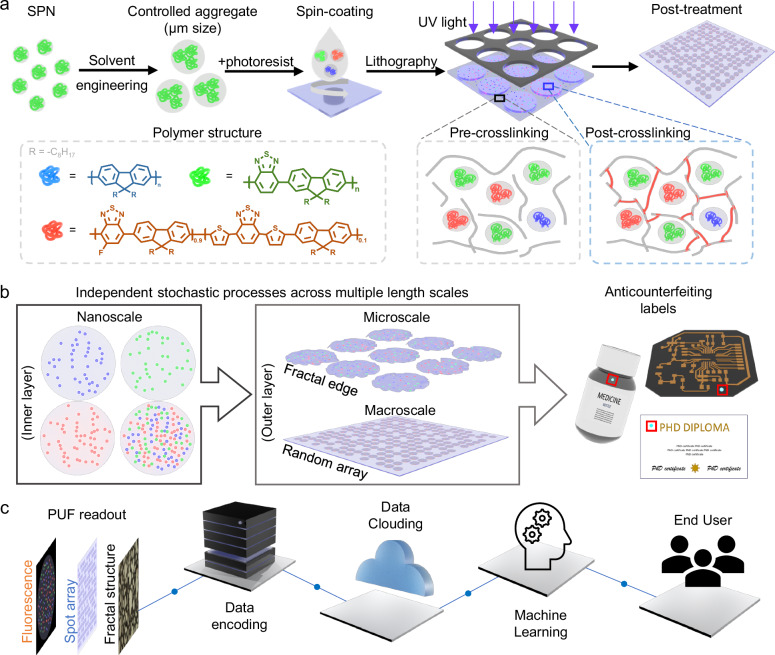
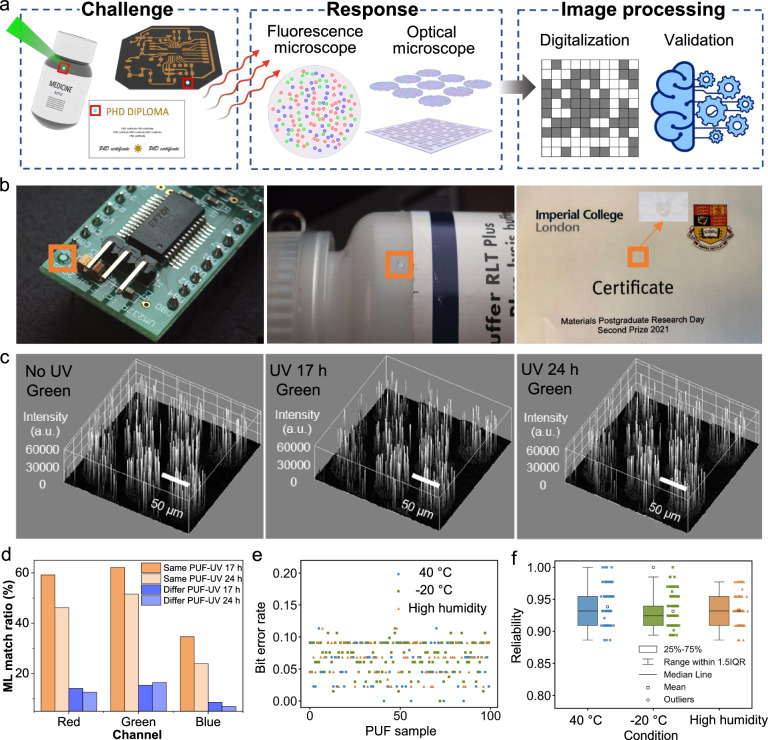
Physical unclonable functions (PUFs) are considered the most promising approach to address the global issue of counterfeiting. Current PUF devices are often based on a single stochastic process, which can be broken, especially since their practical encoding capacities can be significantly lower than the theoretical value. Here we present stochastic PUF devices with features across multiple length scales, which incorporate semiconducting polymer nanoparticles (SPNs) as fluorescent taggants. The SPNs exhibit high brightness, photostability and size tunability when compared to the current state-of-the-art taggants. As a result, they are easily detectable and highly resilient to UV radiation. By embedding SPNs in photoresists, we generate PUFs consisting of nanoscale (distribution of SPNs within microspots), microscale (fractal edges on microspots), and macroscale (random microspot array) designs. With the assistance of a deep-learning model, the resulting PUFs show both near-ideal performance and accessibility for general end users, offering a strategy for next-generation security devices.
Overview
CoChat Summary
TL;DR
The paper presents optical physical unclonable function (PUF) anti-counterfeiting devices that combine semiconducting polymer nanoparticles (SPNs) with photoresist patterning to create independent stochastic features at nanoscale, microscale, and macroscale. The devices show near-ideal PUF metrics, high photostability, and deep-learning-assisted authentication, with an encoding capacity of ca. 10^220322 from a 1 mm² area.
Key findings
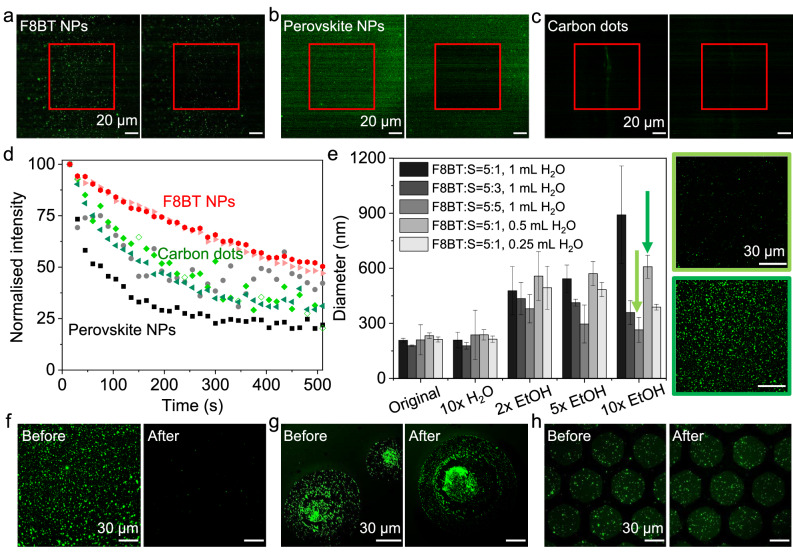
- SPNs, especially F8BT, outperformed carbon dots, CdSe:ZnS quantum dots, and CsPbBr3 perovskite nanocrystals in brightness and photostability under identical confocal conditions; Qdot intensity was two to ten times lower than SPNs of comparable size, and F8BT NPs showed superior photostability over 500 s of continuous laser scanning.
- SPN size was tunable via surfactant/water/ethanol conditions: F8BT:PS-PEG at 1:1 maintained ~250 nm in 10-fold ethanol, while a 5:1 ratio precipitated into 1:5 THF:water aggregated to ~600 nm and gave clearer, larger spots detectable at 10% laser power.
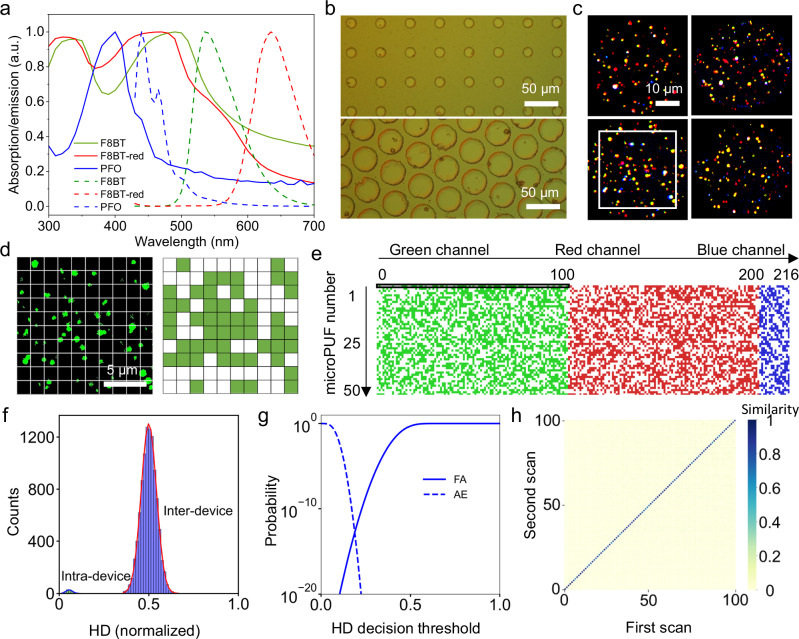
- A blend of blue, green, and red SPNs with emission maxima at 440, 535, and 635 nm enabled multichannel PUFs in SU-8; each microspot yielded 216 bits, and 50 microspots produced 10,800-bit keys with bit uniformity 0.4948 ± 0.0064, inter-device Hamming distance 0.5000 ± 0.0427, and intra-device Hamming distance 0.05568 ± 0.0181.
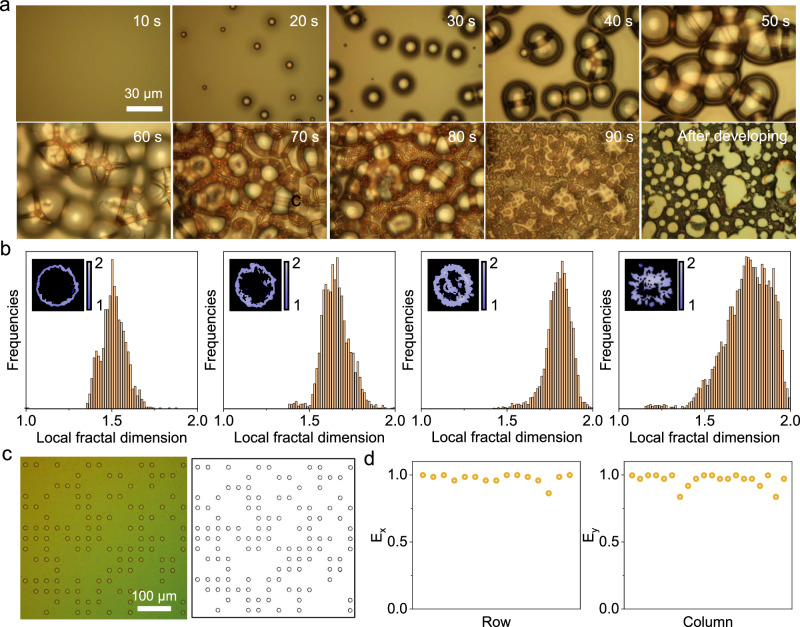
- Additional stochastic processes—fractal edges and randomly delaminated microspot arrays—were incorporated; fluorescence channels alone gave an encoding capacity of ca. 10^220322 from 1 mm², and devices retained >90% reliability after one week at 40 °C, −20 °C, or 85% humidity, with no significant fluorescence decrease after 17 and 24 h UV exposure.
Methods
- F8BT-red was synthesized by Suzuki–Miyaura coupling; SPNs were prepared by mixing F8BT, PFO, or F8BT-red with PS-g-FEO surfactant in THF, adding water, evaporating THF, and characterizing size by DLS.
- Photolithography used SU-8 2002/2010 and AZ 4562 photoresists; standard processing included spin-coating, soft bake, 365 nm UV exposure, post-exposure bake, and development, while fractal edges were generated with SU-8 2002:AZ 4562 blends and microspot delamination was induced by sonication in developer.
- Fluorescence imaging and photobleaching used confocal microscopy at 405 nm; PUF keys were generated by binarizing fluorescent images with 10 × 10 pixel units for F8BT/F8BT-red and 50 × 50 pixels for PFO, and identification used the LoFTR deep-learning model; stability tests included artificial sweat (0.9 g/L NaCl, 0.2 g/L KCl, 30 min), UV irradiation, and aging at 40 °C, −20 °C, and 85% humidity.
Limitations
- The paper does not state an explicit limitations section; evident from the text, the encoding capacities of the microspot array and fractal edges could not compete with the SPN fluorescent patterns, though their readout was more straightforward and convenient.
- Evident from the text, SPN aggregates grew larger four hours after ethanol dilution, requiring thin-film formation shortly after aggregate formation, and initial 10–100 nm particles were not ideal for practical readout due to low signal-to-noise ratios.
- Evident from the text, PVA and PS films failed in artificial sweat, AZ-only microstructures were not stable and could be washed away, and some photoresist blends required too high an exposure dose or were unstable under lower UV exposure.
Model-written summary. Check it against the paper before relying on it.
Integrity signals
Registry
Cites
Statistics
Figures
Verification
Claims the paper makes
1 Valid · 4 Not valid · 13 Not checked · 86 Own results and interpretations
The sources with a verdict support this claim; the rest weren’t checked yet, have no full text we could read, or their verdicts aren’t rated yet.
In the paper
“Semiconducting polymer nanoparticles (SPNs) are another viable taggant, as they have been shown to outperform most other fluorescent materials for both brightness and photostability19,20.”
§ Bright and stable anti-counterfeiting devices with independent stochastic processes covering multiple length scales > Introduction
What the sources say
- Not checked yetcites [19] Liu, M.-H., Zhang, Z., Yang, Y.-C. & Chan, Y.-H. Polymethine-based semiconducting polymer dots with narrow-band emission and absorption/emission maxima at NIR-II for bioimaging. Angew. Chem. Int. Ed. 60, 983–989 (2021). 32990356 source
Checked before — its earlier verdict is held back until a new check runs.
- Supportedcites [20] Rong, Y. et al. Multicolor fluorescent semiconducting polymer dots with narrow emissions and high brightness. ACS Nano 7, 376–384 (2013). 23282278 PMC3552064 source
The Introduction/Abstract of Rong et al. (2013) states that Pdots 'have attracted great interest because of their extraordinary fluorescence brightness and photostability' and lists 'high fluorescence brightness, fast radiative rates, and excellent photostability' as their superior characteristics as fluorescent probes, positioned against the limitations it attributes to conventional organic dyes ('limited brightness and poor photostability'), Qdots and dye-doped latex spheres. The Results back this quantitatively: single-particle brightness of BODIPY 520 Pdots ~9x (calculated 7.6x) that of Qdot 525 and ~2x that of PFBT dots, and photobleaching tests showing BODIPY 600/690 Pdots with no observable intensity loss over 1.5 h and BODIPY 520 Pdots slightly more photostable than Qdot 525. The citing sentence is a broad background generalization ('most other fluorescent materials'); the source supports the substance — superior brightness and photostability versus the main alternative probe classes — rather than enumerating every material. (LLM, conf=0.80)
boostedstates a cause- Asserted: passes — The authors put it forward as true.
- Checkable: passes — It can be checked against evidence.
- Load-bearing: passes — The paper’s conclusions depend on it.
- Based: passes — The paper gives a reason why it holds.
- Not checked yet
A result the paper reports from its own data — it cites no other source for it, so there is none to check. The quote shows it is in the paper.
In the paper
“We found a higher amount of surfactant (F8BT:PS-PEG at 1:1) caused the particles to be more resistant to aggregation, even in a mixture with a 10-fold ethanol volume, maintaining a diameter of approximately 250 nm.”
§ Bright and stable anti-counterfeiting devices with independent stochastic processes covering multiple length scales > Results and Discussion > Optimization and Characterization of SPNs for PUF devices
plainstates a cause- Asserted: passes — The authors put it forward as true.
- Checkable: passes — It can be checked against evidence.
- Load-bearing: passes — The paper’s conclusions depend on it.
- Based: passes — The paper gives a reason why it holds.
A result the paper reports from its own data — it cites no other source for it, so there is none to check. The quote shows it is in the paper.
In the paper
“We found by increasing the proportion of AZ 4562 and reducing the UV irradiation time, the microspots exhibited higher fractal dimensions (Fig. 4b).”
§ Bright and stable anti-counterfeiting devices with independent stochastic processes covering multiple length scales > Results and Discussion > Microspot fabrication to introduce multi-layered PUFs
plainstates a cause- Asserted: passes — The authors put it forward as true.
- Checkable: passes — It can be checked against evidence.
- Load-bearing: passes — The paper’s conclusions depend on it.
- Based: passes — The paper gives a reason why it holds.
A result the paper reports from its own data — it cites no other source for it, so there is none to check. The quote shows it is in the paper.
In the paper
“Employing the same LoFTR algorithm as described above showed excellent matching scores between identical images (Fig. S20d) and images with varied exposure time (Figure S20e).”
§ Bright and stable anti-counterfeiting devices with independent stochastic processes covering multiple length scales > Results and Discussion > Proof-of-concept application and stability testing
boostedstates an association- Asserted: passes — The authors put it forward as true.
- Checkable: passes — It can be checked against evidence.
- Load-bearing: passes — The paper’s conclusions depend on it.
- Based: passes — The paper gives a reason why it holds.
A result the paper reports from its own data — it cites no other source for it, so there is none to check. The quote shows it is in the paper.
In the paper
“In the case of Qdots, we found a few large particles (most likely caused by aggregation) but their intensity was two to ten times lower than the SPNs with comparable size (Fig. S1).”
§ Bright and stable anti-counterfeiting devices with independent stochastic processes covering multiple length scales > Results and Discussion > Screening of fluorescent nanoparticles
hedgedstates an association- Asserted: passes — The authors put it forward as true.
- Checkable: passes — It can be checked against evidence.
- Load-bearing: unclear — It is unclear whether the paper’s conclusions depend on it.
- Based: passes — The paper gives a reason why it holds.
56 more claims
Create a free account to see all 104 claims and to verify the 20 references still open.
- It may state two separate claims as one. 33
- Probably not a substantial claim. 14
Self-check
Percentages, sums and reported differences re-computed from the paper’s own numbers.
Each contradiction between two passages listed here was confirmed by an independent check.
Rated major: it would touch a result — a value a result rests on, reported and recomputed p-values on opposite sides of the significance level, two passages that conflict with no sign which is right, or a cited work retracted before this paper was published.
In the paper
§ Bright and stable anti-counterfeiting devices with independent stochastic processes covering multiple length scales > Results and Discussion > Optimization and Characterization of SPNs for PUF devices
“when we precipitated a lower surfactant ratio (5:1) into less water (1:5, THF:water), the nanoparticles aggregated to a consistent hydrodynamic diameter of approximately 600 nm”
§ Bright and stable anti-counterfeiting devices with independent stochastic processes covering multiple length scales > Methods > Preparation and characterization of SPNs
“F8BT solution (1 mg/mL in THF) and PS-g-FEO solution (10 mg/mL in THF) were prepared. For size optimization, 10, 30 or 50 µL PS-g-FEO were mixed with 50 µL F8BT solution, respectively.”
Rated major: it would touch a result — a value a result rests on, reported and recomputed p-values on opposite sides of the significance level, two passages that conflict with no sign which is right, or a cited work retracted before this paper was published.
In the paper
§ Bright and stable anti-counterfeiting devices with independent stochastic processes covering multiple length scales > Results and Discussion > Proof-of-concept application and stability testing
“c) Photostability test of the PUF devices. UV wavelength: 365 nm. UV intensity: 12 W/cm2.”
§ Bright and stable anti-counterfeiting devices with independent stochastic processes covering multiple length scales > Methods > Fluorescence imaging and photostability
“For UV stability measurements, the printed SPN microspots were treated under irradiation (305 nm, 10 mW/cm2) for 6 h.”
Rated minor: it would not touch a result — a value no result rests on, a p-value that stays on the same side of the significance level, or a conflict that is clerical, resolved elsewhere in the paper, or outside its own findings.
In the paper
§ Bright and stable anti-counterfeiting devices with independent stochastic processes covering multiple length scales > Results and Discussion > Screening of fluorescent nanoparticles
“We performed photobleaching tests under continuous laser scanning for 500 s.”
§ Bright and stable anti-counterfeiting devices with independent stochastic processes covering multiple length scales > Methods > Fluorescence imaging and photostability
“Images were recorded every 15 s for 15 min (1024 × 1024 resolution).”
Rated minor: it would not touch a result — a value no result rests on, a p-value that stays on the same side of the significance level, or a conflict that is clerical, resolved elsewhere in the paper, or outside its own findings.
In the paper
§ Bright and stable anti-counterfeiting devices with independent stochastic processes covering multiple length scales > Results and Discussion > Screening of fluorescent nanoparticles
“c carbon dots (Ex: 405 nm, laser power: 15%, gain: 500%)”
§ Bright and stable anti-counterfeiting devices with independent stochastic processes covering multiple length scales > Methods > Fluorescence imaging and photostability
“Before the photobleaching measurement, the area of interest was focused and selected with a laser power of 15% and a gain value of 150%. Except for carbon dots, a laser power of 15% and a gain value of 500% were applied to get a decent fluorescence signal.”
Citations
Cites
Fiji: an open-source platform for biological-image analysis
Schindelin, J., Arganda-Carreras, I., Frise, E., Kaynig, V., Longair, M., Pietzsch, T., Preibisch, S., Rueden, C., Saalfeld, S., Schmid, B., et al. (2012) · Nature Methods · doi:10.1038/nmeth.2019 · Cited by 66,890
Pappu, R., Recht, B., Taylor, J., & Gershenfeld, N. (2002) · Science · doi:10.1126/science.1074376 · Cited by 2,018
Highly Fluorescent Semiconducting Polymer Dots for Biology and Medicine
Wu, C., & Chiu, D. T. (2013) · Angewandte Chemie International Edition · doi:10.1002/anie.201205133 · Cited by 1,101
Feng, L., Zhu, C., Yuan, H., Liu, L., Lv, F., & Wang, S. (2013) · Chemical Society Reviews · doi:10.1039/c3cs60036j · Cited by 873
Hydrophobic carbon dots with blue dispersed emission and red aggregation-induced emission
Yang, H., Liu, Y., Guo, Z., Lei, B., Zhuang, J., Zhang, X., Liu, Z., & Hu, C. (2019) · Nature Communications · doi:10.1038/s41467-019-09830-6 · Cited by 751
Gao, Y., Al-Sarawi, S. F., & Abbott, D. (2020) · Nature Electronics · doi:10.1038/s41928-020-0372-5 · Cited by 613
Liu, Y., Han, F., Li, F., Zhao, Y., Chen, M., Xu, Z., Zheng, X., Hu, H., Yao, J., Guo, T., et al. (2019) · Nature Communications · doi:10.1038/s41467-019-10406-7 · Cited by 551
Bioconjugation of Ultrabright Semiconducting Polymer Dots for Specific Cellular Targeting
Wu, C., Schneider, T., Zeigler, M., Yu, J., Schiro, P. G., Burnham, D. R., McNeill, J. D., & Chiu, D. T. (2010) · Journal of the American Chemical Society · doi:10.1021/ja107196s · Cited by 528
Gao, Z., Han, Y., & Wang, F. (2018) · Nature Communications · doi:10.1038/s41467-018-06392-x · Cited by 284
An optical authentication system based on imaging of excitation-selected lanthanide luminescence
Carro-Temboury, M. R., Arppe, R., Vosch, T., & Sørensen, T. J. (2018) · Science Advances · doi:10.1126/sciadv.1701384 · Cited by 242
Leem, J. W., Kim, M. S., Choi, S. H., Kim, S.-R., Kim, S.-W., Song, Y. M., Young, R. J., & Kim, Y. L. (2020) · Nature Communications · doi:10.1038/s41467-019-14066-5 · Cited by 218
Multicolor Fluorescent Semiconducting Polymer Dots with Narrow Emissions and High Brightness
Rong, Y., Wu, C., Yu, J., Zhang, X., Ye, F., Zeigler, M., Gallina, M. E., Wu, I.-C., Zhang, Y., Chan, Y.-H., et al. (2013) · ACS Nano · doi:10.1021/nn304376z · Cited by 215
Zuo, M., Qian, W., Li, T., Hu, X., Jiang, J., & Wang, L. (2018) · ACS Applied Materials & Interfaces · doi:10.1021/acsami.8b14110 · Cited by 187
Zhang, J., Liu, Y. L., Njel, C., Ronneberger, S., Tarakina, N. V., & Loeffler, F. F. (2023) · Nature Nanotechnology · doi:10.1038/s41565-023-01405-3 · Cited by 152
Self-citationRevisiting silk: a lens-free optical physical unclonable function
Kim, M. S., Lee, G. J., Leem, J. W., Choi, S., Kim, Y. L., & Song, Y. M. (2022) · Nature Communications · doi:10.1038/s41467-021-27278-5 · Cited by 149
Concealable physically unclonable function chip with a memristor array
Gao, B., Lin, B., Pang, Y., Xu, F., Lu, Y., Chiu, Y.-C., Liu, Z., Tang, J., Chang, M.-F., Qian, H., et al. (2022) · Science Advances · doi:10.1126/sciadv.abn7753 · Cited by 144
Self-citationSemiconducting Polymer Nanoparticles as Fluorescent Probes for Biological Imaging and Sensing
Chan, Y., & Wu, P. (2015) · Particle & Particle Systems Characterization · doi:10.1002/ppsc.201400123 · Cited by 139
Liu, M., Zhang, Z., Yang, Y., & Chan, Y. (2021) · Angewandte Chemie International Edition · doi:10.1002/anie.202011914 · Cited by 134
Radiative lifetime-encoded unicolour security tags using perovskite nanocrystals
Yakunin, S., Chaaban, J., Benin, B. M., Cherniukh, I., Bernasconi, C., Landuyt, A., Shynkarenko, Y., Bolat, S., Hofer, C. K., Romanyuk, Y. E., et al. (2021) · Nature Communications · doi:10.1038/s41467-021-21214-3 · Cited by 133
Zampetti, A., Minotto, A., Squeo, B. M., Gregoriou, V. G., Allard, S., Scherf, U., Chochos, C. L., & Cacialli, F. (2017) · Scientific Reports · doi:10.1038/s41598-017-01785-2 · Cited by 129
Ke, C.-S., Fang, C.-C., Yan, J.-Y., Tseng, P.-J., Pyle, J. R., Chen, C.-P., Lin, S.-Y., Chen, J., Zhang, X., & Chan, Y.-H. (2017) · ACS Nano · doi:10.1021/acsnano.7b00215 · Cited by 127
Bright Far‐Red/Near‐Infrared Conjugated Polymer Nanoparticles for In Vivo Bioimaging
Ding, D., Liu, J., Feng, G., Li, K., Hu, Y., & Liu, B. (2013) · Small · doi:10.1002/smll.201300171 · Cited by 121
Wang, K., Shi, J., Lai, W., He, Q., Xu, J., Ni, Z., Liu, X., Pi, X., & Yang, D. (2024) · Nature Communications · doi:10.1038/s41467-024-47479-y · Cited by 102
Random fractal-enabled physical unclonable functions with dynamic AI authentication
Sun, N., Chen, Z., Wang, Y., Wang, S., Xie, Y., & Liu, Q. (2023) · Nature Communications · doi:10.1038/s41467-023-37588-5 · Cited by 99
Chaotic Organic Crystal Phosphorescent Patterns for Physical Unclonable Functions
Im, H., Yoon, J., Choi, J., Kim, J., Baek, S., Park, D. H., Park, W., & Kim, S. (2021) · Advanced Materials · doi:10.1002/adma.202102542 · Cited by 97
Conjugated Polymer Dots for Ultra‐Stable Full‐Color Fluorescence Patterning
Chang, K., Liu, Z., Chen, H., Sheng, L., Zhang, S. X., Chiu, D. T., Yin, S., Wu, C., & Qin, W. (2014) · Small · doi:10.1002/smll.201401436 · Cited by 96
High-intensity near-IR fluorescence in semiconducting polymer dots achieved by cascade FRET strategy
Zhang, X., Yu, J., Rong, Y., Ye, F., Chiu, D. T., & Uvdal, K. (2013) · Chemical Science · doi:10.1039/c3sc50222h · Cited by 92
Tsai, W.-K., Lai, Y.-S., Tseng, P.-J., Liao, C.-H., & Chan, Y.-H. (2017) · ACS Applied Materials & Interfaces · doi:10.1021/acsami.7b08993 · Cited by 88
Hybrid low-voltage physical unclonable function based on inkjet-printed metal-oxide transistors
Scholz, A. S., Zimmermann, L., Gengenbach, U. K., Koker, L., Chen, Z., Hahn, H., Sikora, A., Tahoori, M. B., & Aghassi‐Hagmann, J. (2020) · Nature Communications · doi:10.1038/s41467-020-19324-5 · Cited by 84
Fractal Gold Nanoframework for Highly Stretchable Transparent Strain-Insensitive Conductors
Ho, M. D., Liu, Y., Dong, D., Zhao, Y., & Cheng, W. (2018) · Nano Letters · doi:10.1021/acs.nanolett.8b00694 · Cited by 81
Xiao, H. J., Liu, B., Qiu, L., Li, G., Zhang, G., Huang, D., Zhao, Y., Yang, C., Jiang, F., Dang, P., et al. (2021) · Angewandte Chemie International Edition · doi:10.1002/anie.202115136 · Cited by 77
LoFTR: Detector-Free Local Feature Matching with TransformersPreprint
Sun, J., Shen, Z., Wang, Y., et al. (2021) · arXiv (Cornell University) · doi:10.48550/arxiv.2104.00680 · Cited by 76
Dutta, T., Woody, K. B., Parkin, S. R., Watson, M. D., & Gierschner, J. (2009) · Journal of the American Chemical Society · doi:10.1021/ja9068134 · Cited by 61
Dong, Y., Ling, Y., Wang, D., Liu, Y., Chen, X., Zheng, S., Wu, X., Shen, J., Feng, S., Zhang, J., et al. (2022) · Science Advances · doi:10.1126/sciadv.add1980 · Cited by 58
Self-citationAlidaei-Sharif, H., Roghani-Mamaqani, H., Babazadeh-Mamaqani, M., Sahandi-Zangabad, K., Abdollahi, A., & Salami-Kalajahi, M. (2023) · Journal of Photochemistry and Photobiology A: Chemistry · doi:10.1016/j.jphotochem.2022.114343 · Cited by 45
Electromagnetically unclonable functions generated by non-Hermitian absorber-emitter
Yang, M., Ye, Z., Pan, H., Farhat, M., Cetin, A. E., & Chen, P.-Y. (2023) · Science Advances · doi:10.1126/sciadv.adg7481 · Cited by 41
Park, G., Choi, Y., Kwon, S. J., & Yoon, D. K. (2023) · Advanced Materials · doi:10.1002/adma.202303077 · Cited by 40
Tarik, F. B., Famili, A., Lao, Y., & Ryckman, J. D. (2022) · Scientific Reports · doi:10.1038/s41598-022-19796-z · Cited by 35
Fighting counterfeiting at the nanoscale
(2019) · Nature Nanotechnology · doi:10.1038/s41565-019-0484-0 · Cited by 29
Creamer, A., Fiego, A. L., Agliano, A., Prados‐Martin, L., Høgset, H., Najer, A., Richards, D. A., Wojciechowski, J. P., Foote, J. E. J., Kim, N., et al. (2024) · Advanced Materials · doi:10.1002/adma.202300413 · Cited by 27
Self-citationU.S. Intellectual Property and Counterfeit Goods—Landscape Review of Existing/Emerging ResearchPreprint
Bharadwaj, V., Brock, M., Heing, B., Miró, R., & Mukarram, N. (2020) · SSRN Electronic Journal · doi:10.2139/ssrn.3577710 · Cited by 17
Photoswitchable semiconducting polymer dots for pattern encoding and superresolution imaging
Yao, Z., Wang, X., Liu, J., Zhou, S., Zhang, Z., He, S., Liu, J., Wu, C., & Fang, X. (2023) · Chemical Communications · doi:10.1039/d2cc06707b · Cited by 12
Research works printed but not linked: 3
- Becker, G. T. 535-555 (Springer Berlin Heidelberg).
- Sun, J., Shen, Z., Wang, Y., Bao, H. & Zhou, X. in 2021 IEEE/CVF Conference on Computer Vision and Pattern Recognition (CVPR) 8918-8927 (IEEE Computer Society, 2021).
- Veith-Wolf, B., Witteck, R., Morlier, A., Schulte-Huxel, H. & Schmidt, J. in IEEE 43rd Photovolt. Spec. Conf. 1173-1178.
Cited by
Designing Physical Unclonable Functions From Optically Active Materials
Klausen, M., Zhang, J., & Stevens, M. M. (2025) · Advanced Materials · doi:10.1002/adma.202502059 · Cited by 78
Self-citationIlluminating Advances in Materials: Optical Physical Unclonable Functions for Security Applications
Ali, S. R., Kershaw, S. V., Faisal, M. M., Halak, B., & Abdelazim, N. M. (2025) · Advanced Optical Materials · doi:10.1002/adom.202501564 · Cited by 25
Seo, H., Park, T., Ali, A., Jung, B. K., Choi, Y. K., Park, J., & Oh, S. J. (2025) · Advanced Functional Materials · doi:10.1002/adfm.202507395 · Cited by 20
All‐Optical Reconfigurable Physical Unclonable Function for Sustainable Security
Kwak, J., Moon, C., Yu, H.-B., Kim, S., & Kim, D. (2026) · Advanced Materials · doi:10.1002/adma.202521712 · Cited by 14
Exploring the intersection of natural sciences and information technology via entropy and randomness
Luescher, A. M., Heckel, R., & Grass, R. N. (2025) · Nature Communications · doi:10.1038/s41467-025-62353-1 · Cited by 13
Metadata
- Authors
- Zhang, J., Creamer, A., Xie, K., Tang, J., Salter, L., Wojciechowski, J. P., & Stevens, M. M.
- Affiliations
- University of Oxford (GB)
- Imperial College London (GB)
- Corresponding author
- Stevens, Molly M.
- Venue
- Nature Communications
- Published
- 2025-01-08
- Volume
- 16
- Issue
- 1
- Pages
- 502-502
- ISSN
- 2041-1723 (ISSN-L)
- PMC
- PMC11711641
- OpenAlex
- W4406170775
- Cited by
- 33
- References
- 42
- Citations by year
- 2026: 22 · 2025: 11
- FWCI
- 12.05
- Type
- journal article
- Language
- en
- Open access
- gold
- doi.org
- Licence
- cc-by
- creativecommons.org/licenses/by/4.0 (tdm)
- creativecommons.org/licenses/by/4.0 (vor)
- Locations
- Nature Communications (publishedVersion, cc-by)
- Oxford University Research Archive (ORA) (University of Oxford) (publishedVersion, cc-by)
- PubMed Central (publishedVersion, cc-by)
- PubMed (publishedVersion)
- RePEc: Research Papers in Economics (submittedVersion)
- DOAJ (DOAJ: Directory of Open Access Journals) (submittedVersion, cc-by-sa)
- Funders
- Wellcome Trust (104931/Z/14/Z)
- UK Research and Innovation (MR/R015651/1, BB/L015129/1, BB/T017929/1)
- Cancer Research UK (100063)
- Research Councils UK (EP/R00529X/1, EP/L016702/1)
- Imperial College London (BB/T017929/1)
- Rosetrees Trust
- Medical Research Council (MR/R015651/1)
- Engineering and Physical Sciences Research Council (EP/X027287/1)
- Biotechnology and Biological Sciences Research Council (BB/L015129/1, L015129, BB/T017929/1)
- Topics
- Physical Sciences › Computer Science › Hardware and Architecture › Physical Unclonable Functions (PUFs) and Hardware Security
- Physical Sciences › Computer Science › Computer Vision and Pattern Recognition › Chaos-based Image/Signal Encryption
- Physical Sciences › Computer Science › Information Systems › QR Code Applications and Technologies
- Keywords
- physical unclonable functions, anti-counterfeiting, semiconducting polymer nanoparticles, photostability, size tunability, deep learning, encoding capacity, UV resistance, security inks
About these checks
Registry, retraction, Cites and statistics results are computed, not judged, with one exception: a printed reference that no index lists is read once by a model before it counts as a citation error. Claims are extracted by a model and kept only when their quote appears verbatim in the text; each cited source is then checked, with a model’s help, for whether it says what the claim relies on. Those verdicts can be wrong — read the claim’s quote and the cited source before relying on one.
A language model drew the claims from the paper on 2026-11-19, under version 3 of the claim definition (model deepseek-v4.1-flash, prompt extract-v3).
A second model labelled each claim on 2026-11-19 (model jev-1.13-20260917, definition revision gold-guideline-v0.2).
Cited sources are checked with a language model’s help (qwen3.8-omni-flash).
Statistics and arithmetic are recomputed, not judged.
Confidence bands are shown only for fields calibrated on our annotated test set. None is calibrated yet, so no band is shown.
What counts as a claim ›How we measure confidence ›How we check this ›
Are you an author, or do you see a problem with this page? Request a review
Data sources
Bibliographic data: Semantic Scholar, OpenAlex, Crossref.
Contains information from the Semantic Scholar Academic Graph Datasets, made available under the ODC Attribution License (ODC-BY 1.0).
Semantic Scholar’s data is described in: Kinney, R., et al. (2023). The Semantic Scholar Open Data Platform. arXiv:2301.10140.
