

An automated framework for assessing how well LLMs cite relevant medical references
Open accessThe DOI matches its Crossref record; 47 of the 47 references it cites were found in a registry or an index; 5 of the 10 sources its claims cite were checked for support.
Abstract
As large language models (LLMs) are increasingly used to address health-related queries, it is crucial that they support their conclusions with credible references. While models can cite sources, the extent to which these support claims remains unclear. To address this gap, we introduce SourceCheckup, an automated agent-based pipeline that evaluates the relevance and supportiveness of sources in LLM responses. We evaluate seven popular LLMs on a dataset of 800 questions and 58,000 pairs of statements and sources on data that represent common medical queries. Our findings reveal that between 50% and 90% of LLM responses are not fully supported, and sometimes contradicted, by the sources they cite. Even for GPT-4o with Web Search, approximately 30% of individual statements are unsupported, and nearly half of its responses are not fully supported. Independent assessments by doctors further validate these results. Our research underscores significant limitations in current LLMs to produce trustworthy medical references. Assessing the degree to which medical large language models reliably convey existing, trustworthy knowledge is crucial. This study introduces SourceCheckup, an automated framework revealing that large language models frequently cite medical references that do not fully support, or even contradict, their responses, showing significant gaps in reliability for clinical use.
Overview
CoChat Summary
TL;DR
SourceCheckup is an automated agent-based pipeline for evaluating whether LLM responses to medical questions cite sources that actually support their statements. Across seven LLMs and 800 questions, it finds that 50–90% of responses are not fully supported by their cited sources, even for GPT-4o with web search.
Key findings
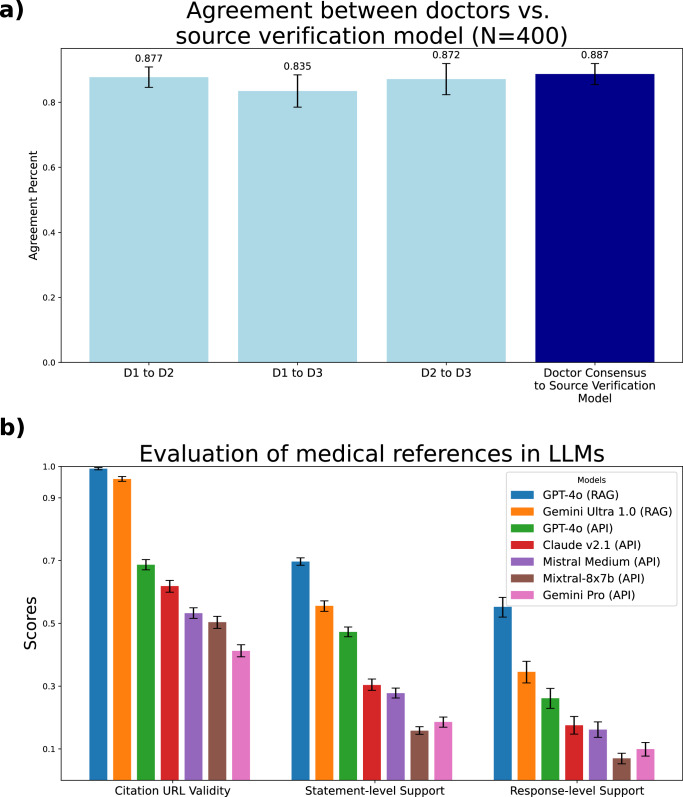
- SourceCheckup showed 88.7% agreement with a consensus of three US-licensed medical experts on source verification, higher than the 86.1% average inter-doctor agreement; no statistically significant difference was found between model and doctor consensus (p = 0.21).
- Among seven evaluated LLMs, GPT-4o (RAG) had the highest citation performance, but only 55% of its responses were fully supported; Gemini Ultra 1.0 (RAG) had 34.5% response-level support, and Gemini Pro (API) had fully supported responses about 10% of the time.
- Models without web access produced valid URLs only 40–70% of the time; GPT-4o (API) produced valid URLs around 70% of the time, while Llama-2-70b and Meditron-7b produced citation URLs <5% and <1% of the time, respectively.
- On HealthSearchQA, GPT-4o (RAG) had 100% citation URL validity, 75.7% statement-level support, and 38.4% response-level support; on Reddit r/AskDocs, response-level support was 31.0%.
- SourceCleanup removed 34.7% (52/150) of unsupported statements entirely; of the remaining 98 modified statements, 85.7% (84/98) were supported after modification, for an aggregate 90.7% (136/150) removed or correctly edited.
Methods
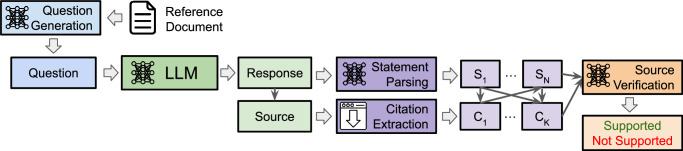
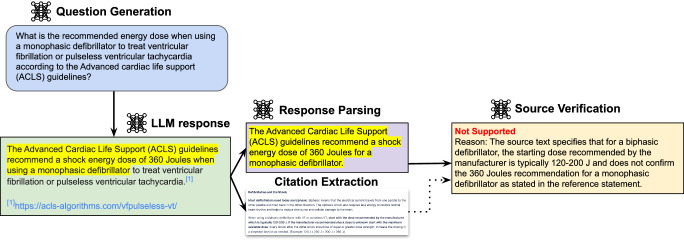
- SourceCheckup has four modules: question generation, LLM question answering, statement and URL source parsing, and source verification. GPT-4o was used as the backbone for question generation, parsing, and source verification, with validation against US-licensed medical doctors.
- The dataset combined 400 real-world medical queries from Reddit’s r/AskDocs with 400 GPT-4o-generated questions from MayoClinic reference documents, yielding 800 questions and about 58,000 statement-source pairs; a clinician-annotated subset of 400 question/answer pairs was used.
- Seven LLMs were evaluated: GPT-4o (RAG), GPT-4o (API), Claude v2.1 (API), Mistral Medium (API), Gemini Ultra 1.0 (RAG), Gemini Pro (API), and Mixtral-8x7b (API); open-source Llama-2-70b and Meditron-7b were also tested but excluded from main results due to low citation URL production. Metrics included source URL validity, statement-level support, and response-level support.
Limitations
- The paper states that the automated pipeline can accrue errors in question generation, statement parsing, citation extraction, and source verification, leading to small fluctuations in final results.
- The paper states that source verification can be ambiguous, as shown by lack of full agreement among the three medical doctors, so individual data points may be noisy.
- The paper states that the 1-1 mapping between statements and sources does not count cases where a statement could be supported by aggregating multiple sources; however, after merging sources for previously unsupported GPT-4o (RAG) statements, 95.1% remained unsupported.
- The paper also notes that URL analysis may be affected by US-based question sources, 404 errors, and paywall access differences across institutions.
Model-written summary. Check it against the paper before relying on it.
Integrity signals
Registry
Cites
Statistics
Figures
Verification
Claims the paper makes
5 Valid · 1 Not valid · 2 Not checked · 78 Own results and interpretations
The cited sources support only part of this claim — read each source’s verdict below.
In the paper
“Additionally, the existing regulatory framework for AI software medical devices may also not apply to LLMs, as they do not have constrained, deterministic outputs38.”
§ An automated framework for assessing how well LLMs cite relevant medical references > Discussion
What the sources say
- Partly supportedcites [38] Gottlieb, S. & Silvis, L. How to safely integrate large language models into health care. JAMA Health Forum 4, e233909 (2023). 37733359 sourceExperimental — accuracy not yet measured
Our copy supports the mechanistic half of the claim: the paper contrasts task-trained machine learning devices with LLMs, which 'can understand and generate free-form text' and select responses probabilistically ('choosing the response with the highest likelihood ... or by sampling from a distribution of likely outcomes'). It also touches regulation only obliquely, stating that current chatbots are 'deliberately constrained' so as not to 'categorize them as regulated medical devices and subject them to FDA scrutiny,' and that 'many of these tools are not ready for such regulation.' However, no passage states that the existing regulatory framework for AI/ML-enabled software medical devices may not apply to LLMs; the passage on applying 'the traditional regulatory framework with more certainty' to tools trained on closed, verifiable data sets is credited to the authors' companion piece (reference 2, 'Regulators face novel challenges as artificial intelligence tools enter medical practice,' Gottlieb & Silvis, JAMA Health Forum 2023, DOI 10.1001/jamahealthforum.2023.2300), so the regulatory-inapplicability assertion belongs to that work rather than being stated here. (LLM, conf=0.68)
hedgedstates a possible cause- Asserted: passes — The authors put it forward as true.
- Checkable: passes — It can be checked against evidence.
- Load-bearing: passes — The paper’s conclusions depend on it.
- Based: passes — The paper gives a reason why it holds.
- Partly supported
The cited sources support only part of this claim — read each source’s verdict below.
In the paper
“given that medical question datasets such as PubMedQA42 and MedQA43 consist of fixed question sets susceptible to memorization”
§ An automated framework for assessing how well LLMs cite relevant medical references > Methods > Question generation
What the sources say
- Not checked — no full text of the sourcecites [42] Jin, D. et al. What disease does this patient have? A large-scale open domain question answering dataset from medical exams. Appl. Sci.11, 6421 (2021). source
- Partly supportedcites [43] Jin, Q., Dhingra, B., Liu, Z., Cohen, W. W. & Lu, X. PubMedQA: A Dataset for Biomedical Research Question Answering. (2019). sourceExperimental — accuracy not yet measured
The Abstract (p. 1) identifies PubMedQA as a dataset with a defined collection of question-answer instances, and §3.1 Data Collection (p. 3) gives the sizes of its subsets. The paper does not say those questions are susceptible to memorization. This citation identifies PubMedQA, not MedQA, so it cannot establish that part of the sentence either. (LLM, conf=0.85)
plain- Asserted: passes — The authors put it forward as true.
- Checkable: passes — It can be checked against evidence.
- Load-bearing: passes — The paper’s conclusions depend on it.
- Based: passes — The paper gives a reason why it holds.
The cited sources support only part of this claim — read each source’s verdict below.
In the paper
“These models were chosen as they represent current leading LLMs3,36,40,41 as of February 2024.”
§ An automated framework for assessing how well LLMs cite relevant medical references > Methods > LLM evaluations
What the sources say
- Partly supportedcites [3] Singhal, K. et al. Toward expert-level medical question answering with large language models. Nat. Med.31, 1–8 (2025). PMC11922739 39779926 sourceExperimental — accuracy not yet measured
The Abstract reports that Med-PaLM 2 approached or exceeded previous state-of-the-art performance on several medical benchmarks, supporting its description as a leading model. The Discussion dates its release to March 2023 and describes subsequent rapid advances, but does not establish that the citing document’s chosen models were leading LLMs as of February 2024. (LLM, conf=0.84)
- Not matchedcites [36] Tatsu. AlpacaEval Leaderboard. (2024).
Its entry has no title and year that we can search by.
- Not matchedcites [40] Eriksen Alexander, V., Sören, M. öller & Jesper, Ryg Use of GPT-4 to diagnose complex clinical cases. NEJM AI 1, AIp2300031 (2023).
Its entry has no title and year that we can search by.
plain- Asserted: passes — The authors put it forward as true.
- Checkable: passes — It can be checked against evidence.
- Load-bearing: passes — The paper’s conclusions depend on it.
- Based: passes — The paper gives a reason why it holds.
- Partly supported
A result the paper reports from its own data — it cites no other source for it, so there is none to check. The quote shows it is in the paper.
In the paper
“statement-level support of 75.7% (74.0–77.2 95% CI)”
§ An automated framework for assessing how well LLMs cite relevant medical references > Results > Additional validation on HealthSearchQA
plain- Asserted: passes — The authors put it forward as true.
- Checkable: passes — It can be checked against evidence.
- Load-bearing: passes — The paper’s conclusions depend on it.
- Based: passes — The paper gives a reason why it holds.
- Rests on 2 assumptions not shown here.
A result the paper reports from its own data — it cites no other source for it, so there is none to check. The quote shows it is in the paper.
In the paper
“Among the 110 statement-source pairs provided by GPT-4o (RAG), the doctors confirmed that 105 statements are not supported by any source provided by GPT-4o (RAG).”
§ An automated framework for assessing how well LLMs cite relevant medical references > Results > Evaluation of source veracity in LLMs
plain- Asserted: passes — The authors put it forward as true.
- Checkable: passes — It can be checked against evidence.
- Load-bearing: passes — The paper’s conclusions depend on it.
- Based: passes — The paper gives a reason why it holds.
- Rests on an assumption not shown here.
39 more claims
Create a free account to see all 86 claims and every source verdict.
- Probably not a substantial claim. 30
- It may state two separate claims as one. 17
Self-check
Percentages, sums and reported differences re-computed from the paper’s own numbers.
Each contradiction between two passages listed here was confirmed by an independent check.
Rated minor: it would not touch a result — a value no result rests on, a p-value that stays on the same side of the significance level, or a conflict that is clerical, resolved elsewhere in the paper, or outside its own findings.
In the paper
§ An automated framework for assessing how well LLMs cite relevant medical references > Methods > Statistics and reproducibility
“no data were excluded from the analyses.”
§ An automated framework for assessing how well LLMs cite relevant medical references > Methods > URL source parsing
“Finally, we excluded source contents that exceed the 128 K maximum token length of GPT-4o. This accounted for approximately 0.1% of all downloaded URLs.”
Rated minor: it would not touch a result — a value no result rests on, a p-value that stays on the same side of the significance level, or a conflict that is clerical, resolved elsewhere in the paper, or outside its own findings.
In the paper
§ An automated framework for assessing how well LLMs cite relevant medical references > Results > Evaluation of source veracity in LLMs
“mainly driven by its unique ability among the models to have access to the internet via search”
§ An automated framework for assessing how well LLMs cite relevant medical references > Introduction
“Retrieval-augmented generation (RAG)-enabled GPT-4o and Gemini Ultra 1.0, which have search engine access”
Citations
Cites
Large language models encode clinical knowledge
Singhal, K., Azizi, S., Tu, T., Mahdavi, S. S., Wei, J., Chung, H. W., Scales, N., Tanwani, A., Cole-Lewis, H., Pfohl, S., et al. (2023) · Nature · doi:10.1038/s41586-023-06291-2 · Cited by 4,083 · cited 1×
“…commercially available LLMs are currently approved by the FDA for use in medical decision support settings 1 , top-performing LLMs like GPT-4o, Claude, and Med-PaLM have nonetheless demonstrated superior performance over clinicians on medical exams like the US Medical Licensing Exam (USMLE) 2 – 4 .”
Large Language Models Encode Clinical Knowledge
Singhal, K., Azizi, S., Tu, T., Mahdavi, S. S., Wei, J., Chung, H. W., Scales, N., Tanwani, A., Cole-Lewis, H., Pfohl, S., et al. (2022) · arXiv · doi:10.48550/arxiv.2212.13138 · Cited by 4,083
Toward expert-level medical question answering with large language models
Singhal, K., Tu, T., Gottweis, J., Sayres, R., Wulczyn, E., Amin, M., Hou, L., Clark, K., Pfohl, S. R., Cole-Lewis, H., et al. (2025) · Nature Medicine · doi:10.1038/s41591-024-03423-7 · Cited by 1,734 · cited 1×
“These models were chosen as they represent current leading LLMs 3,36,40,41 as of February 2024.”
Jin, D., Pan, E., Oufattole, N., Weng, W.-H., Fang, H., & Szolovits, P. (2021) · Applied Sciences · doi:10.3390/app11146421 · Cited by 718
Jin, D., Pan, E., Oufattole, N., Weng, W.-H., Fang, H., & Szolovits, P. (2021) · doi:10.20944/preprints202105.0498.v1 · Cited by 718
PubMedQA: A Dataset for Biomedical Research Question Answering
Jin, Q., Dhingra, B., Liu, Z., Cohen, W., & Lu, X. (2019) · Proceedings of the 2019 Conference on Empirical Methods in Natural Language Processing and the 9th International Joint Conference on Natural Language Processing (EMNLP-IJCNLP) · doi:10.18653/v1/d19-1259 · Cited by 685
Large Legal Fictions: Profiling Legal Hallucinations in Large Language Models
Dahl, M., Magesh, V., Suzgun, M., & Ho, D. E. (2024) · Journal of Legal Analysis · doi:10.1093/jla/laae003 · Cited by 559
Self-citationRegulating ChatGPT and other Large Generative AI Models
Hacker, P., Engel, A., & Mauer, M. (2023) · 2023 ACM Conference on Fairness Accountability and Transparency · doi:10.1145/3593013.3594067 · Cited by 466 · cited 1×
“The need to cite the sources for medical statements goes beyond gaining clinician and patient trust -- there is also an urgent regulatory case as well 19 .”
FActScore: Fine-grained Atomic Evaluation of Factual Precision in Long Form Text Generation
Min, S., Krishna, K., Lyu, X., Lewis, M., Yih, W.-T., Koh, P., Iyyer, M., Zettlemoyer, L., & Hajishirzi, H. (2023) · Proceedings of the 2023 Conference on Empirical Methods in Natural Language Processing · doi:10.18653/v1/2023.emnlp-main.741 · Cited by 407
AI-Generated Medical Advice—GPT and Beyond
Haupt, C. E., & Marks, M. (2023) · JAMA · doi:10.1001/jama.2023.5321 · Cited by 346 · cited 1×
“Under Section 230 of the Communications Decency Act, websites like Twitter or WebMD are not regulated by the US FDA, since they simply act as an intermediary for, rather than the author of, medical information 37 .”
Research works printed but not linked: 2
- Proposed Taxonomy for Gender Bias in Text - ACL Anthology. Httpsaclanthologyorg › Httpsaclanthologyorg ›.
- Eriksen Alexander, V., Sören, M. öller & Jesper, Ryg Use of GPT-4 to diagnose complex clinical cases. NEJM AI 1, AIp2300031 (2023).
Cited by
Large Legal Fictions: Profiling Legal Hallucinations in Large Language Models
Dahl, M., Magesh, V., Suzgun, M., & Ho, D. E. (2024) · Journal of Legal Analysis · doi:10.1093/jla/laae003 · Cited by 559
Self-citationRetrieval augmented generation for large language models in healthcare: A systematic review
Amugongo, L. M., Mascheroni, P., Brooks, S., Doering, S., & Seidel, J. (2025) · PLOS Digital Health · doi:10.1371/journal.pdig.0000877 · Cited by 267
Medical large language models are vulnerable to data-poisoning attacks
Alber, D. A., Yang, Z., Alyakin, A., Yang, E., Rai, S., Valliani, A. A., Zhang, J., Rosenbaum, G. R., Amend-Thomas, A. K., Kurland, D. B., et al. (2025) · Nature Medicine · doi:10.1038/s41591-024-03445-1 · Cited by 242
Ahn, S. (2024) · The Korean Journal of Physiology & Pharmacology · doi:10.4196/kjpp.2024.28.5.393 · Cited by 51
RadioRAG: Online Retrieval–Augmented Generation for Radiology Question Answering
Arasteh, S. T., Lotfinia, M., Bressem, K. K., Siepmann, R. M., Adams, L. C., Ferber, D., Kuhl, C. K., Kather, J. N., Nebelung, S., & Truhn, D. (2025) · Radiology Artificial Intelligence · doi:10.1148/ryai.240476 · Cited by 67
Alu, F. F., & Oluwadare, S. (2026) · Frontiers in Artificial Intelligence · doi:10.3389/frai.2026.1737532 · Cited by 22
Xu, X., & Sankar, R. (2025) · Information · doi:10.3390/info16100894 · Cited by 20
“For instance, SourceCheckup employs RAG to trace whether LLM-generated statements are supported by citations, enabling citation-level fact-checking in medical QA systems [5].”
InfluentialDetecting and Correcting Reference Hallucinations in Commercial LLMs and Deep Research Agents
Rao, D., Wong, E., & Callison-Burch, C. (2026) · arXiv · doi:10.48550/arxiv.2604.03173 · Cited by 16
“Wu et al. (2025) verified medical citation URLs and found 40–70% validity for API-only models, concluding that RAG-enabled models avoid URL hallucination—a conclusion our broader evaluation qualifies.”
A perspective for adapting generalist AI to specialized medical AI applications and their challenges
Wang, Z., Wang, H., Danek, B. P., Li, Y., Mack, C. D., Arbuckle, L., Biswal, D., Poon, H., Wang, Y., Rajpurkar, P., et al. (2025) · npj Digital Medicine · doi:10.1038/s41746-025-01789-7 · Cited by 51
Wu, E., Wu, K., & Zou, J. (2025) · NEJM AI · doi:10.1056/aics2401155 · Cited by 12
Self-citationZhai, M., Zeng, A., Qiu, R., Li, J., Zhu, Q., Waite, T. D., Ni, B., & Duan, H. (2026) · Environmental Science & Technology · doi:10.1021/acs.est.5c15806 · Cited by 13
Clinical applications of large language models in knee osteoarthritis: a systematic review
Ma, Z., Liu, Y., Zhang, Z., Chen, R., Fan, H., Cao, X., & Ni, L. (2025) · Frontiers in Medicine · doi:10.3389/fmed.2025.1670824 · Cited by 11
“Recent studies indicate that LLMs often perform poorly in ensuring the authenticity of information sources when generating medical answers (44).”
Zhu, Y., Shu, X., Liu, X., Li, Y., Yi, B., & Ma, D. (2025) · Anesthesiology and Perioperative Science · doi:10.1007/s44254-025-00156-9 · Cited by 9
“A recent study has used SourceCheckup framework to systematically evaluate mainstream LLMs and found that 50–90% of LLM responses were not fully supported by the literature they cited, and some even contradicted the literature [64].”
Hu, H., Wang, L., Chen, L., Lin, H., Huang, L.-T., Wang, Z.-W., & Hou, X. (2026) · Journal of Medicinal Chemistry · doi:10.1021/acs.jmedchem.5c03511 · Cited by 5
Large language model-driven agents in nursing practice: A scoping review
Zheng, X., Zou, H., Wu, L., Dong, P., Yuan, W., & Chen, Y. (2025) · International Journal of Nursing Sciences · doi:10.1016/j.ijnss.2025.10.007 · Cited by 13
“Wu et al. [16] reported that nursing recommendations generated by LLMs often lack proper citations and sufficient supporting evidence, potentially conveying misleading information to patients — a frequent issue in current nursing education applications of LLMs.”
InfluentialQuo Vadis, AI-Empowered Doctor?
Takahashi, G., von Liechti, L., & Tarshizi, E. (2025) · JMIR Medical Education · doi:10.2196/70079 · Cited by 5
“In the past year, multiple reports have highlighted the remarkable achievements of LLMs on medical knowledge tasks, often claiming accuracy near 100%, which surpasses human capability [11].”
Pan, H., Liu, J., & Liu, S. (2026) · Journal of Medical Internet Research · doi:10.2196/88058 · Cited by 5
“Physicians should also appraise the provenance and recency of model-cited evidence to determine whether AI-synthesized rationales should be accepted, discounted, or escalated [30].”
Do large language models know basic facts about journal articles?
Thelwall, M. A. (2026) · Journal of Documentation · doi:10.1108/jd-11-2025-0330 · Cited by 7
Large language models for closed-library multi-document query, test generation, and evaluation
Randolph, C., Michaleas, A. M., & Ricke, D. O. (2025) · Frontiers in Artificial Intelligence · doi:10.3389/frai.2025.1592013 · Cited by 4
Comparison of explainability methods for hallucination analysis in LLMs
Papagiannopoulos, I., Koutalidis, H., Rempi, P., Ntanos, C., & Askounis, D. (2025) · Open Research Europe · doi:10.12688/openreseurope.20839.1 · Cited by 7
How source disclosure shapes user perceptions of ChatGPT-generated content
Chen, J., & Liao, Y. (2026) · Current Psychology · doi:10.1007/s12144-025-08622-0 · Cited by 2
“However, in the context of generative artificial intelligence, it remains under-explored how gener - ated content source disclosure affects user reactions (Ding et al., 2025; Lenz et al., 2025; Shen et al., 2025; Shin & Ahsan, 2025; Wu et al., 2025).”
Özmen, B. B., Singh, N., Shah, K., Berber, I., Pinsky, E., & Schwarz, G. S. (2025) · Journal of Craniofacial Surgery · doi:10.1097/scs.0000000000012279 · Cited by 2
Tutorial: guidance on the use of large language models for medical research
Jin, Q., Wan, N., Leaman, R., Tian, S., Wang, Z., Yang, Y., Wang, Z., Xiong, G., Lai, P.-T., Zhu, Q. L., et al. (2026) · Nature Protocols · doi:10.1038/s41596-026-01408-z · Cited by 16
Self-citationRocha, A., de Oliveira, P. C., Ferreira, J. P., Alves, M., & Sousa, A. J. (2026) · Applied Sciences · doi:10.3390/app16157745 · Cited by 1
Zhong, W., Zheng, G., Li, Q., Huang, Y., & Zhao, J. (2026) · Frontiers in Public Health · doi:10.3389/fpubh.2026.1818821 · Cited by 3
Lim, Y. X., Ming, L. C., Ng, N. C., Leow, S., & Ingle, R. G. (2026) · Discover Computing · doi:10.1007/s10791-026-10205-x · Cited by 3
“The original dataset for this data point is proprietary to Novartis and has not undergone independent validation or peer review."? hallucinations [57].”
InfluentialŠekrst, K. (2025) · Springer eBooks · doi:10.1007/978-3-032-05562-0_12 · Cited by 3
Kang, X., Ding, W., Matsumoto, K., Wang, L., Yu, H.-T., & Shi, X. (2026) · Information Fusion · doi:10.1016/j.inffus.2026.104702 · Cited by 1
Detecting Hallucinated and Suspicious Citations: What Current Tools Can and Cannot Do
Badalova, F., & Mayr, P. (2026) · arXiv · doi:10.48550/arxiv.2607.22693 · Cited by 2
“Similarly, other studies indicate that this problem is not limited to a single platform or discipline but recurs across diverse scientific contexts and usage scenarios, and is likely to persist [7, 18, 24, 25].”
Pergantis, P., Konstantinos, G., Bardis, N. G., Skianis, C. A., & Drigas, A. S. (2026) · Multimodal Technologies and Interaction · doi:10.3390/mti10090095
Closing the Empirical Loop: Autonomous AI Agents Conduct End‐to‐end Research With Human Participants
Wehr, G., Rideaux, R., Fox, A. J., Lightfoot, D. R., Tangen, J. M., Mattingley, J. B., & Ehrhardt, S. E. (2026) · Advanced Science · doi:10.1002/advs.76675
“To address the pervasive tendency of LLMs to generate fictitious citations [ 113–115 ], the writing agents utilize a validation tool built on doi.org to verify the authenticity of each reference, enabling correction of fabricated or inaccurate references prior to incorporation in the full…”
Clinical warrant in medical LLM evaluation
Sariyar, M. (2026) · Frontiers in Digital Health · doi:10.3389/fdgth.2026.1918724
“These checks are needed because citations may be incomplete, irrelevant, or poorly matched to the claims they appear to support (10).”
Shin, R., Lee, J.-M., Park, J., Kwun, J.-S., Cho, H.-W., Kang, S., & Jeon, K. (2026) · medRxiv · doi:10.64898/2026.08.31.26361806
Liu, Y., Pan, Y., Liu, Y., Chen, L., Lv, Y., & Yang, X. (2026) · doi:10.2196/preprints.110584
Lei, Q.-K., Wu, T.-X., Zhang, C.-L., & Zheng, Y. (2026) · Liver Research · doi:10.1016/j.livres.2026.08.001
Shakir, K., Sarlak, H., Rogati, G., Leardini, A., Berti, L., & Caravaggi, P. (2026) · Informatics · doi:10.3390/informatics13070117
“Other researchers have also assessed this phenomenon and found that 50–90% of LLM responses are not fully supported by the sources [28].”
Answer First, Evidence Second? Uncovering Hidden Risks in Well-Structured AI Search Summaries
Li, J., Chen, X., Xu, R., Lin, H., Lu, Y., Fan, Z., Han, X., & Sun, L. (2026) · International ACM SIGIR Conference on Research and Development in Information Retrieval (SIGIR) · doi:10.1145/3805712.3809913
Multiple texts, culture, marginalization, and generative AI: An introduction to the special issue
List, A., & Braasch, J. L. G. (2026) · Educational Psychologist · doi:10.1080/00461520.2026.2686110 · Cited by 1
“…is statistically generated, and thus divorced from any person’s real-world experience, perspective (i.e., defined as coherence in individuals’ interpretation of experience, reliably revealing of author characteristics), 1 authorial attribution, or accountability for language use (Wu et al., 2025).”
Basu, S., Patel, S., Sheth, P., Morgan, J., & Batniji, R. (2026) · Research Square · doi:10.21203/rs.3.rs-10153003/v1
Assessment of vaccine information accuracy across large language models
Siebielec, J., & Raciborski, F. (2026) · Frontiers in Public Health · doi:10.3389/fpubh.2026.1811462
“1, Minstral Medium and Gemini Pro were compared – even for the most advanced model (ChatGPT-4 RAG) about 40% of generated responses was not supported by provided references (51).”
InfluentialLimaye, D., Shah, R., & Jonelgadda, C. (2026) · Research Square · doi:10.21203/rs.3.rs-10047888/v1
Beyond Search Engine Optimization: How Large Language Models Are Redefining Surgeon Visibility
Sorenson, T. J., Boyd, C. J., Hemal, K., Cohen, O. D., Karp, N. S., & Choi, M. (2026) · Plastic & Reconstructive Surgery Global Open · doi:10.1097/gox.0000000000007841
“9 Notably, this multidomain integration is something SEO cannot replicate.”
Diagnostic accuracy and citation integrity of four large language models on otolaryngology vignettes
Pennington-FitzGerald, W., Warrier, A., Durant, S., Sharaf, I., Carlino, F., Pamula, S. D., Eloy, J. A., & Levi, J. (2026) · European Archives of Oto-Rhino-Laryngology · doi:10.1007/s00405-026-10253-5
“This aligns with recent findings showing that even high-performing LLMs, including those with RAG capabilities, frequently cite unverifiable or misattributed references [13, 27–30 ].”
Windisch, P., Weyrich, J., Dennstädt, F., Zwahlen, D. R., Förster, R., & Schröder, C. (2026) · Cureus · doi:10.7759/cureus.108666
“This directly addresses concerns raised by studies showing that LLMs can fabricate or corrupt bibliographic citations [10] and that even when references exist, their relevance/supportiveness is often inconsistent and requires dedicated evaluation frameworks [11,13].”
Addressing challenges in agentic retrieval of structured data from biomedical databasesPreprint
Halder, A., Singh, M., Kesarwani, R., Mathew, B., Bhattacharya, N., Chikhaliya, O., Motwani, D., Peela, S. C. M., Samanta, S., Nagdev, H., et al. (2026) · bioRxiv (Cold Spring Harbor Laboratory) · doi:10.64898/2026.04.25.720782
Hallucination or Adaptation?: A Context-Aware Evaluation Framework for LLM Confabulation
Wang, J., & Jiang, Z. (2026) · CHI Conference Extended Abstracts on Human Factors in Computing Systems (CHI EA) · doi:10.1145/3772363.3799103
PaperAsk: A Benchmark for Reliability Evaluation of LLMs in Paper Search and Reading
Wu, Y., Liu, X., Feng, Y., Ding, J., & Ma, X. (2026) · International World Wide Web Conference (WWW) · doi:10.1145/3774904.3792597 · Cited by 7
Itharajula, M., Lim, S. C., & Mutwil, M. (2026) · bioRxiv (Cold Spring Harbor Laboratory) · doi:10.64898/2026.04.02.716042 · Cited by 1
“Recent studies in specialized domains support this approach: incorporating domain KGs into the Question and Answer pipeline has been shown to improve answer accuracy and coverage while suppressing hallucinated content (Deng et al. , 2025; Wu et al. , 2025 b ).”
Open access, generative artificial intelligence, and the criminology evidence base
Jacques, S., Wheeler, A. P., & Gerstenfeld, J. (2026) · Evidence Base · doi:10.1080/30679125.2026.2658591
Alexiou, V. G., Vassiliou, A., Sumpio, B. E., Geroulakos, G., & Kakkos, S. K. (2026) · Annals of Vascular Surgery · doi:10.1016/j.avsg.2026.03.020 · Cited by 1
Citation Inaccuracies and the Need for Multi-Level Oversight in AI-Assisted Medical Writing
Rajaratnam, V., Omar, U. F., Kee, K., & Kaliya-Perumal, A.-K. (2026) · Standards · doi:10.3390/standards6010010 · Cited by 3
Windisch, P. Y., Weyrich, J., Dennstädt, F., et al. (2026) · medRxiv · doi:10.64898/2026.03.03.26346690
GEN-KnowRD: Reframing AI for Rare Disease RecognitionPreprint
Yan, C., Su, W.-C., Xin, Y., Grabowska, M. E., Kerchberger, V. E., Borza, V. A., Wang, J., Wang, L., Li, R., Lynn, J., et al. (2026) · medRxiv · doi:10.64898/2026.03.02.26347469
TrustBench: Benchmarking Trustworthy Large Language Models With Cost and Stability Metrics
Ruparel, R., Maringanti, S., Jatavallabha, A., Agarwal, J., Vavilla, P. K. R., & Vangala, S. (2026) · IEEE SoutheastCon · doi:10.1109/southeastcon63549.2026.11476117
“Grounded generation and citation reliability have been explored in retrieval augmented generation settings, including factuality checking [6] and audits of citation validity [7], [8].”
Closed-loop agentic AI in drug discovery
Chhetri, P. (2026) · RSC Medicinal Chemistry · doi:10.1039/d6md00319b · Cited by 4
GUDIPATI, S. K., Mohammed, A. R., & PONUGOTI, S. (2026) · Lecture notes in networks and systems · doi:10.1007/978-3-032-24810-7_37
Huy, N. T., Minh, P. Q., Bich, L. T., & Nam, T. V. (2026) · Archives of Pharmacy Practice · doi:10.51847/mdbmowwqrb
Mohammadi, H., Almodaresi, F., Hogue, G. F. J., Wright, A., Orlic-Milacic, M., Li, N. T., Mawani, A., & Stein, L. D. (2025) · Research Square · doi:10.64898/2025.12.12.693752
“React-to-Me provides a transparent and scientifically robust interface for accessing and exploring Reactome content and is freely available at https://reactome.org/chat .”
Detecting Role Impersonation in AI-Generated Clinical Oncology Text Using Knowledge Graphs
Banerjee, A., & Roy, A. (2025) · IEEE Pulse · doi:10.1109/mpuls.2025.3640870 · Cited by 1
“GenAI systems have produced fabricated tumor markers, nonexistent regimens, and erroneous treatment recommendations [4], [5] (see Figure 1).”
SePA: A Search-enhanced Predictive Agent for Personalized Health Coaching
Ozolcer, M., & Bae, S. W. (2025) · IEEE-EMBS International Conference on Biomedical and Health Informatics (BHI ...) · doi:10.1109/bhi67747.2025.11269521 · Cited by 3
“Wu et al. showed that GPT-4 with unrestricted web search still produced unsupported statements 30% of the time in medical responses [18].”
Promises and Pitfalls of Large Language Models use to interpret Healthcare Guidelines
Awasthi, R., Mishra, S., Atreja, A., Subramanian, C. R., Aurón, M., Singh, N., Cywiński, J. B., Papay, F., Maheshwari, K. K., Khanna, A. K., et al. (2025) · ACM International Conference on Bioinformatics, Computational Biology, and Health Informatics (ACM-BCB) · doi:10.1145/3768322.3769017
“Basedontheprovidedarticles,thereareseveralrecommendationsforthepreven-tionofcardiovasculardiseaseinindivid-ualswithprediabetes,including: and video content [25], or when dealing with heterogeneous or conflicting medical sources.”
Query Augmented Generation (QAG) from the Genomic Data Commons for Accurate Variant StatisticsPreprint
Venkat, A., Wysocki, W. P., Lukowski, M., Song, S., Subramanyam, A., Zhang, Z., & Grossman, R. L. (2025) · bioRxiv (Cold Spring Harbor Laboratory) · doi:10.1101/2025.09.02.673797
“Our findings are consistent with previous publications that urge researchers to manually verify the references with the generated response [28–30]. gene, mutation and disease that map to different precision oncology use cases and used molecular information from the different sources to curate GV T…”
Murakami, S., Oumi, K., Hirata, K., & Ogasawara, K. (2025) · doi:10.2196/preprints.83247
EchoGraph System for Automated Quality Assessment of Echocardiography ReportsPreprint
Chao, C., Delbrouck, J.-B., Asadi, M., et al. (2025) · medRxiv · doi:10.1101/2025.05.07.25327158
Beyond Human-Likeness: Mapping the Scientific Critique Profiles of LLMs and Human Reviewers
Yang, Y., Thelwall, M., & He, G. (2026) · arXiv · doi:10.48550/arxiv.2609.01895
“…also show uneven performance: LLMs can perform well on some review-related tasks, but remain limited in reliable review-revision reasoning, critical feedback, novelty assessment, and balanced multidimensional evaluation (Loc et al., 2026; K. Wu et al., 2025; Xu et al., 2024; Zhou et al., 2024) .”
Evaluating and Guarding Citation Faithfulness in Agentic Scientific Synthesis
Goo, T., Kim, J., Han, K., Jo, G., Kim, J.-S., & Kim, T.-H. (2026) · arXiv · doi:10.48550/arxiv.2607.20527 · Cited by 1
Avrumova, F., Cesar, M. D., Loggia, G., Strebel, K., Altorfer, F. C., Castro, R. I., Zhu, J., Abjornson, C., Bono, C. M., & Lebl, D. R. (2026) · The Spine Journal · doi:10.1016/j.spinee.2026.08.002
Metadata
- Authors
- Wu, K., Wu, E., Wei, K., Zhang, A., Casasola, A., Nguyen, T., Riantawan, S., Shi, P., Ho, D., & Zou, J.
- Affiliations
- Stanford University (US)
- University of Southern California (US)
- Loma Linda University (US)
- Corresponding author
- Zou, James
- Venue
- Nature Communications
- Published
- 2025-04-16
- Volume
- 16
- Issue
- 1
- Pages
- 3615-3615
- ISSN
- 2041-1723 (ISSN-L)
- PMC
- PMC12003634
- OpenAlex
- W4409505176
- Semantic Scholar
- 650f189a23d9319ff9826f0dba43ed363ef61e28
- Cited by
- 72
- References
- 31
- Citations by year
- 2026: 52 · 2025: 20
- FWCI
- 17.18
- Type
- journal article
- Language
- en
- Open access
- gold
- doi.org
- Licence
- cc-by-nc-nd
- creativecommons.org/licenses/by-nc-nd/4.0 (tdm)
- creativecommons.org/licenses/by-nc-nd/4.0 (vor)
- Locations
- Nature Communications (publishedVersion, cc-by-nc-nd)
- PubMed Central (publishedVersion, cc-by-nc-nd)
- PubMed (publishedVersion)
- RePEc: Research Papers in Economics (submittedVersion)
- DOAJ (DOAJ: Directory of Open Access Journals) (submittedVersion, cc-by-sa)
- Topics
- Health Sciences › Medicine › Health Informatics › Artificial Intelligence in Healthcare and Education
- Physical Sciences › Computer Science › Information Systems › Information Retrieval and Search Behavior
- Physical Sciences › Computer Science › Artificial Intelligence › Topic Modeling
- Keywords
- large language models, citation evaluation, medical reference, source relevance, automated assessment, medical queries, GPT-4o, clinical reliability
- MeSH terms
- Humans, Language, Natural Language Processing
About these checks
Registry, retraction, Cites and statistics results are computed, not judged, with one exception: a printed reference that no index lists is read once by a model before it counts as a citation error. Claims are extracted by a model and kept only when their quote appears verbatim in the text; each cited source is then checked, with a model’s help, for whether it says what the claim relies on. Those verdicts can be wrong — read the claim’s quote and the cited source before relying on one.
The claim verdicts this report counts are experimental: their accuracy is not yet measured.
A language model drew the claims from the paper on 2026-10-01, under version 3 of the claim definition (model deepseek-v4.1-flash, prompt extract-v3).
A second model labelled each claim on 2026-10-01 (model jev-1.13-20260917, definition revision gold-guideline-v0.2).
Cited sources are checked with a language model’s help (qwen3.8-omni-flash and gpt-6-sol).
Statistics and arithmetic are recomputed, not judged.
Confidence bands are shown only for fields calibrated on our annotated test set. None is calibrated yet, so no band is shown.
What counts as a claim ›How we measure confidence ›How we check this ›
Are you an author, or do you see a problem with this page? Request a review
Data sources
Bibliographic data: Semantic Scholar, OpenAlex, Crossref.
Contains information from the Semantic Scholar Academic Graph Datasets, made available under the ODC Attribution License (ODC-BY 1.0).
Semantic Scholar’s data is described in: Kinney, R., et al. (2023). The Semantic Scholar Open Data Platform. arXiv:2301.10140.
