

The DOI matches its Crossref record; 22 of the 22 references it cites were found in a registry or an index; 26 of the 38 sources its claims cite were checked for support.
An auditable and source-verified framework for clinical AI decision support: integrating retrieval-augmented generation with data provenance
Open accessAbstract
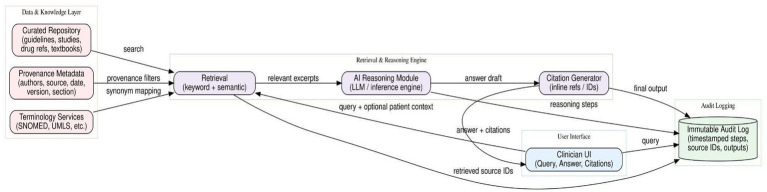
Conceptual framework for auditable, source-verified AI-CDSS integrating curated evidence retrieval, provenance metadata, and tamper-evident audit logging.
Overview
CoChat Summary
## TL;DR
This paper is a conceptual framework for clinical AI decision support that combines retrieval-augmented generation with explicit provenance and tamper-evident audit logging. It does not present a prototype, experiments, or empirical results; instead, it proposes a trust-oriented architecture and a staged evaluation roadmap.
## Key findings
- The authors propose three core trust requirements for an AI-CDSS: every recommendation must be backed by identifiable sources, every stage of processing must be recorded, and outputs must be delivered in a user-friendly manner.
- The framework has three main components: a data/knowledge layer, a retrieval and reasoning engine, and a user interface with audit logging.
- In the paper’s sepsis walkthrough, the system retrieves the Surviving Sepsis Campaign 2021 guideline and returns the recommendation: 30 mL/kg IV crystalloid fluid immediately for suspected sepsis-induced hypoperfusion, labeled “Strong recommendation, Low quality of evidence.”
- The authors’ planned evaluation includes PubMedQA, MedQA, and clinician studies with about 50–60 clinicians; they state this sample size should provide around 80% power to detect meaningful differences in trust and cognitive workload at α = 0.05.
## Methods
- Design: Conceptual, future-oriented system design developed by synthesizing prior literature on evidence-based medicine, provenance, trustworthy AI, and clinical decision support; no prototype or empirical experiments were conducted.
- Data/sample: No study sample was collected for the paper itself. The framework is described using curated medical sources such as clinical guidelines, PubMed abstracts, textbooks, and terminology systems including SNOMED-CT and UMLS; a clinical simulation uses a suspected sepsis case.
- Main analysis: Architectural proposal and walkthrough of a retrieval-augmented reasoning pipeline with provenance metadata, semantic mapping, audit logging, and planned evaluation phases (simulation testing, clinician usability study, and decision-quality proxies).
## Limitations
- The paper explicitly states that it is purely conceptual and that the system has not been implemented, tested, or empirically validated; its practical effectiveness is unknown.
- The authors note a dependency on a comprehensive, up-to-date medical knowledge base, which they say would be a major challenge to build and maintain.
- They also identify citation misattribution in RAG systems, latency/usability trade-offs, bias in underlying evidence, and privacy/security concerns as feasibility issues; these are limitations stated in the paper.
Model-written summary. Check it against the paper before relying on it.
Integrity signals
Registry
Cites
Statistics
Figures

Verification
Claims the paper makes
25 Valid · 0 Not valid · 12 Not checked · 35 Own results and interpretations
Every source the paper cites for this claim was checked and supports it.
In the paper
“leading studies have repeatedly identified that lack of transparency is a major barrier to AI-CDS adoption (Tun et al., 2025; Amann et al., 2022).”
§ An auditable and source-verified framework for clinical AI decision support: integrating retrieval-augmented generation with data provenance > Introduction
What the sources say
- Supportedcites Tun et al., 2025 source
The Results section identifies opaque, difficult-to-interpret AI recommendations as a major concern that erodes health care workers’ trust. The Conclusions name algorithmic obscurity as a barrier, and the Introduction describes trust as critical to successful integration and use of AI-CDSS. No page numbers are provided in the supplied passages. (LLM, conf=0.88)
- Supportedcites Amann et al., 2022 source
The Introduction says that opaque, black-box AI can cause a lack of trust, which it calls an important barrier to CDSS adoption. It also identifies increasing transparency as a way to foster trust. (LLM, conf=0.91)
boostedstates a cause- Asserted: passes — The authors put it forward as true.
- Checkable: passes — It can be checked against evidence.
- Load-bearing: passes — The paper’s conclusions depend on it.
- Based: passes — The paper gives a reason why it holds.
- Supported
The cited sources support only part of this claim — read each source’s verdict below.
In the paper
“However, even with the significant promise real-world adoption has been slow because clinicians are wary of opaque algorithms that they cannot verify (Tun et al., 2025).”
§ An auditable and source-verified framework for clinical AI decision support: integrating retrieval-augmented generation with data provenance > Introduction
What the sources say
- Partly supportedcites Tun et al., 2025 sourceExperimental — accuracy not yet measured
The Results (Insights Into Health Care Workers’ Trust in AI; no page available) identify black-box algorithms and difficult-to-interpret recommendations as barriers to clinicians’ trust. The Introduction links trust to successful clinical integration, but the paper does not establish that real-world adoption has been slow specifically because clinicians cannot verify opaque algorithms; it identifies several other barriers as well. (LLM, conf=0.84)
plainstates a cause- Asserted: passes — The authors put it forward as true.
- Checkable: passes — It can be checked against evidence.
- Load-bearing: passes — The paper’s conclusions depend on it.
- Based: passes — The paper gives a reason why it holds.
- Partly supported
Every source the paper cites for this claim was checked and supports it.
In the paper
“These findings suggest that integrating evidence retrieval can make AI-CDSS outputs more trustworthy (Hurt et al., 2025).”
§ An auditable and source-verified framework for clinical AI decision support: integrating retrieval-augmented generation with data provenance > Background and related work
What the sources say
- Supportedcites Hurt et al., 2025 source
The Discussion says OpenEvidence answered clinical questions accurately with cited literature and identifies its use of trusted, peer-reviewed sources as a main advantage. The Conclusions likewise describe accurate, evidence-based responses supported by peer-reviewed citations. This supports the citing sentence’s hedged claim that integrating evidence retrieval can make AI decision-support outputs more trustworthy. (LLM, conf=0.85)
hedgedstates a possible cause- Asserted: passes — The authors put it forward as true.
- Checkable: passes — It can be checked against evidence.
- Load-bearing: passes — The paper’s conclusions depend on it.
- Based: passes — The paper gives a reason why it holds.
- Supported
The cited sources support only part of this claim — read each source’s verdict below.
In the paper
“In practice, clinicians say they prefer recommendations that explicitly cite medical guidelines or high-quality studies (Hurt et al., 2025).”
§ An auditable and source-verified framework for clinical AI decision support: integrating retrieval-augmented generation with data provenance > Introduction
What the sources say
- Partly supportedcites Hurt et al., 2025 sourceExperimental — accuracy not yet measured
The Methods describe physicians assessing the accuracy of references and evidence-based support, and the Discussion says they rated recommendations backed by cited literature positively (page unavailable). The paper does not report clinicians saying they prefer recommendations that explicitly cite guidelines or high-quality studies. (LLM, conf=0.78)
plain- Asserted: passes — The authors put it forward as true.
- Checkable: passes — It can be checked against evidence.
- Load-bearing: passes — The paper’s conclusions depend on it.
- Based: passes — The paper gives a reason why it holds.
- Partly supported
Every source the paper cites for this claim was checked and supports it.
In the paper
“As Ahmed et al. (2023) note, logs of this kind provide a “comprehensive record” that enables traceability, accountability, and auditing of the system.”
§ An auditable and source-verified framework for clinical AI decision support: integrating retrieval-augmented generation with data provenance > Methods (framework design) > Proposed framework
What the sources say
- Supportedcites Ahmed et al., 2023 source
Section 2.1.3 (Logging-based technology) explicitly says logs provide a comprehensive record of data-related events, enabling traceability, accountability, and auditing. This directly supports the attributed claim. (LLM, conf=0.95)
plainstates a cause- Asserted: passes — The authors put it forward as true.
- Checkable: passes — It can be checked against evidence.
- Load-bearing: passes — The paper’s conclusions depend on it.
- Based: passes — The paper gives a reason why it holds.
- Supported
12 more claims · 1 with their cited sources checked
Create a free account to see all 72 claims and to verify the 5 references still open.
- Probably not a substantial claim. 45
- It may state two separate claims as one. 24
Citations
Cites
GRADE: an emerging consensus on rating quality of evidence and strength of recommendations
Guyatt, G. H., Oxman, A. D., Vist, G. E., Kunz, R., Falck-Ytter, Y., Alonso-Coello, P., & Schünemann, H. J. (2008) · BMJ · doi:10.1136/bmj.39489.470347.ad · Cited by 23,305
Evidence based medicine: what it is and what it isn't
Sackett, D. L., Rosenberg, W. M. C., Gray, J. A. M., Haynes, R. B., & Richardson, W. S. (1996) · BMJ · doi:10.1136/bmj.312.7023.71 · Cited by 15,769 · cited 2×
“This concept corresponds with the theory of evidence-based medicine (EBM) established in the 1990s, which asserts that therapeutic judgments must amalgamate personal competence with the most reliable external evidence Sackett et al. (1996).”
Surviving sepsis campaign: international guidelines for management of sepsis and septic shock 2021
Evans, L., Rhodes, A., Alhazzani, W., Antonelli, M., Coopersmith, C. M., French, C., Machado, F. R., Mcintyre, L., Ostermann, M., Prescott, H. C., et al. (2021) · Intensive Care Medicine · doi:10.1007/s00134-021-06506-y · Cited by 5,082
The unified medical language system (UMLS): integrating biomedical terminology
Bodenreider, O. (2004) · Nucleic Acids Research · doi:10.1093/nar/gkh061 · Cited by 4,356 · cited 5×
“Terminology services: This layer houses the standardized ontologies, specifically SNOMED-CT (Donnelly, 2006) and UMLS (Bodenreider, 2004), that the system uses to bridge the gap between messy clinical language and formal medical evidence.”
InfluentialHyperledger fabric: a distributed operating system for permissioned blockchains
Androulaki, E., Barger, A., Bortnikov, V., Cachin, C., Christidis, K., De Caro, A., Enyeart, D., Ferris, C., Laventman, G., Manevich, Y., et al. (2018) · Proceedings of the Thirteenth EuroSys Conference · doi:10.1145/3190508.3190538 · Cited by 3,654 · cited 2×
“To ensure the sub-second latency required in time-sensitive clinical settings, the framework utilizes a hybrid storage model on a permissioned distributed ledger (Hyperledger Fabric) (Androulaki et al., 2018).”
Jin, D., Pan, E., Oufattole, N., Weng, W.-H., Fang, H., & Szolovits, P. (2020) · Applied Sciences · doi:10.48550/arxiv.2009.13081 · Cited by 2,339 · cited 1×
“First, we will test the system in-silico using PubMedQA (Jin et al., 2019) and MedQA (Jin et al., 2020), along with clinical vignettes.”
Clinical decision support systems for the practice of evidence-based medicine
Sim, I., Gorman, P., Greenes, R. A., Haynes, R. B., Kaplan, B., Lehmann, H., & Tang, P. C. (2001) · Journal of the American Medical Informatics Association · doi:10.1136/jamia.2001.0080527 · Cited by 732 · cited 2×
“Initial informatics initiatives in Clinical Decision Support (CDS) reflected this notion: Sim et al. (2001) advocated for the incorporation of both literature-derived and practice-derived data into machine-interpretable knowledge bases to facilitate decision-making (Sim et al., 2001).”
Jin, D., Pan, E., Oufattole, N., Weng, W.-H., Fang, H., & Szolovits, P. (2021) · Applied Sciences · doi:10.3390/app11146421 · Cited by 718
Jin, D., Pan, E., Oufattole, N., Weng, W.-H., Fang, H., & Szolovits, P. (2021) · doi:10.20944/preprints202105.0498.v1 · Cited by 718
PubMedQA: A Dataset for Biomedical Research Question Answering
Jin, Q., Dhingra, B., Liu, Z., Cohen, W., & Lu, X. (2019) · Proceedings of the 2019 Conference on Empirical Methods in Natural Language Processing and the 9th International Joint Conference on Natural Language Processing (EMNLP-IJCNLP) · doi:10.18653/v1/d19-1259 · Cited by 685
Research works printed but not linked: 4
- 2024, Regulation (EU) 2024/1689 of the European Parliament and of the Council of 13 June 2024 laying down harmonised rules on artificial intelligence (Artificial Intelligence Act)
- 2021, 2020 drug trials snapshots summary report
- 2020, Drug Trails Snapshot Summary Report
- 2024, Transparency for machine learning-enabled medical devices: Guiding principles
Cited by
Natural Language Processing in Healthcare: From Unstructured Data to Clinical Intelligence
Kumar, D., Choudhary, N., Gupta, V., Tanwar, R., Bahmani, K., Antal, S., Jarora, S., Gupta, S., Shaikh, M. S., Webster, T. J., et al. (2026) · Intelligent Systems with Applications · doi:10.1016/j.iswa.2026.200698 · Cited by 3
The Escape Register: A Failure-Driven Safety Methodology for Multi-Agent Clinical AI SystemsPreprint
Siegel, N. (2026) · Research Square · doi:10.21203/rs.3.rs-9374687/v1 · Cited by 2
Artificial intelligence in drug development: From molecular discovery to precision medicine
Xie, T., Zhang, Z., Wang, Y., Wang, H., Chen, X., Feng, H., & Shao, F. (2026) · Genes & Diseases · doi:10.1016/j.gendis.2026.102402 · Cited by 1
Kang, X., Ding, W., Matsumoto, K., Wang, L., Yu, H.-T., & Shi, X. (2026) · Information Fusion · doi:10.1016/j.inffus.2026.104702 · Cited by 1
Agentic systems in computational pathology: architectures, evidence, and translational challenges
Lu, X., Li, Q., Gao, Y., Wei, D., Lyu, M., Ma, S., Li, J., Wu, Y., Cai, L., Zhang, T., et al. (2026) · Journal of Translational Medicine · doi:10.1186/s12967-026-08829-0 · Cited by 2
“Source-verified architectures can link recommendations to retrieved evidence and record intermediate steps [201].”
Metadata
- Authors
- Alu, F. F., & Oluwadare, S.
- Affiliations
- University of Cincinnati (US)
- Corresponding author
- Alu, Fidelis Fidelis
- ORCID
- Oluwadare, Sunkanmi
- Venue
- Frontiers in Artificial Intelligence
- Publisher
- Frontiers Media SA
- Published
- 2026-02-04
- Volume
- 9
- Pages
- 1737532-1737532
- ISSN
- 2624-8212 (ISSN-L)
- PMC
- PMC12913532
- OpenAlex
- W7127628418
- Cited by
- 22
- References
- 15
- Citations by year
- 2026: 22
- FWCI
- 28.60
- Type
- journal article
- Language
- en
- Open access
- gold
- doi.org
- Licence
- Locations
- Frontiers in Artificial Intelligence (publishedVersion, cc-by)
- PubMed (publishedVersion)
- PubMed Central (publishedVersion, cc-by)
- DOAJ (DOAJ: Directory of Open Access Journals) (submittedVersion, cc-by-sa)
- Topics
- Health Sciences › Medicine › Health Informatics › Artificial Intelligence in Healthcare and Education
- Physical Sciences › Computer Science › Artificial Intelligence › Explainable Artificial Intelligence (XAI)
- Health Sciences › Health Professions › Health Information Management › Electronic Health Records Systems
- Keywords
- clinical decision support, retrieval-augmented generation, data provenance, audit logging, source verification, trustworthy AI, evidence-based medicine, medical knowledge base, clinical guidelines, AI transparency, regulatory compliance, software as a medical device, EU AI Act, clinician trust
About these checks
Registry, retraction, Cites and statistics results are computed, not judged, with one exception: a printed reference that no index lists is read once by a model before it counts as a citation error. Claims are extracted by a model and kept only when their quote appears verbatim in the text; each cited source is then checked, with a model’s help, for whether it says what the claim relies on. Those verdicts can be wrong — read the claim’s quote and the cited source before relying on one.
The claim verdicts this report counts are experimental: their accuracy is not yet measured.
A language model drew the claims from the paper on 2026-10-10, under version 3 of the claim definition (model deepseek-v4.1-flash, prompt extract-v3).
A second model labelled each claim on 2026-10-10 (model jev-1.13-20260917, definition revision gold-guideline-v0.2).
Cited sources are checked with a language model’s help (gpt-6-sol).
Statistics and arithmetic are recomputed, not judged.
Confidence bands are shown only for fields calibrated on our annotated test set. None is calibrated yet, so no band is shown.
What counts as a claim ›How we measure confidence ›How we check this ›
Are you an author, or do you see a problem with this page? Request a review
How to cite
Cite CoChat for the checks on this page, and the paper for its own findings.
- This page
- CoChat. (2026). Citation check: An auditable and source-verified framework for clinical AI decision support: integrating retrieval-augmented generation with data provenance. https://app.cochat.ai/papers/10.3389/frai.2026.1737532
- The paper
- Alu, F. F., & Oluwadare, S. (2026). An auditable and source-verified framework for clinical AI decision support: integrating retrieval-augmented generation with data provenance. Frontiers in Artificial Intelligence. https://doi.org/10.3389/frai.2026.1737532
Data sources
Bibliographic data: Semantic Scholar, OpenAlex, Crossref.
Contains information from the Semantic Scholar Academic Graph Datasets, made available under the ODC Attribution License (ODC-BY 1.0).
Semantic Scholar’s data is described in: Kinney, R., et al. (2023). The Semantic Scholar Open Data Platform. arXiv:2301.10140.
