

GDF8 and activin A blockade protects against GLP-1–induced muscle loss while enhancing fat loss in obese male mice and non-human primates
Open accessThe DOI matches its Crossref record; 63 of the 63 references it cites were found in a registry or an index; 39 of the 65 sources its claims cite were checked for support.
Abstract
Glucagon-like peptide-1 receptor agonists act via appetite suppression and caloric restriction. These treatments can result in significant muscle loss, likely due to evolutionary mechanisms protecting against food scarcity as muscle is a major energy utilizer. One mechanism that reduces muscle mass involves activation of type II activin receptors, ActRIIA/B, which yield profound muscle growth in humans when blocked. We previously demonstrated GDF8, also known as myostatin, and activin A are the two major ActRIIA/B ligands mediating muscle minimization. Here, we report that dual blockade can also prevent muscle loss associated with glucagon-like peptide-1 receptor agonists – and even increase muscle mass – in both obese mice and non-human primates; moreover, this muscle preservation enhances fat loss and is metabolically beneficial. These data raise the possibility that supplementing glucagon-like peptide-1 receptor agonist treatment with GDF8 and activin A blockade could greatly improve the quality of weight loss during the treatment of obesity in humans. Myostatin and activin A are the two primary negative regulators of muscle mass. Blocking these circulating ligands during GLP-1 therapy induces improved body composition through preservation of lean mass and enhanced fat mass loss in obese primates.
Overview
CoChat Summary
TL;DR
In obese male mice and obese cynomolgus monkeys, blocking GDF8 (myostatin) and activin A alongside semaglutide preserved or increased lean mass while also increasing fat loss. The authors argue this could improve the quality of GLP-1–induced weight loss by reducing muscle loss and improving metabolic outcomes.
Key findings
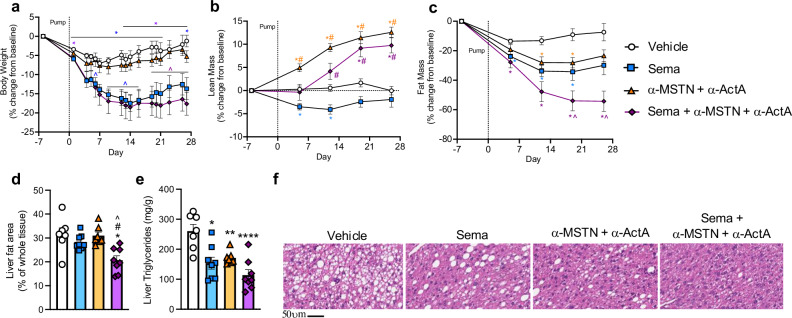
- In obese mice, semaglutide caused significant lean mass loss, whereas semaglutide plus α-MSTN/α-ActA protected against that loss and produced a significant increase in lean mass.
- In the mouse study, semaglutide plus α-MSTN/α-ActA caused markedly greater fat loss than semaglutide alone, described as “almost twice” the fat loss seen with semaglutide alone.
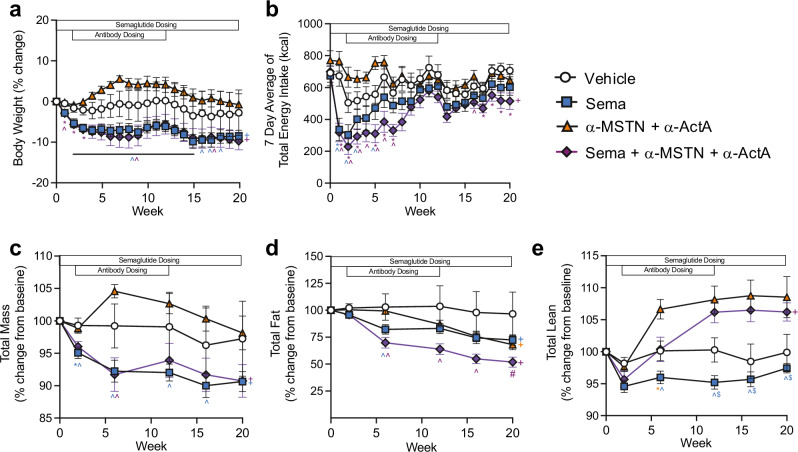
- In obese cynomolgus monkeys, after α-MSTN/α-ActA was added at week 2, the semaglutide + antibody arm diverged from semaglutide alone with progressively greater fat loss and progressively greater increases in lean mass.
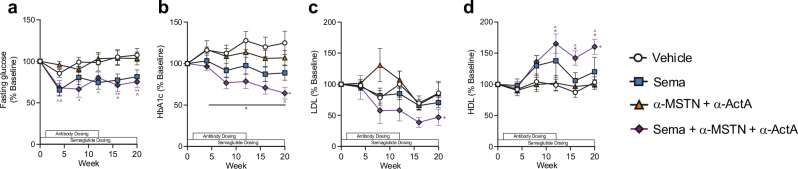
- The monkey study also reported beneficial changes in HbA1c%, LDL-C, and HDL-C across treated arms, with the semaglutide + α-MSTN + α-ActA arm showing the biggest beneficial changes.
Methods
- Two diet-induced obese mouse studies in male C57Bl/6 mice tested semaglutide, α-MSTN/α-ActA, both together, or controls; body composition was tracked by qNMR, and liver fat/triglycerides were assessed in the first study.
- A 20-week study in obese male cynomolgus monkeys (final cohort 40 animals, 10 per group) tested semaglutide with or without α-MSTN/α-ActA; primary endpoints were body weight and body composition by DXA, with food intake, HbA1c%, and lipid profiles also measured.
- The main analysis used one-way or two-way repeated measures ANOVA; the paper states no sample size calculations were performed.
Limitations
- Stated by the paper: the combination was tested only in male mice and male monkeys, so female GLP-1 combination effects were not directly tested here.
- Stated by the paper: no sample size calculation was performed for any study.
- Evident from the text: the report is preclinical and does not directly test the combination in humans with obesity in this paper.
Model-written summary. Check it against the paper before relying on it.
Integrity signals
Registry
Cites
Statistics
Figures
Verification
Claims the paper makes
16 Valid · 2 Not valid · 8 Not checked · 59 Own results and interpretations
At least one cited source doesn’t support this claim or points to a different paper, and none confirmed it — see the verdicts below.
In the paper
“less than 30% of patients remain on treatment for more than a year6–8”
§ GDF8 and activin A blockade protects against GLP-1–induced muscle loss while enhancing fat loss in obese male mice and non-human primates > Introduction
What the sources say
- Disputedcites [6] Weiss, T. et al. Real-world weight change, adherence, and discontinuation among patients with type 2 diabetes initiating glucagon-like peptide-1 receptor agonists in the UK. BMJ Open Diabetes Res. Care 10, e002517 (2022). 35101924 PMC8804648 sourceExperimental — accuracy not yet measured
The Results > Discontinuation passage reports that 45.2% discontinued GLP-1 RA therapy within 12 months, meaning approximately 54.8% had not discontinued by then—not fewer than 30%. It also reports a median time to discontinuation of 426 days, beyond one year. (LLM, conf=0.90)
Checked by a reasoning model — may be wrong.
- Disputedcites [7] Vilsboll, T., Lindahl, C. O., Nielsen, N. F. & Tikkanen, C. K. Real-world impact of once-weekly subcutaneous semaglutide after 2 years of follow-up: Results from a nationwide observational study in people with type 2 diabetes. Diabetes Obes. Metab. 25, 1740–1749 (2023). 36809678 sourceExperimental — accuracy not yet measured
Section 3.4 (page not available) reports that 43.9% discontinued semaglutide by 720 days, meaning 56.1% had not discontinued after nearly two years. The study concerns semaglutide in people with type 2 diabetes, rather than all GLP-1 receptor agonists, but its persistence finding is contrary to the cited claim that fewer than 30% remain on treatment beyond a year. (LLM, conf=0.90)
Checked by a reasoning model — may be wrong.
- Not checked — no full text of the sourcecites [8] Mody, R. et al. Greater adherence and persistence with injectable dulaglutide compared with injectable semaglutide at 1-year follow-up: Data from US clinical practice. Clin. Ther. 44, 537–554 (2022). 35264311 source
plain- Asserted: passes — The authors put it forward as true.
- Checkable: passes — It can be checked against evidence.
- Load-bearing: unclear — It is unclear whether the paper’s conclusions depend on it.
- Based: passes — The paper gives a reason why it holds.
- Disputed
The cited sources support only part of this claim — read each source’s verdict below.
In the paper
“up to 40% of GLP-1 RA-induced weight loss can be due to loss of lean mass3–5.”
- Also stated in: § Introduction · plain
“up to 40% of GLP-1 RA-induced weight loss can be due to loss of lean mass3–5”
- Also stated in: § Discussion · plain
“up to 40% of the profound weight loss induced by these agents can be due to loss of lean mass3–5”
§ GDF8 and activin A blockade protects against GLP-1–induced muscle loss while enhancing fat loss in obese male mice and non-human primates > Introduction
What the sources say
- Partly supportedcites [3] Sargeant, J. A. et al. A review of the effects of glucagon-like peptide-1 receptor agonists and sodium-glucose cotransporter 2 inhibitors on lean body mass in humans. Endocrinol. Metab. 34, 247–262 (2019). PMC6769337 31565876 sourceExperimental — accuracy not yet measured
The Results section on GLP-1 receptor agonists reports that lean body mass accounted for 40% of weight loss in one liraglutide group, supporting the central point. But it also reports contributions above 40%, including 65.2% in another liraglutide group, so 40% is not a supported upper limit. (LLM, conf=0.86)
- Supportedcites [4] McCrimmon, R. J. et al. Effects of once-weekly semaglutide vs once-daily canagliflozin on body composition in type 2 diabetes: a substudy of the SUSTAIN 8 randomised controlled clinical trial. Diabetologia 63, 473–485 (2020). 31897524 PMC6997246 source
The Results report a 2.3 kg reduction in lean mass with semaglutide, a GLP-1 receptor agonist. The Discussion gives a 5.7 kg reduction in fat plus lean mass for the semaglutide group, making lean mass approximately 40% of that loss. No page numbers are available in our copy. (LLM, conf=0.91)
- Partly supportedcites [5] Christoffersen, B. O. et al. Beyond appetite regulation: Targeting energy expenditure, fat oxidation, and lean mass preservation for sustainable weight loss. Obesity 30, 841–857 (2022). 35333444 PMC9310705 sourceExperimental — accuracy not yet measured
The 'Lean mass preservation' section and Figure 2 caption state that 15% to 40% of weight lost through sustained energy restriction or weight-loss therapies can be lean mass. They do not establish that the upper-end figure applies specifically to GLP-1 receptor agonist–induced weight loss. (LLM, conf=0.86)
plainstates a cause- Asserted: passes — The authors put it forward as true.
- Checkable: passes — It can be checked against evidence.
- Load-bearing: passes — The paper’s conclusions depend on it.
- Based: passes — The paper gives a reason why it holds.
- Also stated in: § Introduction · plain
The cited sources support only part of this claim — read each source’s verdict below.
In the paper
“blocking these receptors can result in profound muscle growth in animals and humans18–22”
- Also stated in: § Abstract · plain
“One mechanism that reduces muscle mass involves activation of type II activin receptors, ActRIIA/B, which yield profound muscle growth in humans when blocked.”
§ GDF8 and activin A blockade protects against GLP-1–induced muscle loss while enhancing fat loss in obese male mice and non-human primates > Introduction
What the sources say
- Supportedcites [18] Amato, A. A. et al. Treatment of sporadic inclusion body myositis with bimagrumab. Neurology 83, 2239–2246 (2014). 25381300 PMC4277670 sourceExperimental — accuracy not yet measured
The introductory passage in our copy says that blocking ActRII signaling leads to muscle growth in animals and humans. The Abstract also reports increased thigh muscle volume after ActRII inhibition in a small human trial, supporting the claim that blocking these receptors can produce substantial muscle growth. (LLM, conf=0.92)
- Not checked — no full text of the sourcecites [19] Lach-Trifilieff, E. et al. An antibody blocking activin type II receptors induces strong skeletal muscle hypertrophy and protects from atrophy. Mol. Cell Biol. 34, 606–618 (2014). 24298022 PMC3911487 source
- Partly supportedcites [20] Morvan, F. et al. Blockade of activin type II receptors with a dual anti-ActRIIA/IIB antibody is critical to promote maximal skeletal muscle hypertrophy. Proc. Natl. Acad. Sci. USA 114, 12448–12453 (2017). 29109273 PMC5703284 sourceExperimental — accuracy not yet measured
The Results report marked muscle hypertrophy after ActRIIA/IIB blockade in mice. The Discussion also reports increased appendicular lean body mass of 5–6% in humans treated with bimagrumab, but does not characterize the human increase as profound; that qualifier overstates the human evidence. (LLM, conf=0.84)
- Not checked — no full text of the sourcecites [21] Rooks, D. et al. Treatment of sarcopenia with bimagrumab: Results from a phase II, randomized, controlled, proof-of-concept study. J. Am. Geriatr. Soc. 65, 1988–1995 (2017). 28653345 source
- Not checked — no full text of the sourcecites [22] Lee, S. J. & McPherron, A. C. Regulation of myostatin activity and muscle growth. Proc. Natl. Acad. Sci. USA 98, 9306–9311 (2001). 11459935 PMC55416 source
plainstates a cause- Asserted: passes — The authors put it forward as true.
- Checkable: passes — It can be checked against evidence.
- Load-bearing: passes — The paper’s conclusions depend on it.
- Based: passes — The paper gives a reason why it holds.
- Also stated in: § Abstract · plain
Every source the paper cites for this claim was checked and supports it.
In the paper
“there is some evidence that patients started on GLP-1 RAs may actually decrease their physical activity39.”
§ GDF8 and activin A blockade protects against GLP-1–induced muscle loss while enhancing fat loss in obese male mice and non-human primates > Discussion
What the sources say
- Supportedcites [39] Yates, T. et al. Initiation of new glucose-lowering therapies may act to reduce physical activity levels: Pooled analysis from three randomized trials. Diabetes Care 45, 2749–2752 (2022). 35984425 source
The Abstract reports that participants receiving liraglutide, a GLP-1 receptor agonist, had reduced daily physical activity after six months. The Conclusions also state that initiation of GLP-1RA therapy was associated with reduced physical activity, while noting that this post hoc finding warrants further investigation. Page numbers are not given for these passages in our copy. (LLM, conf=0.94)
hedgedstates a possible cause- Asserted: passes — The authors put it forward as true.
- Checkable: passes — It can be checked against evidence.
- Load-bearing: unclear — It is unclear whether the paper’s conclusions depend on it.
- Based: passes — The paper gives a reason why it holds.
- Supported
The cited sources support only part of this claim — read each source’s verdict below.
In the paper
“decreasing muscle in individuals with obesity may have profoundly negative metabolic consequences and exacerbate many obesity-related health conditions5.”
§ GDF8 and activin A blockade protects against GLP-1–induced muscle loss while enhancing fat loss in obese male mice and non-human primates > Discussion
What the sources say
- Partly supportedcites [5] Christoffersen, B. O. et al. Beyond appetite regulation: Targeting energy expenditure, fat oxidation, and lean mass preservation for sustainable weight loss. Obesity 30, 841–857 (2022). 35333444 PMC9310705 sourceExperimental — accuracy not yet measured
The paper’s “Lean mass preservation” section says muscle loss reduces resting energy expenditure, supporting a negative metabolic consequence. It discusses this chiefly in the context of weight loss and maintenance; the cited passages do not establish that decreasing muscle exacerbates many obesity-related health conditions. (LLM, conf=0.86)
hedgedstates a possible cause- Asserted: passes — The authors put it forward as true.
- Checkable: passes — It can be checked against evidence.
- Load-bearing: passes — The paper’s conclusions depend on it.
- Based: passes — The paper gives a reason why it holds.
- Partly supported
36 more claims · 6 with their cited sources checked
Create a free account to see all 85 claims and to verify the 1 reference still open.
- It may state two separate claims as one. 28
- Probably not a substantial claim. 23
- The quote only partly states this claim. 2
Self-check
Percentages, sums and reported differences re-computed from the paper’s own numbers.
Each contradiction between two passages listed here was confirmed by an independent check.
Rated minor: it would not touch a result — a value no result rests on, a p-value that stays on the same side of the significance level, or a conflict that is clerical, resolved elsewhere in the paper, or outside its own findings.
In the paper
§ GDF8 and activin A blockade protects against GLP-1–induced muscle loss while enhancing fat loss in obese male mice and non-human primates > Methods > Diet-induced obese non-human primate study
“A final cohort of 40 monkeys was selected and balanced across four groups (each n = 10 based on body weight and percent body fat, as measured by DXA).”
§ GDF8 and activin A blockade protects against GLP-1–induced muscle loss while enhancing fat loss in obese male mice and non-human primates > Methods > Diet-induced obese non-human primate study
“The baseline characteristics of the five groups are listed in Supplementary Table S1.”
Citations
Cites
Regulation of skeletal muscle mass in mice by a new TGF-p superfamily member
McPherron, A. C., Lawler, A. M., & Lee, S.-J. (1997) · Nature · doi:10.1038/387083a0 · Cited by 4,013
Guh, D. P., Zhang, W., Bansback, N., Amarsi, Z., Birmingham, C. L., & Anis, A. H. (2009) · BMC Public Health · doi:10.1186/1471-2458-9-88 · Cited by 3,855
The expensive-tissue hypothesis: The brain and the digestive system in human and primate evolution
Aiello, L. C., & Wheeler, P. (1995) · Current Anthropology · doi:10.1086/204350 · Cited by 2,291 · cited 1×
“During much of evolutionary history, when food scarcity and caloric deprivation was a major evolutionary pressure, mechanisms evolved to minimize muscle size and thus decrease non-essential energy expenditure 42,44,55 .”
Double muscling in cattle due to mutations in the myostatin gene
McPherron, A. C., & Lee, S.-J. (1997) · Proceedings of the National Academy of Sciences · doi:10.1073/pnas.94.23.12457 · Cited by 2,039
Blundell, J. E., Baker, J. L., Boyland, E., Blaak, E., Charzewska, J., de Henauw, S., Frühbeck, G., Gonzalez-Gross, M., Hebebrand, J., Holm, L., et al. (2017) · Obesity Facts · doi:10.1159/000455952 · Cited by 1,945
Regulation of myostatin activity and muscle growth
Lee, S.-J., & McPherron, A. C. (2001) · Proceedings of the National Academy of Sciences · doi:10.1073/pnas.151270098 · Cited by 1,616 · cited 10×
“We report that dual blockade with our fully human GDF8 and ActA blocking antibodies during GLP-1 RA-treatment of obese mice and NHPs preserves lean mass, while also increasing fat loss and improving metabolic measures.”
InfluentialA deletion in the bovine myostatin gene causes the double–muscled phenotype in cattle
Grobet, L., Royo Martin, L. J., Poncelet, D., Pirottin, D., Brouwers, B., Riquet, J., Schoeberlein, A., Dunner, S., Ménissier, F., Massabanda, J., et al. (1997) · Nature Genetics · doi:10.1038/ng0997-71 · Cited by 1,556
Myostatin Mutation Associated with Gross Muscle Hypertrophy in a Child
Schuelke, M., Wagner, K. R., Stolz, L. E., Hübner, C., Riebel, T., Kömen, W., Braun, T., Tobin, J. F., & Lee, S.-J. (2004) · New England Journal of Medicine · doi:10.1056/nejmoa040933 · Cited by 1,399 · cited 1×
“Myostatin de fi ciency has been studied in many species including mice, dogs, sheep, cattle and humans 46 – 50 .”
Church, T. S., Thomas, D. M., Tudor-Locke, C., Katzmarzyk, P. T., Earnest, C. P., Rodarte, R. Q., Martin, C. K., Blair, S. N., & Bouchard, C. (2011) · PLoS ONE · doi:10.1371/journal.pone.0019657 · Cited by 1,294
Clop, A., Marcq, F., Takeda, H., Pirottin, D., Tordoir, X., Bibé, B., Bouix, J., Caiment, F., Elsen, J.-M., Eychenne, F., et al. (2006) · Nature Genetics · doi:10.1038/ng1810 · Cited by 1,260
Cited by
GLP-1 receptor agonists and sarcopenia: Weight loss at a cost? A brief narrative review
Pantazopoulos, D., Gouveri, E., Papazoglou, D., & Παπάνας, Ν. (2025) · Diabetes Research and Clinical Practice · doi:10.1016/j.diabres.2025.112924 · Cited by 55
Zhang, B., Chen, Q., Chen, Q., & Zhang, H. (2025) · Metabolism · doi:10.1016/j.metabol.2025.156333 · Cited by 35
Gonzalez Trotter, D., Donahue, S., Wynne, C., Ali, S., Parasoglou, P., Boyapati, A., Mohammadi, K., Musser, B. J., Meier, P., Mastaitis, J., et al. (2025) · Nature Communications · doi:10.1038/s41467-025-59380-3 · Cited by 23
Self-citationLanger, H. T., Gilmore, N. K., Hayden, C. M. T., Roux, J., Bariohay, B., Rouquet, T., Awada, M., Marcotorchino, J., Bournot, L., Nunn, E., et al. (2026) · Cell Reports Medicine · doi:10.1016/j.xcrm.2026.102665 · Cited by 21
“10,32 However, neither of the studies included a lean con-trol or pair-fed group to explore whether the muscle mass changes with incretins were disproportionate or a simple function of weight loss.”
GLP-1 physiology and pharmacology along the gut-brain axis
Beutler, L. R. (2026) · Journal of Clinical Investigation · doi:10.1172/jci194744 · Cited by 36
“Pharmacologic approaches to preserve lean mass during GLP-1RA therapy are being actively investigated (151).”
GLP-1 and Its Role in Glycogen Production: A Narrative Review
Lotosky, J., Jean, X., Altankhuyag, A., Khan, S. R., Bernotas, A., Sharafshah, A., Blum, K., Posner, A. R., & Thanos, P. K. (2025) · Biomedicines · doi:10.3390/biomedicines13071610 · Cited by 17
“A preclinical model shows promise in mitigating muscle loss associated with GLP-1RA through the concurrent use of biologics that attenuate muscle-wasting pathways in skeletal muscle [167].”
Targeting Sarcopenia in CKD: The Emerging Role of GLP-1 Receptor Agonists
Llinares-Arvelo, V., Martínez‐Alberto, C. E., González-Luis, A., Macía-Heras, M., Siverio-Morales, O., Navarro‐González, J. F., & Donate‐Correa, J. (2025) · International Journal of Molecular Sciences · doi:10.3390/ijms26168096 · Cited by 15
“Notably, combining semaglutide with activin receptor II blockade preserves lean mass under caloric restriction, offering a potential synergy in CKD, where weight loss and muscle wasting often co-occur [108].”
The evolving landscape of obesity pharmacotherapy
Petersen, J., Finan, B., Johansen, V. B. I., Müller, T. D., & Clemmensen, C. (2026) · Nature Reviews Drug Discovery · doi:10.1038/s41573-026-01427-1 · Cited by 22
“Additionally, another phase II study is investigating dual blockade of GDF8 and activin A with monoclonal antibodies in combination with semaglutide 2.4 mg (NCT06299098), a strategy that has shown promising results in preclinical studies 273 .”
InfluentialAbu-Nejim, H., & Becker, R. C. (2025) · Current Atherosclerosis Reports · doi:10.1007/s11883-025-01350-7 · Cited by 16
“GLP-1R agonists increase signaling through ActRIIA/B via myostatin and activin A [174].”
Carlsson, M., Frank, E., Màrmol, J. M., Ali, M. S., Raun, S. H., Battey, E., Andersen, N. R., Irazoki, A., Lund, C., Henríquez‐Olguín, C., et al. (2025) · Molecular Metabolism · doi:10.1016/j.molmet.2025.102261 · Cited by 9
“However, these results are in contrast to clinical data showing reduced HbA1c in Phase II clinical trials with a single dose of Bimagrumab [20,24], or reduced HbA1c levels upon long-term myostatin and activin A inhibition in primates co-treated with GLP-1RA [25].”
Yang, M., Zhou, F., Wang, C., sun, T., zhao, W., Liu, L., Meng, Y., & tian, L. (2026) · American Journal of Physiology-Endocrinology and Metabolism · doi:10.1152/ajpendo.00473.2025 · Cited by 5
Fat, muscle, and anti-obesity medications in cardiovascular disease prevention
Khan, M. S., Dawood, M. H., Handelsman, Y., Anker, S. D., Coats, A. J. S., Green, J. B., & Butler, J. (2026) · European Heart Journal · doi:10.1093/eurheartj/ehag201 · Cited by 9
Myostatin in Obesity: A Molecular Link Between Metabolic Dysfunction and Musculotendinous Remodeling
Cesanelli, L., Minderis, P., Fokin, A., Ratkevičius, A., Satkunskienė, D., & Degens, H. (2026) · International Journal of Molecular Sciences · doi:10.3390/ijms27020967 · Cited by 7
“…only resulted in greater fat loss but also prevented muscle wasting and improved metabolic measures in both obese mice and non-human primates, suggesting that simultaneous inhibition of multiple negative regulators of muscle mass optimizes body composition outcomes of anti-obesity therapies [31].”
Metabolic and appetitive regulation of adipocyte mass during treatment of obesity
Purnell, J. Q., & le Roux, C. W. (2025) · Journal of Internal Medicine · doi:10.1111/joim.70045 · Cited by 11
“…populations, such as the elderly, has not yet been substantiated, but if the biological processes are better understood, then it may be possible to intervene with nutritional (higher protein) [80], exercise (resistance), or pharmacological treatments (anti-myostatin [81]) to protect muscle mass.”
Li, X., Zhao, Z., Yang, J., Zhang, Y., Yao, X., Sun, H., & Shen, Y. (2026) · Pharmaceuticals · doi:10.3390/ph19071091 · Cited by 11
“…is evaluating semaglutide combined with the anti-myostatin antibody trevogrumab, with or without the anti-activin A antibody garetosmab, and interim results indicate that combination therapy substantially preserves lean mass while enhancing fat loss relative to semaglutide alone [147,148].”
Kwan, A. T. H., Lakhani, M., & McIntyre, R. S. (2026) · Clinical Nutrition · doi:10.1016/j.clnu.2026.106620 · Cited by 10
Exercise pills for cardiometabolic health cannot mimic the exercise milieu
Plaza‐Florido, A., Lindholm, M. E., Carrera‐Bastos, P., Santos‐Lozano, A., Valenzuela, P. L., Fiuza‐Luces, C., Radom‐Aizik, S., & Lucía, A. (2025) · Trends in Endocrinology and Metabolism · doi:10.1016/j.tem.2025.07.005 · Cited by 8
Lempesis, I. G., & Dalamaga, Μ. (2026) · Metabolism Open · doi:10.1016/j.metop.2026.100463 · Cited by 8
“Similarly, the COURAGE trial (interim 26 week analysis) showed that combining semaglutide with trevogrumab (anti-myostatin) preserved 50 – 51% of lean mass, while adding garetosmab (anti-activin A) preserved up to 80% of lean mass while further enhancing fat loss [102 – 104].”
Nalbandian, M., Lone, J. B., Moal, E. L., Kim, I., Jeuris, K., Li, Y. K., Kraft, P. E., Zhao, M., Koleckar, K., Zhang, Z., et al. (2026) · Proceedings of the National Academy of Sciences · doi:10.1073/pnas.2606533123 · Cited by 10
Herman, J. L., Dornbos, P., Landheer, K., Geraghty, B. J., Egerman, M. A., Phan, D., Germino, M., Mastaitis, J. W., Walls, J. R., Lotta, L. A., et al. (2026) · Nature Communications · doi:10.1038/s41467-026-70422-2 · Cited by 9
Self-citationBreen, D. M., Joaquim, S., Paulhus, B. L., Bennett, D., Bernardo, B. L., Collins, S. M., Esquejo, R. M., Kim-Muller, J. Y., Laura, L., Peloquin, M., et al. (2026) · Journal of Cachexia Sarcopenia and Muscle · doi:10.1002/jcsm.70312 · Cited by 2
Jeong, M., McColl, T. J., & Clarke, D. C. (2025) · Applied Physiology, Nutrition, and Metabolism · doi:10.1139/apnm-2025-0017 · Cited by 5
The Future of Obesity Management: Bridging Pharmacologic Innovation and Public Health
Qian, F., & Wang, L. (2025) · Diabetes Metabolic Syndrome and Obesity · doi:10.2147/dmso.s579769 · Cited by 2
“14 Further research is needed to fully understand the impact of tirzepatide and other incretin analogues on body composition.”
Cadena, S. M., Bogdanovich, S., Khurana, T. S., Pullen, A. E., Pearsall, R. S., Curran, E., Faucette, R., Lane, J., Seehra, J. S., Lachey, J. L., et al. (2026) · PLoS ONE · doi:10.1371/journal.pone.0342666 · Cited by 2
“Similarly, treatment with both antibodies significantly increased muscle mass in mice and non-human primates subjected to combined diet induced obesity and GLP-1-induced muscle loss [39].”
Hierholzer, J. D., Benson, H., Ewida, H. A., & Ahmed, M. S. (2026) · Biochimica et Biophysica Acta (BBA) - Molecular Basis of Disease · doi:10.1016/j.bbadis.2026.168172 · Cited by 4
Nalbandian, M., Lone, J., Moal, E. L., Kim, I., Li, Y., Kraft, P., Zhao, M., Kolacar, K., Zhang, Z., Svensson, K. J., et al. (2026) · bioRxiv · doi:10.64898/2026.02.26.708119 · Cited by 1
“Several therapeutic strategies aimed at enhancing muscle mass in the context of GLP-1RA mediated weight loss have focused on inhibiting the myostatin/activin signaling pathway (17, 64), given its well-characterized role in muscle wasting.”
Lisco, G., Tullio, A. D., Disoteo, O., Dicorato, P., Tortora, A., Geronimo, V. D., & Triggiani, V. (2026) · Reviews in Endocrine and Metabolic Disorders · doi:10.1007/s11154-026-10033-w · Cited by 1
“Inhibition of receptor ligands has been shown to induce skeletal muscle hypertrophy, in addition to promoting bone formation and enhancing hematopoiesis [85–87].”
Beyond G protein and arrestin: GRK2-biased β₂AR signaling
(2025) · doi:10.1016/j.tips.2025.07.010 · Cited by 1
Sanchis‐Gomar, F., Neeland, I. J., Ruiz‐Lozano, P., Alnahar, O., & Rodríguez, F. (2025) · Current Cardiology Reports · doi:10.1007/s11886-025-02334-4 · Cited by 1
“A striking new preclinical study has shown that dual blockade of myostatin (with trevogrumab) and activin A (with garetosmab) prevents muscle loss associated with incretin-based therapy in obese mice and non-human primates, and even promotes mild muscle gain alongside enhanced fat loss [65].”
Roddy, K. L., Greenwald, M. R., Hollman, N., Dorand, M. F., & Richards, J. R. (2025) · Obesity Pillars · doi:10.1016/j.obpill.2025.100199 · Cited by 4
“Newer agents under development also have shown promise in limiting muscle-loss and maintaining lean-body mass [18], which may help obviate some of the unique nutritional challenges faced by patients pursuing peri-transplant weight loss.”
Warden, B. A., Duell, P. B., Bucheit, J. D., & Purnell, J. Q. (2026) · Journal of clinical lipidology · doi:10.1016/j.jacl.2025.11.013 · Cited by 1
Piguet, C. E. M., Nucci, R., & Beaudry, J. L. (2026) · The Journal of Physiology · doi:10.1113/jp291081 · Cited by 1
Advantages of Skeletal Muscle Preservation in Settings of Weight Loss
Glass, D. J. (2026) · Aging Cell · doi:10.1111/acel.70521 · Cited by 1
“This approach was recently tested in rodents and non-human primates (Mastaitis et al. 2025).”
InfluentialAgonistes du récepteur du GLP-1 et sarcopénie : question émergente ou véritable enjeu clinique ?
Halimi, S. (2025) · Médecine des Maladies Métaboliques · doi:10.1016/j.mmm.2025.10.004
Sasset, L., Cameron, A. D., Sussman, C., Rubinelli, L., Maji, D., Miller, R. C., Thompson, A. T., Campbell, D., Walker, M. R., Drozdz, M. M., et al. (2026) · Molecular Therapy — Nucleic Acids · doi:10.1016/j.omtn.2026.102946
“56,57 MYO Technology-based delivery is particularly well-suited to such multiplexing, in that delivery of multiple genes can be easily accomplished either on a single plasmid or via incorporation of multiple plasmids expressing different genes into a single IM/EP injection.”
Strengthening muscle for healthy ageing: innovative treatments for sarcopenia
Ancel, S., Moal, E. L., Wang, Y. X., & Blau, H. M. (2026) · Nature Reviews Drug Discovery · doi:10.1038/s41573-026-01514-3
Sarcopenia and obesity: Two sides of the same coin. Incretin technologies in addressing the problem
Demidova, T. Y., Толмачева, К. А., & Прилепа, С. А. (2025) · FOCUS Endocrinology · doi:10.62751/2713-0177-2025-6-4-06
GDF3 is an endogenous antagonist of the ActE-ALK7/ACVR2 pathway in adipocytesPreprint
Kotikalapudi, N., Ramachandran, D., Zhou, E. Y., Howard, J. A., Vieira, C. J., Chen, W., HSU, S., Shin, K. C., Naz, S., Jiang, Z. G., et al. (2026) · bioRxiv (Cold Spring Harbor Laboratory) · doi:10.64898/2026.09.18.752693
“Our results align with recent studies demonstrating that BIMA or ACVR2B-Fc administration increases blood glucose levels and affects glucose regulation in mice (51, 54–57) , highlighting the complex interplay between activin signaling and metabolic homeostasis.”
Moore, N., Bareja, A., Ross, L. M., Collins, K. A., Racette, S. B., Redman, L. M., Martin, C. K., Das, S. K., Kraus, W. E., & Huffman, K. M. (2026) · bioRxiv (Cold Spring Harbor Laboratory) · doi:10.64898/2026.01.29.702632
Langer, H. T., Gilmore, N. K., Hayden, C. M. T., Roux, J., Bariohay, B., Rhouquet, T., Awada, M., Marcotorchino, J., Bournot, L., Nunn, E. D. F., et al. (2025) · medRxiv · doi:10.1101/2025.07.28.25332295
“At the pre-clinical level, two studies have shown that myostatin/activin A inhibition can prevent muscle loss in pre-clinical models of incretin-treated obesity [9, 26].”
Cho, D. (2026) · CardioMetabolic Syndrome Journal · doi:10.51789/cmsj.2026.6.e30
Fennel, Z. J., Kurian, A., Bourrant, P., Skiles, C. M., Castro, R. J., Yee, E. M., Greilach, S. A., Keirstead, H. S., Nistor, G., Berchtold, N. C., et al. (2025) · Obesity · doi:10.1002/oby.70068 · Cited by 1
For Weight Loss: Why Do GLP-1 Agonists Work, and How Can We Make Them Work Better?
Giang, C., Meng, J., Mohammad, M. A., Liu, Z., Wu, X., & Zhu, Y. (2026) · Biology · doi:10.3390/biology15161395 · Cited by 1
Moore, N., Bareja, A., Ross, L. M., Collins, K. A., Racette, S. B., Redman, L. M., Martin, C. K., Das, S. K., Ryan, C. P., Belsky, D. W., et al. (2026) · Obesity · doi:10.1002/oby.70293
Jagasia, K., Pfeiffer, A. M., & Vitale, K. (2026) · Journal of Aging Research and Lifestyle · doi:10.1016/j.jarlif.2026.100083 · Cited by 2
“This is hypothesized to occur through appetite suppression, leading to reduced caloric (including protein) intake and triggering of catabolic hormones utilizing muscle mass for energy [16].”
Targeting skeletal muscle wasting: emerging therapeutics and translational challenges
Roberts, B. M. (2026) · Biochimica et Biophysica Acta (BBA) - General Subjects · doi:10.1016/j.bbagen.2026.131001
Exerkines in precision management of metabolic diseases
Jin, L., Lin, Y., Zheng, Y., Wang, A., Liao, P., Luo, Y., Sui, Z., Ni, X., Zhang, J., Shen, Q., et al. (2026) · Chinese Medical Journal · doi:10.1097/cm9.0000000000004200
Yu, X., Jia, S., & Shen, D. (2026) · BIO Web of Conferences · doi:10.1051/bioconf/202623702005 · Cited by 1
Lim, J. H., Shaikh, S., Lee, E. J., & Choi, I. (2026) · Food Bioscience · doi:10.1016/j.fbio.2026.109987
A Lineup for Next Anti-Obesity Medicines: Beyond Incretin-Based Pharmacotherapy
Lee, S. M., Song, H., & Kwon, Y. O.-S. (2026) · Pharmaceuticals · doi:10.3390/ph19071047
“As expected, blocking two ligands together with the respective antibody (trevogrumab for GDF8 and garetosmab for ActA) prevented muscle loss and even increased muscle mass from baseline in vivo during GLP-1 receptor agonist administration [184].”
Muscle mass loss during GLP1 receptor agonist therapy prevented with GDF8 and activin A blockade
Tysoe, O. (2025) · Nature Reviews Endocrinology · doi:10.1038/s41574-025-01140-w · Cited by 5
Skeletal Muscle Dysfunction in Heart Failure
Challa, A. A., Pandey, A., Brubaker, P. H., Kitzman, D. W., Bozkurt, B., & Kalra, D. K. (2026) · JACC Heart Failure · doi:10.1016/j.jchf.2026.103353 · Cited by 1
Metadata
- Authors
- Mastaitis, J. W., Gomez, D., Raya, J. G., Li, D., Min, S., Stec, M., Kleiner, S., McWilliams, T., Altarejos, J. Y., Murphy, A. J., Yancopoulos, G. D., & Sleeman, M. W.
- Affiliations
- Regeneron (United States) (US)
- Corresponding author
- Sleeman, Mark W.
- ORCID
- Venue
- Nature Communications
- Published
- 2025-05-13
- Volume
- 16
- Issue
- 1
- Pages
- 4377-4377
- ISSN
- 2041-1723 (ISSN-L)
- PMC
- PMC12075787
- OpenAlex
- W4410325205
- Semantic Scholar
- ed7cfd398a296e671cd876da867aa2f3d4c1b2d5
- Cited by
- 53
- References
- 63
- Citations by year
- 2026: 34 · 2025: 19
- FWCI
- 15.82
- Type
- journal article
- Language
- en
- Open access
- gold
- doi.org
- Licence
- cc-by-nc-nd
- creativecommons.org/licenses/by-nc-nd/4.0 (tdm)
- creativecommons.org/licenses/by-nc-nd/4.0 (vor)
- Locations
- Nature Communications (publishedVersion, cc-by-nc-nd)
- PubMed Central (publishedVersion, cc-by-nc-nd)
- PubMed (publishedVersion)
- RePEc: Research Papers in Economics (submittedVersion)
- DOAJ (DOAJ: Directory of Open Access Journals) (submittedVersion, cc-by-sa)
- Funders
- Regeneron Pharmaceuticals (N/A)
- Topics
- Life Sciences › Biochemistry, Genetics and Molecular Biology › Molecular Biology › Muscle Physiology and Disorders
- Health Sciences › Medicine › Physiology (medical) › Nutrition and Health in Aging
- Health Sciences › Medicine › Physiology (medical) › Adipose Tissue and Metabolism
- Keywords
- myostatin, activin A, GLP-1 receptor agonists, muscle mass loss, obesity, fat loss, body composition, muscle mass preservation, non-human primates, weight loss
- MeSH terms
- Glucagon-Like Peptide-1 Receptor, Glucagon-Like Peptide-1 Receptor Agonists, Adipose Tissue, Animals, Humans, Male, Mice, Inbred C57BL, Mice, Obese, Obesity, Muscle, Skeletal, Activins, Activin Receptors, Type II, Mice, Glucagon-Like Peptide 1, Myostatin
About these checks
Registry, retraction, Cites and statistics results are computed, not judged, with one exception: a printed reference that no index lists is read once by a model before it counts as a citation error. Claims are extracted by a model and kept only when their quote appears verbatim in the text; each cited source is then checked, with a model’s help, for whether it says what the claim relies on. Those verdicts can be wrong — read the claim’s quote and the cited source before relying on one.
The claim verdicts this report counts are experimental: their accuracy is not yet measured.
A language model drew the claims from the paper on 2026-09-28, under version 3 of the claim definition (model deepseek-v4.1-flash, prompt extract-v3).
A second model labelled each claim on 2026-09-28 (model jev-1.13-20260917, definition revision gold-guideline-v0.2).
Cited sources are checked with a language model’s help (gpt-6-sol).
Statistics and arithmetic are recomputed, not judged.
Confidence bands are shown only for fields calibrated on our annotated test set. None is calibrated yet, so no band is shown.
What counts as a claim ›How we measure confidence ›How we check this ›
Are you an author, or do you see a problem with this page? Request a review
Data sources
Bibliographic data: Semantic Scholar, OpenAlex, Crossref.
Contains information from the Semantic Scholar Academic Graph Datasets, made available under the ODC Attribution License (ODC-BY 1.0).
Semantic Scholar’s data is described in: Kinney, R., et al. (2023). The Semantic Scholar Open Data Platform. arXiv:2301.10140.
