

Brain anatomy of the Cambrian fossil Jianfengia multisegmentalis informs euarthropod phylogeny
Open accessThe DOI matches its Crossref record; 64 of the 64 references it cites were found in a registry or an index.
Abstract
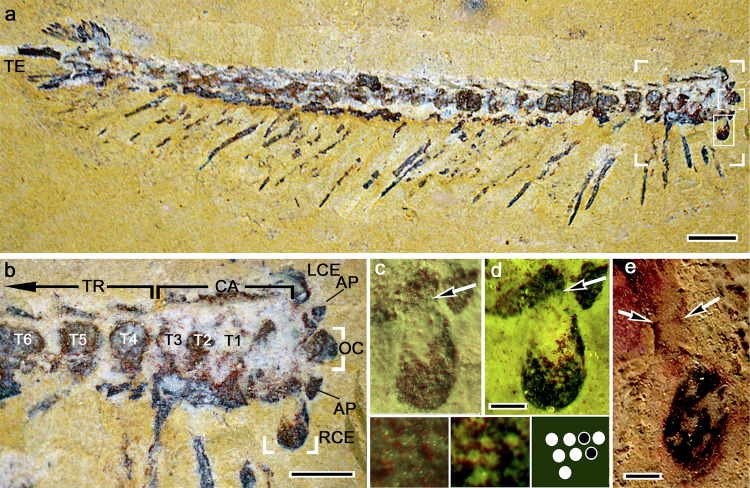
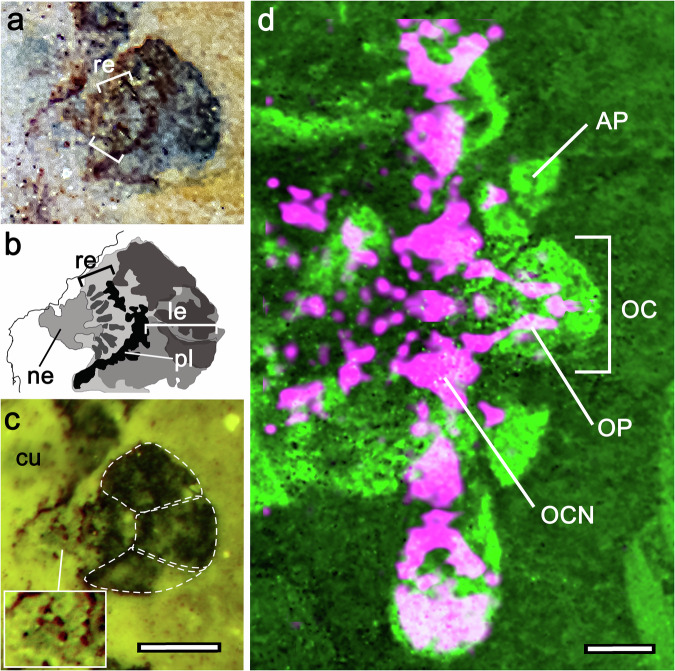
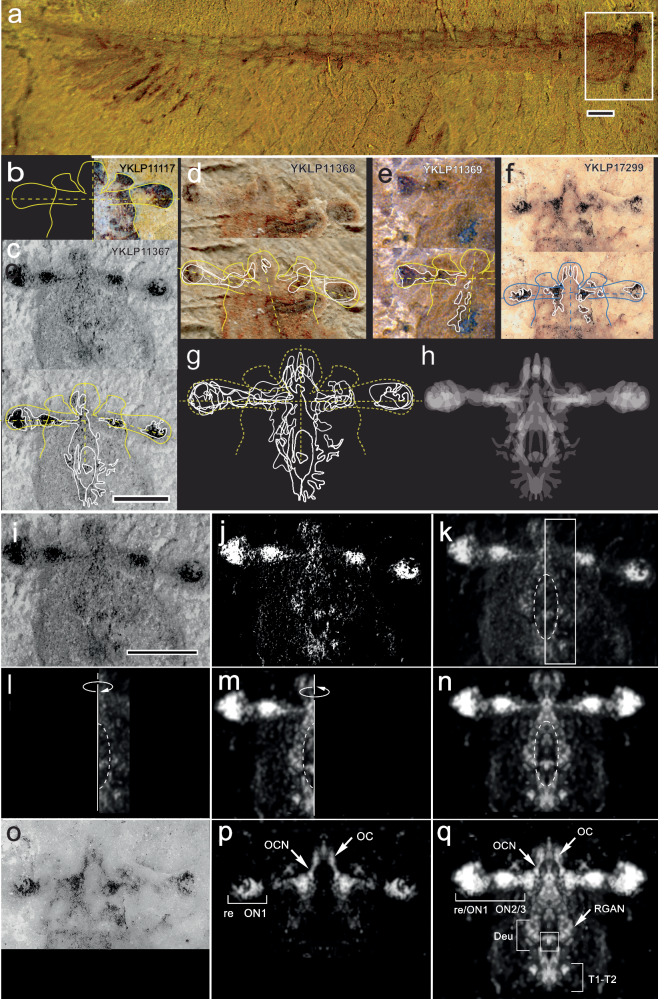
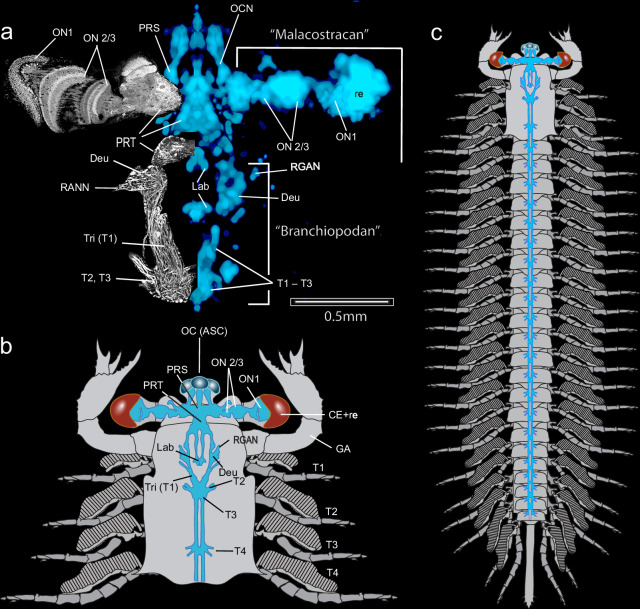
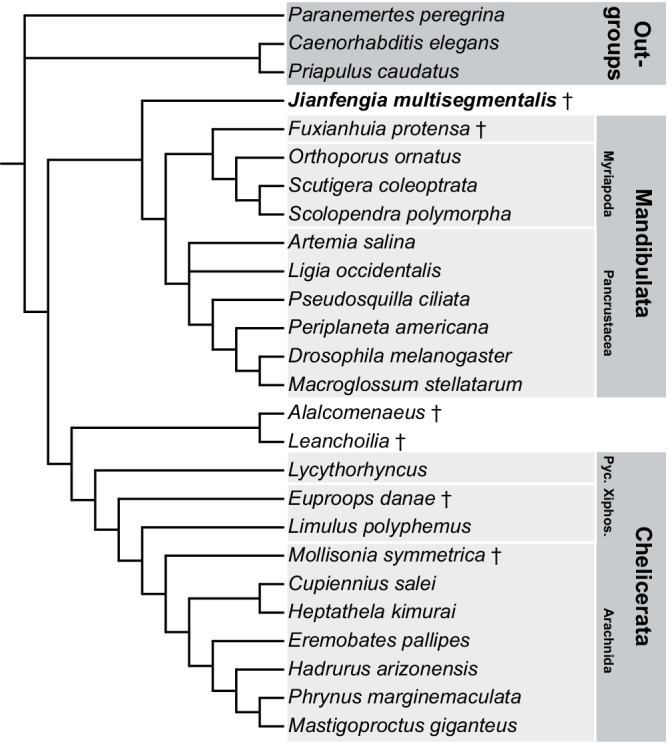
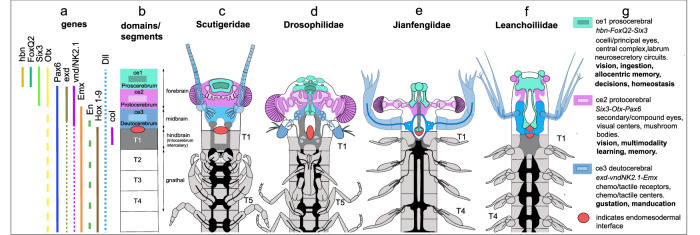
Cambrian fossils from the Chengjiang biota demonstrate that over half a billion years ago early stem euarthropods existed coevally with representatives of already recognizable crown groups. Prominent stem taxa were Fuxianhuia protensa and Alalcomenaeus whose cerebral and ganglionic traits identify them as, respectively, stem mandibulates and stem chelicerates. Here we report on the visual systems and brain of the enigmatic lower Cambrian euarthropod Jianfengia multisegmentalis, which reveals neural traits suggestive of Pancrustacea despite its possession of ‘great appendages’. As occur in pancrustaceans, three nested optic neuropils are resolved in the eyestalks of Jianfengia, together with rostral ocelli and their associated nerves supplying a discrete forebrain region. Sutured eyestalks typifying crown Malacostraca provide compound eyes populated by ommatidia revealing structures suggesting cone-building cells. These and other neuroanatomical traits provide a powerful tool for resolving euarthropod relationships. Phylogenetic analyses deploying neural traits of Jianfengia, other Cambrian taxa, and extant Euarthropoda elucidate the status of Jianfengia as sister to total Mandibulata and reveal the short-bodied ‘great appendage’ Leanchoiliidae as sister to total Chelicerata. Together these data provide independent evidence for a 23 year-old proposition that ‘great appendage’ morphology defines the early stem from which derived the two branches of the euarthropod tree of life.
Overview
The claims and statistics of this paper haven’t been checked yet.
Free: it reads the open-access text and checks the first 5 claims that cite a source we can check. Create a free account to check every claim.
Integrity signals
Registry
Cites
Statistics
Figures
Verification
Claims the paper makes
The claims and statistics of this paper haven’t been checked yet.
Free: it reads the open-access text and checks the first 5 claims that cite a source we can check. Create a free account to check every claim.
Self-check
Percentages, sums and reported differences re-computed from the paper’s own numbers.
The self-check needs the paper’s full text.
Citations
Cites
MrBayes 3.2: Efficient Bayesian Phylogenetic Inference and Model Choice Across a Large Model Space
Ronquist, F., Teslenko, M., van der Mark, P., Ayres, D. L., Darling, A., Höhna, S., Larget, B., Liu, L., Suchard, M. A., & Huelsenbeck, J. P. (2012) · Systematic Biology · doi:10.1093/sysbio/sys029 · Cited by 27,843
Letunic, I., & Bork, P. (2024) · Nucleic Acids Research · doi:10.1093/nar/gkae268 · Cited by 4,497
Pfenninger, M., & Posada, D. (2002) · Evolution · doi:10.1111/j.0014-3820.2002.tb00191.x · Cited by 1,520
Modulating Hox gene functions during animal body patterning
Pearson, J. C., Lemons, D., & McGinnis, W. (2005) · Nature Reviews Genetics · doi:10.1038/nrg1726 · Cited by 879 · cited 1×
“I already liked the previous version, but after applying the suggestions by different experts I consider this manuscript as more robust, and I would like to see it published in its current form.”
A palaeontological solution to the arthropod head problem
Budd, G. E. (2002) · Nature · doi:10.1038/417271a · Cited by 282
Candidate Gustatory Interneurons Modulating Feeding Behavior in the Drosophila Brain
Melcher, C., & Pankratz, M. J. (2005) · PLoS Biology · doi:10.1371/journal.pbio.0030305 · Cited by 275
Mediation of Drosophila head development by gap-like segmentation genes
Cohen, S. M., & Jürgens, G. (1990) · Nature · doi:10.1038/346482a0 · Cited by 271
Arthropod Brains: Evolution, Functional Elegance, and Historical Significance
Strausfeld, N. J. (2012) · doi:10.2307/j.ctv1dp0v2h · Cited by 244
Self-citationChen, J., Waloszek, D., & Maas, A. (2004) · Lethaia · doi:10.1080/00241160410004764 · Cited by 216
Complex brain and optic lobes in an early Cambrian arthropod
Ma, X., Hou, X., Edgecombe, G. D., & Strausfeld, N. J. (2012) · Nature · doi:10.1038/nature11495 · Cited by 197
Self-citationAntibody-based therapies for malaria
Pleass, R. J., & Holder, A. A. (2005) · Nature Reviews Microbiology · doi:10.1038/nrmicro1267 · Cited by 182
Six3 demarcates the anterior-most developing brain region in bilaterian animals
Steinmetz, P. R., Urbach, R., Posnien, N., Eriksson, J., Kostyuchenko, R. P., Brena, C., Guy, K., Akam, M., Bucher, G., & Arendt, D. (2010) · EvoDevo · doi:10.1186/2041-9139-1-14 · Cited by 173
Chelicerate neural ground pattern in a Cambrian great appendage arthropod
Tanaka, G., Hou, X., Ma, X., Edgecombe, G. D., & Strausfeld, N. J. (2013) · Nature · doi:10.1038/nature12520 · Cited by 160
Self-citationPhylogeny of the Myriapoda – Crustacea – Insecta: a new attempt using photoreceptor structure*
Paulus, H. F. (2000) · Journal of Zoological Systematics & Evolutionary Research · doi:10.1046/j.1439-0469.2000.383152.x · Cited by 152
Functional morphology, ontogeny and evolution of mantis shrimp‐like predators in the Cambrian
HAUG, J. T., WALOSZEK, D., MAAS, A., LIU, Y., & HAUG, C. (2012) · Palaeontology · doi:10.1111/j.1475-4983.2011.01124.x · Cited by 145
The phylogeny of arachnomorph arthropods and the origin of the Chelicerata
Cotton, T. J., & Braddy, S. J. (2003) · Transactions of the Royal Society of Edinburgh: Earth Sciences · doi:10.1017/s0263593300000596 · Cited by 140
Arthropod eyes: The early Cambrian fossil record and divergent evolution of visual systems
Strausfeld, N. J., Ma, X., Edgecombe, G. D., Fortey, R. A., Land, M. F., Liu, Y., Cong, P., & Hou, X. (2015) · Arthropod Structure & Development · doi:10.1016/j.asd.2015.07.005 · Cited by 120
Self-citationMajor Revisions in Pancrustacean Phylogeny and Evidence of Sensitivity to Taxon Sampling
Bernot, J. P., Owen, C. L., Wolfe, J. M., Meland, K., Olesen, J., & Crandall, K. A. (2023) · Molecular Biology and Evolution · doi:10.1093/molbev/msad175 · Cited by 118
Müller, C. H. G., Rosenberg, J., Richter, S., & Meyer‐Rochow, V. B. (2003) · Zoomorphology · doi:10.1007/s00435-003-0085-0 · Cited by 111
Haug, J. T., Briggs, D. E. G., & Haug, C. (2012) · BMC Evolutionary Biology · doi:10.1186/1471-2148-12-162 · Cited by 111
Control of Drosophila head segment identity by the bZIP homeotic gene cnc
Mohler, J., Mahaffey, J. W., Deutsch, E., & Vani, K. (1995) · Development · doi:10.1242/dev.121.1.237 · Cited by 106
Harzsch, S., & Glötzner, J. (2002) · Arthropod Structure & Development · doi:10.1016/s1467-8039(02)00012-9 · Cited by 97
Posnien, N., Koniszewski, N. D. B., Hein, H. J., & Bucher, G. (2011) · PLoS Genetics · doi:10.1371/journal.pgen.1002416 · Cited by 94
Strausfeld, N. J., & Andrew, D. R. (2011) · Arthropod Structure & Development · doi:10.1016/j.asd.2011.02.002 · Cited by 94
Self-citationHomology of Head Sclerites in Burgess Shale Euarthropods
Ortega‐Hernández, J. (2015) · Current Biology · doi:10.1016/j.cub.2015.04.034 · Cited by 93
The frontal eyes of crustaceans
Elofsson, R. (2006) · Arthropod Structure & Development · doi:10.1016/j.asd.2006.08.004 · Cited by 87
Mushroom body evolution demonstrates homology and divergence across Pancrustacea
Strausfeld, N. J., Wolff, G. H., & Sayre, M. E. (2020) · eLife · doi:10.7554/elife.52411 · Cited by 83
Self-citationThree-Dimensionally Preserved Appendages in an Early Cambrian Stem-Group Pancrustacean
Zhai, D., Ortega‐Hernández, J., Wolfe, J. M., Hou, X., Cao, C., & Liu, Y. (2018) · Current Biology · doi:10.1016/j.cub.2018.11.060 · Cited by 70
Self-citationA New Leanchoiliid Megacheiran Arthropod from the Lower Cambrian Emu Bay Shale, South Australia
Edgecombe, G. D., García‐Bellido, D. C., & Paterson, J. R. (2011) · Acta Palaeontologica Polonica · doi:10.4202/app.2010.0080 · Cited by 67
Preservational pathways of corresponding brains of a Cambrian euarthropod
Ma, X., Edgecombe, G. D., Hou, X., Goral, T., & Strausfeld, N. J. (2015) · Current Biology · doi:10.1016/j.cub.2015.09.063 · Cited by 65 · cited 1×
“126) clearly show that Alalcomenaeus has club-shaped, penduculate compound eyes (here Fig.”
Self-citationBriggs, D. E. G., & Collins, D. (1999) · Palaeontology · doi:10.1111/1475-4983.00104 · Cited by 61
Fossils from South China redefine the ancestral euarthropod body plan
Aria, C., Zhao, F., Zeng, H., Guo, J. C., & Zhu, M. (2020) · BMC Evolutionary Biology · doi:10.1186/s12862-019-1560-7 · Cited by 53
A conserved genetic mechanism specifies deutocerebral appendage identity in insects and arachnids
Sharma, P. P., Tarazona, O. A., Lopez, D. H., Schwager, E. E., Cohn, M. J., Wheeler, W. C., & Extavour, C. G. M. (2015) · Proceedings of the Royal Society B Biological Sciences · doi:10.1098/rspb.2015.0698 · Cited by 51
Andrew, D. R., Brown, S. M., & Strausfeld, N. J. (2012) · The Journal of Comparative Neurology · doi:10.1002/cne.23099 · Cited by 45
Self-citationEvolutionary plasticity of collier function in head development of diverse arthropods
Schaeper, N. D., Pechmann, M., Damen, W. G. M., Prpíc, N.-M., & Wimmer, E. A. (2010) · Developmental Biology · doi:10.1016/j.ydbio.2010.05.001 · Cited by 41
Kirsch, R., & Richter, S. (2007) · Arthropod Structure & Development · doi:10.1016/j.asd.2006.08.013 · Cited by 37
Comparative Studies on the Head of Mandibulate Arthropods
Rockstein, M. (1951) · Annals of the Entomological Society of America · doi:10.1093/aesa/44.2.295 · Cited by 37
The mapping of visual space by identified large second-order neurons in the dragonfly median ocellus
Berry, R. P., Stange, G., Olberg, R. M., & van Kleef, J. (2006) · Journal of Comparative Physiology A · doi:10.1007/s00359-006-0142-5 · Cited by 37
A 520 million-year-old chelicerate larva
Liu, Y., Haug, J. T., Haug, C., Briggs, D. E. G., & Hou, X. (2014) · Nature Communications · doi:10.1038/ncomms5440 · Cited by 36
Self-citationMulti-Segmented Arthropods from the Middle Cambrian of British Columbia (Canada)
David, L. (2013) · Journal of Paleontology · doi:10.1666/12-112.1 · Cited by 36
The lower Cambrian lobopodianCardiodictyonresolves the origin of euarthropod brains
Strausfeld, N. J., Hou, X., Sayre, M. E., & Hirth, F. (2022) · Science · doi:10.1126/science.abn6264 · Cited by 35
Self-citationEarly Palaeozoic non-lamellipedian arthropods
Bergström, J., & Hou, X. (2005) · Crustacean issues · doi:10.1201/9781420037548.ch4 · Cited by 34
Self-citationOcellar interneurons in the honeybee: Structure and signals ofl-neurons
Milde, J. J. (1984) · Journal of Comparative Physiology A · doi:10.1007/bf01350222 · Cited by 31
Cap'n'collar differentiates the mandible from the maxilla in the beetle Tribolium castaneum
Coulcher, J. F., & Telford, M. J. (2012) · EvoDevo · doi:10.1186/2041-9139-3-25 · Cited by 30
Setton, E. V. W., March, L. E., Nolan, E. D., Jones, T. E. M., Cho, H., Wheeler, W. C., Extavour, C. G. M., & Sharma, P. P. (2017) · Developmental Biology · doi:10.1016/j.ydbio.2017.07.016 · Cited by 30
Semper's cells in the insect compound eye: Insights into ocular form and function
Charlton-Perkins, M. A., Friedrich, M., & Cook, T. A. (2021) · Developmental Biology · doi:10.1016/j.ydbio.2021.07.015 · Cited by 29
Dominguez-Cejudo, M. A., & Casares, F. (2015) · Development · doi:10.1242/dev.125179 · Cited by 28
Leanchoiliidae reveals the ancestral organization of the stem euarthropod brain
Lan, T., Zhao, Y., Zhao, F., He, Y., Martínez, P., & Strausfeld, N. J. (2021) · Current Biology · doi:10.1016/j.cub.2021.07.048 · Cited by 26
Self-citationFrom Stem Cell to Structure: Neurogenesis in the CNS of Decapod Crustaceans
Harzsch, S. (2002) · Springer eBooks · doi:10.1007/978-3-662-04843-6_32 · Cited by 23
Ocellar interneurones in the blowfly Calliphora erythrocephala: Morphology and central projections
N�ssel, D., & Hagberg, M. (1985) · Cell and Tissue Research · doi:10.1007/bf00214556 · Cited by 22
Subdivision of arthropod cap-n-collar expression domains is restricted to Mandibulata
Sharma, P. P., Gupta, T., Schwager, E. E., Wheeler, W. C., & Extavour, C. G. M. (2014) · EvoDevo · doi:10.1186/2041-9139-5-3 · Cited by 22
Convergent evolution of optic lobe neuropil in Pancrustacea
Strausfeld, N. J., & Olea-Rowe, B. (2021) · Arthropod Structure & Development · doi:10.1016/j.asd.2021.101040 · Cited by 20
Self-citationSchoenemann, B., & Clarkson, E. N. K. (2023) · Scientific Reports · doi:10.1038/s41598-023-31089-7 · Cited by 20
Zhang, X., Liu, Y., O’Flynn, R. J., Schmidt, M., Melzer, R. R., Hou, X., Mai, H., Guo, J. C., Yu, M., & Ortega‐Hernández, J. (2022) · Palaeontology · doi:10.1111/pala.12624 · Cited by 20
Self-citationJaume, D., Boxshall, G. A., & Bamber, R. N. (2006) · Zoological Journal of the Linnean Society · doi:10.1111/j.1096-3642.2006.00235.x · Cited by 17
Visual anticipation biases conscious decision making but not bottom-up visual processing
Mathews, Z., Cetnarski, R., & Verschure, P. F. M. J. (2015) · Frontiers in Psychology · doi:10.3389/fpsyg.2014.01443 · Cited by 16
Reimann, A., & Richter, S. (2007) · Arthropod Structure & Development · doi:10.1016/j.asd.2007.08.005 · Cited by 15
Dahms, H.-U. (1988) · Hydrobiologia · doi:10.1007/bf00026345 · Cited by 14
Cambrian origin of the arachnid brain
Strausfeld, N. J., Andrew, D. R., & Hirth, F. (2025) · Current Biology · doi:10.1016/j.cub.2025.06.063 · Cited by 13
Self-citationRathore, S., Meece, M., Charlton-Perkins, M. A., Cook, T. A., & Buschbeck, E. K. (2023) · Frontiers in Cell and Developmental Biology · doi:10.3389/fcell.2023.1104620 · Cited by 11
A pyritized Ordovician leanchoiliid arthropod
Parry, L. A., Briggs, D. E. G., Ran, R., O’Flynn, R. J., Mai, H., Clark, E., & Liu, Y. (2024) · Current Biology · doi:10.1016/j.cub.2024.10.013 · Cited by 11
Evolution: Oh, my Cambrian nerves
Wolfe, J. M., & Ortega‐Hernández, J. (2021) · Current Biology · doi:10.1016/j.cub.2021.08.065 · Cited by 8
The Visual System of Myriapoda
Sombke, A., & Müller, C. H. G. (2023) · Springer series in vision research · doi:10.1007/978-3-031-23216-9_7 · Cited by 7
Sombke, A., & Rosenberg, J. (2015) · Oxford University Press eBooks · doi:10.1093/acprof:oso/9780199682201.003.0039 · Cited by 4
Research works printed but not linked: 3
- Hou, X.-G. Two new arthropods from lower Cambrian, Chengjiang, eastern Yunnan. Acta Palaeontol. Sin. 26, 236–255 (1987).
- Dohle, W. Are the insects terrestrial crustaceans? In: T. Deuve (ed) Origin of the Hexapoda. Ann. Soc. Entmol. Fr. 37, 85–103 (2001).
- Russell, D., Bicknell, C., Ortega-Hernández, J., Edgecombe, G. D., Gaines, R. R. & Paterson, J. R. Central nervous system of a 310-m.y.-old horseshoe crab: expanding the taphonomic window for nervous system preservation. Geology 49, 1381–1385 (2021).
Cited by
Divergence of computational centers within homologous brain domains across Arthropoda
Strausfeld, N. J., Wolff, G. H., & Hirth, F. (2025) · Elsevier eBooks · doi:10.1016/b978-0-443-27380-3.00042-7 · Cited by 5
Self-citationOrtega‐Hernández, J. (2026) · Journal of Systematic Palaeontology · doi:10.1080/14772019.2026.2663907 · Cited by 3
Organization of the trilobite-type brain may have curtailed its survivalPreprint
Strausfeld, N. J., Hou, X., & Hirth, F. (2026) · bioRxiv (Cold Spring Harbor Laboratory) · doi:10.64898/2026.03.24.713993 · Cited by 1
Self-citationAncient nervous system architecture in a living ctenophorePreprint
Ferraioli, A., Miramón-Puértolas, P., Altenkirch, P. E., Jan, A., Colgren, J. J., Vinther, J., & Burkhardt, P. (2026) · bioRxiv (Cold Spring Harbor Laboratory) · doi:10.64898/2026.05.20.726345
Cerebral Organization in the trilobite Yunnanocephalus yunnanensisPreprint
Strausfeld, N. J., & Hirth, F. (2026) · bioRxiv (Cold Spring Harbor Laboratory) · doi:10.64898/2026.10.22.761110
Self-citation
Metadata
- Authors
- Strausfeld, N. J., Andrew, D. R., Hou, X., & Hirth, F.
- Affiliations
- University of Arizona (US)
- Lycoming College (US)
- Yunnan University (CN)
- King's College London (GB)
- Corresponding author
- Strausfeld, Nicholas J.
- Andrew, David R.
- Hou, Xianguang
- Hirth, Frank
- Venue
- Nature Communications
- Published
- 2025-08-28
- Volume
- 16
- Issue
- 1
- Pages
- 7938-7938
- ISSN
- 2041-1723 (ISSN-L)
- PMC
- PMC12394709
- OpenAlex
- W4413771965
- Cited by
- 3
- References
- 64
- Citations by year
- 2026: 2 · 2025: 1
- FWCI
- 2.10
- Type
- journal article
- Language
- en
- Open access
- gold
- doi.org
- Licence
- cc-by
- creativecommons.org/licenses/by/4.0 (tdm)
- creativecommons.org/licenses/by/4.0 (vor)
- Locations
- Nature Communications (publishedVersion, cc-by)
- bioRxiv (Cold Spring Harbor Laboratory) (acceptedVersion, cc-by-nc-nd)
- PubMed Central (publishedVersion, cc-by)
- PubMed (publishedVersion)
- Research Portal (King's College London) (submittedVersion, cc-by)
- DOAJ (DOAJ: Directory of Open Access Journals) (submittedVersion, cc-by-sa)
- Zenodo (CERN European Organization for Nuclear Research) (submittedVersion, cc-by-nd)
- The Catalogue of Life
- Funders
- National Science Foundation (1754798)
- UK Biotechnology and Biological Sciences Research Council
- Topics
- Physical Sciences › Earth and Planetary Sciences › Paleontology › Paleontology and Evolutionary Biology
- Life Sciences › Agricultural and Biological Sciences › Ecology, Evolution, Behavior and Systematics › Fossil Insects in Amber
- Physical Sciences › Earth and Planetary Sciences › Paleontology › Paleontology and Stratigraphy of Fossils
- Keywords
- Chengjiang biota, neuroanatomy, eyestalk, ocelli, compound eye, Mandibulata, Chelicerata, Pancrustacea
- MeSH terms
- Animals, Arthropods, Brain, Biological Evolution, Fossils, Phylogeny
About these checks
Registry, retraction, Cites and statistics results are computed, not judged, with one exception: a printed reference that no index lists is read once by a model before it counts as a citation error. Claims are extracted by a model and kept only when their quote appears verbatim in the text; each cited source is then checked, with a model’s help, for whether it says what the claim relies on. Those verdicts can be wrong — read the claim’s quote and the cited source before relying on one.
Statistics and arithmetic are recomputed, not judged.
Confidence bands are shown only for fields calibrated on our annotated test set. None is calibrated yet, so no band is shown.
What counts as a claim ›How we measure confidence ›How we check this ›
Are you an author, or do you see a problem with this page? Request a review
Data sources
Bibliographic data: Semantic Scholar, OpenAlex, Crossref.
Contains information from the Semantic Scholar Academic Graph Datasets, made available under the ODC Attribution License (ODC-BY 1.0).
Semantic Scholar’s data is described in: Kinney, R., et al. (2023). The Semantic Scholar Open Data Platform. arXiv:2301.10140.
