

Bayesian analyses of radiocarbon dates suggest multiple origins of ceramic technology in Early Holocene Africa
Open accessThe DOI matches its Crossref record; 98 of the 98 references it cites were found in a registry or an index; none of the 46 sources its claims cite is checked for support yet.
Abstract
Ceramic technology emerged and spread in Saharan Africa between the end of the 11th and the beginning of the 10th millennium cal BP during the so-called African Humid Period. This innovation is linked to hunter-gatherer-fisher groups adapting to changing and increased ecological productivity. Several putative points of origin and the resulting corridors of diffusion of this technology have been suggested in the literature, but there is currently no consensus on whether ceramics in this region originated as a single or multiple independent episodes of innovation. Here, we synthesise the available radiocarbon evidence associated with the presence and absence of ceramic technology in Early Holocene Africa and statistically model spatio-temporal diffusion processes using different combinations of putative origin points. The result of our model comparison provides support for either a dual or triple-origin model, with core areas potentially in the Central Sahara, Nile Valley and West Africa. These findings refine current debates on early pottery innovation, highlighting the role of localized technological choices, environmental factors and interregional interactions in shaping its spread.
Overview
CoChat Summary
TL;DR
Bayesian modelling of radiocarbon dates from Early Holocene Africa rejects a single origin for ceramic technology and best supports a triple-origin model with core areas at Bir Kiseiba, Adrar Bous 10, and Ounjougou Ravin de la Mouche. The results suggest multiregional, non-uniform diffusion, with Ounjougou prominent early and Adrar Bous accelerating after ca. 8000 cal BP.
Key findings
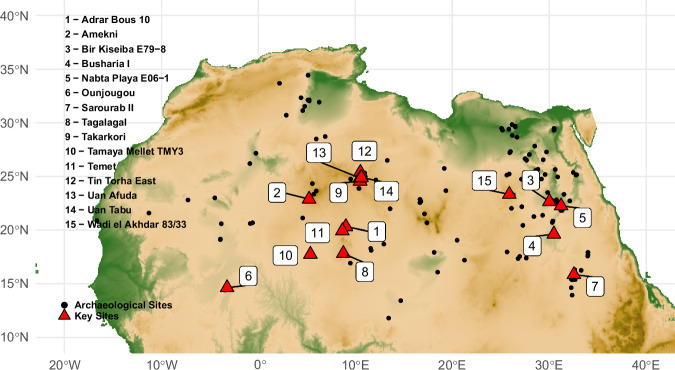
- The triple-origin binomial model m7 (Bir Kiseiba + Adrar Bous 10 + Ounjougou) had WAIC 8336.11, ΔWAIC 0, and weight 0.973; the dual model m5 (Bir Kiseiba + Ounjougou) had ΔWAIC 7.551 and weight 0.022, while all single-origin models had ΔWAIC > 29.
- Quantile regression single-origin models showed slope posterior ranges close to or inclusive of 0, indicating distance from a putative origin alone poorly predicts ceramic presence.
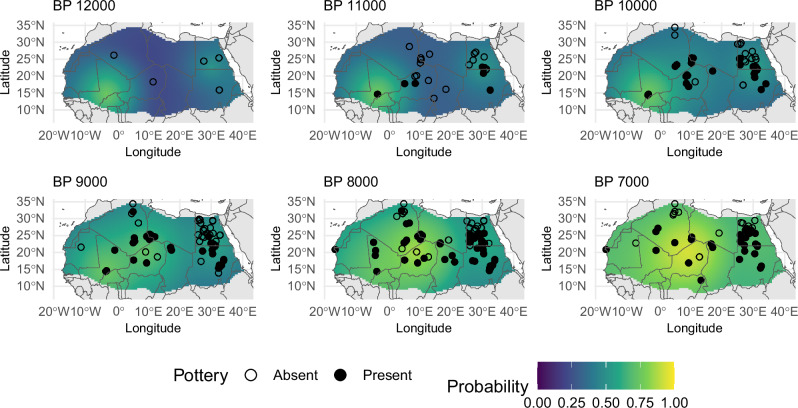
- In the triple-origin model, western Africa reached higher ceramic-presence probabilities more rapidly initially; from ca. 8000 cal BP, diffusion from Adrar Bous accelerated, while Bir Kiseiba showed consistently lower probability, likely due to anisotropic diffusion.
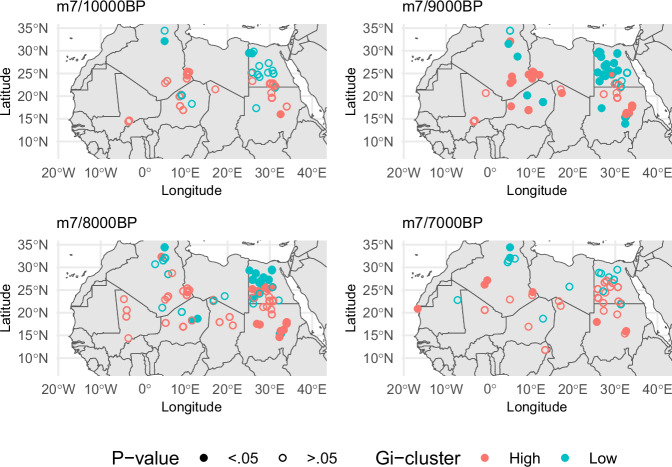
- Residual spatial analyses found significant clustering in Egypt, including areas where ceramics were predicted present but absent (e.g., northern Egypt at 8000 BP) and predicted absent but present (e.g., Sudan at 8000 BP).
Methods
- The database comprised 855 radiocarbon dates from 259 sites with pottery presence/absence checked from recovery contexts; dates were restricted to 12,000–7000 BP and the Sahara/Sahel ecoregions from 34°N to 10°N, excluding Mediterranean Africa. Samples close in time within sites were binned at a 100-year threshold, prioritizing lowest measurement error, yielding a final dataset of 586 radiocarbon dates.
- Bayesian quantile regression modelled 337 pottery-presence dates using an asymmetric Laplace distribution at the 5th percentile, with calendar date as a function of great-arc distance from three putative origins: Bir Kiseiba, Adrar Bous, and Ounjougou Ravin de la Mouche.
- Bayesian binomial models compared seven combinations of one, two, or three origins, modelling pottery presence/absence as a function of calendar date, distance, and their interaction, while accounting for radiocarbon uncertainty and site-level stratigraphic relationships; models were compared via WAIC, and residuals were examined with local Getis-Ord G statistics.
Limitations
- Stated in the paper: samples are small and often biased; true origination dates are earlier than the earliest dated samples; geographic proximity to the true origin is confounded by sampling error and spatial variation in sampling intensity; most data come from palimpsest-like deposits that may not represent the earliest pottery phase; and the small sample size does not allow more complex anisotropic models.
- Evident from the text: only three candidate origin locations were tested, and the reported ΔWAIC between the best triple-origin model and the best dual-origin model is 7.55, so the preference for triple over dual origins is not overwhelming by that metric alone.
Model-written summary. Check it against the paper before relying on it.
Integrity signals
Registry
Cites
Statistics
Figures
Verification
Claims the paper makes
0 Valid · 3 Not valid · 19 Not checked · 39 Own results and interpretations
A result the paper reports from its own data — it cites no other source for it, so there is none to check. The quote shows it is in the paper.
In the paper
“All single-origin models (m1 - m3) returned a ΔWAIC larger than 29 (Table 1), effectively suggesting no support for these models.”
§ Bayesian analyses of radiocarbon dates suggest multiple origins of ceramic technology in Early Holocene Africa > Results
hedged- Asserted: passes — The authors put it forward as true.
- Checkable: passes — It can be checked against evidence.
- Load-bearing: passes — The paper’s conclusions depend on it.
- Based: passes — The paper gives a reason why it holds.
A result the paper reports from its own data — it cites no other source for it, so there is none to check. The quote shows it is in the paper.
In the paper
“The situation changes during later periods, from ca. 8000 cal BP when the initially slow diffusion from Adrar Bous saw an acceleration, suggested by the positive estimate of the interaction term.”
§ Bayesian analyses of radiocarbon dates suggest multiple origins of ceramic technology in Early Holocene Africa > Results
hedgedstates an association- Asserted: passes — The authors put it forward as true.
- Checkable: passes — It can be checked against evidence.
- Load-bearing: unclear — It is unclear whether the paper’s conclusions depend on it.
- Based: passes — The paper gives a reason why it holds.
A result the paper reports from its own data — it cites no other source for it, so there is none to check. The quote shows it is in the paper.
In the paper
“The mean posterior probability of the presence of ceramic (Fig. 2, Supplementary Fig. 2, Supplementary Data 1) shows clearly how western Africa reaches higher probabilities more rapidly compared to the rest of the window of analyses initially.”
§ Bayesian analyses of radiocarbon dates suggest multiple origins of ceramic technology in Early Holocene Africa > Results
boostedstates an association- Asserted: passes — The authors put it forward as true.
- Checkable: passes — It can be checked against evidence.
- Load-bearing: passes — The paper’s conclusions depend on it.
- Based: passes — The paper gives a reason why it holds.
A result the paper reports from its own data — it cites no other source for it, so there is none to check. The quote shows it is in the paper.
In the paper
“A closer inspection of the parameters of the triple origin model (m7) suggests a more prominent role played by Ounjougou Ravin de la Mouche in the initial diffusion process.”
§ Bayesian analyses of radiocarbon dates suggest multiple origins of ceramic technology in Early Holocene Africa > Results
hedgedstates a cause- Asserted: passes — The authors put it forward as true.
- Checkable: passes — It can be checked against evidence.
- Load-bearing: unclear — It is unclear whether the paper’s conclusions depend on it.
- Based: passes — The paper gives a reason why it holds.
A result the paper reports from its own data — it cites no other source for it, so there is none to check. The quote shows it is in the paper.
In the paper
“Both the results of the quantile (Supplementary Table 1, Supplementary Fig. 1) and the binomial models (Fig. 2, Supplementary Figs. 2–8, Table 1, Supplementary Data 1) reject the possibility of a single point of origin for the diffusion of ceramic technology.”
§ Bayesian analyses of radiocarbon dates suggest multiple origins of ceramic technology in Early Holocene Africa > Results
plain- Asserted: passes — The authors put it forward as true.
- Checkable: passes — It can be checked against evidence.
- Load-bearing: passes — The paper’s conclusions depend on it.
- Based: passes — The paper gives a reason why it holds.
24 more claims
Create a free account to see all 61 claims and to verify the 44 references still open.
- It may state two separate claims as one. 18
- Probably not a substantial claim. 16
Citations
Cites
The Analysis of Spatial Association by Use of Distance Statistics
Getis, A., & Ord, J. K. (1992) · Geographical Analysis · doi:10.1111/j.1538-4632.1992.tb00261.x · Cited by 6,276
Willow Smoke and Dogs’ Tails: Hunter-Gatherer Settlement Systems and Archaeological Site Formation
Binford, L. R. (1980) · American Antiquity · doi:10.2307/279653 · Cited by 2,653
Cultural Responses to Climate Change During the Late Holocene
deMenocal, P. B. (2001) · Science · doi:10.1126/science.1059287 · Cited by 1,207
Yu, K., & Moyeed, R. A. (2001) · Statistics & Probability Letters · doi:10.1016/s0167-7152(01)00124-9 · Cited by 998
Climate-Controlled Holocene Occupation in the Sahara: Motor of Africa's Evolution
Kuper, R., & Kröpelin, S. (2006) · Science · doi:10.1126/science.1130989 · Cited by 922
Ancient watercourses and biogeography of the Sahara explain the peopling of the desert
Drake, N. A., Blench, R. M., Armitage, S. J., Bristow, C. S., & White, K. H. (2011) · Proceedings of the National Academy of Sciences · doi:10.1073/pnas.1012231108 · Cited by 526
Testart, A., Forbis, R. G., Hayden, B., Ingold, T., Perlman, S. M., Pokotylo, D. L., Rowley-Conwy, P., & Stuart, D. E. (1982) · Current Anthropology · doi:10.1086/202894 · Cited by 504
Early Pottery at 20,000 Years Ago in Xianrendong Cave, China
Wu, X., Zhang, C., Goldberg, P., Cohen, D., Pan, Y., Arpin, T., & Bar-Yosef, O. (2012) · Science · doi:10.1126/science.1218643 · Cited by 346
Eerkens, J. W., & Lipo, C. P. (2007) · Journal of Archaeological Research · doi:10.1007/s10814-007-9013-z · Cited by 333
Timpson, A., Colledge, S., Crema, E., Edinborough, K., Kerig, T., Manning, K., Thomas, M. G., & Shennan, S. (2014) · Journal of Archaeological Science · doi:10.1016/j.jas.2014.08.011 · Cited by 332
Self-citation
Research works printed but not linked: 19
- Jordan, P. & Zvelebil, M. Ceramics before Farming: The Dispersal of Pottery among Prehistoric Eurasian Hunter-Gatherers. vol. 53 (Left Coast Press, 2010).
- Keally, C. T., Taniguchi, Y. & Kuzmin, Y. V. Understanding the beginnings of pottery technology in Japan and neighboring East Asia. Rev. Archaeol. 24, 3–14 (2003).
- Arkell, A. J. Early Khartoum: An Account of the Excavation of an Early Occupation Site Carried out by the Sudan Government Antiquities Service in 1944-45. (Cambridge University Press, Cambridge, 1949).
- Barich, B. E. La serie stratigrafica dell’uadi Ti-n-Torha (Acacus, Libia): per una interpretazione delle facies a ceramica saharo-sudanesi. Orig. Preistor Protoistor Delle Civilta Antiche Roma 8, 7–157 (1974).
- Gatto, M. C. Early Neolithic pottery of the Nabta-Kiseiba area: stylistic attributes and regional relationships. in Holocene Settlements of the Egyptian Sahara. Vol. II The pottery of Nabta Playa (ed. Nelson, K. and A.) 65–78 (Plenum Press, New York, 2002).
- Close, A. E. Few and far between: Early ceramics in North Africa. in The emergence of pottery: technology and innovation in ancient societies (ed. Barnett W. K.) 23–37 (Smithsonian Institution Press, Washington D.C, 1995).
- Ehret, C. Nilo-Saharans and the Saharo-Sudanese Neolithic. Archaeol. Afr.: Food, Met. Towns 104, 125 (1993).
- Blench, R. Language, linguistics, and archaeology in the study of African prehistory. In Oxford Handbook of African Archaeology (eds. Mitchell, P. J. & Lane, P. J.) 49–64 (Oxford University Press, Oxford, 2013).
- Jakob, B. From the Mesolithic to the beginning of the Neolithic in Upper Nubia: The sequence of Wadi El-Arab (8300–5400 B. C. cal. In M. Honegger (Ed.), Kerma 2015-2016 and 2016–2017 Soudan (pp. 42–48). Neuchâtel: Documents de la mission archéologique suisse au Soudan7, (2017).
- Hakem, A. A. & Khabir, A. R. M. Sarourab 2: A new contribution to the Early Khartoum tradition from Bauda site. Late Prehist. Nile Basin Sahara 381, 386 (1989).
- Gatto, M., Honeggar, M., Fallet, C. & Bundi, M. Preliminary report on the most ancient pottery from the Kerma region. Doc. Mission Archéol. Suisse Soudan 5, 4–10 (2013).
- Gatto, M. C. The Khartoum variant pottery in context: Rethinking the early and middle Holocene Nubian sequence. Arch. Nil. Moyen 10, 57–72 (2006).
- Barich, B. E. Herder-Foragers and Low-Level Food Producers. Some Insights into the Early Food Production in Northern Africa. in Archaeology of Food. New Data from International Missions in Africa and Asia: Proceedings of the 1st Workshop on the Archaeology of Food. (eds. et al) (ISMEO-Scienze e Lettere, Roma, 2019).
- Garcea, E. A. A. Uan Tabu in the Settlement History of Libyan Sahara. vol. 2 (All’Insegna del Giglio, Firenze, 2001).
- Caneva, I. Pottery decoration in prehistoric Sahara and Upper Nile: a new perspective. in Archaeology and environment in the Libyan Sahara. The excavations in the Tadrart Acacus (ed. Barich, B. E.) vol. 1987 231–254 (British Archaeological Reports, 1987).
- Mitchell, P. African Connections: Archaeological Perspectives on Africa and the Wider World. vol. VII (AltaMira Press, Walnut Creek, 2005).
- Caneva, I. Pottery using gatherers and hunters at Saggai (Sudan): Pre-conditions for food-production. Origini 12, 7–278 (1983).
- Arnold, D. E. Ceramic Theory and Cultural Process. (Cambridge University Press, 1985).
- Watanabe, S. A widely applicable Bayesian information criterion. J. Mach. Learn. Res. 14, 867–897 (2013).
Cited by
Adaba, A. S. A. (2026) · المجلة الإفريقية للدراسات المتقدمة في العلوم الإنسانية والاجتماعية · Cited by 5
Stojanowski, C. M., Irish, J. D., & Sereno, P. C. (2026) · American Journal of Biological Anthropology · doi:10.1002/ajpa.70262 · Cited by 1
Mesfin, I., Coutros, P. R., Hanon, R., Raul, M. K., Vie, J.-T., Hammou, Y., Nafoia, J., Dehut, C., Sabao, N. D., Robion‐Brunner, C., et al. (2026) · Journal of Archaeological Science Reports · doi:10.1016/j.jasrep.2026.105805 · Cited by 1
Long-Term Population Dynamics Following Innovations in Food Production
Freeman, J., & Robinson, E. N. (2026) · Journal of Archaeological Method and Theory · doi:10.1007/s10816-026-09770-8
An ICAR spatial model to reconstruct regional geographic variations in arrival timesPreprint
Mes, A. K., & Crema, E. R. (2026) · SSRN Electronic Journal · doi:10.2139/ssrn.6193310
Self-citation
Metadata
- Authors
- Rotunno, R., & Crema, E. R.
- Affiliations
- University of Cambridge (GB)
- Corresponding author
- Rotunno, Rocco
- Venue
- Nature Communications
- Published
- 2025-10-03
- Volume
- 16
- Issue
- 1
- Pages
- 8819-8819
- ISSN
- 2041-1723 (ISSN-L)
- PMC
- PMC12494898
- OpenAlex
- W4414781974
- Cited by
- 8
- References
- 98
- Citations by year
- 2026: 8
- FWCI
- 8.07
- Type
- journal article
- Language
- en
- Open access
- gold
- doi.org
- Licence
- cc-by
- creativecommons.org/licenses/by/4.0 (tdm)
- creativecommons.org/licenses/by/4.0 (vor)
- Locations
- Nature Communications (publishedVersion, cc-by)
- Europe PMC (PubMed Central) (publishedVersion, cc-by)
- PubMed Central (publishedVersion, cc-by)
- PubMed (publishedVersion)
- DOAJ (DOAJ: Directory of Open Access Journals) (submittedVersion)
- IRIS Research product catalog (Sapienza University of Rome) (submittedVersion)
- Apollo (University of Cambridge) (submittedVersion, cc-by)
- Apollo (University of Cambridge) (submittedVersion)
- Apollo (cc-by)
- Funders
- EHSCAN-Exploring Early Holocene Saharan Cultural Adaptation and social Networks through socio-ecological inferential modelling. (Engineering and Physical Sciences Research Council
- Philip Leverhulme Prize
- Topics
- Social Sciences › Archeology › Archaeology and ancient environmental studies
- Social Sciences › Anthropology › Pleistocene-Era Hominins and Archaeology
- Social Sciences › Anthropology › African Studies and Geopolitics
- Keywords
- ceramic technology, origins of pottery, Early Holocene, African Humid Period, Saharan Africa, radiocarbon chronology, diffusion of innovations, hunter-gatherers, Nile Valley, West Africa, Central Sahara, technology diffusion
- MeSH terms
- Africa, Archaeology, Bayes Theorem, Ceramics, Humans, Technology, Africa South of the Sahara, History, Ancient, Radiometric Dating
About these checks
Registry, retraction, Cites and statistics results are computed, not judged, with one exception: a printed reference that no index lists is read once by a model before it counts as a citation error. Claims are extracted by a model and kept only when their quote appears verbatim in the text; each cited source is then checked, with a model’s help, for whether it says what the claim relies on. Those verdicts can be wrong — read the claim’s quote and the cited source before relying on one.
A language model drew the claims from the paper on 2026-11-23, under version 3 of the claim definition (model deepseek-v4.1-flash, prompt extract-v3).
A second model labelled each claim on 2026-11-23 (model jev-1.13-20260917, definition revision gold-guideline-v0.2).
Statistics and arithmetic are recomputed, not judged.
Confidence bands are shown only for fields calibrated on our annotated test set. None is calibrated yet, so no band is shown.
What counts as a claim ›How we measure confidence ›How we check this ›
Are you an author, or do you see a problem with this page? Request a review
How to cite
Cite CoChat for the checks on this page, and the paper for its own findings.
- This page
- CoChat. (2026). Citation check: Bayesian analyses of radiocarbon dates suggest multiple origins of ceramic technology in Early Holocene Africa. https://app.cochat.ai/papers/10.1038/s41467-025-63887-0
- The paper
- Rotunno, R., & Crema, E. R. (2025). Bayesian analyses of radiocarbon dates suggest multiple origins of ceramic technology in Early Holocene Africa. Nature Communications. https://doi.org/10.1038/s41467-025-63887-0
Data sources
Bibliographic data: Semantic Scholar, OpenAlex, Crossref.
Contains information from the Semantic Scholar Academic Graph Datasets, made available under the ODC Attribution License (ODC-BY 1.0).
Semantic Scholar’s data is described in: Kinney, R., et al. (2023). The Semantic Scholar Open Data Platform. arXiv:2301.10140.
