

Comprehensive evaluation of GLP-1 receptor agonists: an umbrella review of clinical outcomes across multiple diseases
Open accessThe DOI matches its Crossref record; 60 of the 60 references it cites were found in a registry or an index.
Abstract
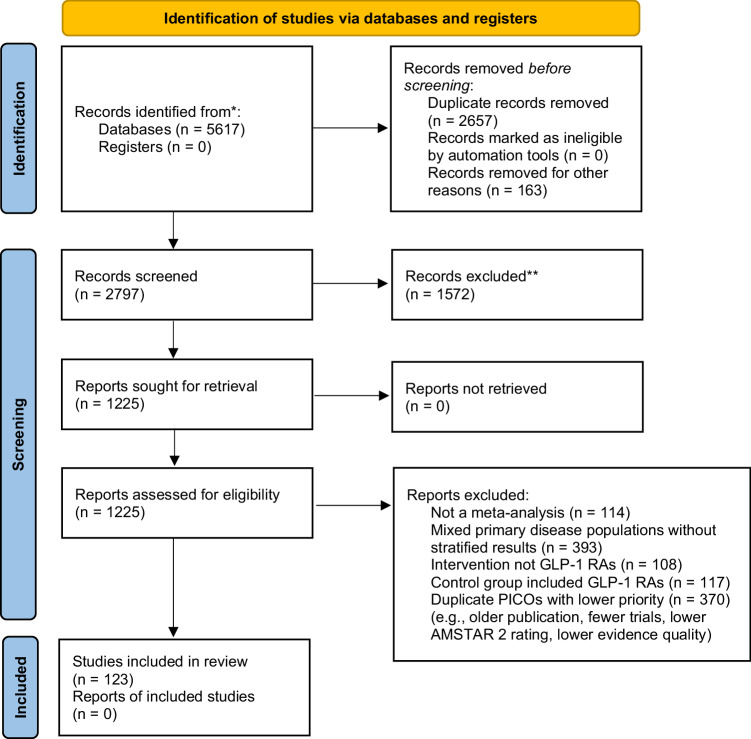
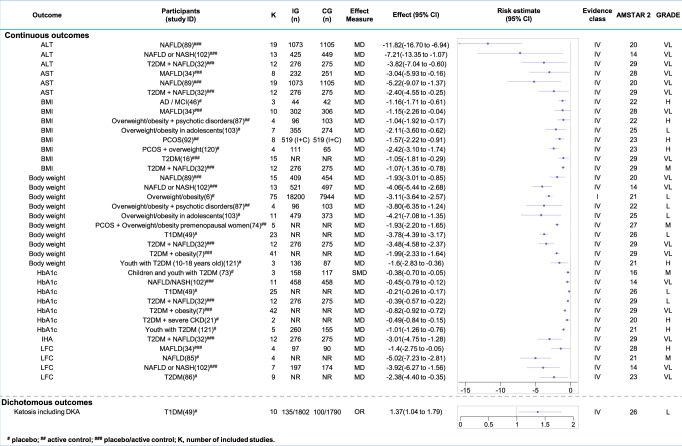
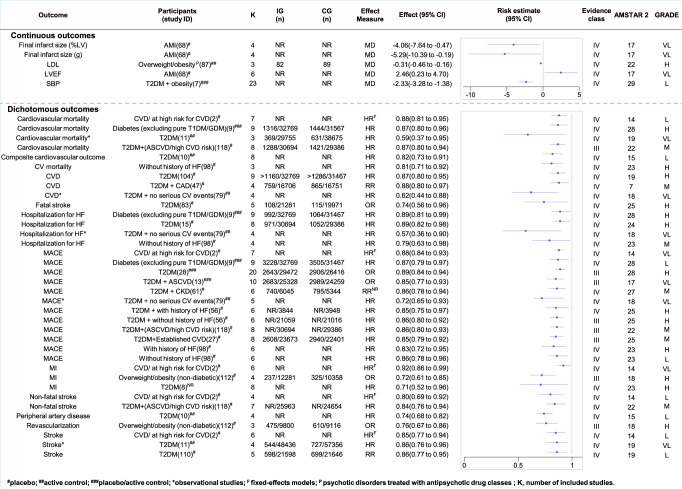
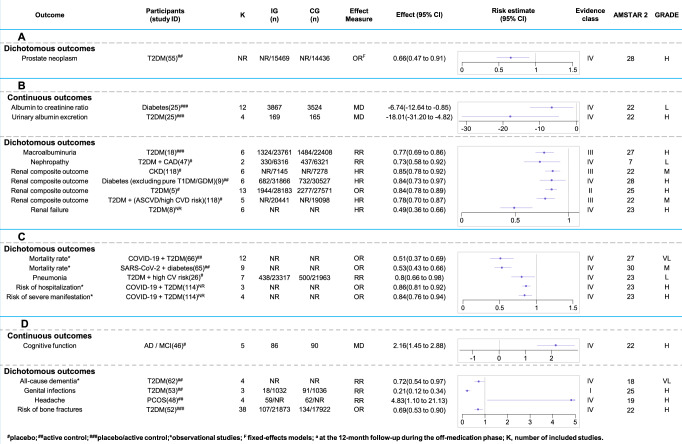
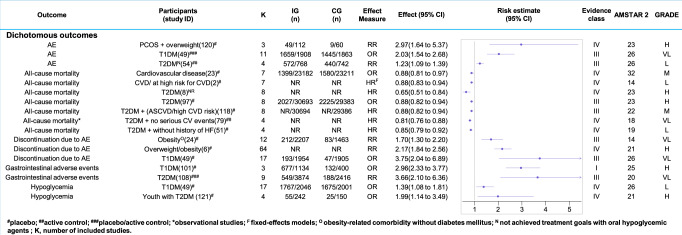
Glucagon-like peptide-1 receptor agonists (GLP-1 RAs) were initially approved for type 2 diabetes mellitus. Recent evidence suggests their therapeutic potential in various diseases, though their efficacy and safety remain incompletely understood. Here, we conduct an umbrella review including 123 meta-analyses covering 464 outcomes from 5617 articles to comprehensively assess the effectiveness and adverse events (AEs) of GLP-1 RAs across diverse outcomes. GLP-1 RAs showed trends toward improvements in endocrine and metabolic, cardiovascular, renal, and respiratory outcomes, cognitive function, with a potential reduction in fracture risk and all-cause mortality in certain populations. However, increased risks of certain AEs, including diabetic retinopathy, ketoacidosis, gastrointestinal events, and treatment discontinuation, were also observed. AMSTAR 2 assessments indicate that the existing evidence is limited by methodological shortcomings, including incomplete reporting of excluded studies, suboptimal literature search strategies, and insufficient evaluation of how bias in primary studies may influence meta-analytic estimates. Some outcomes did not reach statistical significance in all populations, highlighting the need for further high-quality clinical research. Careful consideration of potential benefits and risks is essential for optimizing treatment outcomes and ensuring patient safety when using GLP-1 RAs in clinical practice.
Overview
The claims and statistics of this paper haven’t been checked yet.
Free: it reads the open-access text and checks the first 5 claims that cite a source we can check. Create a free account to check every claim.
Integrity signals
Registry
Cites
Statistics
Figures
Verification
Claims the paper makes
The claims and statistics of this paper haven’t been checked yet.
Free: it reads the open-access text and checks the first 5 claims that cite a source we can check. Create a free account to check every claim.
Self-check
Percentages, sums and reported differences re-computed from the paper’s own numbers.
The self-check needs the paper’s full text.
Citations
Cites
GRADE guidelines: 1. Introduction—GRADE evidence profiles and summary of findings tables
Guyatt, G., Oxman, A. D., Akl, E. A., Kunz, R., Vist, G., Brozek, J., Norris, S., Falck-Ytter, Y., Glasziou, P., & deBeer, H. (2011) · Journal of Clinical Epidemiology · doi:10.1016/j.jclinepi.2010.04.026 · Cited by 10,681
Shea, B. J., Reeves, B. C., Wells, G., Thuku, M., Hamel, C., Moran, J., Moher, D., Tugwell, P., Welch, V., Kristjansson, E., et al. (2017) · BMJ · doi:10.1136/bmj.j4008 · Cited by 10,636 · cited 1×
“The methodological quality of the included meta-analyses was assessed using the AMSTAR 2 tool 59 .”
The Physiology of Glucagon-like Peptide 1
Holst, J. J. (2007) · Physiological Reviews · doi:10.1152/physrev.00034.2006 · Cited by 3,371
Semaglutide and Cardiovascular Outcomes in Obesity without Diabetes
Lincoff, A. M., Brown-Frandsen, K., Colhoun, H. M., Deanfield, J., Emerson, S. S., Esbjerg, S., Hardt-Lindberg, S., Hovingh, G. K., Kahn, S. E., Kushner, R. F., et al. (2023) · New England Journal of Medicine · doi:10.1056/nejmoa2307563 · Cited by 3,236 · cited 1×
“Moreover, a large-scale randomized controlled trial (RCTs) involving more than 17,000 individuals with obesity and car-diovasculardiseasedemonstratedthatsemaglutidereducedtheriskof cardiovasculardeath,myocardialinfarction(MI),andstrokecompared to the placebo 9 .”
Davies, M. J., Aroda, V. R., Collins, B. S., Gabbay, R. A., Green, J., Maruthur, N. M., Rosas, S. E., Del Prato, S., Mathieu, C., Mingrone, G., et al. (2022) · Diabetes Care · doi:10.2337/dci22-0034 · Cited by 2,104 · cited 1×
“Although our synthesis shows increased gastrointestinal AEs and treatment discontinuation related to AEs, these challenges can generally be managed in practice through low-dose initiation, gradual up-titration, and regular monitoring 49 .”
The Discovery and Development of Liraglutide and Semaglutide
Knudsen, L. B., & Lau, J. (2019) · Frontiers in Endocrinology · doi:10.3389/fendo.2019.00155 · Cited by 970 · cited 1×
“fi rst for diabetes and later for obesity in 2014, while semaglutide, also a modi fi ed GLP-1 analogue, now treats both conditions 5 .”
Ten simple rules for conducting umbrella reviews
Fusar-Poli, P., & Radua, J. (2018) · Evidence Based Mental Health · doi:10.1136/ebmental-2018-300014 · Cited by 724
Cryo-EM structure of the activated GLP-1 receptor in complex with a G protein
Zhang, Y., Sun, B., Feng, D., Hu, H., Chu, M., Qu, Q., Tarrasch, J. T., Li, S., Sun Kobilka, T., Kobilka, B. K., et al. (2017) · Nature · doi:10.1038/nature22394 · Cited by 576
Effects of SGLT2 Inhibitors on Kidney and Cardiovascular Function
Vallon, V., & Verma, S. (2021) · Annual Review of Physiology · doi:10.1146/annurev-physiol-031620-095920 · Cited by 516
Sodhi, M., Rezaeianzadeh, R., Kezouh, A., & Etminan, M. (2023) · JAMA · doi:10.1001/jama.2023.19574 · Cited by 471
Research works printed but not linked: 1
- Science’s 2023 Breakthrough of the Year: weight loss drugs with a real shot at fighting obesity. https://www.science.org/content/article/breakthrough-of-the-year-2023.
Cited by
Kansakar, U., Jankauskas, S. S., Pande, S., Mone, P., Varzideh, F., & Santulli, G. (2026) · International Journal of Molecular Sciences · doi:10.3390/ijms27031409 · Cited by 22
Pinto, L. F., & Guerreiro, C. A. M. (2026) · Seizure · doi:10.1016/j.seizure.2026.05.013 · Cited by 5
ROSENSTOCK, J., Lingvay, I., RYAN, D. H., Jastreboff, A. M., Kushner, R., ACOSTA, A., Blevins, T., Choi, M., HOLMES, F. L., Smith, T., et al. (2026) · Nature Medicine · doi:10.1038/s41591-026-04476-6 · Cited by 9
Food systems transformation would reshape global agriculture
Gibson, M., Sundiang, M., Mason-D’Croz, D., Oliveira, T. D., Beier, F., Benavidez, L., Bos, A., Chepeliev, M. G., Doelman, J., Dunston, S., et al. (2026) · Nature · doi:10.1038/s41586-026-10775-2 · Cited by 23
Dziewierz, A., & Siudak, Z. (2026) · Nutrients · doi:10.3390/nu18111761 · Cited by 3
“Furthermore, landmark trials such as SELECT have confirmed significant reductions in major adverse cardiovascular events (MACE), establishing these agents as systemic disease-modifying therapies beyond glycemic and weight control [7,14,15].”
Beyond Glycemic Control: Ocular Effects of Glucagon-like Peptide-1 Receptor Agonists
Lixi, F., Troisi, M., Calabresi, V., Giagoni, A., Rossi, C., Timofte-Zorila, M.-M., Tarași, T.-C., Vitiello, L., Tomi, M.-I., Gheorghe, A. G., et al. (2026) · Vision · doi:10.3390/vision10020029 · Cited by 3
Yoon, Y., Hwang, J., Yang, C. C.-K., Moon, M., Lee, J.-J., Lam, K. H. S., de Castro, J. C., Suryadi, T., Suhaimi, A., & Lee, J.-J. (2026) · International Journal of Molecular Sciences · doi:10.3390/ijms27146287 · Cited by 1
Mallardo, M., Messina, A., Monda, V., Marra, M. L., Monda, A., Allocca, S., Casillo, M., Maio, G. D., Perrone, P., Daniele, A., et al. (2026) · Nutrients · doi:10.3390/nu18172748 · Cited by 1
Pathan, R. M., Madhavaram, N., Sultana, N., Mehta, D., Avula, S. T., Reddy, N. V. J., Dumpala, M., Gupta, S., Dubbakula, R. R., & Kesani, T. (2026) · Research Square · doi:10.21203/rs.3.rs-8733607/v1
GLP-1 receptor and Mitochondria-ER Contact Sites: an emerging mechanism of metabolic regulation
Cruz, P., Puebla-Huerta, A., Troncoso, M. F., Silva-Pavez, E., Hidalgo, Y., & Ahumada-Castro, U. (2026) · Frontiers in Physiology · doi:10.3389/fphys.2026.1826699
Parekh, R. S., Inban, P., Thai, A., Agrawal, A., Kudaiarov, D., & Tariq, H. (2026) · Disease-a-Month · doi:10.1016/j.disamonth.2026.102150
Jones, G. B. (2026) · International Journal of Cardiology · doi:10.1016/j.ijcard.2026.134632
Goc, A., Sumera, W., & Niedzwiecki, A. (2026) · Nutrients · doi:10.3390/nu18132111
Beware: Cycling May Not Always Be Good for You!
Roemer, F. W. (2026) · Radiology · doi:10.1148/radiol.261789
Multisystem Benefits of GLP-1 Microdosing: A Narrative Review
Panlilio, M. A., Piserchio, N., Hennessey, M., Torres, K., Khan, S., & Choy, L. (2026) · Cureus · doi:10.7759/cureus.113635
Villa, E. C. (2026) · Gastrointestinal Endoscopy · doi:10.1016/j.gie.2026.05.014
Glucagon-like peptide-1 regulates lipid metabolism through actions in the gut and liver
Lewis, G. F., Feng, J. N., & Jin, T. (2026) · Metabolism and Diseases · doi:10.1016/j.metdis.2026.100023
Are Glucagon-Like Peptide-1 Receptor Agonists Suitable for Secondary Stroke Prevention?
Kwon, H. S., & Koh, S. (2026) · Journal of Clinical Neurology · doi:10.3988/jcn.2026.0463
Prospects for the use of new antidiabetic drugs in rheumatology
Nasonov, E. L., Shestakova, M. V., Kondratyeva, L. V., & Елисеев, М. С. (2026) · Rheumatology Science and Practice · doi:10.47360/1995-4484-2026-315-334 · Cited by 1
Wang, J., Pederson, A. M., Flanders, M. D., Choi, M., Buto, P. T., Sims, K. D., Chen, R., Couch, E., Gilsanz, P., Hayes, K. N., et al. (2026) · medRxiv · doi:10.64898/2026.09.04.26362304
Ding, W., Liu, Q., Luo, Q., Yao, X., & Fan, X. (2026) · Diabetes Obesity and Metabolism · doi:10.1111/dom.71304
ACHIEVE-2: Orforglipron vs. Dapagliflozin bei unzureichend kontrolliertem Typ-2-Diabetes
Weiner, J. (2026) · Die Diabetologie · doi:10.1007/s11428-026-01510-6
Bartkowiak, D., Jakubczyk, B., Lasota, A., Kopoczyński, Ł., Wiesner, M., Wodzinski, L., Boguszewski, K., Porazinski, H., Mlynarska, A., & Ratajski, O. (2026) · Cureus · doi:10.7759/cureus.116245
The immunometabolic basis of chronic metabolic diseases
Sangineto, M., Ciarnelli, M., Bianco, R., Savino, G., Girolamo, G. D., Gioia, G. D., Colangelo, T., & Serviddio, G. (2026) · Trends Open · doi:10.1016/j.treopn.2026.09.003
Boosting the nuclear Wnt/β-catenin feedback loop for the specific elimination of colorectal cancer
Liao, S., Du, R., Zeng, X., Zhai, J., Zhang, Y., Li, K., Li, X., Wu, J., Song, R., Chen, Z., et al. (2026) · Gut · doi:10.1136/gutjnl-2026-338973
Governor, S., Davila-Garcia, D. M., Rivera-Segarra, E., Filiatreau, L. M., Tollinchi-Natali, N., Essien, E., Altaee, O., Otchere, P., Cabassa, L. J., & Dávila‐Román, V. G. (2026) · Journal of the American Heart Association · doi:10.1161/jaha.126.051982
Lessons from dog lifespan therapeutics for their human companions
Peloquin, M., Chen, H. C., & Halioua-Haubold, C.-L. (2026) · GeroScience · doi:10.1007/s11357-026-02618-9
From Receptor Architecture to Outcome Maturity: A Clinical Framework for Multiorgan Incretin Therapy
Sztanek, F., Lőrincz, H., Nagy, A. C., & Harangi, M. (2026) · Endocrine Practice · doi:10.1016/j.eprac.2026.10.013
Metadata
- Authors
- Kong, F., Zhao, Y., Zhang, W., Wang, X., Wu, T., Zhou, Z., Xu, Y., Xia, L., & Sun, T.
- Affiliations
- Chengdu University of Traditional Chinese Medicine (CN)
- Corresponding author
- Xu, Ying
- Xia, Lina
- Sun, Tao
- Venue
- Nature Communications
- Published
- 2026-01-07
- Volume
- 17
- Issue
- 1
- Pages
- 972-972
- ISSN
- 2041-1723 (ISSN-L)
- PMC
- PMC12847739
- OpenAlex
- W7118511453
- Cited by
- 29
- References
- 58
- Citations by year
- 2026: 29
- FWCI
- 30.83
- Type
- journal article
- Language
- en
- Open access
- gold
- doi.org
- Licence
- cc-by-nc-nd
- creativecommons.org/licenses/by-nc-nd/4.0 (tdm)
- creativecommons.org/licenses/by-nc-nd/4.0 (vor, 20 d)
- Locations
- Nature Communications (publishedVersion, cc-by-nc-nd)
- Europe PMC (PubMed Central) (publishedVersion, cc-by-nc-nd)
- PubMed (publishedVersion)
- PubMed Central (publishedVersion, cc-by-nc-nd)
- DOAJ (DOAJ: Directory of Open Access Journals) (submittedVersion, cc-by-sa)
- Funders
- Chengdu University of Traditional Chinese Medicine
- Jiangxi University of Traditional Chinese Medicine
- Chengdu University
- Maryland Population Research Center, University of Maryland
- Topics
- Health Sciences › Medicine › Endocrinology, Diabetes and Metabolism › Diabetes Treatment and Management
- Health Sciences › Medicine › Pharmacology (medical) › Pharmacology and Obesity Treatment
- Health Sciences › Medicine › Cardiology and Cardiovascular Medicine › Heart Failure Treatment and Management
- Keywords
- GLP-1 receptor agonists, type 2 diabetes, cardiovascular outcomes, renal outcomes, respiratory outcomes, cognitive function, fracture risk, all-cause mortality, adverse events, diabetic ketoacidosis, diabetic retinopathy, gastrointestinal adverse effects, treatment discontinuation, off-label drug use
- MeSH terms
- Glucagon-Like Peptide-1 Receptor, Glucagon-Like Peptide-1 Receptor Agonists, Diabetes Mellitus, Type 2, Humans, Hypoglycemic Agents, Meta-Analysis as Topic, Treatment Outcome
About these checks
Registry, retraction, Cites and statistics results are computed, not judged, with one exception: a printed reference that no index lists is read once by a model before it counts as a citation error. Claims are extracted by a model and kept only when their quote appears verbatim in the text; each cited source is then checked, with a model’s help, for whether it says what the claim relies on. Those verdicts can be wrong — read the claim’s quote and the cited source before relying on one.
Statistics and arithmetic are recomputed, not judged.
Confidence bands are shown only for fields calibrated on our annotated test set. None is calibrated yet, so no band is shown.
What counts as a claim ›How we measure confidence ›How we check this ›
Are you an author, or do you see a problem with this page? Request a review
Data sources
Bibliographic data: Semantic Scholar, OpenAlex, Crossref.
Contains information from the Semantic Scholar Academic Graph Datasets, made available under the ODC Attribution License (ODC-BY 1.0).
Semantic Scholar’s data is described in: Kinney, R., et al. (2023). The Semantic Scholar Open Data Platform. arXiv:2301.10140.
