

Comprehensive evaluation of GLP-1 receptor agonists: an umbrella review of clinical outcomes across multiple diseases
Open accessThe DOI matches its Crossref record; 60 of the 60 references it cites were found in a registry or an index.
Abstract
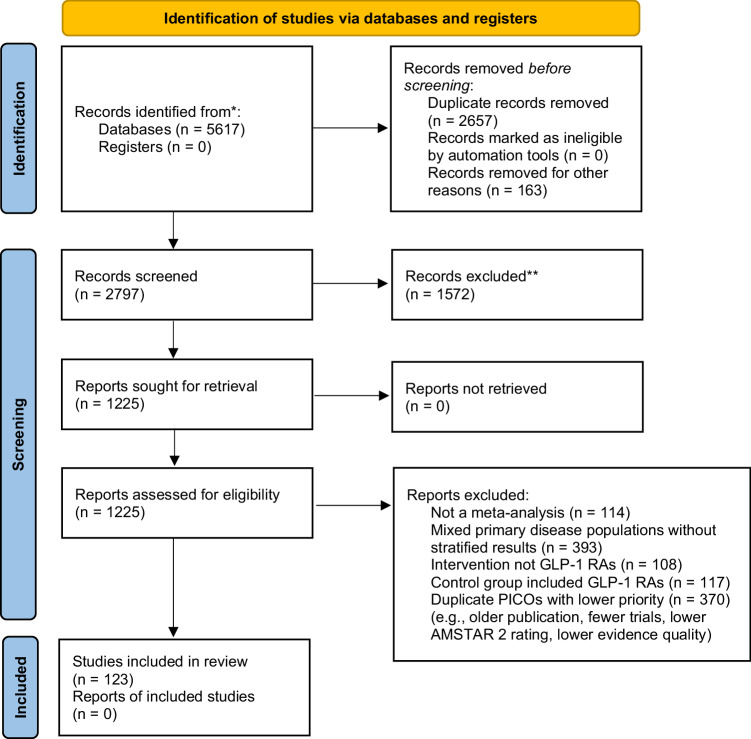
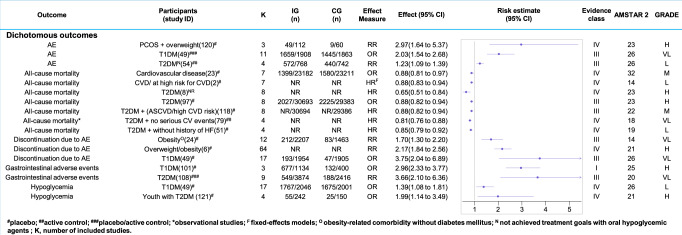
Glucagon-like peptide-1 receptor agonists (GLP-1 RAs) were initially approved for type 2 diabetes mellitus. Recent evidence suggests their therapeutic potential in various diseases, though their efficacy and safety remain incompletely understood. Here, we conduct an umbrella review including 123 meta-analyses covering 464 outcomes from 5617 articles to comprehensively assess the effectiveness and adverse events (AEs) of GLP-1 RAs across diverse outcomes. GLP-1 RAs showed trends toward improvements in endocrine and metabolic, cardiovascular, renal, and respiratory outcomes, cognitive function, with a potential reduction in fracture risk and all-cause mortality in certain populations. However, increased risks of certain AEs, including diabetic retinopathy, ketoacidosis, gastrointestinal events, and treatment discontinuation, were also observed. AMSTAR 2 assessments indicate that the existing evidence is limited by methodological shortcomings, including incomplete reporting of excluded studies, suboptimal literature search strategies, and insufficient evaluation of how bias in primary studies may influence meta-analytic estimates. Some outcomes did not reach statistical significance in all populations, highlighting the need for further high-quality clinical research. Careful consideration of potential benefits and risks is essential for optimizing treatment outcomes and ensuring patient safety when using GLP-1 RAs in clinical practice.
Overview
The claims and statistics of this paper haven’t been checked yet.
Free: it reads the open-access text and checks the first 5 claims that cite a source we can check. Create a free account to check every claim.
Integrity signals
Registry
Cites
Statistics
Figures
Verification
Claims the paper makes
The claims and statistics of this paper haven’t been checked yet.
Free: it reads the open-access text and checks the first 5 claims that cite a source we can check. Create a free account to check every claim.
Self-check
Percentages, sums and reported differences re-computed from the paper’s own numbers.
The self-check needs the paper’s full text.
Citations
Cites
GRADE guidelines: 1. Introduction—GRADE evidence profiles and summary of findings tables
Guyatt, G., Oxman, A. D., Akl, E. A., Kunz, R., Vist, G., Brozek, J., Norris, S., Falck-Ytter, Y., Glasziou, P., & deBeer, H. (2011) · Journal of Clinical Epidemiology · doi:10.1016/j.jclinepi.2010.04.026 · Cited by 10,681
Shea, B. J., Reeves, B. C., Wells, G., Thuku, M., Hamel, C., Moran, J., Moher, D., Tugwell, P., Welch, V., Kristjansson, E., et al. (2017) · BMJ · doi:10.1136/bmj.j4008 · Cited by 10,636 · cited 1×
“The methodological quality of the included meta-analyses was assessed using the AMSTAR 2 tool 59 .”
The Physiology of Glucagon-like Peptide 1
Holst, J. J. (2007) · Physiological Reviews · doi:10.1152/physrev.00034.2006 · Cited by 3,371
Semaglutide and Cardiovascular Outcomes in Obesity without Diabetes
Lincoff, A. M., Brown-Frandsen, K., Colhoun, H. M., Deanfield, J., Emerson, S. S., Esbjerg, S., Hardt-Lindberg, S., Hovingh, G. K., Kahn, S. E., Kushner, R. F., et al. (2023) · New England Journal of Medicine · doi:10.1056/nejmoa2307563 · Cited by 3,236 · cited 1×
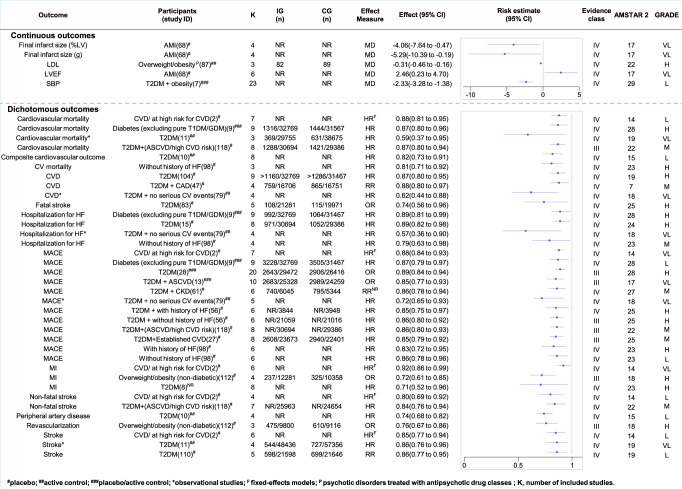
“Moreover, a large-scale randomized controlled trial (RCTs) involving more than 17,000 individuals with obesity and car-diovasculardiseasedemonstratedthatsemaglutidereducedtheriskof cardiovasculardeath,myocardialinfarction(MI),andstrokecompared to the placebo 9 .”
Davies, M. J., Aroda, V. R., Collins, B. S., Gabbay, R. A., Green, J., Maruthur, N. M., Rosas, S. E., Del Prato, S., Mathieu, C., Mingrone, G., et al. (2022) · Diabetes Care · doi:10.2337/dci22-0034 · Cited by 2,104 · cited 1×
“Although our synthesis shows increased gastrointestinal AEs and treatment discontinuation related to AEs, these challenges can generally be managed in practice through low-dose initiation, gradual up-titration, and regular monitoring 49 .”
The Discovery and Development of Liraglutide and Semaglutide
Knudsen, L. B., & Lau, J. (2019) · Frontiers in Endocrinology · doi:10.3389/fendo.2019.00155 · Cited by 970 · cited 1×
“fi rst for diabetes and later for obesity in 2014, while semaglutide, also a modi fi ed GLP-1 analogue, now treats both conditions 5 .”
Ten simple rules for conducting umbrella reviews
Fusar-Poli, P., & Radua, J. (2018) · Evidence Based Mental Health · doi:10.1136/ebmental-2018-300014 · Cited by 724
Cryo-EM structure of the activated GLP-1 receptor in complex with a G protein
Zhang, Y., Sun, B., Feng, D., Hu, H., Chu, M., Qu, Q., Tarrasch, J. T., Li, S., Sun Kobilka, T., Kobilka, B. K., et al. (2017) · Nature · doi:10.1038/nature22394 · Cited by 576
Effects of SGLT2 Inhibitors on Kidney and Cardiovascular Function
Vallon, V., & Verma, S. (2021) · Annual Review of Physiology · doi:10.1146/annurev-physiol-031620-095920 · Cited by 516
Sodhi, M., Rezaeianzadeh, R., Kezouh, A., & Etminan, M. (2023) · JAMA · doi:10.1001/jama.2023.19574 · Cited by 471
GLP-1 Receptor Activation Modulates Appetite- and Reward-Related Brain Areas in Humans
van Bloemendaal, L., IJzerman, R. G., ten Kulve, J. S., Barkhof, F., Konrad, R. J., Drent, M. L., Veltman, D. J., & Diamant, M. (2014) · Diabetes · doi:10.2337/db14-0849 · Cited by 427 · cited 1×
“By activating peripheral and central GLP-1 receptors, they modulate appetite-related neurohormonal signals — including insulin and leptin — and regulate adipocyte metabolism, thereby contributing to sustained weight loss 20,21 .”
Htike, Z. Z., Zaccardi, F., Papamargaritis, D., Webb, D. R., Khunti, K., & Davies, M. J. (2017) · Diabetes, Obesity and Metabolism · doi:10.1111/dom.12849 · Cited by 416
Little, R. R., Rohlfing, C. L., & Sacks, D. B. (2011) · Clinical Chemistry · doi:10.1373/clinchem.2010.148841 · Cited by 365 · cited 1×
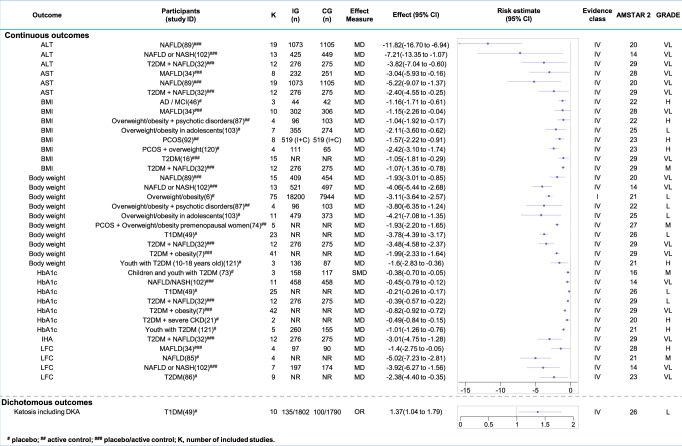
“For glycemic control, the mean reduction in HbA1c across most T2DM subgroups approaches or reaches the commonlyreferenced threshold for clinical relevance of 0.5% 47 , and in key target populations (e.g., T2DM with obesity) can reach 0.8 – 1.0%, indicating clinically perceptible improvements.”
InfluentialThe AMPK pathway in fatty liver disease
Fang, C., Pan, J., Qu, N., Lei, Y., Han, J., Zhang, J., & Han, D. (2022) · Frontiers in Physiology · doi:10.3389/fphys.2022.970292 · Cited by 364 · cited 1×
“GLP-1RAs mayalsoimprove liver function, this effectis thought to involve activation of AMP-activated protein kinase (AMPK), a key metabolic regulator that inhibits fatty acid synthesis and promotes fatty acid β -oxidation, leading to decreased lipid accumulation in hepatocytes 22 – 25 .”
Dietary sugar consumption and health: umbrella review
Huang, Y., Chen, Z., Chen, B., Li, J., Yuan, X., Li, J., Wang, W., Dai, T., Chen, H., Wang, Y., et al. (2023) · BMJ · doi:10.1136/bmj-2022-071609 · Cited by 348
Mapping the effectiveness and risks of GLP-1 receptor agonists
Xie, Y., Choi, T., & Al-Aly, Z. (2025) · Nature Medicine · doi:10.1038/s41591-024-03412-w · Cited by 300 · cited 1×
“Notably, a recent large-scale cohort study by Xie and colleagues using U.S. Department of Veterans Affairs data mapped associations between GLP-1 RA use and 175 health outcomes, providing comprehensive real-world insights to inform future investigations 57 .”
Long, J.-K., Dai, W., Zheng, Y.-W., & Zhao, S.-P. (2019) · Molecular Medicine · doi:10.1186/s10020-019-0085-2 · Cited by 281
Emerging Role of cAMP/AMPK Signaling
Aslam, M., & Ladilov, Y. (2022) · Cells · doi:10.3390/cells11020308 · Cited by 241
Weight Loss Outcomes Associated With Semaglutide Treatment for Patients With Overweight or Obesity
Ghusn, W., De la Rosa, A., Sacoto, D., Cifuentes, L., Campos, A., Feris, F., Hurtado, M. D., & Acosta, A. (2022) · JAMA Network Open · doi:10.1001/jamanetworkopen.2022.31982 · Cited by 238 · cited 1×
“Multiple clinical studies have demonstrated that semaglutide effectively induces weight loss, establishing it as an effective anti-obesity treatment for individuals with overweight or obesity 6,7 .”
Basu, A., Charkoudian, N., Schrage, W., Rizza, R. A., Basu, R., & Joyner, M. J. (2007) · American Journal of Physiology-Endocrinology and Metabolism · doi:10.1152/ajpendo.00373.2007 · Cited by 226
American Diabetes Association Professional Practice Committee, ElSayed, N. A., Aleppo, G., Bannuru, R. R., Bruemmer, D., Collins, B. S., Ekhlaspour, L., Hilliard, M. E., Johnson, E. L., Khunti, K., et al. (2024) · Diabetes Care · doi:10.2337/dc24-s008 · Cited by 213 · cited 1×
“…the proportion of individuals with overweight or obesity achieving ≥ 5% weight loss increases (approximately equivalent to 2 – 5 kg, depending on baseline weight), a threshold associated with improvements in blood pressure, blood lipids, functional capacity, and health-related quality of life 48 .”
Antibodies and venom peptides: new modalities for ion channels
Wulff, H., Christophersen, P., Colussi, P., Chandy, K. G., & Yarov-Yarovoy, V. (2019) · Nature Reviews Drug Discovery · doi:10.1038/s41573-019-0013-8 · Cited by 182
McGowan, B. M., Bruun, J. M., Capehorn, M., Pedersen, S. D., Pietiläinen, K. H., Muniraju, H. A. K., Quiroga, M., Varbo, A., & Lau, D. C. W. (2024) · The Lancet Diabetes & Endocrinology · doi:10.1016/s2213-8587(24)00182-7 · Cited by 176
The benefits of GLP-1 drugs beyond obesity
Drucker, D. J. (2024) · Science · doi:10.1126/science.adn4128 · Cited by 165
Edholm, T., Degerblad, M., Grybäck, P., Hilsted, L., Holst, J. J., Jacobsson, H., Efendic, S., Schmidt, P. T., & Hellström, P. M. (2010) · Neurogastroenterology & Motility · doi:10.1111/j.1365-2982.2010.01554.x · Cited by 164 · cited 1×
“Moreover, GLP-1 RAs can cross the blood – brain barrier and target key hypothalamic nuclei involved in energy homeostasis 17 – 19 .”
Killion, E. A., Chen, M., Falsey, J. R., Sivits, G., Hager, T., Atangan, L., Helmering, J., Lee, J., Li, H., Wu, B., et al. (2020) · Nature Communications · doi:10.1038/s41467-020-18751-8 · Cited by 151
van Bloemendaal, L., Veltman, D. J., ten Kulve, J. S., Groot, P. F. C., Ruhé, H. G., Barkhof, F., Sloan, J. H., Diamant, M., & Ijzerman, R. G. (2015) · Diabetes, Obesity and Metabolism · doi:10.1111/dom.12506 · Cited by 151
Kornelius, E., Huang, J.-Y., Lo, S.-C., Huang, C.-N., & Yang, Y.-S. (2024) · Scientific Reports · doi:10.1038/s41598-024-75965-2 · Cited by 143 · cited 1×
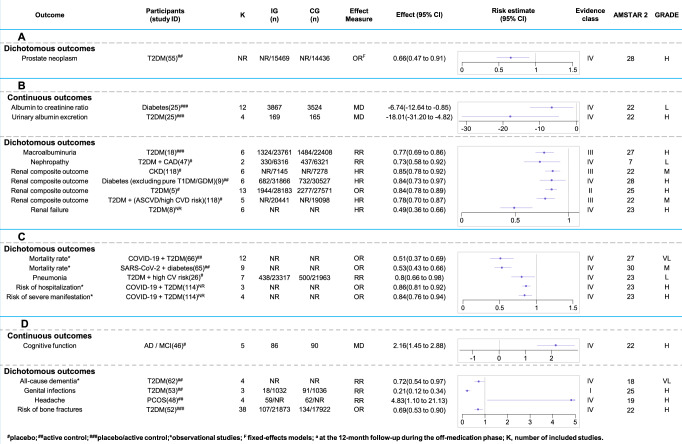
“While clinical evidence 52,53 has indicated a possible elevated risk, causality has not been established.”
Faillie, J.-L., Yu, O. H., Yin, H., Hillaire-Buys, D., Barkun, A., & Azoulay, L. (2016) · JAMA Internal Medicine · doi:10.1001/jamainternmed.2016.1531 · Cited by 134 · cited 1×
“Weight reduction is likely mediated by delayed gastric emptying, enhanced satiety, and reduced caloric intake 16 .”
Kabahizi, A., Wallace, B., Lieu, L., Chau, D., Dong, Y., Hwang, E., & Williams, K. W. (2022) · British Journal of Pharmacology · doi:10.1111/bph.15682 · Cited by 126 · cited 1×
“These symptoms are a leading cause of treatment discontinuation and are likely related to the delayed gastric emptying induced by GLP-1 RAs 43,44 .”
Targher, G., Mantovani, A., & Byrne, C. D. (2023) · The Lancet Gastroenterology & Hepatology · doi:10.1016/s2468-1253(22)00338-7 · Cited by 121
Schoretsanitis, G., Weiler, S., Barbui, C., Raschi, E., & Gastaldon, C. (2024) · JAMA Network Open · doi:10.1001/jamanetworkopen.2024.23385 · Cited by 107 · cited 1×
“A disproportionality analysis using global pharmacovigilance data identi fi ed a signi fi cant signal for semaglutide-associated suicidal ideation, particularly among individuals concurrently using antidepressants or benzodiazepines 54 .”
GLP1R Attenuates Sympathetic Response to High Glucose via Carotid Body Inhibition
Pauza, A. G., Thakkar, P., Tasic, T., Felippe, I., Bishop, P., Greenwood, M. P., Rysevaite-Kyguoliene, K., Ast, J., Broichhagen, J., Hodson, D. J., et al. (2022) · Circulation Research · doi:10.1161/circresaha.121.319874 · Cited by 106
Molecular mechanisms by which GLP-1 RA and DPP-4i induce insulin sensitivity
Yaribeygi, H., Sathyapalan, T., & Sahebkar, A. (2019) · Life Sciences · doi:10.1016/j.lfs.2019.116776 · Cited by 102
Butler, J., Abildstrøm, S. Z., Borlaug, B. A., Davies, M. J., Kitzman, D. W., Petrie, M. C., Shah, S. J., Verma, S., Abhayaratna, W. P., Chopra, V., et al. (2023) · Journal of the American College of Cardiology · doi:10.1016/j.jacc.2023.09.811 · Cited by 88
Glucagon-like peptide 1-related peptides increase nitric oxide effects to reduce platelet activation
Barale, C., Buracco, S., Cavalot, F., Frascaroli, C., Guerrasio, A., & Russo, I. (2017) · Thrombosis and Haemostasis · doi:10.1160/th16-07-0586 · Cited by 86
Satiety: a gut–brain–relationship
Barakat, G. M., Ramadan, W., Assi, G., & Khoury, N. B. E. (2024) · The Journal of Physiological Sciences · doi:10.1186/s12576-024-00904-9 · Cited by 82 · cited 1×
“By activating peripheral and central GLP-1 receptors, they modulate appetite-related neurohormonal signals — including insulin and leptin — and regulate adipocyte metabolism, thereby contributing to sustained weight loss 20,21 .”
McLean, B. A., Wong, C. K., Kabir, M. G., & Drucker, D. J. (2022) · Molecular Metabolism · doi:10.1016/j.molmet.2022.101641 · Cited by 82 · cited 1×
“GLP-1 GLP-1 receptors are widely expressed in myocardial and vascular systems 34 , and activation of these receptors may reduce cardiovascular risk by enhancing endothelial nitric oxide production 35,36 , modulating vascular tone, and reducing epicardial adipose tissue volume 37,38 .”
Wang, F., Mao, Y., Wang, H., Liu, Y., & Huang, P. (2021) · Clinical Drug Investigation · doi:10.1007/s40261-021-01110-w · Cited by 78
Miyata, K. N., Lo, C., Zhao, S., Liao, M.-C., Pang, Y., Chang, S., Peng, J., Kretzler, M., Filep, J. G., Ingelfinger, J. R., et al. (2021) · Clinical Science · doi:10.1042/cs20210094 · Cited by 76
García‐Vega, D., Sánchez-López, D., Rodríguez-Carnero, G., Villar‐Taibo, R., Viñuela, J. E., Lestegás-Soto, A., Seoane‐Blanco, A., Moure‐González, M., Bravo, S. B., Fernández, Á. L., et al. (2024) · Cardiovascular Diabetology · doi:10.1186/s12933-023-02096-9 · Cited by 72
Park, J., Ntelis, S., Yunasan, E., Downton, K. D., Yip, T. C.-F., Munir, K. M., & Haq, N. (2023) · The Journal of Clinical Endocrinology & Metabolism · doi:10.1210/clinem/dgad471 · Cited by 69 · cited 1×
“Despite these bene fi ts, our fi ndings also suggest an increased risk ofketosisinindividualswithT1DMtreatedwithGLP-1RAs 26 .”
Postoperative Aspiration Pneumonia Among Adults Using GLP-1 Receptor Agonists
Chen, Y.-H., Zink, T., Chen, Y.-W., Nin, D. Z., Talmo, C. T., Hollenbeck, B. L., Grant, A. R., Niu, R., Chang, D. C., & Smith, E. L. (2025) · JAMA Network Open · doi:10.1001/jamanetworkopen.2025.0081 · Cited by 60
Alkabbani, W., Suissa, K., Gu, K. D., Cromer, S. J., Paik, J. M., Bykov, K., Hobai, I., Thompson, C. C., Wexler, D. J., & Patorno, E. (2024) · BMJ · doi:10.1136/bmj-2024-080340 · Cited by 60
Kong, F., Wu, T., Dai, J., Zhai, Z., Cai, J., Zhu, Z., Xu, Y., & Sun, T. (2023) · Frontiers in Pharmacology · doi:10.3389/fphar.2023.1205207 · Cited by 54
Self-citationMcIntyre, R. S., Mansur, R. B., Rosenblat, J. D., Rhee, T. G., Cao, B., Teopiz, K. M., Wong, S., Le, G. H., Ho, R., & Kwan, A. T. H. (2025) · Journal of Affective Disorders · doi:10.1016/j.jad.2024.10.062 · Cited by 53
Ebrahimi, P., Batlle, J. C., Ayati, A., Maqsood, M. H., Long, C., Tarabanis, C., McGowan, N., Liebers, D. T., Laynor, G., Hosseini, K., et al. (2025) · JAMA Psychiatry · doi:10.1001/jamapsychiatry.2025.0091 · Cited by 51 · cited 1×
“In contrast, a recent meta-analysis 55 synthesizing randomized and observational data did not fi nd a signi fi cant association between GLP-1 RAs and suicide or self-harm outcomes.”
Nexøe‐Larsen, C. C., Sørensen, P. H., Hausner, H., Agersnap, M., Baekdal, M., Brønden, A., Gustafsson, L. N., Sonne, D. P., Vedtofte, L., Vilsbøll, T., et al. (2018) · Diabetes, Obesity and Metabolism · doi:10.1111/dom.13420 · Cited by 51 · cited 1×
“Prolonged gastric transit time may contribute to bile stasis, thereby increasing the risk of gallbladder-related disorders 45 .”
Cardioprotective anti-hyperglycaemic medications: a review of clinical trials
Ahmed, H. M., Khraishah, H., & Cho, L. (2017) · European Heart Journal · doi:10.1093/eurheartj/ehx668 · Cited by 45
GLP-1 and the Neurobiology of Eating Control: Recent Advances
Jones, L. A., & Brierley, D. I. (2025) · Endocrinology · doi:10.1210/endocr/bqae167 · Cited by 43 · cited 1×
“In addition, nausea is believed to result mainly from central mechanisms, in which activation of GLP-1R neurons in the area postrema plays a predominant role rather than from delayed gastric emptying alone 46 .”
Papaconstantinou, I. G., Zeglinas, C., Gazouli, M., Nastos, C., Yiallourou, A., Papalois, A. E., & Tzathas, C. (2014) · Journal of Gastrointestinal Surgery · doi:10.1007/s11605-014-2487-3 · Cited by 41
Tang, H., Lu, Y., Donahoo, W. T., Shao, H., Shi, L., Fonseca, V. A., Guo, Y., Bian, J., & Guo, J. (2024) · Annals of Internal Medicine · doi:10.7326/m24-0329 · Cited by 40
Yang, Z., Yu, M., Mei, M., Chen, C., Lv, Y., Xiang, L., & Li, R. (2022) · Nutrition Metabolism and Cardiovascular Diseases · doi:10.1016/j.numecd.2021.10.003 · Cited by 37 · cited 2×
“Thismight be due to reduced or interrupted insulin doses, gastrointestinal AEs (e.g., vomiting, dehydration), and decreased appetite leading to reducedfoodintake 27 .”
Effect of glucagon-like peptide-1 (GLP-1) analogues on epicardial adipose tissue: A meta-analysis
Berg, G., Barchuk, M., Lobo, M., & Nogueira, J. P. (2022) · Diabetes & Metabolic Syndrome: Clinical Research & Reviews · doi:10.1016/j.dsx.2022.102562 · Cited by 36 · cited 1×
“GLP-1 GLP-1 receptors are widely expressed in myocardial and vascular systems 34 , and activation of these receptors may reduce cardiovascular risk by enhancing endothelial nitric oxide production 35,36 , modulating vascular tone, and reducing epicardial adipose tissue volume 37,38 .”
Małyszczak, A., Przeździecka-Dołyk, J., Szydełko-Paśko, U., & Misiuk‐Hojło, M. (2024) · Journal of Clinical Medicine · doi:10.3390/jcm13061797 · Cited by 30
SGLT2 and SGLT1 inhibitors suppress the activities of the RVLM neurons in newborn Wistar rats
Oshima, N., Onimaru, H., Yamashiro, A., Goto, H., Tanoue, K., Fukunaga, T., Sato, H., Uto, A., Matsubara, H., Imakiire, T., et al. (2023) · Hypertension Research · doi:10.1038/s41440-023-01417-5 · Cited by 25
PKA Enhances the Acute Insulin Response Leading to the Restoration of Glucose Control
Kaihara, K. A., Dickson, L. M., Ellenbroek, J. H., Orr, C. M. D., Layden, B. T., & Wicksteed, B. (2015) · Diabetes · doi:10.2337/db14-1051 · Cited by 22 · cited 1×
“Upon binding to GLP-1 receptors, GLP-1 RAs activate G-protein signaling pathways, leading to increased cyclic AMP and activation of protein kinase A, which in turn enhances insulin biosynthesis and suppresses glucagon secretion 13 – 15 .”
Nesti, L., & Tricò, D. (2024) · World Journal of Diabetes · doi:10.4239/wjd.v15.i5.818 · Cited by 22
Igweokpala, S., Sule, N., Douros, A., Yu, O. H. Y., & Filion, K. B. (2023) · Diabetes Obesity and Metabolism · doi:10.1111/dom.15367 · Cited by 14
Kamrul-Hasan, A. B. M., Dutta, D., Nagendra, L., Bhattacharya, S., Singla, R., & Kalra, S. (2024) · Medicine · doi:10.1097/md.0000000000038568 · Cited by 10
Research works printed but not linked: 1
- Science’s 2023 Breakthrough of the Year: weight loss drugs with a real shot at fighting obesity. https://www.science.org/content/article/breakthrough-of-the-year-2023.
Cited by
Kansakar, U., Jankauskas, S. S., Pande, S., Mone, P., Varzideh, F., & Santulli, G. (2026) · International Journal of Molecular Sciences · doi:10.3390/ijms27031409 · Cited by 22
Pinto, L. F., & Guerreiro, C. A. M. (2026) · Seizure · doi:10.1016/j.seizure.2026.05.013 · Cited by 5
ROSENSTOCK, J., Lingvay, I., RYAN, D. H., Jastreboff, A. M., Kushner, R., ACOSTA, A., Blevins, T., Choi, M., HOLMES, F. L., Smith, T., et al. (2026) · Nature Medicine · doi:10.1038/s41591-026-04476-6 · Cited by 9
Food systems transformation would reshape global agriculture
Gibson, M., Sundiang, M., Mason-D’Croz, D., Oliveira, T. D., Beier, F., Benavidez, L., Bos, A., Chepeliev, M. G., Doelman, J., Dunston, S., et al. (2026) · Nature · doi:10.1038/s41586-026-10775-2 · Cited by 23
Dziewierz, A., & Siudak, Z. (2026) · Nutrients · doi:10.3390/nu18111761 · Cited by 3
“Furthermore, landmark trials such as SELECT have confirmed significant reductions in major adverse cardiovascular events (MACE), establishing these agents as systemic disease-modifying therapies beyond glycemic and weight control [7,14,15].”
Metadata
- Authors
- Kong, F., Zhao, Y., Zhang, W., Wang, X., Wu, T., Zhou, Z., Xu, Y., Xia, L., & Sun, T.
- Affiliations
- Chengdu University of Traditional Chinese Medicine (CN)
- Corresponding author
- Xu, Ying
- Xia, Lina
- Sun, Tao
- Venue
- Nature Communications
- Published
- 2026-01-07
- Volume
- 17
- Issue
- 1
- Pages
- 972-972
- ISSN
- 2041-1723 (ISSN-L)
- PMC
- PMC12847739
- OpenAlex
- W7118511453
- Cited by
- 29
- References
- 58
- Citations by year
- 2026: 29
- FWCI
- 30.83
- Type
- journal article
- Language
- en
- Open access
- gold
- doi.org
- Licence
- cc-by-nc-nd
- creativecommons.org/licenses/by-nc-nd/4.0 (tdm)
- creativecommons.org/licenses/by-nc-nd/4.0 (vor, 20 d)
- Locations
- Nature Communications (publishedVersion, cc-by-nc-nd)
- Europe PMC (PubMed Central) (publishedVersion, cc-by-nc-nd)
- PubMed (publishedVersion)
- PubMed Central (publishedVersion, cc-by-nc-nd)
- DOAJ (DOAJ: Directory of Open Access Journals) (submittedVersion, cc-by-sa)
- Funders
- Chengdu University of Traditional Chinese Medicine
- Jiangxi University of Traditional Chinese Medicine
- Chengdu University
- Maryland Population Research Center, University of Maryland
- Topics
- Health Sciences › Medicine › Endocrinology, Diabetes and Metabolism › Diabetes Treatment and Management
- Health Sciences › Medicine › Pharmacology (medical) › Pharmacology and Obesity Treatment
- Health Sciences › Medicine › Cardiology and Cardiovascular Medicine › Heart Failure Treatment and Management
- Keywords
- GLP-1 receptor agonists, type 2 diabetes, cardiovascular outcomes, renal outcomes, respiratory outcomes, cognitive function, fracture risk, all-cause mortality, adverse events, diabetic ketoacidosis, diabetic retinopathy, gastrointestinal adverse effects, treatment discontinuation, off-label drug use
- MeSH terms
- Glucagon-Like Peptide-1 Receptor, Glucagon-Like Peptide-1 Receptor Agonists, Diabetes Mellitus, Type 2, Humans, Hypoglycemic Agents, Meta-Analysis as Topic, Treatment Outcome
About these checks
Registry, retraction, Cites and statistics results are computed, not judged, with one exception: a printed reference that no index lists is read once by a model before it counts as a citation error. Claims are extracted by a model and kept only when their quote appears verbatim in the text; each cited source is then checked, with a model’s help, for whether it says what the claim relies on. Those verdicts can be wrong — read the claim’s quote and the cited source before relying on one.
Statistics and arithmetic are recomputed, not judged.
Confidence bands are shown only for fields calibrated on our annotated test set. None is calibrated yet, so no band is shown.
What counts as a claim ›How we measure confidence ›How we check this ›
Are you an author, or do you see a problem with this page? Request a review
Data sources
Bibliographic data: Semantic Scholar, OpenAlex, Crossref.
Contains information from the Semantic Scholar Academic Graph Datasets, made available under the ODC Attribution License (ODC-BY 1.0).
Semantic Scholar’s data is described in: Kinney, R., et al. (2023). The Semantic Scholar Open Data Platform. arXiv:2301.10140.
