

The DOI matches its Crossref record; 54 of the 54 references it cites were found in a registry or an index.
Inter-personal diversity and temporal dynamics of dental, tongue, and salivary microbiota in the healthy oral cavity
Open accessAbstract
Oral microbes form a complex and dynamic biofilm community, which is subjected to daily host and environmental challenges. Dysbiosis of the oral biofilm is correlated with local and distal infections and postulating a baseline for the healthy core oral microbiota provides an opportunity to examine such shifts during the onset and recurrence of disease. Here we quantified the daily, weekly, and monthly variability of the oral microbiome by sequencing the largest oral microbiota time-series to date, covering multiple oral sites in ten healthy individuals. Temporal dynamics of salivary, dental, and tongue consortia were examined by high-throughput 16S rRNA gene sequencing over 90 days, with four individuals sampled additionally 1 year later. Distinct communities were observed between dental, tongue, and salivary samples, with high levels of similarity observed between the tongue and salivary communities. Twenty-six core OTUs that classified within Streptococcus, Fusobacterium, Haemophilus, Neisseria, Prevotella , and Rothia genera were present in ≥95% samples and accounted for ~65% of the total sequence data. Phylogenetic diversity varied from person to person, but remained relatively stable within individuals over time compared to inter-individual variation. In contrast, the composition of rare microorganisms was highly variable over time, within most individuals. Using machine learning, an individual's oral microbial assemblage could be correctly assigned to them with 88–97% accuracy, depending on the sample site; 83% of samples taken a year after initial sampling could be confidently traced back to the source subject.
Overview
The claims and statistics of this paper haven’t been checked yet.
Run the check — free, no account needed. It reads the open-access text and checks the sources it cites.
Integrity signals
Registry
Cites
Statistics
Figures
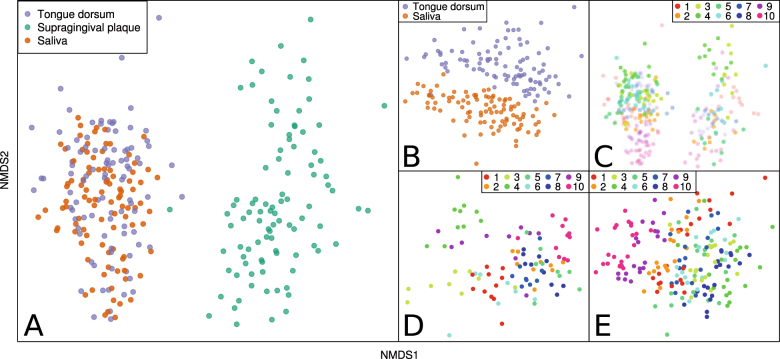
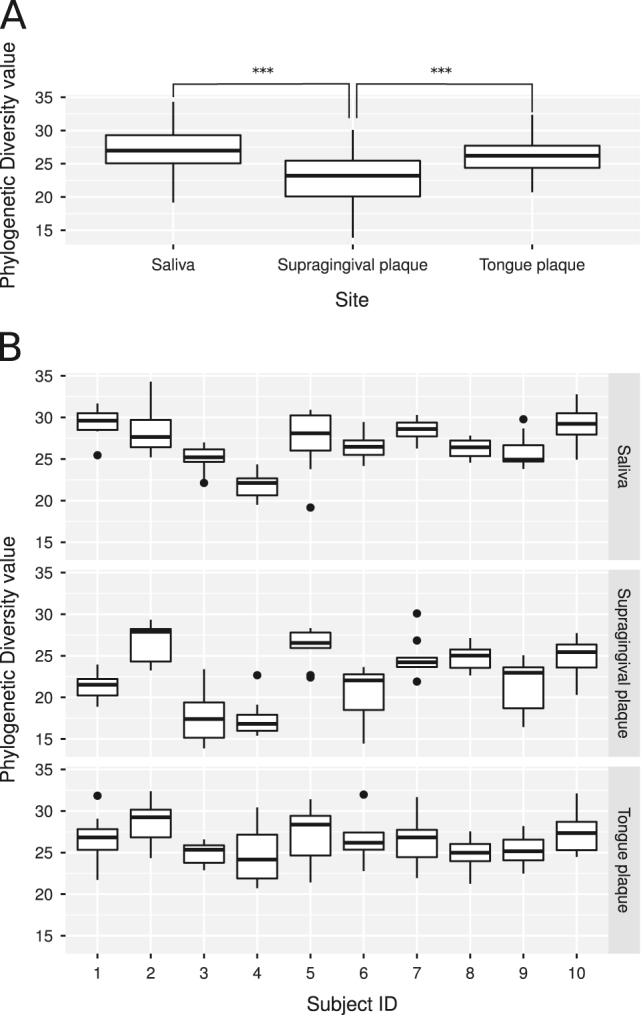
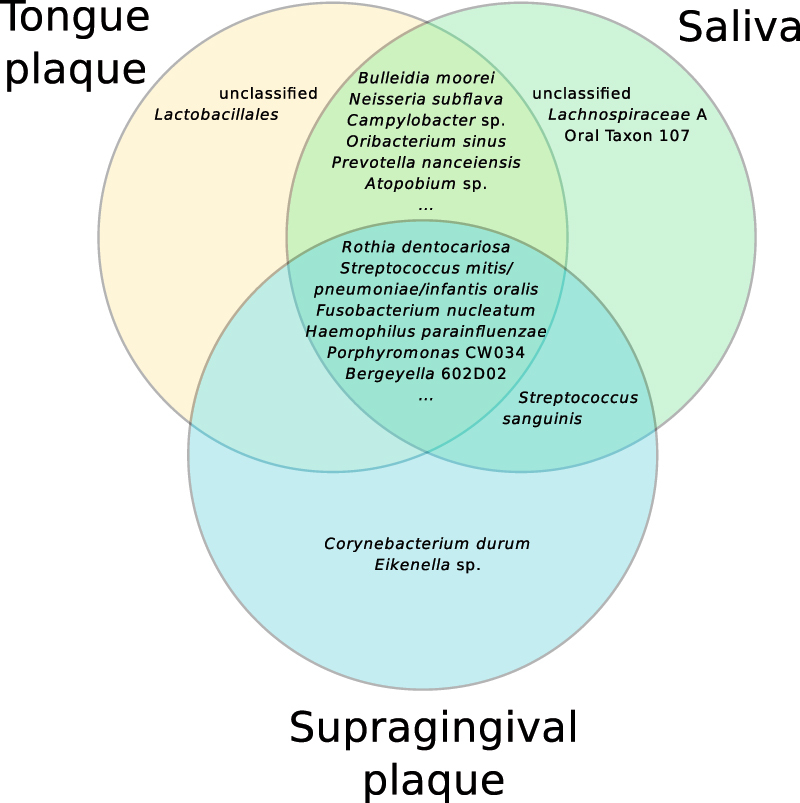
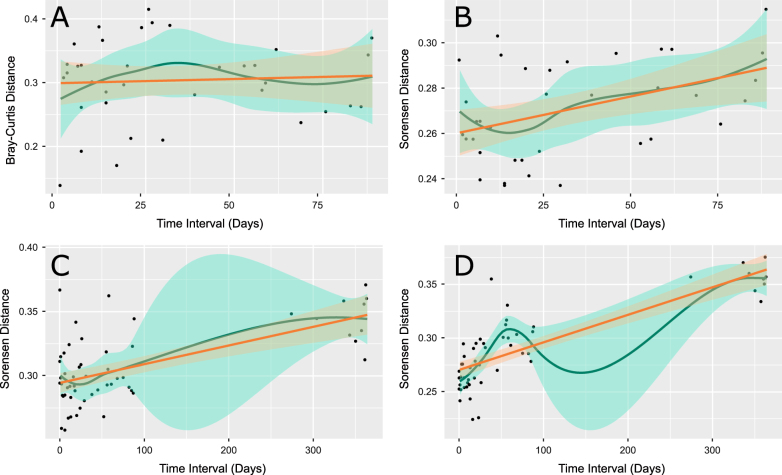
Verification
Claims the paper makes
The claims and statistics of this paper haven’t been checked yet.
Run the check — free, no account needed. It reads the open-access text and checks the sources it cites.
Claims other papers make about this one
Each is checked against this paper’s own text: does it say what the citing paper says it does?
In the citing paper
“The human oral microbiota is markedly diverse among individuals.29”
From The oral microbiome: Role of key organisms and complex networks in oral health and disease (2021) · cites this paper as [29]
Self-check
Percentages, sums and reported differences re-computed from the paper’s own numbers.
The self-check needs the paper’s full text.
Citations
Cites
Scikit-learn: Machine Learning in Python
Pedregosa, F., Varoquaux, G., Gramfort, A., Michel, V., Thirion, B., Grisel, O., Blondel, M., Müller, A., Nothman, J., Louppe, G., et al. (2012) · arXiv · doi:10.48550/arxiv.1201.0490 · Cited by 71,016
QIIME allows analysis of high-throughput community sequencing data
Caporaso, J. G., Kuczynski, J., Stombaugh, J., Bittinger, K., Bushman, F. D., Costello, E. K., Fierer, N., Peña, A. G., Goodrich, J. K., Gordon, J. I., et al. (2010) · Nature Methods · doi:10.1038/nmeth.f.303 · Cited by 34,887
vegan: Community Ecology Package
Oksanen, J., Simpson, G. L., Blanchet, F. G., Kindt, R., Legendre, P., Minchin, P. R., O’Hara, R. B., Sólymos, P., Stevens, M. H. H., Szöcs, E., et al. (2001) · doi:10.32614/cran.package.vegan · Cited by 27,099
Naive Bayesian Classifier for Rapid Assignment of rRNA Sequences into the New Bacterial Taxonomy
Wang, Q., Garrity, G. M., Tiedje, J. M., & Cole, J. R. (2007) · Applied and Environmental Microbiology · doi:10.1128/aem.00062-07 · Cited by 20,145
UPARSE: highly accurate OTU sequences from microbial amplicon reads
Edgar, R. C. (2013) · Nature Methods · doi:10.1038/nmeth.2604 · Cited by 16,770
FastTree 2 – Approximately Maximum-Likelihood Trees for Large Alignments
Price, M. N., Dehal, P. S., & Arkin, A. P. (2010) · PLoS ONE · doi:10.1371/journal.pone.0009490 · Cited by 14,894
Structure, function and diversity of the healthy human microbiome
The Human Microbiome Project Consortium (2012) · Nature · doi:10.1038/nature11234 · Cited by 11,726
Muyzer, G., de Waal, E. C., & Uitterlinden, A. G. (1993) · Applied and Environmental Microbiology · doi:10.1128/aem.59.3.695-700.1993 · Cited by 11,490
Global patterns of 16S rRNA diversity at a depth of millions of sequences per sample
Caporaso, J. G., Lauber, C. L., Walters, W. A., Berg-Lyons, D., Lozupone, C., Turnbaugh, P. J., Fierer, N., & Knight, R. D. (2010) · Proceedings of the National Academy of Sciences · doi:10.1073/pnas.1000080107 · Cited by 9,944
Turnbaugh, P. J., Ley, R. E., Hamady, M., Fraser-Liggett, C. M., Knight, R., & Gordon, J. I. (2007) · Nature · doi:10.1038/nature06244 · Cited by 6,091
Research works printed but not linked: 1
- Marsh, P. D., Martin, M. V., Lewis, M. A. & Williams, D. Oral Microbiol. (Elsevier Health Sciences, 2009).
Cited by
Sorted by citations
The oral microbiome: Role of key organisms and complex networks in oral health and disease
Sedghi, L., DiMassa, V., Harrington, A., Lynch, S. V., & Kapila, Y. L. (2021) · Periodontology 2000 · doi:10.1111/prd.12393 · Cited by 755
Caselli, E., Fabbri, C., D’Accolti, M., Soffritti, I., Bassi, C., Mazzacane, S., & Franchi, M. (2020) · BMC Microbiology · doi:10.1186/s12866-020-01801-y · Cited by 410
d’Enfert, C., Kaune, A.-K., Alaban, L. R., Chakraborty, S., Cole, N. L., Delavy, M., Kosmala, D., Marsaux, B., Fróis-Martins, R., Morelli, M., et al. (2020) · FEMS Microbiology Reviews · doi:10.1093/femsre/fuaa060 · Cited by 377
Biogeography of the Oral Microbiome: The Site-Specialist Hypothesis
Mark Welch, J. L., Dewhirst, F. E., & Borisy, G. G. (2019) · Annual Review of Microbiology · doi:10.1146/annurev-micro-090817-062503 · Cited by 284
Sharma, N., Bhatia, S., Sodhi, A. S., & Batra, N. (2018) · AIMS Microbiology · doi:10.3934/microbiol.2018.1.42 · Cited by 275
Metadata
- Authors
- Hall, M. W., Singh, N., Ng, K. F., Lam, D. K., Goldberg, M. B., Tenenbaum, H. C., Neufeld, J. D., G. Beiko, R., & Senadheera, D. B.
- Affiliations
- Dalhousie University (CA)
- University of Toronto (CA)
- Mount Sinai Hospital (CA)
- University of Waterloo (CA)
- Corresponding author
- Senadheera, Dilani B.
- ORCID
- Venue
- npj Biofilms and Microbiomes
- Published
- 2017-01-26
- Volume
- 3
- Issue
- 1
- Pages
- 2-2
- ISSN
- 2055-5008 (ISSN-L)
- PMC
- PMC5445578
- OpenAlex
- W2581739967
- Cited by
- 226
- References
- 54
- Citations by year
- 2026: 17 · 2025: 19 · 2024: 29 · 2023: 19 · 2022: 22 · 2021: 37 · 2020: 42 · 2019: 18 · 2018: 19 · 2017: 4
- FWCI
- 31.32
- Type
- journal article
- Language
- en
- Open access
- gold
- doi.org
- Locations
- npj Biofilms and Microbiomes (publishedVersion, cc-by)
- Europe PMC (PubMed Central) (publishedVersion, cc-by)
- PubMed Central (publishedVersion, cc-by)
- PubMed (publishedVersion)
- DOAJ (DOAJ: Directory of Open Access Journals) (submittedVersion, cc-by-sa)
- Funders
- Canada Research Chairs
- Canadian Institutes of Health Research (115192)
- Natural Sciences and Engineering Research Council of Canada
- Topics
- Health Sciences › Dentistry › Periodontics › Oral microbiology and periodontitis research
- Life Sciences › Biochemistry, Genetics and Molecular Biology › Molecular Biology › Gut microbiota and health
- Physical Sciences › Environmental Science › Ecology › Microbial Community Ecology and Physiology
- Keywords
- oral microbiota, temporal dynamics, salivary microbiota, dental plaque microbiota, tongue microbiota, interindividual variability, core microbiome, dental plaque, dysbiosis, phylogenetic diversity, microbial community stability
About these checks
Registry, retraction, Cites and statistics results are computed, not judged, with one exception: a printed reference that no index lists is read once by a model before it counts as a citation error. Claims are extracted by a model and kept only when their quote appears verbatim in the text; each cited source is then checked, with a model’s help, for whether it says what the claim relies on. Those verdicts can be wrong — read the claim’s quote and the cited source before relying on one.
Statistics and arithmetic are recomputed, not judged.
Confidence bands are shown only for fields calibrated on our annotated test set. None is calibrated yet, so no band is shown.
What counts as a claim ›How we measure confidence ›How we check this ›
Are you an author, or do you see a problem with this page? Request a review
