

The making of a miscreant: tobacco smoke and the creation of pathogen-rich biofilms
Open accessThe DOI matches its Crossref record; 75 of the 75 references it cites were found in a registry or an index.
Abstract
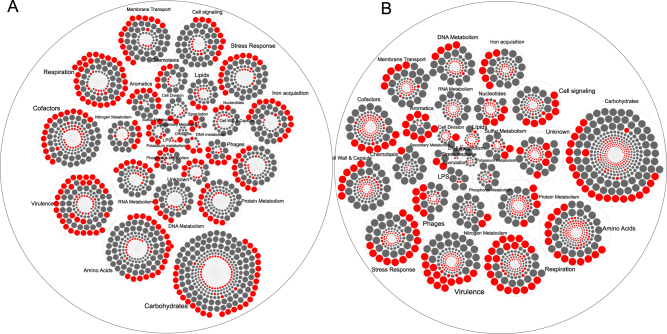
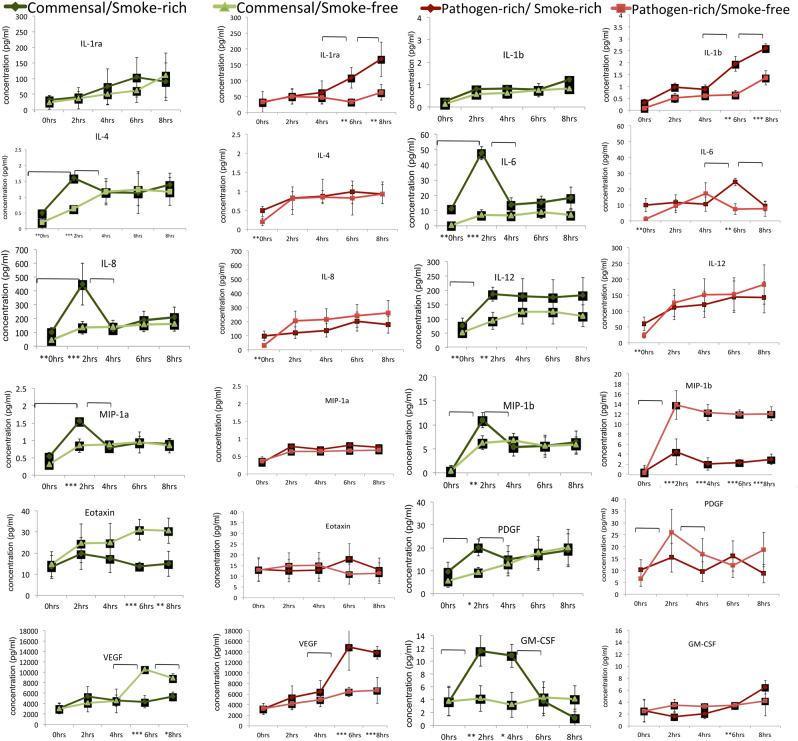
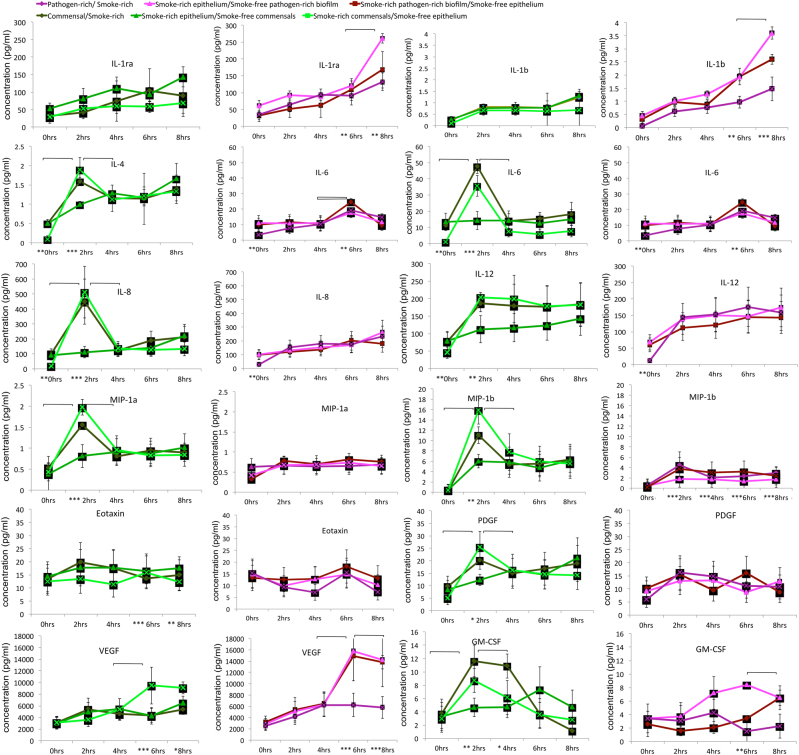
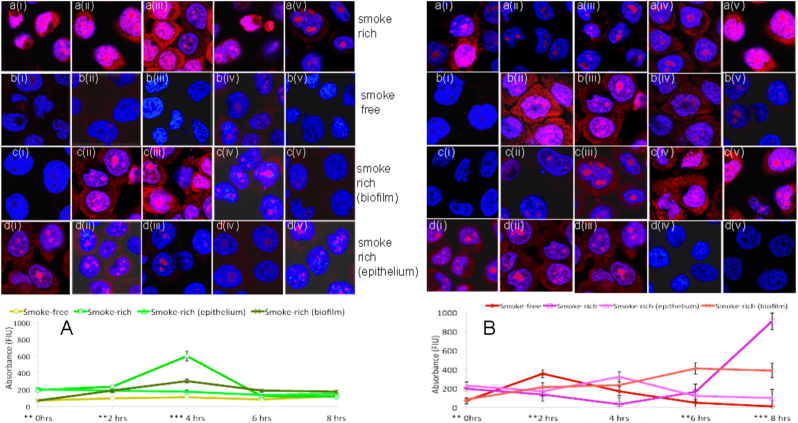
We have previously reported that oral biofilms in clinically healthy smokers are pathogen-rich, and that this enrichment occurs within 24 h of biofilm formation. The present investigation aimed to identify a mechanism by which smoking creates this altered community structure. By combining in vitro microbial–mucosal interface models of commensal (consisting of Streptococcus oralis, Streptococcus sanguis, Streptococcus mitis, Actinomyces naeslundii, Neisseria mucosa and Veillonella parvula) and pathogen-rich (comprising S.oralis, S.sanguis, S.mitis, A.naeslundii, N.mucosa and V.parvula, Fusobacterium nucleatum, Porphyromonas gingivalis, Filifactor alocis, Dialister pneumosintes, Selenonomas sputigena, Selenominas noxia, Catonella morbi, Parvimonas micra and Tannerella forsythia) communities with metatranscriptomics, targeted proteomics and fluorescent microscopy, we demonstrate that smoke exposure significantly downregulates essential metabolic functions within commensal biofilms, while significantly increasing expression of virulence genes, notably lipopolysaccharide (LPS), flagella and capsule synthesis. By contrast, in pathogen-rich biofilms several metabolic pathways were over-expressed in response to smoke exposure. Under smoke-rich conditions, epithelial cells mounted an early and amplified pro-inflammatory and oxidative stress response to these virulence-enhanced commensal biofilms, and a muted early response to pathogen-rich biofilms. Commensal biofilms also demonstrated early and widespread cell death. Similar results were observed when smoke-free epithelial cells were challenged with smoke-conditioned biofilms, but not vice versa. In conclusion, our data suggest that smoke-induced transcriptional shifts in commensal biofilms triggers a florid pro-inflammatory response, leading to early commensal death, which may preclude niche saturation by these beneficial organisms. The cytokine-rich, pro-oxidant, anaerobic environment sustains inflammophilic bacteria, and, in the absence of commensal antagonism, may promote the creation of pathogen-rich biofilms in smokers.
Overview
The claims and statistics of this paper haven’t been checked yet.
Free: it reads the open-access text and checks the first 5 claims that cite a source we can check. Create a free account to check every claim.
Integrity signals
Registry
Cites
Statistics
Figures
Verification
Claims the paper makes
The claims and statistics of this paper haven’t been checked yet.
Free: it reads the open-access text and checks the first 5 claims that cite a source we can check. Create a free account to check every claim.
Claims other papers make about this one
Each is checked against this paper’s own text: does it say what the citing paper says it does?
The cited source says what the claim attributes to it.
In the citing paper
“However, it is noteworthy that capsular biosynthesis genes in model commensal subgingival biofilms were upregulated in response to tobacco exposure.74”
From The dental plaque biofilm matrix (2021) · cites this paper as [74]
Self-check
Percentages, sums and reported differences re-computed from the paper’s own numbers.
The self-check needs the paper’s full text.
Citations
Cites
Raza, H., John, A., & Nemmar, A. (2013) · Cellular Physiology and Biochemistry · doi:10.1159/000350087 · Cited by 47,221
QIIME allows analysis of high-throughput community sequencing data
Caporaso, J. G., Kuczynski, J., Stombaugh, J., Bittinger, K., Bushman, F. D., Costello, E. K., Fierer, N., Peña, A. G., Goodrich, J. K., Gordon, J. I., et al. (2010) · Nature Methods · doi:10.1038/nmeth.f.303 · Cited by 34,887
Fast and sensitive protein alignment using DIAMOND
Buchfink, B., Xie, C., & Huson, D. H. (2015) · Nature Methods · doi:10.1038/nmeth.3176 · Cited by 14,201 · cited 2×
“Microbial transcripts were quality filtered using SolexaQA++, and aligned against the Human Oral Microbiome Database(71) using DIAMOND.(72) Aligned sequences were annotated to the KEGG database using Megan 6.”
MethodInfluentialStructure, function and diversity of the healthy human microbiome
The Human Microbiome Project Consortium (2012) · Nature · doi:10.1038/nature11234 · Cited by 11,726
Changes of Intestinal Functions in Liver Cirrhosis
Fukui, H., & Wiest, R. (2016) · Inflammatory Intestinal Diseases · doi:10.1159/000444436 · Cited by 6,808
Kraken: ultrafast metagenomic sequence classification using exact alignments
Wood, D. E., & Salzberg, S. L. (2014) · Genome Biology · doi:10.1186/gb-2014-15-3-r46 · Cited by 4,521
Recognition of Commensal Microflora by Toll-Like Receptors Is Required for Intestinal Homeostasis
Rakoff-Nahoum, S., Paglino, J., Eslami-Varzaneh, F., Edberg, S., & Medzhitov, R. (2004) · Cell · doi:10.1016/j.cell.2004.07.002 · Cited by 4,251
Immunobiology: the immune system in health and disease
(1995) · Choice Reviews Online · doi:10.5860/choice.32-3876 · Cited by 4,110
MEGAN analysis of metagenomic data
Huson, D. H., Auch, A. F., Qi, J., & Schuster, S. C. (2007) · Genome Research · doi:10.1101/gr.5969107 · Cited by 3,312
Commensal Host-Bacterial Relationships in the Gut
Hooper, L. V., & Gordon, J. I. (2001) · Science · doi:10.1126/science.1058709 · Cited by 2,362 · cited 1×
“It is well known that an intact epithelial barrier plays a critical role in maintaining the health of mucosal surfaces, both by preventing ingress of bacteria and by secreting immuno-modulatory signaling molecules.(1,2) Evidence is now emerging that host-associated bacterial biofilms play a similarly important role in…”
Background
Research works printed but not linked: 5
- Kumar PS Griffen AL Moeschberger ML Leys EJ Identification of candidate periodontal pathogens and benficial species using quantitative 16S clonal analysis J. Clin. Microbiol. 2005 43 3944 3955 10.1128/JCM.43.8.3944-3955.2005 16081935 PMC1233920 · DOI · Paper page
- Kumar PS Tobacco smoking affects bacterial acquisition and colonization in oral biofilms Infect. Immun. 2011 79 4730 4738 10.1128/IAI.05371-11 21859855 PMC3257914 · DOI · Paper page
- Kumar PS Tobacco smoking affects bacterial acquisition and colonization in oral biofilms Infect. Immun. 2011 79 4730 4738 10.1128/IAI.05371-11 21859855 PMC3257914 · DOI · Paper page
- Guggenheim B In vitro modeling of host-parasite interactions: the’subgingival’biofilm challenge of primary human epithelial cells BMC Microbiol. 2009 9 280 10.1186/1471-2180-9-280 20043840 PMC2818713 · DOI · Paper page
- Kulkarni R Cigarette smoke inhibits airway epithelial cell innate immune responses to bacteria Infect. Immun. 2010 78 2146 2152 10.1128/IAI.01410-09 20194598 PMC2863539 · DOI
Cited by
The Oral Microbiota: Dynamic Communities and Host Interactions
Lamont, R. J., Koo, H., & Hajishengallis, G. (2018) · Nature Reviews Microbiology · doi:10.1038/s41579-018-0089-x · Cited by 2,217
The dental plaque biofilm matrix
Jakubovics, N. S., Goodman, S. D., Mashburn‐Warren, L., Stafford, G. P., & Cieplik, F. (2021) · Periodontology 2000 · doi:10.1111/prd.12361 · Cited by 488
Apatzidou, D. A. (2022) · Periodontology 2000 · doi:10.1111/prd.12449 · Cited by 188
The Impact of Smoking on Subgingival Microflora: From Periodontal Health to Disease
Jiang, Y., Zhou, X., Cheng, L., & Li, M. (2020) · Frontiers in Microbiology · doi:10.3389/fmicb.2020.00066 · Cited by 168
Adverse effects of electronic cigarettes on the disease-naive oral microbiome
Ganesan, S. M., Dabdoub, S. M., Nagaraja, H. N., Scott, M. L., Pamulapati, S., Berman, M. L., Shields, P. G., Wewers, M. E., & Kumar, P. (2020) · Science Advances · doi:10.1126/sciadv.aaz0108 · Cited by 144
Self-citation
Metadata
- Authors
- Shah, S. A., Ganesan, S. M., Varadharaj, S., Dabdoub, S. M., Walters, J. D., & Kumar, P. S.
- Affiliations
- The Ohio State University (US)
- Corresponding author
- Kumar, Purnima S.
- Venue
- npj Biofilms and Microbiomes
- Published
- 2017-10-24
- Volume
- 3
- Issue
- 1
- Pages
- 26-26
- ISSN
- 2055-5008 (ISSN-L)
- PMC
- PMC5655325
- OpenAlex
- W2767057995
- Semantic Scholar
- 8b095474fbb79dc32f8f09ccfb370d5a1dd26e07
- Cited by
- 39
- References
- 75
- Citations by year
- 2026: 3 · 2025: 3 · 2024: 3 · 2023: 5 · 2022: 5 · 2021: 8 · 2020: 6 · 2019: 3 · 2018: 2
- FWCI
- 4.15
- Type
- journal article
- Language
- en
- Open access
- gold
- doi.org
- Licence
- cc-by
- creativecommons.org/licenses/by/4.0 (tdm)
- creativecommons.org/licenses/by/4.0 (vor)
- Locations
- npj Biofilms and Microbiomes (publishedVersion, cc-by)
- Europe PMC (PubMed Central) (publishedVersion, cc-by)
- PubMed Central (publishedVersion, cc-by)
- PubMed (publishedVersion)
- Funders
- National Institutes of Health (4r01de022579-05)
- National Cancer Institute (P30CA016058)
- National Institute of Dental and Craniofacial Research (R01‐DE‐022579)
- Topics
- Health Sciences › Dentistry › Periodontics › Oral microbiology and periodontitis research
- Life Sciences › Biochemistry, Genetics and Molecular Biology › Molecular Biology › Bacterial biofilms and quorum sensing
- Health Sciences › Dentistry › General Dentistry › Oral Health Pathology and Treatment
- Keywords
- tobacco smoke, dental plaque, commensal bacteria, virulence gene expression, lipopolysaccharide, flagella synthesis, capsule synthesis, oxidative stress, inflammation, bacterial cell death, oral microbiota
About these checks
Registry, retraction, Cites and statistics results are computed, not judged, with one exception: a printed reference that no index lists is read once by a model before it counts as a citation error. Claims are extracted by a model and kept only when their quote appears verbatim in the text; each cited source is then checked, with a model’s help, for whether it says what the claim relies on. Those verdicts can be wrong — read the claim’s quote and the cited source before relying on one.
Statistics and arithmetic are recomputed, not judged.
Confidence bands are shown only for fields calibrated on our annotated test set. None is calibrated yet, so no band is shown.
What counts as a claim ›How we measure confidence ›How we check this ›
Are you an author, or do you see a problem with this page? Request a review
Data sources
Bibliographic data: Semantic Scholar, OpenAlex, Crossref.
Contains information from the Semantic Scholar Academic Graph Datasets, made available under the ODC Attribution License (ODC-BY 1.0).
Semantic Scholar’s data is described in: Kinney, R., et al. (2023). The Semantic Scholar Open Data Platform. arXiv:2301.10140.
