

The DOI matches its Crossref record; 47 of the 47 references it cites were found in a registry or an index.
Semi-supervised machine-learning classification of materials synthesis procedures
Open accessAbstract
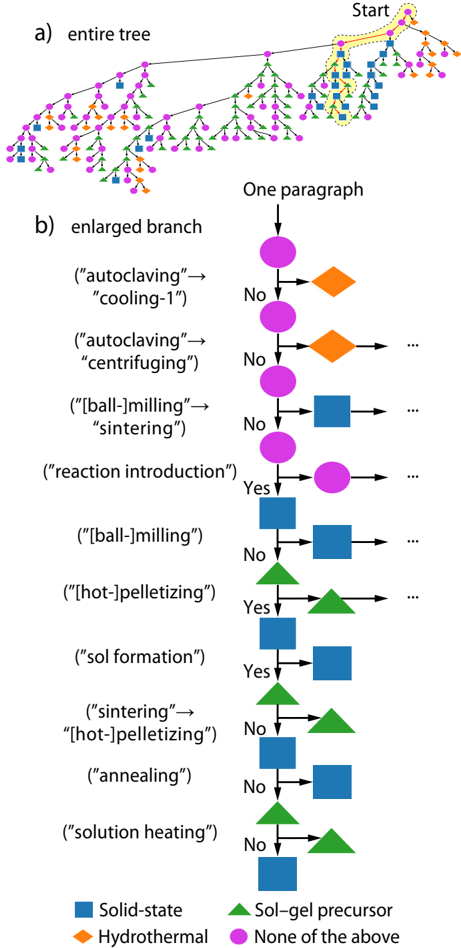
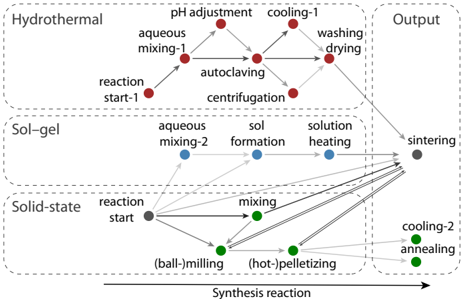
Digitizing large collections of scientific literature can enable new informatics approaches for scientific analysis and meta-analysis. However, most content in the scientific literature is locked-up in written natural language, which is difficult to parse into databases using explicitly hard-coded classification rules. In this work, we demonstrate a semi-supervised machine-learning method to classify inorganic materials synthesis procedures from written natural language. Without any human input, latent Dirichlet allocation can cluster keywords into topics corresponding to specific experimental materials synthesis steps, such as “grinding” and “heating”, “dissolving” and “centrifuging”, etc. Guided by a modest amount of annotation, a random forest classifier can then associate these steps with different categories of materials synthesis, such as solid-state or hydrothermal synthesis. Finally, we show that a Markov chain representation of the order of experimental steps accurately reconstructs a flowchart of possible synthesis procedures. Our machine-learning approach enables a scalable approach to unlock the large amount of inorganic materials synthesis information from the literature and to process it into a standardized, machine-readable database.
Overview
The claims and statistics of this paper haven’t been checked yet.
Free: it reads the open-access text and checks the first 5 claims that cite a source we can check. Create a free account to check every claim.
Integrity signals
Registry
Cites
Statistics
Figures


Verification
Claims the paper makes
The claims and statistics of this paper haven’t been checked yet.
Free: it reads the open-access text and checks the first 5 claims that cite a source we can check. Create a free account to check every claim.
Claims other papers make about this one
Each is checked against this paper’s own text: does it say what the citing paper says it does?
The cited source says what the claim attributes to it.
In the citing paper
“Another exciting outcome from NLP is to extract the process-structure-property-performance relationships by mining text corpora, which has enabled one to discover new materials 145 and identify materials synthesis procedures 146 , although there have been limited applications of this approach in concrete science.”
From Machine learning in concrete science: applications, challenges, and best practices (2022) · cites this paper as [146]
Self-check
Percentages, sums and reported differences re-computed from the paper’s own numbers.
The self-check needs the paper’s full text.
Citations
Cites
Breiman, L. (2001) · Machine Learning · doi:10.1023/a:1010933404324 · Cited by 133,538
Scikit-learn: Machine Learning in Python
Pedregosa, F., Varoquaux, G., Gramfort, A., Michel, V., Thirion, B., Grisel, O., Blondel, M., Müller, A., Nothman, J., Louppe, G., et al. (2012) · arXiv · doi:10.48550/arxiv.1201.0490 · Cited by 71,016
(2003) · Journal of Machine Learning Research · doi:10.5555/944919.944937 · Cited by 32,337
GAN(Generative Adversarial Nets)
(2017) · Journal of Japan Society for Fuzzy Theory and Intelligent Informatics · doi:10.3156/jsoft.29.5_177_2 · Cited by 19,270
Commentary: The Materials Project: A materials genome approach to accelerating materials innovation
Jain, A., Ong, S. P., Hautier, G., Chen, W., Richards, W. D., Dacek, S., Cholia, S., Gunter, D., Skinner, D., Ceder, G., et al. (2013) · APL Materials · doi:10.1063/1.4812323 · Cited by 13,094 · cited 1×
“Over the last 30 years, advances in computational materials science have led to tremendous successes in materials design, with dozens of computationally designed novel compounds,(1,2) and on-demand availability of ab initio predicted properties.(3) However, the materials discovery pipeline remains bottlenecked by the…”
BackgroundSelf-citationFoundations of statistical natural language processing
Manning, C. D., & Schütze, H. (1999) · Cited by 9,816
Thumbs up?: sentiment classification using machine learning techniques
Pang, B., Lee, L., & Vaithyanathan, S. (2002) · Proceedings of the ACL-02 conference on Empirical methods in natural language processing - EMNLP '02 · doi:10.3115/1118693.1118704 · Cited by 7,024
Learning Word Vectors for Sentiment Analysis
Maas, A. L., Daly, R. E., Pham, P. T., Huang, D., Ng, A. Y., & Potts, C. (2011) · Cited by 6,961
Blei, D. M. (2012) · Communications of the ACM · doi:10.1145/2133806.2133826 · Cited by 5,516
Speech and language processing
(2010) · Day-to-Day Dyslexia in the Classroom · doi:10.4324/9780203461891_chapter_3 · Cited by 3,544
Research works printed but not linked: 2
- Goodfellow, I. et al. Generative adversarial nets. In Advances in neural information processing systems. 2672–2680.
- Xie, P. & Xing, E. P. Integrating document clustering and topic modeling. arXiv preprint arXiv:1309.6874 (2013). · arXiv
Cited by
Big-Data Science in Porous Materials: Materials Genomics and Machine Learning
Jablonka, K. M., Ongari, D., Moosavi, S. M., & Smit, B. (2020) · Chemical Reviews · doi:10.1021/acs.chemrev.0c00004 · Cited by 599
Machine Learning for Electrocatalyst and Photocatalyst Design and Discovery
Mai, H., Le, T. C., Chen, D., Winkler, D. A., & Caruso, R. A. (2022) · Chemical Reviews · doi:10.1021/acs.chemrev.2c00061 · Cited by 552
Machine learning for a sustainable energy future
Yao, Z., Lum, Y., Johnston, A., Mejia-Mendoza, L. M., Zhou, X., Wen, Y., Aspuru-Guzik, A., Sargent, E. H., & Seh, Z. W. (2022) · Nature Reviews Materials · doi:10.1038/s41578-022-00490-5 · Cited by 517
Machine learning in concrete science: applications, challenges, and best practices
Li, Z., Yoon, J., Zhang, R., Rajabipour, F., Srubar III, W. V., Dabo, I., & Radlińska, A. (2022) · npj Computational Materials · doi:10.1038/s41524-022-00810-x · Cited by 388
Nandy, A., Duan, C., Taylor, M. G., Liu, F., Steeves, A. H., & Kulik, H. J. (2021) · Chemical Reviews · doi:10.1021/acs.chemrev.1c00347 · Cited by 358
Metadata
- Authors
- Huo, H., Rong, Z., Kononova, O., Sun, W., Botari, T., He, T., Tshitoyan, V., & Ceder, G.
- Affiliations
- Lawrence Berkeley National Laboratory (US)
- University of California, Berkeley (US)
- Corresponding author
- Ceder, Gerbrand
- Venue
- npj Computational Materials
- Published
- 2019-07-08
- Volume
- 5
- Issue
- 1
- ISSN
- 2057-3960 (ISSN-L)
- OpenAlex
- W2961421843
- Cited by
- 151
- References
- 46
- Citations by year
- 2026: 13 · 2025: 21 · 2024: 25 · 2023: 26 · 2022: 30 · 2021: 22 · 2020: 13 · 2019: 1
- FWCI
- 5.96
- Type
- journal article
- Language
- en
- Open access
- gold
- doi.org
- Licence
- cc-by
- creativecommons.org/licenses/by/4.0 (tdm)
- creativecommons.org/licenses/by/4.0 (vor)
- Locations
- npj Computational Materials (publishedVersion, cc-by)
- OSTI OAI (U.S. Department of Energy Office of Scientific and Technical Information) (submittedVersion)
- DOAJ (DOAJ: Directory of Open Access Journals) (submittedVersion)
- eScholarship (California Digital Library) (submittedVersion)
- Funders
- National Science Foundation (5710003959)
- United States Department of Defense | United States Navy | Office of Naval Research (N00014-14-1-0444)
- Topics
- Physical Sciences › Materials Science › Materials Chemistry › Machine Learning in Materials Science
- Social Sciences › General Social Sciences › Computational and Text Analysis Methods
- Physical Sciences › Computer Science › Artificial Intelligence › Text and Document Classification Technologies
- Keywords
- inorganic synthesis, semi-supervised learning, latent Dirichlet allocation, topic modeling, random forest, Markov chains
About these checks
Registry, retraction, Cites and statistics results are computed, not judged, with one exception: a printed reference that no index lists is read once by a model before it counts as a citation error. Claims are extracted by a model and kept only when their quote appears verbatim in the text; each cited source is then checked, with a model’s help, for whether it says what the claim relies on. Those verdicts can be wrong — read the claim’s quote and the cited source before relying on one.
Statistics and arithmetic are recomputed, not judged.
Confidence bands are shown only for fields calibrated on our annotated test set. None is calibrated yet, so no band is shown.
What counts as a claim ›How we measure confidence ›How we check this ›
Are you an author, or do you see a problem with this page? Request a review
How to cite
Cite CoChat for the checks on this page, and the paper for its own findings.
- This page
- CoChat. (2026). Citation check: Semi-supervised machine-learning classification of materials synthesis procedures. https://app.cochat.ai/papers/10.1038/s41524-019-0204-1
- The paper
- Huo, H., Rong, Z., Kononova, O., Sun, W., Botari, T., He, T., Tshitoyan, V., & Ceder, G. (2019). Semi-supervised machine-learning classification of materials synthesis procedures. npj Computational Materials. https://doi.org/10.1038/s41524-019-0204-1
Data sources
Bibliographic data: Semantic Scholar, OpenAlex, Crossref.
Contains information from the Semantic Scholar Academic Graph Datasets, made available under the ODC Attribution License (ODC-BY 1.0).
Semantic Scholar’s data is described in: Kinney, R., et al. (2023). The Semantic Scholar Open Data Platform. arXiv:2301.10140.
