

Semi-supervised machine-learning classification of materials synthesis procedures
Open accessThe DOI matches its Crossref record; 47 of the 47 references it cites were found in a registry or an index.
Abstract
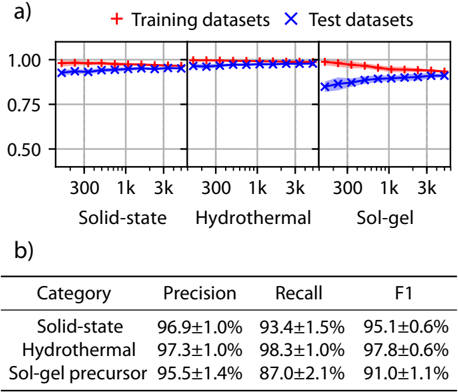
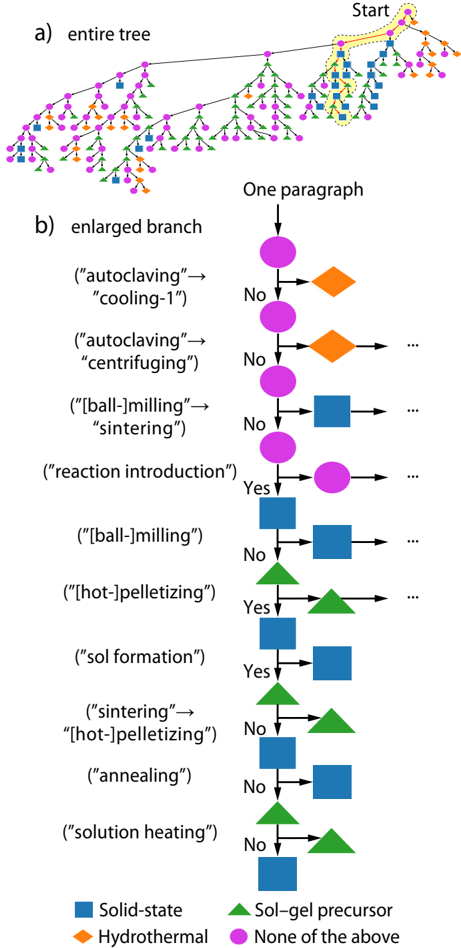
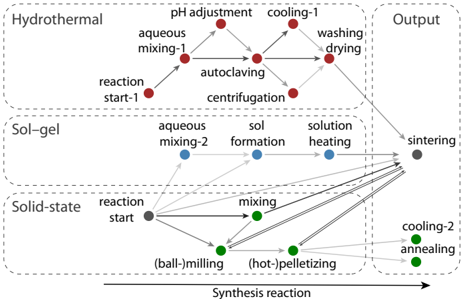
Digitizing large collections of scientific literature can enable new informatics approaches for scientific analysis and meta-analysis. However, most content in the scientific literature is locked-up in written natural language, which is difficult to parse into databases using explicitly hard-coded classification rules. In this work, we demonstrate a semi-supervised machine-learning method to classify inorganic materials synthesis procedures from written natural language. Without any human input, latent Dirichlet allocation can cluster keywords into topics corresponding to specific experimental materials synthesis steps, such as “grinding” and “heating”, “dissolving” and “centrifuging”, etc. Guided by a modest amount of annotation, a random forest classifier can then associate these steps with different categories of materials synthesis, such as solid-state or hydrothermal synthesis. Finally, we show that a Markov chain representation of the order of experimental steps accurately reconstructs a flowchart of possible synthesis procedures. Our machine-learning approach enables a scalable approach to unlock the large amount of inorganic materials synthesis information from the literature and to process it into a standardized, machine-readable database.
Overview
The claims and statistics of this paper haven’t been checked yet.
Free: it reads the open-access text and checks the first 5 claims that cite a source we can check. Create a free account to check every claim.
Integrity signals
Registry
Cites
Statistics
Figures

Verification
Claims the paper makes
The claims and statistics of this paper haven’t been checked yet.
Free: it reads the open-access text and checks the first 5 claims that cite a source we can check. Create a free account to check every claim.
Claims other papers make about this one
Each is checked against this paper’s own text: does it say what the citing paper says it does?
The cited source says what the claim attributes to it.
In the citing paper
“Another exciting outcome from NLP is to extract the process-structure-property-performance relationships by mining text corpora, which has enabled one to discover new materials 145 and identify materials synthesis procedures 146 , although there have been limited applications of this approach in concrete science.”
From Machine learning in concrete science: applications, challenges, and best practices (2022) · cites this paper as [146]
Self-check
Percentages, sums and reported differences re-computed from the paper’s own numbers.
The self-check needs the paper’s full text.
Citations
Cites
Breiman, L. (2001) · Machine Learning · doi:10.1023/a:1010933404324 · Cited by 133,538
Scikit-learn: Machine Learning in Python
Pedregosa, F., Varoquaux, G., Gramfort, A., Michel, V., Thirion, B., Grisel, O., Blondel, M., Müller, A., Nothman, J., Louppe, G., et al. (2012) · arXiv · doi:10.48550/arxiv.1201.0490 · Cited by 71,016
(2003) · Journal of Machine Learning Research · doi:10.5555/944919.944937 · Cited by 32,337
GAN(Generative Adversarial Nets)
(2017) · Journal of Japan Society for Fuzzy Theory and Intelligent Informatics · doi:10.3156/jsoft.29.5_177_2 · Cited by 19,270
Commentary: The Materials Project: A materials genome approach to accelerating materials innovation
Jain, A., Ong, S. P., Hautier, G., Chen, W., Richards, W. D., Dacek, S., Cholia, S., Gunter, D., Skinner, D., Ceder, G., et al. (2013) · APL Materials · doi:10.1063/1.4812323 · Cited by 13,094 · cited 1×
“Over the last 30 years, advances in computational materials science have led to tremendous successes in materials design, with dozens of computationally designed novel compounds,(1,2) and on-demand availability of ab initio predicted properties.(3) However, the materials discovery pipeline remains bottlenecked by the…”
BackgroundSelf-citationFoundations of statistical natural language processing
Manning, C. D., & Schütze, H. (1999) · Cited by 9,816
Thumbs up?: sentiment classification using machine learning techniques
Pang, B., Lee, L., & Vaithyanathan, S. (2002) · Proceedings of the ACL-02 conference on Empirical methods in natural language processing - EMNLP '02 · doi:10.3115/1118693.1118704 · Cited by 7,024
Learning Word Vectors for Sentiment Analysis
Maas, A. L., Daly, R. E., Pham, P. T., Huang, D., Ng, A. Y., & Potts, C. (2011) · Cited by 6,960
Blei, D. M. (2012) · Communications of the ACM · doi:10.1145/2133806.2133826 · Cited by 5,516
Speech and language processing
(2010) · Day-to-Day Dyslexia in the Classroom · doi:10.4324/9780203461891_chapter_3 · Cited by 3,544
Research works printed but not linked: 2
- Goodfellow, I. et al. Generative adversarial nets. In Advances in neural information processing systems. 2672-2680.
- Xie, P. & Xing, E. P. Integrating document clustering and topic modeling. arXiv preprint arXiv:1309.6874 (2013). · arXiv
Cited by
Big-Data Science in Porous Materials: Materials Genomics and Machine Learning
Jablonka, K. M., Ongari, D., Moosavi, S. M., & Smit, B. (2020) · Chemical Reviews · doi:10.1021/acs.chemrev.0c00004 · Cited by 599
Machine Learning for Electrocatalyst and Photocatalyst Design and Discovery
Mai, H., Le, T. C., Chen, D., Winkler, D. A., & Caruso, R. A. (2022) · Chemical Reviews · doi:10.1021/acs.chemrev.2c00061 · Cited by 552
Machine learning for a sustainable energy future
Yao, Z., Lum, Y., Johnston, A., Mejia-Mendoza, L. M., Zhou, X., Wen, Y., Aspuru-Guzik, A., Sargent, E. H., & Seh, Z. W. (2022) · Nature Reviews Materials · doi:10.1038/s41578-022-00490-5 · Cited by 517
Machine learning in concrete science: applications, challenges, and best practices
Li, Z., Yoon, J., Zhang, R., Rajabipour, F., Srubar III, W. V., Dabo, I., & Radlińska, A. (2022) · npj Computational Materials · doi:10.1038/s41524-022-00810-x · Cited by 388
Nandy, A., Duan, C., Taylor, M. G., Liu, F., Steeves, A. H., & Kulik, H. J. (2021) · Chemical Reviews · doi:10.1021/acs.chemrev.1c00347 · Cited by 358
Accelerated data-driven materials science with the Materials Project
Horton, M. K., Huck, P., Yang, R. X., Munro, J. M., Dwaraknath, S., Ganose, A. M., Kingsbury, R. S., Wen, M., Shen, J. X., Mathis, T. S., et al. (2025) · Nature Materials · doi:10.1038/s41563-025-02272-0 · Cited by 300
“In addition, it hosts databases of molecules 9–11 , synthesis recipes extracted from the literature 12–14 , the properties of battery materials 15–18 and metal–organic frameworks 19 , and catalysis datasets 20 that are developed in collaboration with the MP or that have been developed externally.”
Self-citationData-driven materials research enabled by natural language processing and information extraction
Olivetti, E. A., Cole, J. M., Kim, E., Kononova, O., Ceder, G., Han, T. Y.-J., & Hiszpanski, A. M. (2020) · Applied Physics Reviews · doi:10.1063/5.0021106 · Cited by 302
“56 LDA provided a probabilistic topic distribution for each sentence.”
BackgroundSelf-citationText-mined dataset of inorganic materials synthesis recipes
Kononova, O., Huo, H., He, T., Rong, Z., Botari, T., Sun, W., Tshitoyan, V., & Ceder, G. (2019) · Scientific Data · doi:10.1038/s41597-019-0224-1 · Cited by 259
Self-citationMachine learning approaches for the prediction of materials properties
Chibani, S., & Coudert, F.-X. (2020) · APL Materials · doi:10.1063/5.0018384 · Cited by 255
Computational chemistry for water-splitting electrocatalysis
Miao, L., Jia, W., Cao, X., & Jiao, L. (2024) · Chemical Society Reviews · doi:10.1039/d2cs01068b · Cited by 241
Amici, J., Asinari, P., Ayerbe, E., Barboux, P., Bayle‐Guillemaud, P., Behm, R. J., Berecibar, M., Berg, E., Bhowmik, A., Bodoardo, S., et al. (2022) · Advanced Energy Materials · doi:10.1002/aenm.202102785 · Cited by 235
Automated extraction of chemical synthesis actions from experimental procedures
Vaucher, A. C., Zipoli, F., Geluykens, J., Nair, V. H., Schwaller, P., & Laino, T. (2020) · Nature Communications · doi:10.1038/s41467-020-17266-6 · Cited by 202
Opportunities and challenges of text mining in materials research
Kononova, O., He, T., Huo, H., Trewartha, A., Olivetti, E. A., & Ceder, G. (2021) · iScience · doi:10.1016/j.isci.2021.102155 · Cited by 182
“, 2017c) and to classify these papers based by synthesis method used in the paper (Huo et al., 2019).”
MethodSelf-citationArtificial Intelligence for Materials Discovery, Development, and Optimization
Madika, B., Saha, A., Kang, C., Buyantogtokh, B., Agar, J., Wolverton, C. M., Voorhees, P., Littlewood, P., Kalinin, S., & Hong, S. (2025) · ACS Nano · doi:10.1021/acsnano.5c04200 · Cited by 171
Chaikittisilp, W., Yamauchi, Y., & Ariga, K. (2022) · Advanced Materials · doi:10.1002/adma.202107212 · Cited by 163
Trewartha, A., Walker, N., Huo, H., Lee, S., Cruse, K., Dagdelen, J., Dunn, A., Persson, K. A., Ceder, G., & Jain, A. (2022) · Patterns · doi:10.1016/j.patter.2022.100488 · Cited by 163
Self-citationToward autonomous design and synthesis of novel inorganic materials
Szymanski, N. J., Zeng, Y., Huo, H., Bartel, C. J., Kim, H., & Ceder, G. (2021) · Materials Horizons · doi:10.1039/d1mh00495f · Cited by 159
Self-citationArtificial Intelligence to Power the Future of Materials Science and Engineering
Sha, W., Guo, Y., Yuan, Q. M., Tang, S., Zhang, X., Lu, S., Guo, X., Cao, Y., & Cheng, S. (2020) · Advanced Intelligent Systems · doi:10.1002/aisy.201900143 · Cited by 171
Applications of natural language processing and large language models in materials discovery
Jiang, X., Wang, W., Tian, S., Wang, H., Lookman, T., & Su, Y. (2025) · npj Computational Materials · doi:10.1038/s41524-025-01554-0 · Cited by 145
“For a limited annotated corpus, semi-supervised ML strategies 32,37,81,84 and rules-based methods 26,35,36 work better.”
Inorganic Materials Synthesis Planning with Literature-Trained Neural Networks
Kim, E., Jensen, Z., van Grootel, A., Huang, K., Staib, M., Mysore, S., Chang, H.-S., Strubell, E., McCallum, A., Jegelka, S., et al. (2020) · Journal of Chemical Information and Modeling · doi:10.1021/acs.jcim.9b00995 · Cited by 142
How machine learning can accelerate electrocatalysis discovery and optimization
Steinmann, S. N., Wang, Q., & Seh, Z. W. (2023) · Materials Horizons · doi:10.1039/d2mh01279k · Cited by 142
Toward autonomous laboratories: Convergence of artificial intelligence and experimental automation
Xie, Y., Sattari, K., Zhang, C., & Lin, J. (2022) · Progress in Materials Science · doi:10.1016/j.pmatsci.2022.101043 · Cited by 145
Explainable Machine Learning Algorithms For Predicting Glass Transition Temperatures
Alcobaça, E., Mastelini, S. M., Botari, T., Pimentel, B. A., Cassar, D. R., de Carvalho, A. C. P. L. F., & Zanotto, E. D. (2020) · Acta Materialia · doi:10.1016/j.actamat.2020.01.047 · Cited by 121
“In this scenario, Machine Learning (ML) has demonstrated a considerable capability to address complex problems in materials sciences by leveraging existing available knowledge [3,4].”
BackgroundSelf-citationMachine learning assisted synthesis of lithium-ion batteries cathode materials
Liow, C. H., Kang, H., Kim, S.-G., Na, M., Lee, Y., Baucour, A., Bang, K., Shim, Y., Choe, J., Hwang, G., et al. (2022) · Nano Energy · doi:10.1016/j.nanoen.2022.107214 · Cited by 106
Developing machine learning for heterogeneous catalysis with experimental and computational data
Bozal‐Ginesta, C., Pablo‐García, S., Choi, C., Tarancón, A., & Aspuru‐Guzik, A. (2025) · Nature Reviews Chemistry · doi:10.1038/s41570-025-00740-4 · Cited by 157
Leveraging machine learning in porous media
Delpisheh, M., Ebrahimpour, B., Fattahi, A., Siavashi, M., Mir, H., Mashhadimoslem, H., Abdol, M. A., Ghorbani, M., Shokri, J., Niblett, D., et al. (2024) · Journal of Materials Chemistry A · doi:10.1039/d4ta00251b · Cited by 108
Wang, Z., Kononova, O., Cruse, K., He, T., Huo, H., Fei, Y., Zeng, Y., Sun, Y., Cai, Z., Sun, W., et al. (2022) · Scientific Data · doi:10.1038/s41597-022-01317-2 · Cited by 83
“The resulting F1 score of the paragraph classification is 99.5%, an improvement over the F1 score of 94.6% in our previous work 57 , when evaluated using the same labeled training dataset.”
BackgroundInfluentialSelf-citationSimilarity of Precursors in Solid-State Synthesis as Text-Mined from Scientific Literature
He, T., Sun, W., Huo, H., Kononova, O., Rong, Z., Tshitoyan, V., Botari, T., & Ceder, G. (2020) · Chemistry of Materials · doi:10.1021/acs.chemmater.0c02553 · Cited by 85
Self-citationMachine learning and symbolic regression investigation on stability of MXene materials
He, M., & Zhang, L. (2021) · Computational Materials Science · doi:10.1016/j.commatsci.2021.110578 · Cited by 90
Yang, R., McCandler, C. A., Andriuc, O., Siron, M., Woods‐Robinson, R., Horton, M. K., & Persson, K. A. (2022) · ACS Nano · doi:10.1021/acsnano.2c08411 · Cited by 97
Accelerating materials language processing with large language models
Choi, J., & Lee, B. (2024) · Communications Materials · doi:10.1038/s43246-024-00449-9 · Cited by 118
MatGPT: A Vane of Materials Informatics from Past, Present, to Future
Wang, Z., Chen, A., Tao, K., Han, Y., & Li, J. (2023) · Advanced Materials · doi:10.1002/adma.202306733 · Cited by 94
Can we predict materials that can be synthesised?
Szczypiński, F., Bennett, S., & Jelfs, K. E. (2021) · Chemical Science · doi:10.1039/d0sc04321d · Cited by 85
Machine Learning for the Discovery, Design, and Engineering of Materials.
Duan, C., Nandy, A., & Kulik, H. J. (2022) · Annual Review of Chemical and Biomolecular Engineering · doi:10.1146/annurev-chembioeng-092320-120230 · Cited by 69
Catalyze Materials Science with Machine Learning
Kim, J., Kang, D., Kim, S., & Jang, H. W. (2021) · ACS Materials Letters · doi:10.1021/acsmaterialslett.1c00204 · Cited by 72
de Paula, A. J., Ferreira, O. P., Filho, A. G. S., Filho, F. N., Andrade, C. E., & de Faria, A. F. (2022) · Chemistry of Materials · doi:10.1021/acs.chemmater.1c02961 · Cited by 67
Machine Learning Classifiers for Surface Crack Detection in Fracture Experiments
Müller, A., Karathanasopoulos, N., Roth, C. C., & Mohr, D. (2021) · International Journal of Mechanical Sciences · doi:10.1016/j.ijmecsci.2021.106698 · Cited by 66
Pellegrino, F., Isopescu, R., Pellutiè, L., Sordello, F., Rossi, A. M., Ortel, E., Martra, G., Hodoroaba, V., & Maurino, V. (2020) · Scientific Reports · doi:10.1038/s41598-020-75967-w · Cited by 72
Rahimi, M., Mashhadimoslem, H., Thanh, H. V., Ranjbar, B., Khosrowshahi, M. S., Rohani, A., & Elkamel, A. (2023) · Energy · doi:10.1016/j.energy.2023.128546 · Cited by 62
Ravinder, Venugopal, V., Bishnoi, S., Singh, S., Zaki, M., Grover, H. S., Bauchy, M., Agarwal, M., & Krishnan, N. M. A. (2021) · International Journal of Applied Glass Science · doi:10.1111/ijag.15881 · Cited by 56
Text-mined dataset of gold nanoparticle synthesis procedures, morphologies, and size entities
Cruse, K., Trewartha, A., Lee, S., Wang, Z., Huo, H., He, T., Kononova, O., Jain, A., & Ceder, G. (2022) · Scientific Data · doi:10.1038/s41597-022-01321-6 · Cited by 56
Self-citationImage-based machine learning for materials science
Zhang, L., & Shao, S. (2022) · Journal of Applied Physics · doi:10.1063/5.0087381 · Cited by 59
Accurate machine learning in materials science facilitated by using diverse data sources
Batra, R. (2021) · Nature · doi:10.1038/d41586-020-03259-4 · Cited by 53
New challenges in oxygen reduction catalysis: a consortium retrospective to inform future research
Stevens, M. B., Anand, M., Kreider, M. E., Price, E. K., Zeledon, J. A. Z., Wang, L., Peng, J., Li, H., Gregoire, J. M., Hummelshøj, J. S., et al. (2022) · Energy & Environmental Science · doi:10.1039/d2ee01333a · Cited by 57
Machine Learning-Based Computational Design Methods for High-Entropy Alloys
Zhao, Y. M., Zhang, J. Y., Liaw, P. K., & Yang, T. (2025) · High Entropy Alloys & Materials · doi:10.1007/s44210-025-00055-5 · Cited by 74
Mai, H., Le, T. C., Chen, D., Winkler, D. A., & Caruso, R. A. (2022) · Advanced Science · doi:10.1002/advs.202203899 · Cited by 51
Edström, K., Dominko, R., Fichtner, M., & Perraud, S. (2020) · doi:10.33063/diva2-1452023 · Cited by 46
Designing bioinspired brick-and-mortar composites using machine learning and statistical learning
Morsali, S. R., Qian, D., & Minary‐Jolandan, M. (2020) · Communications Materials · doi:10.1038/s43246-020-0012-7 · Cited by 45
Predicting synthesizability of crystalline materials via deep learning
Davariashtiyani, A., Kadkhodaie, Z., & Kadkhodaei, S. (2021) · Communications Materials · doi:10.1038/s43246-021-00219-x · Cited by 47
“The synthesizable crystal samples in our data set span across 156 distinct space groups (see Supplementary Note 2 and Supplementary Fig.”
BackgroundInfluentialAdvances in materials informatics: a review
Sivan, D., Kumar, K. S., Abdullah, A., Raj, V., Misnon, I. I., Ramakrishna, S., & Jose, R. (2024) · Journal of Materials Science · doi:10.1007/s10853-024-09379-w · Cited by 58
Inverse Design of Nanoparticles Using Multi‐Target Machine Learning
Li, S., & Barnard, A. S. (2021) · Advanced Theory and Simulations · doi:10.1002/adts.202100414 · Cited by 45
Karpovich, C. J., Pan, E., Jensen, Z., & Olivetti, E. (2023) · Chemistry of Materials · doi:10.1021/acs.chemmater.2c03010 · Cited by 56
Distributed representations of atoms and materials for machine learning
Antunes, L. M., Grau‐Crespo, R., & Butler, K. T. (2022) · npj Computational Materials · doi:10.1038/s41524-022-00729-3 · Cited by 55
Accurate, interpretable predictions of materials properties within transformer language models
Korolev, V., & Protsenko, P. V. (2023) · Patterns · doi:10.1016/j.patter.2023.100803 · Cited by 49
“The corresponding AI field, natural language processing[82], has already found successful applications in materials science such as named entity recognition[83, 84, 85] and paragraph classification[84, 86, 87].”
BackgroundMachine learning–assisted colloidal synthesis: A review
Gulevich, D., Nabiev, I. R., & Samokhvalov, P. S. (2023) · Materials Today Chemistry · doi:10.1016/j.mtchem.2023.101837 · Cited by 48
Zhang, S., He, X., Xia, X., Xiao, P., Wu, Q., Zheng, F., & Lu, Q. (2023) · ACS Applied Materials & Interfaces · doi:10.1021/acsami.3c05376 · Cited by 39
Advanced machine learning decision policies for diameter control of carbon nanotubes
Rao, R. S., Carpena‐Núñez, J., Nikolaev, P. N., Susner, M. A., Reyes, K. G., & Maruyama, B. (2021) · npj Computational Materials · doi:10.1038/s41524-021-00629-y · Cited by 42
A database of molecular properties integrated in the Materials Project
Spotte‐Smith, E. W. C., Cohen, O., Blau, S. M., Munro, J. M., Yang, R., Guha, R. D., Patel, H. D., Vijay, S., Huck, P., Kingsbury, R., et al. (2023) · Digital Discovery · doi:10.1039/d3dd00153a · Cited by 40
Peivaste, I., Belouettar, S., Mercuri, F., Fantuzzi, N., Dehghani, H., Izadi, R., Ibrahim, H., Lengiewicz, J., Belouettar-Mathis, M., Bendine, K., et al. (2025) · Composite Structures · doi:10.1016/j.compstruct.2025.119419 · Cited by 54
Classification of Arabic Tweets: A Review
Alruily, M. (2021) · Electronics · doi:10.3390/electronics10101143 · Cited by 41
The Impact of Domain-Specific Pre-Training on Named Entity Recognition Tasks in Materials SciencePreprint
Walker, N., Trewartha, A., Huo, H., Lee, S.-H., Cruse, K., Dagdelen, J. M., Dunn, A., Persson, K. A., Ceder, G., & Jain, A. (2021) · SSRN Electronic Journal · doi:10.2139/ssrn.3950755 · Cited by 50
Self-citationExploring Optimal Reaction Conditions Guided by Graph Neural Networks and Bayesian Optimization
Kwon, Y., Lee, D., Kim, J. W., Choi, Y.-S., & Kim, S. (2022) · ACS Omega · doi:10.1021/acsomega.2c05165 · Cited by 40
Machine learning in energy chemistry: introduction, challenges and perspectives
Xu, Y., Ge, J., & Ju, C. (2023) · Energy Advances · doi:10.1039/d3ya00057e · Cited by 36
Liu, Y., Ding, L., Yang, Z., Ge, X., Liu, D., Liu, W., Yu, T., Avdeev, M., & Shi, S. (2023) · Science China Technological Sciences · doi:10.1007/s11431-022-2283-7 · Cited by 33
“Based on 800 abstracts jointly labeled by two materials experts, Ceder et al. [13–16] successfully employed Bi-LSTM (bidirectional long short-term memory) and CRF (conditional random field) model to find thermo-electric predictions and inorganic materials entities from 1.5 million abstracts of…”
MethodInfluentialAlloy synthesis and processing by semi-supervised text mining
Wang, W., Jiang, X. F., Tian, S., Liu, P., Lookman, T., Su, Y., & Xie, J. (2023) · npj Computational Materials · doi:10.1038/s41524-023-01138-w · Cited by 38
ULSA: unified language of synthesis actions for the representation of inorganic synthesis protocols
Wang, Z., Cruse, K., Fei, Y., Chia, A., Zeng, Y., Huo, H., He, T., Deng, B., Kononova, O., & Ceder, G. (2022) · Digital Discovery · doi:10.1039/d1dd00034a · Cited by 43
Self-citationDesigning materials acceleration platforms for heterogeneous CO2 photo(thermal)catalysis
Wang, A., Bozal‐Ginesta, C., Kumar, S. G. H., Aspuru‐Guzik, A., & Ozin, G. A. (2023) · Matter · doi:10.1016/j.matt.2023.03.015 · Cited by 29
Single and Combined Neuroimaging Techniques for Alzheimer’s Disease Detection
Amini, M., Pedram, M. M., Moradi, A., Jamshidi, M., & Ouchani, M. (2021) · Computational Intelligence and Neuroscience · doi:10.1155/2021/9523039 · Cited by 33
Harnessing GPT-3.5 for text parsing in solid-state synthesis – case study of ternary chalcogenides
Thway, M., Low, A. K. Y., Khetan, S., Dai, H., Recatala‐Gomez, J., Chen, A. P., & Hippalgaonkar, K. (2024) · Digital Discovery · doi:10.1039/d3dd00202k · Cited by 37
Quantitative Topic Analysis of Materials Science Literature Using Natural Language Processing
Choi, J., & Lee, B. (2023) · ACS Applied Materials & Interfaces · doi:10.1021/acsami.3c12301 · Cited by 26
Topic modeling and its applications in materials science and engineering
Rani, S., & Kumar, M. (2021) · Materials Today Proceedings · doi:10.1016/j.matpr.2021.02.313 · Cited by 30
Large language model enhanced corpus of CO2 reduction electrocatalysts and synthesis procedures
Chen, X., Gao, Y., Wang, L., Cui, W., Huang, J., Du, Y., & Wang, B. (2024) · Scientific Data · doi:10.1038/s41597-024-03180-9 · Cited by 37
“After training the BERT model, we used a paragraph classification method based on semi-supervised learning 23 .”
MethodGleaves, D., Fu, N., Siriwardane, E. M. D., Zhao, Y., & Hu, J. (2023) · Digital Discovery · doi:10.1039/d2dd00098a · Cited by 27
Synthesizability of materials stoichiometry using semi-supervised learning
Jang, J., Noh, J., Zhou, L., Gu, G. H., Gregoire, J. M., & Jung, Y. (2024) · Matter · doi:10.1016/j.matt.2024.05.002 · Cited by 35
Challenges in Information-Mining the Materials Literature: A Case Study and Perspective
Smith, A. K., Bhat, V., Ai, Q., & Risko, C. M. (2022) · Chemistry of Materials · doi:10.1021/acs.chemmater.2c00445 · Cited by 26
Ali, S., Wang, X., Tayyab, Z., Shah, M. A. K. Y., Hussain, I., Alibrahim, K. A., Tayyab, M., & Rauf, S. (2024) · Materials Science and Engineering B · doi:10.1016/j.mseb.2024.117925 · Cited by 24
Lin, W., Jin, L., Jiang, Z., Cai, M., Lai, Z., Yurchenko, D., Yan, B., Zhou, S., Novoselov, K. S., Liao, W., et al. (2026) · Advanced Functional Materials · doi:10.1002/adfm.75070 · Cited by 48
Artificial intelligence for materials research at extremes
Maruyama, B., Hattrick-Simpers, J. R., Musinski, W. D., Graham-Brady, L. L., Li, K., Hollenbach, J. D., Singh, A., & Taheri, M. L. (2022) · MRS Bulletin · doi:10.1557/s43577-022-00466-4 · Cited by 22
Probe microscopy is all you need *
Kalinin, S. V., Vasudevan, R. K., Liu, Y., Ghosh, A., Roccapriore, K. M., & Ziatdinov, M. A. (2023) · Machine Learning Science and Technology · doi:10.1088/2632-2153/acccd5 · Cited by 33
“To date, the vast majority of automated or hybrid labs utilize the human made workflows derived from human experts or via literature mining [197–201].”
BackgroundGriffin, L. A., Gaponenko, I., & Bassiri‐Gharb, N. (2020) · Advanced Materials · doi:10.1002/adma.202002425 · Cited by 20
Deep learning of electrochemical CO 2 conversion literature reveals research trends and directions
Choi, J., Bang, K., Jang, S., Choi, J., Ordoñez, J., Buttler, D. J., Hiszpanski, A. M., Han, T. Y.-J., Sohn, S. S., Lee, B., et al. (2023) · Journal of Materials Chemistry A · doi:10.1039/d3ta02780e · Cited by 20
Jacobs, R. M., Schultz, L. E., Scourtas, A., Schmidt, K. J., Price-Skelly, O., Engler, W., Foster, I. T., Blaiszik, B. J., Voyles, P. M., & Morgan, D. D. (2024) · Machine Learning Science and Technology · doi:10.1088/2632-2153/ad95db · Cited by 39
Sun, W. Q., & David, N. (2025) · Faraday Discussions · doi:10.1039/d4fd00112e · Cited by 31
Self-citationKireeva, N. V., Pervov, V. S., & Tsivadze, A. Y. (2023) · Computational Materials Science · doi:10.1016/j.commatsci.2023.112591 · Cited by 17
Impact of data bias on machine learning for crystal compound synthesizability predictions
Davariashtiyani, A., Wang, B., Hajinazar, S., Zurek, E., & Kadkhodaei, S. (2024) · Machine Learning Science and Technology · doi:10.1088/2632-2153/ad9378 · Cited by 26
Saleem, A., Shaw, L. L., Chen, Z., & Lai, W. (2025) · Advanced Energy Materials · doi:10.1002/aenm.202405300 · Cited by 15
CLASSIFICATION BASED ON SEMI-SUPERVISED LEARNING: A REVIEW
Mehyadin, A. E., & Abdulazeez, A. M. (2021) · Iraqi Journal for Computers and Informatics · doi:10.25195/ijci.v47i1.277 · Cited by 18
“In the field of graph analysis, being non-parametric, including, discriminating, and transfusive are common characteristics. may use the principle of expanding [or are influenced by] either by graph theory, such as the theory of local and global continuity, or other strategies[29].”
BackgroundMethodLiu, X., Koverga, V. A., Nguyen, T. T. H., Ngo, A. T., & Li, T. (2024) · Applied Physics Reviews · doi:10.1063/5.0187154 · Cited by 16
Unsupervised learning and pattern recognition in alloy design
Bhat, N., Birbilis, N., & Barnard, A. S. (2024) · Digital Discovery · doi:10.1039/d4dd00282b · Cited by 19
Showing Flow: Comparing Usability of Chord and Sankey Diagrams
Gutwin, C. A., Mairena, A., & Bandi, V. (2023) · CHI Conference on Human Factors in Computing Systems · doi:10.1145/3544548.3581119 · Cited by 18
“, a workfow for diagnosing hardware errors [23]).”
BackgroundGuha, S., Mullick, A., Agrawal, J., Ram, S., Ghui, S., Lee, S., Bhattacharjee, S., & Goyal, P. (2021) · Computational Materials Science · doi:10.1016/j.commatsci.2021.110325 · Cited by 26
Machine learning-driven alloy digital design for hydrogen storage: a review
Liu, T., Xue, L., Cheng, B. C., Zhao, Y., Dou, B., Paredes, M., & Song, L.-K. (2025) · Digital Twin · doi:10.1080/27525783.2025.2511889 · Cited by 15
Data driven design of compositionally complex energy materials
Wang, L., He, Z., & Ouyang, B. (2023) · Computational Materials Science · doi:10.1016/j.commatsci.2023.112513 · Cited by 15
Text Mining the Literature to Inform Experiments and Rationalize Impurity Phase Formation for BiFeO3
Cruse, K., Baibakova, V., Abdelsamie, M., Hong, K., Bartel, C. J., Trewartha, A., Jain, A., Sutter-Fella, C. M., & Ceder, G. (2024) · Chemistry of Materials · doi:10.1021/acs.chemmater.3c02203 · Cited by 13
Self-citationWan, Z., Chen, Z., Chen, H., Jiang, Y., Zhang, J., Wang, Y., Wang, J., Sun, H., Zhu, Z., Zhu, J., et al. (2024) · Energy & Environmental Science · doi:10.1039/d4ee02970d · Cited by 13
Machine learning in physics: A short guide
Rodrigues, F. A. (2023) · Europhysics Letters (EPL) · doi:10.1209/0295-5075/ad0575 · Cited by 15
“In Physics, SSL has been used, for example, to classify materials synthesis procedures [47] and detect distinct events in a large dataset of in tokamak discharges [48].”
MethodAnalyzing Research Trends in Inorganic Materials Literature Using NLP
Kuniyoshi, F., Ozawa, J., & Miwa, M. (2021) · Lecture notes in computer science · doi:10.1007/978-3-030-86517-7_20 · Cited by 15
Yang, Y. A., Jiang, H., Zhai, H., Chen, J., Jiang, Q., Chen, S., Li, B., & Cao, X. (2022) · Journal of Non-Crystalline Solids · doi:10.1016/j.jnoncrysol.2022.121927 · Cited by 10
Prediction of heavy-section ductile iron fracture toughness based on machine learning
Song, L., Zhang, H., Zhang, J., & Guo, H. Y. (2024) · Scientific Reports · doi:10.1038/s41598-024-55089-3 · Cited by 13
Extracting and Analyzing Inorganic Material Synthesis Procedures in the Literature
Makino, K., Kuniyoshi, F., Ozawa, J., & Miwa, M. (2022) · IEEE Access · doi:10.1109/access.2022.3160201 · Cited by 9
“In this study, although several deep learning methods have been proposed to select paragraphs that mention material synthesis procedure [12], [13], [18], we decided to use all paragraphs to extract procedures because paragraph classification requires additional paragraph-level annotation and model…”
Method
Metadata
- Authors
- Huo, H., Rong, Z., Kononova, O., Sun, W., Botari, T., He, T., Tshitoyan, V., & Ceder, G.
- Affiliations
- Lawrence Berkeley National Laboratory (US)
- University of California, Berkeley (US)
- Corresponding author
- Ceder, Gerbrand
- Venue
- npj Computational Materials
- Published
- 2019-07-08
- Volume
- 5
- Issue
- 1
- ISSN
- 2057-3960 (ISSN-L)
- OpenAlex
- W2961421843
- Semantic Scholar
- 30b133dbfcbef95e5af32d2e8925ce9721c01d50
- Cited by
- 151
- References
- 46
- Citations by year
- 2026: 13 · 2025: 21 · 2024: 25 · 2023: 26 · 2022: 30 · 2021: 22 · 2020: 13 · 2019: 1
- FWCI
- 5.96
- Type
- journal article
- Language
- en
- Open access
- gold
- doi.org
- Licence
- cc-by
- creativecommons.org/licenses/by/4.0 (tdm)
- creativecommons.org/licenses/by/4.0 (vor)
- Locations
- npj Computational Materials (publishedVersion, cc-by)
- OSTI OAI (U.S. Department of Energy Office of Scientific and Technical Information) (submittedVersion)
- DOAJ (DOAJ: Directory of Open Access Journals) (submittedVersion)
- eScholarship (California Digital Library) (submittedVersion)
- Funders
- National Science Foundation (5710003959)
- United States Department of Defense | United States Navy | Office of Naval Research (N00014-14-1-0444)
- Topics
- Physical Sciences › Materials Science › Materials Chemistry › Machine Learning in Materials Science
- Social Sciences › General Social Sciences › Computational and Text Analysis Methods
- Physical Sciences › Computer Science › Artificial Intelligence › Text and Document Classification Technologies
- Keywords
- inorganic synthesis, semi-supervised learning, latent Dirichlet allocation, topic modeling, random forest, Markov chains
About these checks
Registry, retraction, Cites and statistics results are computed, not judged, with one exception: a printed reference that no index lists is read once by a model before it counts as a citation error. Claims are extracted by a model and kept only when their quote appears verbatim in the text; each cited source is then checked, with a model’s help, for whether it says what the claim relies on. Those verdicts can be wrong — read the claim’s quote and the cited source before relying on one.
Statistics and arithmetic are recomputed, not judged.
Confidence bands are shown only for fields calibrated on our annotated test set. None is calibrated yet, so no band is shown.
What counts as a claim ›How we measure confidence ›How we check this ›
Are you an author, or do you see a problem with this page? Request a review
Data sources
Bibliographic data: Semantic Scholar, OpenAlex, Crossref.
Contains information from the Semantic Scholar Academic Graph Datasets, made available under the ODC Attribution License (ODC-BY 1.0).
Semantic Scholar’s data is described in: Kinney, R., et al. (2023). The Semantic Scholar Open Data Platform. arXiv:2301.10140.
