

The DOI matches its Crossref record; 34 of the 34 references it cites were found in a registry or an index.
Rapid whole-genome sequencing decreases infant morbidity and cost of hospitalization
Open accessAbstract
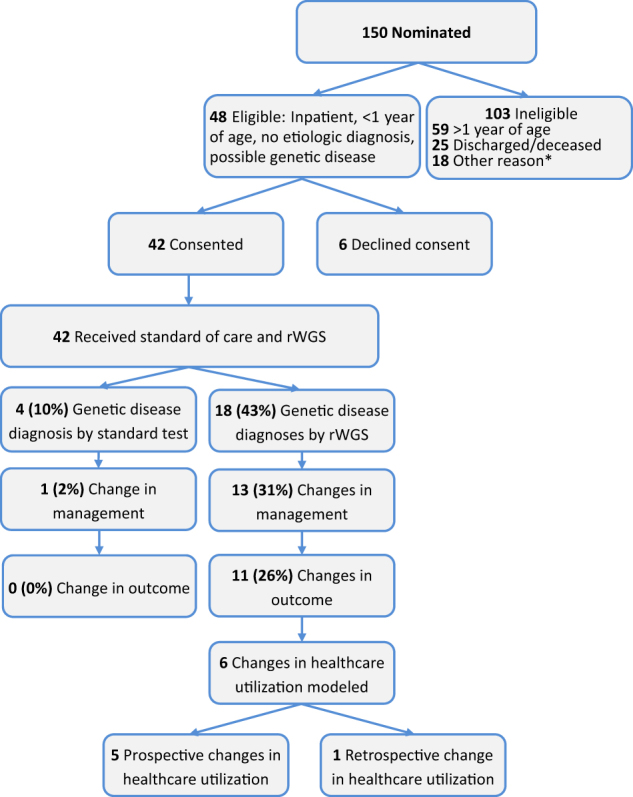
Genetic disorders are a leading cause of morbidity and mortality in infants. Rapid whole-genome sequencing (rWGS) can diagnose genetic disorders in time to change acute medical or surgical management (clinical utility) and improve outcomes in acutely ill infants. We report a retrospective cohort study of acutely ill inpatient infants in a regional children’s hospital from July 2016–March 2017. Forty-two families received rWGS for etiologic diagnosis of genetic disorders. Probands also received standard genetic testing as clinically indicated. Primary end-points were rate of diagnosis, clinical utility, and healthcare utilization. The latter was modelled in six infants by comparing actual utilization with matched historical controls and/or counterfactual utilization had rWGS been performed at different time points. The diagnostic sensitivity of rWGS was 43% (eighteen of 42 infants) and 10% (four of 42 infants) for standard genetic tests ( P = .0005). The rate of clinical utility of rWGS (31%, thirteen of 42 infants) was significantly greater than for standard genetic tests (2%, one of 42; P = .0015). Eleven (26%) infants with diagnostic rWGS avoided morbidity, one had a 43% reduction in likelihood of mortality, and one started palliative care. In six of the eleven infants, the changes in management reduced inpatient cost by $800,000–$2,000,000. These findings replicate a prior study of the clinical utility of rWGS in acutely ill inpatient infants, and demonstrate improved outcomes and net healthcare savings. rWGS merits consideration as a first tier test in this setting.
Overview
The claims and statistics of this paper haven’t been checked yet.
Run the check — free, no account needed. It reads the open-access text and checks the sources it cites.
Integrity signals
Registry
Cites
Statistics
Figures
Verification
Claims the paper makes
The claims and statistics of this paper haven’t been checked yet.
Run the check — free, no account needed. It reads the open-access text and checks the sources it cites.
Claims other papers make about this one
Each is checked against this paper’s own text: does it say what the citing paper says it does?
The cited source says what the claim attributes to it.
In the citing paper
“reflecting the clinical utility of rapid WGS in decreasing infant morbidity.”
From Interstitial lung disease and pancreatic exocrine insufficiency in CADDS: Phenotypic expansion and literature review (2023) · cites this paper as [14]
Self-check
Percentages, sums and reported differences re-computed from the paper’s own numbers.
The self-check needs the paper’s full text.
Citations
Cites
Abyzov, A., Urban, A. E., Snyder, M., & Gerstein, M. (2011) · Genome Research · doi:10.1101/gr.114876.110 · Cited by 1,658
Features of Alagille Syndrome in 92 Patients: Frequency and Relation to Prognosis
Emerick, K. M., Rand, E. B., Goldmuntz, E., Krantz, I. D., Spinner, N. B., & Piccoli, D. A. (1999) · Hepatology · doi:10.1002/hep.510290331 · Cited by 657
Lionel, A. C., Costain, G., Monfared, N., Walker, S., Reuter, M. S., Hosseini, S. M., Thiruvahindrapuram, B., Merico, D., Jobling, R., Nalpathamkalam, T., et al. (2018) · Genetics in Medicine · doi:10.1038/gim.2017.119 · Cited by 557
Mortality in the United States, 2024
Xu, J., Murphy, S. L., Kochanek, K. D., & Arias, E. (2026) · doi:10.15620/cdc/174641 · Cited by 461
Stark, Z., Tan, T. Y., Chong, B., Brett, G. R., Yap, P., Walsh, M., Yeung, A., Peters, H. L., Mordaunt, D., Cowie, S., et al. (2016) · Genetics in Medicine · doi:10.1038/gim.2016.1 · Cited by 398
ANALYSIS OF THE FUTURE: THE DELPHI METHOD
Helmer, O. (1967) · Defense Technical Information Center (DTIC) · Cited by 381
Stavropoulos, D. J., Merico, D., Jobling, R. K., Bowdin, S. C., Monfared, N., Thiruvahindrapuram, B., Nalpathamkalam, T., Pellecchia, G., Yuen, R. K. C., Szego, M. J., et al. (2016) · npj Genomic Medicine · doi:10.1038/npjgenmed.2015.12 · Cited by 366
Neurologic outcomes of 90 neonates and infants with persistent hyperinsulinemic hypoglycemia
Menni, F., de Lonlay, P., Sevin, C., Touati, G., Peigné, C., Barbier, V., Nihoul-Fékété, C., Saudubray, J.-M., & Robert, J.-J. (2001) · PEDIATRICS · doi:10.1542/peds.107.3.476 · Cited by 347
Willig, L., Petrikin, J., Smith, L. D., Saunders, C., Thiffault, I., Miller, N. A., Soden, S., Cakici, J. A., Herd, S. M., Twist, G. P., et al. (2015) · The Lancet Respiratory Medicine · doi:10.1016/s2213-2600(15)00139-3 · Cited by 340
Self-citation
Cited by
Sorted by citations
Clark, M. M., Stark, Z., Farnaes, L., Tan, T. Y., White, S. M., Dimmock, D., & Kingsmore, S. F. (2018) · npj Genomic Medicine · doi:10.1038/s41525-018-0053-8 · Cited by 619
Self-citationManickam, K., McClain, M. R., Demmer, L., Biswas, S., Kearney, H. M., Malinowski, J. R., Massingham, L. J., Miller, D. E., Yu, T. W., & Hisama, F. M. (2021) · Genetics in Medicine · doi:10.1038/s41436-021-01242-6 · Cited by 675
Personalized Medicine and the Power of Electronic Health Records
Abul-Husn, N. S., & Kenny, E. E. (2019) · Cell · doi:10.1016/j.cell.2019.02.039 · Cited by 355
Therapies for rare diseases: therapeutic modalities, progress and challenges ahead
Tambuyzer, E., Vandendriessche, B., Austin, C. P., Brooks, P. J., Larsson, K., Miller Needleman, K. I., Valentine, J., Davies, K., Groft, S. C., Preti, R., et al. (2020) · Nature Reviews Drug Discovery · doi:10.1038/s41573-019-0049-9 · Cited by 357
Kingsmore, S. F., Cakici, J. A., Clark, M. M., Gaughran, M., Feddock, M., Batalov, S., Bainbridge, M. N., Carroll, J. M., Caylor, S. A., Clarke, C., et al. (2019) · The American Journal of Human Genetics · doi:10.1016/j.ajhg.2019.08.009 · Cited by 354
Self-citation
Metadata
- Authors
- Farnaes, L., Hildreth, A., Sweeney, N. M., Clark, M. M., Chowdhury, S., Nahas, S., Cakici, J. A., Benson, W., Kaplan, R. H., Kronick, R., Bainbridge, M. N., Friedman, J., Gold, J. J., Ding, Y., Veeraraghavan, N., Dimmock, D., & Kingsmore, S. F.
- Affiliations
- University of California San Diego (US)
- Rady Children's Institute for Genomic Medicine (US)
- Corresponding author
- Kingsmore, Stephen F.
- ORCID
- Venue
- npj Genomic Medicine
- Published
- 2018-04-04
- Volume
- 3
- Issue
- 1
- Pages
- 10-10
- ISSN
- 2056-7944 (ISSN-L)
- PMC
- PMC5884823
- OpenAlex
- W2795749588
- Cited by
- 445
- References
- 34
- Citations by year
- 2026: 33 · 2025: 39 · 2024: 51 · 2023: 67 · 2022: 69 · 2021: 68 · 2020: 60 · 2019: 46 · 2018: 11
- FWCI
- 28.30
- Type
- journal article
- Language
- en
- Open access
- gold
- doi.org
- Locations
- npj Genomic Medicine (publishedVersion, cc-by)
- PubMed Central (publishedVersion, cc-by)
- PubMed (publishedVersion)
- DOAJ (DOAJ: Directory of Open Access Journals) (submittedVersion)
- Funders
- National Human Genome Research Institute
- Eunice Kennedy Shriver National Institute of Child Health and Human Development (U19HD077693, R01HD101540)
- Topics
- Life Sciences › Biochemistry, Genetics and Molecular Biology › Genetics › Genomics and Rare Diseases
- Life Sciences › Biochemistry, Genetics and Molecular Biology › Clinical Biochemistry › Metabolism and Genetic Disorders
- Life Sciences › Biochemistry, Genetics and Molecular Biology › Genetics › Connective tissue disorders research
- Keywords
- rapid whole genome sequencing, infants, genetic disorders, diagnostic yield, clinical utility, health care utilization, hospital costs, acute illness, diagnostic sensitivity, palliative care, mortality
About these checks
Registry, retraction, Cites and statistics results are computed, not judged, with one exception: a printed reference that no index lists is read once by a model before it counts as a citation error. Claims are extracted by a model and kept only when their quote appears verbatim in the text; each cited source is then checked, with a model’s help, for whether it says what the claim relies on. Those verdicts can be wrong — read the claim’s quote and the cited source before relying on one.
Statistics and arithmetic are recomputed, not judged.
Confidence bands are shown only for fields calibrated on our annotated test set. None is calibrated yet, so no band is shown.
What counts as a claim ›How we measure confidence ›How we check this ›
Are you an author, or do you see a problem with this page? Request a review
