

Interpretable video-based tracking and quantification of parkinsonism clinical motor states
Open accessPublished version of a preprint
The DOI matches its Crossref record; 70 of the 70 references it cites were found in a registry or an index.
Abstract
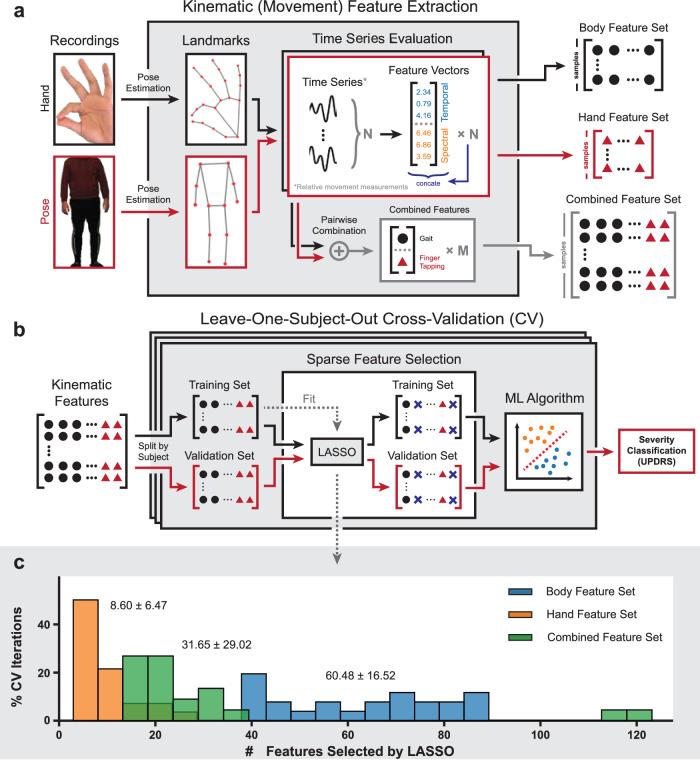
Quantification of motor symptom progression in Parkinson’s disease (PD) patients is crucial for assessing disease progression and for optimizing therapeutic interventions, such as dopaminergic medications and deep brain stimulation. Cumulative and heuristic clinical experience has identified various clinical signs associated with PD severity, but these are neither objectively quantifiable nor robustly validated. Video-based objective symptom quantification enabled by machine learning (ML) introduces a potential solution. However, video-based diagnostic tools often have implementation challenges due to expensive and inaccessible technology, and typical “black-box” ML implementations are not tailored to be clinically interpretable. Here, we address these needs by releasing a comprehensive kinematic dataset and developing an interpretable video-based framework that predicts high versus low PD motor symptom severity according to MDS-UPDRS Part III metrics. This data driven approach validated and robustly quantified canonical movement features and identified new clinical insights, not previously appreciated as related to clinical severity, including pinkie finger movements and lower limb and axial features of gait. Our framework is enabled by retrospective, single-view, seconds-long videos recorded on consumer-grade devices such as smartphones, tablets, and digital cameras, thereby eliminating the requirement for specialized equipment. Following interpretable ML principles, our framework enforces robustness and interpretability by integrating (1) automatic, data-driven kinematic metric evaluation guided by pre-defined digital features of movement, (2) combination of bi-domain (body and hand) kinematic features, and (3) sparsity-inducing and stability-driven ML analysis with simple-to-interpret models. These elements ensure that the proposed framework quantifies clinically meaningful motor features useful for both ML predictions and clinical analysis.
Overview
The claims and statistics of this paper haven’t been checked yet.
Free: it reads the open-access text and checks the first 5 claims that cite a source we can check. Create a free account to check every claim.
Integrity signals
Registry
Cites
Statistics
Figures
Verification
Claims the paper makes
The claims and statistics of this paper haven’t been checked yet.
Free: it reads the open-access text and checks the first 5 claims that cite a source we can check. Create a free account to check every claim.
Claims other papers make about this one
Each is checked against this paper’s own text: does it say what the citing paper says it does?
The check wasn’t confident either way, so it gives no verdict — never disputed.
In the citing paper
“PENSIEVE-AI uses an image-based deep learning model to detect mild cognitive impairment (MCI) and dementia based on touch-screen tablet drawing tasks,60”
From Review of Artificial Intelligence for Clinical Use in Alzheimer's Disease and Related Dementias (2026) · cites this paper as [60]
Experimental — accuracy not yet measuredThe check wasn’t confident either way, so it gives no verdict — never disputed.
In the citing paper
“Further studies show promise of AI applications in optimizing cognitive test administration and scoring across diverse cultures and health literacy levels.59,60”
From Review of Artificial Intelligence for Clinical Use in Alzheimer's Disease and Related Dementias (2026) · cites this paper as [60]
Experimental — accuracy not yet measured
Self-check
Percentages, sums and reported differences re-computed from the paper’s own numbers.
The self-check needs the paper’s full text.
Citations
Cites
Breiman, L. (2001) · Machine Learning · doi:10.1023/a:1010933404324 · Cited by 133,538 · cited 1×
“…seven different ML algorithms: (1) linear discriminant analysis (LDA) 62 ; (2) logistic regression (LR) 63 ; (3) support vector machine (SVM) 64 ; (4) random forest (RF) 65 ; (5) adaptive-boosted trees (AdaBoost; AB) 66 ; (6) K-nearestneighbors(KNN) 67 ; and, (7) Gaussian naive Bayes (GNB) 68 .”
Regression shrinkage and selection via the lasso
Tibshirani, R. (1996) · Journal of the Royal Statistical Society Series B: Statistical Methodology · doi:10.1111/j.2517-6161.1996.tb02080.x · Cited by 51,482
Feature Pyramid Networks for Object Detection
Lin, T.-Y., Dollar, P., Girshick, R., He, K., Hariharan, B., & Belongie, S. (2017) · 2017 IEEE Conference on Computer Vision and Pattern Recognition (CVPR) · doi:10.1109/cvpr.2017.106 · Cited by 30,939 · cited 1×
“For the “ on ” state, participants were given a standard morning dose of Levodopa medication and evaluated one hour later.”
BackgroundData Structures for Statistical Computing in Python
McKinney, W. (2010) · Proceedings of the Python in Science Conference · doi:10.25080/majora-92bf1922-00a · Cited by 11,032 · cited 1×
“For the gait task, participantswere instructed to walk towardand away from the camera fora minimum of 10 meters (30 feet) each way.”
MethodFrom local explanations to global understanding with explainable AI for trees
Lundberg, S. M., Erion, G., Chen, H., DeGrave, A., Prutkin, J. M., Nair, B., Katz, R., Himmelfarb, J., Bansal, N., & Lee, S.-I. (2020) · Nature Machine Intelligence · doi:10.1038/s42256-019-0138-9 · Cited by 10,551 · cited 1×
“Weperforma comprehensivekinematicfeaturestabilityanalysistoidentifyconserved featuresacrossensembleofmodels 32 – 34 and feature contributions to model outputs via tree SHAP (Shapley Additive exPlanations) analysis 35 .”
MethodGoetz, C. G., Tilley, B. C., Shaftman, S. R., Stebbins, G. T., Fahn, S., Martinez‐Martin, P., Poewe, W., Sampaio, C., Stern, M. B., Dodel, R., et al. (2008) · Movement Disorders · doi:10.1002/mds.22340 · Cited by 7,536 · cited 1×
“Clinical signs such as fi nger tapping slowness and decrement(bradykinesia)withintheMDS-UPDRShavebeendiscoveredby clinicalheuristicsandcodi fi ed by expert consensus, precluding well-vali-dated, objective, data-driven and quanti fi able assessment of patients.”
BackgroundHearst, M. A., Dumais, S. T., Osuna, E., Platt, J., & Scholkopf, B. (1998) · IEEE Intelligent Systems and their Applications · doi:10.1109/5254.708428 · Cited by 7,243 · cited 8×
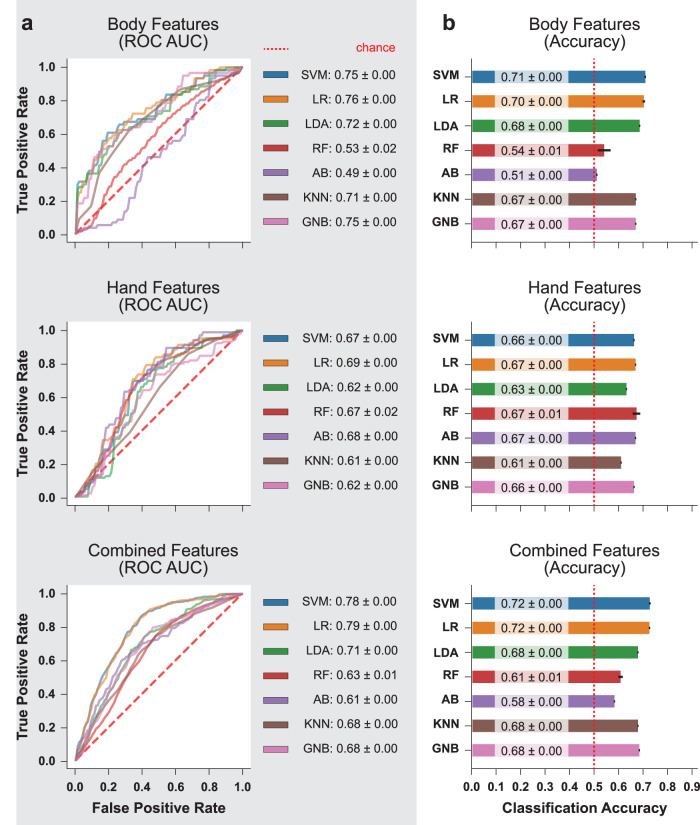
“In terms of classi fi cation accuracy, SVM and LR achieved an average accuracy of 72%, with LDA, KNN, and GNB following closely at 68%.”
InfluentialOpenPose: Realtime Multi-Person 2D Pose Estimation Using Part Affinity Fields
Cao, Z., Hidalgo, G., Simon, T., Wei, S.-E., & Sheikh, Y. (2021) · IEEE Transactions on Pattern Analysis and Machine Intelligence · doi:10.1109/tpami.2019.2929257 · Cited by 5,536
DeepLabCut: markerless pose estimation of user-defined body parts with deep learning
Mathis, A., Mamidanna, P., Cury, K. M., Abe, T., Murthy, V. N., Mathis, M. W., & Bethge, M. (2018) · Nature Neuroscience · doi:10.1038/s41593-018-0209-y · Cited by 5,187
Multimodal Machine Learning: A Survey and Taxonomy
Baltrusaitis, T., Ahuja, C., & Morency, L.-P. (2019) · IEEE Transactions on Pattern Analysis and Machine Intelligence · doi:10.1109/tpami.2018.2798607 · Cited by 5,018
Research works printed but not linked: 1
- Hand, D. J. & Yu, K. Idiot’s Bayes? Not so stupid after all? Int Stat. Rev. 69, 385–398 (2001).
Cited by
Computer Vision in Clinical Neurology: A Review
Friedrich, M. U., Relton, S. D., Wong, D., & Alty, J. (2025) · JAMA Neurology · doi:10.1001/jamaneurol.2024.5326 · Cited by 34
Video‐Based Data‐Driven Models for Diagnosing Movement Disorders: Review and Future Directions
Martínez‐García‐Peña, R., Koens, L. H., Azzopardi, G., & Tijssen, M. A. J. (2025) · Movement Disorders · doi:10.1002/mds.30327 · Cited by 26
“Separate cameras can target speci fi c body regions (such as hands in PD 23 and head in dystonia) 58 for focused analysis.”
di Biase, L., Pecoraro, P. M., & Bugamelli, F. (2025) · Sensors · doi:10.3390/s25206373 · Cited by 24
“Deng and colleagues [132] analyzed smartphone/tablet videos to quantify motor severity and treatment state in parkinsonism.”
Virameteekul, S., Shin, C., Hirczy, S. S., Sarva, H., Paul, S. S., Maetzler, W., Mirelman, A., Schneider, R. B., Hausdorff, J. M., Vizcarra, J. A., et al. (2025) · Movement Disorders · doi:10.1002/mds.70097 · Cited by 14
Digital Technologies for Symptom Monitoring in Parkinson Disease
Chunga, N., Reddy, V., Barbosa, W., & Adams, J. (2026) · Current Neurology and Neuroscience Reports · doi:10.1007/s11910-026-01481-7 · Cited by 13
“Novel machine learning frameworks are also being developed to assess single-view and seconds-long videos (e.g., finger tap - ping) captured on consumer-grade devices—like tablets and smartphones—to classify motor severity in PD [41].”
3D pose estimation for scalable remote gait kinematics assessment
Natraj, S., Messmer, T., Fujii, Y., Suzuki, K. S., Riener, R., Hoogland, I. E., & GRANADOS, D. F. P. (2025) · npj Digital Medicine · doi:10.1038/s41746-025-02211-y · Cited by 12
Amadiaz, Y., Alfonso-Lizarazo, E. H., & Moh, A. N. S. (2025) · Array · doi:10.1016/j.array.2025.100575 · Cited by 11
Review of Artificial Intelligence for Clinical Use in Alzheimer's Disease and Related Dementias
Breithaupt, A. G., Tang, A., Paolillo, E. W., Bibars, M., Johnson, E. C. B., Saloner, R., Possin, K. L., Windon, C. C., Hill-Jarrett, T. G., Giorgio, J., et al. (2026) · Seminars in Neurology · doi:10.1055/a-2744-9871 · Cited by 6
Vision-skeleton dual-modality framework for generalizable assessment of Parkinson’s disease gait
Liu, W., Lin, X., Chen, X., Liu, Y., Zhong, Z., Chen, R., Chen, G., & Yu, L. (2025) · Medical Image Analysis · doi:10.1016/j.media.2025.103727 · Cited by 7
Hu, T., Zhang, Q., Yin, Z., Xu, Y., Dong, B., An, Q., Wang, Y., Gan, Y., Fan, H., Zhao, Z., et al. (2026) · npj Parkinson's Disease · doi:10.1038/s41531-025-01252-0 · Cited by 5
“Based on established literature 18,20,24 , we constructed features from key domains that capture symptom severity and are potentially modi fi able by both levodopa and DBS, such as frequency, amplitude, velocity, and motor stability.”
InfluentialLee, S., Kim, M., Choi, K. S., Jeong, C., Yu, R., Lee, J., Shin, J. H., Kim, H., & Jeon, B. (2025) · Scientific Reports · doi:10.1038/s41598-025-26389-z · Cited by 1
“Several studies have successfully demonstrated the feasibility of quantifying individual motor features such as facial bradykinesia 13 , pose-estimation 14 , and video-based prediction of Parkinson’s disease (PD) motor severity 15 .”
Miah, A. S. M., Hossain, M. M. A., Hassan, N., Okuyama, Y., & Shin, J. (2025) · International Conference on Awareness Science and Technology (iCAST) · doi:10.1109/icast68191.2025.11300107 · Cited by 1
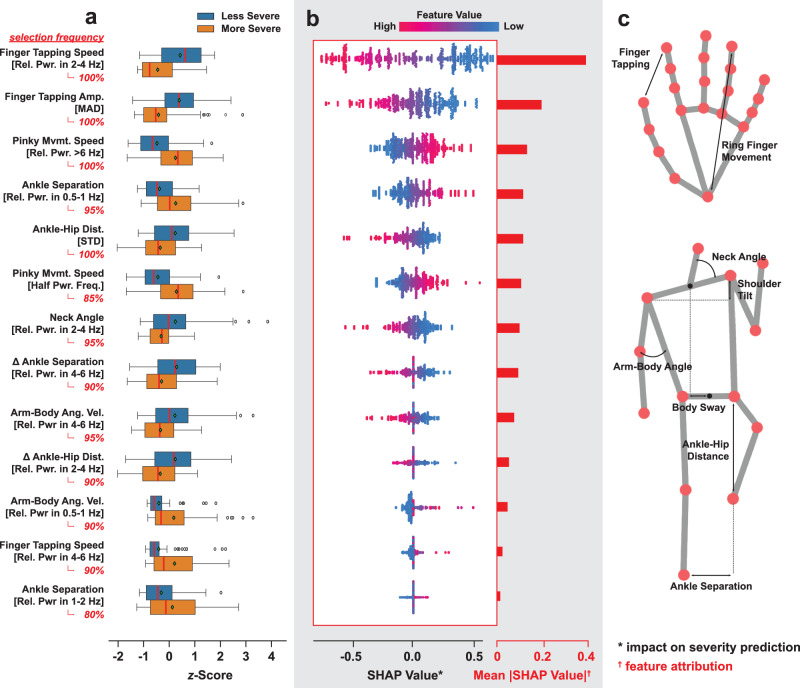
“Deng et al. used video-based systems to capture kinematic data to identify key movement features—such as pinkie finger motion and gait parameters—linked to PD severity via MDS-UPDRS Part III [27].”
Interpretable Biomechanical Feature Selection for VR Exercise Assessment Using SHAP and LDA
Czajkowska, U., Żuk, M., Popek, M., & Pezowicz, C. A. (2026) · Sensors · doi:10.3390/s26020464 · Cited by 1
Ehsan, T., Tangermann, M., Güçlütürk, Y., Shin, S., Ho, K. C., Bloem, B. R., & Evers, L. J. W. (2026) · npj Parkinson's Disease · doi:10.1038/s41531-026-01307-w · Cited by 3
“These findings indicate that among the misclassified samples, 33.33% of the model-predicted scores were confirmed by the new as-sessor, suggesting that a portion of the model’s misclas-sifications may be due to inherent variability in human scoring rather than a failure of the algorithm itself.”
InfluentialComparative Analysis of Acted-Out and Real Patient Gait Parameters for Sensing Applications
Parsay, A., Torun, M., Delio, P. R., & Mostofi, Y. (2025) · IEEE International Conference on Pervasive Computing and Communications Workshops (PerCom Workshops) · doi:10.1109/percomworkshops65533.2025.00103 · Cited by 1
A Non-Invasive Gait-Based Screening Approach for Parkinson's Disease Using Time-Series Analysis
Chen, H., Tee, C., Tan, V. W. S., Goh, M., Saedon, N. '., Alkhatib, A. A. A., & Farfoura, M. E. (2025) · Symmetry · doi:10.3390/sym17091385 · Cited by 2
AI Program Classifies Parkinson's Severity Based on 5-Second Videos
Hurley, D. (2024) · Neurology Today · doi:10.1097/01.nt.0001052392.48155.3c
Lower-Limb Bradykinesia Assessment in Parkinson's Disease From Routine Clinical Videos
Coutinho, K., Lapeña-Motilva, J., Monje, M. H. G., Ávila, J. C. M., Pérez-Martínez, D. A., Sánchez‐Ferro, Á., & Malpica, N. (2025) · Proceedings - IEEE Symposium on Computer-Based Medical Systems · doi:10.1109/cbms65348.2025.00099
Amprimo, G., Priano, L., Vismara, L., & Ferraris, C. (2026) · Algorithms · doi:10.3390/a19020146
“In addition, the discrete nature of clinical scores constrains resolution and provides limited insight into which specific gait components are altered, reducing interpretability and clinical transparency [15].”
Chen, N., Wang, S., Liu, J., Zheng, X., & Shang, H. (2026) · Journal of Nanobiotechnology · doi:10.1186/s12951-026-04154-2 · Cited by 2
“While simple ML models permit some inter-pretability through feature importance analysis, their complex counterparts often function as “black boxes”, impeding the elucidation of their prediction rationale [143–145].”
Zawad, M. R. S., Tumpa, Z. N., Sollis, L. J., Parab, S., & Washington, P. Y. (2026) · JMIR Formative Research · doi:10.2196/81368 · Cited by 1
Diurnal step count patterns in progressive multiple sclerosis
Behal, A., Block, V. J., Cree, B., & Abbasi-Asl, R. (2026) · Multiple Sclerosis Journal · doi:10.1177/13524585261475910
Self-citationVanitha, V., Srivani, M., Bellam, S. K., & Mohanavel, S. K. (2026) · Communications in computer and information science · doi:10.1007/978-3-032-31233-4_13
Son, S., Park, C., Ryu, J., Lee, E.-J., Jo, S., & Lim, M. H. (2026) · Biomedical Signal Processing and Control · doi:10.1016/j.bspc.2026.111455
Computer vision, Parkinson’s disease, and the unfinished work of clinical translation
Alty, J., & Friedrich, M. U. (2026) · npj Parkinson s Disease · doi:10.1038/s41531-026-01577-4
Metadata
- Authors
- Deng, D., Ostrem, J. L., Nguyen, V., Cummins, D. D., Sun, J., Pathak, A., Little, S., & Abbasi-Asl, R.
- Affiliations
- University of California, San Francisco (US)
- Google (United States) (US)
- Corresponding author
- Little, Simon
- Abbasi-Asl, Reza
- ORCID
- Venue
- npj Parkinson's Disease
- Published
- 2024-06-25
- Volume
- 10
- Issue
- 1
- Pages
- 122-122
- ISSN
- 2373-8057 (ISSN-L)
- PMC
- PMC11199701
- OpenAlex
- W4399999456
- Cited by
- 25
- References
- 70
- Citations by year
- 2026: 11 · 2025: 13 · 2024: 1
- FWCI
- 6.69
- Type
- journal article
- Language
- en
- Open access
- gold
- doi.org
- Licence
- cc-by
- creativecommons.org/licenses/by/4.0 (tdm)
- creativecommons.org/licenses/by/4.0 (vor)
- Locations
- npj Parkinson s Disease (publishedVersion, cc-by)
- medRxiv (acceptedVersion, cc-by-nc-nd)
- PubMed Central (publishedVersion, cc-by)
- PubMed (publishedVersion)
- eScholarship (California Digital Library) (submittedVersion, cc-by)
- DOAJ (DOAJ: Directory of Open Access Journals) (submittedVersion)
- Funders
- UCSF Innovation Ventures
- Topics
- Health Sciences › Medicine › Clinical Neurology › Parkinson's Disease Mechanisms and Treatments
- Health Sciences › Health Professions › Health Information Management › Artificial Intelligence in Healthcare
- Health Sciences › Health Professions › Physical Therapy, Sports Therapy and Rehabilitation › Balance, Gait, and Falls Prevention
- Keywords
- Parkinson's disease, parkinsonism, motor impairment severity, model interpretability, kinematic parameters, MDS-UPDRS III, gait, axial symptoms, smartphone-based assessment, disease progression
About these checks
Registry, retraction, Cites and statistics results are computed, not judged, with one exception: a printed reference that no index lists is read once by a model before it counts as a citation error. Claims are extracted by a model and kept only when their quote appears verbatim in the text; each cited source is then checked, with a model’s help, for whether it says what the claim relies on. Those verdicts can be wrong — read the claim’s quote and the cited source before relying on one.
Statistics and arithmetic are recomputed, not judged.
Confidence bands are shown only for fields calibrated on our annotated test set. None is calibrated yet, so no band is shown.
What counts as a claim ›How we measure confidence ›How we check this ›
Are you an author, or do you see a problem with this page? Request a review
Data sources
Bibliographic data: Semantic Scholar, OpenAlex, Crossref.
Contains information from the Semantic Scholar Academic Graph Datasets, made available under the ODC Attribution License (ODC-BY 1.0).
Semantic Scholar’s data is described in: Kinney, R., et al. (2023). The Semantic Scholar Open Data Platform. arXiv:2301.10140.
