

Automatic speech analysis combined with machine learning reliably predicts the motor state in people with Parkinson's disease
Open accessThe DOI matches its Crossref record; 42 of the 42 references it cites were found in a registry or an index.
Abstract
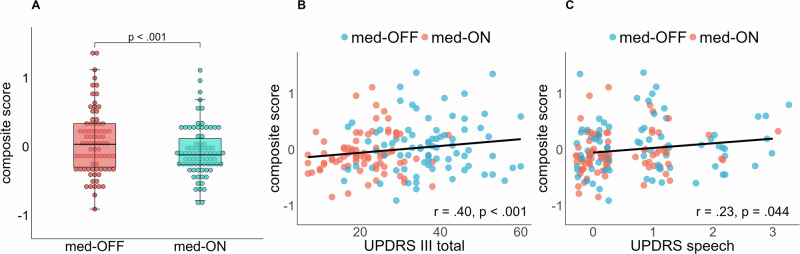
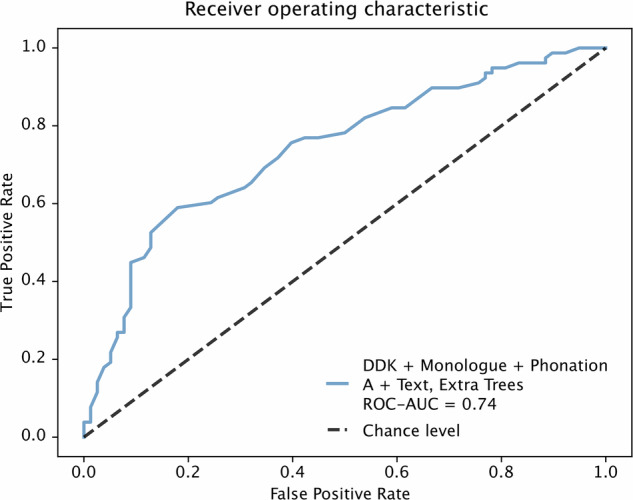
It is still under debate whether levodopa treatment improves speech functions in Parkinson’s disease (PD). Therefore, speech functions of people with PD were compared in medication-OFF condition (withdrawal of PD medication for at least 12 h) and medication-ON condition (after receiving 200 mg of soluble levodopa). A total of 78 participants, including 51 males and 27 females, performed predefined standard speech tasks. Acoustic speech features were automatically extracted with the algorithm given by the Dysarthria Analyzer. Results suggest that acute levodopa intake improves phonatory-respiratory speech functions and speech planning abilities, while the articulatory system remains unaffected. Furthermore, the study provided preliminary evidence that speech function is able to predict the medication status in individuals with PD as the constructed speech-based biomarker score did not only correlate with established measures of (speech) motor impairment but could also differentiate between the medication OFF and ON status. A post-hoc machine learning model yielded similar results.
Overview
The claims and statistics of this paper haven’t been checked yet.
Free: it reads the open-access text and checks the first 5 claims that cite a source we can check. Create a free account to check every claim.
Integrity signals
Registry
Cites
Statistics
Figures
Verification
Claims the paper makes
The claims and statistics of this paper haven’t been checked yet.
Free: it reads the open-access text and checks the first 5 claims that cite a source we can check. Create a free account to check every claim.
Claims other papers make about this one
Each is checked against this paper’s own text: does it say what the citing paper says it does?
The check wasn’t confident either way, so it gives no verdict — never disputed.
In the citing paper
“The emergence of deep learning architectures, particularly convolutional neural networks (CNNs), has revolutionized neuroimaging analysis, including MRI and PET scan interpretation.76”
From Review of Artificial Intelligence for Clinical Use in Alzheimer's Disease and Related Dementias (2026) · cites this paper as [76]
Experimental — accuracy not yet measured
Self-check
Percentages, sums and reported differences re-computed from the paper’s own numbers.
The self-check needs the paper’s full text.
Citations
Cites
Fitting Linear Mixed-Effects Models Using lme4
Bates, D., Mächler, M., Bolker, B., & Walker, S. (2015) · Journal of Statistical Software · doi:10.18637/jss.v067.i01 · Cited by 86,835
Hughes, A. J., Daniel, S. E., Kilford, L., & Lees, A. J. (1992) · Journal of Neurology, Neurosurgery & Psychiatry · doi:10.1136/jnnp.55.3.181 · Cited by 10,378
Bakdash, J. Z., & Marusich, L. R. (2017) · Frontiers in Psychology · doi:10.3389/fpsyg.2017.00456 · Cited by 2,018
The Unified Parkinson's Disease Rating Scale (UPDRS): Status and recommendations
Movement Disorder Society Task Force on Rating Scales for Parkinson's Disease (2003) · Movement Disorders · doi:10.1002/mds.10473 · Cited by 1,810
Patel, R. R., Awan, S. N., Barkmeier-Kraemer, J., Courey, M., Deliyski, D., Eadie, T., Paul, D., Švec, J. G., & Hillman, R. (2018) · American Journal of Speech-Language Pathology · doi:10.1044/2018_ajslp-17-0009 · Cited by 818
Goldsack, J. C., Coravos, A., Bakker, J. P., Bent, B., Dowling, A. V., Fitzer-Attas, C., Godfrey, A., Godino, J. G., Gujar, N., Izmailova, E., et al. (2020) · npj Digital Medicine · doi:10.1038/s41746-020-0260-4 · Cited by 557
Acoustic and Intelligibility Characteristics of Sentence Production in Neurogenic Speech Disorders
Weismer, G., Jeng, J.-Y., Laures, J. S., Kent, R. D., & Kent, J. F. (2001) · Folia Phoniatrica et Logopaedica · doi:10.1159/000052649 · Cited by 338
Limitations of current Parkinson's disease therapy
Rascol, O., Payoux, P., Ory, F., Ferreira, J. J., Brefel-Courbon, C., & Montastruc, J.-L. (2003) · Annals of Neurology · doi:10.1002/ana.10513 · Cited by 337
Treatment of Parkinson's disease: levodopa as the first choice
Katzenschlager, R., & Lees, A. J. (2002) · Journal of Neurology · doi:10.1007/s00415-002-1204-4 · Cited by 209
Kim, Y., Kent, R. D., & Weismer, G. (2011) · Journal of Speech, Language, and Hearing Research · doi:10.1044/1092-4388(2010/10-0020 · Cited by 198
Research works printed but not linked: 1
- Deuschl, G., Oertel, W. & Reichmann, H. Idiopathisches Parkinson-syndrom. Leitlin. f.ür. Diagn. Ther. Neurol. S3, 77 (2016).
Cited by
Clinical utility of digital technologies in Parkinson’s disease
Falkenburger, B. H., Fanciulli, A., Pötter‐Nerger, M., van Eimeren, T., Claßen, J., Höglinger, G. U., Redecker, C., Winkler, J., & Klucken, J. (2025) · Journal of Neural Transmission · doi:10.1007/s00702-025-03062-3 · Cited by 8
Review of Artificial Intelligence for Clinical Use in Alzheimer's Disease and Related Dementias
Breithaupt, A. G., Tang, A., Paolillo, E. W., Bibars, M., Johnson, E. C. B., Saloner, R., Possin, K. L., Windon, C. C., Hill-Jarrett, T. G., Giorgio, J., et al. (2026) · Seminars in Neurology · doi:10.1055/a-2744-9871 · Cited by 6
Early detection of Parkinson's disease through supervised machine learning techniques on voice data
Pathak, P., Akashe, S., & Upadhyay, G. M. (2025) · Informatics in Medicine Unlocked · doi:10.1016/j.imu.2025.101705 · Cited by 6
Pandey, P. V. K., & Sahu, S. S. (2025) · Journal of Voice · doi:10.1016/j.jvoice.2025.06.036 · Cited by 6
Kim, M., Yeo, E., Choi, K., & Kim, J.-W. (2026) · arXiv (Cornell University) · doi:10.48550/arxiv.2609.09499 · Cited by 2
Cross-Attention Multi-Modal Transformer for Early Diagnosis of Parkinson's Disease
Shin, J., Maua, J., Nagib, M. N., Ahmed, A., Ahmed, M., & Mridha, M. F. (2026) · IEEE Open Journal of the Computer Society · doi:10.1109/ojcs.2026.3675788 · Cited by 2
Shao, S., Wang, Y., Jiang, S., Zhao, S., Yang, D., Wang, J., Bai, Y., & Zhang, J. (2025) · arXiv (Cornell University) · doi:10.48550/arxiv.2509.23719 · Cited by 1
Wu, H., Yang, Y., Wang, L., Su, H., & Li, X. (2026) · Journal of Evaluation in Clinical Practice · doi:10.1111/jep.70580
Tsutsumi, K., Chang, P. D., Ezzati, A., & Isfahani, S. A. (2026) · Frontiers in Neurology · doi:10.64898/2026.01.01.25343300
Kaur, J., Jain, A. K., & Singh, U. (2026) · Lecture notes in networks and systems · doi:10.1007/978-3-032-31119-1_44
How Neurological Disorders Affect Acoustic Features of Speech? A Data Mining Approach
Sayadi, M., Torabinezhad, F., Bayazian, G., & Abedian, S. (2025) · Advances in Medical Informatics · doi:10.22034/aimi.2025.12.7
Xu, H., Zou, Z., Zhou, J., Wen, Y., Wang, Z., Bashir, H., Wu, M., Hu, T., & Zou, X. (2026) · Research Square · doi:10.21203/rs.3.rs-10605653/v1
BenMessaoud, Z., BenHassen, S., Néji, M., Hussain, A., Farhat, N., Smaoui, E., Dammek, M., Frikha, M., Alimi, A. M., & Mhiri, C. (2026) · Multimedia Tools and Applications · doi:10.1007/s11042-026-21682-z
Oropharyngeal dysphagia in Parkinson’s disease — voice as a window into swallowing function
Sarzyńska-Długosz, I. M. (2025) · Neurologia i Neurochirurgia Polska · doi:10.5603/pjnns.108657
A Machine Learning-Based Framework for Parkinson's Disease Identification Using Speech Analysis
Mondal, B., Saha, S. K., Ghosh, P., Debnath, T., & Debnath, K. (2026) · International Conference on Trends in Quantum Computing and Emerging Business Technologies (TQCEBT) · doi:10.1109/tqcebt67648.2026.11681320
Early Detection and Severity Assessment of Parkinson's Disease Using Speech-Based Machine Learning
Kumar, R., Ambareesh, A. V., Rabbani, S. M., Singh, C. M. V., & Reddy, R. V. (2026) · International Engineering Data Analytics and Management Conference (EAMCON) · doi:10.68337/cpsm.v1.i1.2026-003
Metadata
- Authors
- Thies, T., Mallick, E., Tröger, J., Baykara, E., Mücke, D., & Barbe, M. T.
- Affiliations
- University of Cologne (DE)
- Corresponding author
- Thies, Tabea
- Venue
- npj Parkinson's Disease
- Published
- 2025-05-02
- Volume
- 11
- Issue
- 1
- Pages
- 105-105
- ISSN
- 2373-8057 (ISSN-L)
- PMC
- PMC12048546
- OpenAlex
- W4410019708
- Cited by
- 8
- References
- 40
- Citations by year
- 2026: 4 · 2025: 4
- FWCI
- 5.15
- Type
- journal article
- Language
- en
- Open access
- gold
- doi.org
- Licence
- cc-by
- creativecommons.org/licenses/by/4.0 (tdm)
- creativecommons.org/licenses/by/4.0 (vor)
- Locations
- npj Parkinson s Disease (publishedVersion, cc-by)
- PubMed Central (publishedVersion, cc-by)
- PubMed (publishedVersion)
- Kölner Universitäts PublikationsServer (Universität zu Köln) (acceptedVersion, cc-by)
- DOAJ (DOAJ: Directory of Open Access Journals) (submittedVersion, cc-by-sa)
- Funders
- Deutsche Forschungsgemeinschaft (281511265)
- Topics
- Health Sciences › Health Professions › Speech and Hearing › Voice and Speech Disorders
- Health Sciences › Medicine › Clinical Neurology › Parkinson's Disease Mechanisms and Treatments
- Social Sciences › Psychology › Experimental and Cognitive Psychology › Phonetics and Phonology Research
- Keywords
- Parkinson's disease, levodopa, speech analysis, acoustic speech features, speech preparation, machine learning prediction
About these checks
Registry, retraction, Cites and statistics results are computed, not judged, with one exception: a printed reference that no index lists is read once by a model before it counts as a citation error. Claims are extracted by a model and kept only when their quote appears verbatim in the text; each cited source is then checked, with a model’s help, for whether it says what the claim relies on. Those verdicts can be wrong — read the claim’s quote and the cited source before relying on one.
Statistics and arithmetic are recomputed, not judged.
Confidence bands are shown only for fields calibrated on our annotated test set. None is calibrated yet, so no band is shown.
What counts as a claim ›How we measure confidence ›How we check this ›
Are you an author, or do you see a problem with this page? Request a review
Data sources
Bibliographic data: Semantic Scholar, OpenAlex, Crossref.
Contains information from the Semantic Scholar Academic Graph Datasets, made available under the ODC Attribution License (ODC-BY 1.0).
Semantic Scholar’s data is described in: Kinney, R., et al. (2023). The Semantic Scholar Open Data Platform. arXiv:2301.10140.
