

Efficient symmetry-preserving state preparation circuits for the variational quantum eigensolver algorithm
Open accessThe DOI matches its Crossref record; 36 of the 36 references it cites were found in a registry or an index.
Abstract
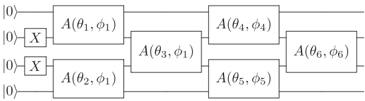
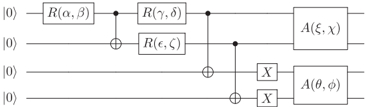
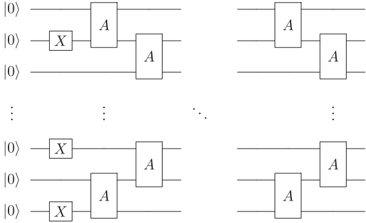
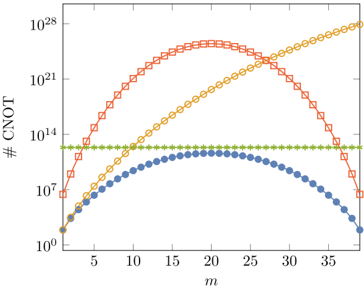
The variational quantum eigensolver is one of the most promising approaches for performing chemistry simulations using noisy intermediate-scale quantum (NISQ) processors. The efficiency of this algorithm depends crucially on the ability to prepare multi-qubit trial states on the quantum processor that either include, or at least closely approximate, the actual energy eigenstates of the problem being simulated while avoiding states that have little overlap with them. Symmetries play a central role in determining the best trial states. Here, we present efficient state preparation circuits that respect particle number, total spin, spin projection, and time-reversal symmetries. These circuits contain the minimal number of variational parameters needed to fully span the appropriate symmetry subspace dictated by the chemistry problem while avoiding all irrelevant sectors of Hilbert space. We show how to construct these circuits for arbitrary numbers of orbitals, electrons, and spin quantum numbers, and we provide explicit decompositions and gate counts in terms of standard gate sets in each case. We test our circuits in quantum simulations of the $${H}_{2}$$ H 2 and $$LiH$$ L i H molecules and find that they outperform standard state preparation methods in terms of both accuracy and circuit depth.
Overview
The claims and statistics of this paper haven’t been checked yet.
Free: it reads the open-access text and checks the first 5 claims that cite a source we can check. Create a free account to check every claim.
Integrity signals
Registry
Cites
Statistics
Figures


Verification
Claims the paper makes
The claims and statistics of this paper haven’t been checked yet.
Free: it reads the open-access text and checks the first 5 claims that cite a source we can check. Create a free account to check every claim.
Claims other papers make about this one
Each is checked against this paper’s own text: does it say what the citing paper says it does?
The source backs part of the claim, not all of it — or backs it for a different population, condition or comparison.
In the citing paper
“As discussed in the section on ansatzes, the UCC ansatz for VQE of the quantum alternating operator ansatz [23, 24] for optimization are problem-inspired ansatzes which are usually trainable even when randomly initialized.”
From Variational quantum algorithms (2021) · cites this paper as [23]
Experimental — accuracy not yet measuredThe cited source says what the claim attributes to it.
In the citing paper
“Such an ansatz leads to particularly small parameter counts for quantum chemistry problems such as the H 2 and LiH molecules (Gard et al. , 2020).”
From Noisy intermediate-scale quantum algorithms (2022) · cites this paper as Gard et al., 2020
The check wasn’t confident either way, so it gives no verdict — never disputed.
In the citing paper
“QAOA has provable performance guarantees [23, 282] for p = 1 .”
From Variational quantum algorithms (2021) · cites this paper as [23]
Experimental — accuracy not yet measuredThe check wasn’t confident either way, so it gives no verdict — never disputed.
In the citing paper
“The most famous VQA for quantum-enhanced optimization is the QAOA [23], originally introduced to approximately solve combinatorial problems such as Constraint-Satisfaction (SAT) [127] and Max-Cut problems [128].”
From Variational quantum algorithms (2021) · cites this paper as [23]
Experimental — accuracy not yet measured
Self-check
Percentages, sums and reported differences re-computed from the paper’s own numbers.
The self-check needs the paper’s full text.
Citations
Cites
Quantum Computing in the NISQ era and beyond
Preskill, J. (2018) · Quantum · doi:10.22331/q-2018-08-06-79 · Cited by 8,830
Simulating physics with computers
Feynman, R. P. (1982) · International Journal of Theoretical Physics · doi:10.1007/bf02650179 · Cited by 7,691
A variational eigenvalue solver on a photonic quantum processor
Peruzzo, A., McClean, J., Shadbolt, P., Yung, M.-H., Zhou, X.-Q., Love, P. J., Aspuru-Guzik, A., & O’Brien, J. L. (2014) · Nature Communications · doi:10.1038/ncomms5213 · Cited by 4,552
Hardware-efficient variational quantum eigensolver for small molecules and quantum magnets
Kandala, A., Mezzacapo, A., Temme, K., Takita, M., Brink, M., Chow, J. M., & Gambetta, J. M. (2017) · Nature · doi:10.1038/nature23879 · Cited by 2,982
�ber das Paulische �quivalenzverbot
Jordan, P., & Wigner, E. (1928) · Zeitschrift f�r Physik · doi:10.1007/bf01331938 · Cited by 2,597 · cited 1×
“In this work, we focus on mapping chemistry problems onto quantum processors using the Jordan-Wigner mapping, 3,29 in which each qubit in the quantum processor corresponds to a particular spin-orbital, and the qubit states 0 j i and 1 j i encode the occupation of that spin-orbital.”
MethodBarren plateaus in quantum neural network training landscapes
McClean, J. R., Boixo, S., Smelyanskiy, V. N., Babbush, R., & Neven, H. (2018) · Nature Communications · doi:10.1038/s41467-018-07090-4 · Cited by 2,329
The theory of variational hybrid quantum-classical algorithms
McClean, J. R., Romero, J., Babbush, R., & Aspuru-Guzik, A. (2016) · New Journal of Physics · doi:10.1088/1367-2630/18/2/023023 · Cited by 2,227
Simulated Quantum Computation of Molecular Energies
Aspuru-Guzik, A., Dutoi, A. D., Love, P. J., & Head-Gordon, M. (2005) · Science · doi:10.1126/science.1113479 · Cited by 1,418
Scalable Quantum Simulation of Molecular Energies
O’Malley, P. J. J., Babbush, R., Kivlichan, I. D., Romero, J., McClean, J. R., Barends, R., Kelly, J., Roushan, P., Tranter, A., Ding, N., et al. (2016) · Physical Review X · doi:10.1103/physrevx.6.031007 · Cited by 1,059 · cited 1×
“Some of the advantages of VQE are that its variational character can provide some degree of error mitigation in the gates, 7,13 – 15 and that it features shallower circuits compared to the phase estimation algorithm.”
BackgroundAn adaptive variational algorithm for exact molecular simulations on a quantum computer
Grimsley, H. R., Economou, S. E., Barnes, E., & Mayhall, N. J. (2019) · Nature Communications · doi:10.1038/s41467-019-10988-2 · Cited by 1,033
Self-citation
Research works printed but not linked: 4
- Shende, V. V. & Markov, I. L. Quantum circuits for incompletely specified two- qubit operators. Quantum Inf. Comput. 5, 49 (2005).
- Nielsen, M. A. & Chuang, I. L. Quantum Computation and Quantum Information: 10th Anniversary Edition. (Cambridge University Press, New York, 2011).
- Bravyi, S., Gambetta, J.M., Mezzacapo, A. & Temme, K. Tapering off qubits to simulate fermionic hamiltonians. Preprint at https://arxiv.org/abs/1905.01534 (2017). · arXiv
- Li, Y. & Benjamin, S. C. Efficient variational quantum simulator incorporating active error minimization. Phys. Rev. X 7, 021050 (2017).
Cited by
Variational quantum algorithms
Cerezo, M., Arrasmith, A., Babbush, R., Benjamin, S. C., Endo, S., Fujii, K., McClean, J. R., Mitarai, K., Yuan, X., Cincio, L., et al. (2021) · Nature Reviews Physics · doi:10.1038/s42254-021-00348-9 · Cited by 3,385
“One of the main advantages of the hardware efficient ansatz is its versatility, as it can accommodate encoding symmetries [11, 12] and bringing correlated qubits closer for depth reduction [13], as well as being especially”
BackgroundNoisy intermediate-scale quantum algorithms
Bharti, K., Cervera-Lierta, A., Kyaw, T. H., Haug, T., Alperin-Lea, S., Anand, A., Degroote, M., Heimonen, H., Kottmann, J. S., Menke, T., et al. (2022) · Reviews of Modern Physics · doi:10.1103/revmodphys.94.015004 · Cited by 2,231
The Variational Quantum Eigensolver: A review of methods and best practices
Tilly, J., Chen, H., Cao, S., Picozzi, D., Setia, K., Li, Y., Grant, E., Wossnig, L., Rungger, I., Booth, G. H., et al. (2022) · Physics Reports · doi:10.1016/j.physrep.2022.08.003 · Cited by 1,031
Tang, H. L., Shkolnikov, V. O., Barron, G. S., Grimsley, H. R., Mayhall, N. J., Barnes, E., & Economou, S. E. (2021) · PRX Quantum · doi:10.1103/prxquantum.2.020310 · Cited by 408
Self-citationTang, H. L., Shkolnikov, V. O., Barron, G. S., Grimsley, H. R., Mayhall, N. J., Barnes, E., & Economou, S. E. (2019) · arXiv · doi:10.48550/arxiv.1911.10205 · Cited by 408
“This problem was addressed by constructing particle-conserving entangling gates in-a stead of ordinary two-qubit gates [27, 28] and symmetry-preserving circuits [29].”
MethodSelf-citation
Metadata
- Authors
- Gard, B. T., Zhu, L., Barron, G. S., Mayhall, N. J., Economou, S. E., & Barnes, E.
- Affiliations
- Virginia Tech (US)
- Corresponding author
- Gard, Bryan T.
- Venue
- npj Quantum Information
- Published
- 2020-01-28
- Volume
- 6
- Issue
- 1
- ISSN
- 2056-6387 (ISSN-L)
- OpenAlex
- W2942327165
- Cited by
- 266
- References
- 35
- Citations by year
- 2026: 20 · 2025: 44 · 2024: 39 · 2023: 39 · 2022: 53 · 2021: 50 · 2020: 21
- FWCI
- 16.02
- Type
- journal article
- Language
- en
- Open access
- gold
- doi.org
- Licence
- cc-by
- creativecommons.org/licenses/by/4.0 (tdm)
- creativecommons.org/licenses/by/4.0 (vor)
- Locations
- npj Quantum Information (publishedVersion, cc-by)
- arXiv (Cornell University) (publishedVersion)
- DOAJ (DOAJ: Directory of Open Access Journals) (submittedVersion)
- OSTI OAI (U.S. Department of Energy Office of Scientific and Technical Information) (submittedVersion)
- VTechWorks (Virginia Tech) (submittedVersion, cc-by)
- arXiv (Cornell University)
- Funders
- U.S. Department of Energy (de-sc0019199, de-sc0019318)
- National Science Foundation (1839136)
- Topics
- Physical Sciences › Computer Science › Artificial Intelligence › Quantum Computing Algorithms and Architecture
- Physical Sciences › Physics and Astronomy › Atomic and Molecular Physics, and Optics › Quantum many-body systems
- Physical Sciences › Physics and Astronomy › Atomic and Molecular Physics, and Optics › Advanced Chemical Physics Studies
- Keywords
- variational quantum eigensolver, time-reversal symmetry, variational parameters, gate decomposition, circuit depth, H2 molecule, LiH molecule, quantum chemistry simulation, NISQ devices
About these checks
Registry, retraction, Cites and statistics results are computed, not judged, with one exception: a printed reference that no index lists is read once by a model before it counts as a citation error. Claims are extracted by a model and kept only when their quote appears verbatim in the text; each cited source is then checked, with a model’s help, for whether it says what the claim relies on. Those verdicts can be wrong — read the claim’s quote and the cited source before relying on one.
Statistics and arithmetic are recomputed, not judged.
Confidence bands are shown only for fields calibrated on our annotated test set. None is calibrated yet, so no band is shown.
What counts as a claim ›How we measure confidence ›How we check this ›
Are you an author, or do you see a problem with this page? Request a review
How to cite
Cite CoChat for the checks on this page, and the paper for its own findings.
- This page
- CoChat. (2026). Citation check: Efficient symmetry-preserving state preparation circuits for the variational quantum eigensolver algorithm. https://app.cochat.ai/papers/10.1038/s41534-019-0240-1
- The paper
- Gard, B. T., Zhu, L., Barron, G. S., Mayhall, N. J., Economou, S. E., & Barnes, E. (2020). Efficient symmetry-preserving state preparation circuits for the variational quantum eigensolver algorithm. npj Quantum Information. https://doi.org/10.1038/s41534-019-0240-1
Data sources
Bibliographic data: Semantic Scholar, OpenAlex, Crossref.
Contains information from the Semantic Scholar Academic Graph Datasets, made available under the ODC Attribution License (ODC-BY 1.0).
Semantic Scholar’s data is described in: Kinney, R., et al. (2023). The Semantic Scholar Open Data Platform. arXiv:2301.10140.
