

Orbital-optimized pair-correlated electron simulations on trapped-ion quantum computers
Open accessThe DOI matches its Crossref record; 58 of the 58 references it cites were found in a registry or an index.
Abstract
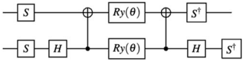
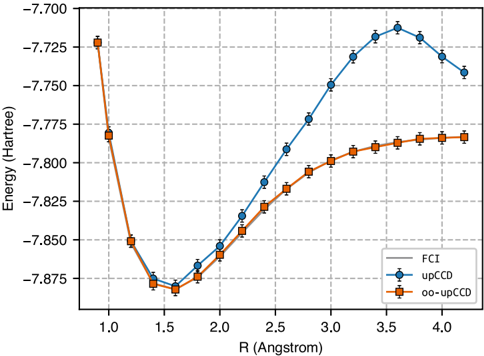
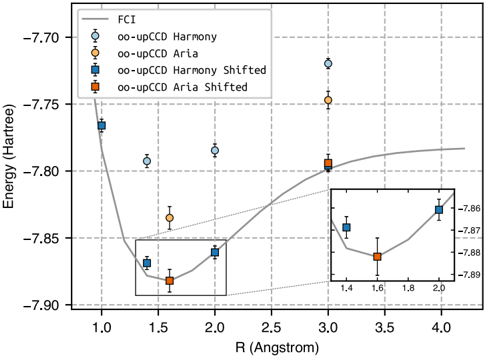
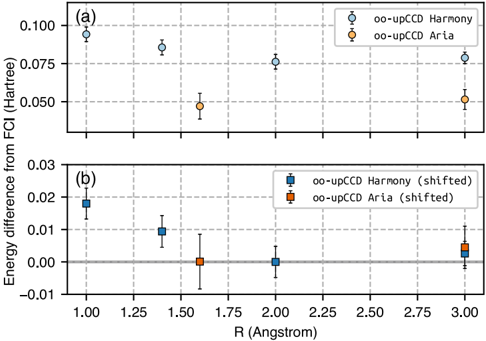
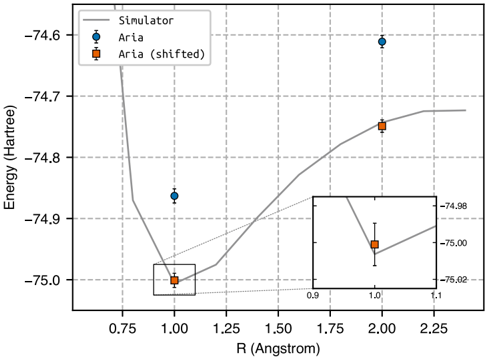
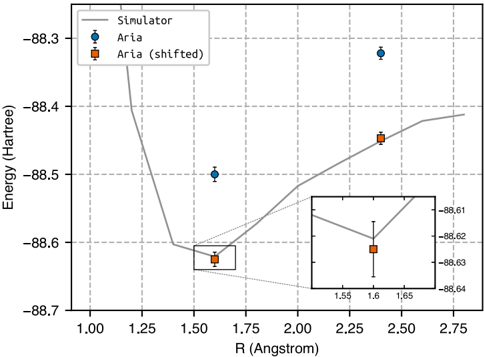
Variational quantum eigensolvers (VQE) are among the most promising approaches for solving electronic structure problems on near-term quantum computers. A critical challenge for VQE in practice is that one needs to strike a balance between the expressivity of the VQE ansatz versus the number of quantum gates required to implement the ansatz, given the reality of noisy quantum operations on near-term quantum computers. In this work, we consider an orbital-optimized pair-correlated approximation to the unitary coupled cluster with singles and doubles (uCCSD) ansatz and report a highly efficient quantum circuit implementation for trapped-ion architectures. We show that orbital optimization can recover significant additional electron correlation energy without sacrificing efficiency through measurements of low-order reduced density matrices (RDMs). In the dissociation of small molecules, the method gives qualitatively accurate predictions in the strongly-correlated regime when running on noise-free quantum simulators. On IonQ’s Harmony and Aria trapped-ion quantum computers, we run end-to-end VQE algorithms with up to 12 qubits and 72 variational parameters—the largest full VQE simulation with a correlated wave function on quantum hardware. We find that even without error mitigation techniques, the predicted relative energies across different molecular geometries are in excellent agreement with noise-free simulators.
Overview
The claims and statistics of this paper haven’t been checked yet.
Free: it reads the open-access text and checks the first 5 claims that cite a source we can check. Create a free account to check every claim.
Integrity signals
Registry
Cites
Statistics
Figures
Verification
Claims the paper makes
The claims and statistics of this paper haven’t been checked yet.
Free: it reads the open-access text and checks the first 5 claims that cite a source we can check. Create a free account to check every claim.
Self-check
Percentages, sums and reported differences re-computed from the paper’s own numbers.
The self-check needs the paper’s full text.
Citations
Cites
1 retracted
Quantum computational quantification of protein–ligand interactions
Kirsopp, J. J. M., Di Paola, C., Manrique, D. Z., Krompiec, M., Greene‐Diniz, G., Guba, W., Meyder, A., Wolf, D., Strahm, M., & Muñoz Ramo, D. (2022) · International Journal of Quantum Chemistry · doi:10.1002/qua.26975 · Cited by 59 · cited 2×
“[30] Josh JM Kirsopp, Cono Di Paola, David Zsolt Manrique, Michal Krompiec, Gabriel Greene-Diniz, Wolfgang Guba, Agnes Meyder, Detlef Wolf, Martin Strahm, and David Muñoz Ramo, “Quantum computational quantification of protein–ligand interactions,” International Journal of Quantum Chemistry 122, e26975 (2022).”
BackgroundRetractedQuantum supremacy using a programmable superconducting processor
Arute, F., Arya, K., Babbush, R., Bacon, D., Bardin, J. C., Barends, R., Biswas, R., Boixo, S., Brandao, F. G. S. L., Buell, D. A., et al. (2019) · Nature · doi:10.1038/s41586-019-1666-5 · Cited by 7,720 · cited 1×
“In contrast, quantum computation[8] has attracted significant attention for its potential to solve certain computational problems more efficiently than with classical computers, especially since IBM launched the first cloud accessible quantum computer and Google demonstrated quantum advantage[9].”
BackgroundA variational eigenvalue solver on a photonic quantum processor
Peruzzo, A., McClean, J., Shadbolt, P., Yung, M.-H., Zhou, X.-Q., Love, P. J., Aspuru-Guzik, A., & O’Brien, J. L. (2014) · Nature Communications · doi:10.1038/ncomms5213 · Cited by 4,552 · cited 2×
“Forging [33] H2O 5 3 Yes Yes IBM 2021 HEA [3] LiH (dipole moment) 4 16 Yes Yes IBM 2021 HEA [25] TADF 2 4 Yes Yes IBM 2021 qubit CC [34] H10 2 3 No Yes IonQ 2021 HEA [35] Li2O4 model 2 4 Yes Yes IBM 2020 Hartree-Fock [14] H12 12 36 Yes Yes Google 2020 upCCD [15] H2O 3 3 Yes No IonQ 2019 HEA [24] LiH 4 20 Yes Yes IBM 2…”
BackgroundMethodThe density-matrix renormalization group
Schollwöck, U. (2005) · Reviews of Modern Physics · doi:10.1103/revmodphys.77.259 · Cited by 3,323
Hardware-efficient variational quantum eigensolver for small molecules and quantum magnets
Kandala, A., Mezzacapo, A., Temme, K., Takita, M., Brink, M., Chow, J. M., & Gambetta, J. M. (2017) · Nature · doi:10.1038/nature23879 · Cited by 2,982 · cited 6×
“Forging [33] H2O 5 3 Yes Yes IBM 2021 HEA [3] LiH (dipole moment) 4 16 Yes Yes IBM 2021 HEA [25] TADF 2 4 Yes Yes IBM 2021 qubit CC [34] H10 2 3 No Yes IonQ 2021 HEA [35] Li2O4 model 2 4 Yes Yes IBM 2020 Hartree-Fock [14] H12 12 36 Yes Yes Google 2020 upCCD [15] H2O 3 3 Yes No IonQ 2019 HEA [24] LiH 4 20 Yes Yes IBM 2…”
BackgroundMethodInfluentialP y SCF: the Python‐based simulations of chemistry framework
Sun, Q., Berkelbach, T. C., Blunt, N. S., Booth, G. H., Guo, S., Li, Z., Liu, J., McClain, J. D., Sayfutyarova, E. R., Sharma, S., et al. (2018) · WIREs Computational Molecular Science · doi:10.1002/wcms.1340 · Cited by 1,741 · cited 3×
“All the calculations are performed in the STO-3G basis set provided by the PySCF[?”
BackgroundMethodInfluentialQuantum Chemistry in the Age of Quantum Computing
Cao, Y., Romero, J., Olson, J. P., Degroote, M., Johnson, P. D., Kieferová, M., Kivlichan, I. D., Menke, T., Peropadre, B., Sawaya, N. P. D., et al. (2019) · Chemical Reviews · doi:10.1021/acs.chemrev.8b00803 · Cited by 1,560 · cited 1×
“One of its most promising applications is to solve electronic structure problems efficiently[10]: to illustrate, consider that for a problem containing N spin orbitals, the number of classical bits required to represent the wave function scales combinatorially with N, while on a quantum computer only N qubits are need…”
BackgroundSimulated Quantum Computation of Molecular Energies
Aspuru-Guzik, A., Dutoi, A. D., Love, P. J., & Head-Gordon, M. (2005) · Science · doi:10.1126/science.1113479 · Cited by 1,418 · cited 6×
“in principle, the electronic energy can be exactly computed in polynomial time using quantum phase estimation (QPE)[48] or its iterative variant[49].”
MethodInfluentialQuantum Chemistry in the Age of Quantum Computing
Cao, Y., Romero, J., Olson, J., Degroote, M., Johnson, P., Kieferová, M., Kivlichan, I., Menke, T., Peropadre, B., Sawaya, N., et al. (n.d.) · OPUS - Open Publications of UTS Scholars (University of Technology Sydney) · Cited by 1,265
Scalable Quantum Simulation of Molecular Energies
O’Malley, P. J. J., Babbush, R., Kivlichan, I. D., Romero, J., McClean, J. R., Barends, R., Kelly, J., Roushan, P., Tranter, A., Ding, N., et al. (2016) · Physical Review X · doi:10.1103/physrevx.6.031007 · Cited by 1,059 · cited 2×
“Forging [33] H2O 5 3 Yes Yes IBM 2021 HEA [3] LiH (dipole moment) 4 16 Yes Yes IBM 2021 HEA [25] TADF 2 4 Yes Yes IBM 2021 qubit CC [34] H10 2 3 No Yes IonQ 2021 HEA [35] Li2O4 model 2 4 Yes Yes IBM 2020 Hartree-Fock [14] H12 12 36 Yes Yes Google 2020 upCCD [15] H2O 3 3 Yes No IonQ 2019 HEA [24] LiH 4 20 Yes Yes IBM 2…”
Method
Research works printed but not linked: 5
- Parr, R. G. & Yang, W. Density-Functional Theory of Atoms and Molecules (Oxford University Press, New York, 1989).
- Nielsen, M. A. & Chuang, I. L. Quantum Computation and Quantum Information (Cambridge University Press, Cambridge, 2010).
- Hempel, C. et al. Quantum Chemistry Calculations on a Trapped-Ion Quantum Computer. Phys. Rev. X 8, 031022 (2018).
- Gao, Q. et al. Applications of Quantum Computing for Investigations of Electronic Transitions in Phenylsulfonyl-carbazole TADF Emitters. npj Quant. Inf. 7, 70 (2021).
- Khan, I. et al. Chemically Aware Unitary Coupled Cluster with ab initio Calcula- tions on System Model H1: A Refrigerant Chemicals Application. J. Comp. Phys. 158, 214114 (2023).
Cited by
Chemistry beyond the scale of exact diagonalization on a quantum-centric supercomputer
Moreno, J. R., Motta, M., Haas, H., Javadi-Abhari, A., Jurcevic, P., Kirby, W., Martiel, S., Sharma, K., Sharma, S., Shirakawa, T., et al. (2025) · Science Advances · doi:10.1126/sciadv.adu9991 · Cited by 442
Experimental quantum computational chemistry with optimized unitary coupled cluster ansatz
Guo, S., Sun, J., Qian, H., Gong, M., Zhang, Y., Chen, F., Ye, Y., Wu, Y., Cao, S., Liu, K., et al. (2024) · Nature Physics · doi:10.1038/s41567-024-02530-z · Cited by 117
Quantum support vector machines for classification and regression on a trapped-ion quantum computer
Suzuki, T., Hasebe, T., & Miyazaki, T. (2024) · Quantum Machine Intelligence · doi:10.1007/s42484-024-00165-0 · Cited by 105
Feniou, C., Hassan, M., Traoré, D., Giner, E., Maday, Y., & Piquemal, J. (2023) · Communications Physics · doi:10.1038/s42005-023-01312-y · Cited by 100
Motta, M., Sung, K. J., Whaley, K. B., Head‐Gordon, M., & Shee, J. (2023) · Chemical Science · doi:10.1039/d3sc02516k · Cited by 139
Krylov diagonalization of large many-body Hamiltonians on a quantum processor
Yoshioka, N., Amico, M., Kirby, W., Jurcevic, P., Dutt, A., Fuller, B., Garion, S., Haas, H., Hamamura, I., Ivrii, A., et al. (2025) · Nature Communications · doi:10.1038/s41467-025-59716-z · Cited by 133
A hybrid quantum computing pipeline for real world drug discovery
Li, W., Yin, Z., Li, X., Ma, D., Yi, S., Zhang, Z., Zou, C., Bu, K., Dai, M., Yue, J., et al. (2024) · Scientific Reports · doi:10.1038/s41598-024-67897-8 · Cited by 67
“To reduce the qubit requirement, the paired unitary coupled-cluster ansatz can be employed, which requires only 1 qubits for each orbital due to the restriction of electron pairing 53,54 .”
MethodShajan, A., Kaliakin, D. S., Mitra, A., Moreno, J. R., Li, Z., Motta, M., Johnson, C., Saki, A. A., Das, S., Sitdikov, I., et al. (2025) · Journal of Chemical Theory and Computation · doi:10.1021/acs.jctc.5c00114 · Cited by 85
Quantum computing and chemistry
Weidman, J. D., Sajjan, M., Mikolas, C. A., Stewart, Z. J., Pollanen, J., Kais, S., & Wilson, A. K. (2024) · Cell Reports Physical Science · doi:10.1016/j.xcrp.2024.102105 · Cited by 71
Shirakawa, T., Robledo-Moreno, J., Itoko, T., Tripathi, V., Ueda, K., Kawashima, Y., Broers, L., Kirby, W., Pathak, H., Paik, H., et al. (2026) · Future Generation Computer Systems · doi:10.1016/j.future.2026.108731 · Cited by 53
“These issues have confined the scaling of quantum chemistry simulations to a few qubits [6].”
Accurate and gate-efficient quantum Ansätze for electronic states without adaptive optimization
Burton, H. G. A. (2024) · Physical Review Research · doi:10.1103/physrevresearch.6.023300 · Cited by 56
“Orbital optimisation has been shown to increase the accuracy of VQE for the UCC ansatz restricted to double excitations,[10, 45] pair-correlated simulations on real hardware,[46] and separable pair approximations .”
BackgroundStatistical Phase Estimation and Error Mitigation on a Superconducting Quantum Processor
Blunt, N. S., Caune, L., Izsák, R., Campbell, E. T., & Holzmann, N. (2023) · PRX Quantum · doi:10.1103/prxquantum.4.040341 · Cited by 48
Machine learning assisted construction of a shallow depth dynamic ansatz for noisy quantum hardware
Halder, S., Dey, A., Shrikhande, C., & Maitra, R. (2024) · Chemical Science · doi:10.1039/d3sc05807g · Cited by 29
Buonaiuto, G., Gargiulo, F., Pietro, G. D., Esposito, M., & Pota, M. (2024) · Quantum Machine Intelligence · doi:10.1007/s42484-024-00144-5 · Cited by 30
“Other types of quantum hardware will have different characteristics (Peruzzo et al. 2014; Zhao et al. 2023), i.e. more or less limitations depending on the specific feature under investigation.”
Computing band gaps of periodic materials via sample-based quantum diagonalization
Duriez, A., Carvalho, P. C., Barroca, M. A., Zipoli, F., Jaderberg, B., Ferreira, R. N. B., Sharma, K., Mezzacapo, A., Wunsch, B. H., & Steiner, M. B. (2026) · npj Computational Materials · doi:10.1038/s41524-026-02059-0 · Cited by 22
“However, the reduced scale and large amounts of hardware noise of modern-day quantum processors have so far limited the range of application to small systems with little industrial and technological relevance [31].”
TenCirChem: An Efficient Quantum Computational Chemistry Package for the NISQ Era
Li, W., Allcock, J., Cheng, L., Zhang, S., Chen, Y., Mailoa, J. P., Shuai, Z., & Zhang, S. (2023) · Journal of Chemical Theory and Computation · doi:10.1021/acs.jctc.3c00319 · Cited by 30
Zhao, L., Goings, J. J., Aboumrad, W., Arrasmith, A., Calderín, L., Churchill, S., Gabay, D., Harvey-Brown, T., Hiles, M. L., Kaja, M., et al. (2026) · Physical Review Research · doi:10.1103/n1tf-8kr7 · Cited by 24
Self-citationScalable approach to quantum simulation via projection-based embedding
Ralli, A., de la Bastida, M. W., & Coveney, P. V. (2024) · Physical Review A · doi:10.1103/physreva.109.022418 · Cited by 26
“To date, the largest chemical VQE simulations are a 12-qubit study of a H 12 chain [18] and a 12-qubit simulation of Li 2 O [19].”
Solving an industrially relevant quantum chemistry problem on quantum hardware
Nützel, L., Gresch, A., Hehn, L., Marti, L., Freund, R., Steiner, A., Marciniak, C. D., Eckstein, T., Stockinger, N., Wolf, S., et al. (2025) · Quantum Science and Technology · doi:10.1088/2058-9565/ad9ed3 · Cited by 33
Extending quantum computing through subspace, embedding and classical molecular dynamics techniques
Bickley, T. M., Mingare, A., Weaving, T., de la Bastida, M. W., Wan, S., Nibbi, M., Seitz, P., Ralli, A., Love, P. J., Chung, M. T., et al. (2025) · Digital Discovery · doi:10.1039/d5dd00225g · Cited by 23
Zeng, X., Fan, Y., Liu, J., Li, Z., & Yang, J. (2023) · Journal of Chemical Theory and Computation · doi:10.1021/acs.jctc.3c00527 · Cited by 18
“51 A practical quantum simulation should be able to generate data that can be tested with laboratory experiments.”
BackgroundWeaving, T., Ralli, A., Kirby, W. M., Love, P. J., Succi, S., & Coveney, P. V. (2023) · Physical Review Research · doi:10.1103/physrevresearch.5.043054 · Cited by 20
Selected Configuration Interaction Using Time-Evolved Population Statistics
Weaving, T., Mingare, A., Ralli, A., & Coveney, P. V. (2026) · Journal of Chemical Theory and Computation · doi:10.1021/acs.jctc.5c01994 · Cited by 14
Quantum encoder for fixed-Hamming-weight subspaces
Farias, R. M. S., Maciel, T. O., Camilo, G., Lin, R., Ramos-Calderer, S., & Aolita, L. (2025) · Physical Review Applied · doi:10.1103/physrevapplied.23.044014 · Cited by 23
“Moreover, HW-k encoders have the additional benefit of being the natural subspace for applications in fields such as quantum chemistry, due to the particle-preserving nature of typical Hamiltonians [1, 2, 23–25].”
Quantum machine learning of molecular energies with hybrid quantum-neural wavefunction
Li, W., Zhang, S., Sheng, Z., Gong, C., Chen, J., & Shuai, Z. (2025) · Digital Discovery · doi:10.1039/d5dd00222b · Cited by 12
“The orbital optimization pUCCD (oo-pUCCD) method [42, 55, 56] reduces the error to a modest extent for most molecules, except for N 2 and CO, where the errors of pUCCD and oo-pUCCD are comparable.”
Quantum subspace expansion in the presence of hardware noise
Getelina, J. C., Sharma, P., Iadecola, T., Orth, P. P., & Yao, Y. (2024) · APL Quantum · doi:10.1063/5.0217294 · Cited by 14
“…and correlation function measurement utilizing Trotter-decomposed circuits [8–17], ground state energy estimation using auxiliary-field quantum Monte Carlo guided by trial states prepared on a QPU (QC-AFQMC) [18], and state preparation by optimizing parameterized quantum circuits (PQCs) [19–21].”
MethodEfficient and Robust Parameter Optimization of the Unitary Coupled-Cluster Ansatz
Li, W., Ge, Y., Zhang, S., Chen, Y., & Zhang, S. (2024) · Journal of Chemical Theory and Computation · doi:10.1021/acs.jctc.4c00155 · Cited by 16
“The difficulty associated with parameter optimization is manifested by the growing popularity of pre-optimizing the circuit parameters on a classical simulator in recent hardware experiments [26–28].”
BackgroundMolecular Symmetry in VQE: A Dual Approach for Trapped-Ion Simulations of Benzene
Goings, J. J., Zhao, L., Jakowski, J., Morris, T., & Pooser, R. C. (2023) · IEEE International Conference on Quantum Computing and Engineering (QCE) · doi:10.1109/qce57702.2023.10187 · Cited by 16
“We follow closely with the approaches discussed in two previous studies [11], [17] on trapped-ion quantum computers.”
BackgroundMethodSelf-citationImplementation of the Projective Quantum Eigensolver on a Quantum Computer
Misiewicz, J. P., & Evangelista, F. A. (2024) · The Journal of Physical Chemistry A · doi:10.1021/acs.jpca.3c07429 · Cited by 13
Classical simulation of free-fermionic dynamics and quantum chemistry with magic inputPreprint
Oh, C., Oszmaniec, M., Reardon-Smith, O., & Zimborás, Z. (2026) · arXiv (Cornell University) · doi:10.48550/arxiv.2604.26813 · Cited by 11
“Recently, these paired-electron ans¨atze have also re-emerged as highly efficient, hardware-aware building blocks for near-term quantum processors (e.g., oo-upCCD circuits) [44, 45].”
A hybrid qubit encoding: splitting Fock space into Fermionic and Bosonic subspaces
Santos, F. J. D. A., & Kottmann, J. S. (2025) · Quantum Science and Technology · doi:10.1088/2058-9565/adbdee · Cited by 13
Bridging quantum computing and nuclear structure: Atomic nuclei on a trapped-ion quantum computer
Yoshida, S., Sato, T., Ogata, T., & Kimura, M. (2026) · Physical Review Research · doi:10.1103/td9s-z7my · Cited by 14
“| 1 → 5 In chemistry, pUCCD has been successfully applied to systems of paired electrons with spin up and spin down [21–23].”
Patra, C., Mukherjee, D., Halder, S., Mondal, D., & Maitra, R. (2024) · The Journal of Chemical Physics · doi:10.1063/5.0229137 · Cited by 12
Kottmann, J. S., & Scala, F. (2024) · Journal of Chemical Theory and Computation · doi:10.1021/acs.jctc.3c00565 · Cited by 19
“(12) re-expresses the transformed wavefunction in the spatial orbitals Note that, in contrast to other works [11, 38, 40, 41] we are not restricting the total Hamiltonian to the hard-core Boson approximation, but rather express the total wavefunction as a linear combination of hard-core Bosonic…”
ResultCascaded variational quantum eigensolver algorithm
Gunlycke, D., Hellberg, C. S., & Stenger, J. (2024) · Physical Review Research · doi:10.1103/physrevresearch.6.013238 · Cited by 12
“Since its introduction, the VQE algorithm has been applied to calculate the ground-state energy of a number of systems in chemistry and physics [12, 14–33].”
MethodGround-state-energy calculation for the water molecule on a superconducting quantum processor
Jones, M. A., Vallury, H. J., & Hollenberg, L. C. L. (2024) · Physical Review Applied · doi:10.1103/physrevapplied.21.064017 · Cited by 15
“While larger electronic structure computations have been performed, these are made possible by encoding multiple spin-orbitals into a single qubit [18,33–35] and/or through exploiting the assumption of weak entanglement [21, 29].”
BackgroundMethodEfficient Quantum Cooling Algorithm for Fermionic Systems
Marti, L., Mansuroglu, R., & Hartmann, M. J. (2025) · Quantum · doi:10.22331/q-2025-02-18-1635 · Cited by 18
Hardware-efficient variational quantum algorithm in a trapped-ion quantum computer
Zhuang, J.-Z., Wu, Y., & Duan, L.-M. (2024) · Physical Review A · doi:10.1103/physreva.110.062414 · Cited by 11
“Here, we consider the ground state problem of three commonly used molecules H 2 , LiH , and F 2 [20, 51].”
Seniority-zero wavefunction parameterizations
Calero-Osorio, D. F., & Ayers, P. W. (2025) · Theoretical Chemistry Accounts · doi:10.1007/s00214-025-03245-x · Cited by 8
Patra, C., Halder, S., & Maitra, R. (2024) · The Journal of Chemical Physics · doi:10.1063/5.0210854 · Cited by 11
Experimental quantum natural gradient optimization in photonics
Wang, Y., Xue, S., Wang, Y., Ding, J., Shi, W., Wang, D., Liu, Y., Liu, Y., Fu, X., Huang, G.-Y., et al. (2023) · Optics Letters · doi:10.1364/ol.494560 · Cited by 10
Construction of Chemistry-Inspired Dynamic Ansatz Utilizing Generative Machine Learning
Halder, S., Anand, K., & Maitra, R. (2025) · The Journal of Physical Chemistry A · doi:10.1021/acs.jpca.5c02346 · Cited by 9
Bidart, A., Vaish, P., Kabengele, T., Pang, Y., Liu, Y., & Rubenstein, B. M. (2026) · Annual Review of Physical Chemistry · doi:10.1146/annurev-physchem-082624-084635 · Cited by 10
“IonQ’s Aria system executed an orbital-optimized pair-correlated (oo-upCCD) VQE with 72 parameters on 12 qubits, mapping full dissociation curves for H 2 O and BeH 2 and retained simulator-level accuracy without explicit error mitigation [54].”
Singh, H., Bertels, L. W., Claudino, D., Economou, S. E., Barnes, E., Bauman, N. P., Kowalski, K., & Mayhall, N. J. (2025) · Journal of Chemical Theory and Computation · doi:10.1021/acs.jctc.5c00896 · Cited by 12
“Several ans¨atze have been explored in the context of VQE, generally falling into the categories of “chemistry-/physics-inspired”, 14,18,39–49 usually a modification of unitary coupled cluster (UCC) 50,51 or Jastrow 52 ans¨atze from classical electronic structure theory, or “hardware-efficient”, 19,53 which form an an…”
InfluentialEnhancing the electron pair approximation with measurements on trapped-ion quantum computers
Zhao, L., Wang, Q., Goings, J. J., Shin, K., Kyoung, W., Noh, S., Rhee, Y. M., & Kim, K. (2024) · npj Quantum Information · doi:10.1038/s41534-024-00871-4 · Cited by 13
“We recently developed a resource-ef fi cient VQE algorithm 27 for quantum chemistry simulations.”
Self-citationWang, Q., Agarawal, V., Hermes, M. R., Motta, M., Rice, J. E., Jones, G. O., & Gagliardi, L. (2024) · The Journal of Chemical Physics · doi:10.1063/5.0215697 · Cited by 6
Photonic variational quantum eigensolver using entanglement measurements
Lee, J., Song, W., Lee, D., Kim, Y., Lee, S.-W., Lim, H., Jung, H., Han, S.-W., & Kim, Y. (2024) · Quantum Science and Technology · doi:10.1088/2058-9565/ad6d87 · Cited by 8
Quantum computation of π → π* and n → π* excited states of aromatic heterocycles
Castellanos, M. A., Motta, M., & Rice, J. E. (2023) · Molecular Physics · doi:10.1080/00268976.2023.2282736 · Cited by 8
Tiled unitary product states for strongly correlated Hamiltonians
Burton, H. G. A. (2024) · Faraday Discussions · doi:10.1039/d4fd00064a · Cited by 9
On the theory of quantum and towards practical computation: A review
Kudelić, R. (2024) · Journal of Computational Science · doi:10.1016/j.jocs.2024.102454 · Cited by 7
Few-Shot, Robust Calibration of Single Qubit Gates Using Bayesian Robust Phase Estimation
Hurant, T., Sun, K., Jia, Z., Kim, J., & Brown, K. R. (2024) · IEEE International Conference on Quantum Computing and Engineering (QCE) · doi:10.1109/qce60285.2024.00147 · Cited by 5
“Progress in quantum computing has accelerated in recent years and systems containing tens of qubits now exist in both academia and industry [1], [5], [6], [14], [21], [23].”
Self-citationComparison of encoding schemes for quantum computing of S > 1 / 2 spin chains
Lötstedt, E., & Yamanouchi, K. (2025) · Physical Review A · doi:10.1103/7mvy-zq7j · Cited by 6
Seniority-zero linear canonical transformation theory
Calero-Osorio, D. F., & Ayers, P. W. (2026) · The Journal of Chemical Physics · doi:10.1063/5.0309818 · Cited by 5
Surrogate optimization of variational quantum circuits
Gustafson, E., Tiihonen, J., Chamaki, D., Sorourifar, F., Mullinax, J. W., Li, A. C. Y., Maciejewski, F. B., Sawaya, N. P. D., Krogel, J. T., Bernal, D. E., et al. (2025) · Proceedings of the National Academy of Sciences · doi:10.1073/pnas.2408530122 · Cited by 7
Characterization of overparametrization in the simulation of realistic quantum systems
Duschenes, M., Carrasquilla, J., & Laflamme, R. (2024) · Physical Review A · doi:10.1103/physreva.109.062607 · Cited by 6
Windom, Z. W., Claudino, D., & Bartlett, R. J. (2024) · The Journal of Physical Chemistry A · doi:10.1021/acs.jpca.4c03935 · Cited by 6
Algorithm for multireference unitary coupled-cluster quantum computations of molecule systems
Wu, D., Bai, C. L., Sagawa, H., & Zhang, H. Q. (2025) · Physical Review A · doi:10.1103/19cp-hfj9 · Cited by 4
Quantum simulation of carbon capture in periodic metal–organic frameworks
Rocca, D., Gonthier, J. F., Levin, J., Schäfer, T., Grüneis, A., Lee, H. W., & Kang, B. (2026) · Digital Discovery · doi:10.1039/d6dd00023a · Cited by 4
Du, X., Shen, Y., Wu, Z., Zeng, B., & Yang, S. (2024) · Physical Review Applied · doi:10.1103/physrevapplied.22.014055 · Cited by 4
“After that, VQE based on ion trap [22–24], superconducting [25– 30] and NMR [31] systems are also realized.”
MethodQuantum computing of Hückel molecular orbitals of linear polyenes
Ato, Y., Tachikawa, Y., Yoshida, R., Lötstedt, E., & Yamanouchi, K. (2025) · Chemical Physics Letters · doi:10.1016/j.cplett.2025.142276 · Cited by 4
Goings, J. J., Shin, K., Noh, S., Kyoung, W., Kim, D., Baek, J., Roetteler, M., Epifanovsky, E., & Zhao, L. (2025) · Journal of Chemical Theory and Computation · doi:10.1021/acs.jctc.5c01351 · Cited by 6
Self-citationAutomated near-term quantum algorithm discovery for molecular ground statesPreprint
Finger, F., Rapp, F., Kalidindi, P. V., He, K., Yin, K., Koziell-Pipe, A., Manrique, D. Z., Greene‐Diniz, G., Clark, S. R. L., Fawzi, H., et al. (2026) · arXiv (Cornell University) · doi:10.48550/arxiv.2603.26359 · Cited by 5
“Those strategies resemble an “engineer → test → refine” pattern aligned with pool-engineered adaptive-VQE resource reductions [49], coordinate-wise gradient-free excitation optimizers [50, 51], and orbital-optimized VQE strategies [52].”
A physics-informed measurement protocol for expectation values of fermionic observables
Bincoletto, D., & Kottmann, J. S. (2026) · Digital Discovery · doi:10.1039/d5dd00251f · Cited by 4
Photonic variational quantum eigensolver for NISQ-compatible quantum technology
Hu, K.-M., Namkung, M., & Lim, H. (2025) · Nano Convergence · doi:10.1186/s40580-025-00525-x · Cited by 4
Hakim, D. F., Prayitno, T. B., Choong, P. S., Sarwono, Y. P., & Kwek, L. C. (2026) · Physical Review A · doi:10.1103/jt1n-44dr · Cited by 5
Variational quantum eigensolver for closed-shell molecules with non-bosonic corrections
Kim, K., Lim, S., Shin, K., Lee, G., Jung, Y., Kyoung, W., Rhee, J. K., & Rhee, Y. M. (2024) · Physical Chemistry Chemical Physics · doi:10.1039/d3cp05570a · Cited by 11
Self-citationAdiabatic state preparation from general initial states
Fuller, B., Motta, M., Harwood, S. M., Murthy, C., Gujarati, T. P., Mezzacapo, A., & Trenev, D. (2025) · Molecular Physics · doi:10.1080/00268976.2025.2526723 · Cited by 2
Distributed photonic variational quantum eigensolver with parameterized weak measurements
Lee, D., Bilash, B., Lee, J., Lim, H., Kim, Y., Lee, S.-W., & Kim, Y.-S. (2026) · npj Quantum Information · doi:10.1038/s41534-025-01163-1 · Cited by 5
Rovibrational energy levels of H2O by quantum computing
Lötstedt, E., & Szidarovszky, T. (2026) · The Journal of Chemical Physics · doi:10.1063/5.0333947 · Cited by 3
Recent developments in TURBOMOLE
Franzke, Y. J., Sharma, M., Bhasin, P., Bruder, F., Huniar, U., Komonvasee, P., Krstić, M., Nejad, A., Pausch, A., Sorathia, K., et al. (2026) · The Journal of Chemical Physics · doi:10.1063/5.0351594 · Cited by 2
Rocca, D., Loipersberger, M., Gonthier, J. F., Parrish, R. M., Hong, J., Kang, B., Park, C., & Lee, H.-W. (2024) · IEEE International Conference on Quantum Computing and Engineering (QCE) · doi:10.1109/qce60285.2024.00082 · Cited by 2
Deterministic Storage of Quantum Information in the Genetic CodePreprint
Rivelino, R. (2024) · arXiv (Cornell University) · doi:10.48550/arxiv.2412.07504 · Cited by 2
Tripathi, A. P., Mathur, N., & Tripathi, V. (2026) · arXiv (Cornell University) · doi:10.48550/arxiv.2604.20961 · Cited by 2
“VQE was introduced in the context of quantum chemistry [19, 29], and since then it has been applied to a wide range of problems, including quantum chemistry [2, 4, 14, 26, 28, 41] and condensed matter systems [12, 16, 34, 37].”
Classical and Quantum Computing modalities - A Review
Rajni (2025) · Journal of Condensed Matter · doi:10.61343/jcm.v2i02.72 · Cited by 1
Wang, P., Yang, X., Wu, C.-W., Li, C.-Y., Wu, W., & Chen, P.-X. (2025) · Physical Review A · doi:10.1103/79nd-mr7f · Cited by 3
Fragment, Entangle, and Consolidate: Strong Correlation through Bifold Quantum Circuits
Choudhury, A., Halder, S., Maitra, R., & Ghosh, D. (2026) · Journal of Chemical Theory and Computation · doi:10.1021/acs.jctc.6c00512 · Cited by 2
Exploiting biased noise in variational quantum models
van Rossum, C., Shrapnel, S., & Gupta, R. S. (2026) · Quantum Science and Technology · doi:10.1088/2058-9565/ae636a · Cited by 2
Kalam, A., Deb, P., Sakurai, A., Sahoo, B. K., Prasannaa, V. S., & Das, B. P. (2026) · Physical Review Research · doi:10.1103/kmb5-nkqz · Cited by 1
Bassi, H., Shen, Y., Bhat, H. S., & Beeumen, R. V. (2025) · APL Quantum · doi:10.1063/5.0280978 · Cited by 1
Practical Quantum Chemistry on Near Term Quantum Computers
Ralli, A. (2023) · UCL Discovery (University College London) · Cited by 1
Benchmarking quantum trial wavefunctions for phaseless auxiliary-field quantum Monte CarloPreprint
Rofougaran, R., Mehta, N., Klymko, K., Rao, P., Mullinax, J. W., Stein, S., Tubman, N. M., & Rrapaj, E. (2026) · arXiv (Cornell University) · doi:10.48550/arxiv.2605.02056 · Cited by 1
“Therefore, the present work complements ex-3 isting VQE benchmarking studies [35] by examining these ansatze in a hybrid quantum–classical setting leveraging high-performance computing resources.”
Towards Quantum Computation of Bulk FeOPreprint
Staros, D. J., Petrovich, F., Kirmani, A. A., Blaschke, D. N., Cerezo, M., & Zhu, J.-X. (2026) · arXiv (Cornell University) · doi:10.48550/arxiv.2610.36268 · Cited by 1
“Molecular successes include the quantum computation of the H 2 ground state energy to within chemical accuracy, 14 ∗ jxzhu@lanl.gov the calculation of dissociation curves for H 2 , LiH, H 2 O, and BeH 2 , 20,21 and other examples as detailed in a recent review article.”
Simulation of time-dependent quantum dynamics using quantum computers
Lötstedt, E., Nishi, T., & Yamanouchi, K. (2024) · Advances in atomic, molecular, and optical physics · doi:10.1016/bs.aamop.2024.05.002 · Cited by 1
Exploring electron-phonon coupling using quantum computing methods
Zhou, P., & Shang, H. (2024) · Physica Scripta · doi:10.1088/1402-4896/ad8a01
MOSQ: Accelerating Classical Simulation of UCCSD Ansatz Circuits using Merged Operation
Choi, S., Jang, E., Kim, Y., & Ro, W. W. (2024) · IEEE International Conference on Computer Design: VLSI in Computers and Processors (ICCD) · doi:10.1109/iccd63220.2024.00090
Ma, S., Pan, G., & Guan, Y. (2025) · Lecture notes in computer science · doi:10.1007/978-981-95-1233-1_17
Low depth unitary coupled cluster algorithm for large chemical systems
Canfield, J., Zgid, D., & Freericks, J. K. (2026) · The Journal of Chemical Physics · doi:10.1063/5.0333459
Variational compilation of native gates for efficient trapped-ion Hamiltonian simulation
Wang, P., Li, C. Z., Shi, H., & Chen, P. (2026) · Chinese Physics B · doi:10.1088/1674-1056/ae6b33
Practical demonstration of high-accuracy electronic structure on a quantum computer
Per, M. C., Rhodes, N., Srikumar, M., & Dai, J. W. (2026) · AIP Advances · doi:10.1063/5.0329448
Applications of quantum computing to real materials: quantum simulations of conducting polymers
Sticher, L. F. C. (2026) · Spiral (Imperial College London) · doi:10.25560/131391
From QCCD Trapped-Ion Hardware to Quantum Compilers: Capabilities, Architectures, and CompilationPreprint
Schmid, L., Eisinger, J., Schoenberger, D., Marciniak, C. D., Hilder, J., Poschinger, U., Wille, R., & Schmidt‐Kaler, F. (2026) · arXiv (Cornell University) · doi:10.48550/arxiv.2610.36965
Provazza, J., Knitter, O., Goings, J. J., Epifanovsky, E., Chen, C., Roetteler, M., & Zhao, L. (2026) · arXiv (Cornell University) · doi:10.48550/arxiv.2611.08129
Self-citation
Metadata
- Authors
- Zhao, L., Goings, J., Shin, K., Kyoung, W., Fuks, J. I., Kevin Rhee, J.-K., Rhee, Y. M., Wright, K., Nguyen, J., Kim, J., & Johri, S.
- Affiliations
- IonQ (United States) (US)
- Hyundai Motors (South Korea) (KR)
- Korea Advanced Institute of Science and Technology (KR)
- Corresponding author
- Zhao, Luning
- Shin, Kyujin
- ORCID
- Venue
- npj Quantum Information
- Published
- 2023-06-23
- Volume
- 9
- Issue
- 1
- ISSN
- 2056-6387 (ISSN-L)
- OpenAlex
- W4381803783
- Semantic Scholar
- 7e9bdde6741b79e5853c88b8072258ccc77a9a8c
- Cited by
- 73
- References
- 54
- Citations by year
- 2026: 13 · 2025: 21 · 2024: 33 · 2023: 6
- FWCI
- 6.88
- Type
- journal article
- Language
- en
- Open access
- gold
- doi.org
- Licence
- cc-by
- creativecommons.org/licenses/by/4.0 (tdm)
- creativecommons.org/licenses/by/4.0 (vor)
- Locations
- npj Quantum Information (publishedVersion, cc-by)
- arXiv (Cornell University) (submittedVersion)
- DOAJ (DOAJ: Directory of Open Access Journals) (submittedVersion, cc-by-sa)
- arXiv (Cornell University) (cc-by)
- Funders
- Hyundai Motor Group
- Topics
- Physical Sciences › Computer Science › Artificial Intelligence › Quantum Computing Algorithms and Architecture
- Physical Sciences › Physics and Astronomy › Atomic and Molecular Physics, and Optics › Advanced Chemical Physics Studies
- Physical Sciences › Physics and Astronomy › Atomic and Molecular Physics, and Optics › Quantum many-body systems
- Keywords
- variational quantum eigensolver, orbital optimization, trapped-ion quantum computer, reduced density matrix, electron correlation energy, molecular dissociation, strongly correlated molecules, quantum circuit implementation, IonQ
About these checks
Registry, retraction, Cites and statistics results are computed, not judged, with one exception: a printed reference that no index lists is read once by a model before it counts as a citation error. Claims are extracted by a model and kept only when their quote appears verbatim in the text; each cited source is then checked, with a model’s help, for whether it says what the claim relies on. Those verdicts can be wrong — read the claim’s quote and the cited source before relying on one.
Statistics and arithmetic are recomputed, not judged.
Confidence bands are shown only for fields calibrated on our annotated test set. None is calibrated yet, so no band is shown.
What counts as a claim ›How we measure confidence ›How we check this ›
Are you an author, or do you see a problem with this page? Request a review
Data sources
Bibliographic data: Semantic Scholar, OpenAlex, Crossref.
Contains information from the Semantic Scholar Academic Graph Datasets, made available under the ODC Attribution License (ODC-BY 1.0).
Semantic Scholar’s data is described in: Kinney, R., et al. (2023). The Semantic Scholar Open Data Platform. arXiv:2301.10140.
