

Orbital-optimized pair-correlated electron simulations on trapped-ion quantum computers
Open accessThe DOI matches its Crossref record; 58 of the 58 references it cites were found in a registry or an index.
Abstract
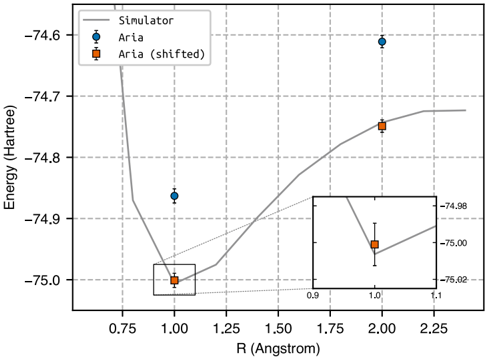
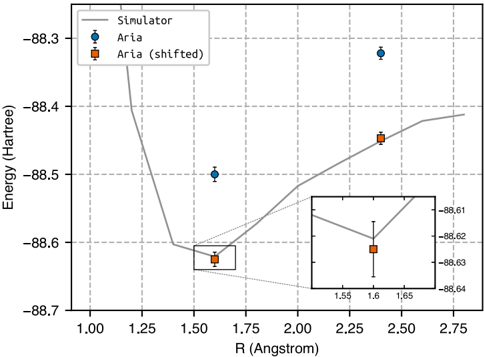
Variational quantum eigensolvers (VQE) are among the most promising approaches for solving electronic structure problems on near-term quantum computers. A critical challenge for VQE in practice is that one needs to strike a balance between the expressivity of the VQE ansatz versus the number of quantum gates required to implement the ansatz, given the reality of noisy quantum operations on near-term quantum computers. In this work, we consider an orbital-optimized pair-correlated approximation to the unitary coupled cluster with singles and doubles (uCCSD) ansatz and report a highly efficient quantum circuit implementation for trapped-ion architectures. We show that orbital optimization can recover significant additional electron correlation energy without sacrificing efficiency through measurements of low-order reduced density matrices (RDMs). In the dissociation of small molecules, the method gives qualitatively accurate predictions in the strongly-correlated regime when running on noise-free quantum simulators. On IonQ’s Harmony and Aria trapped-ion quantum computers, we run end-to-end VQE algorithms with up to 12 qubits and 72 variational parameters—the largest full VQE simulation with a correlated wave function on quantum hardware. We find that even without error mitigation techniques, the predicted relative energies across different molecular geometries are in excellent agreement with noise-free simulators.
Overview
The claims and statistics of this paper haven’t been checked yet.
Free: it reads the open-access text and checks the first 5 claims that cite a source we can check. Create a free account to check every claim.
Integrity signals
Registry
Cites
Statistics
Figures
Verification
Claims the paper makes
The claims and statistics of this paper haven’t been checked yet.
Free: it reads the open-access text and checks the first 5 claims that cite a source we can check. Create a free account to check every claim.
Self-check
Percentages, sums and reported differences re-computed from the paper’s own numbers.
The self-check needs the paper’s full text.
Citations
Cites
1 retracted
Quantum computational quantification of protein–ligand interactions
Kirsopp, J. J. M., Di Paola, C., Manrique, D. Z., Krompiec, M., Greene‐Diniz, G., Guba, W., Meyder, A., Wolf, D., Strahm, M., & Muñoz Ramo, D. (2022) · International Journal of Quantum Chemistry · doi:10.1002/qua.26975 · Cited by 59 · cited 2×
“[30] Josh JM Kirsopp, Cono Di Paola, David Zsolt Manrique, Michal Krompiec, Gabriel Greene-Diniz, Wolfgang Guba, Agnes Meyder, Detlef Wolf, Martin Strahm, and David Muñoz Ramo, “Quantum computational quantification of protein–ligand interactions,” International Journal of Quantum Chemistry 122, e26975 (2022).”
BackgroundRetractedQuantum supremacy using a programmable superconducting processor
Arute, F., Arya, K., Babbush, R., Bacon, D., Bardin, J. C., Barends, R., Biswas, R., Boixo, S., Brandao, F. G. S. L., Buell, D. A., et al. (2019) · Nature · doi:10.1038/s41586-019-1666-5 · Cited by 7,720 · cited 1×
“In contrast, quantum computation[8] has attracted significant attention for its potential to solve certain computational problems more efficiently than with classical computers, especially since IBM launched the first cloud accessible quantum computer and Google demonstrated quantum advantage[9].”
BackgroundA variational eigenvalue solver on a photonic quantum processor
Peruzzo, A., McClean, J., Shadbolt, P., Yung, M.-H., Zhou, X.-Q., Love, P. J., Aspuru-Guzik, A., & O’Brien, J. L. (2014) · Nature Communications · doi:10.1038/ncomms5213 · Cited by 4,552 · cited 2×
“Forging [33] H2O 5 3 Yes Yes IBM 2021 HEA [3] LiH (dipole moment) 4 16 Yes Yes IBM 2021 HEA [25] TADF 2 4 Yes Yes IBM 2021 qubit CC [34] H10 2 3 No Yes IonQ 2021 HEA [35] Li2O4 model 2 4 Yes Yes IBM 2020 Hartree-Fock [14] H12 12 36 Yes Yes Google 2020 upCCD [15] H2O 3 3 Yes No IonQ 2019 HEA [24] LiH 4 20 Yes Yes IBM 2…”
BackgroundMethodThe density-matrix renormalization group
Schollwöck, U. (2005) · Reviews of Modern Physics · doi:10.1103/revmodphys.77.259 · Cited by 3,323
Hardware-efficient variational quantum eigensolver for small molecules and quantum magnets
Kandala, A., Mezzacapo, A., Temme, K., Takita, M., Brink, M., Chow, J. M., & Gambetta, J. M. (2017) · Nature · doi:10.1038/nature23879 · Cited by 2,982 · cited 6×
“Forging [33] H2O 5 3 Yes Yes IBM 2021 HEA [3] LiH (dipole moment) 4 16 Yes Yes IBM 2021 HEA [25] TADF 2 4 Yes Yes IBM 2021 qubit CC [34] H10 2 3 No Yes IonQ 2021 HEA [35] Li2O4 model 2 4 Yes Yes IBM 2020 Hartree-Fock [14] H12 12 36 Yes Yes Google 2020 upCCD [15] H2O 3 3 Yes No IonQ 2019 HEA [24] LiH 4 20 Yes Yes IBM 2…”
BackgroundMethodInfluentialP y SCF: the Python‐based simulations of chemistry framework
Sun, Q., Berkelbach, T. C., Blunt, N. S., Booth, G. H., Guo, S., Li, Z., Liu, J., McClain, J. D., Sayfutyarova, E. R., Sharma, S., et al. (2018) · WIREs Computational Molecular Science · doi:10.1002/wcms.1340 · Cited by 1,741 · cited 3×
“All the calculations are performed in the STO-3G basis set provided by the PySCF[?”
BackgroundMethodInfluentialQuantum Chemistry in the Age of Quantum Computing
Cao, Y., Romero, J., Olson, J. P., Degroote, M., Johnson, P. D., Kieferová, M., Kivlichan, I. D., Menke, T., Peropadre, B., Sawaya, N. P. D., et al. (2019) · Chemical Reviews · doi:10.1021/acs.chemrev.8b00803 · Cited by 1,560 · cited 1×
“One of its most promising applications is to solve electronic structure problems efficiently[10]: to illustrate, consider that for a problem containing N spin orbitals, the number of classical bits required to represent the wave function scales combinatorially with N, while on a quantum computer only N qubits are need…”
BackgroundSimulated Quantum Computation of Molecular Energies
Aspuru-Guzik, A., Dutoi, A. D., Love, P. J., & Head-Gordon, M. (2005) · Science · doi:10.1126/science.1113479 · Cited by 1,418 · cited 6×
“in principle, the electronic energy can be exactly computed in polynomial time using quantum phase estimation (QPE)[48] or its iterative variant[49].”
MethodInfluentialQuantum Chemistry in the Age of Quantum Computing
Cao, Y., Romero, J., Olson, J., Degroote, M., Johnson, P., Kieferová, M., Kivlichan, I., Menke, T., Peropadre, B., Sawaya, N., et al. (n.d.) · OPUS - Open Publications of UTS Scholars (University of Technology Sydney) · Cited by 1,265
Scalable Quantum Simulation of Molecular Energies
O’Malley, P. J. J., Babbush, R., Kivlichan, I. D., Romero, J., McClean, J. R., Barends, R., Kelly, J., Roushan, P., Tranter, A., Ding, N., et al. (2016) · Physical Review X · doi:10.1103/physrevx.6.031007 · Cited by 1,059 · cited 2×
“Forging [33] H2O 5 3 Yes Yes IBM 2021 HEA [3] LiH (dipole moment) 4 16 Yes Yes IBM 2021 HEA [25] TADF 2 4 Yes Yes IBM 2021 qubit CC [34] H10 2 3 No Yes IonQ 2021 HEA [35] Li2O4 model 2 4 Yes Yes IBM 2020 Hartree-Fock [14] H12 12 36 Yes Yes Google 2020 upCCD [15] H2O 3 3 Yes No IonQ 2019 HEA [24] LiH 4 20 Yes Yes IBM 2…”
MethodAn adaptive variational algorithm for exact molecular simulations on a quantum computer
Grimsley, H. R., Economou, S. E., Barnes, E., & Mayhall, N. J. (2019) · Nature Communications · doi:10.1038/s41467-019-10988-2 · Cited by 1,033 · cited 2×
“Fortunately, there exist scalable approaches for identifying and simulating only non-redundant parameters, such as the gradient based selection used for the ADAPT-VQE[17] method.”
MethodError mitigation extends the computational reach of a noisy quantum processor
Kandala, A., Temme, K., Córcoles, A. D., Mezzacapo, A., Chow, J. M., & Gambetta, J. M. (2019) · Nature · doi:10.1038/s41586-019-1040-7 · Cited by 871 · cited 7×
“Over the past few years, various error mitigation methods have been developed, such as noise extrapolation [24], density matrix purification [14, 18], symmetry verification [54], randomized compiling [55], and noise-estimation.”
BackgroundMethodInfluentialHamiltonian Simulation by Qubitization
Low, G. H., & Chuang, I. L. (2019) · Quantum · doi:10.22331/q-2019-07-12-163 · Cited by 854
Towards quantum chemistry on a quantum computer
Lanyon, B. P., Whitfield, J. D., Gillett, G. G., Goggin, M. E., Almeida, M. P., Kassal, I., Biamonte, J. D., Mohseni, M., Powell, B. J., Barbieri, M., et al. (2010) · Nature Chemistry · doi:10.1038/nchem.483 · Cited by 796 · cited 1×
“in principle, the electronic energy can be exactly computed in polynomial time using quantum phase estimation (QPE)[48] or its iterative variant[49].”
MethodHartree-Fock on a superconducting qubit quantum computer
Collaborators, G. A. Q. A., Arute, F., Arya, K., Babbush, R., Bacon, D., Bardin, J. C., Barends, R., Boixo, S., Broughton, M., Buckley, B. B., et al. (2020) · Science · doi:10.1126/science.abb9811 · Cited by 729 · cited 8×
“However, the calculations faced a considerable amount of hardware noise, necessitating the use of Hartree-Fock specific error mitigation techniques to achieve sufficiently accurate results.”
BackgroundMethodInfluentialHamiltonian Simulation by Qubitization
Low, G. H., & Chuang, I. L. (2019) · DSpace@MIT (Massachusetts Institute of Technology) · Cited by 714
Computation of Molecular Spectra on a Quantum Processor with an Error-Resilient Algorithm
Colless, J. I., Ramasesh, V. V., Dahlen, D., Blok, M. S., Kimchi-Schwartz, M. E., McClean, J. R., Carter, J., de Jong, W. A., & Siddiqi, I. (2018) · Physical Review X · doi:10.1103/physrevx.8.011021 · Cited by 460 · cited 4×
“Forging [33] H2O 5 3 Yes Yes IBM 2021 HEA [3] LiH (dipole moment) 4 16 Yes Yes IBM 2021 HEA [25] TADF 2 4 Yes Yes IBM 2021 qubit CC [34] H10 2 3 No Yes IonQ 2021 HEA [35] Li2O4 model 2 4 Yes Yes IBM 2020 Hartree-Fock [14] H12 12 36 Yes Yes Google 2020 upCCD [15] H2O 3 3 Yes No IonQ 2019 HEA [24] LiH 4 20 Yes Yes IBM 2…”
MethodInfluentialOptimal quantum circuits for general two-qubit gates
Vatan, F., & Williams, C. (2004) · Physical Review A · doi:10.1103/physreva.69.032315 · Cited by 443 · cited 2×
“As has been shown before [27], the Givens rotation matrix belongs to the SO(4) group, which can be implemented in 12 elementary (i.”
BackgroundMethodGeneralized Unitary Coupled Cluster Wave functions for Quantum Computation
Lee, J., Huggins, W. J., Head-Gordon, M., & Whaley, K. B. (2019) · Journal of Chemical Theory and Computation · doi:10.1021/acs.jctc.8b01004 · Cited by 432
Encoding Electronic Spectra in Quantum Circuits with Linear T Complexity
Babbush, R., Gidney, C., Berry, D. W., Wiebe, N., McClean, J., Paler, A., Fowler, A., & Neven, H. (2018) · Physical Review X · doi:10.1103/physrevx.8.041015 · Cited by 383
Barkoutsos, P. K., Gonthier, J. F., Sokolov, I., Moll, N., Salis, G., Fuhrer, A., Ganzhorn, M., Egger, D. J., Troyer, M., Mezzacapo, A., et al. (2018) · Physical Review A · doi:10.1103/physreva.98.022322 · Cited by 363
Ground-state energy estimation of the water molecule on a trapped-ion quantum computer
Nam, Y., Chen, J.-S., Pisenti, N. C., Wright, K., Delaney, C., Maslov, D., Brown, K. R., Allen, S., Amini, J. M., Apisdorf, J., et al. (2020) · npj Quantum Information · doi:10.1038/s41534-020-0259-3 · Cited by 345
Self-citationEven More Efficient Quantum Computations of Chemistry Through Tensor Hypercontraction
Lee, J., Berry, D. W., Gidney, C., Huggins, W. J., McClean, J. R., Wiebe, N., & Babbush, R. (2021) · PRX Quantum · doi:10.1103/prxquantum.2.030305 · Cited by 304
Qubit Coupled Cluster Method: A Systematic Approach to Quantum Chemistry on a Quantum Computer
Ryabinkin, I. G., Yen, T.-C., Genin, S. N., & Izmaylov, A. F. (2018) · Journal of Chemical Theory and Computation · doi:10.1021/acs.jctc.8b00932 · Cited by 287
Quantum computing enhanced computational catalysis
von Burg, V., Low, G. H., Häner, T., Steiger, D. S., Reiher, M., Roetteler, M., & Troyer, M. (2020) · arXiv · doi:10.48550/arxiv.2007.14460 · Cited by 258 · cited 1×
“Finding accurate solutions to the electronic structure problem is of great importance to various industries, from modeling pharmaceutical drug docking [1], to designing new materials for light harvesting and CO2 reduction [2], to elucidating reaction mechanisms in novel battery materials [3].”
BackgroundQuantum computing enhanced computational catalysis
von Burg, V., Low, G. H., Häner, T., Steiger, D. S., Reiher, M., Roetteler, M., & Troyer, M. (2021) · Physical Review Research · doi:10.1103/physrevresearch.3.033055 · Cited by 252 · cited 1×
“Finding accurate solutions to the electronic structure problem is of great importance to various industries, from modeling pharmaceutical drug docking [1], to designing new materials for light harvesting and CO2 reduction [2], to elucidating reaction mechanisms in novel battery materials [3].”
BackgroundError-Mitigated Digital Quantum Simulation
McArdle, S., Yuan, X., & Benjamin, S. (2019) · Physical Review Letters · doi:10.1103/physrevlett.122.180501 · Cited by 245 · cited 1×
“Over the past few years, various error mitigation methods have been developed, such as noise extrapolation [24], density matrix purification [14, 18], symmetry verification [54], randomized compiling [55], and noise-estimation.”
BackgroundQuantum chemistry as a benchmark for near-term quantum computers
McCaskey, A. J., Parks, Z. P., Jakowski, J., Moore, S. V., Morris, T. D., Humble, T. S., & Pooser, R. C. (2019) · npj Quantum Information · doi:10.1038/s41534-019-0209-0 · Cited by 223 · cited 2×
“Forging [33] H2O 5 3 Yes Yes IBM 2021 HEA [3] LiH (dipole moment) 4 16 Yes Yes IBM 2021 HEA [25] TADF 2 4 Yes Yes IBM 2021 qubit CC [34] H10 2 3 No Yes IonQ 2021 HEA [35] Li2O4 model 2 4 Yes Yes IBM 2020 Hartree-Fock [14] H12 12 36 Yes Yes Google 2020 upCCD [15] H2O 3 3 Yes No IonQ 2019 HEA [24] LiH 4 20 Yes Yes IBM 2…”
BackgroundMethodPerspective on the Current State-of-the-Art of Quantum Computing for Drug Discovery Applications
Blunt, N. S., Camps, J., Crawford, O., Izsák, R., Leontica, S., Mirani, A., Moylett, A. E., Scivier, S. A., Sünderhauf, C., Schopf, P., et al. (2022) · Journal of Chemical Theory and Computation · doi:10.1021/acs.jctc.2c00574 · Cited by 192 · cited 1×
“Finding accurate solutions to the electronic structure problem is of great importance to various industries, from modeling pharmaceutical drug docking [1], to designing new materials for light harvesting and CO2 reduction [2], to elucidating reaction mechanisms in novel battery materials [3].”
BackgroundKent, P. R. C., Annaberdiyev, A., Benali, A., Bennett, M. C., Borda, E. J. L., Doak, P., Hao, H., Jordan, K. D., Krogel, J. T., Kylänpää, I., et al. (2020) · The Journal of Chemical Physics · doi:10.1063/5.0004860 · Cited by 185 · cited 2×
“In these cases, approximate approaches may either fail completely (such as in single-reference methods like DFT or CC), or will be prohibitively costly (such as in multi-reference methods like DMRG or QMC).”
MethodSelf-citationIterative Qubit Coupled Cluster Approach with Efficient Screening of Generators
Ryabinkin, I. G., Lang, R. A., Genin, S. N., & Izmaylov, A. F. (2020) · Journal of Chemical Theory and Computation · doi:10.1021/acs.jctc.9b01084 · Cited by 170
Takeshita, T., Rubin, N. C., Jiang, Z., Lee, E., Babbush, R., & McClean, J. R. (2020) · Physical Review X · doi:10.1103/physrevx.10.011004 · Cited by 165 · cited 3×
“A more practical way is to trade-off circuit depths with measurements and employ approaches such as the quantum subspace expansion (QSE) [37, 53].”
MethodSokolov, I. O., Barkoutsos, P. K., Ollitrault, P. J., Greenberg, D., Rice, J., Pistoia, M., & Tavernelli, I. (2020) · The Journal of Chemical Physics · doi:10.1063/1.5141835 · Cited by 164
Mitigating Depolarizing Noise on Quantum Computers with Noise-Estimation Circuits
Urbanek, M., Nachman, B., Pascuzzi, V. R., He, A., Bauer, C. W., & de Jong, W. A. (2021) · Physical Review Letters · doi:10.1103/physrevlett.127.270502 · Cited by 163 · cited 1×
“Over the past few years, various error mitigation methods have been developed, such as noise extrapolation [24], density matrix purification [14, 18], symmetry verification [54], randomized compiling [55], and noise-estimation.[56] We believe that an efficient VQE approach combined with measurement based post-processi…”
BackgroundNearest centroid classification on a trapped ion quantum computer
Johri, S., Debnath, S., Mocherla, A., Singh, A., Prakash, A., Kim, J., & Kerenidis, I. (2021) · npj Quantum Information · doi:10.1038/s41534-021-00456-5 · Cited by 160 · cited 1×
“It has been used in numerous applications, including quantum chemistry [15, 34], quantum machine learning [44, 45], and finance [46, 47].”
Self-citationDoubling the Size of Quantum Simulators by Entanglement Forging
Eddins, A., Motta, M., Gujarati, T. P., Bravyi, S., Mezzacapo, A., Hadfield, C., & Sheldon, S. (2022) · PRX Quantum · doi:10.1103/prxquantum.3.010309 · Cited by 160 · cited 2×
“[33] Andrew Eddins, Mario Motta, Tanvi P Gujarati, Sergey Bravyi, Antonio Mezzacapo, Charles Hadfield, and Sarah Sheldon, “Doubling the size of quantum simulators by entanglement forging,” PRX Quantum 3, 010309 (2022).”
BackgroundMethodApplication-Oriented Performance Benchmarks for Quantum Computing
Lubinski, T., Johri, S., Varosy, P., Coleman, J., Zhao, L., Necaise, J., Baldwin, C. H., Mayer, K., & Proctor, T. (2021) · arXiv · doi:10.48550/arxiv.2110.03137 · Cited by 159
Self-citationIs the Trotterized UCCSD Ansatz Chemically Well-Defined?
Grimsley, H. R., Claudino, D., Economou, S. E., Barnes, E., & Mayhall, N. J. (2020) · Journal of Chemical Theory and Computation · doi:10.1021/acs.jctc.9b01083 · Cited by 157
Application-Oriented Performance Benchmarks for Quantum Computing
Lubinski, T., Johri, S., Varosy, P., Coleman, J., Zhao, L., Necaise, J., Baldwin, C. H., Mayer, K., & Proctor, T. (2023) · IEEE Transactions on Quantum Engineering · doi:10.1109/tqe.2023.3253761 · Cited by 154
Self-citationThe influence of orbital rotation on the energy of closed-shell wavefunctions
Limacher, P. A., Kim, T. D., Ayers, P. W., Johnson, P. A., Baerdemacker, S. D., Neck, D. V., & Bultinck, P. (2014) · Molecular Physics · doi:10.1080/00268976.2013.874600 · Cited by 132
Purification-based quantum error mitigation of pair-correlated electron simulations
O’Brien, T. E., Anselmetti, G.-L., Gkritsis, F., Elfving, V. E., Polla, S., Huggins, W. J., Oumarou, O., Kechedzhi, K., Abanin, D. A., Acharya, R., et al. (2023) · Nature Physics · doi:10.1038/s41567-023-02240-y · Cited by 129 · cited 6×
“Year Ansatz System # Qubits # Parameters Full VQE? Error Mitigation? Hardware Vendor 2022 oo-upCCD [this work] Li2O 12 72 Yes No IonQ 2022 upCCD [26] Cyclobutene Ring 10 25 No Yes Google 2022 uCCSD [29] CH3 6 4 No Yes Quantinuum”
BackgroundMethodInfluentialRandomized Compiling for Scalable Quantum Computing on a Noisy Superconducting Quantum Processor
Hashim, A., Naik, R. K., Morvan, A., Ville, J.-L., Mitchell, B., Kreikebaum, J. M., Davis, M., Smith, E., Iancu, C., O’Brien, K. P., et al. (2021) · Physical Review X · doi:10.1103/physrevx.11.041039 · Cited by 128 · cited 1×
“Over the past few years, various error mitigation methods have been developed, such as noise extrapolation [24], density matrix purification [14, 18], symmetry verification [54], randomized compiling [55], and noise-estimation.”
BackgroundGeneration of High-Resolution Handwritten Digits with an Ion-Trap Quantum Computer
Rudolph, M. S., Toussaint, N. B., Katabarwa, A., Johri, S., Peropadre, B., & Perdomo-Ortiz, A. (2020) · arXiv · doi:10.48550/arxiv.2012.03924 · Cited by 97 · cited 1×
“It has been used in numerous applications, including quantum chemistry [15, 34], quantum machine learning [44, 45], and finance [46, 47].”
Self-citationQuantum computation of dominant products in lithium–sulfur batteries
Rice, J. E., Gujarati, T. P., Motta, M., Takeshita, T. Y., Lee, E., Latone, J. A., & Garcia, J. M. (2021) · The Journal of Chemical Physics · doi:10.1063/5.0044068 · Cited by 97 · cited 7×
“Finding accurate solutions to the electronic structure problem is of great importance to various industries, from modeling pharmaceutical drug docking [1], to designing new materials for light harvesting and CO2 reduction [2], to elucidating reaction mechanisms in novel battery materials [3].”
BackgroundMethodInfluentialLocal, expressive, quantum-number-preserving VQE ansätze for fermionic systems
Anselmetti, G.-L. R., Wierichs, D., Gogolin, C., & Parrish, R. M. (2021) · New Journal of Physics · doi:10.1088/1367-2630/ac2cb3 · Cited by 96
Generation of High-Resolution Handwritten Digits with an Ion-Trap Quantum Computer
Rudolph, M. S., Toussaint, N. B., Katabarwa, A., Johri, S., Peropadre, B., & Perdomo-Ortiz, A. (2022) · Physical Review X · doi:10.1103/physrevx.12.031010 · Cited by 94 · cited 1×
“It has been used in numerous applications, including quantum chemistry [15, 34], quantum machine learning [44, 45], and finance [46, 47].”
Self-citationA Generic Compilation Strategy for the Unitary Coupled Cluster AnsatzPreprint
Cowtan, A., Simmons, W., & Duncan, R. (2020) · arXiv (Cornell University) · doi:10.48550/arxiv.2007.10515 · Cited by 86 · cited 1×
“Even the most efficient implementation of uCCSD circuits contain thousands of entangling gates for small systems[19], which makes it impractical to run on NISQ quantum computers.”
BackgroundKawashima, Y., Lloyd, E., Coons, M. P., Nam, Y., Matsuura, S., Garza, A. J., Johri, S., Huntington, L. M. J., Senicourt, V., Maksymov, A., et al. (2021) · Communications Physics · doi:10.1038/s42005-021-00751-9 · Cited by 84 · cited 2×
“Forging [33] H2O 5 3 Yes Yes IBM 2021 HEA [3] LiH (dipole moment) 4 16 Yes Yes IBM 2021 HEA [25] TADF 2 4 Yes Yes IBM 2021 qubit CC [34] H10 2 3 No Yes IonQ 2021 HEA [35] Li2O4 model 2 4 Yes Yes IBM 2020 Hartree-Fock [14] H12 12 36 Yes Yes Google 2020 upCCD [15] H2O 3 3 Yes No IonQ 2019 HEA [24] LiH 4 20 Yes Yes IBM 2…”
MethodSelf-citationGenerative quantum learning of joint probability distribution functions
Zhu, E. Y., Johri, S., Bacon, D., Esencan, M., Kim, J., Muir, M., Murgai, N., Nguyen, J., Pisenti, N. C., Schouela, A., et al. (2022) · Physical Review Research · doi:10.1103/physrevresearch.4.043092 · Cited by 81 · cited 1×
“It has been used in numerous applications, including quantum chemistry [15, 34], quantum machine learning [44, 45], and finance [46, 47].”
Self-citationPair extended coupled cluster doubles
Henderson, T. M., Bulik, I. W., & Scuseria, G. E. (2015) · The Journal of Chemical Physics · doi:10.1063/1.4921986 · Cited by 70
Motta, M., Jones, G. O., Rice, J. E., Gujarati, T. P., Sakuma, R., Liepuoniute, I., García, J. M., & Ohnishi, Y. (2023) · Chemical Science · doi:10.1039/d2sc06019a · Cited by 66 · cited 2×
“[32] Mario Motta, Gavin O Jones, Julia E Rice, Tanvi P Gujarati, Rei Sakuma, Ieva Liepuoniute, Jeannette M Garcia, and Yuya Ohnishi, “Quantum chemistry simulation of ground-and excited-state properties of the sulfonium cation on a superconducting quantum processor,” arXiv preprint arXiv:2208.”
BackgroundSimulating quantum chemistry in the seniority-zero space on qubit-based quantum computers
Elfving, V. E., Millaruelo, M., Gámez, J. A., & Gogolin, C. (2021) · Physical Review A · doi:10.1103/physreva.103.032605 · Cited by 65 · cited 1×
“Technique Effect Previous work Electron Pair→Bosons Reduce number of qubits by a factor of 2 [15] Givens Rotation with Magic Gate Most efficient Givens rotation implementation in terms of CX gates [27] Hamiltonian Grouping 3 circuits per energy measurements regardless of system size [28] Measurement of RDMs 3 circuits…”
MethodComputational Investigations of the Lithium Superoxide Dimer Rearrangement on Noisy Quantum Devices
Gao, Q., Nakamura, H., Gujarati, T. P., Jones, G. O., Rice, J. E., Wood, S. P., Pistoia, M., Garcia, J. M., & Yamamoto, N. (2021) · The Journal of Physical Chemistry A · doi:10.1021/acs.jpca.0c09530 · Cited by 60 · cited 7×
“Forging [33] H2O 5 3 Yes Yes IBM 2021 HEA [3] LiH (dipole moment) 4 16 Yes Yes IBM 2021 HEA [25] TADF 2 4 Yes Yes IBM 2021 qubit CC [34] H10 2 3 No Yes IonQ 2021 HEA [35] Li2O4 model 2 4 Yes Yes IBM 2020 Hartree-Fock [14] H12 12 36 Yes Yes Google 2020 upCCD [15] H2O 3 3 Yes No IonQ 2019 HEA [24] LiH 4 20 Yes Yes IBM 2…”
BackgroundMethodInfluentialYamamoto, K., Manrique, D. Z., Khan, I. T., Sawada, H., & Ramo, D. M. (2022) · Physical Review Research · doi:10.1103/physrevresearch.4.033110 · Cited by 36 · cited 2×
“[31] Kentaro Yamamoto, David Zsolt Manrique, Irfan T Khan, Hideaki Sawada, and David Muñoz Ramo, “Quantum hardware calculations of periodic systems with partition-”
BackgroundKhan, I. T., Tudorovskaya, M., Kirsopp, J. J. M., Ramo, D. M., Warrier, P. W., Papanastasiou, D. K., & Singh, R. (2023) · The Journal of Chemical Physics · doi:10.1063/5.0144680 · Cited by 30
Low-depth amplitude estimation on a trapped-ion quantum computer
Giurgică-Tiron, T., Johri, S., Kerenidis, I., Nguyen, J., Pisenti, N. C., Prakash, A., Sosnova, K., Wright, K., & Zeng, W. J. (2022) · Physical Review Research · doi:10.1103/physrevresearch.4.033034 · Cited by 27 · cited 1×
“It has been used in numerous applications, including quantum chemistry [15, 34], quantum machine learning [44, 45], and finance [46, 47].”
Self-citationApplication-oriented performance benchmarks for quantum computing
Lubinski, T., Johri, S., Varosy, P., Coleman, J., Zhao, L., Necaise, J., Baldwin, C. H., Mayer, K., & Proctor, T. (2021) · Zenodo · doi:10.5281/zenodo.6972743 · Cited by 26
Self-citationAmplitude Determinant Coupled Cluster with Pairwise Doubles
Zhao, L., & Neuscamman, E. (2016) · Journal of Chemical Theory and Computation · doi:10.1021/acs.jctc.6b00812 · Cited by 19
Self-citation
Research works printed but not linked: 5
- Parr, R. G. & Yang, W. Density-Functional Theory of Atoms and Molecules (Oxford University Press, New York, 1989).
- Nielsen, M. A. & Chuang, I. L. Quantum Computation and Quantum Information (Cambridge University Press, Cambridge, 2010).
- Hempel, C. et al. Quantum Chemistry Calculations on a Trapped-Ion Quantum Computer. Phys. Rev. X 8, 031022 (2018).
- Gao, Q. et al. Applications of Quantum Computing for Investigations of Electronic Transitions in Phenylsulfonyl-carbazole TADF Emitters. npj Quant. Inf. 7, 70 (2021).
- Khan, I. et al. Chemically Aware Unitary Coupled Cluster with ab initio Calcula- tions on System Model H1: A Refrigerant Chemicals Application. J. Comp. Phys. 158, 214114 (2023).
Cited by
Chemistry beyond the scale of exact diagonalization on a quantum-centric supercomputer
Moreno, J. R., Motta, M., Haas, H., Javadi-Abhari, A., Jurcevic, P., Kirby, W., Martiel, S., Sharma, K., Sharma, S., Shirakawa, T., et al. (2025) · Science Advances · doi:10.1126/sciadv.adu9991 · Cited by 442
Experimental quantum computational chemistry with optimized unitary coupled cluster ansatz
Guo, S., Sun, J., Qian, H., Gong, M., Zhang, Y., Chen, F., Ye, Y., Wu, Y., Cao, S., Liu, K., et al. (2024) · Nature Physics · doi:10.1038/s41567-024-02530-z · Cited by 117
Quantum support vector machines for classification and regression on a trapped-ion quantum computer
Suzuki, T., Hasebe, T., & Miyazaki, T. (2024) · Quantum Machine Intelligence · doi:10.1007/s42484-024-00165-0 · Cited by 105
Feniou, C., Hassan, M., Traoré, D., Giner, E., Maday, Y., & Piquemal, J. (2023) · Communications Physics · doi:10.1038/s42005-023-01312-y · Cited by 100
Motta, M., Sung, K. J., Whaley, K. B., Head‐Gordon, M., & Shee, J. (2023) · Chemical Science · doi:10.1039/d3sc02516k · Cited by 139
Metadata
- Authors
- Zhao, L., Goings, J., Shin, K., Kyoung, W., Fuks, J. I., Kevin Rhee, J.-K., Rhee, Y. M., Wright, K., Nguyen, J., Kim, J., & Johri, S.
- Affiliations
- IonQ (United States) (US)
- Hyundai Motors (South Korea) (KR)
- Korea Advanced Institute of Science and Technology (KR)
- Corresponding author
- Zhao, Luning
- Shin, Kyujin
- ORCID
- Venue
- npj Quantum Information
- Published
- 2023-06-23
- Volume
- 9
- Issue
- 1
- ISSN
- 2056-6387 (ISSN-L)
- OpenAlex
- W4381803783
- Cited by
- 73
- References
- 54
- Citations by year
- 2026: 13 · 2025: 21 · 2024: 33 · 2023: 6
- FWCI
- 6.88
- Type
- journal article
- Language
- en
- Open access
- gold
- doi.org
- Licence
- cc-by
- creativecommons.org/licenses/by/4.0 (tdm)
- creativecommons.org/licenses/by/4.0 (vor)
- Locations
- npj Quantum Information (publishedVersion, cc-by)
- arXiv (Cornell University) (submittedVersion)
- DOAJ (DOAJ: Directory of Open Access Journals) (submittedVersion, cc-by-sa)
- arXiv (Cornell University) (cc-by)
- Funders
- Hyundai Motor Group
- Topics
- Physical Sciences › Computer Science › Artificial Intelligence › Quantum Computing Algorithms and Architecture
- Physical Sciences › Physics and Astronomy › Atomic and Molecular Physics, and Optics › Advanced Chemical Physics Studies
- Physical Sciences › Physics and Astronomy › Atomic and Molecular Physics, and Optics › Quantum many-body systems
- Keywords
- variational quantum eigensolver, orbital optimization, trapped-ion quantum computer, reduced density matrix, electron correlation energy, molecular dissociation, strongly correlated molecules, quantum circuit implementation, IonQ
About these checks
Registry, retraction, Cites and statistics results are computed, not judged, with one exception: a printed reference that no index lists is read once by a model before it counts as a citation error. Claims are extracted by a model and kept only when their quote appears verbatim in the text; each cited source is then checked, with a model’s help, for whether it says what the claim relies on. Those verdicts can be wrong — read the claim’s quote and the cited source before relying on one.
Statistics and arithmetic are recomputed, not judged.
Confidence bands are shown only for fields calibrated on our annotated test set. None is calibrated yet, so no band is shown.
What counts as a claim ›How we measure confidence ›How we check this ›
Are you an author, or do you see a problem with this page? Request a review
Data sources
Bibliographic data: Semantic Scholar, OpenAlex, Crossref.
Contains information from the Semantic Scholar Academic Graph Datasets, made available under the ODC Attribution License (ODC-BY 1.0).
Semantic Scholar’s data is described in: Kinney, R., et al. (2023). The Semantic Scholar Open Data Platform. arXiv:2301.10140.
