

Stripe order from the perspective of the Hubbard model
Open accessThe DOI matches its Crossref record; 38 of the 38 references it cites were found in a registry or an index.
Abstract
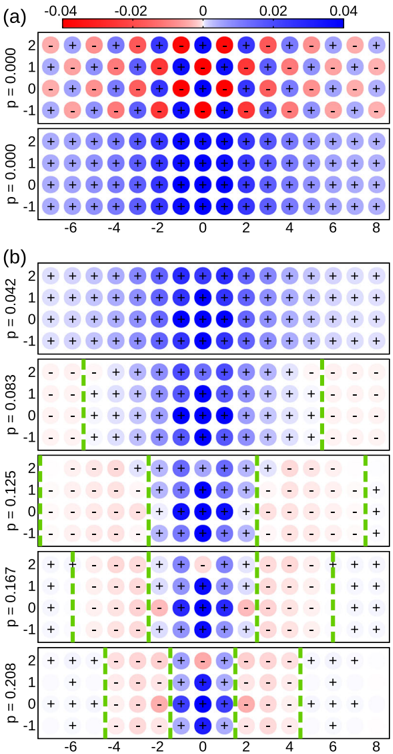
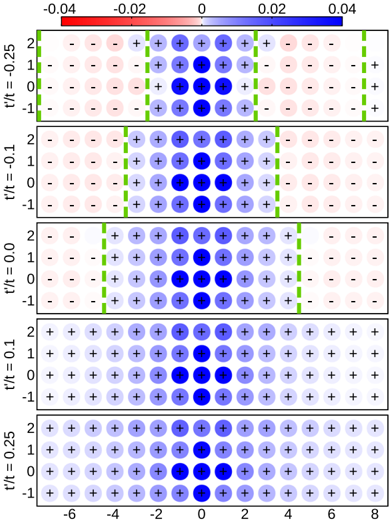
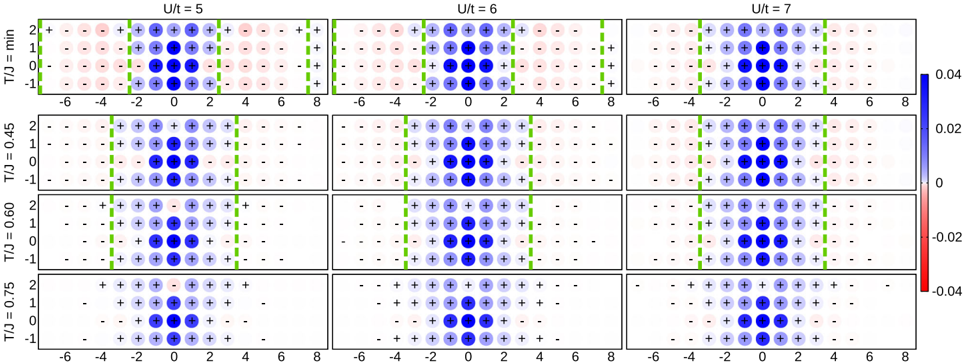
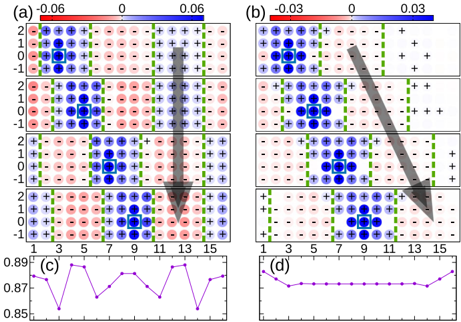
A microscopic understanding of the strongly correlated physics of the cuprates must account for the translational and rotational symmetry breaking that is present across all cuprate families, commonly in the form of stripes. Here we investigate emergence of stripes in the Hubbard model, a minimal model believed to be relevant to the cuprate superconductors, using determinant quantum Monte Carlo (DQMC) simulations at finite temperatures and density matrix renormalization group (DMRG) ground state calculations. By varying temperature, doping, and model parameters, we characterize the extent of stripes throughout the phase diagram of the Hubbard model. Our results show that including the often neglected next-nearest-neighbor hopping leads to the absence of spin incommensurability upon electron-doping and nearly half-filled stripes upon hole-doping. The similarities of these findings to experimental results on both electron and hole-doped cuprate families support a unified description across a large portion of the cuprate phase diagram.
Overview
The claims and statistics of this paper haven’t been checked yet.
Free: it reads the open-access text and checks the first 5 claims that cite a source we can check. Create a free account to check every claim.
Integrity signals
Registry
Cites
Statistics
Figures

Verification
Claims the paper makes
The claims and statistics of this paper haven’t been checked yet.
Free: it reads the open-access text and checks the first 5 claims that cite a source we can check. Create a free account to check every claim.
Claims other papers make about this one
Each is checked against this paper’s own text: does it say what the citing paper says it does?
In the citing paper
“Nor are the stripes half-filled as seen in previous state-of-theart calculations ( 40 ).”
From Coexistence of superconductivity with partially filled stripes in the Hubbard model (2024) · cites this paper as [40]
In the citing paper
“Previous studies in width-4 cylinders have found that the ground state in this system has half-filled stripes ( 40, 43, 44 ).”
From Coexistence of superconductivity with partially filled stripes in the Hubbard model (2024) · cites this paper as [40]
Self-check
Percentages, sums and reported differences re-computed from the paper’s own numbers.
The self-check needs the paper’s full text.
Citations
Cites
Density matrix formulation for quantum renormalization groups
White, S. R. (1992) · Physical Review Letters · doi:10.1103/physrevlett.69.2863 · Cited by 7,702
Evidence for stripe correlations of spins and holes in copper oxide superconductors
Tranquada, J. M., Sternlieb, B. J., Axe, J. D., Nakamura, Y., & Uchida, S. (1995) · Nature · doi:10.1038/375561a0 · Cited by 3,144
Bayesian inference and the analytic continuation of imaginary-time quantum Monte Carlo data
Jarrell, M., & Gubernatis, J. E. (1996) · Physics Reports · doi:10.1016/0370-1573(95)00074-7 · Cited by 1,315
Maier, T., Jarrell, M., Pruschke, T., & Hettler, M. H. (2005) · Reviews of Modern Physics · doi:10.1103/revmodphys.77.1027 · Cited by 1,310
Monte Carlo calculations of coupled boson-fermion systems. I
Blankenbecler, R., Scalapino, D. J., & Sugar, R. L. (1981) · Physical Review D · doi:10.1103/physrevd.24.2278 · Cited by 1,220
Charged magnetic domain lines and the magnetism of high-Tcoxides
Zaanen, J., & Gunnarsson, O. (1989) · Physical Review B · doi:10.1103/physrevb.40.7391 · Cited by 1,066 · cited 1×
“4c, d), where zero-temperature DMRG results reveal a static charge density wave, with peaks and troughs in the electron occupation coinciding with the antiphase domains, in agreement with the long-established picture of stripes known from the earliest mean-field studies.(26,27) The finite temperature DQMC results inst…”
ResultNumerical study of the two-dimensional Hubbard model
White, S. R., Scalapino, D. J., Sugar, R. L., Loh, E. Y., Gubernatis, J. E., & Scalettar, R. T. (1989) · Physical Review B · doi:10.1103/physrevb.40.506 · Cited by 943
Yamada, K., Lee, C. H., Kurahashi, K., Wada, J., Wakimoto, S., Ueki, S., Kimura, H., Endoh, Y., Hosoya, S., Shirane, G., et al. (1998) · Physical Review B · doi:10.1103/physrevb.57.6165 · Cited by 900
Progress and perspectives on electron-doped cuprates
Armitage, N. P., Fournier, P., & Greene, R. L. (2010) · Reviews of Modern Physics · doi:10.1103/revmodphys.82.2421 · Cited by 689
Stripe order in the underdoped region of the two-dimensional Hubbard model
Zheng, B.-X., Chung, C.-M., Corboz, P., Ehlers, G., Qin, M.-P., Noack, R. M., Shi, H., White, S. R., Zhang, S., & Chan, G. K.-L. (2017) · Science · doi:10.1126/science.aam7127 · Cited by 606 · cited 1×
“The growth of modern computing power combined with recent developments in computational techniques has allowed for significant progress toward understanding static properties of the Hubbard model.(2) However, to connect with experimental results, it has become necessary to determine and benchmark the dynamical propert…”
Background
Cited by
Items 101–163 of 163
Charge stripe manipulation of superconducting pairing symmetry transition
Chen, C., Zhong, P., Sui, X., Ma, R., Liang, Y., Hu, S., Ma, T., Lin, H., & Huang, B. Q. (2024) · Nature Communications · doi:10.1038/s41467-024-53841-x · Cited by 11
“Besides, our calculations indicate that this dominant s -wave pairing can be further enhanced by a larger coulomb repulsion U (see Fig.”
Improved hybrid parallel strategy for density matrix renormalization group method*
Chen, F., Cheng, C., & Luo, H. (2020) · Chinese Physics B · doi:10.1088/1674-1056/ab8a42 · Cited by 7
Li, Q., Qi, Y., & Li, W. (2026) · arXiv (Cornell University) · doi:10.48550/arxiv.2604.16293 · Cited by 7
Geometric Orthogonal Metals: Hidden Antiferromagnetism and the Pseudogap from Fluctuating Stripes
Schlömer, H., Bohrdt, A., & Grusdt, F. (2025) · PRX Quantum · doi:10.1103/5sq4-r7dk · Cited by 10
Electronic transport through correlated electron systems with nonhomogeneous charge orderings
Smorka, R., Žonda, M., & Thoss, M. (2020) · Physical review. B./Physical review. B · doi:10.1103/physrevb.101.155116 · Cited by 7
π phase shift across stripes in a charge density wave system
Ying, T., Scalettar, R. T., & Mondaini, R. (2022) · Physical review. B./Physical review. B · doi:10.1103/physrevb.105.115116 · Cited by 6
“Finally, Appendix E compares our DQMC results with ED, showing that the qualitative physics is unchanged.”
BackgroundInfluentialQuantum Science with Arrays of Metastable Helium-3 Atoms
Li, Z., De, R., Sivakumar, R., Huie, W., Wei, H., Piel, J., Greene, C. H., Hazzard, K. R. A., Yan, Z. Z., & Covey, J. P. (2026) · PRX Quantum · doi:10.1103/hpnb-6ql3 · Cited by 5
Dressing due to correlations strongly reduces the effect of electron-phonon coupling
Yam, Y. C., Sawatzky, G. A., & Berciu, M. (2022) · Physical review. B./Physical review. B · doi:10.1103/physrevb.106.075152 · Cited by 5
Effect of next-nearest neighbor hopping on the single-particle excitations at finite temperature
Rashid, H. A., & Singh, D. K. (2024) · SciPost Physics · doi:10.21468/scipostphys.16.4.107 · Cited by 5
Liu, F., Peng, C., Huang, E. W., Moritz, B., Jia, C., & Devereaux, T. (2024) · npj Quantum Materials · doi:10.1038/s41535-024-00659-x · Cited by 5
“Our desire to understand how the strong interactions of electrons are affected by the interlayer hybridization with itinerant electrons has motivated us to investigate the spin and charge density waves, which were proposed to exist in the doped single-band Hubbard model 40,41 .”
Self-citationLiu, T., Jost, D., Moritz, B., Huang, E. W., Hackl, R., & Devereaux, T. (2021) · Physical review. B./Physical review. B · doi:10.1103/physrevb.103.134502 · Cited by 6
Self-citationGazizova, D., & LeBlanc, J. P. F. (2023) · Physical review. B./Physical review. B · doi:10.1103/physrevb.108.165149 · Cited by 6
Half-filled stripes in a hole-doped three-orbital spin-fermion model for cuprates
Hussein, M. S. D. A., Dagotto, E. R., & Moreo, A. (2019) · Physical review. B./Physical review. B · doi:10.1103/physrevb.99.115108 · Cited by 5
Free energy and metastable states in the square-lattice $J_1$-$J_2$ Ising model
Abalmasov, V. A. (2024) · SciPost Physics · doi:10.21468/scipostphys.16.6.151 · Cited by 4
Farid, R., Gazizova, D., McNiven, B. D. E., & LeBlanc, J. P. F. (2025) · Physical review. B./Physical review. B · doi:10.1103/physrevb.111.125118 · Cited by 4
Charge density wave solutions of the Hubbard model in the composite operator formalism
Banerjee, A., Pangburn, E., Mahato, C., Ghosal, A., & Pépin, C. (2025) · Physical review. B./Physical review. B · doi:10.1103/physrevb.111.165123 · Cited by 7
“Other studies have found charge stripes with period 5 a 0 as the most probable ground state [43] at the same doping.”
Quench dynamics of stripes and phase separation in the two-dimensional t − J model
Staszewski, L., & Wietek, A. (2025) · Physical review. B./Physical review. B · doi:10.1103/nfmp-32tt · Cited by 4
Singh, N. (2025) · Journal of Superconductivity and Novel Magnetism · doi:10.1007/s10948-025-07065-9 · Cited by 5
Structural complexity of snapshots of two-dimensional Fermi-Hubbard systems
Ibarra-García-Padilla, E., Striegel, S. L., Scalettar, R. T., & Khatami, E. (2024) · Physical Review A · doi:10.1103/physreva.109.053304 · Cited by 6
“…complexity vs doping illustrate that features related to phases that emerge in this doping range at lower temperatures (such as fluctuating stripes [30–32]) are more complex than the AFM parent state at half filling and that this metallic region is also more complex than the conventional Fermi…”
InfluentialStripes and the emergence of charge π -phase shifts in isotropically paired systems
Sun, J., Ying, T., Scalettar, R. T., & Mondaini, R. (2024) · Physical review. B./Physical review. B · doi:10.1103/physrevb.110.l161101 · Cited by 4
“By breaking lattice rotational symmetry, they facilitate the manifestation of charge stripes along the short direction [11– 15, 19, 22, 23, 56].”
BackgroundMethodRequirements for building effective Hamiltonians using quantum-enhanced density matrix downfoldingPreprint
Pathak, S., Russo, A., Seritan, S., Magann, A. B., Bobrow, E., Landahl, A. J., & Baczewski, A. (2024) · arXiv (Cornell University) · doi:10.48550/arxiv.2403.01043 · Cited by 4
Proof that the momentum-mixing Hatsugai-Kohmoto model equals the twisted Hubbard model
Bai, Y., & Phillips, P. (2026) · Physical review. B./Physical review. B · doi:10.1103/ry4h-kkvs · Cited by 4
Spin Dynamics in the t–t′–J Model: Dynamical Density-Matrix Renormalization Group Study
Tohyama, T., Sota, S., & Yunoki, S. (2020) · Journal of the Physical Society of Japan · doi:10.7566/jpsj.89.124709 · Cited by 3
Farkašovský, P. (2025) · The European Physical Journal Plus · doi:10.1140/epjp/s13360-025-07142-x · Cited by 2
Cooper condensation and pair wave functions in systems of strongly correlated electrons
Karlsson, H., Hofmann, J. S., & Wietek, A. (2026) · Physical review. B./Physical review. B · doi:10.1103/q1dy-gsmh · Cited by 4
SU(2) gauge theory of fluctuating stripe order in the two-dimensional Hubbard model
Müller-Groeling, H., Bonetti, P. M., Forni, P., & Metzner, W. (2026) · Physical review. B./Physical review. B · doi:10.1103/tksj-ywhm · Cited by 2
Transport anisotropy and metal-insulator transition in striped Dirac fermion systems
Meng, J., Ma, R., Zhang, L., & Ma, T. (2022) · Physical review. B./Physical review. B · doi:10.1103/physrevb.106.235140 · Cited by 2
Phase coexistence in a half-filled extended Hubbard model
Philoxene, L., Dao, V. H., & Frésard, R. (2023) · Modern Physics Letters B · doi:10.1142/s0217984923420022 · Cited by 2
Variational Monte Carlo study of stripes as a function of doping in the t−t′ Hubbard model
Lechiara, A., Marino, V., & Tocchio, L. F. (2024) · Journal of Physics Condensed Matter · doi:10.1088/1361-648x/ad5b43 · Cited by 4
Yang, L., & Feiguin, A. E. (2024) · Physical review. B./Physical review. B · doi:10.1103/physrevb.110.085122 · Cited by 4
Controlling magnetic correlations in a driven Hubbard system far from half-filling
Gao, H., Coulthard, J. R., Jaksch, D., & Mur-Petit, J. (2020) · Physical Review A · doi:10.1103/physreva.101.053634 · Cited by 2
Quantum Monte Carlo study of a bilayer U(2)×U(2) -symmetric Hubbard model
Caplan, Y., & Orgad, D. (2023) · Physical review. B./Physical review. B · doi:10.1103/physrevb.108.165131 · Cited by 3
Robust fluctuating intertwined charge stripes in the Emery modelPreprint
Zhang, R., Zhao, S., Jiang, H., Moritz, B., Huang, E. W., & Devereaux, T. (2026) · arXiv (Cornell University) · doi:10.48550/arxiv.2605.21585 · Cited by 2
“…of intertwined stripes in the Emery model is still at an early stage compared to that of the single-band Hubbard model, where DQMC simulations have captured fluctuating intertwined spin and charge stripes [23, 24] and strong nematic fluctuations [25], likely related to the charge stripes [26].”
Self-citationMeixner, M., Eßl, H., Reitner, M., Toschi, A., & Schäfer, T. (2026) · arXiv (Cornell University) · doi:10.48550/arxiv.2606.24755 · Cited by 3
“…putative super-conducting regime in two dimensions, careful numerical studies have revealed a subtle competition of stripe ordering (a concomitant modulation of charge and spin degrees of freedom) with pairing tendencies, both for the ground state and for non-zero temperature (e.g., [25, 27–34]).”
Coexisting magnetic, charge, and superconducting orders in the two-dimensional Hubbard model
Scholle, R., Bonetti, P. M., Metzner, W., & Vilardi, D. (2026) · Physical review. B./Physical review. B · doi:10.1103/8ck6-482h · Cited by 1
Sign-resolved statistics and the origin of bias in quantum Monte Carlo
Larson, R., Mondaini, R., & Scalettar, R. T. (2026) · Physical review. B./Physical review. B · doi:10.1103/x24t-bd2q · Cited by 1
Dao, V. H., & Frésard, R. (2017) · Europhysics Letters (EPL) · doi:10.1209/0295-5075/120/17004
(2019) · SciPost Physics · doi:10.21468/scipost.report.1016
(2019) · SciPost Physics · doi:10.21468/scipost.report.1013
(2022) · SciPost Physics · doi:10.21468/scipost.report.5005
(2022) · SciPost Physics · doi:10.21468/scipost.report.4136
Yang, S., Liu, X., Li, W., Yang, J., Ying, T., Li, X., & Sun, X. (2022) · Journal of Physics Condensed Matter · doi:10.1088/1361-648x/ac7e9c
“Furthermore, the stripe orders are found to be formed spontaneously in the Hubbard model on square lattice [39–41], indicating that the stripe order may coexists with cuprate superconductivity intrinsically.”
(2021) · SciPost Physics · doi:10.21468/scipost.report.4116
(2023) · SciPost Physics · doi:10.21468/scipost.report.8305
(2023) · SciPost Physics · doi:10.21468/scipost.report.8200
(2023) · SciPost Physics · doi:10.21468/scipost.report.8142
Report on scipost_202310_00028v3
(2024) · SciPost Physics · doi:10.21468/scipost.report.8472
Report on scipost_202310_00028v3
(2024) · SciPost Physics · doi:10.21468/scipost.report.8483
Report on scipost_202401_00010v1
(2024) · SciPost Physics · doi:10.21468/scipost.report.8529
Report on scipost_202401_00010v1
(2024) · SciPost Physics · doi:10.21468/scipost.report.8497
Photodynamic melting of phase-reversed charge stripes and enhanced condensation
Sun, J., Scalettar, R. T., & Mondaini, R. (2026) · Physical review. B./Physical review. B · doi:10.1103/qb8n-n2np
Superfluid Dome in the Spatially Modulated Two-Dimensional XY Model
Song, F.-F., Chugh, A., Nuomin, H., Kawashima, N., & Wietek, A. (2025) · Physical Review Letters · doi:10.1103/s8xd-6mzm
Shichao, F., & Jiarui, Z. (2026) · Acta Physica Sinica · doi:10.7498/aps.75.20251362
Theoretical perspectives on charge dynamics in high-temperature cuprate superconductors
Yamase, H. (2026) · Journal of Physics Condensed Matter · doi:10.1088/1361-648x/ae5142 · Cited by 1
“This observation strongly indicates that charge order in these materials is likely driven by coupling to magnetic fluctuations or spin order [82, 83].”
Photopoulos, R. (2019) · theses.fr (ABES) · doi:10.70675/07accc75z1205z440dz8512ze401d01664c3 · Cited by 1
Long-range Coulomb interactions and charge frustration in strongly correlated quantum matter
Driscoll, K. (2022) · theses.fr (ABES) · doi:10.70675/7adf5bb7zb602z4afcz9b35z9cac6156c913 · Cited by 2
Fluctuations collectives dans les systèmes de fermions fortement corrélés
Linnér, E. (2023) · theses.fr (ABES) · doi:10.70675/1f9260cez39a8z406az92dczda2a923b0729
Strongly correlated Hubbard model within the composite operator formalism
Haurie, L. (2024) · theses.fr (ABES) · doi:10.70675/f25f825dz9b7az4589zb49fz3ca7c4d9f184
Role of interstitial s orbital in a model of infinite-layer nickelates
Anonymous, Peng, R., & Jiang, M. (2026) · Physical review. B./Physical review. B · doi:10.1103/j7n2-vhkt
“Moreover, it remains applicable to relatively large lattice sizes at temperatures that are still rather low by numerical standards 30,34,35 at dominant k points in the Brillouin zone.”
Spin dynamics from the Niu-Kleinman adiabatic approach and slave-boson mean-field theory
Anonymous, Xie, T., Shi, S., Jiang, K., & Hu, J. (2026) · Physical review. B./Physical review. B · doi:10.1103/3hcv-nckk
Paramagnon softening upon doping in oxychloride cuprate superconductorsPreprint
Fawaz, C., Gaspard, L., Chaix, L., Laveder, L., Bacq-Labreuil, B., Porée, V., Yakhou, F., Kummer, K., Brookes, N. B., Nicolaou, A., et al. (2026) · arXiv (Cornell University) · doi:10.48550/arxiv.2610.05160
Metadata
- Authors
- Huang, E. W., Mendl, C. B., Jiang, H.-C., Moritz, B., & Devereaux, T. P.
- Affiliations
- SLAC National Accelerator Laboratory (US)
- University of North Dakota (US)
- Corresponding author
- Devereaux, Thomas P.
- Venue
- npj Quantum Materials
- Published
- 2018-04-20
- Volume
- 3
- Issue
- 1
- ISSN
- 2397-4648 (ISSN-L)
- OpenAlex
- W2751557833
- Cited by
- 151
- References
- 38
- Citations by year
- 2026: 15 · 2025: 17 · 2024: 23 · 2023: 23 · 2022: 22 · 2021: 21 · 2020: 14 · 2019: 13 · 2018: 3
- FWCI
- 6.90
- Type
- journal article
- Language
- en
- Open access
- gold
- doi.org
- Licence
- cc-by
- creativecommons.org/licenses/by/4.0 (tdm)
- creativecommons.org/licenses/by/4.0 (vor)
- Locations
- npj Quantum Materials (publishedVersion, cc-by)
- arXiv (Cornell University) (submittedVersion)
- OSTI OAI (U.S. Department of Energy Office of Scientific and Technical Information) (submittedVersion)
- DOAJ (DOAJ: Directory of Open Access Journals) (submittedVersion)
- arXiv (Cornell University) (cc-by)
- Funders
- U.S. Department of Energy (-AC02-05CH11231, Contract No. DE-AC02-05-CH11231, 76SF00515, DE–AC02–76SF00515, 05CH11231, No. DE-AC02-05-CH11231, DE AC02 05CH11231, AC02‐76SF00515, No. DE-AC02–76SF00515, Contract No. DE-AC02-76SF00515, DE-AC02-)
- Alexander von Humboldt-Stiftung (DE-AC02-05CH11231, DE-AC02-76SF00515)
- National Energy Research Scientific Computing Center (DE–AC02–05CH11231, 05CH11231, AC02-05CH11231, Contract No. DE-AC02-05CH11231)
- Basic Energy Sciences (DE-AC02, Contract No. DE-AC02-05-CH11231, DE-AC02-05CH11231., No. DE-AC02-05-CH11231, AC02–05CH11231, 76SF00515, Contract No. DE-AC02-76SF00515, AC02-76SF00515, DE-AC-02-76SF00515)
- Division of Materials Sciences and Engineering (DE-AC02, AC02-05CH11231, DE-AC02-76SF00515, DE‐AC02‐05‐CH11231)
- Topics
- Physical Sciences › Physics and Astronomy › Condensed Matter Physics › Physics of Superconductivity and Magnetism
- Physical Sciences › Physics and Astronomy › Atomic and Molecular Physics, and Optics › Quantum many-body systems
- Physical Sciences › Physics and Astronomy › Condensed Matter Physics › Advanced Condensed Matter Physics
- Keywords
- stripe order, Hubbard model, cuprate superconductors, strongly correlated electrons, translational symmetry breaking, rotational symmetry breaking, next-nearest-neighbor hopping, n-type doping, p-type doping, cuprate phase diagram
About these checks
Registry, retraction, Cites and statistics results are computed, not judged, with one exception: a printed reference that no index lists is read once by a model before it counts as a citation error. Claims are extracted by a model and kept only when their quote appears verbatim in the text; each cited source is then checked, with a model’s help, for whether it says what the claim relies on. Those verdicts can be wrong — read the claim’s quote and the cited source before relying on one.
Statistics and arithmetic are recomputed, not judged.
Confidence bands are shown only for fields calibrated on our annotated test set. None is calibrated yet, so no band is shown.
What counts as a claim ›How we measure confidence ›How we check this ›
Are you an author, or do you see a problem with this page? Request a review
Data sources
Bibliographic data: Semantic Scholar, OpenAlex, Crossref.
Contains information from the Semantic Scholar Academic Graph Datasets, made available under the ODC Attribution License (ODC-BY 1.0).
Semantic Scholar’s data is described in: Kinney, R., et al. (2023). The Semantic Scholar Open Data Platform. arXiv:2301.10140.
