

Stripe order from the perspective of the Hubbard model
Open accessThe DOI matches its Crossref record; 38 of the 38 references it cites were found in a registry or an index.
Abstract
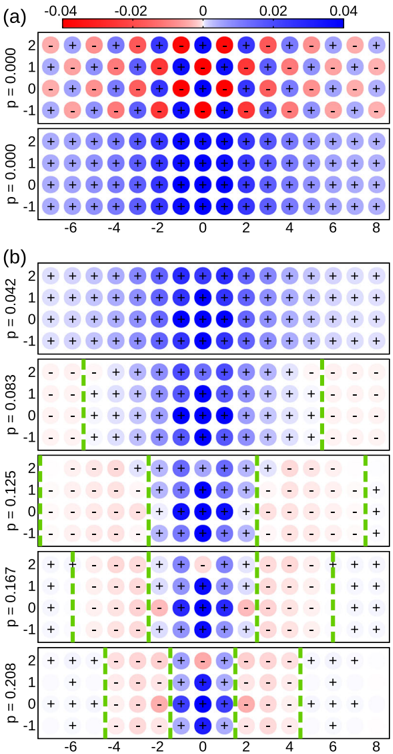
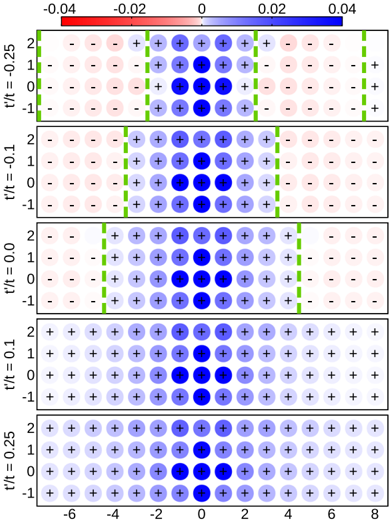
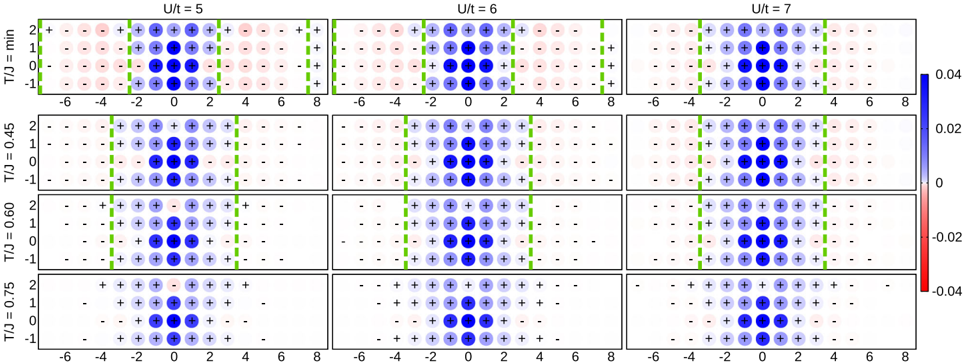
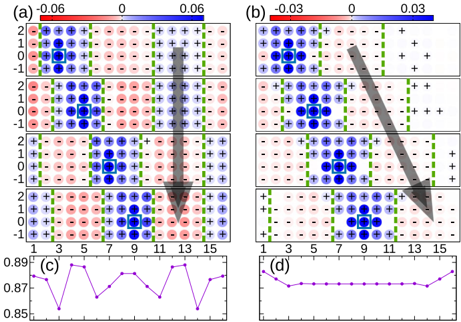
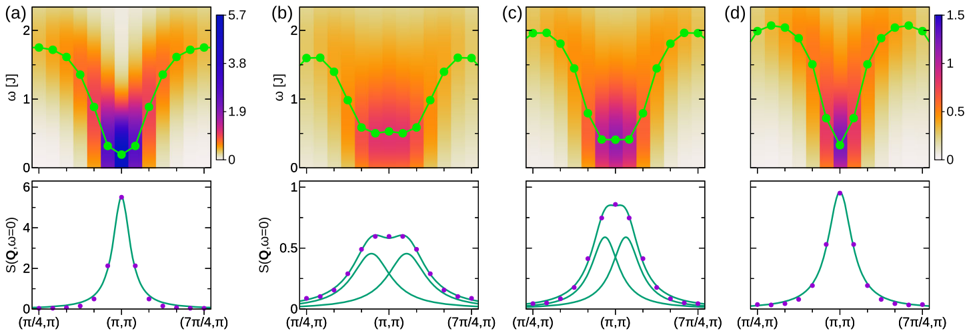
A microscopic understanding of the strongly correlated physics of the cuprates must account for the translational and rotational symmetry breaking that is present across all cuprate families, commonly in the form of stripes. Here we investigate emergence of stripes in the Hubbard model, a minimal model believed to be relevant to the cuprate superconductors, using determinant quantum Monte Carlo (DQMC) simulations at finite temperatures and density matrix renormalization group (DMRG) ground state calculations. By varying temperature, doping, and model parameters, we characterize the extent of stripes throughout the phase diagram of the Hubbard model. Our results show that including the often neglected next-nearest-neighbor hopping leads to the absence of spin incommensurability upon electron-doping and nearly half-filled stripes upon hole-doping. The similarities of these findings to experimental results on both electron and hole-doped cuprate families support a unified description across a large portion of the cuprate phase diagram.
Overview
The claims and statistics of this paper haven’t been checked yet.
Free: it reads the open-access text and checks the first 5 claims that cite a source we can check. Create a free account to check every claim.
Integrity signals
Registry
Cites
Statistics
Figures

Verification
Claims the paper makes
The claims and statistics of this paper haven’t been checked yet.
Free: it reads the open-access text and checks the first 5 claims that cite a source we can check. Create a free account to check every claim.
Claims other papers make about this one
Each is checked against this paper’s own text: does it say what the citing paper says it does?
In the citing paper
“Nor are the stripes half-filled as seen in previous state-of-theart calculations ( 40 ).”
From Coexistence of superconductivity with partially filled stripes in the Hubbard model (2024) · cites this paper as [40]
In the citing paper
“Previous studies in width-4 cylinders have found that the ground state in this system has half-filled stripes ( 40, 43, 44 ).”
From Coexistence of superconductivity with partially filled stripes in the Hubbard model (2024) · cites this paper as [40]
Self-check
Percentages, sums and reported differences re-computed from the paper’s own numbers.
The self-check needs the paper’s full text.
Citations
Cites
Density matrix formulation for quantum renormalization groups
White, S. R. (1992) · Physical Review Letters · doi:10.1103/physrevlett.69.2863 · Cited by 7,702
Evidence for stripe correlations of spins and holes in copper oxide superconductors
Tranquada, J. M., Sternlieb, B. J., Axe, J. D., Nakamura, Y., & Uchida, S. (1995) · Nature · doi:10.1038/375561a0 · Cited by 3,144
Bayesian inference and the analytic continuation of imaginary-time quantum Monte Carlo data
Jarrell, M., & Gubernatis, J. E. (1996) · Physics Reports · doi:10.1016/0370-1573(95)00074-7 · Cited by 1,315
Maier, T., Jarrell, M., Pruschke, T., & Hettler, M. H. (2005) · Reviews of Modern Physics · doi:10.1103/revmodphys.77.1027 · Cited by 1,310
Monte Carlo calculations of coupled boson-fermion systems. I
Blankenbecler, R., Scalapino, D. J., & Sugar, R. L. (1981) · Physical Review D · doi:10.1103/physrevd.24.2278 · Cited by 1,220
Charged magnetic domain lines and the magnetism of high-Tcoxides
Zaanen, J., & Gunnarsson, O. (1989) · Physical Review B · doi:10.1103/physrevb.40.7391 · Cited by 1,066 · cited 1×
“4c, d), where zero-temperature DMRG results reveal a static charge density wave, with peaks and troughs in the electron occupation coinciding with the antiphase domains, in agreement with the long-established picture of stripes known from the earliest mean-field studies.(26,27) The finite temperature DQMC results inst…”
ResultNumerical study of the two-dimensional Hubbard model
White, S. R., Scalapino, D. J., Sugar, R. L., Loh, E. Y., Gubernatis, J. E., & Scalettar, R. T. (1989) · Physical Review B · doi:10.1103/physrevb.40.506 · Cited by 943
Yamada, K., Lee, C. H., Kurahashi, K., Wada, J., Wakimoto, S., Ueki, S., Kimura, H., Endoh, Y., Hosoya, S., Shirane, G., et al. (1998) · Physical Review B · doi:10.1103/physrevb.57.6165 · Cited by 900
Progress and perspectives on electron-doped cuprates
Armitage, N. P., Fournier, P., & Greene, R. L. (2010) · Reviews of Modern Physics · doi:10.1103/revmodphys.82.2421 · Cited by 689
Stripe order in the underdoped region of the two-dimensional Hubbard model
Zheng, B.-X., Chung, C.-M., Corboz, P., Ehlers, G., Qin, M.-P., Noack, R. M., Shi, H., White, S. R., Zhang, S., & Chan, G. K.-L. (2017) · Science · doi:10.1126/science.aam7127 · Cited by 606 · cited 1×
“The growth of modern computing power combined with recent developments in computational techniques has allowed for significant progress toward understanding static properties of the Hubbard model.(2) However, to connect with experimental results, it has become necessary to determine and benchmark the dynamical propert…”
BackgroundQuantum magnetic excitations from stripes in copper oxide superconductors
Tranquada, J. M., Woo, H., Perring, T. G., Goka, H., Gu, G. D., Xu, G., Fujita, M., & Yamada, K. (2004) · Nature · doi:10.1038/nature02574 · Cited by 592
Density Matrix Renormalization Group Study of the Striped Phase in the 2Dt−JModel
White, S. R., & Scalapino, D. J. (1998) · Physical Review Letters · doi:10.1103/physrevlett.80.1272 · Cited by 505
Competing States in thet-JModel: Uniformd-Wave State versus Stripe State
Corboz, P., Rice, T. M., & Troyer, M. (2014) · Physical Review Letters · doi:10.1103/physrevlett.113.046402 · Cited by 482
Magnetism in La2CuO4 based compounds
Machida, K. (1989) · Physica C: Superconductivity · doi:10.1016/0921-4534(89)90316-x · Cited by 408 · cited 1×
“4c, d), where zero-temperature DMRG results reveal a static charge density wave, with peaks and troughs in the electron occupation coinciding with the antiphase domains, in agreement with the long-established picture of stripes known from the earliest mean-field studies.(26,27) The finite temperature DQMC results inst…”
ResultResonant X-Ray Scattering Studies of Charge Order in Cuprates
Comin, R., & Damascelli, A. (2016) · Annual Review of Condensed Matter Physics · doi:10.1146/annurev-conmatphys-031115-011401 · Cited by 385 · cited 1×
“In other compounds, while the charge ordering has wavevector (and hence periodicity) in the same range as that of La-based cuprates and is similarly pronounced around 1/8-doping, the doping dependence differs.(33) In La-based cuprates, both charge ordering wavevectors and spin incommensurability (periodicities) increa…”
The structure of the high-energy spin excitations in a high-transition-temperature superconductor
Hayden, S. M., Mook, H. A., Dai, P., Perring, T. G., & Doğan, F. (2004) · Nature · doi:10.1038/nature02576 · Cited by 375
Superconductivity and the Pseudogap in the Two-Dimensional Hubbard Model
Gull, E., Parcollet, O., & Millis, A. J. (2013) · Physical Review Letters · doi:10.1103/physrevlett.110.216405 · Cited by 317
Systematic Study ofd-Wave Superconductivity in the 2D Repulsive Hubbard Model
Maier, T. A., Jarrell, M., Schulthess, T. C., Kent, P. R. C., & White, J. B. (2005) · Physical Review Letters · doi:10.1103/physrevlett.95.237001 · Cited by 287
Stripe order, depinning, and fluctuations inLa1.875Ba0.125CuO4andLa1.875Ba0.075Sr0.050CuO4
Fujita, M., Goka, H., Yamada, K., Tranquada, J. M., & Regnault, L. P. (2004) · Physical Review B · doi:10.1103/physrevb.70.104517 · Cited by 283
Numerical evidence of fluctuating stripes in the normal state of high- T c cuprate superconductors
Huang, E. W., Mendl, C. B., Liu, S., Johnston, S., Jiang, H.-C., Moritz, B., & Devereaux, T. P. (2017) · Science · doi:10.1126/science.aak9546 · Cited by 218
Self-citationAnomalous superconductivity and its competition with antiferromagnetism in doped Mott insulators
Kancharla, S. S., Kyung, B., Sénéchal, D., Civelli, M., Capone, M., Kotliar, G., & Tremblay, A.-M. S. (2008) · Physical Review B · doi:10.1103/physrevb.77.184516 · Cited by 185
Strong Coupling Superconductivity, Pseudogap, and Mott Transition
Sordi, G., Sémon, P., Haule, K., & Tremblay, A.-M. S. (2012) · Physical Review Letters · doi:10.1103/physrevlett.108.216401 · Cited by 160
Commensurate Spin Dynamics in the Superconducting State of an Electron-Doped Cuprate Superconductor
Yamada, K., Kurahashi, K., Uefuji, T., Fujita, M., Park, S., Lee, S.-H., & Endoh, Y. (2003) · Physical Review Letters · doi:10.1103/physrevlett.90.137004 · Cited by 136 · cited 1×
“Subject to the limited momentum resolution of our calculation, the low-energy behavior seen here is reminiscent of the commensurate excitations at (π, π) seen in electron-doped cuprates.(21,22)”
BackgroundStripes on a 6-Leg Hubbard Ladder
White, S. R., & Scalapino, D. J. (2003) · Physical Review Letters · doi:10.1103/physrevlett.91.136403 · Cited by 116
Miao, H., Lorenzana, J., Seibold, G., Peng, Y. Y., Amorese, A., Yakhou, F., Kummer, K., Brookes, N. B., Konik, R., Thampy, V., et al. (2017) · Proceedings of the National Academy of Sciences · doi:10.1073/pnas.1708549114 · Cited by 109
Bad Metals from Fluctuating Density Waves
Delacrétaz, L. V., Goutéraux, B., Hartnoll, S. A., & Karlsson, A. (2017) · SciPost Physics · doi:10.21468/scipostphys.3.3.025 · Cited by 105 · cited 1×
“Recent hydrodynamic studies have proposed fluctuating charge or spin density waves as a source of bad metallic behavior.(23,24) Future work via similar finite temperature quantum Monte Carlo simulations could address these potential connections between fluctuating stripes and possible signatures of strange metal physi…”
BackgroundTheory of hydrodynamic transport in fluctuating electronic charge density wave states
Delacrétaz, L. V., Goutéraux, B., Hartnoll, S. A., & Karlsson, A. (2017) · Physical review. B./Physical review. B · doi:10.1103/physrevb.96.195128 · Cited by 105 · cited 1×
“Recent hydrodynamic studies have proposed fluctuating charge or spin density waves as a source of bad metallic behavior.(23,24) Future work via similar finite temperature quantum Monte Carlo simulations could address these potential connections between fluctuating stripes and possible signatures of strange metal physi…”
BackgroundSpin and Charge Order in the Doped Hubbard Model: Long-Wavelength Collective Modes
Chang, C.-C., & Zhang, S. (2010) · Physical Review Letters · doi:10.1103/physrevlett.104.116402 · Cited by 94
One-Dimensional Metallic Behavior of the Stripe Phase inLa2−xSrxCuO4
Fleck, M., Lichtenstein, A. I., Pavarini, E., & Oleś, A. M. (2000) · Physical Review Letters · doi:10.1103/physrevlett.84.4962 · Cited by 92
Stripe formation in doped Hubbard ladders
Hager, G., Wellein, G., Jeckelmann, E., & Fehske, H. (2005) · Physical Review B · doi:10.1103/physrevb.71.075108 · Cited by 87
Energetics of superconductivity in the two-dimensional Hubbard model
Gull, E., & Millis, A. J. (2012) · Physical Review B · doi:10.1103/physrevb.86.241106 · Cited by 86
Enoki, M., Fujita, M., Nishizaki, T., Iikubo, S., Singh, D. K., Chang, S., Tranquada, J. M., & Yamada, K. (2013) · Physical Review Letters · doi:10.1103/physrevlett.110.017004 · Cited by 49 · cited 1×
“25 correspond well to neutron scattering experiments where multiple hole-doped compounds show incommensurablity corresponding to period 4–5 spin stripes at 1/8 hole-doping.(20) Also at 1/8 hole-doping, Fig.”
BackgroundSimulation of the NMR response in the pseudogap regime of the cuprates
Chen, X., LeBlanc, J. P. F., & Gull, E. (2017) · Nature Communications · doi:10.1038/ncomms14986 · Cited by 40
Maier, T., Álvarez, G., Summers, M. S., & Schulthess, T. C. (2010) · Physical Review Letters · doi:10.1103/physrevlett.104.247001 · Cited by 37
Determinant quantum Monte Carlo study of the enhancement of d -wave pairing by charge inhomogeneity
Mondaini, R., Ying, T., Paiva, T., & Scalettar, R. T. (2012) · Physical Review B · doi:10.1103/physrevb.86.184506 · Cited by 36
Analytic continuation of QMC data with a sign problemPreprint
Macridin, A., Doluweera, S., Jarrell, M., & Maier, T. (2004) · arXiv (Cornell University) · doi:10.48550/arxiv.cond-mat/0410098 · Cited by 12
Advancing Large Scale Many-Body QMC Simulations on GPU Accelerated Multicore Systems
Tomás, A. E., Chang, C., Scalettar, R. T., & Bai, Z. (2012) · IEEE International Parallel and Distributed Processing Symposium (IPDPS) · doi:10.1109/ipdps.2012.37 · Cited by 9
Jiang, C., Bai, Z., & Scalettar, R. T. (2016) · IEEE International Parallel and Distributed Processing Symposium (IPDPS) · doi:10.1109/ipdps.2016.69 · Cited by 3
Cited by
Arovas, D. P., Berg, E., Kivelson, S. A., & Raghu, S. (2022) · Annual Review of Condensed Matter Physics · doi:10.1146/annurev-conmatphys-031620-102024 · Cited by 441
“Moving to W = 4 leg ladders and cylinders, a still richer variety of behaviors has been observed (99, 100, 101).”
BackgroundMethodThe Physics of Pair-Density Waves: Cuprate Superconductors and Beyond
Agterberg, D. F., Davis, J. C. S., Edkins, S. D., Fradkin, E., Van Harlingen, D. J., Kivelson, S. A., Lee, P. A., Radzihovsky, L., Tranquada, J. M., & Wang, Y. (2020) · Annual Review of Condensed Matter Physics · doi:10.1146/annurev-conmatphys-031119-050711 · Cited by 428
The Hubbard Model: A Computational Perspective
Qin, M., Schäfer, T., Andergassen, S., Corboz, P., & Gull, E. (2022) · Annual Review of Condensed Matter Physics · doi:10.1146/annurev-conmatphys-090921-033948 · Cited by 408
Superconductivity in the doped Hubbard model and its interplay with next-nearest hopping t ′
Jiang, H.-C., & Devereaux, T. P. (2019) · Science · doi:10.1126/science.aal5304 · Cited by 228
Self-citationStrange metallicity in the doped Hubbard model
Huang, E. W., Sheppard, R., Moritz, B., & Devereaux, T. (2019) · Science · doi:10.1126/science.aau7063 · Cited by 187
Self-citation
Metadata
- Authors
- Huang, E. W., Mendl, C. B., Jiang, H.-C., Moritz, B., & Devereaux, T. P.
- Affiliations
- SLAC National Accelerator Laboratory (US)
- University of North Dakota (US)
- Corresponding author
- Devereaux, Thomas P.
- Venue
- npj Quantum Materials
- Published
- 2018-04-20
- Volume
- 3
- Issue
- 1
- ISSN
- 2397-4648 (ISSN-L)
- OpenAlex
- W2751557833
- Cited by
- 151
- References
- 38
- Citations by year
- 2026: 15 · 2025: 17 · 2024: 23 · 2023: 23 · 2022: 22 · 2021: 21 · 2020: 14 · 2019: 13 · 2018: 3
- FWCI
- 6.90
- Type
- journal article
- Language
- en
- Open access
- gold
- doi.org
- Licence
- cc-by
- creativecommons.org/licenses/by/4.0 (tdm)
- creativecommons.org/licenses/by/4.0 (vor)
- Locations
- npj Quantum Materials (publishedVersion, cc-by)
- arXiv (Cornell University) (submittedVersion)
- OSTI OAI (U.S. Department of Energy Office of Scientific and Technical Information) (submittedVersion)
- DOAJ (DOAJ: Directory of Open Access Journals) (submittedVersion)
- arXiv (Cornell University) (cc-by)
- Funders
- U.S. Department of Energy (-AC02-05CH11231, Contract No. DE-AC02-05-CH11231, 76SF00515, DE–AC02–76SF00515, 05CH11231, No. DE-AC02-05-CH11231, DE AC02 05CH11231, AC02‐76SF00515, No. DE-AC02–76SF00515, Contract No. DE-AC02-76SF00515, DE-AC02-)
- Alexander von Humboldt-Stiftung (DE-AC02-05CH11231, DE-AC02-76SF00515)
- National Energy Research Scientific Computing Center (DE–AC02–05CH11231, 05CH11231, AC02-05CH11231, Contract No. DE-AC02-05CH11231)
- Basic Energy Sciences (DE-AC02, Contract No. DE-AC02-05-CH11231, DE-AC02-05CH11231., No. DE-AC02-05-CH11231, AC02–05CH11231, 76SF00515, Contract No. DE-AC02-76SF00515, AC02-76SF00515, DE-AC-02-76SF00515)
- Division of Materials Sciences and Engineering (DE-AC02, AC02-05CH11231, DE-AC02-76SF00515, DE‐AC02‐05‐CH11231)
- Topics
- Physical Sciences › Physics and Astronomy › Condensed Matter Physics › Physics of Superconductivity and Magnetism
- Physical Sciences › Physics and Astronomy › Atomic and Molecular Physics, and Optics › Quantum many-body systems
- Physical Sciences › Physics and Astronomy › Condensed Matter Physics › Advanced Condensed Matter Physics
- Keywords
- stripe order, Hubbard model, cuprate superconductors, strongly correlated electrons, translational symmetry breaking, rotational symmetry breaking, next-nearest-neighbor hopping, n-type doping, p-type doping, cuprate phase diagram
About these checks
Registry, retraction, Cites and statistics results are computed, not judged, with one exception: a printed reference that no index lists is read once by a model before it counts as a citation error. Claims are extracted by a model and kept only when their quote appears verbatim in the text; each cited source is then checked, with a model’s help, for whether it says what the claim relies on. Those verdicts can be wrong — read the claim’s quote and the cited source before relying on one.
Statistics and arithmetic are recomputed, not judged.
Confidence bands are shown only for fields calibrated on our annotated test set. None is calibrated yet, so no band is shown.
What counts as a claim ›How we measure confidence ›How we check this ›
Are you an author, or do you see a problem with this page? Request a review
Data sources
Bibliographic data: Semantic Scholar, OpenAlex, Crossref.
Contains information from the Semantic Scholar Academic Graph Datasets, made available under the ODC Attribution License (ODC-BY 1.0).
Semantic Scholar’s data is described in: Kinney, R., et al. (2023). The Semantic Scholar Open Data Platform. arXiv:2301.10140.
