Cited by 86Antifungal resistance and susceptibilityFungal Plant Pathogen ControlFungal and yeast genetics research

The DOI matches its Crossref record; 2 of the 2 references it cites were found in a registry or an index.

Aspergillus fumigatus strains that evolve resistance to the agrochemical fungicide ipflufenoquin in vitro are also resistant to olorofim

Open access

Published version of a preprint

Abstract

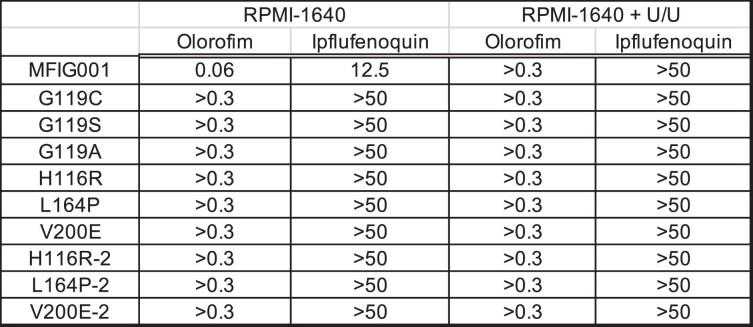
Widespread use of azole antifungals in agriculture has been linked to resistance in the pathogenic fungus Aspergillus fumigatus . We show that exposure of A. fumigatus to the agrochemical fungicide, ipflufenoquin, in vitro can select for strains that are resistant to olorofim, a first-in-class clinical antifungal with the same mechanism of action. Resistance is caused by non-synonymous mutations within the target of ipflufenoquin/olorofim activity, dihydroorotate dehydrogenase (DHODH), and these variants have no overt growth defects.

Overview

The claims and statistics of this paper haven’t been checked yet.

Run the check — free, no account needed. It reads the open-access text and checks the sources it cites.

A few free checks a day · papers already verified open instantly · results are public

Integrity signals

Registry

Crossref · 10.1038/s41564-023-01542-4

Cites

2 of 2 references verified0 citation errors · 0 not checkable

Statistics

Figures

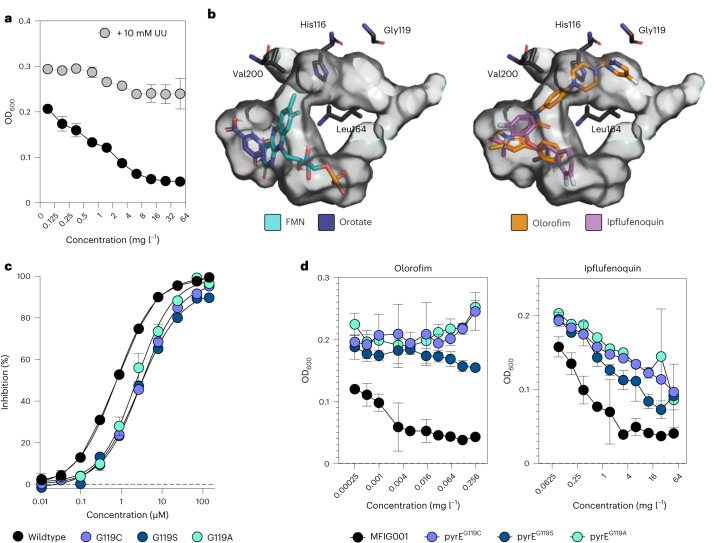
Fig. 1 Ipflufenoquin acts against DHODH. a, MIC determination of ipflufenoquin (0.175–50 mg l−1) against A. fumigatus MFIG001 in RPMI-1640 (black) using the EUCAST methodology and with addition of 10 mM uridine and uracil (grey). OD600 was measured after 48 h. Three biological replicates were assessed. Data are presented as mean ± s.e.m. b, Molecular docking of FMN and orotate (left in cyan and blue, respectively) and olorofim and ipflufenoquin (right, orange and purple, respectively) to an Alphafold2 model of A. fumigatus DHODH. The pocket of the active site is shown in grey. c, Protein inhibition assay of ipflufenoquin towards wildtype and G119 variants of DHODH. At least five biological replicates were assessed. Data are presented as mean ± s.e.m. (n = 5). d, MIC determination of G119 variants (G119C, G119S and G119A) against ipflufenoquin (right) and olorofim (left) according to EUCAST methodology. OD600 was measured after 48 h. Three biological replicates were assessed. Data are presented as mean ± s.e.m. Source data
Fig. 1 Ipflufenoquin acts against DHODH. a, MIC determination of ipflufenoquin (0.175–50 mg l−1) against A. fumigatus MFIG001 in RPMI-1640 (black) using the EUCAST methodology and with addition of 10 mM uridine and uracil (grey). OD600 was measured after 48 h. Three biological replicates were assessed. Data are presented as mean ± s.e.m. b, Molecular docking of FMN and orotate (left in cyan and blue, respectively) and olorofim and ipflufenoquin (right, orange and purple, respectively) to an Alphafold2 model of A. fumigatus DHODH. The pocket of the active site is shown in grey. c, Protein inhibition assay of ipflufenoquin towards wildtype and G119 variants of DHODH. At least five biological replicates were assessed. Data are presented as mean ± s.e.m. (n = 5). d, MIC determination of G119 variants (G119C, G119S and G119A) against ipflufenoquin (right) and olorofim (left) according to EUCAST methodology. OD600 was measured after 48 h. Three biological replicates were assessed. Data are presented as mean ± s.e.m. Source dataCC BY · PubMed Central
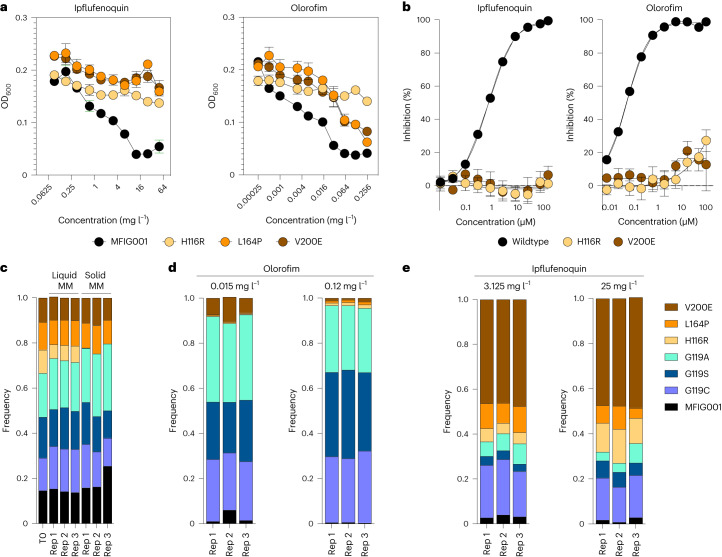
Fig. 2 Ipflufenoquin can select for olorofim-resistant A. fumigatus. a, MIC determination of H116R, L164P and V200E variant mutants against ipflufenoquin and olorofim according to EUCAST methodology. OD600 was measured after 48 h. Three biological replicates were assessed. Data are presented as mean ± s.e.m. b, Protein inhibition assay of ipflufenoquin towards wildtype, V200E and H116R variants of DHODH. At least five biological replicates were assessed. Data are presented as mean ± s.e.m. (n = 5). c, Frequency of mutants after mixed-inoculum experiments to determine basal fitness of each mutant on solid and liquid MM medium. Three biological replicates were assessed and individual data from replicates are shown. d, Frequency of mutants after low (0.015 mg l−1) and high (0.12 mg l−1) olorofim challenge in a mixed-inoculum competition assay. Three biological replicates were assessed and individual data from replicates are shown. e, Frequency of mutants after low (3.125 mg l−1) and high (25 mg l−1) ipflufenoquin challenge in a mixed-inoculum competition assay. Three biological replicates were assessed and individual data from replicates are shown. Source data
Fig. 2 Ipflufenoquin can select for olorofim-resistant A. fumigatus. a, MIC determination of H116R, L164P and V200E variant mutants against ipflufenoquin and olorofim according to EUCAST methodology. OD600 was measured after 48 h. Three biological replicates were assessed. Data are presented as mean ± s.e.m. b, Protein inhibition assay of ipflufenoquin towards wildtype, V200E and H116R variants of DHODH. At least five biological replicates were assessed. Data are presented as mean ± s.e.m. (n = 5). c, Frequency of mutants after mixed-inoculum experiments to determine basal fitness of each mutant on solid and liquid MM medium. Three biological replicates were assessed and individual data from replicates are shown. d, Frequency of mutants after low (0.015 mg l−1) and high (0.12 mg l−1) olorofim challenge in a mixed-inoculum competition assay. Three biological replicates were assessed and individual data from replicates are shown. e, Frequency of mutants after low (3.125 mg l−1) and high (25 mg l−1) ipflufenoquin challenge in a mixed-inoculum competition assay. Three biological replicates were assessed and individual data from replicates are shown. Source dataCC BY · PubMed Central
Extended Data Fig. 1 MIC determination of olorofim and ipflufenoquin. MIC determination of olorofim and ipflufenoquin against G119 variants of A. fumigatus. Three biological replicates were assessed.
Extended Data Fig. 1 MIC determination of olorofim and ipflufenoquin. MIC determination of olorofim and ipflufenoquin against G119 variants of A. fumigatus. Three biological replicates were assessed.CC BY · PubMed Central
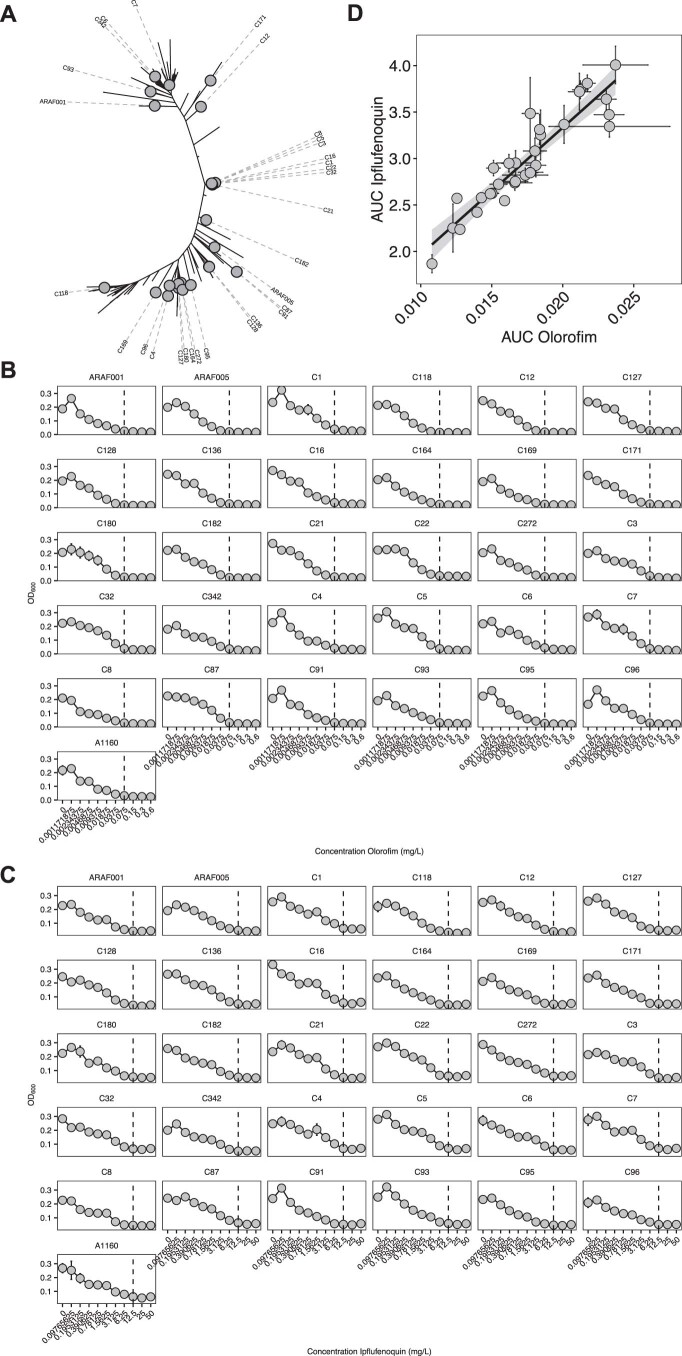
Extended Data Fig. 2 MIC determination for natural A. fumigatus isolates of olorofim and ipflufenoquin. A: Phylogenetic tree highlighting natural A. fumigatus isolates used (n = 30) sampled across a wide genetic diversity of the species, tree generated in Rhodes et al.5. B and C: MIC determination of olorofim (B) and ipflufenoquin (C) against thirty natural A. fumigatus isolates. Three biological replicates were assessed per isolate. Data are presented as the mean with SEM. The MIC is shown as a dotted line. D: Correlation of the AUC to ipflufenoquin and olorofim of the 30 natural A. fumigatus isolates. Three biological replicates were assessed per isolate. Data are presented as the mean with SEM. Source data
Extended Data Fig. 2 MIC determination for natural A. fumigatus isolates of olorofim and ipflufenoquin. A: Phylogenetic tree highlighting natural A. fumigatus isolates used (n = 30) sampled across a wide genetic diversity of the species, tree generated in Rhodes et al.5. B and C: MIC determination of olorofim (B) and ipflufenoquin (C) against thirty natural A. fumigatus isolates. Three biological replicates were assessed per isolate. Data are presented as the mean with SEM. The MIC is shown as a dotted line. D: Correlation of the AUC to ipflufenoquin and olorofim of the 30 natural A. fumigatus isolates. Three biological replicates were assessed per isolate. Data are presented as the mean with SEM. Source dataCC BY · PubMed Central
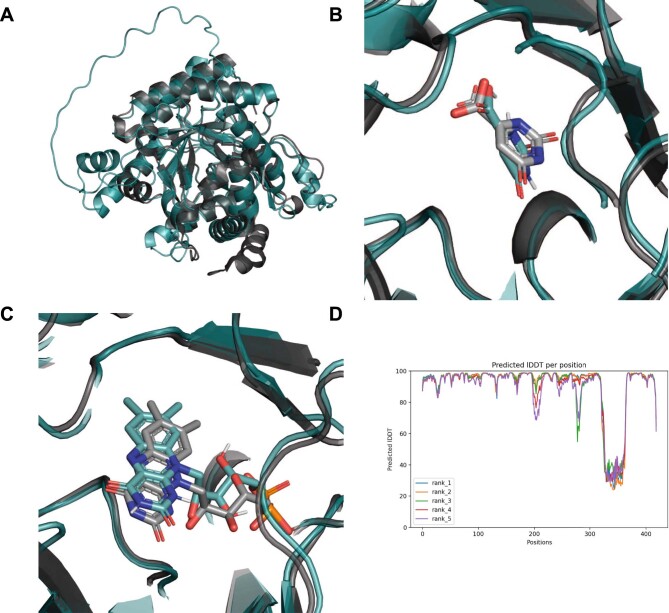
Extended Data Fig. 3 An Alphafold2 model of A. fumigatus DHODH. A: superposition of human DHODH (PDB: 2PRH_1, grey) and A. fumigatus DHODH (teal). The AfDHODH modelled region was Asp110-Leu523, which included a region of low per-residue confidence scores (pIDDT), Arg426-Val478, which is shown as a long loop. hDHODH and AfDHODH share 35% identify and 84% coverage across the full-length sequences. B: co-crystal structure of hDHODH (grey) in complex with orotate, shown in grey. The predicted pose of orotate from molecular docking with AfDHODH (teal) is superimposed. C: co-crystal structure of hDHODH (grey) in complex with FMN, shown in grey. The predicted pose of FMN from molecular docking with AfDHODH (teal) is superimposed. D: Predicted plDDT for 5 predicted structures from AlphaFold2. We used the rank 1 model. A score of <50 is considered very low confidence. Models show a region of low per-residue confidence, Arg316-Val368, which is shown as a long loop (A). However, this region was distal to the binding pocket discussed and therefore not of functional relevance to this work.
Extended Data Fig. 3 An Alphafold2 model of A. fumigatus DHODH. A: superposition of human DHODH (PDB: 2PRH_1, grey) and A. fumigatus DHODH (teal). The AfDHODH modelled region was Asp110-Leu523, which included a region of low per-residue confidence scores (pIDDT), Arg426-Val478, which is shown as a long loop. hDHODH and AfDHODH share 35% identify and 84% coverage across the full-length sequences. B: co-crystal structure of hDHODH (grey) in complex with orotate, shown in grey. The predicted pose of orotate from molecular docking with AfDHODH (teal) is superimposed. C: co-crystal structure of hDHODH (grey) in complex with FMN, shown in grey. The predicted pose of FMN from molecular docking with AfDHODH (teal) is superimposed. D: Predicted plDDT for 5 predicted structures from AlphaFold2. We used the rank 1 model. A score of <50 is considered very low confidence. Models show a region of low per-residue confidence, Arg316-Val368, which is shown as a long loop (A). However, this region was distal to the binding pocket discussed and therefore not of functional relevance to this work.CC BY · PubMed Central
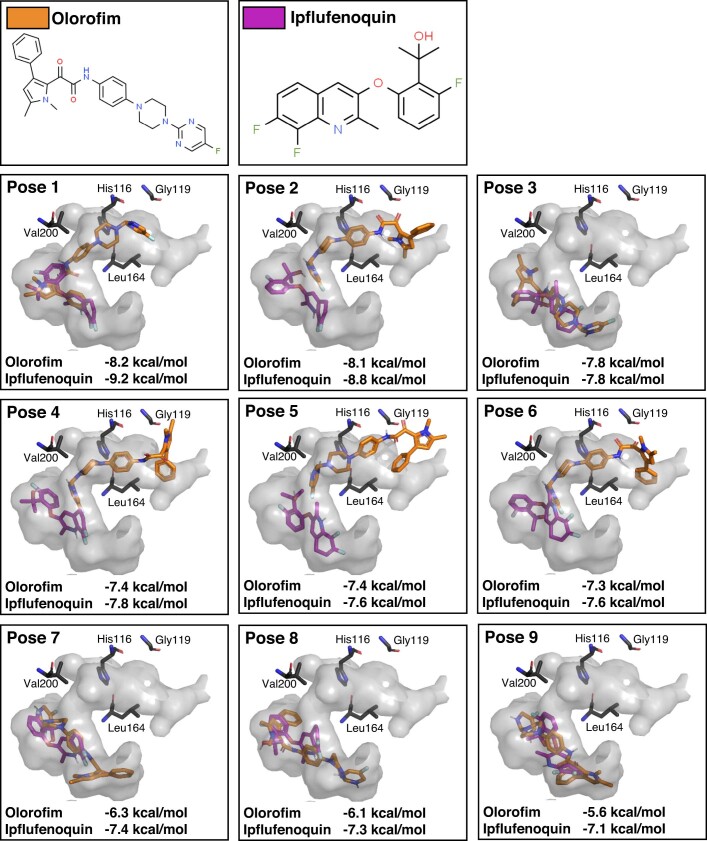
Extended Data Fig. 4 Rank 9 AfDHODH docking models. Olorofim and ipflufenoquin were docked to the predicted active site of AfDHODH using VSPipe with the standard parameters. The top 9 poses are shown with olorofim in magenta and ipflufenoquin in orange. Binding energies and residues relevant for decreased susceptibility to olorofim and ipflufenoquin are displayed for each pose.
Extended Data Fig. 4 Rank 9 AfDHODH docking models. Olorofim and ipflufenoquin were docked to the predicted active site of AfDHODH using VSPipe with the standard parameters. The top 9 poses are shown with olorofim in magenta and ipflufenoquin in orange. Binding energies and residues relevant for decreased susceptibility to olorofim and ipflufenoquin are displayed for each pose.CC BY · PubMed Central
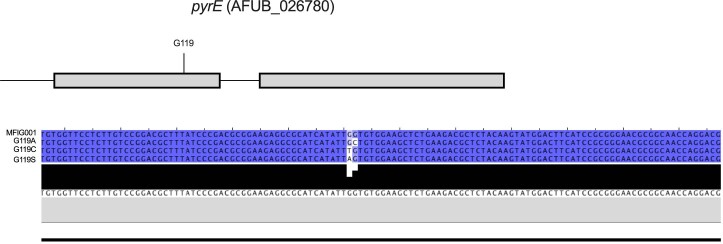
Extended Data Fig. 5 Sanger sequencing validation of G119 variants. The pyrE gene was amplified by PCR and Sanger sequencing over the G119 position was performed. No other mutations within the pyrE coding region were observed. Source data
Extended Data Fig. 5 Sanger sequencing validation of G119 variants. The pyrE gene was amplified by PCR and Sanger sequencing over the G119 position was performed. No other mutations within the pyrE coding region were observed. Source dataCC BY · PubMed Central
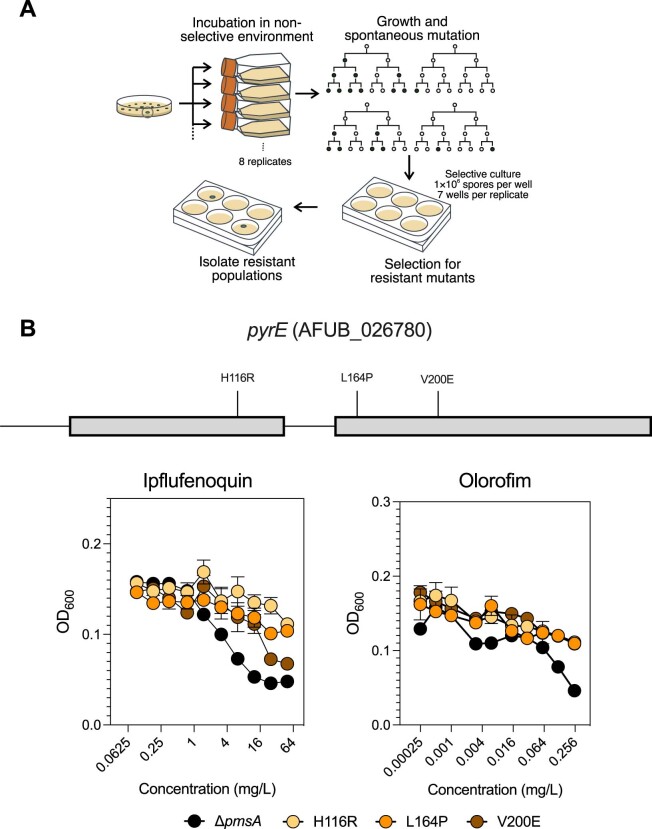
Extended Data Fig. 6 Determination of ipflufenoquin and olorofim against pmsA mutants. A) workflow of fluctuation assays in A. fumigatus. Non-selective environment generate a genetically diverse population, for which resistant mutants are selected for on ipflufenoquin containing medium. B) MIC determination of olorofim and ipflufenoquin against G119 variants of A. fumigatus according to EUCAST methodology. OD600 was measured after 48 hours. Three biological replicates were assessed. Data are presented as the mean with SEM.
Extended Data Fig. 6 Determination of ipflufenoquin and olorofim against pmsA mutants. A) workflow of fluctuation assays in A. fumigatus. Non-selective environment generate a genetically diverse population, for which resistant mutants are selected for on ipflufenoquin containing medium. B) MIC determination of olorofim and ipflufenoquin against G119 variants of A. fumigatus according to EUCAST methodology. OD600 was measured after 48 hours. Three biological replicates were assessed. Data are presented as the mean with SEM.CC BY · PubMed Central
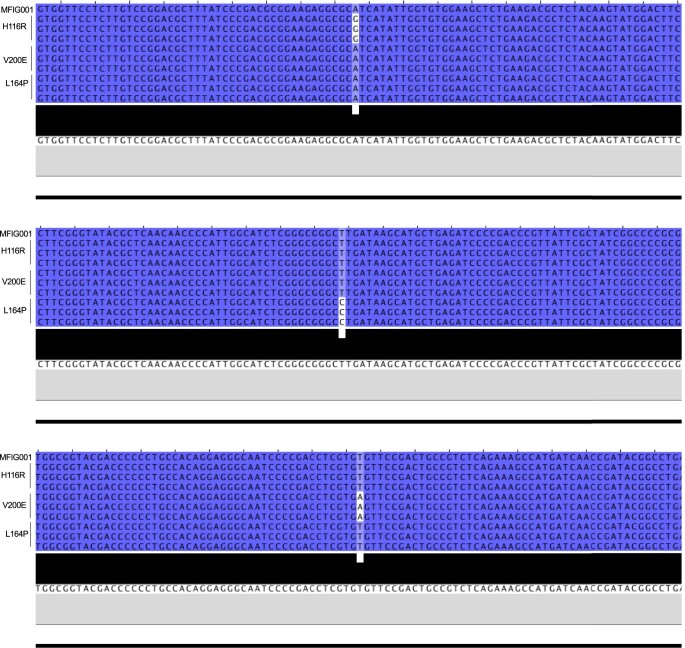
Extended Data Fig. 7 Sanger sequencing validation of H116R, L164P and V200E variants. The pyrE gene was amplified by PCR and Sanger sequencing over the H116, L164 and V200 position was performed. No other mutations within the pyrE coding region were observed. Source data
Extended Data Fig. 7 Sanger sequencing validation of H116R, L164P and V200E variants. The pyrE gene was amplified by PCR and Sanger sequencing over the H116, L164 and V200 position was performed. No other mutations within the pyrE coding region were observed. Source dataCC BY · PubMed Central
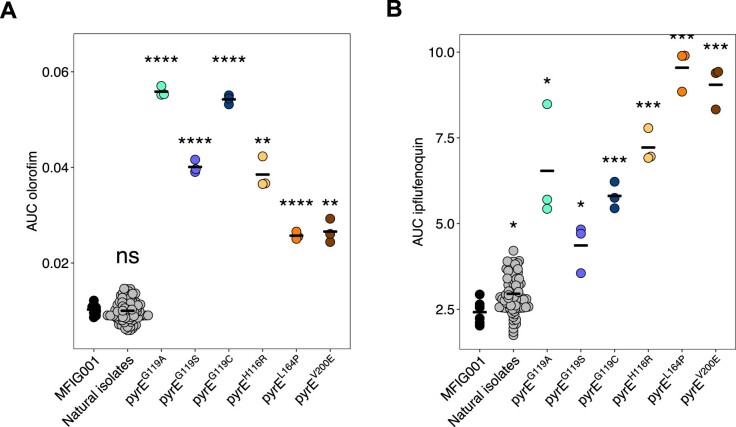
Extended Data Fig. 8 AUC analysis of A. fumigatus isolates to olorofim and ipflufenoquin. AUC of MIC curves to A: olorofim and B: ipflufenoquin presented in Figs. 1, 2 and Extended Data Fig. 2. Each point represents an independent replicate (N = 3 for pyrE mutants, N = 90 for natural isolates, N = 6 for MFIG001). Crossbar shows the mean within groups. Significant differences between groups calculated using two-sided t-tests with Bonferri correction for multiple comparisons, * < 0.05, ** < 0.01, *** < 0.001, (ANOVA A: olorofim F7,109 = 511, p < 0.0001, B: ipflufenoquin F7,109 = 141, p < 0.0001 (pairwise comparisons in Source Data).
Extended Data Fig. 8 AUC analysis of A. fumigatus isolates to olorofim and ipflufenoquin. AUC of MIC curves to A: olorofim and B: ipflufenoquin presented in Figs. 1, 2 and Extended Data Fig. 2. Each point represents an independent replicate (N = 3 for pyrE mutants, N = 90 for natural isolates, N = 6 for MFIG001). Crossbar shows the mean within groups. Significant differences between groups calculated using two-sided t-tests with Bonferri correction for multiple comparisons, * < 0.05, ** < 0.01, *** < 0.001, (ANOVA A: olorofim F7,109 = 511, p < 0.0001, B: ipflufenoquin F7,109 = 141, p < 0.0001 (pairwise comparisons in Source Data).CC BY · PubMed Central
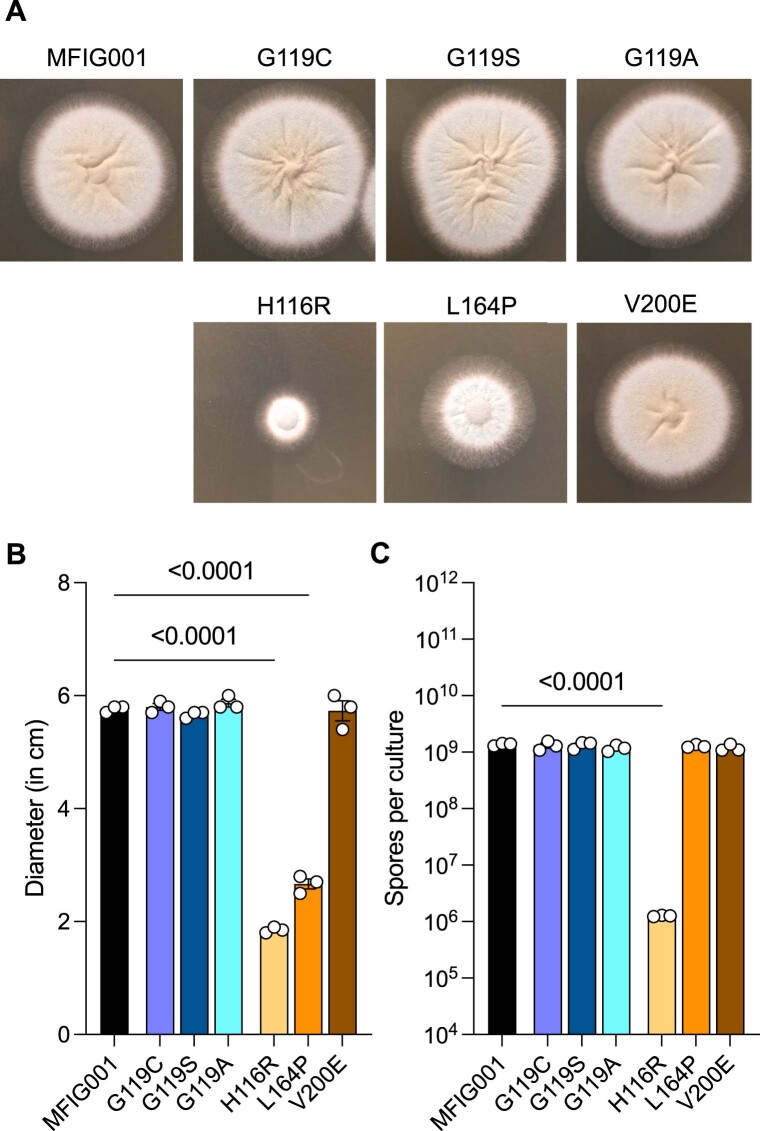
Extended Data Fig. 9 Phenotypic characterisation of resistant mutants. A) Representative images of spot assays on Sabouraud agar medium of MFIG001 and mutant isolates. B) Radial growth was measured after 48 hours on Sabouraud agar medium. Data are presented as the mean ± s.d. of three experiments. P values were determined by two-sided ANOVA with Tukey multiple comparison between means from a sample size of n = 3. C) Sporulation was measured after 3 days by inoculating MM cultures with equal spores. Spores were harvested through Miracloth and counted on a haemocytometer. Data are presented as the mean ± s.d. of three experiments. P values were determined by two-sided ANOVA from a sample size of n = 3. Source data
Extended Data Fig. 9 Phenotypic characterisation of resistant mutants. A) Representative images of spot assays on Sabouraud agar medium of MFIG001 and mutant isolates. B) Radial growth was measured after 48 hours on Sabouraud agar medium. Data are presented as the mean ± s.d. of three experiments. P values were determined by two-sided ANOVA with Tukey multiple comparison between means from a sample size of n = 3. C) Sporulation was measured after 3 days by inoculating MM cultures with equal spores. Spores were harvested through Miracloth and counted on a haemocytometer. Data are presented as the mean ± s.d. of three experiments. P values were determined by two-sided ANOVA from a sample size of n = 3. Source dataCC BY · PubMed Central
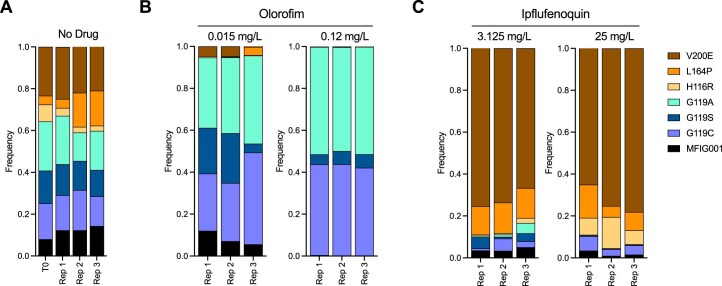
Extended Data Fig. 10 Competitive fitness in liquid RPMI-1640. A) Relative abundance of MFIG001 and mutants in RPMI-1640. Abundance was calculated as the amount of reads per isolate normalised to total QC-passed sequencing reads. Data are presented for independent replicates of three experiments. B) Abundance of MFIG001 and mutants in low (0.015 mg/L) and high (0.12 mg/L) olorofim challenge in a mixed inoculum competition assay. Data are presented for independent replicates of three experiments. C) Abundance of MFIG001 and mutants in low (3.125 mg/L) and high (25 mg/L) ipflufenoquin challenge in a mixed inoculum competition assay. Data are presented for independent replicates of three experiments.
Extended Data Fig. 10 Competitive fitness in liquid RPMI-1640. A) Relative abundance of MFIG001 and mutants in RPMI-1640. Abundance was calculated as the amount of reads per isolate normalised to total QC-passed sequencing reads. Data are presented for independent replicates of three experiments. B) Abundance of MFIG001 and mutants in low (0.015 mg/L) and high (0.12 mg/L) olorofim challenge in a mixed inoculum competition assay. Data are presented for independent replicates of three experiments. C) Abundance of MFIG001 and mutants in low (3.125 mg/L) and high (25 mg/L) ipflufenoquin challenge in a mixed inoculum competition assay. Data are presented for independent replicates of three experiments.CC BY · PubMed Central

Verification

Claims the paper makes

The claims and statistics of this paper haven’t been checked yet.

Run the check — free, no account needed. It reads the open-access text and checks the sources it cites.

A few free checks a day · papers already verified open instantly · results are public

Self-check

Percentages, sums and reported differences re-computed from the paper’s own numbers.

The self-check needs the paper’s full text.

Citations

Cites

Research works printed but not linked: 27

  1. Patterson, T. F. et al. Executive summary: practice guidelines for the diagnosis and management of aspergillosis: 2016 update by the Infectious Diseases Society of America. Clin. Infect. Dis. 63, 433–442 (2016). · DOI
  2. Snelders, E. et al. Triazole fungicides can induce cross-resistance to medical triazoles in Aspergillus fumigatus. PLoS ONE 7, e31801 (2012). · DOI
  3. Fraaije, B. et al. The multi-fungicide resistance status of Aspergillus fumigatus populations in arable soils and the wider European environment. Front. Microbiol. 11, 599233 (2020). · DOI
  4. Rhodes, J. et al. Population genomics confirms acquisition of drug-resistant Aspergillus fumigatus infection by humans from the environment. Nat. Microbiol. 7, 663–674 (2022). · DOI
  5. Bromley, M. J. et al. Occurrence of azole-resistant species of Aspergillus in the UK environment. J. Glob. Antimicrob. Resist. 2, 276–279 (2014). · DOI
  6. Bueid, A. et al. Azole antifungal resistance in Aspergillus fumigatus: 2008 and 2009. J. Antimicrob. Chemother. 65, 2116–2118 (2010). · DOI
  7. Buil, J. B. et al. Trends in azole resistance in Aspergillus fumigatus, the Netherlands, 1994–2016. Emerg. Infect. Dis. 25, 176–178 (2019). · DOI
  8. Steinmann, J. et al. Emergence of azole-resistant invasive aspergillosis in HSCT recipients in Germany. J. Antimicrob. Chemother. 70, 1522–1526 (2015). · DOI
  9. van Paassen, J. et al. Emerging aspergillosis by azole-resistant Aspergillus fumigatus at an intensive care unit in the Netherlands, 2010 to 2013. Eur. Surveill. https://doi.org/10.2807/1560-7917.es.2016.21.30.30300 (2016). · DOI
  10. Oliver, J. D. et al. F901318 represents a novel class of antifungal drug that inhibits dihydroorotate dehydrogenase. Proc. Natl Acad. Sci. USA 113, 12809–12814 (2016). · DOI · Paper page
  11. van Rhijn, N. et al. Antagonism of the azoles to olorofim and cross-resistance are governed by linked transcriptional networks in Aspergillus fumigatus. mBio 13, e0221522 (2022). · DOI
  12. Fujii, S. Features of the new fungicide quinoprol (ipflufenoquine). Plant Prot. 77, 164–166 (2023).
  13. Bo-geun, B. & Oh-jin, K. Introduction of the new fungicide, KINOPROL®. Proceedings of the Korean Society of Pesticide Science Conference 125–131 (2022).
  14. Umetsu, N. & Shirai, Y. Development of novel pesticides in the 21st century. J. Pestic. Sci. 45, 54–74 (2020). · DOI
  15. Hirayama, K. Curative effects of fungicides against Venturia inaequalis causing apple scab. J. Gen. Plant Pathol. 88, 264–269 (2022). · DOI
  16. Buil, J. B. et al. Resistance profiling of Aspergillus fumigatus to olorofim indicates absence of intrinsic resistance and unveils the molecular mechanisms of acquired olorofim resistance. Emerg. Microbes Infect. 11, 703–714 (2022). · DOI
  17. van Rhijn, N. et al. Development of a marker-free mutagenesis system using CRISPR-Cas9 in the pathogenic mould Aspergillus fumigatus. Fungal Genet. Biol. 145, 103479 (2020). · DOI
  18. Astvad, K. M. T. et al. Olorofim susceptibility testing of 1,423 Danish mold isolates obtained in 2018–2019 confirms uniform and broad-spectrum activity. Antimicrob. Agents Chemother. 65, e01527–20 (2020). · DOI
  19. Macdonald, D. et al. Inducible cell fusion permits use of competitive fitness profiling in the human pathogenic fungus Aspergillus fumigatus. Antimicrob. Agents Chemother. 63, e01615-18 (2019).
  20. Stukenbrock, E. & Gurr, S. Address the growing urgency of fungal disease in crops. Nature 617, 31–34 (2023). · DOI
  21. Schoustra, S. E. et al. Environmental hotspots for azole resistance selection of Aspergillus fumigatus, the Netherlands. Emerg. Infect. Dis. 25, 1347–1353 (2019). · DOI · Paper page
  22. Bertuzzi, M. et al. On the lineage of Aspergillus fumigatus isolates in common laboratory use. Med. Mycol. 59, 7–13 (2021). · DOI
  23. Pontecorvo, G. et al. The genetics of Aspergillus nidulans. Adv. Genet. 5, 141–238 (1953). · DOI
  24. Arendrup, M. C. et al. EUCAST technical note on Aspergillus and amphotericin B, itraconazole, and posaconazole. Clin. Microbiol. Infect. 18, E248–50 (2012). · DOI
  25. Alvarez-Carretero, S. et al. VSpipe, an integrated resource for virtual screening and hit selection: applications to protein tyrosine phospahatase inhibition. Molecules 23, 353 (2018). · DOI
  26. Trott, O. & Olson, A. J. AutoDock Vina: improving the speed and accuracy of docking with a new scoring function, efficient optimization, and multithreading. J. Comput. Chem. 31, 455–461 (2010). · DOI · Paper page
  27. Fraczek, M. G. et al. The cdr1B efflux transporter is associated with non-cyp51a-mediated itraconazole resistance in Aspergillus fumigatus. J. Antimicrob. Chemother. 68, 1486–1496 (2013). · DOI

Metadata

Authors
van Rhijn, N., Storer, I. S. R., Birch, M., Oliver, J. D., Bottery, M. J., & Bromley, M. J.
Affiliations
  • University of Manchester (GB)
  • F2G (United Kingdom) (GB)
Corresponding author
Bromley, Michael J.
Venue
Nature Microbiology
Published
2023-12-27
Volume
9
Issue
1
Pages
29-34
ISSN
2058-5276 (ISSN-L)
OpenAlex
W4390273837
Cited by
86
References
2
Citations by year
2026: 31 · 2025: 35 · 2024: 19 · 2023: 1
FWCI
17.80
Type
journal article
Language
en
Open access
Locations
  • Nature Microbiology (publishedVersion, cc-by)
  • Research Square (acceptedVersion, cc-by)
  • PubMed Central (publishedVersion, cc-by)
  • PubMed (publishedVersion)
  • Research Explorer (The University of Manchester) (publishedVersion, cc-by)
  • UEA Digital Repository (University of East Anglia) (acceptedVersion)
Funders
  • Wellcome Trust (219551/Z/19/Z, 226408/Z/22/Z, 221653/Z/20/Z)
  • RCUK | Medical Research Council (DTP)
Topics
  • Health Sciences › Medicine › Infectious Diseases › Antifungal resistance and susceptibility
  • Life Sciences › Agricultural and Biological Sciences › Plant Science › Fungal Plant Pathogen Control
  • Life Sciences › Biochemistry, Genetics and Molecular Biology › Molecular Biology › Fungal and yeast genetics research
Keywords
Aspergillus fumigatus, olorofim, fungicide resistance, azole resistance, dihydroorotate dehydrogenase, non-synonymous mutations, fungicide selection
MeSH terms
Acetamides, Antifungal Agents, Aspergillus fumigatus, Fungicides, Industrial, Piperazines, Pyrimidines, Pyrroles, Agrochemicals

About these checks

Registry, retraction, Cites and statistics results are computed, not judged, with one exception: a printed reference that no index lists is read once by a model before it counts as a citation error. Claims are extracted by a model and kept only when their quote appears verbatim in the text; each cited source is then checked, with a model’s help, for whether it says what the claim relies on. Those verdicts can be wrong — read the claim’s quote and the cited source before relying on one.

Statistics and arithmetic are recomputed, not judged.

Confidence bands are shown only for fields calibrated on our annotated test set. None is calibrated yet, so no band is shown.

What counts as a claim ›How we measure confidence ›How we check this ›

Are you an author, or do you see a problem with this page? Request a review