

A strong no-go theorem on the Wigner’s friend paradox
Open accessThe DOI matches its Crossref record; 62 of the 66 references it cites were found in a registry or an index; 13 of the 45 sources its claims cite were checked for support.
Abstract
Does quantum theory apply at all scales, including that of observers? New light on this fundamental question has recently been shed through a resurgence of interest in the long-standing Wigner’s friend paradox. This is a thought experiment addressing the quantum measurement problem—the difficulty of reconciling the (unitary, deterministic) evolution of isolated systems and the (non-unitary, probabilistic) state update after a measurement. Here, by building on a scenario with two separated but entangled friends introduced by Brukner, we prove that if quantum evolution is controllable on the scale of an observer, then one of ‘No-Superdeterminism’, ‘Locality’ or ‘Absoluteness of Observed Events’—that every observed event exists absolutely, not relatively—must be false. We show that although the violation of Bell-type inequalities in such scenarios is not in general sufficient to demonstrate the contradiction between those three assumptions, new inequalities can be derived, in a theory-independent manner, that are violated by quantum correlations. This is demonstrated in a proof-of-principle experiment where a photon’s path is deemed an observer. We discuss how this new theorem places strictly stronger constraints on physical reality than Bell’s theorem. For a scenario of two separated but entangled observers, inequalities are derived from three fundamental assumptions. An experiment shows that these inequalities can be violated if quantum evolution is controllable on the scale of an observer.
Overview
CoChat Summary
## TL;DR
This paper introduces “Local Friendliness” (LF), a set of assumptions for extended Wigner’s friend scenarios, and proves that if quantum evolution is controllable at the scale of an observer, then at least one of No-Superdeterminism, Locality, or Absoluteness of Observed Events must fail. It derives LF inequalities, shows they can be violated by quantum theory, and demonstrates the effect in a proof-of-principle photon experiment.
## Key findings
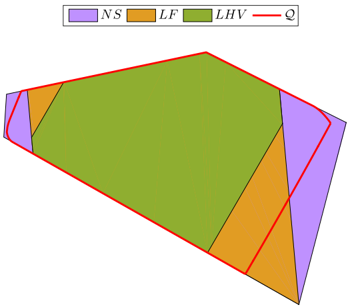
- For the bipartite EWFS with N = 2 measurement settings, LF correlations are the same as LHV correlations, but for N = 3 settings and O = 2 outcomes, LF correlations are a strict superset of LHV correlations.
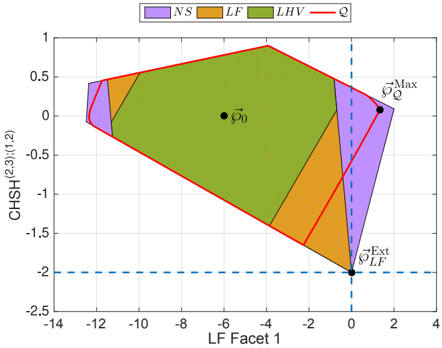
- For the N = 3, O = 2 case, the LF set is a polytope with 932 facets, grouped into 9 inequivalent classes; the paper identifies categories including Genuine LF, I 3322, Brukner, Semi-Brukner, and Bell non-LF inequalities.
- The paper reports quantum violations of all the inequality categories it studies; for example, the strongest calculated violation of the first Genuine LF inequality is 1.345 with white-noise tolerance 18.3%, and the second Genuine LF inequality reaches 0.880 with white-noise tolerance 18.0%.
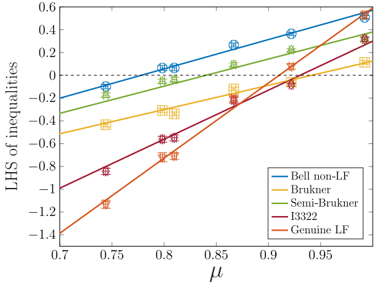
- In the experiment, the authors use polarization-encoded photons and report that the data show sequential violations of Bell non-LF, Semi-Brukner, and Genuine LF inequalities; at µ = 0.80 and 0.81, they violate Bell inequalities without violating any LF inequality, and they verified that none of the 932 LF inequalities were violated there.
## Methods
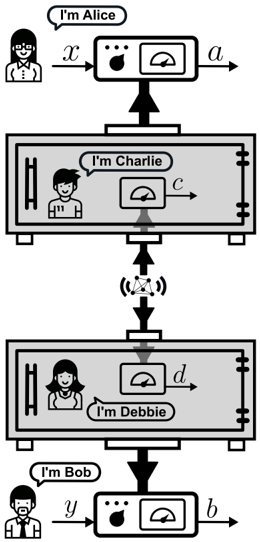
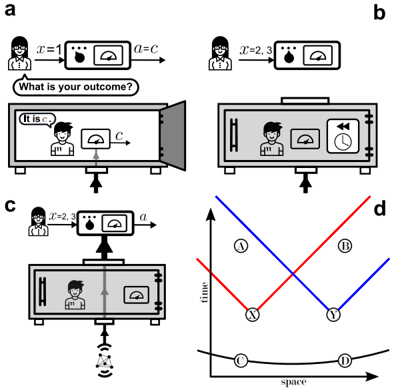
- Theoretical design: the paper formalizes an extended Wigner’s friend scenario with two superobservers (Alice and Bob) and two friends (Charlie and Debbie), then defines LF via AOE, NSD, and Locality, and derives the corresponding LF inequalities and polytope structure.
- Computational analysis: the authors enumerate the 932 LF facets for the N = 3, O = 2 scenario using PANDA, and search for quantum violations using a see-saw algorithm and semidefinite-programming hierarchies.
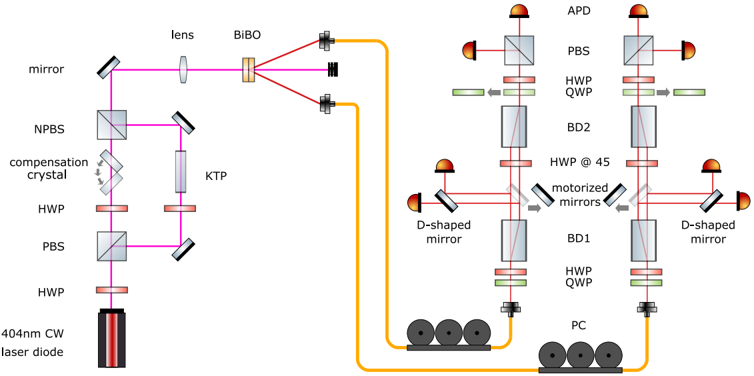
- Experimental sample and measurements: a proof-of-principle photonic implementation uses polarization-encoded photons as the systems, photon paths as the friends, and photodetection measurements for the superobservers; the experiment includes quantum state tomography and nine measurement-setting combinations from the three settings on each side.
## Limitations
- The paper states that the experiment is a proof-of-principle version because the “friends” are photon paths, not macroscopic sentient observers; it says a fully rigorous demonstration would require more plausible observers plus shot-by-shot randomized settings and closing separation, efficiency, and freedom-of-choice loopholes.
- The text makes evident that the experimental test does not close the loopholes needed for a definitive observer-level test, because the authors explicitly say the stronger demonstration would require additional experimental controls not implemented here.
- The paper notes that, even if LF inequalities were not violated with actual observers, an alternative explanation could be that nature forbids such coherent control at observer scale; this is presented as an open possibility rather than resolved experimentally.
Model-written summary. Check it against the paper before relying on it.
Integrity signals
Registry
Cites
Statistics
Figures
Verification
Claims the paper makes
10 Valid · 1 Not valid · 16 Not checked · 59 Own results and interpretations
Every source the paper cites for this claim was checked and supports it.
In the paper
“In particular, Brukner [14] introduced an extended Wigner's friend scenario (EWFS) with two spatially separated laboratories, each containing a friend, accompanied by a superobserver who can perform various measurements on their friend's laboratory.”
What the sources say
- Supportedcites [14] Brukner, ˘ C. A no-go theorem for observer-independent facts. Entropy 20 , 350 (2018). source
Section 3, “The No-Go Theorem” (page not provided), describes two laboratories, each containing a friend (Charlie or Debbie), and a corresponding super-observer (Alice or Bob). It says Alice and Bob can choose between different measurements, including a Wigner-type measurement. This supports the citing sentence’s description of Brukner’s extended scenario. (LLM, conf=0.92)
plain- Asserted: passes — The authors put it forward as true.
- Checkable: passes — It can be checked against evidence.
- Load-bearing: passes — The paper’s conclusions depend on it.
- Based: passes — The paper gives a reason why it holds.
- Supported
Every source the paper cites for this claim was checked and supports it.
In the paper
“Although decoherence can 'save the appearances' by explaining the suppression of quantum effects at the macroscopic level, it cannot solve the measurement problem: 'We are still left with a multitude of (albeit individually well-localized quasiclassical) components of the wave function, and we need to supplement or otherwise to interpret this situation in order to explain why and how single outcom”
What the sources say
- Supportedcites [2] Schlosshauer, M. Decoherence, the measurement problem, and interpretations of quantum mechanics. Reviews of Modern Physics 76 , 1267-1305 (2005). source
The Concluding Remarks (p. 37) state that, within the standard interpretation of quantum mechanics, decoherence cannot solve the problem of definite outcomes and that further interpretation is needed to explain single outcomes. The Introduction (p. 2) also directly answers whether decoherence solves the measurement problem: “Clearly not.” (LLM, conf=0.94)
plain- Asserted: passes — The authors put it forward as true.
- Checkable: passes — It can be checked against evidence.
- Load-bearing: passes — The paper’s conclusions depend on it.
- Based: passes — The paper gives a reason why it holds.
- Supported
Every source the paper cites for this claim was checked and supports it.
In the paper
“Clearly, our experiment (and that of ref. [17]) did not probe collapse theories.”
What the sources say
- Supportedcites [17] Proietti, M. et al. Experimental test of local observer independence. Science Advances 5 , eaaw9832 (2019). source
The Discussion says that testing larger observers could rule out alternative collapse models, but that this is not the point of a Bell-Wigner test. This supports the characterization that the cited experiment did not probe collapse theories. (LLM, conf=0.88)
boosted- Asserted: passes — The authors put it forward as true.
- Checkable: passes — It can be checked against evidence.
- Load-bearing: passes — The paper’s conclusions depend on it.
- Based: passes — The paper gives a reason why it holds.
- Supported
Every source the paper cites for this claim was checked and supports it.
In the paper
“A recent six-photon experiment [17], using a set-up where the role of each friend is played by a single photon, successfully violated such a Bell inequality derived from Brukner's assumptions.”
What the sources say
- Supportedcites [17] Proietti, M. et al. Experimental test of local observer independence. Science Advances 5 , eaaw9832 (2019). source
The Introduction derives the tested Bell-Wigner inequality from free choice, locality, and observer-independent facts. The Results describe photons storing each friend’s measurement record and report 1,794 six-photon coincidence events, yielding a violation of inequality (2) by more than five standard deviations. (LLM, conf=0.93)
plainstates a cause- Asserted: passes — The authors put it forward as true.
- Checkable: passes — It can be checked against evidence.
- Load-bearing: passes — The paper’s conclusions depend on it.
- Based: passes — The paper gives a reason why it holds.
- Supported
The cited sources that could be checked couldn’t confirm or dispute this claim.
In the paper
“we obtain the complete set of 932 LF facets for this scenario.”
What the sources say
- Could not verifycites [38] Clauser, J. F., Horne, M. A., Shimony, A. & Holt, R. A. Proposed Experiment to Test Local HiddenVariable Theories. Phys. Rev. Lett. 23 , 880-884 (1969). sourceExperimental — accuracy not yet measured
The paper’s proposed-experiment section discusses a local hidden-variable inequality and photon-polarizer measurements, not an enumeration of LF facets. Searches for “932 LF facets N=3 O=2” and for local-friendliness facets found no passage addressing the claimed count; page numbers were not available in our copy. (LLM, conf=0.78)
plain- Asserted: passes — The authors put it forward as true.
- Checkable: passes — It can be checked against evidence.
- Load-bearing: unclear — It is unclear whether the paper’s conclusions depend on it.
- Based: passes — The paper gives a reason why it holds.
- Could not verify
52 more claims · 1 with their cited sources checked
Create a free account to see all 86 claims and to verify the 19 references still open.
- Probably not a substantial claim. 16
- It may state two separate claims as one. 15
Citations
Cites
On the Einstein Podolsky Rosen paradox
Bell, J. S. (1964) · Physics Physique Fizika · doi:10.1103/physicsphysiquefizika.1.195 · Cited by 12,252
Proposed Experiment to Test Local Hidden-Variable Theories
Clauser, J. F., Horne, M. A., Shimony, A., & Holt, R. A. (1969) · Physical Review Letters · doi:10.1103/physrevlett.23.880 · Cited by 7,573 · cited 1×
“[31] Clauser, J.”
A Suggested Interpretation of the Quantum Theory in Terms of "Hidden" Variables. I
Bohm, D. (1952) · Physical Review · doi:10.1103/physrev.85.166 · Cited by 5,510 · cited 2×
“Proposed resolutions have radical implications: they either reject the idea that measurement outcomes have single, observer-independent values [4–7], or postulate fasterthan-light [8, 9] or retrocausal effects [10, 11] at a hiddenvariable level.”
Background"Relative State" Formulation of Quantum Mechanics
Everett, H. (1957) · Reviews of Modern Physics · doi:10.1103/revmodphys.29.454 · Cited by 3,379 · cited 1×
“[4] Everett, H.”
Loophole-free Bell inequality violation using electron spins separated by 1.3 kilometres
Hensen, B., Bernien, H., Dréau, A. E., Reiserer, A., Kalb, N., Blok, M. S., Ruitenberg, J., Vermeulen, R. F. L., Schouten, R. N., Abellán, C., et al. (2015) · Nature · doi:10.1038/nature15759 · Cited by 2,852 · cited 1×
“[34] Hensen, B.”
Brunner, N., Cavalcanti, D., Pironio, S., Scarani, V., & Wehner, S. (2014) · Reviews of Modern Physics · doi:10.1103/revmodphys.86.419 · Cited by 2,688
A Suggested Interpretation of the Quantum Theory in Terms of "Hidden" Variables. II
Bohm, D. (1952) · Physical Review · doi:10.1103/physrev.85.180 · Cited by 2,052
On gravity's role in quantum state reduction
Penrose, R. (1996) · General Relativity and Gravitation · doi:10.1007/bf02105068 · Cited by 1,872 · cited 1×
“[13] Penrose, R.”
The Problem of Hidden Variables in Quantum Mechanics
Kochen, S., & Specker, E. P. (1975) · The Logico-Algebraic Approach to Quantum Mechanics · doi:10.1007/978-94-010-1795-4_17 · Cited by 1,650
Significant-Loophole-Free Test of Bell’s Theorem with Entangled Photons
Giustina, M., Versteegh, M. A. M., Wengerowsky, S., Handsteiner, J., Hochrainer, A., Phelan, K., Steinlechner, F., Kofler, J., Larsson, J.-Å., Abellán, C., et al. (2015) · Physical Review Letters · doi:10.1103/physrevlett.115.250401 · Cited by 1,529 · cited 1×
“[33] Giustina, M.”
Research works printed but not linked: 1
- Shimony, A. Controllable and uncontrollable nonlocality. In Kamefuchi, S. (ed.) Foundations of Quantum Mechanics in the Light of New Technology , 225-230 (Physical Society of Japan, Tokyo, 1984).
Cited by
A Quintet of Quandaries: Five No-Go Theorems for Relational Quantum Mechanics
Pienaar, J. (2021) · Foundations of Physics · doi:10.1007/s10701-021-00500-6 · Cited by 96
Stable Facts, Relative FactsPreprint
Biagio, A. D., & Rovelli, C. (2020) · PhilSci-Archive (University of Pittsburgh) · Cited by 98
Relational Quantum Mechanics Is about Facts, Not States: A Reply to Pienaar and Brukner
Di Biagio, A., & Rovelli, C. (2022) · Foundations of Physics · doi:10.1007/s10701-022-00579-5 · Cited by 35
A no-go theorem for the persistent reality of Wigner’s friend’s perception
Guérin, P. A., Baumann, V., Santo, F. D., & Brukner, Č. (2021) · Communications Physics · doi:10.1038/s42005-021-00589-1 · Cited by 104
Qubits are not observers -- a no-go theorem
Brukner, Č. (2021) · arXiv · doi:10.48550/arxiv.2107.03513 · Cited by 57
QBism and Relational Quantum Mechanics compared
Pienaar, J. (2021) · Foundations of Physics · doi:10.1007/s10701-021-00501-5 · Cited by 72
Biagio, A. D., & Rovelli, C. (2021) · Foundations of Physics · doi:10.1007/s10701-021-00429-w · Cited by 117
Is the life-world reduction sufficient in quantum physics?
Bitbol, M. (2020) · Continental Philosophy Review · doi:10.1007/s11007-020-09515-8 · Cited by 42
Experimental aspects of indefinite causal order in quantum mechanics
Rozema, L. A., Strömberg, T., Cao, H., Guo, Y., Liu, B., & Walther, P. J. (2024) · Nature Reviews Physics · doi:10.1038/s42254-024-00739-8 · Cited by 83
The original Wigner’s friend paradox within a realist toy model
Lostaglio, M., & Bowles, J. (2021) · Proceedings of the Royal Society A Mathematical Physical and Engineering Sciences · doi:10.1098/rspa.2021.0273 · Cited by 44
The arrow of time in operational formulations of quantum theory
Biagio, A. D., Donà, P., & Rovelli, C. (2021) · Quantum · doi:10.22331/q-2021-08-09-520 · Cited by 62
Brukner, Č. (2020) · Nature Physics · doi:10.1038/s41567-020-0984-8 · Cited by 49
Physics and Metaphysics of Wigner’s Friends: Even Performed Premeasurements Have No Results
Żukowski, M., & Markiewicz, M. (2021) · Physical Review Letters · doi:10.1103/physrevlett.126.130402 · Cited by 62
No-go theorem based on incomplete information of Wigner about his friend
Xu, Z., Steinberg, J., Nguyen, H. C., & Gühne, O. (2023) · Physical Review A · doi:10.1103/physreva.107.022424 · Cited by 37
Renes, J. M. (2021) · arXiv (Cornell University) · doi:10.48550/arxiv.2107.02193 · Cited by 41
Cavalcanti, E. G. (2021) · Foundations of Physics · doi:10.1007/s10701-021-00417-0 · Cited by 57
Self-citationReference Frame Induced Symmetry Breaking on Holographic Screens
Fields, C., Glazebrook, J. F., & Marcianò, A. (2021) · Symmetry · doi:10.3390/sym13030408 · Cited by 32
Device-independent certification of indefinite causal order in the quantum switch
van der Lugt, T., Barrett, J., & Chiribella, G. (2023) · Nature Communications · doi:10.1038/s41467-023-40162-8 · Cited by 57
What Does ‘(Non)-absoluteness of Observed Events’ Mean?
Adlam, E. (2024) · Foundations of Physics · doi:10.1007/s10701-023-00747-1 · Cited by 44
Multiparty orthogonal product states with minimal genuine nonlocality
Rout, S., Maity, A. G., Mukherjee, A., Halder, S., & Banik, M. (2021) · Physical Review A · doi:10.1103/physreva.104.052433 · Cited by 35
Emergence in Context: A Treatise in Twenty-First Century Natural Philosophy
Bishop, R. C., Silberstein, M., & Pexton, M. (2022) · doi:10.1093/oso/9780192849786.001.0001 · Cited by 47
Wiseman, H. M., Cavalcanti, E. G., & Rieffel, E. G. (2023) · Quantum · doi:10.22331/q-2023-09-14-1112 · Cited by 60
Self-citationScientific Objectivity and Its Limits
Healey, R. (2021) · The British Journal for the Philosophy of Science · doi:10.1086/716169 · Cited by 32
Any consistent coupling between classical gravity and quantum matter is fundamentally irreversible
Galley, T. D., Giacomini, F., & Selby, J. H. (2023) · Quantum · doi:10.22331/q-2023-10-16-1142 · Cited by 56
Yīng, Y., Ansanelli, M. M., Biagio, A. D., Wolfe, E., Schmid, D., & Cavalcanti, E. G. (2024) · Quantum · doi:10.22331/q-2024-09-26-1485 · Cited by 40
Self-citationFlam-Shepherd, D., Wu, T., Gu, X., Cervera-Lierta, A., Krenn, M., & Aspuru‐Guzik, A. (2022) · Nature Machine Intelligence · doi:10.1038/s42256-022-00493-5 · Cited by 35
A possibilistic no-go theorem on the Wigner’s friend paradox
Haddara, M., & Cavalcanti, E. G. (2023) · New Journal of Physics · doi:10.1088/1367-2630/aceea3 · Cited by 35
Self-citationBeyond Causal Explanation: Einstein’s Principle Not Reichenbach’s
Silberstein, M., Stuckey, W. M., & McDevitt, T. J. (2021) · Entropy · doi:10.3390/e23010114 · Cited by 24
Sun, K., Liu, Z., Wang, Y., Hao, Z.-Y., Xu, X.-Y., Xu, J., Li, C., Guo, G., Castellini, A., Lami, L., et al. (2022) · Proceedings of the National Academy of Sciences · doi:10.1073/pnas.2119765119 · Cited by 24
Testing quantum theory with thought experiments
Nurgalieva, N., & Renner, R. (2020) · Contemporary Physics · doi:10.1080/00107514.2021.1880075 · Cited by 34
Wigner’s friend and Relational Quantum Mechanics: A Reply to Laudisa
Weststeijn, N. (2021) · Foundations of Physics · doi:10.1007/s10701-021-00487-0 · Cited by 18
Wigner-friend scenarios with noninvasive weak measurements
Matzkin, A., & Sokolovski, D. (2020) · Physical Review A · doi:10.1103/physreva.102.062204 · Cited by 13
Silberstein, M., & Stuckey, W. M. (2022) · Oxford University Press eBooks · doi:10.1093/oso/9780197501665.003.0011 · Cited by 20
Quantum realism: Axiomatization and quantification
Orthey, A. C., & Angelo, R. M. (2022) · Physical Review A · doi:10.1103/physreva.105.052218 · Cited by 13
Rovelli, C. (2022) · Oxford University Press eBooks · doi:10.1093/oxfordhb/9780198844495.013.44 · Cited by 13
Certifying long-range quantum correlations through routed Bell tests
Lobo, E. P., Pauwels, J., & Pironio, S. (2024) · Quantum · doi:10.22331/q-2024-05-02-1332 · Cited by 29
Which features of quantum physics are not fundamentally quantum but are due to indeterminism?
Santo, F. D., & Gisin, N. (2025) · Quantum · doi:10.22331/q-2025-04-03-1686 · Cited by 29
Quantum erasing the memory of Wigner's friend
Elouard, C., Lewalle, P., Manikandan, S. K., Rogers, S., Frank, A., & Jordan, A. N. (2021) · Quantum · doi:10.22331/q-2021-07-08-498 · Cited by 21
Wigner’s friend and relational objectivity
Brukner, Č. (2022) · Nature Reviews Physics · doi:10.1038/s42254-022-00505-8 · Cited by 15
Relational Quantum Mechanics, quantum relativism, and the iteration of relativity
Riedel, T. (2024) · Studies in History and Philosophy of Science Part A · doi:10.1016/j.shpsa.2024.02.007 · Cited by 21
Events in quantum mechanics are maximally non-absolute
Moreno, G., Nery, R., Duarte, C., & Chaves, R. (2022) · Quantum · doi:10.22331/q-2022-08-24-785 · Cited by 12
Identifying weak values with intrinsic dynamical properties in modal theories
Pandey, D., Sampaio, R., Ala-Nissilä, T., Albareda, G., & Oriols, X. (2021) · Physical Review A · doi:10.1103/physreva.103.052219 · Cited by 13
Relational Quantum Mechanics and the PBR Theorem: A Peaceful Coexistence
Oldofredi, A., & Calosi, C. (2021) · Foundations of Physics · doi:10.1007/s10701-021-00485-2 · Cited by 12
Quantum mechanical rules for observed observers and the consistency of quantum theory
Polychronakos, A. P. (2024) · Nature Communications · doi:10.1038/s41467-024-47170-2 · Cited by 18
Quantum Measurements with, and Yet without an Observer
Sokolovski, D. (2020) · Entropy · doi:10.3390/e22101185 · Cited by 14
Non-Markovian wave-function collapse models are Bohmian-like theories in disguise
Tilloy, A., & Wiseman, H. M. (2021) · Quantum · doi:10.22331/q-2021-11-29-594 · Cited by 14
Self-citationLocal Quantum Theory with Fluids in Space-Time
Waegell, M. (2023) · Quantum Reports · doi:10.3390/quantum5010011 · Cited by 16
Fresh perspectives on the foundations of quantum physics
(2023) · doi:10.1038/s42254-023-00586-z · Cited by 8
Self-citationWang, X., Zhang, K., & Wang, J. (2023) · Classical and Quantum Gravity · doi:10.1088/1361-6382/acc829 · Cited by 18
On the consistency of relative facts
Cavalcanti, E. G., Biagio, A. D., & Carlo Rovelli, C. (2023) · European Journal for Philosophy of Science · doi:10.1007/s13194-023-00551-8 · Cited by 20
Self-citationConsiderations on the Relativity of Quantum Irrealism
Engelbert, N. G., & Angelo, R. M. (2023) · Entropy · doi:10.3390/e25040603 · Cited by 8
Generalizing Optimal Bell Inequalities
Bernards, F., & Gühne, O. (2020) · Physical Review Letters · doi:10.1103/physrevlett.125.200401 · Cited by 10
Relational Quantum Mechanics at the Crossroads
Calosi, C., & Riedel, T. (2024) · Foundations of Physics · doi:10.1007/s10701-024-00810-5 · Cited by 18
Gravitationally-induced wave function collapse time for molecules
Tomaz, A. A., Mattos, R. S., & Barbatti, M. (2024) · Physical Chemistry Chemical Physics · doi:10.1039/d4cp02364a · Cited by 17
The measurement postulates of quantum mechanics are not redundant
Kent, A. (2025) · Quantum · doi:10.22331/q-2025-05-20-1749 · Cited by 11
Epistemic horizons from deterministic laws: lessons from a nomic toy theory
Fankhauser, J., Gonda, T., & Cuevas, G. D. L. (2025) · Synthese · doi:10.1007/s11229-024-04852-0 · Cited by 12
Standard quantum mechanics without observers
Stoica, O. C. (2021) · Physical Review A · doi:10.1103/physreva.103.032219 · Cited by 10
No relation for Wigner's friendPreprint
Castellani, L. (2020) · PhilSci-Archive (University of Pittsburgh) · Cited by 6
Allowing Wigner’s friend to sequentially measure incompatible observables
Utreras-Alarcón, A., Cavalcanti, E. G., & Wiseman, H. M. (2024) · Proceedings of the Royal Society A Mathematical Physical and Engineering Sciences · doi:10.1098/rspa.2024.0040 · Cited by 13
Self-citationWavefunction branching: when you can't tell pure states from mixed states
Taylor, J. K., & McCulloch, I. P. (2025) · Quantum · doi:10.22331/q-2025-03-25-1670 · Cited by 6
“A calculable notion of “branchiness” such as C I − C D could provide a metric for experimental tests probing the boundaries of the quantum to classical transition, such as tests for violations of “local friendliness” [58, 59].”
No Relation for Wigner’s Friend
Castellani, L. (2021) · International Journal of Theoretical Physics · doi:10.1007/s10773-021-04826-9 · Cited by 6
The Embedded-Observer No-Go TheoremPreprint
Materov (2026) · SSRN Electronic Journal · doi:10.2139/ssrn.7243425 · Cited by 8
Bhowmick, S., Kanjilal, S., Pan, A. K., & Sasmal, S. (2024) · Physical Review A · doi:10.1103/physreva.110.052432 · Cited by 5
Is Quantum Relativism Untameable? Revenge Wigner Arguments for Relative Facts
Riedel, T. (2024) · The British Journal for the Philosophy of Science · doi:10.1086/732830 · Cited by 9
Relational Properties and Relational Quantum Mechanics
Fano, V., & Sanchioni, M. (2025) · Foundations of Physics · doi:10.1007/s10701-025-00867-w · Cited by 7
Preface to Special Issue: Quantum Information Revolution: Impact to Foundations
Fuchs, C. A., & Khrennikov, A. Y. (2020) · Foundations of Physics · doi:10.1007/s10701-020-00401-0 · Cited by 3
Extended Wigner's friend paradoxes do not require nonlocal correlations
Walleghem, L., Wagner, R., Yīng, Y., & Schmid, D. (2025) · Physical Review A · doi:10.1103/n4hv-rlgj · Cited by 13
Wigner's friend's memory and the no-signaling principle
Baumann, V., & Brukner, Č. (2024) · Quantum · doi:10.22331/q-2024-09-25-1481 · Cited by 12
Wigner’s Friend Scenarios and the Internal Consistency of Standard Quantum Mechanics
Sokolovski, D., & Matzkin, A. (2021) · Entropy · doi:10.3390/e23091186 · Cited by 4
Conditional probabilities of measurements, quantum time, and the Wigner's-friend case
Trassinelli, M. (2022) · Physical Review A · doi:10.1103/physreva.105.032213 · Cited by 6
The quantum measurement problem: a review of recent trends
Tomaz, A. A., Mattos, R. S., & Barbatti, M. (2025) · The Philosophical Magazine A Journal of Theoretical Experimental and Applied Physics · doi:10.1080/14786435.2025.2601922 · Cited by 32
Law of Total Probability in Quantum Theory and Its Application in Wigner’s Friend Scenario
Yang, J. M. (2022) · Entropy · doi:10.3390/e24070903 · Cited by 6
Saving Science from Quantum Mechanics: The Epistemology of the Measurement Problem
Adlam, E. (2025) · doi:10.1093/9780197808887.001.0001 · Cited by 10
What kind of relationality does quantum mechanics exhibit?
Adlam, E. (2026) · European Journal for Philosophy of Science · doi:10.1007/s13194-025-00709-6 · Cited by 15
Classical Information and Collapse in Wigner’s Friend Setups
Baumann, V. (2023) · Entropy · doi:10.3390/e25101420 · Cited by 7
Biodigital philosophy, supercomputing and technological convergence in the Quantum Age
Peters, M. A. (2022) · Educational Philosophy and Theory · doi:10.1080/00131857.2022.2098716 · Cited by 3
Algorithmic Idealism: What Should You Believe to Experience Next?
Müller, M. P. (2026) · Foundations of Physics · doi:10.1007/s10701-026-00913-1 · Cited by 10
Vilasini, V., & Woods, M. P. (2026) · Physical Review X · doi:10.1103/nqbv-6qgr · Cited by 15
The Relational Interpretation of Quantum PhysicsPreprint
Rovelli, C. (2021) · arXiv (Cornell University) · doi:10.48550/arxiv.2109.09170 · Cited by 44
Wigner and Friends, A Map is not the Territory! Contextuality in Multi-agent Paradoxes
Montanhano, S. B. (2025) · Foundations of Science · doi:10.1007/s10699-024-09971-y · Cited by 6
Fundamental Physics and Computation: The Computer-Theoretic Framework
Miguel-Tomé, S., Lázaro, Á. L. S., & Alonso-Romero, L. (2022) · Universe · doi:10.3390/universe8010040 · Cited by 3
Silberstein, M., & Stuckey, W. M. (2019) · arXiv (Cornell University) · doi:10.48550/arxiv.1901.10825 · Cited by 3
Local friendliness polytopes in multipartite scenarios
Haddara, M., & Cavalcanti, E. G. (2025) · Physical Review A · doi:10.1103/physreva.111.012206 · Cited by 11
Self-citationMacroscopic Wigner's friend paradoxes: Consistency with weak macroscopic realism
Joseph, R. R., Thenabadu, M., Hatharasinghe, C., Fulton, J., Teh, R. Y., Drummond, P. D., & Reid, M. D. (2024) · Physical Review A · doi:10.1103/physreva.110.022219 · Cited by 9
Algebraical Entropy and Arrow of Time
Gogberashvili, M. (2022) · Entropy · doi:10.3390/e24111522 · Cited by 3
Device-independent witness for the nonobjectivity of quantum dynamics
Poderini, D., Rodari, G., Moreno, G., Polino, E., Nery, R., Suprano, A., Duarte, C., Sciarrino, F., & Chaves, R. (2023) · Physical Review A · doi:10.1103/physreva.108.032201 · Cited by 6
Epistemic Boundaries and Quantum Uncertainty: What Local Observers Can (Not) Predict
Fankhauser, J. (2024) · Quantum · doi:10.22331/q-2024-11-07-1518 · Cited by 4
Unitary Interactions Do Not Yield Outcomes: Attempting to Model “Wigner’s Friend”
Kastner, R. E. (2021) · Foundations of Physics · doi:10.1007/s10701-021-00492-3 · Cited by 5
Wave-Particle Duality and the Objectiveness of “True” and “False”
Bolotin, A. (2021) · Foundations of Physics · doi:10.1007/s10701-021-00478-1 · Cited by 4
The Extended Wigner’s Friend, Many-and Single-Worlds and Reasoning from Observation
Steane, A. M. (2025) · Foundations of Physics · doi:10.1007/s10701-025-00831-8 · Cited by 3
Identifying quantum resources in convex resource theories with Kirkwood-Dirac quasiprobabilities
Tan, K. C., & Sasmal, S. (2025) · Physical Review A · doi:10.1103/htcg-9cv2 · Cited by 4
Ingber, L. (2021) · Advances in human and social aspects of technology book series · doi:10.4018/978-1-7998-6772-2.ch006 · Cited by 3
The Firewall Paradox Is Wigner’s Friend Paradox
Hausmann, L., & Renner, R. (2025) · Springer Series in Astrophysics and Cosmology · doi:10.1007/978-981-96-6170-1_13 · Cited by 11
Wigner’s friend scenarios: On what to condition and how to verify the predictions
Santo, F. D., Manzano, G., & Brukner, Č. (2025) · Physical Review Research · doi:10.1103/c3yq-9mc7 · Cited by 9
Quantum Darwinism-encoding transitions on expanding trees
Ferté, B., & Cao, X. (2024) · Physical Review A · doi:10.1103/physreva.109.032226 · Cited by 8
Implications of Local Friendliness Violation for Quantum Causality
Cavalcanti, E. G., & Wiseman, H. M. (2021) · Entropy · doi:10.3390/e23080925 · Cited by 47
Self-citationWigner's friends, tunnelling times and Feynman's “only mystery of quantum mechanics”
Sokolovski, D., & Akhmatskaya, E. V. (2021) · Europhysics Letters (EPL) · doi:10.1209/0295-5075/ac3cd0 · Cited by 2
Possibilistic and maximal indefinite causal order in the quantum switch
van der Lugt, T., & Ormrod, N. (2024) · Quantum · doi:10.22331/q-2024-12-03-1543 · Cited by 14
Moderate Physical Perspectivalism
Adlam, E. (2024) · Philosophy of Science · doi:10.1017/psa.2024.73 · Cited by 11
Metadata
- Authors
- Bong, K.-W., Utreras-Alarcón, A., Ghafari, F., Liang, Y.-C., Tischler, N., Cavalcanti, E. G., Pryde, G. J., & Wiseman, H. M.
- Affiliations
- Griffith University (AU)
- National Cheng Kung University (TW)
- Corresponding author
- Tischler, Nora
- Cavalcanti, Eric G.
- ORCID
- Venue
- Nature Physics
- Published
- 2020-08-17
- Volume
- 16
- Issue
- 12
- Pages
- 1199-1205
- ISSN
- 1745-2473 (ISSN-L)
- 1745-2481
- OpenAlex
- W3104348698
- Semantic Scholar
- 98a38a2828c593ae02dd5f7d0088b6c30bb4c40f
- Cited by
- 224
- References
- 66
- Citations by year
- 2026: 44 · 2025: 42 · 2024: 22 · 2023: 39 · 2022: 26 · 2021: 37 · 2020: 13
- FWCI
- 11.69
- Type
- journal article
- Language
- en
- Open access
- hybrid
- doi.org
- Licence
- cc-by
- www.springernature.com/gp/researchers/text-and-data-mining (tdm)
- www.springernature.com/gp/researchers/text-and-data-mining (vor)
- Locations
- Nature Physics (publishedVersion, cc-by)
- arXiv (Cornell University) (publishedVersion)
- Griffith Research Online (submittedVersion, other-oa)
- arXiv (Cornell University)
- Funders
- Department of Education and Training | Australian Research Council (CE170100012, FT180100317)
- Australian Government Research Training Program Scholarship
- Ministry of Science and Technology, Taiwan (107-2112-M-006-005-MY2 and 107-2627-E-006-001)
- Griffith University Postdoctoral Fellowship
- Foundational Questions Institute (FQXi-RFP-1807)
- Topics
- Physical Sciences › Physics and Astronomy › Atomic and Molecular Physics, and Optics › Quantum Mechanics and Applications
- Physical Sciences › Physics and Astronomy › Atomic and Molecular Physics, and Optics › Quantum Information and Cryptography
- Physical Sciences › Physics and Astronomy › Nuclear and High Energy Physics › Noncommutative and Quantum Gravity Theories
- Keywords
- Wigner's friend paradox, measurement problem, no-go theorem, superdeterminism, locality, Bell inequalities, quantum correlations, proof-of-principle experiment
About these checks
Registry, retraction, Cites and statistics results are computed, not judged, with one exception: a printed reference that no index lists is read once by a model before it counts as a citation error. Claims are extracted by a model and kept only when their quote appears verbatim in the text; each cited source is then checked, with a model’s help, for whether it says what the claim relies on. Those verdicts can be wrong — read the claim’s quote and the cited source before relying on one.
The claim verdicts this report counts are experimental: their accuracy is not yet measured.
A language model drew the claims from the paper on 2026-10-10, under version 3 of the claim definition (model deepseek-v4.1-flash, prompt extract-v3).
A second model labelled each claim on 2026-10-10 (model jev-1.13-20260917, definition revision gold-guideline-v0.2).
Cited sources are checked with a language model’s help (gpt-6-sol).
Statistics and arithmetic are recomputed, not judged.
Confidence bands are shown only for fields calibrated on our annotated test set. None is calibrated yet, so no band is shown.
What counts as a claim ›How we measure confidence ›How we check this ›
Are you an author, or do you see a problem with this page? Request a review
Data sources
Bibliographic data: Semantic Scholar, OpenAlex, Crossref.
Contains information from the Semantic Scholar Academic Graph Datasets, made available under the ODC Attribution License (ODC-BY 1.0).
Semantic Scholar’s data is described in: Kinney, R., et al. (2023). The Semantic Scholar Open Data Platform. arXiv:2301.10140.
