

The DOI matches its Crossref record; 53 of the 53 references it cites were found in a registry or an index.
Exponential suppression of bit or phase errors with cyclic error correction
Open accessAbstract
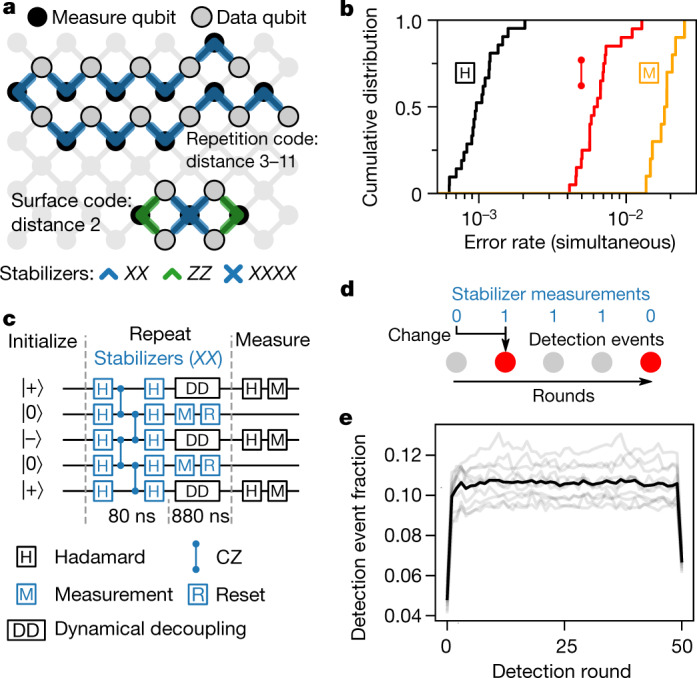
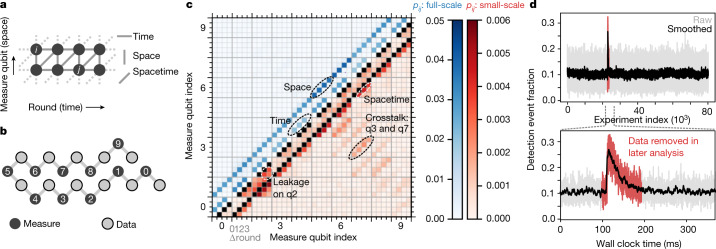
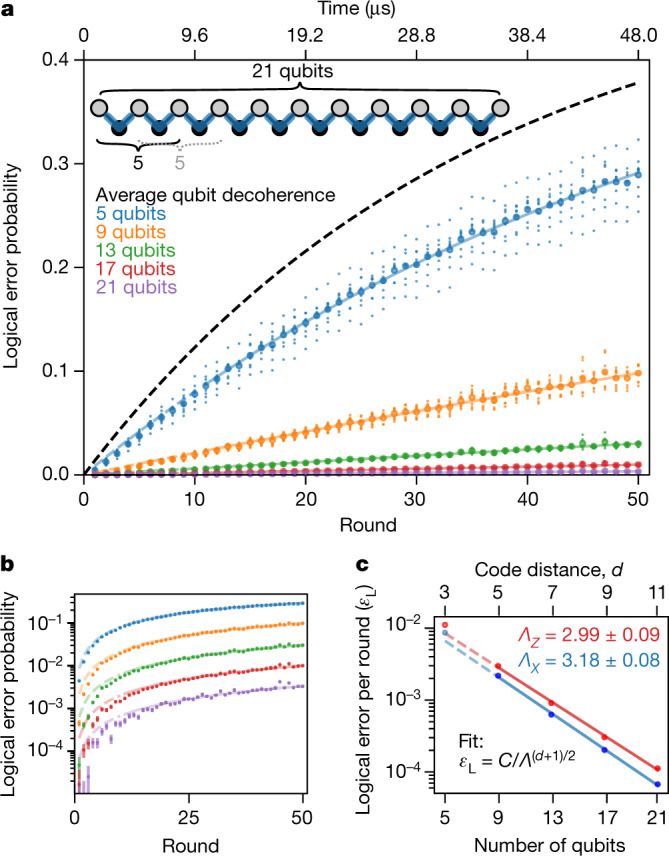
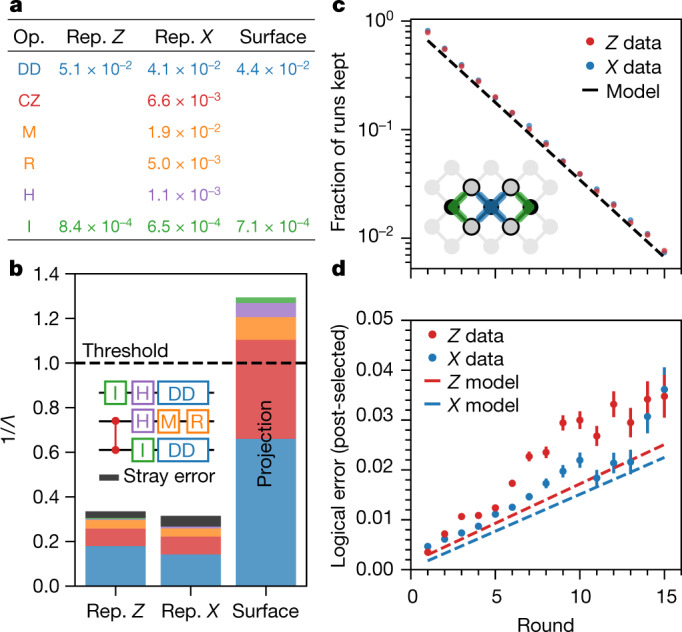
Realizing the potential of quantum computing requires sufficiently low logical error rates 1 . Many applications call for error rates as low as 10 −15 (refs. 2–9 ), but state-of-the-art quantum platforms typically have physical error rates near 10 −3 (refs. 10–14 ). Quantum error correction 15–17 promises to bridge this divide by distributing quantum logical information across many physical qubits in such a way that errors can be detected and corrected. Errors on the encoded logical qubit state can be exponentially suppressed as the number of physical qubits grows, provided that the physical error rates are below a certain threshold and stable over the course of a computation. Here we implement one-dimensional repetition codes embedded in a two-dimensional grid of superconducting qubits that demonstrate exponential suppression of bit-flip or phase-flip errors, reducing logical error per round more than 100-fold when increasing the number of qubits from 5 to 21. Crucially, this error suppression is stable over 50 rounds of error correction. We also introduce a method for analysing error correlations with high precision, allowing us to characterize error locality while performing quantum error correction. Finally, we perform error detection with a small logical qubit using the 2D surface code on the same device 18,19 and show that the results from both one- and two-dimensional codes agree with numerical simulations that use a simple depolarizing error model. These experimental demonstrations provide a foundation for building a scalable fault-tolerant quantum computer with superconducting qubits.
Overview
The claims and statistics of this paper haven’t been checked yet.
Free: it reads the open-access text and checks the first 5 claims that cite a source we can check. Create a free account to check every claim.
Integrity signals
Registry
Cites
Statistics
Figures
Verification
Claims the paper makes
The claims and statistics of this paper haven’t been checked yet.
Free: it reads the open-access text and checks the first 5 claims that cite a source we can check. Create a free account to check every claim.
Claims other papers make about this one
Each is checked against this paper’s own text: does it say what the citing paper says it does?
The check wasn’t confident either way, so it gives no verdict — never disputed.
In the citing paper
“Recent analyses estimate feasible RSA-2048 factoring anywhere between fifteen and thirty-five years depending on hardware error rates and algorithmic progress, implying wide confidence bounds on the temporal risk curves [45,46].”
From Harvest-Now, Decrypt-Later: A Temporal Cybersecurity Risk in the Quantum Transition (2025) · cites this paper as [45]
Experimental — accuracy not yet measuredThe check wasn’t confident either way, so it gives no verdict — never disputed.
In the citing paper
“In practice, the quantum decryption horizon Ha ( t ) is highly uncertain because projections of qubit availability Q ( t ) and error-correction efficiency ECC ( t ) vary by orders of magnitude across studies [45,46].”
From Harvest-Now, Decrypt-Later: A Temporal Cybersecurity Risk in the Quantum Transition (2025) · cites this paper as [45]
Experimental — accuracy not yet measured
Self-check
Percentages, sums and reported differences re-computed from the paper’s own numbers.
The self-check needs the paper’s full text.
Citations
Cites
Quantum Computing in the NISQ era and beyond
Preskill, J. (2018) · Quantum · doi:10.22331/q-2018-08-06-79 · Cited by 8,830
Quantum supremacy using a programmable superconducting processor
Arute, F., Arya, K., Babbush, R., Bacon, D., Bardin, J. C., Barends, R., Biswas, R., Boixo, S., Brandao, F. G. S. L., Buell, D. A., et al. (2019) · Nature · doi:10.1038/s41586-019-1666-5 · Cited by 7,720
Self-citationFault-tolerant quantum computation by anyons
Kitaev, A. Y. (2003) · Annals of Physics · doi:10.1016/s0003-4916(02)00018-0 · Cited by 7,238
Self-citationScheme for reducing decoherence in quantum computer memory
Shor, P. W. (1995) · Physical Review A · doi:10.1103/physreva.52.r2493 · Cited by 4,479
Polynomial-time algorithms for prime factorization and discrete logarithms on a quantum computer
Shor, P. W. (1999) · SIAM Review · doi:10.1137/s0036144598347011 · Cited by 3,904
Charge-insensitive qubit design derived from the Cooper pair box
Koch, J., Yu, T. M., Gambetta, J., Houck, A. A., Schuster, D. I., Majer, J., Blais, A., Devoret, M. H., Girvin, S. M., & Schoelkopf, R. J. (2007) · Physical Review A · doi:10.1103/physreva.76.042319 · Cited by 3,351
Surface codes: Towards practical large-scale quantum computation
Fowler, A. G., Mariantoni, M., Martinis, J. M., & Cleland, A. N. (2012) · Physical Review A · doi:10.1103/physreva.86.032324 · Cited by 3,059
Self-citationGood quantum error-correcting codes exist
Calderbank, A. R., & Shor, P. W. (1996) · Physical Review A · doi:10.1103/physreva.54.1098 · Cited by 2,516
Dennis, E., Kitaev, A., Landahl, A., & Preskill, J. (2002) · Journal of Mathematical Physics · doi:10.1063/1.1499754 · Cited by 1,768
Self-citationDennis, E., Kitaev, A., Landahl, A., & Preskill, J. (2001) · CERN Document Server (European Organization for Nuclear Research) · Cited by 1,485
Self-citation
Research works printed but not linked: 1
- Gottesman, D. Stabilizer Codes and Quantum Error Correction. PhD thesis, CalTech (1997)
Cited by
Noisy intermediate-scale quantum algorithms
Bharti, K., Cervera-Lierta, A., Kyaw, T. H., Haug, T., Alperin-Lea, S., Anand, A., Degroote, M., Heimonen, H., Kottmann, J. S., Menke, T., et al. (2022) · Reviews of Modern Physics · doi:10.1103/revmodphys.94.015004 · Cited by 2,231
Suppressing quantum errors by scaling a surface code logical qubit
Google Quantum, A. I., Acharya, R., Aleiner, I., Allen, R., Andersen, T. I., Ansmann, M., Arute, F., Arya, K., Asfaw, A., Atalaya, J., et al. (2023) · Nature · doi:10.1038/s41586-022-05434-1 · Cited by 1,103
“We attribute this rise to data qubits leaking into non-computational excited states and anticipate that the inclusion of leakage-removal techniques on data qubits would help to mitigate this rise [42, 47–49].”
InfluentialSelf-citationQuantum error correction below the surface code threshold
Collaborators, G. Q. A. A., Acharya, R., Abanin, D. A., Aghababaie-Beni, L., Aleiner, I., Andersen, T. I., Ansmann, M., Arute, F., Arya, K., Asfaw, A., et al. (2025) · Nature · doi:10.1038/s41586-024-08449-y · Cited by 778
“This result constitutes a four orders-of-magnitude improvement compared to the lowest logical error per cycle achieved in previous experiments [33].”
Self-citationK S, U. (2025) · Zenodo (CERN European Organization for Nuclear Research) · doi:10.5281/zenodo.18067974 · Cited by 733
Realizing repeated quantum error correction in a distance-three surface code
Krinner, S., Lacroix, N., Remm, A., Di Paolo, A., Genois, E., Leroux, C., Hellings, C., Lazar, S., Swiadek, F., Herrmann, J., et al. (2022) · Nature · doi:10.1038/s41586-022-04566-8 · Cited by 686
“0(9)% i i c phys =1 4 w with respect to states that are, in principle, correctable; see Supplementary Information (section IX).”
Background
Metadata
- Authors
- Google Quantum, A. I., Chen, Z., Satzinger, K. J., Atalaya, J., Korotkov, A. N., Dunsworth, A., Sank, D., Quintana, C., McEwen, M., Barends, R., Klimov, P. V., Hong, S., Jones, C., Petukhov, A., Kafri, D., Demura, S., Burkett, B., Gidney, C., Fowler, A. G., Paler, A., Putterman, H., Aleiner, I., Arute, F., Arya, K., Babbush, R., Bardin, J. C., Bengtsson, A., Bourassa, A., Broughton, M., Buckley, B. B., Buell, D. A., Bushnell, N., Chiaro, B., Collins, R., Courtney, W., Derk, A. R., Eppens, D., Erickson, C., Farhi, E., Foxen, B., Giustina, M., Greene, A., Gross, J. A., Harrigan, M. P., Harrington, S. D., Hilton, J., Ho, A., Huang, T., Huggins, W. J., Ioffe, L. B., Isakov, S. V., Jeffrey, E., Jiang, Z., Kechedzhi, K., Kim, S., Kitaev, A., Kostritsa, F., Landhuis, D., Laptev, P., Lucero, E., Martin, O., McClean, J. R., McCourt, T., Mi, X., Miao, K. C., Mohseni, M., Montazeri, S., Mruczkiewicz, W., Mutus, J., Naaman, O., Neeley, M., Neill, C., Newman, M., Niu, M. Y., O’Brien, T. E., Opremcak, A., Ostby, E., Pató, B., Redd, N., Roushan, P., Rubin, N. C., Shvarts, V., Strain, D., Szalay, M., Trevithick, M. D., Villalonga, B., White, T., Yao, Z. J., Yeh, P., Yoo, J., Zalcman, A., Neven, H., Boixo, S., Smelyanskiy, V., Chen, Y., Megrant, A., & Kelly, J.
- Affiliations
- Google (United States) (US)
- University of California, Riverside (US)
- Johannes Kepler University of Linz (AT)
- California Institute of Technology (US)
- Corresponding author
- Megrant, Anthony
- Kelly, Julian
- ORCID
- Chen, Zijun
- Satzinger, Kevin J.
- Atalaya, Juan
- Korotkov, Alexander N.
- Dunsworth, Andrew
- Sank, Daniel
- Quintana, Chris
- McEwen, Matt
- Klimov, Paul V.
- Hong, Sabrina
- Kafri, Dvir
- Demura, Sean
- Burkett, Brian
- Fowler, Austin G.
- Paler, Alexandru
- Putterman, Harald
- Arute, Frank
- Arya, Kunal
- Babbush, Ryan
- Bardin, Joseph C.
- Bengtsson, Andreas
- Bourassa, Alexandre
- Broughton, Michael
- Buckley, Bob B.
- Bushnell, Nicholas
- Collins, Roberto
- Eppens, Daniel
- Erickson, Catherine
- Farhi, Edward
- Foxen, Brooks
- Giustina, Marissa
- Gross, Jonathan A.
- Harrigan, Matthew P.
- Harrington, Sean D.
- Huang, Trent
- Huggins, William J.
- Ioffe, L. B.
- Jeffrey, Evan
- Kechedzhi, Kostyantyn
- Kim, Seon
- Kitaev, Alexei
- Landhuis, David
- Lucero, Erik
- Martin, Orion
- McClean, Jarrod R.
- McCourt, Trevor
- Mi, Xiao
- Miao, Kevin C.
- Mohseni, Masoud
- Montazeri, Shirin
- Mruczkiewicz, Wojciech
- Mutus, Josh
- Naaman, Ofer
- Neeley, Matthew
- Neill, Charles
- Niu, Murphy Yuezhen
- O’Brien, Thomas E.
- Pató, Bálint
- Redd, Nicholas
- Roushan, Pedram
- Rubin, Nicholas C.
- Szalay, Marco
- Trevithick, Matthew D.
- Villalonga, Benjamin
- White, Theodore
- Yeh, Ping
- Yoo, Juhwan
- Zalcman, Adam
- Neven, Hartmut
- Boixo, Sergio
- Smelyanskiy, Vadim
- Chen, Yu
- Megrant, Anthony
- Kelly, Julian
- Venue
- Nature
- Published
- 2021-07-14
- Volume
- 595
- Issue
- 7867
- Pages
- 383-387
- ISSN
- 0028-0836 (ISSN-L)
- 1476-4687
- PMC
- PMC8279951
- OpenAlex
- W3178633198
- Cited by
- 393
- References
- 53
- Citations by year
- 2026: 44 · 2025: 80 · 2024: 74 · 2023: 91 · 2022: 80 · 2021: 23
- FWCI
- 23.47
- Type
- journal article
- Language
- en
- Open access
- hybrid
- doi.org
- Licence
- cc-by
- creativecommons.org/licenses/by/4.0 (tdm)
- creativecommons.org/licenses/by/4.0 (vor)
- Locations
- Nature (publishedVersion, cc-by)
- PubMed Central (publishedVersion, cc-by)
- PubMed (publishedVersion)
- arXiv (Cornell University) (submittedVersion)
- CaltechAUTHORS (California Institute of Technology) (submittedVersion, cc-by)
- eScholarship (California Digital Library) (submittedVersion, cc-by)
- arXiv (Cornell University) (cc-by)
- Topics
- Physical Sciences › Computer Science › Artificial Intelligence › Quantum Computing Algorithms and Architecture
- Physical Sciences › Physics and Astronomy › Atomic and Molecular Physics, and Optics › Quantum Information and Cryptography
- Physical Sciences › Physics and Astronomy › Atomic and Molecular Physics, and Optics › Quantum many-body systems
- Keywords
- quantum error correction, repetition codes, superconducting qubits, bit-flip errors, phase-flip errors, error correlation, surface code, fault-tolerant quantum computing, error threshold
About these checks
Registry, retraction, Cites and statistics results are computed, not judged, with one exception: a printed reference that no index lists is read once by a model before it counts as a citation error. Claims are extracted by a model and kept only when their quote appears verbatim in the text; each cited source is then checked, with a model’s help, for whether it says what the claim relies on. Those verdicts can be wrong — read the claim’s quote and the cited source before relying on one.
Statistics and arithmetic are recomputed, not judged.
Confidence bands are shown only for fields calibrated on our annotated test set. None is calibrated yet, so no band is shown.
What counts as a claim ›How we measure confidence ›How we check this ›
Are you an author, or do you see a problem with this page? Request a review
How to cite
Cite CoChat for the checks on this page, and the paper for its own findings.
- This page
- CoChat. (2026). Citation check: Exponential suppression of bit or phase errors with cyclic error correction. https://app.cochat.ai/papers/10.1038/s41586-021-03588-y
- The paper
- Google Quantum, A. I., Chen, Z., Satzinger, K. J., Atalaya, J., Korotkov, A. N., Dunsworth, A., Sank, D., Quintana, C., McEwen, M., Barends, R., Klimov, P. V., Hong, S., Jones, C., Petukhov, A., Kafri, D., Demura, S., Burkett, B., Gidney, C., Fowler, A. G., . . . Kelly, J. (2021). Exponential suppression of bit or phase errors with cyclic error correction. Nature. https://doi.org/10.1038/s41586-021-03588-y
Data sources
Bibliographic data: Semantic Scholar, OpenAlex, Crossref.
Contains information from the Semantic Scholar Academic Graph Datasets, made available under the ODC Attribution License (ODC-BY 1.0).
Semantic Scholar’s data is described in: Kinney, R., et al. (2023). The Semantic Scholar Open Data Platform. arXiv:2301.10140.
