

The DOI matches its Crossref record; 65 of the 69 references it cites were found in a registry or an index; 8 of the 13 sources its claims cite were checked for support.
Suppressing quantum errors by scaling a surface code logical qubit
Open accessAbstract
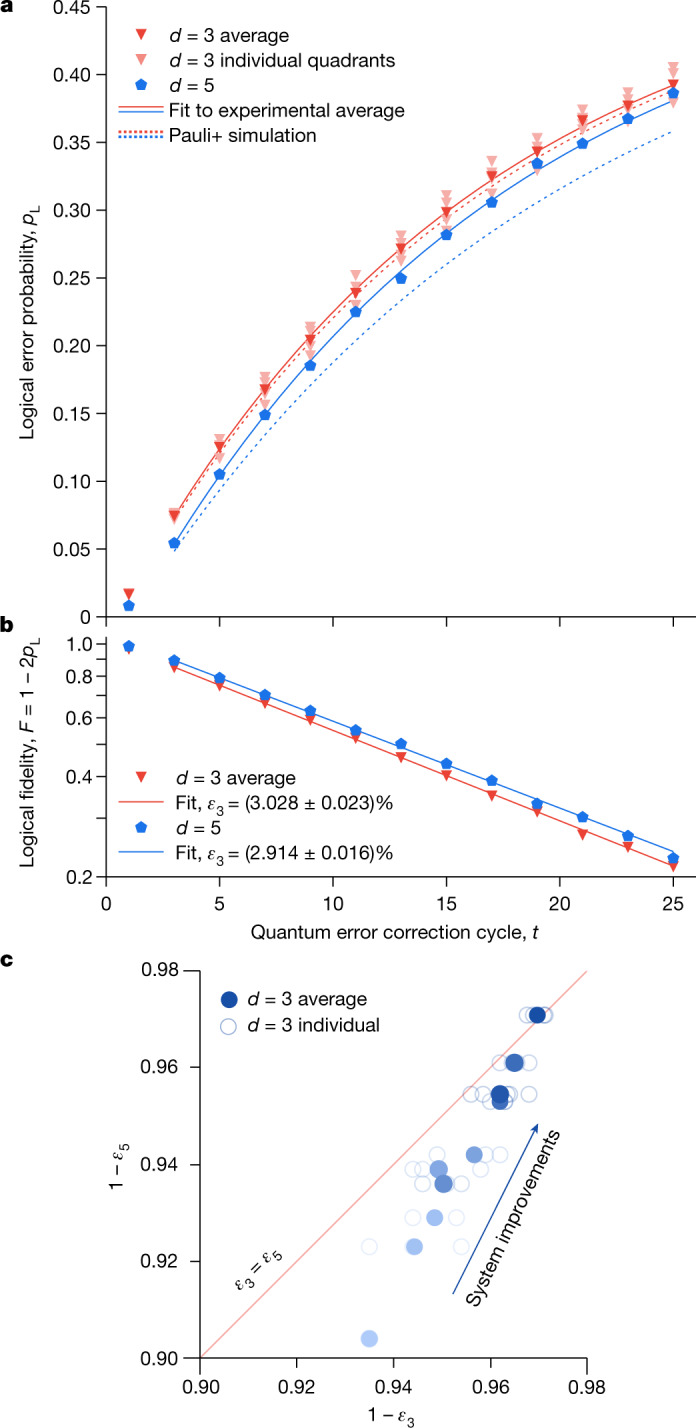
Practical quantum computing will require error rates well below those achievable with physical qubits. Quantum error correction 1,2 offers a path to algorithmically relevant error rates by encoding logical qubits within many physical qubits, for which increasing the number of physical qubits enhances protection against physical errors. However, introducing more qubits also increases the number of error sources, so the density of errors must be sufficiently low for logical performance to improve with increasing code size. Here we report the measurement of logical qubit performance scaling across several code sizes, and demonstrate that our system of superconducting qubits has sufficient performance to overcome the additional errors from increasing qubit number. We find that our distance-5 surface code logical qubit modestly outperforms an ensemble of distance-3 logical qubits on average, in terms of both logical error probability over 25 cycles and logical error per cycle ((2.914 ± 0.016)% compared to (3.028 ± 0.023)%). To investigate damaging, low-probability error sources, we run a distance-25 repetition code and observe a 1.7 × 10 −6 logical error per cycle floor set by a single high-energy event (1.6 × 10 −7 excluding this event). We accurately model our experiment, extracting error budgets that highlight the biggest challenges for future systems. These results mark an experimental demonstration in which quantum error correction begins to improve performance with increasing qubit number, illuminating the path to reaching the logical error rates required for computation.
Overview
CoChat Summary
TL;DR
Google Quantum AI reports a 72-qubit superconducting device running a distance-5 surface code logical qubit that modestly outperforms an ensemble of distance-3 logical qubits over 25 cycles. The result demonstrates that quantum error correction can begin to improve logical performance with increasing code size, while identifying leakage, stray interactions, and high-energy events as key remaining challenges.
Key findings
- The distance-5 surface code achieved a logical error per cycle of (2.914 ± 0.016)% versus (3.028 ± 0.023)% averaged over four distance-3 subgrids, a relative reduction of about 4% with the approximate maximum-likelihood decoder; with belief-matching decoding, the values were (3.056 ± 0.015)% versus (3.118 ± 0.025)%, about 2%.
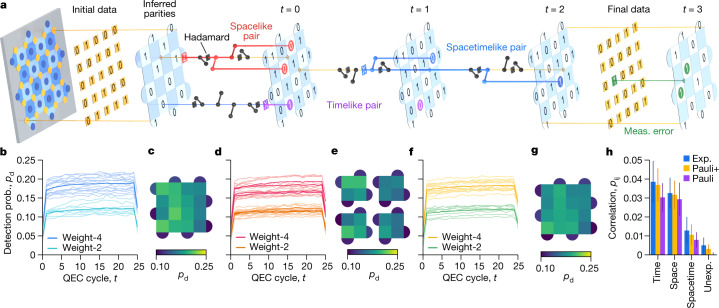
- Detection probabilities were similar across code distances: weight-4 stabilizers averaged 0.185 ± 0.018 for distance-5 and 0.175 ± 0.017 for distance-3; weight-2 stabilizers averaged 0.119 ± 0.012 and 0.115 ± 0.008, respectively.
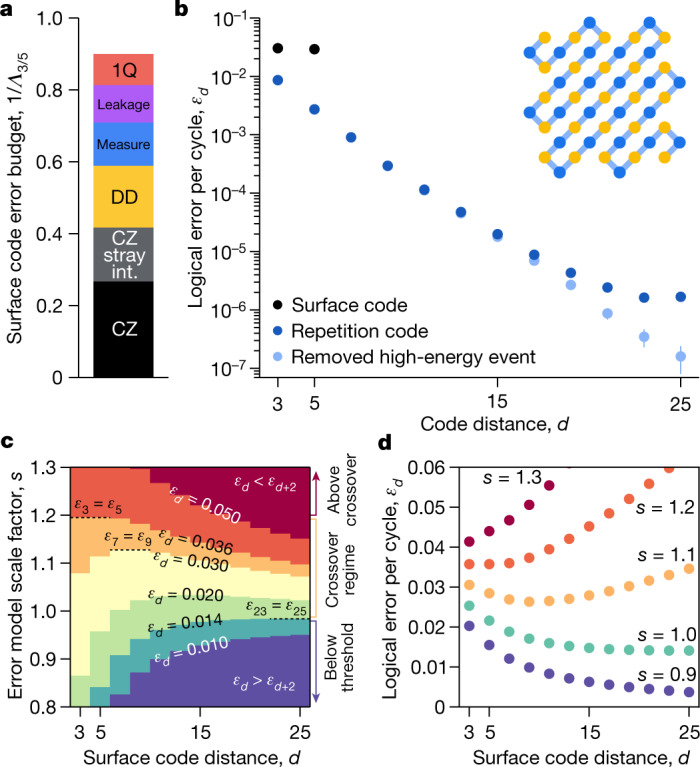
- A distance-25 repetition code reached (1.7 ± 0.3) × 10⁻⁶ logical error per cycle without post-selection; after removing one high-energy event (0.15% of trials), it reached (1.6 ± 0.8) × 10⁻⁷.
- Error budgets identify CZ gate error and data-qubit decoherence during measurement and reset as dominant contributors; the paper estimates component performance must improve by at least 20% to move below threshold.
Methods
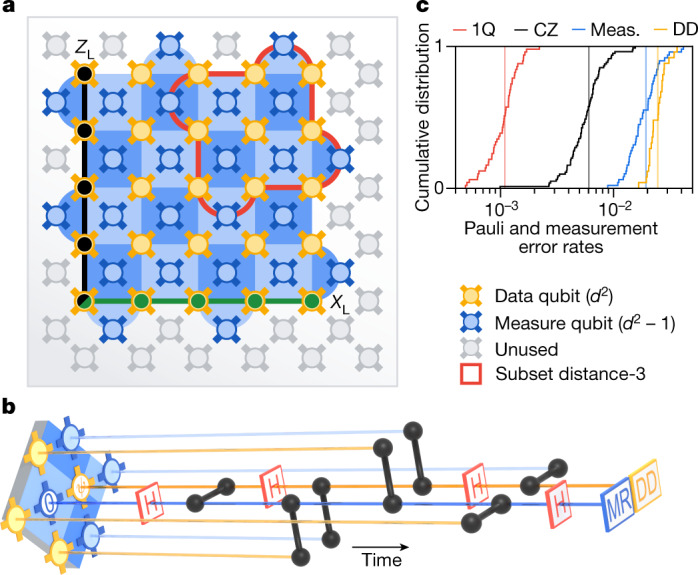
- Implemented the surface code on an expanded Sycamore device with 72 transmon qubits and 121 tunable couplers, mean T1 = 20 μs and T2,CPMG = 30 μs. The distance-5 code used a 49-qubit subset (25 data, 24 measure qubits) and was compared with the average of four distance-3 subgrids, each with nine data and eight measure qubits.
- Each experimental instance initialized a logical state, ran 25 cycles of error correction, and measured the final logical state; detection probabilities were measured over 50,000 instances. Decoding used belief-matching and tensor-network approximate maximum-likelihood decoders, with error hypergraphs derived from detection-event correlations.
- Logical fidelity F = 1 − 2pL was fit to an exponential decay starting at t = 3. Simulations included depolarizing, Pauli+, and Pauli-only models; the distance-25 repetition code was decoded with minimum-weight perfect matching.
Limitations
- The paper states that device inhomogeneity makes comparing distance-5 and distance-3 under identical noise difficult; the distance-5 logical error per cycle was slightly higher than two individual distance-3 codes, and leakage accumulation may cause distance-5 performance to degrade faster as logical error probability approaches 50%.
- The paper states that projections to future devices rely on simplified models and must be validated experimentally, and that leakage, stray interactions, and high-energy events such as cosmic-ray impacts must be mitigated.
- Evident from the text: the demonstration is modest, with only about 2–4% relative improvement over the distance-3 average, and the repetition-code floor was dominated by a single high-energy event; the repetition code also does not correct phase-flip errors and is not suitable for quantum algorithms.
Model-written summary. Check it against the paper before relying on it.
Integrity signals
Registry
Cites
Statistics
Figures
Verification
Claims the paper makes
6 Valid · 1 Not valid · 2 Not checked · 35 Own results and interpretations
The cited sources support only part of this claim — read each source’s verdict below.
In the paper
“This threshold behaviour can be subtle58, and there exists a crossover regime in which, owing to finite-size effects, increasing system size initially suppresses the logical error per cycle before later increasing it.”
§ Suppressing quantum errors by scaling a surface code logical qubit > Towards large-scale quantum error correction
What the sources say
- Partly supportedcites [58] Stephens, A. M. Fault-tolerant thresholds for quantum error correction with the surface code. Phys. Rev. A 89, 022321 (2014). sourceExperimental — accuracy not yet measured
In the Discussion (p. 8) Stephens does describe a subtle crossover: for two codes with d = n and d = n + 2 the logical error rates are equal per round of measurement at some p_n, yet over the d rounds actually required the larger code is more likely to fail, and in Fig. 6 the intersection of consecutive curves drifts downward (from above 0.01 to ~0.0095) with no consistent intersection even for large d. So the source supports a regime in which enlarging the code stops helping and can hurt, but it attributes this to defining the logical error rate per round of measurement rather than per d rounds (pp. 7-8), not to 'finite-size effects' — the paper's finite-size discussion (Methods, p. 3) concerns violations of the scaling ansatz for the smallest codes (d ≤ 7). The specific non-monotonic sequence claimed (increasing size first suppressing, then increasing, the logical error per cycle at fixed physical error rate) is nowhere stated as such, so that framing and causal attribution go beyond this source. (LLM, conf=0.66)
plainstates a cause- Asserted: passes — The authors put it forward as true.
- Checkable: passes — It can be checked against evidence.
- Load-bearing: passes — The paper’s conclusions depend on it.
- Based: passes — The paper gives a reason why it holds.
- Partly supported
The cited sources support only part of this claim — read each source’s verdict below.
In the paper
“We also remove certain Hadamard gates to implement the ZXXZ variant of the surface code44,45, which helps symmetrize the X- and Z-basis logical error rates.”
§ Suppressing quantum errors by scaling a surface code logical qubit > Surface codes with superconducting qubits
What the sources say
- Could not verifycites [44] Wen, X.-G. Quantum orders in an exact soluble model. Phys. Rev. Lett. 90, 016803 (2003). sourceExperimental — accuracy not yet measured
The model description (p. 1) gives a four-spin square-lattice Hamiltonian, and Physical properties (p. 4) discusses its topological ground-state degeneracy. Neither passage addresses a ZXXZ surface-code variant or X- and Z-basis logical error rates; further searches for those terms and Hadamard gates found no supporting passage. (LLM, conf=0.74)
- Partly supportedcites [45] Bonilla Ataides, J. P., Tuckett, D. K., Bartlett, S. D., Flammia, S. T. & Brown, B. J. The XZZX surface code. Nat. Commun. 12, 2172 (2021). sourceExperimental — accuracy not yet measured
The Results describe the XZZX code as responding similarly to Pauli-X and Pauli-Z errors, and the Fig. 4 caption says their separate logical-error thresholds have a negligible discrepancy. The paper does not establish that the variant itself symmetrizes the X- and Z-basis logical error rates; it discusses choosing lattice dimensions to optimize logical failure rates under biased noise. (LLM, conf=0.79)
plainstates a cause- Asserted: passes — The authors put it forward as true.
- Checkable: passes — It can be checked against evidence.
- Load-bearing: unclear — It is unclear whether the paper’s conclusions depend on it.
- Based: passes — The paper gives a reason why it holds.
- Could not verify
Every source the paper cites for this claim was checked and supports it.
In the paper
“In principle, the logical performance of a distance-5 code should improve faster than that of a distance-3 code as physical error rates decrease33.”
§ Suppressing quantum errors by scaling a surface code logical qubit > Decoding and logical error probabilities
What the sources say
- Supportedcites [33] Fowler, A. G., Mariantoni, M., Martinis, J. M. & Cleland, A. N. Surface codes: towards practical large-scale quantum computation. Phys. Rev. A 86, 032324 (2012). source
The paper's sub-threshold scaling statement in VII (p. 11) — 'For p < p_th, the logical error rate falls exponentially with d' — and the restatement in VII B (p. 14), 'larger values of d give lower logical error rates than do smaller d, as long as p is smaller than the threshold', cover the claim's direction. The mechanism is given explicitly in VII A (p. 11): the most likely misidentifications scale as p^{d_e} with d_e = (d+1)/2, illustrated on exactly the d = 5 array of Fig. 3 (two-error vs three-error events scaling p^2 vs p^3), so a distance-5 logical error rate falls as a higher power of p than a distance-3 one, i.e. improves faster as p decreases. Fig. 4 caption (p. 11) shows the same vanishing of P_L with increasing d for p < p_th = 0.57%; the paper plots d = 3, 7, 11, 25, 55 rather than a d = 5 curve, but the claim is hedged ('in principle... should') and follows from the stated scaling law. (LLM, conf=0.85)
hedgedstates a cause- Asserted: passes — The authors put it forward as true.
- Checkable: passes — It can be checked against evidence.
- Load-bearing: passes — The paper’s conclusions depend on it.
- Based: passes — The paper gives a reason why it holds.
- Supported
The sources with a verdict support this claim; the rest weren’t checked yet, have no full text we could read, or their verdicts aren’t rated yet.
In the paper
“Fortunately, quantum error correction can exponentially suppress the operational error rates in a quantum processor, at the expense of temporal and qubit overhead18,19.”
§ Suppressing quantum errors by scaling a surface code logical qubit > Main
What the sources say
- Not checked yetcites [18] Knill, E., Laflamme, R. & Zurek, W. H. Resilient quantum computation. Science 279, 342–345 (1998). source
- Supportedcites [19] Aharonov, D. & Ben-Or, M. Fault-tolerant quantum computation with constant error rate. SIAM J. Comput. 38, 1207–1282 (2008). source
The introduction (p. 6) states that reliability is obtained by applying the encoding scheme recursively, 'since the improvement is exponential in the number of levels', i.e. the effective noise rate is suppressed exponentially in the concatenation depth. The overhead side is stated in the Abstract ('The cost is polylogarithmic in space and time') and quantified in Theorems 10-11 (pp. 52, 56), where the simulated circuit Q' acts on n log^{c1}(v/ε) qubits for time t log^{c2}(v/ε) — i.e. extra qubits and extra time steps. Section 7.2/7.3 (pp. 47-48) confirms the mechanism is quantum error-correcting codes with concatenated blocks, so the attribution to 'quantum error correction' is accurate. (LLM, conf=0.88)
plainstates a cause- Asserted: passes — The authors put it forward as true.
- Checkable: passes — It can be checked against evidence.
- Load-bearing: passes — The paper’s conclusions depend on it.
- Based: passes — The paper gives a reason why it holds.
The sources with a verdict support this claim; the rest weren’t checked yet, have no full text we could read, or their verdicts aren’t rated yet.
In the paper
“We attribute this rise to data qubits leaking into non-computational excited states and anticipate that the inclusion of leakage-removal techniques on data qubits would help to mitigate this rise42,46–48.”
§ Suppressing quantum errors by scaling a surface code logical qubit > Error detectors
What the sources say
- Could not verifycites [42] Chen, Z. et al. Exponential suppression of bit or phase errors with cyclic error correction. Nature 595, 383–387 (2021). sourceExperimental — accuracy not yet measured
Our copy of Chen et al. (2021, Nature) is a structural-biology paper on rhodopsin–GRK1 complexes (cryo-EM/MDFF refinement, Extended Data Table 2; phage-ELISA and RELION/cryoSPARC methods sections), and it contains nothing about qubits, leakage, or detection probabilities. Searches on 'qubit leakage non-computational excited state detection probability' and 'qubit quantum computing leakage removal detection probability' returned only unrelated GRK mutant tables, reference lists and EM-processing passages (Extended Data, References, Methods: EM data processing / Single-point phage ELISA). The paper makes no contrary statement and names no alternative source for the claim, so the attribution cannot be checked against this text. (LLM, conf=0.75)
- Not checked yetcites [46] Aliferis, P. & Terhal, B. M. Fault-tolerant quantum computation for local leakage faults. Quantum Inf. Comput. 7, 139–156 (2007).
- Not checked yetcites [47] Suchara, M., Cross, A. W. & Gambetta, J. M. Leakage suppression in the toric code. Proc. 2015 IEEE International Symposium on Information Theory (ISIT) 1119–1123 (2015). source
- Supportedcites [48] McEwen, M. et al. Removing leakage-induced correlated errors in superconducting quantum error correction. Nat. Commun. 12, 1761 (2021). source
In Results > Injection of leakage, the paper reports that inserting leakage on a data qubit (Fig. 4b) produces 'an increase of detection events that slowly decays, now on both neighboring measure qubits', i.e. a rise in detection-event fraction traceable to population in the data qubit's non-computational levels; the Introduction and Fig. 3/Fig. 1b confirm gates and measurement populate those levels and that leakage may reside on data qubits. Results > Injection of leakage also states the reset protocol 'helps to decrease leakage in data qubits, thereby strongly suppressing time-correlated tails of detection events', supporting the causal attribution the citing sentence draws. The citing authors' own anticipation about adding leakage removal to data qubits is their extrapolation, not something the source contradicts. (LLM, conf=0.82)
plainstates a cause- Asserted: passes — The authors put it forward as true.
- Checkable: passes — It can be checked against evidence.
- Load-bearing: passes — The paper’s conclusions depend on it.
- Based: passes — The paper gives a reason why it holds.
- Could not verify
22 more claims · 1 with their cited sources checked
Create a free account to see all 44 claims and to verify the 5 references still open.
- It may state two separate claims as one. 13
- Probably not a substantial claim. 6
Claims other papers make about this one
Each is checked against this paper’s own text: does it say what the citing paper says it does?
The cited source doesn’t support the claim as written.
In the citing paper
“Some of these experiments are approaching26, or have surpassed28, the threshold at which scaling of the error-correcting code size leads to exponential improvements in the logical qubit error rate.”
From Hardware-efficient quantum error correction via concatenated bosonic qubits (2025) · cites this paper as [26]
Checked by a reasoning model — may be wrong.
Experimental — accuracy not yet measuredThe source backs part of the claim, not all of it — or backs it for a different population, condition or comparison.
In the citing paper
“Operating this logical processor with various types of encoding, we demonstrate improvement of a two-qubit logic gate by scaling surface-code6 distance from d = 3 to d = 7, preparation of colour-code qubits with break-even fidelities5, fault-tolerant creation of logical Greenberger–Horne–Zeilinger (GHZ) states and feedforward entanglement teleportation, as well as operation of 40 colour-code qubit”
From Logical quantum processor based on reconfigurable atom arrays (2024) · cites this paper as [6]
Experimental — accuracy not yet measuredThe source backs part of the claim, not all of it — or backs it for a different population, condition or comparison.
In the citing paper
“Recent experiments have achieved milestone demonstrations of two logical qubits and one entangling gate5,6 and explorations of new encodings25–28.”
From Logical quantum processor based on reconfigurable atom arrays (2024) · cites this paper as [6]
Experimental — accuracy not yet measuredThe source backs part of the claim, not all of it — or backs it for a different population, condition or comparison.
In the citing paper
“Recently, this property has been experimentally verified by reducing idling errors of a code6.”
From Logical quantum processor based on reconfigurable atom arrays (2024) · cites this paper as [6]
Experimental — accuracy not yet measuredThe cited source says what the claim attributes to it.
In the citing paper
“Although many platforms have demonstrated different features of quantum error correction14–20, no quantum processor has definitively shown below-threshold performance.”
From Quantum error correction below the surface code threshold (2025) · cites this paper as [17]
4 more claims about this paper
Create a free account to see every claim other papers make about this one.
Citations
Cites
Quantum supremacy using a programmable superconducting processor
Arute, F., Arya, K., Babbush, R., Bacon, D., Bardin, J. C., Barends, R., Biswas, R., Boixo, S., Brandao, F. G. S. L., Buell, D. A., et al. (2019) · Nature · doi:10.1038/s41586-019-1666-5 · Cited by 7,720 · cited 6×
“Single qubit gates are characterized using parallel randomized benchmarking[31], while CZ gates are characterized with parallel cross-entropy benchmarking (XEB)[32].”
InfluentialSelf-citationSimulating physics with computers
Feynman, R. P. (1982) · International Journal of Theoretical Physics · doi:10.1007/bf02650179 · Cited by 7,691 · cited 1×
“Since Feynman’s proposal to compute using quantum mechanics [3], many potential applications have emerged, including factoring [4], optimization [5], machine learning [6], quantum simulation [7], and quantum chemistry [8].”
Fault-tolerant quantum computation by anyons
Kitaev, A. Y. (2003) · Annals of Physics · doi:10.1016/s0003-4916(02)00018-0 · Cited by 7,238 · cited 1×
“Surface codes [26, 33–36] are a family of quantum error-correcting codes which encode a logical qubit into the joint entangled state of a d × d square of physical qubits, referred to as data qubit s.”
Self-citationBiamonte, J., Wittek, P., Pancotti, N., Rebentrost, P., Wiebe, N., & Lloyd, S. (2017) · Nature · doi:10.1038/nature23474 · Cited by 4,779 · cited 1×
“Since Feynman’s proposal to compute using quantum mechanics [3], many potential applications have emerged, including factoring [4], optimization [5], machine learning [6], quantum simulation [7], and quantum chemistry [8].”
Scheme for reducing decoherence in quantum computer memory
Shor, P. W. (1995) · Physical Review A · doi:10.1103/physreva.52.r2493 · Cited by 4,479
Polynomial-time algorithms for prime factorization and discrete logarithms on a quantum computer
Shor, P. W. (1999) · SIAM Review · doi:10.1137/s0036144598347011 · Cited by 3,904
Charge-insensitive qubit design derived from the Cooper pair box
Koch, J., Yu, T. M., Gambetta, J., Houck, A. A., Schuster, D. I., Majer, J., Blais, A., Devoret, M. H., Girvin, S. M., & Schoelkopf, R. J. (2007) · Physical Review A · doi:10.1103/physreva.76.042319 · Cited by 3,351 · cited 1×
“We implement the surface code on an expanded Sycamore device [32] with 72 transmon qubits [39] and 121 tunable couplers [40, 41].”
Lloyd, S. (1996) · Science · doi:10.1126/science.273.5278.1073 · Cited by 3,088 · cited 1×
“Since Feynman’s proposal to compute using quantum mechanics [3], many potential applications have emerged, including factoring [4], optimization [5], machine learning [6], quantum simulation [7], and quantum chemistry [8].”
Surface codes: Towards practical large-scale quantum computation
Fowler, A. G., Mariantoni, M., Martinis, J. M., & Cleland, A. N. (2012) · Physical Review A · doi:10.1103/physreva.86.032324 · Cited by 3,059
Self-citationA Quantum Adiabatic Evolution Algorithm Applied to Random Instances of an NP-Complete Problem
Farhi, E., Goldstone, J., Gutmann, S., Lapan, J., Lundgren, A., & Preda, D. (2001) · Science · doi:10.1126/science.1057726 · Cited by 2,056
Self-citation
Research works printed but not linked: 3
- Gottesman, D. Stabilizer Codes and Quantum Error Correction. PhD thesis, California Institute of Technology (1997).
- Neill, C. A Path towards Quantum Supremacy with Superconducting Qubits. PhD thesis, Univ. California Santa Barbara (2017).
- Aliferis, P. & Terhal, B. M. Fault-tolerant quantum computation for local leakage faults. Quantum Inf. Comput. 7, 139–156 (2007).
Cited by
Logical quantum processor based on reconfigurable atom arrays
Bluvstein, D., Evered, S. J., Geim, A. A., Li, S. H., Zhou, H., Manovitz, T., Ebadi, S., Cain, M., Kalinowski, M., Hangleiter, D., et al. (2024) · Nature · doi:10.1038/s41586-023-06927-3 · Cited by 1,119
“The AOD tweezers are mobile but have several constraints 7,69 .”
BackgroundMethodInfluentialQuantum error correction below the surface code threshold
Collaborators, G. Q. A. A., Acharya, R., Abanin, D. A., Aghababaie-Beni, L., Aleiner, I., Andersen, T. I., Ansmann, M., Arute, F., Arya, K., Asfaw, A., et al. (2025) · Nature · doi:10.1038/s41586-024-08449-y · Cited by 778
“[29], it was shown that data qubit leakage removal is instrumental to achieving the exponential suppression of logical errors with code distance when physical errors are well below the error threshold.”
InfluentialSelf-citationCai, Z., Babbush, R., Benjamin, S. C., Endo, S., Huggins, W. J., Li, Y., McClean, J. R., & O’Brien, T. E. (2023) · Reviews of Modern Physics · doi:10.1103/revmodphys.95.045005 · Cited by 591
Self-citationQuantum repeaters: From quantum networks to the quantum internet
Azuma, K., Economou, S. E., Elkouss, D., Hilaire, P., Jiang, L., Lo, H.-K., & Tzitrin, I. (2023) · Reviews of Modern Physics · doi:10.1103/revmodphys.95.045006 · Cited by 559
High-fidelity parallel entangling gates on a neutral-atom quantum computer
Evered, S. J., Bluvstein, D., Kalinowski, M., Ebadi, S., Manovitz, T., Zhou, H., Li, S. H., Geim, A. A., Wang, T. T., Maskara, N., et al. (2023) · Nature · doi:10.1038/s41586-023-06481-y · Cited by 522
“This protocol has the advantage of populating atomic dark states which do not contain population in the intermediate state used for the two-photon excitation to the Rydberg state, thereby reducing spontaneous emission.”
Background
Metadata
- Authors
- Google Quantum, A. I., Acharya, R., Aleiner, I., Allen, R., Andersen, T. I., Ansmann, M., Arute, F., Arya, K., Asfaw, A., Atalaya, J., Babbush, R., Bacon, D., Bardin, J. C., Basso, J., Bengtsson, A., Boixo, S., Bortoli, G., Bourassa, A., Bovaird, J., Brill, L., Broughton, M., Buckley, B. B., Buell, D. A., Burger, T., Burkett, B., Bushnell, N., Chen, Y., Chen, Z., Chiaro, B., Cogan, J., Collins, R., Conner, P., Courtney, W., Crook, A. L., Curtin, B., Debroy, D. M., Del Toro Barba, A., Demura, S., Dunsworth, A., Eppens, D., Erickson, C., Faoro, L., Farhi, E., Fatemi, R., Flores Burgos, L., Forati, E., Fowler, A. G., Foxen, B., Giang, W., Gidney, C., Gilboa, D., Giustina, M., Grajales Dau, A., Gross, J. A., Habegger, S., Hamilton, M. C., Harrigan, M. P., Harrington, S. D., Higgott, O., Hilton, J., Hoffmann, M., Hong, S., Huang, T., Huff, A., Huggins, W. J., Ioffe, L. B., Isakov, S. V., Iveland, J., Jeffrey, E., Jiang, Z., Jones, C., Juhas, P., Kafri, D., Kechedzhi, K., Kelly, J., Khattar, T., Khezri, M., Kieferová, M., Kim, S., Kitaev, A., Klimov, P. V., Klots, A. R., Korotkov, A. N., Kostritsa, F., Kreikebaum, J. M., Landhuis, D., Laptev, P., Lau, K.-M., Laws, L., Lee, J., Lee, K., Lester, B. J., Lill, A., Liu, W., Locharla, A., Lucero, E., Malone, F. D., Marshall, J., Martin, O., McClean, J. R., McCourt, T., McEwen, M., Megrant, A., Meurer Costa, B., Mi, X., Miao, K. C., Mohseni, M., Montazeri, S., Morvan, A., Mount, E., Mruczkiewicz, W., Naaman, O., Neeley, M., Neill, C., Nersisyan, A., Neven, H., Newman, M., Ng, J. H., Nguyen, A., Nguyen, M., Niu, M. Y., O’Brien, T. E., Opremcak, A., Platt, J., Petukhov, A., Potter, R., Pryadko, L. P., Quintana, C., Roushan, P., Rubin, N. C., Saei, N., Sank, D., Sankaragomathi, K., Satzinger, K. J., Schurkus, H. F., Schuster, C., Shearn, M. J., Shorter, A., Shvarts, V., Skruzny, J., Smelyanskiy, V., Smith, W. C., Sterling, G., Strain, D., Szalay, M., Torres, A., Vidal, G., Villalonga, B., Vollgraff Heidweiller, C., White, T., Xing, C., Yao, Z. J., Yeh, P., Yoo, J., Young, G., Zalcman, A., Zhang, Y., & Zhu, N.
- Affiliations
- Google (United States) (US)
- University of Technology Sydney (AU)
- California Institute of Technology (US)
- University of California, Riverside (US)
- Ames Research Center (US)
- Corresponding author
- Neven, Hartmut
- ORCID
- Acharya, Rajeev
- Aleiner, Igor
- Allen, Richard
- Andersen, Trond I.
- Ansmann, Markus
- Arute, Frank
- Arya, Kunal
- Asfaw, Abraham
- Atalaya, Juan
- Babbush, Ryan
- Bacon, Dave
- Bardin, Joseph C.
- Basso, Joao
- Bengtsson, Andreas
- Boixo, Sergio
- Bortoli, Gina
- Bourassa, Alexandre
- Bovaird, Jenna
- Broughton, Michael
- Buckley, Bob B.
- Burger, Tim
- Burkett, Brian
- Bushnell, Nicholas
- Chen, Yu
- Chen, Zijun
- Chiaro, Ben
- Cogan, Josh
- Collins, Roberto
- Crook, Alexander L.
- Curtin, Ben
- Del Toro Barba, Alexander
- Demura, Sean
- Dunsworth, Andrew
- Eppens, Daniel
- Erickson, Catherine
- Farhi, Edward
- Fatemi, Reza
- Forati, Ebrahim
- Fowler, Austin G.
- Foxen, Brooks
- Giustina, Marissa
- Gross, Jonathan A.
- Habegger, Steve
- Harrigan, Matthew P.
- Harrington, Sean D.
- Higgott, Oscar
- Hoffmann, Markus
- Hong, Sabrina
- Huang, Trent
- Huggins, William J.
- Ioffe, Lev B.
- Iveland, Justin
- Jeffrey, Evan
- Juhas, Pavol
- Kafri, Dvir
- Kechedzhi, Kostyantyn
- Kelly, Julian
- Khattar, Tanuj
- Khezri, Mostafa
- Kieferová, Mária
- Kim, Seon
- Kitaev, Alexei
- Klimov, Paul V.
- Korotkov, Alexander N.
- Kreikebaum, John Mark
- Landhuis, David
- Lee, Joonho
- Lester, Brian J.
- Lill, Alexander
- Liu, Wayne
- Locharla, Aditya
- Lucero, Erik
- Malone, Fionn D.
- Marshall, Jeffrey
- Martin, Orion
- McClean, Jarrod R.
- McCourt, Trevor
- McEwen, Matt
- Megrant, Anthony
- Mi, Xiao
- Miao, Kevin C.
- Mohseni, Masoud
- Montazeri, Shirin
- Morvan, Alexis
- Mruczkiewicz, Wojciech
- Naaman, Ofer
- Neeley, Matthew
- Neill, Charles
- Nersisyan, Ani
- Neven, Hartmut
- Ng, Jiun How
- Niu, Murphy Yuezhen
- O’Brien, Thomas E.
- Platt, John
- Potter, Rebecca
- Pryadko, Leonid P.
- Quintana, Chris
- Roushan, Pedram
- Rubin, Nicholas C.
- Sank, Daniel
- Sankaragomathi, Kannan
- Satzinger, Kevin J.
- Schurkus, Henry F.
- Shearn, Michael J.
- Smelyanskiy, Vadim
- Sterling, George
- Szalay, Marco
- Villalonga, Benjamin
- Vollgraff Heidweiller, Catherine
- White, Theodore
- Xing, Cheng
- Yeh, Ping
- Yoo, Juhwan
- Zalcman, Adam
- Zhang, Yaxing
- Zhu, Ningfeng
- Venue
- Nature
- Published
- 2023-02-22
- Volume
- 614
- Issue
- 7949
- Pages
- 676-681
- ISSN
- 0028-0836 (ISSN-L)
- 1476-4687
- PMC
- PMC9946823
- OpenAlex
- W4321610982
- Cited by
- 1,103
- References
- 69
- Citations by year
- 2026: 222 · 2025: 418 · 2024: 290 · 2023: 160
- FWCI
- 102.62
- Type
- journal article
- Language
- en
- Open access
- hybrid
- doi.org
- Licence
- cc-by
- creativecommons.org/licenses/by/4.0 (tdm)
- creativecommons.org/licenses/by/4.0 (vor)
- Locations
- Nature (publishedVersion, cc-by)
- PubMed Central (publishedVersion, cc-by)
- PubMed (publishedVersion)
- arXiv (Cornell University) (submittedVersion)
- arXiv (Cornell University) (cc-by)
- Funders
- National Aeronautics and Space Administration (NNA16BD14C, SAA 403512)
- Canadian Institute for Advanced Research
- Ames Research Center (NNA16BD14C)
- University of California, Santa Barbara
- Topics
- Physical Sciences › Computer Science › Artificial Intelligence › Quantum Computing Algorithms and Architecture
- Physical Sciences › Physics and Astronomy › Atomic and Molecular Physics, and Optics › Quantum Information and Cryptography
- Physical Sciences › Physics and Astronomy › Atomic and Molecular Physics, and Optics › Quantum many-body systems
- Keywords
- surface code, logical qubits, quantum error correction, superconducting qubits, logical error rate, error budget, high-energy events, repetition codes
About these checks
Registry, retraction, Cites and statistics results are computed, not judged, with one exception: a printed reference that no index lists is read once by a model before it counts as a citation error. Claims are extracted by a model and kept only when their quote appears verbatim in the text; each cited source is then checked, with a model’s help, for whether it says what the claim relies on. Those verdicts can be wrong — read the claim’s quote and the cited source before relying on one.
The claim verdicts this report counts are experimental: their accuracy is not yet measured.
A language model drew the claims from the paper on 2026-09-29, under version 3 of the claim definition (model deepseek-v4.1-flash, prompt extract-v3).
A second model labelled each claim on 2026-09-29 (model jev-1.13-20260917, definition revision gold-guideline-v0.2).
Cited sources are checked with a language model’s help (qwen3.8-omni-flash and gpt-6-sol).
Statistics and arithmetic are recomputed, not judged.
Confidence bands are shown only for fields calibrated on our annotated test set. None is calibrated yet, so no band is shown.
What counts as a claim ›How we measure confidence ›How we check this ›
Are you an author, or do you see a problem with this page? Request a review
How to cite
Cite CoChat for the checks on this page, and the paper for its own findings.
- This page
- CoChat. (2026). Citation check: Suppressing quantum errors by scaling a surface code logical qubit. https://app.cochat.ai/papers/10.1038/s41586-022-05434-1
- The paper
- Google Quantum, A. I., Acharya, R., Aleiner, I., Allen, R., Andersen, T. I., Ansmann, M., Arute, F., Arya, K., Asfaw, A., Atalaya, J., Babbush, R., Bacon, D., Bardin, J. C., Basso, J., Bengtsson, A., Boixo, S., Bortoli, G., Bourassa, A., Bovaird, J., . . . Zhu, N. (2023). Suppressing quantum errors by scaling a surface code logical qubit. Nature. https://doi.org/10.1038/s41586-022-05434-1
Data sources
Bibliographic data: Semantic Scholar, OpenAlex, Crossref.
Contains information from the Semantic Scholar Academic Graph Datasets, made available under the ODC Attribution License (ODC-BY 1.0).
Semantic Scholar’s data is described in: Kinney, R., et al. (2023). The Semantic Scholar Open Data Platform. arXiv:2301.10140.
