

The DOI matches its Crossref record; 52 of the 57 references it cites were found in a registry or an index; 25 of the 36 sources its claims cite were checked for support.
Quantum computational advantage with a programmable photonic processor
Open accessAbstract
A quantum computer attains computational advantage when outperforming the best classical computers running the best-known algorithms on well-defined tasks. No photonic machine offering programmability over all its quantum gates has demonstrated quantum computational advantage: previous machines 1,2 were largely restricted to static gate sequences. Earlier photonic demonstrations were also vulnerable to spoofing 3 , in which classical heuristics produce samples, without direct simulation, lying closer to the ideal distribution than do samples from the quantum hardware. Here we report quantum computational advantage using Borealis, a photonic processor offering dynamic programmability on all gates implemented. We carry out Gaussian boson sampling 4 (GBS) on 216 squeezed modes entangled with three-dimensional connectivity 5 , using a time-multiplexed and photon-number-resolving architecture. On average, it would take more than 9,000 years for the best available algorithms and supercomputers to produce, using exact methods, a single sample from the programmed distribution, whereas Borealis requires only 36 μs. This runtime advantage is over 50 million times as extreme as that reported from earlier photonic machines. Ours constitutes a very large GBS experiment, registering events with up to 219 photons and a mean photon number of 125. This work is a critical milestone on the path to a practical quantum computer, validating key technological features of photonics as a platform for this goal.
Overview
CoChat Summary
TL;DR
The paper reports a photonic Gaussian boson sampling experiment, Borealis, claiming quantum computational advantage with a fully programmable processor. Using 216 squeezed modes and photon-number-resolving detection, the authors estimate that exact classical simulation would take more than 9,000 years for one sample, while the experiment takes 36 μs.
Key findings
- Borealis implements Gaussian boson sampling on 216 squeezed modes with three-dimensional connectivity, and the paper reports events with up to 219 photons and a mean photon number of 125.
- The authors estimate that the best available classical algorithms and supercomputers would need more than 9,000 years on average to produce one sample from the programmed distribution, versus 36 μs for Borealis.
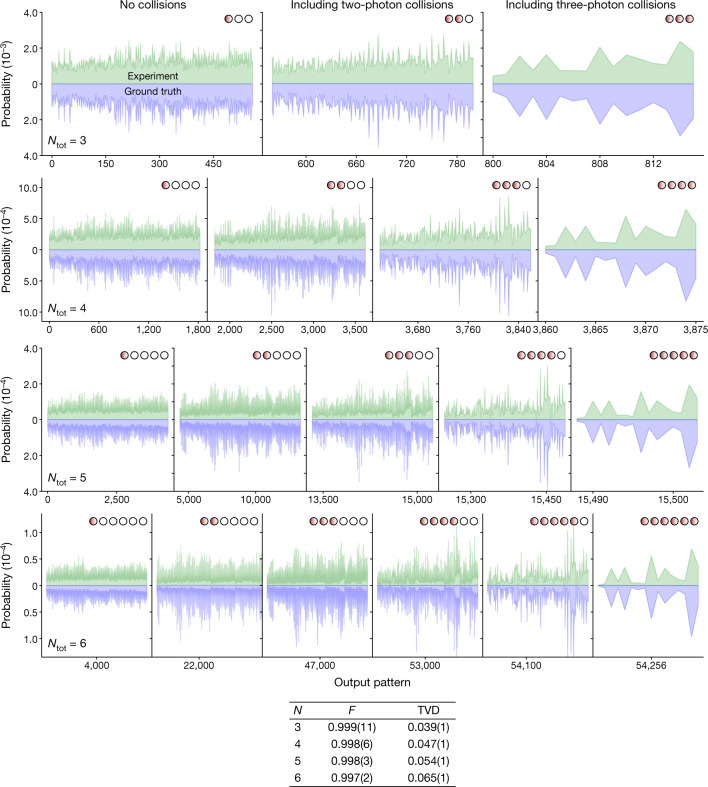
- In the low-photon-number regime, the paper reports fidelities in excess of 99% and TVDs below or equal to 6.5% for total photon-number sectors 3 to 6.
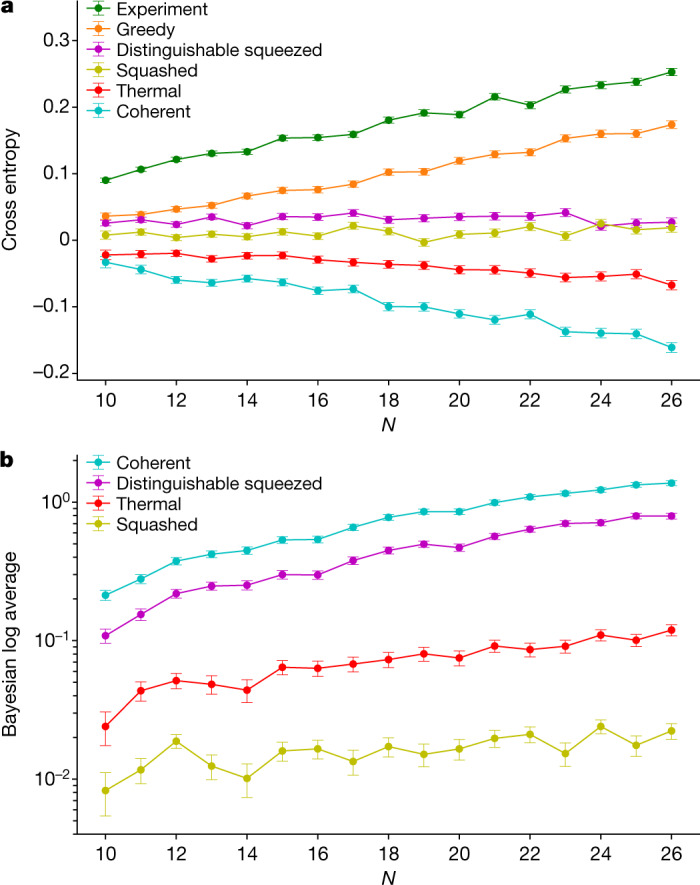
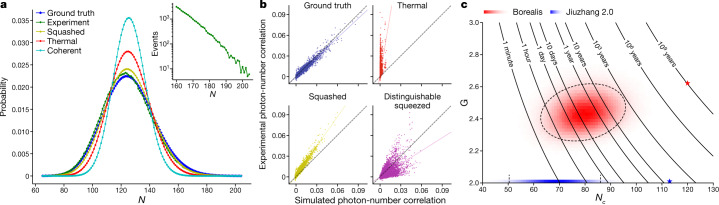
- For the intermediate regime, they analyze 10^6 samples and state that the best adversary (the greedy sampler) remained below the experiment in cross-entropy; for the large regime, the experimental total photon-number distribution has its highest probability at N = 124.35 ± 0.02, with support past 160 photons.
Methods
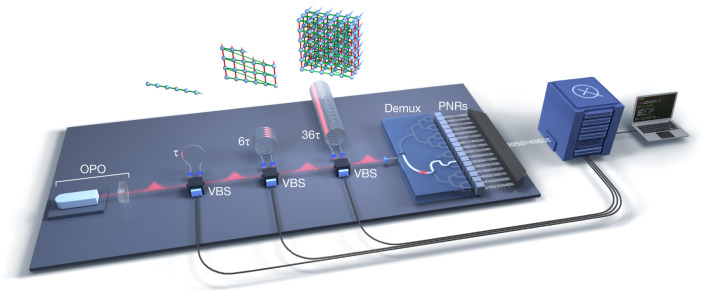
- The experiment uses a time-multiplexed photonic processor with three loop-based interferometers, a 6 MHz pulsed squeezed-light source, and 16-channel demultiplexing to route outputs to superconducting TES photon-number-resolving detectors.
- The device synthesizes a 216-mode Gaussian state by injecting 216 squeezed-light pulses into the interferometer; the loops enable couplings at separations of 1, 6, and 36 time bins.
- Performance is assessed by comparing experimental samples to the calibrated lossy ground truth using fidelity, total variation distance, cross-entropy benchmarks, Bayesian log averages, and cumulant comparisons against several classical adversaries.
Limitations
- The paper states that because estimating all probabilities from the characterized transmission matrix would require orders of magnitude more samples, their analysis is limited; this is why data beyond N > 6 were left for later benchmarks.
- The authors note that the demultiplexer and filter stack introduce losses, estimated at roughly 15% and 20%, respectively, and say improved detector speed could eliminate the demultiplexer.
- Evident from the text: the reported advantage is tied to a specific programmed distribution and a calibrated lossy ground truth, so it is not a general proof of all photonic computations.
Model-written summary. Check it against the paper before relying on it.
Integrity signals
Registry
Cites
Statistics
Figures
Verification
Claims the paper makes
15 Valid · 6 Not valid · 3 Not checked · 69 Own results and interpretations
At least one cited source doesn’t support this claim or points to a different paper, and none confirmed it — see the verdicts below.
In the paper
“In addition, its output cannot be efficiently spoofed in cross-entropy benchmarks using a generalization of the most recent polynomial-time algorithms3.”
§ Quantum computational advantage with a programmable photonic processor > Main
What the sources say
- Disputedcites [3] Villalonga, B. et al. Efficient approximation of experimental Gaussian boson sampling. Preprint at https://arxiv.org/abs/2109.11525 (2021). sourceExperimental — accuracy not yet measured
Our copy never names Borealis (it analyses the GBS experiments of its Refs. 1 and 2, up to 144 output modes), but its central conclusion runs opposite to what the citing sentence attributes to it: the Discussion (p. 8) states that 'a quadratic classical algorithm obtained a better approximation to the ideal distribution' and that the methodology 'can be applied to other boson sampling proposals where marginal probabilities can be computed efficiently'. On the cross-entropy metric specifically, Section III (pp. 7-8, Fig. 6) reports that the order-3 greedy sampler has XE similar to the experiment and that the 2nd-order samplers have smaller (better) XE than the experiment at large click numbers, i.e. efficient XE spoofing is demonstrated, not ruled out. The only hedge the paper offers is cost scaling — the order-k generalization is exponential in k and the scaling with k is called 'an interesting open question' (Introduction p. 2, Discussion p. 8) — which qualifies but does not assert impossibility for a device like Borealis. (LLM, conf=0.68)
Checked by a reasoning model — may be wrong.
plain- Asserted: passes — The authors put it forward as true.
- Checkable: passes — It can be checked against evidence.
- Load-bearing: passes — The paper’s conclusions depend on it.
- Based: passes — The paper gives a reason why it holds.
- Disputed
The cited sources that could be checked couldn’t confirm or dispute this claim.
In the paper
“On average, it would take more than 9,000 years for the best available algorithms and supercomputers to produce, using exact methods, a single sample from the programmed distribution”
- Also stated in: § Experiment · hedged
“we estimate that, on average, it would take Fugaku 9,000 years to generate one sample”
§ Quantum computational advantage with a programmable photonic processor > Abstract
What the sources say
- Could not verifycites [30] Bulmer, J. F. et al. The boundary for quantum advantage in Gaussian boson sampling. Sci. Adv. 8, eabl9236 (2021). sourceExperimental — accuracy not yet measured
The Results (Benchmarking; page not provided) estimate seconds per sample for the paper’s simulated GBS systems, potentially milliseconds on Fugaku. The Discussion (page not provided) mentions programmability as a possible feature of future experiments, but our copy does not identify the claimed programmed distribution or give a 9,000-year estimate for an exact sample from it. Searched for the 9,000-year estimate and programmed distribution. (LLM, conf=0.78)
- Could not verifycites [34] Quesada, N. et al. Quadratic speed-up for simulating gaussian boson sampling. PRX Quantum 3, 010306 (2022). sourceExperimental — accuracy not yet measured
Our full copy (not truncated) contains no years-scale estimate anywhere: searched for '9,000 years', single-sample run time, supercomputer, programmed distribution. The only concrete runtimes are in Sec. IV BENCHMARKING — ~7 h for a 56×56 loop hafnian on a 96-CPU Azure workstation and 'roughly 2 weeks for generating a single sample' for m = 100 modes, N = 50 photons — and the Abstract stresses probabilities can be computed 'in a single workstation, i.e., without the need of a supercomputer'. So the paper neither states the 9,000-year figure nor addresses whatever device/distribution that figure belongs to; its own state-of-the-art exact-sampling numbers point in the opposite direction (much shorter), which means the attribution is unsupported rather than confirmed. (LLM, conf=0.65)
hedged- Asserted: passes — The authors put it forward as true.
- Checkable: passes — It can be checked against evidence.
- Load-bearing: passes — The paper’s conclusions depend on it.
- Based: passes — The paper gives a reason why it holds.
- Also stated in: § Experiment · hedged
Every source the paper cites for this claim was checked and supports it.
In the paper
“we estimate that Fugaku would require 1.5 h, on average, to generate one sample from the experiment in ref. 2”
§ Quantum computational advantage with a programmable photonic processor > Experiment
What the sources say
- Supportedcites [2] Zhong, H.-S. et al. Phase-programmable Gaussian boson sampling using stimulated squeezed light. Phys. Rev. Lett. 127, 180502 (2021). source
The paper’s Abstract identifies its Jiuzhang 2.0 experiment as a Gaussian boson-sampling experiment that produced samples. The citing authors present the 1.5-hour Fugaku figure as their own estimate; the citation identifies the experiment being simulated, not the source of that estimate. (LLM, conf=0.91)
hedged- Asserted: passes — The authors put it forward as true.
- Checkable: passes — It can be checked against evidence.
- Load-bearing: passes — The paper’s conclusions depend on it.
- Based: passes — The paper gives a reason why it holds.
- Rests on 2 assumptions not shown here.
- Supported
Every source the paper cites for this claim was checked and supports it.
In the paper
“if one were to target a universal and programmable interferometer, with depth equal to the number of modes, that covers densely the set of unitary matrices, the exponential accumulation of loss would prohibit showing a quantum advantage.”
§ Quantum computational advantage with a programmable photonic processor > Experiment
What the sources say
- Supportedcites [5] Deshpande, A. et al. Quantum computational advantage via high-dimensional gaussian boson sampling. Sci. Adv. 8, eabi7894 (2022). source
The Results section (“High-dimensional GBS and evidence for hardness”) says that implementing arbitrary unitary transformations requires a circuit whose depth scales linearly with its size. It then states that photon loss scales exponentially with depth, making such models efficiently classically simulatable for sufficiently large numbers of modes in the absence of optical error correction. (LLM, conf=0.92)
- Supportedcites [31] Qi, H., Brod, D. J., Quesada, N. & García-Patrón, R. Regimes of classical simulability for noisy Gaussian boson sampling. Phys. Rev. Lett. 124, 100502 (2020). source
The main text (p. 2) states exactly the attributed content: 'In most linear-optical architectures, photon loss is defined by unit depth of the circuit, leading to an exponential decrease of transmission with the depth. Our results imply that, asymptotically, GBS implemented on these platforms is rendered efficiently simulable by losses if the depth is linear in the number of modes... lossy GBS inevitably loses its quantum advantage for sufficiently large sizes.' The abstract (p. 1) repeats it ('photon loss increases exponentially with the circuit depth, noisy GBS loses its quantum advantage in the asymptotic limit'), and Sec. II of the Supplemental Material (p. 7) names interferometer-depth loss 'the main scalability bottleneck'. A universal/programmable mesh of depth equal to the number of modes falls inside the class of architectures the paper treats, so the consequent is supported; the descriptors 'universal and programmable' and 'covers densely the set of unitary matrices' are the citing authors' motivation for the depth choice and are not asserted by the source, which speaks of 'most linear-optical architectures' generally and adds the caveat that a running-time advantage may persist at intermediate sizes. (LLM, conf=0.85)
hedgedstates a cause- Asserted: passes — The authors put it forward as true.
- Checkable: passes — It can be checked against evidence.
- Load-bearing: passes — The paper’s conclusions depend on it.
- Based: passes — The paper gives a reason why it holds.
- Supported
The cited sources support only part of this claim — read each source’s verdict below.
In the paper
“As discussed in the Methods, combined with the high brightness of our source averaging r ~ 1.1, places our experiment well beyond any attempt at a now-known polynomial-time approximate classical simulation31.”
§ Quantum computational advantage with a programmable photonic processor > Methods > Connectivity
What the sources say
- Partly supportedcites [31] Qi, H., Brod, D. J., Quesada, N. & García-Patrón, R. Regimes of classical simulability for noisy Gaussian boson sampling. Phys. Rev. Lett. 124, 100502 (2020). sourceExperimental — accuracy not yet measured
Our copy supplies the framework the citing sentence leans on: a sufficient condition (inequality (1)) for approximate polynomial-time classical simulation of noisy GBS in terms of squeezing r, transmission η and detector quality q_D, which the authors call 'a natural and useful test that any alleged quantum advantage demonstration with noisy GBS must pass' (p. 1), together with the explicit statement that 'increasing the amount of input squeezing is helpful to evade our classical simulation algorithm' and that 'the region where quantum computational supremacy has not been ruled out expands as we increase ... the amount of input squeezing' (Abstract p. 1; Discussion p. 4). However, the paper never evaluates r ≈ 1.1: the only experiments it plugs into inequality (1) are r ≈ 0.1 (Ref. [48]) and r ≈ 0.38 (Ref. [49]), the latter giving 'no solution for any ε ∈ [0,1]' (p. 2). Moreover, the source's condition is only sufficient for simulability — failing it means supremacy is 'not ruled out', not that the device is provably 'well beyond any attempt at a now-known polynomial-time approximate classical simulation'; that stronger, universal phrasing is the citing authors' own extrapolation. (LLM, conf=0.75)
boostedstates a cause- Asserted: passes — The authors put it forward as true.
- Checkable: passes — It can be checked against evidence.
- Load-bearing: passes — The paper’s conclusions depend on it.
- Based: passes — The paper gives a reason why it holds.
- Partly supported
53 more claims · 8 with their cited sources checked
Create a free account to see all 93 claims and to verify the 3 references still open.
- It may state two separate claims as one. 26
- Probably not a substantial claim. 10
Citations
Cites
Quantum supremacy using a programmable superconducting processor
Arute, F., Arya, K., Babbush, R., Bacon, D., Bardin, J. C., Barends, R., Biswas, R., Boixo, S., Brandao, F. G. S. L., Buell, D. A., et al. (2019) · Nature · doi:10.1038/s41586-019-1666-5 · Cited by 7,720
Weedbrook, C., Pirandola, S., García-Patrón, R., Cerf, N. J., Ralph, T. C., Shapiro, J. H., & Lloyd, S. (2012) · Reviews of Modern Physics · doi:10.1103/revmodphys.84.621 · Cited by 3,664
Quantum computational advantage using photons
Zhong, H.-S., Wang, H., Deng, Y.-H., Chen, M.-C., Peng, L.-C., Luo, Y.-H., Qin, J., Wu, D., Ding, X., Hu, Y., et al. (2020) · Science · doi:10.1126/science.abe8770 · Cited by 2,405
Strong Quantum Computational Advantage Using a Superconducting Quantum Processor
Wu, Y., Bao, W.-S., Cao, S., Chen, F., Chen, M.-C., Chen, X., Chung, T.-H., Deng, H., Du, Y., Fan, D., et al. (2021) · Physical Review Letters · doi:10.1103/physrevlett.127.180501 · Cited by 1,059
Counting near-infrared single-photons with 95% efficiency
Lita, A. E., Miller, A. J., & Nam, S. W. (2008) · Optics Express · doi:10.1364/oe.16.003032 · Cited by 734
Self-citationTopological fault-tolerance in cluster state quantum computation
Raussendorf, R., Harrington, J., & Goyal, K. (2007) · New Journal of Physics · doi:10.1088/1367-2630/9/6/199 · Cited by 617
Quantum circuits with many photons on a programmable nanophotonic chip
Arrazola, J. M., Bergholm, V., Brádler, K., Bromley, T. R., Collins, M. J., Dhand, I., Fumagalli, A., Gerrits, T., Goussev, A., Helt, L. G., et al. (2021) · Nature · doi:10.1038/s41586-021-03202-1 · Cited by 567
Self-citationHamilton, C. S., Kruse, R., Sansoni, L., Barkhofen, S., Silberhorn, C., & Jex, I. (2017) · Physical Review Letters · doi:10.1103/physrevlett.119.170501 · Cited by 503
Generation of time-domain-multiplexed two-dimensional cluster state
Asavanant, W., Shiozawa, Y., Yokoyama, S., Charoensombutamon, B., Emura, H., Alexander, R. N., Takeda, S., Yoshikawa, J.-I., Menicucci, N. C., Yonezawa, H., et al. (2019) · Science · doi:10.1126/science.aay2645 · Cited by 476
Quantum circuits with many photons on a programmable nanophotonic chip
Arrazola, J. M., Bergholm, V., Brádler, K., Bromley, T. R., Collins, M. J., Dhand, I., Fumagalli, A., Gerrits, T., Goussev, A., Helt, L. G., et al. (2021) · RePEc: Research Papers in Economics · Cited by 463
Self-citation
Research works printed but not linked: 1
- 56th edition of the top 500 Top 500 the List https://www.top500.org/lists/top500/2020/11/ (2020).
Cited by
Logical quantum processor based on reconfigurable atom arrays
Bluvstein, D., Evered, S. J., Geim, A. A., Li, S. H., Zhou, H., Manovitz, T., Ebadi, S., Cain, M., Kalinowski, M., Hangleiter, D., et al. (2024) · Nature · doi:10.1038/s41586-023-06927-3 · Cited by 1,119
“70), has an improved Raman scattering contribution and is faster (roughly 1 μs duration).”
BackgroundThe Variational Quantum Eigensolver: A review of methods and best practices
Tilly, J., Chen, H., Cao, S., Picozzi, D., Setia, K., Li, Y., Grant, E., Wossnig, L., Rungger, I., Booth, G. H., et al. (2022) · Physics Reports · doi:10.1016/j.physrep.2022.08.003 · Cited by 1,031
Recent progress in quantum photonic chips for quantum communication and internet
Luo, W., Cao, L., Shi, Y., Wan, L., Zhang, H., Li, S., Chen, G., Li, Y., Li, S., Wang, Y., et al. (2023) · Light: Science & Applications · doi:10.1038/s41377-023-01173-8 · Cited by 284
A versatile single-photon-based quantum computing platform
Maring, N., Fyrillas, A., Pont, M., Ivanov, E., Stepanov, P., Margaria, N., Hease, W., Pishchagin, A., Lemaître, A., Sagnes, I., et al. (2024) · Nature Photonics · doi:10.1038/s41566-024-01403-4 · Cited by 247
Integrated metasurfaces for re-envisioning a near-future disruptive optical platform
Yang, Y., Seong, J., Choi, M., Park, J., Kim, G., Kim, H., Jeong, J., Jung, C., Kim, J., Jeon, G., et al. (2023) · Light: Science & Applications · doi:10.1038/s41377-023-01169-4 · Cited by 244
Metadata
- Authors
- Madsen, L. S., Laudenbach, F., Askarani, M. F., Rortais, F., Vincent, T., Bulmer, J. F. F., Miatto, F. M., Neuhaus, L., Helt, L. G., Collins, M. J., Lita, A. E., Gerrits, T., Nam, S. W., Vaidya, V. D., Menotti, M., Dhand, I., Vernon, Z., Quesada, N., & Lavoie, J.
- Affiliations
- Xanadu Quantum Technologies (Canada) (CA)
- National Institute of Standards and Technology (US)
- Corresponding author
- Quesada, Nicolás
- Lavoie, Jonathan
- ORCID
- Venue
- Nature
- Published
- 2022-06-01
- Volume
- 606
- Issue
- 7912
- Pages
- 75-81
- ISSN
- 0028-0836 (ISSN-L)
- 1476-4687
- PMC
- PMC9159949
- OpenAlex
- W4281891658
- Cited by
- 1,101
- References
- 57
- Citations by year
- 2026: 202 · 2025: 282 · 2024: 302 · 2023: 259 · 2022: 56
- FWCI
- 60.16
- Type
- journal article
- Language
- en
- Open access
- hybrid
- doi.org
- Licence
- cc-by
- creativecommons.org/licenses/by/4.0 (tdm)
- creativecommons.org/licenses/by/4.0 (vor)
- Locations
- Nature (publishedVersion, cc-by)
- PubMed Central (publishedVersion, cc-by)
- PubMed (publishedVersion)
- FIU - Digital Commons (Florida International University) (submittedVersion, cc-by)
- Florida International University Digital Commons (Florida International University) (submittedVersion)
- RePEc: Research Papers in Economics (submittedVersion)
- Funders
- Government of Ontario
- University of Toronto
- National Institute of Standards and Technology
- Topics
- Physical Sciences › Computer Science › Artificial Intelligence › Quantum Computing Algorithms and Architecture
- Physical Sciences › Physics and Astronomy › Atomic and Molecular Physics, and Optics › Quantum Information and Cryptography
- Physical Sciences › Computer Science › Artificial Intelligence › Neural Networks and Reservoir Computing
- Keywords
- quantum advantage, Borealis, Gaussian boson sampling, photon-number-resolving detection, spoofing attacks, quantum computing hardware
About these checks
Registry, retraction, Cites and statistics results are computed, not judged, with one exception: a printed reference that no index lists is read once by a model before it counts as a citation error. Claims are extracted by a model and kept only when their quote appears verbatim in the text; each cited source is then checked, with a model’s help, for whether it says what the claim relies on. Those verdicts can be wrong — read the claim’s quote and the cited source before relying on one.
The claim verdicts this report counts are experimental: their accuracy is not yet measured.
A language model drew the claims from the paper on 2026-10-10, under version 3 of the claim definition (model deepseek-v4.1-flash, prompt extract-v3).
A second model labelled each claim on 2026-10-10 (model jev-1.13-20260917, definition revision gold-guideline-v0.2).
Cited sources are checked with a language model’s help (qwen3.8-omni-flash and gpt-6-sol).
Statistics and arithmetic are recomputed, not judged.
Confidence bands are shown only for fields calibrated on our annotated test set. None is calibrated yet, so no band is shown.
What counts as a claim ›How we measure confidence ›How we check this ›
Are you an author, or do you see a problem with this page? Request a review
How to cite
Cite CoChat for the checks on this page, and the paper for its own findings.
- This page
- CoChat. (2026). Citation check: Quantum computational advantage with a programmable photonic processor. https://app.cochat.ai/papers/10.1038/s41586-022-04725-x
- The paper
- Madsen, L. S., Laudenbach, F., Askarani, M. F., Rortais, F., Vincent, T., Bulmer, J. F. F., Miatto, F. M., Neuhaus, L., Helt, L. G., Collins, M. J., Lita, A. E., Gerrits, T., Nam, S. W., Vaidya, V. D., Menotti, M., Dhand, I., Vernon, Z., Quesada, N., & Lavoie, J. (2022). Quantum computational advantage with a programmable photonic processor. Nature. https://doi.org/10.1038/s41586-022-04725-x
Data sources
Bibliographic data: Semantic Scholar, OpenAlex, Crossref.
Contains information from the Semantic Scholar Academic Graph Datasets, made available under the ODC Attribution License (ODC-BY 1.0).
Semantic Scholar’s data is described in: Kinney, R., et al. (2023). The Semantic Scholar Open Data Platform. arXiv:2301.10140.
