

Synaptic gradients transform object location to action
Open accessThe DOI matches its Crossref record; 52 of the 52 references it cites were found in a registry or an index.
Abstract
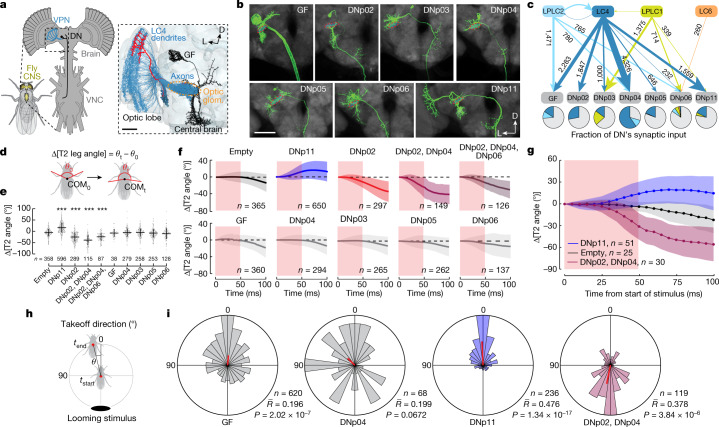
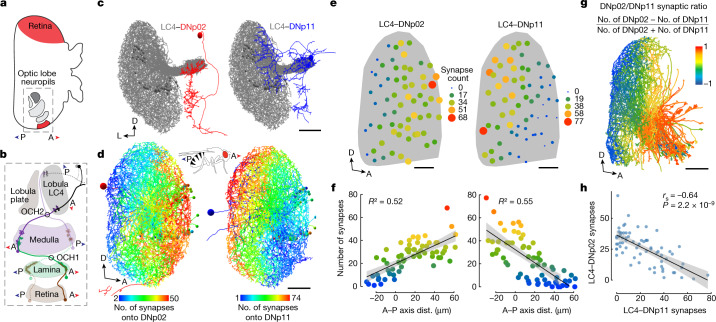
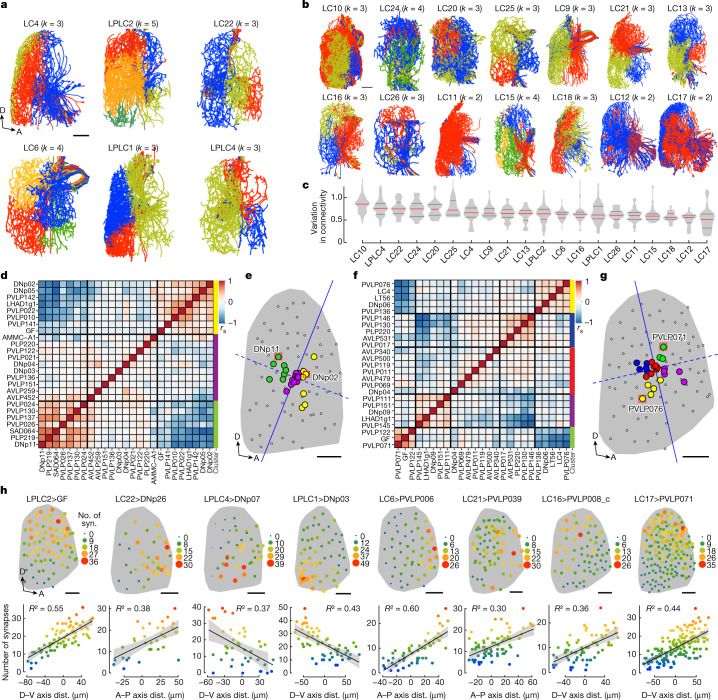
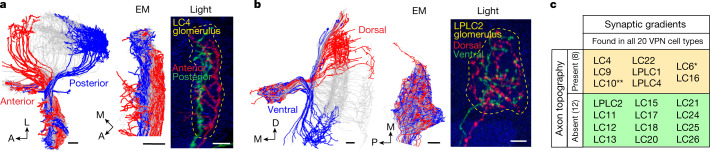
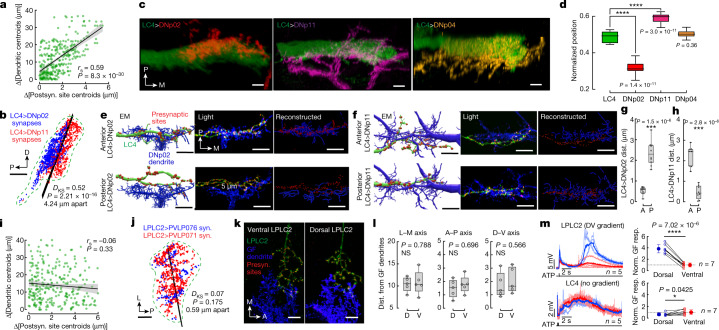
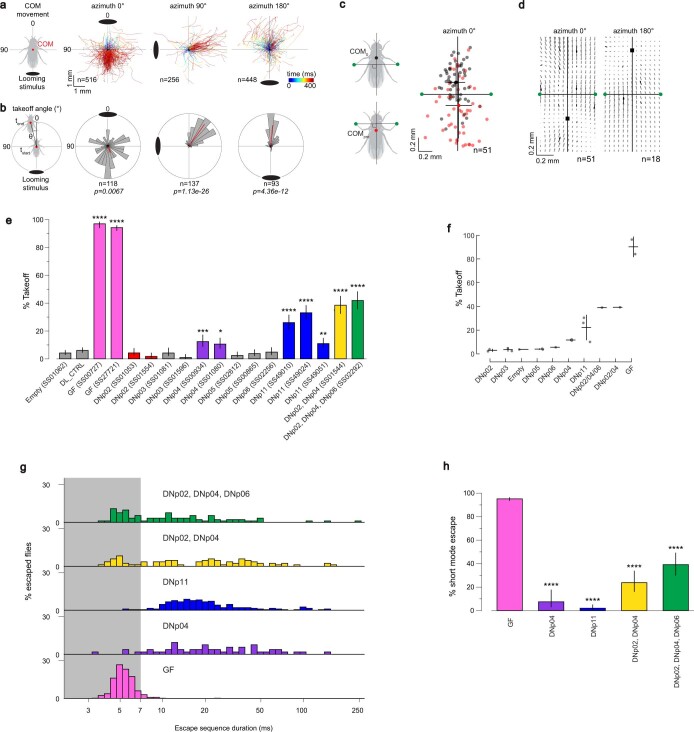
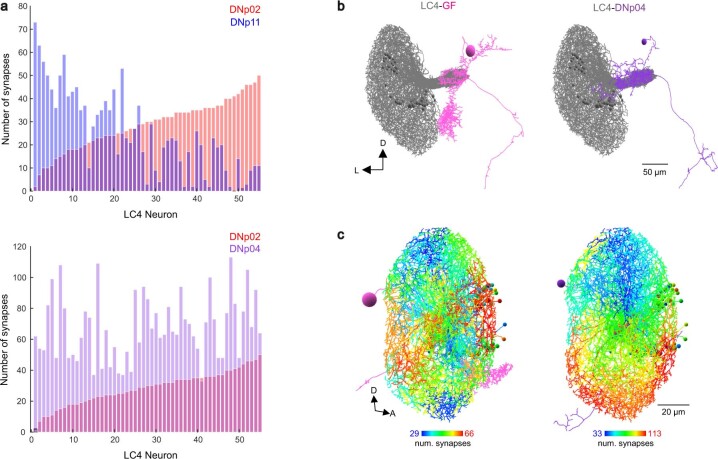
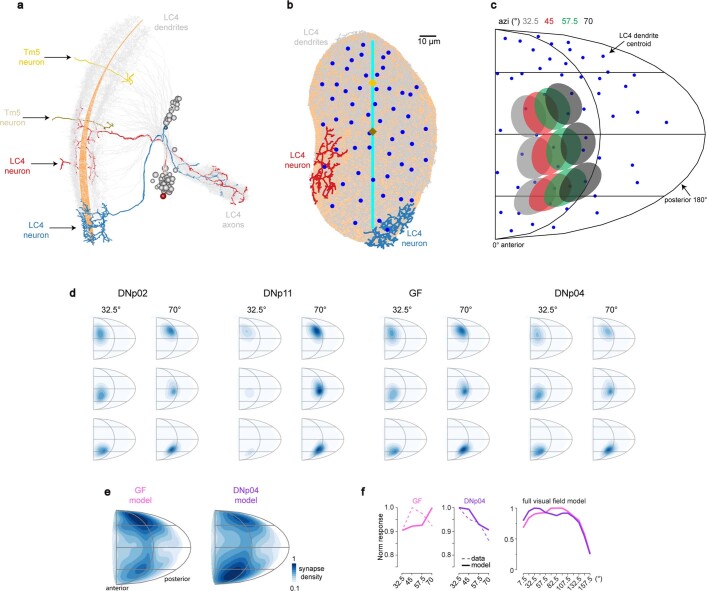
Abstract To survive, animals must convert sensory information into appropriate behaviours1,2. Vision is a common sense for locating ethologically relevant stimuli and guiding motor responses3–5. How circuitry converts object location in retinal coordinates to movement direction in body coordinates remains largely unknown. Here we show through behaviour, physiology, anatomy and connectomics in Drosophila that visuomotor transformation occurs by conversion of topographic maps formed by the dendrites of feature-detecting visual projection neurons (VPNs)6,7 into synaptic weight gradients of VPN outputs onto central brain neurons. We demonstrate how this gradient motif transforms the anteroposterior location of a visual looming stimulus into the fly’s directional escape. Specifically, we discover that two neurons postsynaptic to a looming-responsive VPN type promote opposite takeoff directions. Opposite synaptic weight gradients onto these neurons from looming VPNs in different visual field regions convert localized looming threats into correctly oriented escapes. For a second looming-responsive VPN type, we demonstrate graded responses along the dorsoventral axis. We show that this synaptic gradient motif generalizes across all 20 primary VPN cell types and most often arises without VPN axon topography. Synaptic gradients may thus be a general mechanism for conveying spatial features of sensory information into directed motor outputs.
Overview
The claims and statistics of this paper haven’t been checked yet.
Free: it reads the open-access text and checks the first 5 claims that cite a source we can check. Create a free account to check every claim.
Integrity signals
Registry
Cites
Statistics
Figures



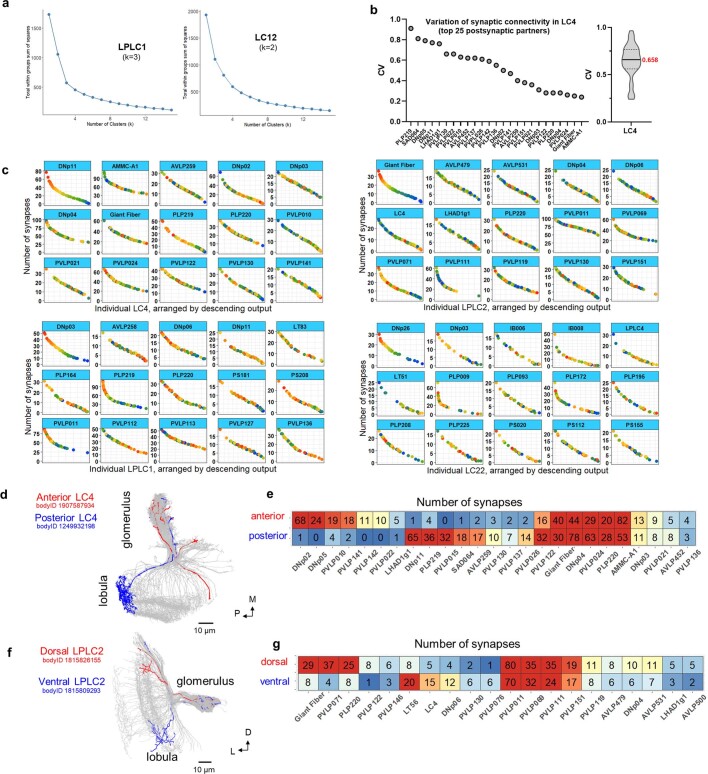


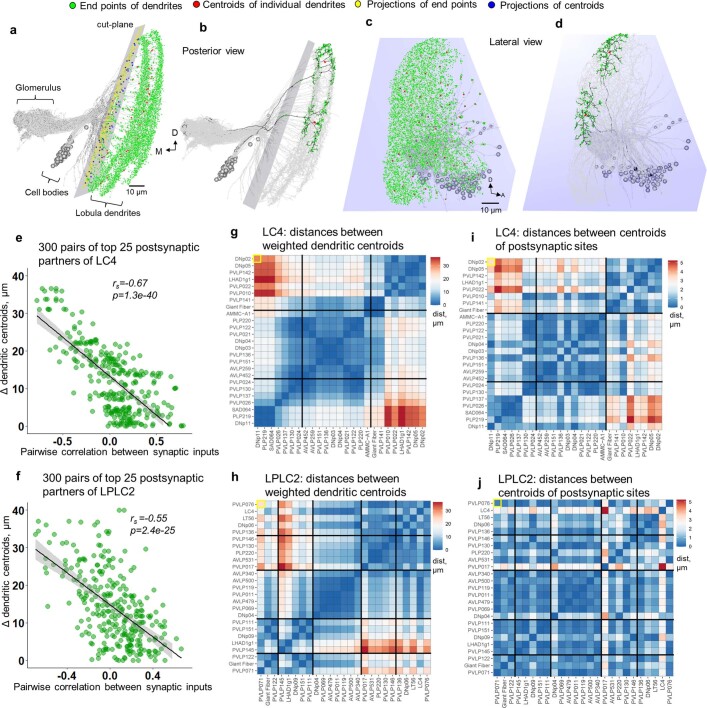
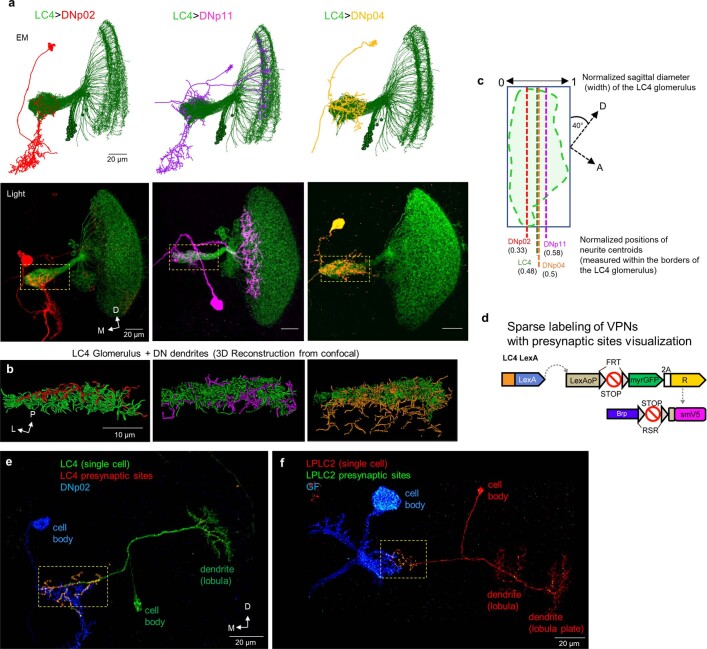

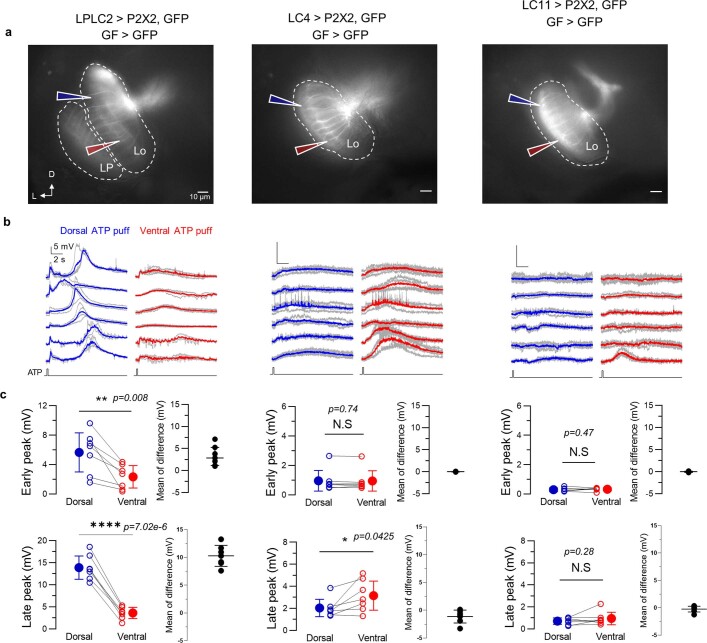
Verification
Claims the paper makes
The claims and statistics of this paper haven’t been checked yet.
Free: it reads the open-access text and checks the first 5 claims that cite a source we can check. Create a free account to check every claim.
Claims other papers make about this one
Each is checked against this paper’s own text: does it say what the citing paper says it does?
The source backs part of the claim, not all of it — or backs it for a different population, condition or comparison.
In the citing paper
“flies that take off after optogenetic activation of these DNs perform full long-mode takeoff sequences (Dombrovski et al., 2023) rather than individual actions.”
From Organization of circuits linking descending input to motor output in the Drosophila Male Adult Nerve Cord connectome (2026) · cites this paper as Dombrovski et al., 2023
Experimental — accuracy not yet measuredThe cited source says what the claim attributes to it.
In the citing paper
“Some columnar cell types are known to exhibit spatial gradients in connectivity 116”
From Neuronal wiring diagram of an adult brain (2023) · cites this paper as [116]
The cited source says what the claim attributes to it.
In the citing paper
“DNp11 promotes a backwards shift of the T2 legs relative to the center of mass (increasing the likelihood of the forward takeoff)”
From Organization of circuits linking descending input to motor output in the Drosophila Male Adult Nerve Cord connectome (2026) · cites this paper as Dombrovski et al., 2023
In the citing paper
“DNp07 and DNp11 drive escape-related behaviors requiring simultaneous movement of both the wings and legs (Ache et al., 2019; Dombrovski et al., 2023).”
From Organization of circuits linking descending input to motor output in the Drosophila Male Adult Nerve Cord connectome (2026) · cites this paper as Dombrovski et al., 2023
In the citing paper
“We have previously identified a number of DNs which are likely to contribute to long-mode takeoffs based either on anatomical evidence that they are downstream of neurons important for looming detection or functional evidence that they initiate long-mode takeoffs when optogenetically stimulated (Dombrovski et al., 2023; Peek, 2018; Williamson et al., 2018).”
From Organization of circuits linking descending input to motor output in the Drosophila Male Adult Nerve Cord connectome (2026) · cites this paper as Dombrovski et al., 2023
5 more claims about this paper
Create a free account to see every claim other papers make about this one.
Self-check
Percentages, sums and reported differences re-computed from the paper’s own numbers.
The self-check needs the paper’s full text.
Citations
Cites
A connectome and analysis of the adult Drosophila central brain
Scheffer, L. K., Xu, C. S., Januszewski, M., Lu, Z., Takemura, S.-Y., Hayworth, K. J., Huang, G. B., Shinomiya, K., Maitlin-Shepard, J., Berg, S., et al. (2020) · eLife · doi:10.7554/elife.57443 · Cited by 1,128
Self-citationA Complete Electron Microscopy Volume of the Brain of Adult Drosophila melanogaster
Zheng, Z., Lauritzen, J. S., Perlman, E., Robinson, C. G., Nichols, M., Milkie, D., Torrens, O., Price, J., Fisher, C. B., Sharifi, N., et al. (2018) · Cell · doi:10.1016/j.cell.2018.06.019 · Cited by 1,050
Georgopoulos, A., Kettner, R., & Schwartz, A. (1988) · The Journal of Neuroscience · doi:10.1523/jneurosci.08-08-02928.1988 · Cited by 830
Direct visuomotor transformations for reaching
Buneo, C. A., Jarvis, M. R., Batista, A. P., & Andersen, R. A. (2002) · Nature · doi:10.1038/416632a · Cited by 656
Nern, A., Pfeiffer, B. D., & Rubin, G. M. (2015) · Proceedings of the National Academy of Sciences · doi:10.1073/pnas.1506763112 · Cited by 584
Wyman (1984) · doi:10.1007/978-1-4899-2286-1 · Cited by 413
The functional organization of descending sensory-motor pathways in Drosophila
Namiki, S., Dickinson, M. H., Wong, A. M., Korff, W., & Card, G. M. (2018) · eLife · doi:10.7554/elife.34272 · Cited by 337
Self-citationVisually mediated motor planning in the escape response of Drosophila
Card, G., & Dickinson, M. H. (2008) · Current Biology · doi:10.1016/j.cub.2008.07.094 · Cited by 309
Self-citationFlies Evade Looming Targets by Executing Rapid Visually Directed Banked Turns
Muijres, F. T., Elzinga, M. J., Melis, J. M., & Dickinson, M. H. (2014) · Science · doi:10.1126/science.1248955 · Cited by 304
Wu, M., Nern, A., Williamson, W. R., Morimoto, M. M., Reiser, M. B., Card, G. M., & Rubin, G. M. (2016) · eLife · doi:10.7554/elife.21022 · Cited by 304
Self-citation
Cited by
Neuronal wiring diagram of an adult brain
Dorkenwald, S., Matsliah, A., Sterling, A. R., Schlegel, P., Yu, S.-C., McKellar, C. E., Lin, A., Costa, M., Eichler, K., Yin, Y., et al. (2024) · Nature · doi:10.1038/s41586-024-07558-y · Cited by 570
Neuronal wiring diagram of an adult brain
Dorkenwald, S., Matsliah, A., Sterling, A. R., Schlegel, P., Yu, S.-C., McKellar, C. E., Lin, A., Costa, M., Eichler, K., Yin, Y., et al. (2023) · doi:10.1101/2023.06.27.546656 · Cited by 149
Distributed control circuits across a brain-and-cord connectome
Bates, A. S., Phelps, J. S., Kim, M., Yang, H. H., Matsliah, A., Ajabi, Z., Perlman, E., Delgado, K. M., Osman, M. A. M., Salmon, C. K., et al. (2026) · Nature · doi:10.1038/s41586-026-10735-w · Cited by 98
Motor control on the move: from insights in insects to general mechanisms
Büschges, A., & Ache, J. M. (2024) · Physiological Reviews · doi:10.1152/physrev.00009.2024 · Cited by 58
Mapping model units to visual neurons reveals population code for social behaviour
Cowley, B. R., Calhoun, A. J., Rangarajan, N., Ireland, E., Turner, M. H., Pillow, J. W., & Murthy, M. (2024) · Nature · doi:10.1038/s41586-024-07451-8 · Cited by 55
“More work is needed to understand how object position is encoded within a single optic glomerulus and how that information is read out 61 . b .”
Background
Metadata
- Authors
- Dombrovski, M., Peek, M. Y., Park, J.-Y., Vaccari, A., Sumathipala, M., Morrow, C., Breads, P., Zhao, A., Kurmangaliyev, Y. Z., Sanfilippo, P., Rehan, A., Polsky, J., Alghailani, S., Tenshaw, E., Namiki, S., Zipursky, S. L., & Card, G. M.
- Affiliations
- Howard Hughes Medical Institute (US)
- Middlebury College (US)
- Corresponding author
- Zipursky, S. Lawrence
- Card, Gwyneth M.
- ORCID
- Venue
- Nature
- Published
- 2023-01-04
- Volume
- 613
- Issue
- 7944
- Pages
- 534-542
- ISSN
- 0028-0836 (ISSN-L)
- 1476-4687
- PMC
- PMC9849133
- OpenAlex
- W4313543884
- Cited by
- 67
- References
- 52
- Citations by year
- 2026: 15 · 2025: 22 · 2024: 16 · 2023: 12
- FWCI
- 7.86
- Type
- journal article
- Language
- en
- Update notices
- correction (2023-03-13)
- Open access
- hybrid
- doi.org
- Licence
- cc-by
- creativecommons.org/licenses/by/4.0 (tdm)
- creativecommons.org/licenses/by/4.0 (vor)
- Locations
- Nature (publishedVersion, cc-by)
- PubMed Central (publishedVersion, cc-by)
- PubMed (publishedVersion)
- RePEc: Research Papers in Economics (submittedVersion)
- eScholarship (California Digital Library) (submittedVersion, cc-by)
- Funders
- Howard Hughes Medical Institute
- Helen Hay Whitney Foundation
- Japan Society for the Promotion of Science (20K21414, 20H03293)
- Topics
- Life Sciences › Neuroscience › Cellular and Molecular Neuroscience › Neurobiology and Insect Physiology Research
- Life Sciences › Neuroscience › Cognitive Neuroscience › Visual perception and processing mechanisms
- Life Sciences › Neuroscience › Cellular and Molecular Neuroscience › Neuroscience and Neuropharmacology Research
- Keywords
- visuomotor transformation, Drosophila, topographic map, dorsal-ventral axis, anterior-posterior axis, connectomics, escape behavior
- MeSH terms
- Animals, Axons, Behavior, Animal, Brain, Dendrites, Drosophila, Escape Reaction, Neurons, Psychomotor Performance, Synapses, Visual Fields
About these checks
Registry, retraction, Cites and statistics results are computed, not judged, with one exception: a printed reference that no index lists is read once by a model before it counts as a citation error. Claims are extracted by a model and kept only when their quote appears verbatim in the text; each cited source is then checked, with a model’s help, for whether it says what the claim relies on. Those verdicts can be wrong — read the claim’s quote and the cited source before relying on one.
Statistics and arithmetic are recomputed, not judged.
Confidence bands are shown only for fields calibrated on our annotated test set. None is calibrated yet, so no band is shown.
What counts as a claim ›How we measure confidence ›How we check this ›
Are you an author, or do you see a problem with this page? Request a review
How to cite
Cite CoChat for the checks on this page, and the paper for its own findings.
- This page
- CoChat. (2026). Citation check: Synaptic gradients transform object location to action. https://app.cochat.ai/papers/10.1038/s41586-022-05562-8
- The paper
- Dombrovski, M., Peek, M. Y., Park, J.-Y., Vaccari, A., Sumathipala, M., Morrow, C., Breads, P., Zhao, A., Kurmangaliyev, Y. Z., Sanfilippo, P., Rehan, A., Polsky, J., Alghailani, S., Tenshaw, E., Namiki, S., Zipursky, S. L., & Card, G. M. (2023). Synaptic gradients transform object location to action. Nature. https://doi.org/10.1038/s41586-022-05562-8
Data sources
Bibliographic data: Semantic Scholar, OpenAlex, Crossref.
Contains information from the Semantic Scholar Academic Graph Datasets, made available under the ODC Attribution License (ODC-BY 1.0).
Semantic Scholar’s data is described in: Kinney, R., et al. (2023). The Semantic Scholar Open Data Platform. arXiv:2301.10140.
