

A Pseudomonas aeruginosa small RNA regulates chronic and acute infection
The DOI matches its Crossref record; 59 of the 59 references it cites were found in a registry or an index.
Abstract
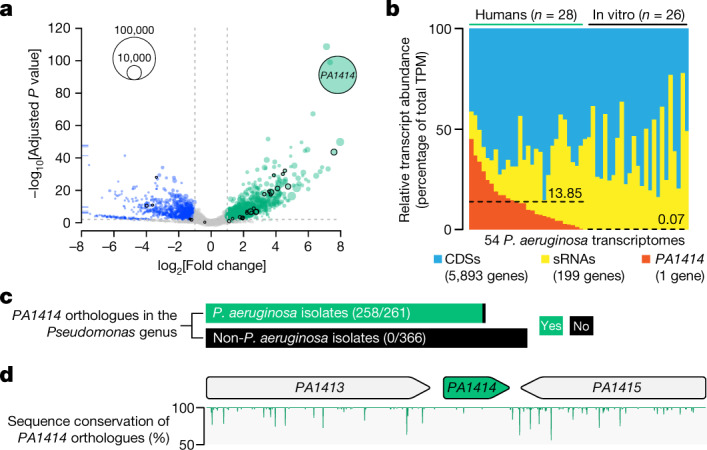
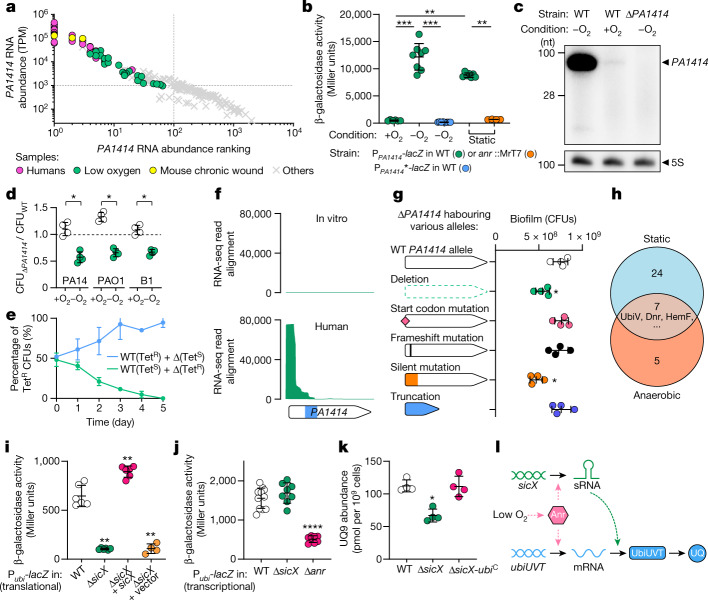
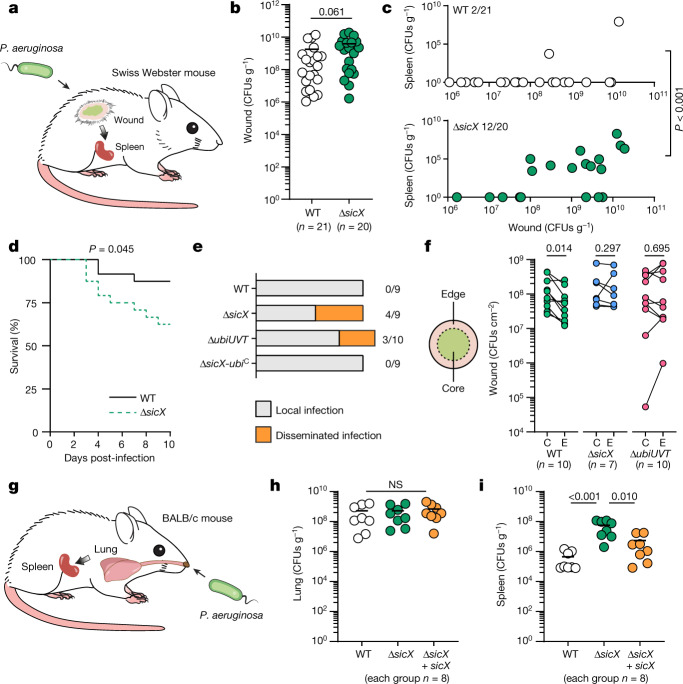
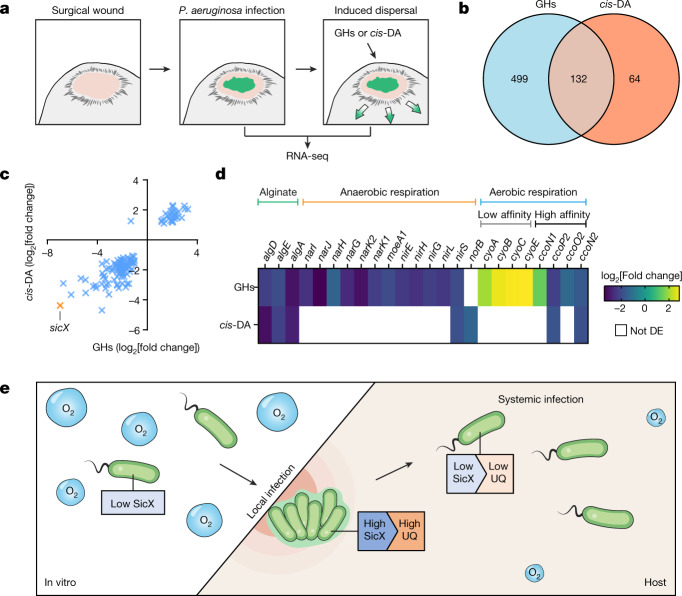
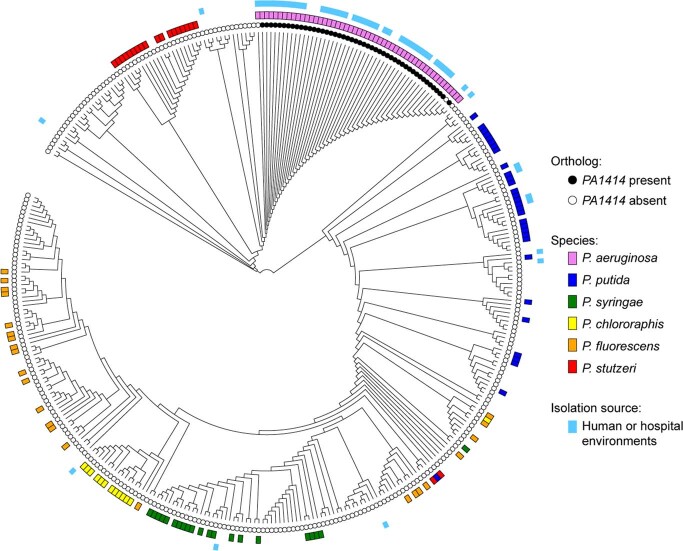
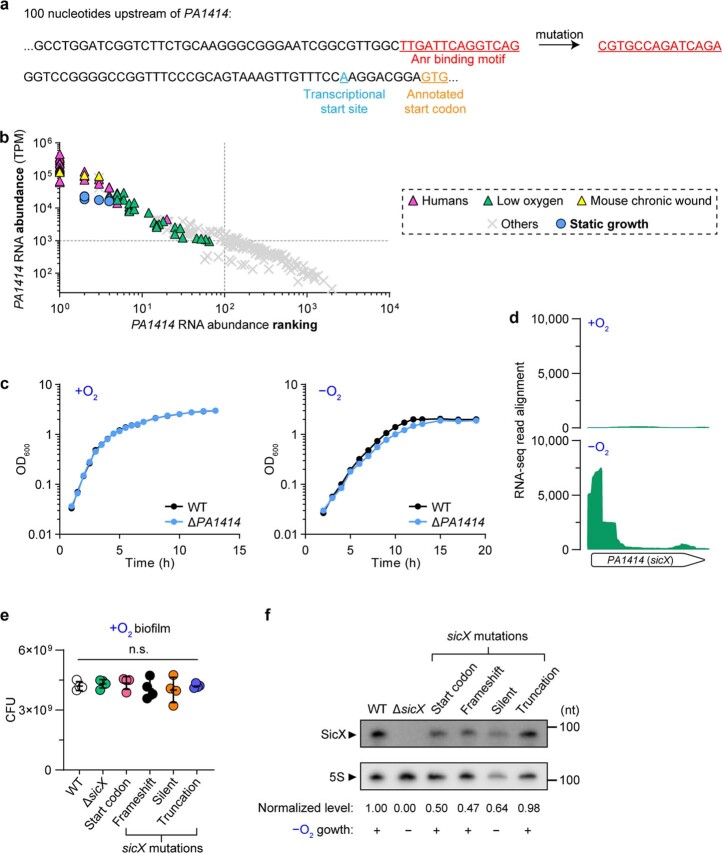
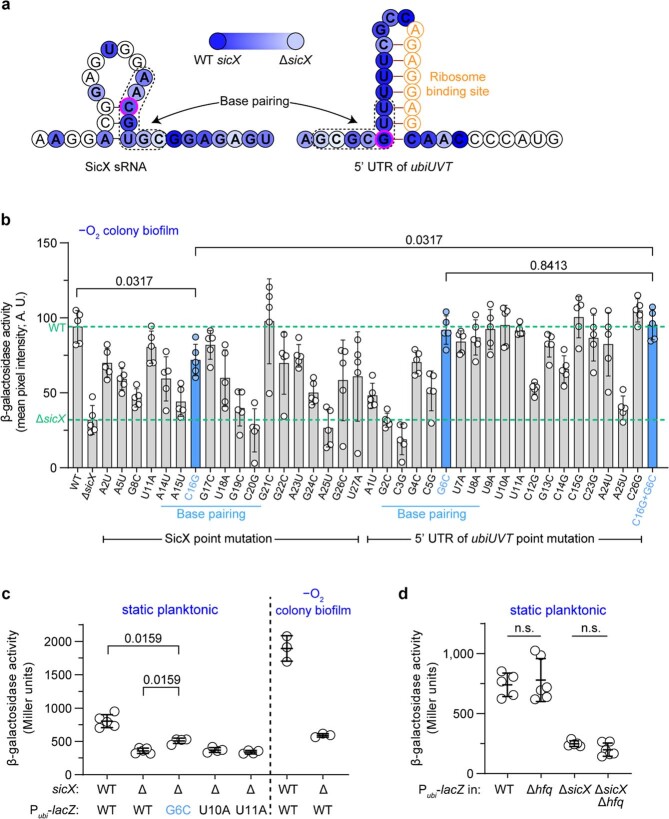
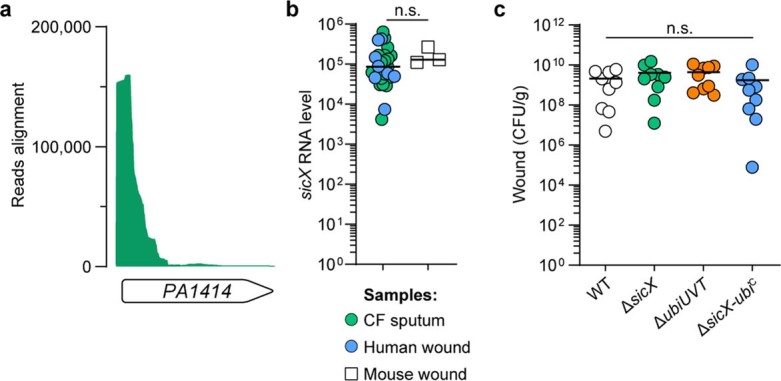
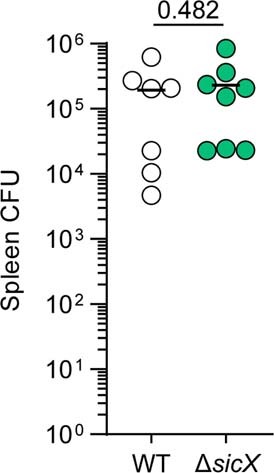
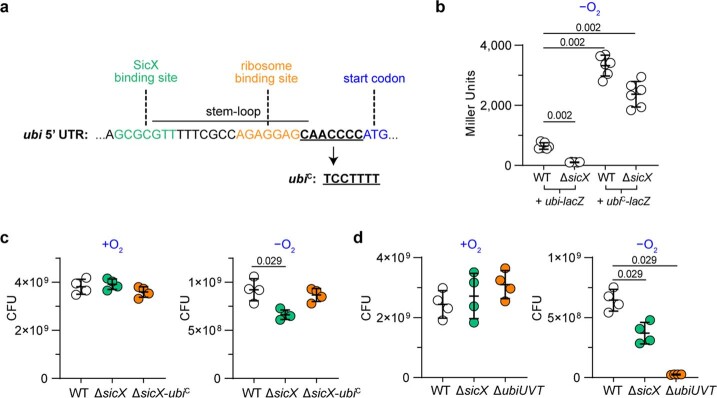
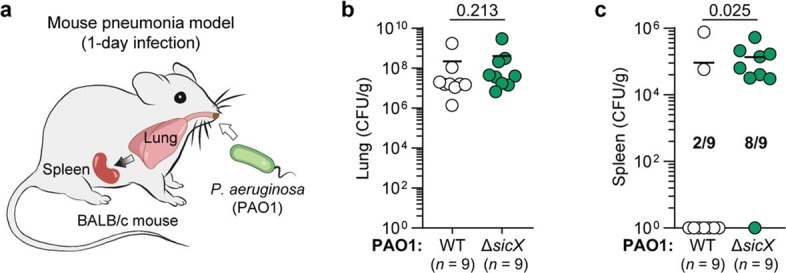
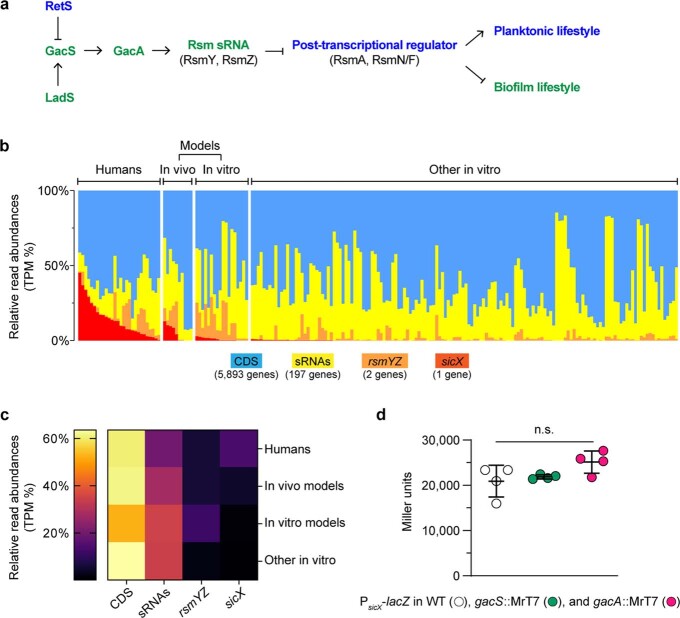
The ability to switch between different lifestyles allows bacterial pathogens to thrive in diverse ecological niches 1,2 . However, a molecular understanding of their lifestyle changes within the human host is lacking. Here, by directly examining bacterial gene expression in human-derived samples, we discover a gene that orchestrates the transition between chronic and acute infection in the opportunistic pathogen Pseudomonas aeruginosa . The expression level of this gene, here named sicX , is the highest of the P. aeruginosa genes expressed in human chronic wound and cystic fibrosis infections, but it is expressed at extremely low levels during standard laboratory growth. We show that sicX encodes a small RNA that is strongly induced by low-oxygen conditions and post-transcriptionally regulates anaerobic ubiquinone biosynthesis. Deletion of sicX causes P. aeruginosa to switch from a chronic to an acute lifestyle in multiple mammalian models of infection. Notably, sicX is also a biomarker for this chronic-to-acute transition, as it is the most downregulated gene when a chronic infection is dispersed to cause acute septicaemia. This work solves a decades-old question regarding the molecular basis underlying the chronic-to-acute switch in P. aeruginosa and suggests oxygen as a primary environmental driver of acute lethality.
Overview
The claims and statistics of this paper haven’t been checked yet.
Free: it reads the open-access text and checks the first 5 claims that cite a source we can check. Create a free account to check every claim.
Integrity signals
Registry
Cites
Statistics
Figures
Verification
Claims the paper makes
The claims and statistics of this paper haven’t been checked yet.
Free: it reads the open-access text and checks the first 5 claims that cite a source we can check. Create a free account to check every claim.
Claims other papers make about this one
Each is checked against this paper’s own text: does it say what the citing paper says it does?
The cited source says what the claim attributes to it.
In the citing paper
“Recently, the oxygen-responsive small RNA inducer of chronic infection X (SicX) has been identified as a critical chronic-to-acute switch in P. aeruginosa during mammalian infection10.”
From Pseudomonas aeruginosa: ecology, evolution, pathogenesis and antimicrobial susceptibility (2025) · cites this paper as [10]
Self-check
Percentages, sums and reported differences re-computed from the paper’s own numbers.
The self-check needs the paper’s full text.
Citations
Cites
Controlling the False Discovery Rate: A Practical and Powerful Approach to Multiple Testing
Benjamini, Y., & Hochberg, Y. (1995) · Journal of the Royal Statistical Society Series B: Statistical Methodology · doi:10.1111/j.2517-6161.1995.tb02031.x · Cited by 109,482
Moderated estimation of fold change and dispersion for RNA-seq data with DESeq2
Love, M. I., Huber, W., & Anders, S. (2014) · Genome Biology · doi:10.1186/s13059-014-0550-8 · Cited by 95,106
The Sequence Alignment/Map format and SAMtools
Li, H., Handsaker, B., Wysoker, A., Fennell, T., Ruan, J., Homer, N., Marth, G., Abecasis, G., Durbin, R., & 1000 Genome Project Data Processing Subgroup (2009) · Bioinformatics · doi:10.1093/bioinformatics/btp352 · Cited by 62,041
Fast gapped-read alignment with Bowtie 2
Langmead, B., & Salzberg, S. L. (2012) · Nature Methods · doi:10.1038/nmeth.1923 · Cited by 56,400
MUSCLE: multiple sequence alignment with high accuracy and high throughput
Edgar, R. C. (2004) · Nucleic Acids Research · doi:10.1093/nar/gkh340 · Cited by 44,662
Cutadapt removes adapter sequences from high-throughput sequencing reads
Martin, M. (2011) · EMBnet.journal · doi:10.14806/ej.17.1.200 · Cited by 33,889
Guindon, S., Dufayard, J.-F., Lefort, V., Anisimova, M., Hordijk, W., & Gascuel, O. (2010) · Systematic Biology · doi:10.1093/sysbio/syq010 · Cited by 18,376
Mfold web server for nucleic acid folding and hybridization prediction
Zuker, M. (2003) · Nucleic Acids Research · doi:10.1093/nar/gkg595 · Cited by 13,404
Jalview Version 2—a multiple sequence alignment editor and analysis workbench
Waterhouse, A. M., Procter, J. B., Martin, D. M. A., Clamp, M., & Barton, G. J. (2009) · Bioinformatics · doi:10.1093/bioinformatics/btp033 · Cited by 11,399
Universal sample preparation method for proteome analysis
Wiśniewski, J. R., Zougman, A., Nagaraj, N., & Mann, M. (2009) · Nature Methods · doi:10.1038/nmeth.1322 · Cited by 8,352
Research works printed but not linked: 4
- Janssen KH Diaz MR Gode CJ Wolfgang MC Yahr TL RsmV, a small noncoding regulatory RNA in Pseudomonas aeruginosa that sequesters RsmA and RsmF from target mRNAs J. Bacteriol. 2018 200 e00277-18 29866805 PMC6060366
- Naumoff D Hierarchical classification of glycoside hydrolases Biochemistry 2011 76 622 635 21639842
- Rahmani-Badi A Sepehr S Fallahi H Heidari-Keshel S Dissection of the cis-2-decenoic acid signaling network in Pseudomonas aeruginosa using microarray technique Front. Microbiol. 2015 6 383 25972860 PMC4412052
- Smyth, G. K. in Bioinformatics and Computational Biology Solutions using R and Bioconductor (eds Gentleman, R., Carey, V. J., Huber, W., Irizarry, R. A. & Dudoit, S.) 397–420 (Springer, 2005).
Cited by
Pseudomonas aeruginosa: ecology, evolution, pathogenesis and antimicrobial susceptibility
Letizia, M., Diggle, S. P., & Whiteley, M. (2025) · Nature Reviews Microbiology · doi:10.1038/s41579-025-01193-8 · Cited by 231
“Carbon sources and nutritional cues strongly influence its physiology and pathogenesis 10,177,178 .”
Self-citationMeirelles, L. A., Vayena, E., Debache, A., Schmidt, E., Rossy, T., Distler, T., Hatzimanikatis, V., & Persat, A. (2024) · Nature Microbiology · doi:10.1038/s41564-024-01842-3 · Cited by 40
Metadata
- Authors
- Cao, P., Fleming, D., Moustafa, D. A., Dolan, S. K., Szymanik, K. H., Redman, W. K., Ramos, A., Diggle, F. L., Sullivan, C. S., Goldberg, J. B., Rumbaugh, K. P., & Whiteley, M.
- Venue
- Nature
- Published
- 2023-05-24
- Volume
- 618
- Issue
- 7964
- Pages
- 358-364
- ISSN
- 0028-0836
- 1476-4687
- PMC
- PMC10247376
- Cited by
- 116
- References
- 59
- Language
- en
- Licence
- creativecommons.org/licenses/by/4.0 (tdm)
- creativecommons.org/licenses/by/4.0 (vor)
About these checks
Registry, retraction, Cites and statistics results are computed, not judged, with one exception: a printed reference that no index lists is read once by a model before it counts as a citation error. Claims are extracted by a model and kept only when their quote appears verbatim in the text; each cited source is then checked, with a model’s help, for whether it says what the claim relies on. Those verdicts can be wrong — read the claim’s quote and the cited source before relying on one.
Statistics and arithmetic are recomputed, not judged.
Confidence bands are shown only for fields calibrated on our annotated test set. None is calibrated yet, so no band is shown.
What counts as a claim ›How we measure confidence ›How we check this ›
Are you an author, or do you see a problem with this page? Request a review
Data sources
Bibliographic data: Semantic Scholar, OpenAlex, Crossref.
Contains information from the Semantic Scholar Academic Graph Datasets, made available under the ODC Attribution License (ODC-BY 1.0).
Semantic Scholar’s data is described in: Kinney, R., et al. (2023). The Semantic Scholar Open Data Platform. arXiv:2301.10140.
