

Like-minded sources on Facebook are prevalent but not polarizing
Open accessThe DOI matches its Crossref record; 41 of the 41 references it cites were found in a registry or an index; 11 of the 33 sources its claims cite were checked for support.
Abstract
Many critics raise concerns about the prevalence of ‘echo chambers’ on social media and their potential role in increasing political polarization. However, the lack of available data and the challenges of conducting large-scale field experiments have made it difficult to assess the scope of the problem. Here we present data from 2020 for the entire population of active adult Facebook users in the USA showing that content from ‘like-minded’ sources constitutes the majority of what people see on the platform, although political information and news represent only a small fraction of these exposures. To evaluate a potential response to concerns about the effects of echo chambers, we conducted a multi-wave field experiment on Facebook among 23,377 users for whom we reduced exposure to content from like-minded sources during the 2020 US presidential election by about one-third. We found that the intervention increased their exposure to content from cross-cutting sources and decreased exposure to uncivil language, but had no measurable effects on eight preregistered attitudinal measures such as affective polarization, ideological extremity, candidate evaluations and belief in false claims. These precisely estimated results suggest that although exposure to content from like-minded sources on social media is common, reducing its prevalence during the 2020 US presidential election did not correspondingly reduce polarization in beliefs or attitudes.
Overview
CoChat Summary
## TL;DR
The paper shows that most Facebook content seen by active adult U.S. users comes from politically like-minded sources, but a three-month field experiment reducing such exposure by about one-third did not measurably change political attitudes. The intervention changed what people saw and engaged with on-platform, but not eight preregistered measures such as affective polarization or ideological extremity.
## Key findings
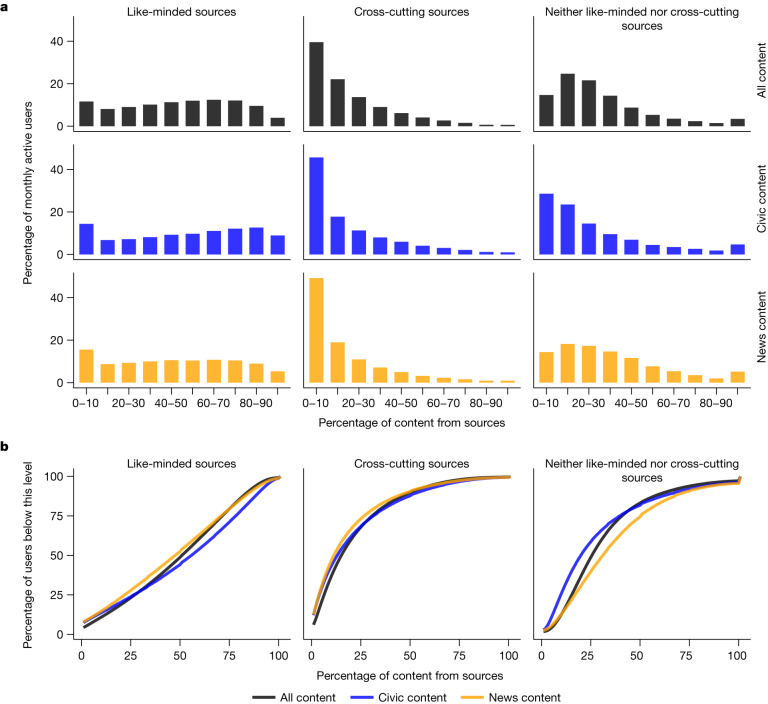
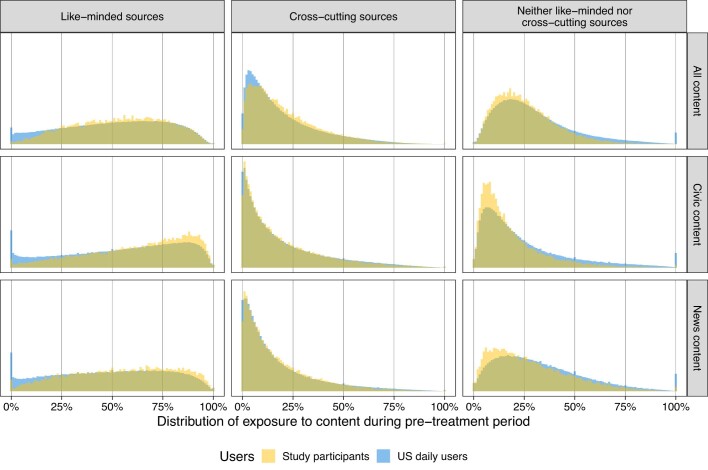
- Among active adult Facebook users in the U.S., the median user received 50.4% of exposures from like-minded sources and 14.7% from cross-cutting sources; civic content and news were a small share of the feed, with medians of 6.9% and 6.7%, respectively.
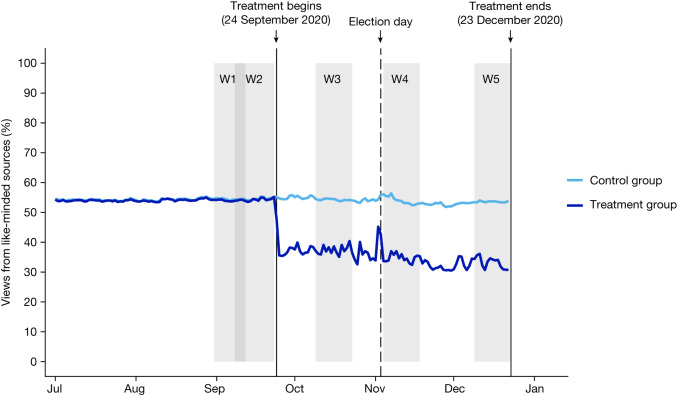
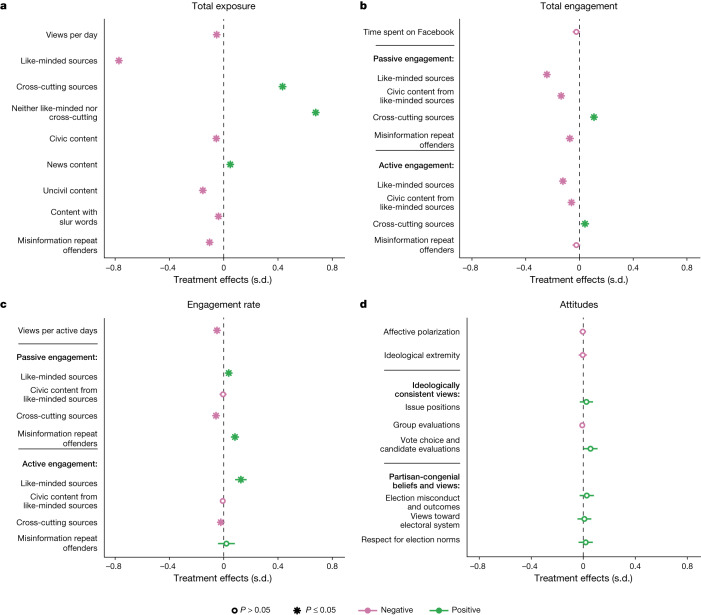
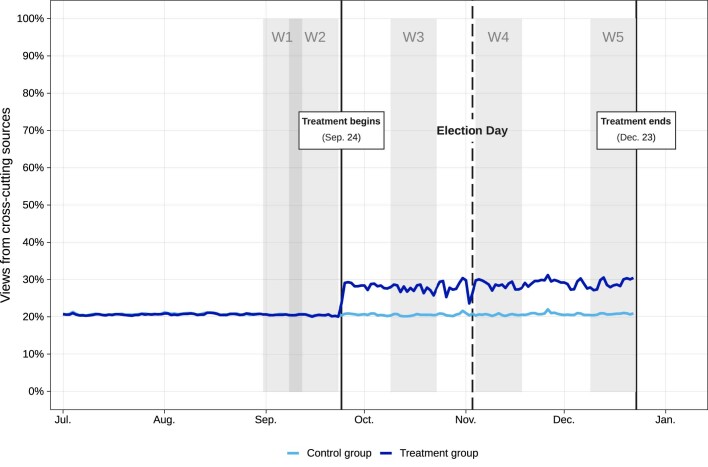
- In the experiment with 23,377 U.S.-based adult Facebook users, exposure to like-minded sources fell from 53.7% in control to 36.2% in treatment during 24 September to 23 December 2020; the reduction was 0.77 s.d. and total views per day declined by 0.05 s.d.
- The intervention reduced exposure to uncivil content by 0.15 s.d. and to content from misinformation repeat offenders by 0.10 s.d.; it also reduced exposure to slur-word content by 0.04 s.d.
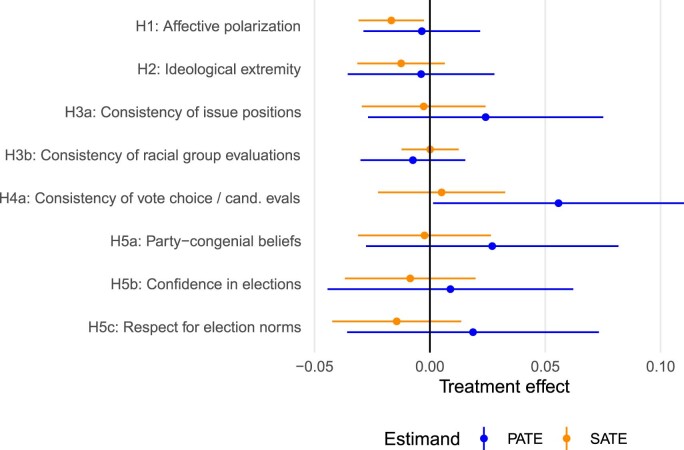
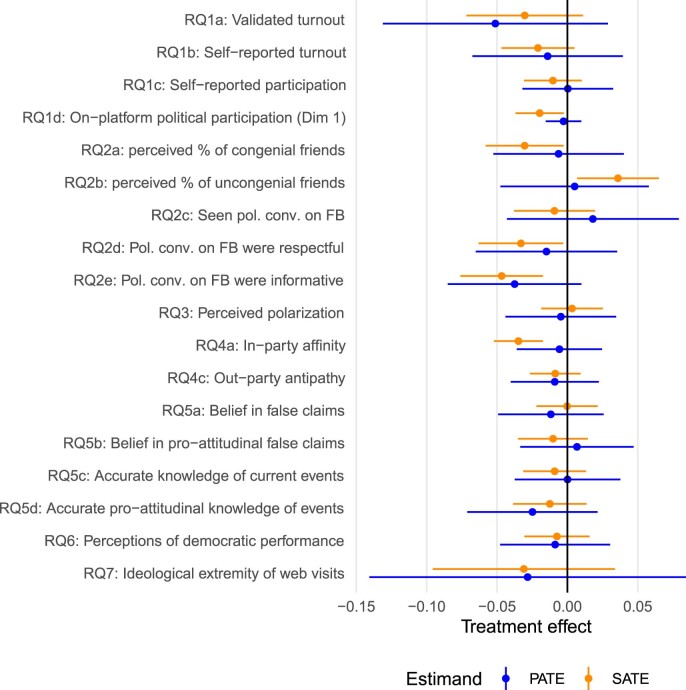
- Despite these exposure changes, the paper reports no measurable effects on 8 preregistered attitudinal outcomes; 7 of 8 primary estimates were ±0.03 s.d. or less, and the paper says effects of ±0.12 s.d. or more can be ruled out.
## Methods
- The paper combines a descriptive analysis of exposure among the population of U.S. adult Facebook users with a multi-wave field experiment among consenting users recruited via Facebook feed survey invitations.
- The experiment used block randomization with equal probability to treatment/control; the final sample for the experiment was 23,377 participants, and surveys were fielded before and after the 2020 U.S. presidential election.
- Treatment downranked all content from friends, Pages, and groups predicted to share the participant’s political leaning; analyses used OLS with robust standard errors, preregistered covariates selected by LASSO, and survey weights for attitude estimates.
## Limitations
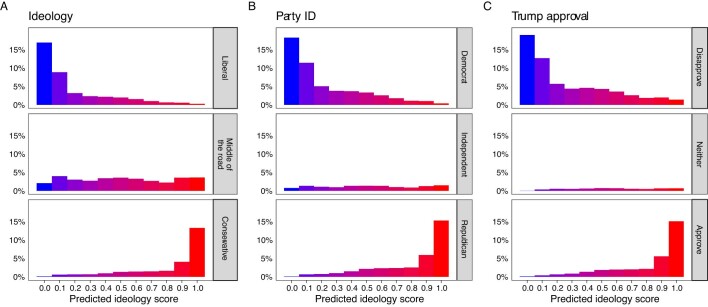
- The paper states it does not directly measure the slant of the content shared, only the estimated political leaning of users, Pages, and groups.
- The paper says it cannot capture effects of prior Facebook use or cumulative effects over years, and it calls for longer experiments and studies of new users.
- Evident from the text: the experiment was conducted during the 2020 presidential election and only on consenting Facebook users, so generalization beyond this setting and population is limited; the paper itself notes that replications in other countries are needed.
Model-written summary. Check it against the paper before relying on it.
Integrity signals
Registry
Cites
Statistics
Figures
Verification
Claims the paper makes
8 Valid · 1 Not valid · 7 Not checked · 96 Own results and interpretations
The sources with a verdict support this claim; the rest weren’t checked yet, have no full text we could read, or their verdicts aren’t rated yet.
In the paper
“a majority of the content that active adult Facebook users in the US see on the platform comes from politically like-minded friends or from Pages or groups with like-minded audiences (mirroring patterns of homophily in real-world networks15,39)”
§ Like-minded sources on Facebook are prevalent but not polarizing > Main > Discussion
What the sources say
- Supportedcites [15] Gentzkow, M. & Shapiro, J. M. Ideological segregation online and offline. Q. J. Econ. 126, 1799–1839 (2011). 10.1093/qje/qjr044 source
The citation is attached to the parenthetical comparison with real-world networks, not the preceding estimate about Facebook content. The Introduction reports ideological segregation in offline networks formed through associations, work, neighborhoods, family, and trusted friends. The paper does not provide the Facebook estimate, but that estimate is not the part this citation is offered to support. (LLM, conf=0.90)
- Not checked — no full text of the sourcecites [39] McPherson, M., Smith-Lovin, L. & Cook, J. M. Birds of a feather: Homophily in social networks. Annu. Rev. Sociol. 27, 415–444 (2001). 10.1146/annurev.soc.27.1.415 source
plain- Asserted: passes — The authors put it forward as true.
- Checkable: passes — It can be checked against evidence.
- Load-bearing: passes — The paper’s conclusions depend on it.
- Based: passes — The paper gives a reason why it holds.
- Supported
The cited sources support only part of this claim — read each source’s verdict below.
In the paper
“social media consumption represents a small fraction of most people’s information diets37”
§ Like-minded sources on Facebook are prevalent but not polarizing > Main > Discussion
What the sources say
- Partly supportedcites [37] Allen, J., Howland, B., Mobius, M., Rothschild, D. & Watts, D. J. Evaluating the fake news problem at the scale of the information ecosystem. Sci. Adv. 6, eaay3539 (2020). 32284969 10.1126/sciadv.aay3539 PMC7124954 sourceExperimental — accuracy not yet measured
The Results report that online news, including exposure on social media, is a small share of media consumption; the Discussion says TV news consumption exceeds online news consumption by 5:1, with an even larger gap for social media sites. Those findings concern news consumed through social media, not all social media consumption. The cited passages also do not establish the claim for most individuals rather than aggregate consumption. (LLM, conf=0.82)
plain- Asserted: passes — The authors put it forward as true.
- Checkable: passes — It can be checked against evidence.
- Load-bearing: passes — The paper’s conclusions depend on it.
- Based: passes — The paper gives a reason why it holds.
- Partly supported
The sources with a verdict support this claim; the rest weren’t checked yet, have no full text we could read, or their verdicts aren’t rated yet.
In the paper
“Without access to behavioural measures of exposure, studies must instead rely on survey self-reports that are prone to measurement error24,25.”
§ Like-minded sources on Facebook are prevalent but not polarizing > Main
What the sources say
- Not checked — no full text of the sourcecites [24] Prior, M. The immensely inflated news audience: Assessing bias in self-reported news exposure. Public Opin. Q. 73, 130–143 (2009). 10.1093/poq/nfp002 source
- Supportedcites [25] Konitzer, T. et al. Comparing estimates of news consumption from survey and passively collected behavioral data. Public Opin. Q. 85, 347–370 (2021). 10.1093/poq/nfab023 source
The Introduction (page not specified) says researchers commonly rely on surveys to measure news consumption and that self-reports can suffer measurement error from memory decay, inaccurate estimates, and social desirability bias. This supports the claim about reliance on error-prone self-reports when behavioral measures are unavailable. (LLM, conf=0.90)
plainstates a cause- Asserted: passes — The authors put it forward as true.
- Checkable: passes — It can be checked against evidence.
- Load-bearing: unclear — It is unclear whether the paper’s conclusions depend on it.
- Based: passes — The paper gives a reason why it holds.
A result the paper reports from its own data — it cites no other source for it, so there is none to check. The quote shows it is in the paper.
In the paper
“the median Facebook user received a majority of their content from like-minded sources—50.4% versus 14.7% from cross-cutting sources”
§ Like-minded sources on Facebook are prevalent but not polarizing > Main > Exposure to like-minded sources
plain- Asserted: passes — The authors put it forward as true.
- Checkable: passes — It can be checked against evidence.
- Load-bearing: passes — The paper’s conclusions depend on it.
- Based: passes — The paper gives a reason why it holds.
A result the paper reports from its own data — it cites no other source for it, so there is none to check. The quote shows it is in the paper.
In the paper
“However, the intervention only modestly increases exposure to content from cross-cutting sources.”
§ Like-minded sources on Facebook are prevalent but not polarizing > Main
plainstates a cause- Asserted: passes — The authors put it forward as true.
- Checkable: passes — It can be checked against evidence.
- Load-bearing: passes — The paper’s conclusions depend on it.
- Based: passes — The paper gives a reason why it holds.
69 more claims
Create a free account to see all 112 claims and to verify the 1 reference still open.
- It may state two separate claims as one. 18
- Probably not a substantial claim. 27
- The quote only partly states this claim. 1
Claims other papers make about this one
Each is checked against this paper’s own text: does it say what the citing paper says it does?
The source backs part of the claim, not all of it — or backs it for a different population, condition or comparison.
In the citing paper
“On the other hand, other research has failed to find long-term changes in user beliefs due to social media ranking algorithms [26,27,29,38]”
From Twitter's Algorithm: Amplifying Anger, Animosity, and Affective Polarization (2023) · cites this paper as [38]
Experimental — accuracy not yet measuredThe source backs part of the claim, not all of it — or backs it for a different population, condition or comparison.
In the citing paper
“That said, other work, specifically on Facebook, offers a more ambiguous portrait.While some evidence suggests it contributes to issue polarization (Allcott et al., 2020;Settle, 2018), other shows it has no effect on ideological extremity, affective polarization, or belief in false claims (Nyhan et al., 2023; also see Guess et al., 2023aGuess et al., , 2023b).”
From How to study democratic backsliding (2024) · cites this paper as Nyhan et al., 2023
Experimental — accuracy not yet measuredThe source backs part of the claim, not all of it — or backs it for a different population, condition or comparison.
In the citing paper
“For instance, Nordbrandt [76], Nyhan et al. [77] observed that while social media usage does not directly influence affective polarization-the individuals' sympathy or antipathy toward specific political parties-prior patterns of social media engagement can shape this relationship.”
From A systematic review of echo chamber research: comparative analysis of conceptualizations, operationalizations, and varying outcomes (2025) · cites this paper as [77]
Experimental — accuracy not yet measuredThe cited source says what the claim attributes to it.
In the citing paper
“Similarly, recent large-scale experiments on Facebook and Instagram found no evidence that reduced exposure to in-party sources or a simpler reverse-chronological algorithm affected polarization and political attitudes (37,23) during the 2020 U.S. election.”
From Reranking partisan animosity in algorithmic social media feeds alters affective polarization (2025) · cites this paper as [23]
The cited source says what the claim attributes to it.
In the citing paper
“Since we did not preregister this analysis, we minimize the number of subjective modeling decisions by considering the same participant characteristics and following a similar reweighting procedure as the Facebook and Instagram Election studies (23,37).”
From Reranking partisan animosity in algorithmic social media feeds alters affective polarization (2025) · cites this paper as [23]
3 more claims about this paper
Create a free account to see every claim other papers make about this one.
Citations
Cites
Birds of a Feather: Homophily in Social Networks
McPherson, M., Smith-Lovin, L., & Cook, J. M. (2001) · Annual Review of Sociology · doi:10.1146/annurev.soc.27.1.415 · Cited by 18,567 · cited 1×
“However, a majority of the content that active adult Facebook users in the US see on the platform comes from politically like-minded friends or from Pages or groups with like-minded audiences (mirroring patterns of homophily in real-world networks 15,39 ).”
BackgroundThe Origins and Consequences of Affective Polarization in the United States
Iyengar, S., Lelkes, Y., Levendusky, M., Malhotra, N., & Westwood, S. J. (2019) · Annual Review of Political Science · doi:10.1146/annurev-polisci-051117-073034 · Cited by 3,603
Self-citationExposure to ideologically diverse news and opinion on Facebook
Bakshy, E., Messing, S., & Adamic, L. A. (2015) · Science · doi:10.1126/science.aaa1160 · Cited by 3,245 · cited 1×
“Prior observational studies of information exposure on platforms focus on Twitter, which is used by only 23% of the public 19–22 , or the news diet of the small minority of active adult users in the US who self-identified as conservative or liberal on Facebook in 2014–2015 23 .”
BackgroundFilter Bubbles, Echo Chambers, and Online News Consumption
Flaxman, S., Goel, S., & Rao, J. M. (2016) · Public Opinion Quarterly · doi:10.1093/poq/nfw006 · Cited by 1,992
FILTER BUBBLE: Wie wir im Internet entmündigt werden
Pariser, E. (2012) · doi:10.3139/9783446431164 · Cited by 1,849
Tweeting From Left to Right: Is Online Political Communication More Than an Echo Chamber?
Barberá, P., Jost, J. T., Nagler, J., Tucker, J. A., & Bonneau, R. (2015) · Psychological Science · doi:10.1177/0956797615594620 · Cited by 1,472
Self-citationPolarization and Partisan Selective Exposure
Stroud, N. J. (2010) · Journal of Communication · doi:10.1111/j.1460-2466.2010.01497.x · Cited by 1,346
Self-citationCross-cutting Social Networks: Testing Democratic Theory in Practice
MUTZ, D. C. (2002) · American Political Science Review · doi:10.1017/s0003055402004264 · Cited by 1,069
Ideological Segregation Online and Offline *
Gentzkow, M., & Shapiro, J. M. (2011) · The Quarterly Journal of Economics · doi:10.1093/qje/qjr044 · Cited by 980
Self-citationPolitical Sectarianism in America
Finkel, E. J., Bail, C. A., Cikara, M., Ditto, P. H., Iyengar, S., Klar, S., Mason, L., McGrath, M. C., Nyhan, B., Rand, D. G., et al. (2020) · Science · doi:10.1126/science.abe1715 · Cited by 931
Self-citation
Research works printed but not linked: 2
- Sunstein, C. R. Republic.com 2.0 (Princeton Univ. Press, 2009).
- Wojcieszak, M. et al. No polarization from partisan news. Int. J. Press/Politics10.1177/1940161221104 (2021). · doi:10.1177/1940161221104
Cited by
Misunderstanding the harms of online misinformation
Budak, C., Nyhan, B., Rothschild, D. M., Thorson, E., & Watts, D. J. (2024) · Nature · doi:10.1038/s41586-024-07417-w · Cited by 156
“Experiments varying individual features of the platform have also yielded mixed results: although increasing exposure to cross-cutting news decreased affective polarization 94 , decreasing exposure to content from like-minded sources had no effect 44 .”
InfluentialSelf-citationQuantifying the impact of misinformation and vaccine-skeptical content on Facebook
Allen, J. N. L., Watts, D. J., & Rand, D. G. (2024) · Science · doi:10.1126/science.adk3451 · Cited by 261
“…sharing of and belief in falsehoods ( 12 – 15 ), consideration of the real-world impact of exposure to misinformation [as opposed to impacts of larger algorithmic changes to platforms ( 16 – 18 )] has been largely relegated to assertions in introductory paragraphs and discussion sections ( 19 ).”
Building Human Values into Recommender Systems: An Interdisciplinary Synthesis
Stray, J., Halevy, A., Assar, P., Hadfield-Menell, D., Boutilier, C., Ashar, A., Bakalar, C., Beattie, L., Ekstrand, M., Leibowicz, C., et al. (2024) · ACM Transactions on Recommender Systems · doi:10.1145/3632297 · Cited by 122
Persistent interaction patterns across social media platforms and over time
Avalle, M., Marco, N. D., Etta, G., Sangiorgio, E., Alipour, S., Bonetti, A., Alvisi, L., Scala, A., Baronchelli, A., Cinelli, M., et al. (2024) · Nature · doi:10.1038/s41586-024-07229-y · Cited by 225
“Consistent with previous studies 36,37 our analysis shows that the macroscopic patterns of online conversations, such as the distribution of users/threads activity and lifetime, are consistent across all data-sets and topics (Supplementary Tables 1–4).”
BackgroundResultInfluentialThe Polarizing Effect of Partisan Echo Chambers
HOBOLT, S. B., Lawall, K., & Tilley, J. R. (2023) · American Political Science Review · doi:10.1017/s0003055423001211 · Cited by 154
“Some find that exposure to political views, and even partisan echo chambers, on social media does not have polarizing effects (Nyhan et al. 2023; Suhay, Bello-Pardo, and Maurer 2018), while others argue that social media usage increases perceptions of differences between partisan groups in ways…”
BackgroundThe effects of Facebook and Instagram on the 2020 election: A deactivation experiment
Allcott, H., Gentzkow, M. A., Mason, W., Wilkins, A. S., Barberá, P., Brown, T., Cisneros, J. C., Crespo-Tenorio, A., Dimmery, D., Freelon, D., et al. (2024) · Proceedings of the National Academy of Sciences · doi:10.1073/pnas.2321584121 · Cited by 170
Self-citationAridor, G., Jiménez-Durán, R., Levy, R., & Song, L. (2024) · Journal of Economic Literature · doi:10.1257/jel.20241743 · Cited by 115
Negative online news articles are shared more to social media
Watson, J., van der Linden, S., Watson, M., & Stillwell, D. (2024) · Scientific Reports · doi:10.1038/s41598-024-71263-z · Cited by 70
“While social media platforms are a vital news source for many, news comprises only a fraction of the diverse content disseminated on these platforms 77 .”
BackgroundHartmann, D., Wang, S. M., Pohlmann, L., & Berendt, B. (2025) · Journal of Computational Social Science · doi:10.1007/s42001-025-00381-z · Cited by 59
Polarization is the psychological foundation of collective engagement
Smith, L. G. E., Thomas, E. F., Bliuc, A., & McGarty, C. (2024) · Communications Psychology · doi:10.1038/s44271-024-00089-2 · Cited by 88
Disentangled contrastive learning for fair graph representations
Zhang, G., Yuan, G., Cheng, D., Liu, L., Li, J., & Zhang, S. (2024) · Neural Networks · doi:10.1016/j.neunet.2024.106781 · Cited by 69
How to study democratic backsliding
Druckman, J. N. (2024) · Political Psychology · doi:10.1111/pops.12942 · Cited by 56
Toxic Content and User Engagement on Social Media: Evidence from a Field Experiment
Beknazar-Yuzbashev, G., Jiménez Durán, R., McCrosky, J., & Stalinski, M. (2022) · doi:10.2139/ssrn.4307346 · Cited by 42
Generative artificial intelligence–mediated confirmation bias in health information seeking
Lopez‐Lopez, E., Abels, C. M., Holford, D., Herzog, S. M., & Lewandowsky, S. (2025) · Annals of the New York Academy of Sciences · doi:10.1111/nyas.15413 · Cited by 38
From social media to artificial intelligence: improving research on digital harms in youth
Mansfield, K. L., Ghai, S., Hakman, T., Ballou, N., Vuorre, M., & Przybylski, A. K. (2025) · The Lancet Child & Adolescent Health · doi:10.1016/s2352-4642(24)00332-8 · Cited by 39
Milli, S., Carroll, M., Wang, Y., Pandey, S., & Dragan, A. D. (2023) · arXiv.org · doi:10.48550/arxiv.2305.16941 · Cited by 200
“On the other hand, other research has failed to find long-term changes in user beliefs due to social media ranking algorithms ( 41, 48 – 50), and the short-term changes in users’ perceptions of their in-group and out-group that we found may not persist.”
On the impossibility of breaking the echo chamber effect in social media using regulation
Avin, C., Daltrophe, H., & Lotker, Z. (2024) · Scientific Reports · doi:10.1038/s41598-023-50850-6 · Cited by 58
“A large-scale recent study of Facebook users in the USA activity from 2020 32–35 shows that content from ‘like-minded’ sources constitutes most of what people see on the platform.”
BackgroundReranking partisan animosity in algorithmic social media feeds alters affective polarization
Piccardi, T., Saveski, M., Jia, C., Hancock, J., Tsai, J. L., & Bernstein, M. S. (2025) · Science · doi:10.1126/science.adu5584 · Cited by 117
“This concern has grown since the 2016 US presidential election ( 23 ), and the debate remains ongoing after the 2020 and 2024 elections.”
Falkenberg, M., Zollo, F., Quattrociocchi, W., Pfeffer, J., & Baronchelli, A. (2024) · Nature Communications · doi:10.1038/s41467-024-53868-0 · Cited by 75
On manipulation by emotional AI: UK adults’ views and governance implications
Bakir, V., Laffer, A., McStay, A., Miranda, D., & Urquhart, L. (2024) · Frontiers in Sociology · doi:10.3389/fsoc.2024.1339834 · Cited by 34
Nudging recommendation algorithms increases news consumption and diversity on YouTube
Yu, X., Haroon, M., Menchen-Trevino, E., & Wojcieszak, M. (2024) · PNAS Nexus · doi:10.1093/pnasnexus/pgae518 · Cited by 72
Self-citationDefining Digital Authoritarianism
Pearson, J. S. (2024) · Philosophy & Technology · doi:10.1007/s13347-024-00754-8 · Cited by 57
Mobile Internet and Political PolarizationPreprint
Melnikov, N. (2021) · SSRN Electronic Journal · doi:10.2139/ssrn.3937760 · Cited by 52
Krause, N. M., Freiling, I., & Scheufele, D. A. (2025) · Proceedings of the National Academy of Sciences · doi:10.1073/pnas.2400928121 · Cited by 39
Beyond online disinformation: assessing national information resilience in four European countries
Dragomir, M., Araújo, J. R., & Horowitz, M. A. (2024) · Humanities and Social Sciences Communications · doi:10.1057/s41599-024-02605-5 · Cited by 45
“…during the 2020 US presidential election, as part of the 2020 Facebook and Instagram Election Study (FIES), a recent article found that reducing exposure to content from like-minded sources on social networks is not correlated with reduced polarization in beliefs or attitudes (Nyhan et al., 2023).”
BackgroundFollowing news on social media boosts knowledge, belief accuracy and trust
Altay, S., Hoes, E., & Wojcieszak, M. (2025) · Nature Human Behaviour · doi:10.1038/s41562-025-02205-6 · Cited by 53
“A host of other interventions have been tested at the platform level, such as friction 15 , downranking like-minded sources 16 , removing reshared content 17 or the introduction of chronological feeds 18 .”
Self-citationThe Online Misinformation Engagement Framework
Geers, M., Swire‐Thompson, B., Lorenz-Spreen, P., Herzog, S. M., Kozyreva, A., & Hertwig, R. (2023) · Current Opinion in Psychology · doi:10.1016/j.copsyc.2023.101739 · Cited by 44
“…attention [34] and valid credibility cues from the offline world (e.g., professional design or elevated Source cues [5], source like-mindedness [6], mindless access [7] Source credibility labels [8], friction [9] Novelty seeking [10], negativity bias [11] Labels and warning signs [12],…”
BackgroundUnderstanding anti-immigration sentiment spreading on Twitter
Nasuto, A., & Rowe, F. (2024) · PLoS ONE · doi:10.1371/journal.pone.0307917 · Cited by 42
Liu, N., Hu, X. E., Savas, Y., Baum, M., Berinsky, A. J., Chaney, A. J. B., Lucas, C., Mariman, R., Benedictis-Kessner, J. D., Guess, A. M., et al. (2025) · Proceedings of the National Academy of Sciences · doi:10.1073/pnas.2318127122 · Cited by 61
The Power and Pitfalls of Social Norms
Wenzel, M., & Woodyatt, L. (2024) · Annual Review of Psychology · doi:10.1146/annurev-psych-020124-120310 · Cited by 42
Post-January 6th deplatforming reduced the reach of misinformation on Twitter
McCabe, S., Ferrari, D., Green, J., Lazer, D. M. J., & Esterling, K. (2024) · Nature · doi:10.1038/s41586-024-07524-8 · Cited by 40
“Several recent papers have reported on experiments with changes to Facebook’s curation algorithm 10,28,29 .”
Patterns of linguistic simplification on social media platforms over time
Marco, N. D., Loru, E., Bonetti, A., Serra, A. O. G., Cinelli, M., & Quattrociocchi, W. (2024) · Proceedings of the National Academy of Sciences · doi:10.1073/pnas.2412105121 · Cited by 66
Cerro, C. C. D. (2024) · Applied Network Science · doi:10.1007/s41109-024-00679-3 · Cited by 59
“A recently published study about the effects of social media’s algorithmic filtering on opinion polarisation (Nyhan et al. 2023) partially explains this slower shift towards a single national identity we observed in the simulation scenarios where filter bubbles were absent and the initial social…”
BackgroundPolarización política y medios de comunicación, su impacto en la democracia y en la sociedad
Gonzálo, S. B., Waisbord, S., & Gómez-García, S. (2023) · El Profesional de la Informacion · doi:10.3145/epi.2023.nov.22 · Cited by 45
The political effects of X’s feed algorithm
Gauthier, G., Hodler, R., Widmer, P., & Zhuravskaya, E. V. (2026) · Nature · doi:10.1038/s41586-026-10098-2 · Cited by 80
“Studies of Meta platforms linking content to user behaviour and attitudes also found no impact, despite prevalent like-minded content and amplified political news 28–30 .”
Management of infodemics in outbreaks or health crises: a systematic review
Abuhaloob, L., Purnat, T. D., Tabche, C., Atwan, Z., Dubois, E., & Rawaf, S. (2024) · Frontiers in Public Health · doi:10.3389/fpubh.2024.1343902 · Cited by 30
“…environments (45, 46), and focus on social media and text messaging instead of social relationships, designed environments, and differentials of impact of content in different communities (47–49), and miss the person-centric understanding of what kind of information did they have (13, 50).”
BackgroundBroockman, D., & Kalla, J. (2024) · American Journal of Political Science · doi:10.1111/ajps.12886 · Cited by 50
Designing social media content recommendation algorithms for societal good
Lasser, J., & Poechhacker, N. (2025) · Annals of the New York Academy of Sciences · doi:10.1111/nyas.15359 · Cited by 37
“Among the few existing studies, the reduction of polarization—and, therefore, increase of the diversity of consumed content— 9,13,14,49 perceived harassment, 37 well-being, 37 consensus and belief-accuracy, 13 and the trustworthiness of the consumed information 50 are common outcomes that…”
Controlling bad-actor-artificial intelligence activity at scale across online battlefields
Johnson, N. F., Sear, R. F., & Illari, L. (2023) · PNAS Nexus · doi:10.1093/pnasnexus/pgae004 · Cited by 22
“Recent studies by joint Meta-academia teams of the pre-GPT 2020 US elections show that even without GPT, the complexity of online collective behavior is still poorly understood (16 – 22 ).”
Curtailing False News, Amplifying TruthPreprint
Guriev, S. M., Henry, E., Marquis, T., et al. (2023) · SSRN Electronic Journal · doi:10.2139/ssrn.4616553 · Cited by 15
Askari, H., Chhabra, A., von Hohenberg, B. C., Heseltine, M., & Wojcieszak, M. (2024) · PNAS Nexus · doi:10.1093/pnasnexus/pgae368 · Cited by 26
Self-citationUnderstanding the complex links between social media and health behaviour
Zollo, F., Baronchelli, A., Betsch, C., Delmastro, M., & Quattrociocchi, W. (2024) · BMJ · doi:10.1136/bmj-2023-075645 · Cited by 20
“21 Echo chambers and user segregation are crucial factors, as provaccination campaigns, for example, may become confined to individu-HOW als who already support vaccination, thus limiting their overall effectiveness.”
BackgroundQuantifying the Impact of Misinformation and Vaccine-Skeptical Content on FacebookPreprint
Allen, J. N. L., Watts, D. J., & Rand, D. G. (2023) · doi:10.31234/osf.io/nwsqa · Cited by 12
Athey, S. C., Cersosimo, M., Koutout, K., & Li, Z. (2023) · SSRN Electronic Journal · doi:10.2139/ssrn.4489759 · Cited by 15
From Transparency to Accountability and Back: A Discussion of Access and Evidence in AI Auditing
Cen, S. H., & Alur, R. (2024) · ACM Conference on Equity and Access in Algorithms, Mechanisms, and Optimization (EAAMO) · doi:10.1145/3689904.3694711 · Cited by 56
News and misinformation consumption: A temporal comparison across European countries
Baqir, A., Galeazzi, A., & Zollo, F. (2024) · PLoS ONE · doi:10.1371/journal.pone.0302473 · Cited by 21
Shaping opinions in social networks with shadow banning
Chen, Y.-S., & Zaman, T. R. (2024) · PLoS ONE · doi:10.1371/journal.pone.0299977 · Cited by 30
“For objectives involving the opinion variance, one must decide if the opinion dynamics shows strong or weak persuasion, as strong persuasion makes shadow banning harder to overcome the natural attractive opinion dynamics.”
BackgroundThe Economics of Social MediaPreprint
Aridor, G., Durán, R. J., Levy, R., & Song, L. (2024) · SSRN Electronic Journal · doi:10.2139/ssrn.4708840 · Cited by 23
Broockman, D., & Kalla, J. (2023) · doi:10.31219/osf.io/b54sx · Cited by 13
The Puzzle of Misinformation: Exposure to Unreliable Content is Higher among the Better Informed
Zhou, A. Y., Tian, Y., & González‐Bailón, S. (2022) · New Media & Society · doi:10.1177/14614448231196863 · Cited by 14
“There is very little research measuring exposure on social media platforms (recent exceptions are González-Bailón et al., 2023, Guess et al., 2023, Nyhan et al., 2023).”
Motivated information acquisition and social norm formation
Dimant, E., Galeotti, F., & Villeval, M. C. (2024) · European Economic Review · doi:10.1016/j.euroecorev.2024.104778 · Cited by 33
Exposure to diverse political views in contemporary media environments
Steinfeld, N., & Lev‐On, A. (2024) · Frontiers in Communication · doi:10.3389/fcomm.2024.1384706 · Cited by 17
Ideology and polarization set the agenda on social media
Loru, E., Galeazzi, A., Bonetti, A., Sangiorgio, E., Marco, N. D., Cinelli, M., Falkenberg, M., Baronchelli, A., & Quattrociocchi, W. (2025) · Scientific Reports · doi:10.1038/s41598-025-19776-z · Cited by 37
“However, their engagement-driven business models and the dynamics of online interactions have raised concerns about their broader social impacts [5, 6], including their role in deepening polarization [7–9], propagating misinformation [10– 12], and amplifying hate speech [13–17].”
The right to audit and power asymmetries in algorithm auditing
Urman, A., Smirnov, I., & Lasser, J. (2024) · EPJ Data Science · doi:10.1140/epjds/s13688-024-00454-5 · Cited by 12
“Another recent study that involved manipulating Facebook algorithm for some groups of users resulted from the same collaboration, and among 30 authors of the study only 1 had their primary affiliation outside the US [55].”
ResultAn agenda for science communication research and practice
Druckman, J. N., Ellenbogen, K. M., Scheufele, D. A., & Yanovitzky, I. (2025) · Proceedings of the National Academy of Sciences · doi:10.1073/pnas.2400932122 · Cited by 25
Contesting personalized recommender systems: a cross-country analysis of user preferences
Starke, C., Metikoš, L., Helberger, N., & de Vreese, C. H. (2024) · Information Communication & Society · doi:10.1080/1369118x.2024.2363926 · Cited by 25
“Recent studies suggest that changing the underlying design of the Facebook and Instagram algorithms reduced user exposure to polarizing content and time spent on these platforms (Guess et al., 2023; Nyhan et al., 2023).”
InfluentialInfluence of Facebook algorithms on political polarization tested
García, D. (2023) · Nature · doi:10.1038/d41586-023-02325-x · Cited by 18
Relative engagement with sources of climate misinformation is growing across social media platforms
Storani, S., Falkenberg, M., Quattrociocchi, W., & Cinelli, M. (2025) · Scientific Reports · doi:10.1038/s41598-025-03082-9 · Cited by 38
Kim, J., Popowski, L., Fang, A., Pyle, C., Freeman, G., Kelly, R., Lee, A. Y., Liu, F., Smith, A. D. R., To, A., et al. (2024) · ACM Conference on Computer Supported Cooperative Work (CSCW) · doi:10.1145/3678884.3681833 · Cited by 21
Auditing for Racial Discrimination in the Delivery of Education Ads
Imana, B., Korolova, A., & Heidemann, J. (2024) · ACM Conference on Fairness, Accountability, and Transparency (FAccT) · doi:10.1145/3630106.3659041 · Cited by 21
“In the rare cases when algorithmic scrutiny has been supported by platforms, it was done only through close collaboration between the platforms and select researchers [20–22, 49], without”
BackgroundThe influence of doomscrolling on mental health: a scoping review
Sharpe, A., Tyndall, I. T., Poulus, D., Obine, E. A. C., & Sharpe, B. T. (2026) · Mental Health and Digital Technologies · doi:10.1108/mhdt-10-2025-0068 · Cited by 31
Toxic Content and User Engagement on Social Media: Evidence from a Field ExperimentPreprint
Beknazar-Yuzbashev, G., Jiménez-Durán, R., McCrosky, J., & Stalinski, M. (2025) · SSRN Electronic Journal · doi:10.2139/ssrn.5130929 · Cited by 35
In Defense of ‘Surveillance Capitalism’
Königs, P. (2024) · Philosophy & Technology · doi:10.1007/s13347-024-00804-1 · Cited by 18
Karell, D., & Sachs, J. D. (2023) · Socius Sociological Research for a Dynamic World · doi:10.1177/23780231231212108 · Cited by 14
“…and polarization, which show, for instance, that false content diffuses faster and more broadly than true content (Vosoughi, Roy, and Aral 2018) and that reducing the amount of like-minded content consumed by users does not lessen their polarization in beliefs or attitudes (Nyhan et al. 2023).”
BackgroundCharting multidimensional ideological polarization across demographic groups in the USA
Ojer, J., Carcamo, D. P., Pastor‐Satorras, R., & Starnini, M. (2025) · Nature Human Behaviour · doi:10.1038/s41562-025-02251-0 · Cited by 29
The Dark Side of Social Media: Recommender Algorithms and Mental Health
Mandile, S. (2026) · CESifo · doi:10.65864/0209bsp0yi · Cited by 15
Conceptualizing, Assessing, and Improving the Quality of Digital Behavioral Data
Weiß, B., Leitgöb, H., & Wagner, C. (2025) · Social Science Computer Review · doi:10.1177/08944393251367041 · Cited by 11
“…survey (e.g., Antoun & Wenz, 2024 in this volume; Munzert et al., 2021; Thornton et al., 2021), while implementing rigorous study designs on external social media platforms typically requires collaboration with platform providers (e.g., Gonz´alez-Bailón et al., 2023; Nyhan et al., 2023).”
Liberals and conservatives share information differently on social media
Chang, H.-C. H., Druckman, J. N., Ferrara, E., & Willer, R. (2025) · PNAS Nexus · doi:10.1093/pnasnexus/pgaf206 · Cited by 15
“This is an important question given that generally (although not entirely) liberals obtain social media information from other liberals and conservatives from other conservatives (2, 11).”
Polarization of public opinions on feminism in China
Piao, J., Zhang, F., Ren, T., Xu, F., Zhou, J., Su, J., Ru, P., & Li, Y. (2025) · Humanities and Social Sciences Communications · doi:10.1057/s41599-025-04635-z · Cited by 15
“Prior studies have mainly centered on traditional social media platforms, e.g., Facebook and Twitter (Bail et al. 2018; Bakshy et al. 2015; Cinelli et al. 2021; Flamino et al. 2023; González-Bailón et al. 2023; Nyhan et al. 2023).”
The Effect of Deactivating Facebook and Instagram on Users’ Emotional State
Allcott, H., Gentzkow, M. A., Wittenbrink, B., Cisneros, J. C., Crespo-Tenorio, A., Dimmery, D., Freelon, D., González‐Bailón, S., Guess, A. M., Kim, Y. M., et al. (2025) · National Bureau of Economic Research · doi:10.3386/w33697 · Cited by 21
Self-citationKobayashi, T., Zhang, Z., & LIU, L. (2024) · Communication Research · doi:10.1177/00936502241289109 · Cited by 13
The place of content ranking algorithms on the AI risk spectrum
Bayer, J. (2024) · Telecommunications Policy · doi:10.1016/j.telpol.2024.102741 · Cited by 10
Socializing Alone: How Online Homophily Has Undermined Social Cohesion in the USPreprint
Сергеевич, Е. Р., Petrova, M., Russo, G., & Yanagizawa-Drott, D. (2024) · SSRN Electronic Journal · doi:10.2139/ssrn.4738801 · Cited by 11
Followers do not dictate the virality of news outlets on social media
Sangiorgio, E., Cinelli, M., Cerqueti, R., & Quattrociocchi, W. (2024) · PNAS Nexus · doi:10.1093/pnasnexus/pgae257 · Cited by 21
“This behavior can create and reinforce online “echo chambers” (20) — digital clusters of homogeneous thought where narratives are collectively shaped and solidified (21 – 23).”
BackgroundThinking of Algorithms as Institutions
Almeida, V. A. F., Mendonça, R. F., & Filgueiras, F. D. B. (2024) · Communications of the ACM · doi:10.1145/3680411 · Cited by 12
Exploring climate change discourses on the internet: a topic modeling study across ten years
Böhm, G., & Pfister, H. (2024) · Journal of Risk Research · doi:10.1080/13669877.2024.2387337 · Cited by 15
“However, recent research by Nyhan and colleagues (Nyhan et al. 2023) suggests that this assumption may not be justified.”
DeMora, S. L., Samayoa, J. A. G., & Albarracín, D. (2024) · Social Science & Medicine · doi:10.1016/j.socscimed.2024.117031 · Cited by 8
Bridging divides: Empathy-augmenting technologies and cultural soul-searching
Ho, T. M., & Ho, M. (2024) · AI & Society · doi:10.1007/s00146-024-01887-2 · Cited by 8
“…it is true that seeing what other people are doing, reading about their thoughts and feelings should make our ability to empathize stronger, yet new results published in Nature by Nyhan et al. (2023) show changing people’s minds is not as easy as reducing exposure or introducing new information.”
Affective and interactional polarization align across countriesPreprint
Falkenberg, M., Zollo, F., Quattrociocchi, W., Pfeffer, J., & Baronchelli, A. (2023) · PsyArXiv (OSF Preprints) · doi:10.31234/osf.io/ngsb6 · Cited by 16
Allen, L. K., DeLiema, D., & Kendeou, P. (2025) · Educational Psychologist · doi:10.1080/00461520.2025.2588213 · Cited by 10
“…example, the comments left on content in social media networks bias users’ perception of that content (Gearhart et al., 2023), and people tend to selectively engage with and trust preferred sources on social media (Bakshy et al., 2015; Cinelli et al., 2020; Geeng et al., 2020; Nyhan et al., 2023).”
News avoidance or curation? Explicating the psychological process in news consumption on Facebook
Wu-Ouyang, B., Lu, S., & Chen, H. (2025) · New Media & Society · doi:10.1177/14614448251351280 · Cited by 7
“For instance, Nyhan et al. (2023) found that algorithmically curated feeds on platforms like Facebook frequently expose users, including politically engaged individuals, to ideologically diverse news sources.”
Chang, H.-C. H., Shaman, B., Chen, Y.-C., Zha, M., Noh, S., Wei, C., Weener, T., & Magee, M. (2025) · SSRN Electronic Journal · doi:10.2139/ssrn.5007096 · Cited by 12
The 2024 Taiwanese Presidential Election on social media: Identity, policy, and affective virality
Chang, H.-C. H., & Fang, Y. S. (2024) · PNAS Nexus · doi:10.1093/pnasnexus/pgae130 · Cited by 15
“After the Cambridge Analytica Scandal in 2016, a significant stream of research has been dedicated to understanding how social media contributes to elections and polarization (25 – 28).”
BackgroundThe adaptive community-response (ACR) method for collecting misinformation on social media
Kauk, J., Kreysa, H., Scherag, A., & Schweinberger, S. R. (2024) · Journal Of Big Data · doi:10.1186/s40537-024-00894-w · Cited by 6
“These profit-seeking steps of social networking services drastically constrain the availability of social data, thereby rendering future research in the field highly challenging, but not impossible (see, e.g., [26, 49]).”
BackgroundBeyond partisan filters: Can underreported news reduce issue polarization?
Bram, C. (2024) · PLoS ONE · doi:10.1371/journal.pone.0297808 · Cited by 7
Phillips, J. B. (2024) · Social Science Computer Review · doi:10.1177/08944393231224535 · Cited by 8
“…publicly available to researchers — that includes the recent release of Facebook collaborative research data on the 2020 presidential election (e.g., Nyhan et al., 2023) found on the Social Media Archive, which mostly offers aggregate level, non-gender coded, Facebook data as supplementary…”
Null effects of social media ads on voter registration: Three digital field experiments
Unan, A., John, P. C., Foos, F., & Cheng-Matsuno, V. (2024) · Research & Politics · doi:10.1177/20531680231225316 · Cited by 13
“Even major changes to the Facebook online experience, such as changes to media feed algorithms, do not impact turnout (Guess et al., 2023), polarisation, or political knowledge (Nyhan et al., 2023).”
BackgroundMotivated Information Acquisition and Social Norm FormationPreprint
Dimant, E., Galeotti, F., & Villeval, M. (2023) · Social Science Research Network · doi:10.2139/ssrn.4525398 · Cited by 6
Tian, Y., & González‐Bailón, S. (2025) · New Media & Society · doi:10.1177/14614448251341496 · Cited by 9
“…and Ryan, 2022); with other behavioral studies of news exposure (e.g. Guess, 2021; Wojcieszak et al., 2024); and with findings showing that most political behavior is produced by a minority of highly committed individuals (e.g. Barberá et al., 2015; Grinberg et al., 2019; Nyhan et al., 2023).”
Massey, P. M., Murray, R. M., Chiang, S. C., Russell, A. M., & Yudell, M. (2023) · JMIR Public Health and Surveillance · doi:10.2196/49881 · Cited by 12
Causal Inferences from Digital Behavioral Data: Methodological Implications
Leitgöb, H., & Keusch, F. (2026) · KZfSS Kölner Zeitschrift für Soziologie und Sozialpsychologie · doi:10.1007/s11577-026-01050-3 · Cited by 8
“…users each of Facebook and Instagram around the 2020U.S. presidential election studied the effect of exposure to content from like-minded sources (Nyhan et al. 2023) and reshared content (Guess et al. 2023b) as well as the effect of algorithmic versus chronological feed exposure (Guess et al.…”
Alsharawy, A., Anstett, R., & Landgrave, M. G. (2025) · Political Studies Review · doi:10.1177/14789299251323741 · Cited by 14
“Our null results on political attitudes are consistent with other recent experimental findings that show social media has minimal effect on political attitudes (Guess et al., 2023a, 2023b; Nyhan et al., 2023).”
Fang, X., Heuser, S., & Stötzer, L. S. (2025) · Journal of Public Economics · doi:10.1016/j.jpubeco.2025.105309 · Cited by 21
Attributing Responsibility to Big Tech for Mass Atrocity: Social Media and Transitional Justice
Espíndola, J. (2024) · Perspectives on Politics · doi:10.1017/s1537592724001282 · Cited by 8
“…of repetition that would be called for, especially because digital platforms evolve constantly and rapidly, and because there is controversy around which measures work e ff ectively to reduce algorithmic in fl uence (see for example Guess et al. 2023a; Guess et al. 2023b; Nyhan et al. 2023).”
AlDahoul, N., Rahwan, T., & Zaki, Y. (2024) · Journal Of Big Data · doi:10.1186/s40537-024-00946-1 · Cited by 20
“Several works have focused on detecting political leaning in newspaper articles [6], tweets [30], and Facebook [31].”
BackgroundHeydemann, S. (2024) · Oxford University Press eBooks · doi:10.1093/oxfordhb/9780198871996.013.51 · Cited by 6
Untangling the truth: User engagement with misinformation in toothache-related Facebook posts
Menezes, T. D. S., Martini, M., Lotto, M., Jucá, A. M., Jorge, O. S., Cruvinel, A. F., & Cruvinel, T. (2024) · Community Dental Health · doi:10.1922/cdh_00190menezes06 · Cited by 9
Huang, J. T., Choi, J., & Wan, Y. (2024) · SSRN Electronic Journal · doi:10.2139/ssrn.4990476 · Cited by 10
Causal Machine Learning: A Deductive–Inductive Framework for Sociological Research
Jeon, N., & Brand, J. E. (2026) · KZfSS Kölner Zeitschrift für Soziologie und Sozialpsychologie · doi:10.1007/s11577-026-01053-0 · Cited by 8
“A second frontier involves digital behavioral data (DBD), such as traces from social media platforms, mobile apps, or digital sensors, for causal inference (e.g., Mehrotra et al. 2017; Nyhan et al. 2023).”
Mosleh, M., Allen, J. N. L., & Rand, D. G. (2025) · Proceedings of the National Academy of Sciences · doi:10.1073/pnas.2425739122 · Cited by 14
“While some prior work has challenged the theory that social media platforms are necessarily “echo chambers” ( 30 – 32 ), it is possible that echo chambers become more common as social media fragments and people leave more diverse platforms for ones filled with their like - minded peers—a phenomenon…”
Metadata
- Authors
- Nyhan, B., Settle, J., Thorson, E., Wojcieszak, M., Barberá, P., Chen, A. Y., Allcott, H., Brown, T., Crespo-Tenorio, A., Dimmery, D., Freelon, D., Gentzkow, M., González-Bailón, S., Guess, A. M., Kennedy, E., Kim, Y. M., Lazer, D., Malhotra, N., Moehler, D., Pan, J., Thomas, D. R., Tromble, R., Rivera, C. V., Wilkins, A., Xiong, B., de Jonge, C. K., Franco, A., Mason, W., Stroud, N. J., & Tucker, J. A.
- Affiliations
- Dartmouth College (US)
- William & Mary (US)
- Syracuse University (US)
- University of California, Davis (US)
- Meta (United States) (US)
- City University of New York (US)
- Stanford University (US)
- University of Vienna (AT)
- University of Pennsylvania (US)
- Princeton University (US)
- Carnegie Mellon University (US)
- University of Wisconsin–Madison (US)
- Northeastern University (US)
- George Washington University (US)
- Center for Media Engagement (US)
- New York University (US)
- Corresponding author
- Nyhan, Brendan
- ORCID
- Nyhan, Brendan
- Settle, Jaime
- Thorson, Emily
- Wojcieszak, Magdalena
- Barberá, Pablo
- Chen, Annie Y.
- Brown, Taylor
- Dimmery, Drew
- Freelon, Deen
- Gentzkow, Matthew
- González-Bailón, Sandra
- Guess, Andrew M.
- Kennedy, Edward
- Kim, Young Mie
- Lazer, David
- Malhotra, Neil
- Moehler, Devra
- Pan, Jennifer
- Thomas, Daniel Robert
- Tromble, Rebekah
- Wilkins, Arjun
- Mason, Winter
- Stroud, Natalie Jomini
- Tucker, Joshua A.
- Venue
- Nature
- Published
- 2023-07-27
- Volume
- 620
- Issue
- 7972
- Pages
- 137-144
- ISSN
- 0028-0836 (ISSN-L)
- 1476-4687
- PMC
- PMC10396953
- OpenAlex
- W4385325063
- Semantic Scholar
- dab93b1ee4e0abff46f7417baa88c5af8bc16fe4
- Cited by
- 333
- References
- 41
- Citations by year
- 2026: 115 · 2025: 100 · 2024: 96 · 2023: 21
- FWCI
- 156.70
- Type
- journal article
- Language
- en
- Update notices
- correction (2023-11-01)
- Open access
- hybrid
- doi.org
- Licence
- cc-by
- creativecommons.org/licenses/by/4.0 (tdm)
- creativecommons.org/licenses/by/4.0 (vor)
- Locations
- Nature (publishedVersion, cc-by)
- PubMed Central (publishedVersion, cc-by)
- PubMed (publishedVersion)
- UvA-DARE (University of Amsterdam) (submittedVersion, cc-by)
- eScholarship (California Digital Library) (submittedVersion, cc-by)
- RePEc: Research Papers in Economics (submittedVersion)
- Funders
- Alfred P. Sloan Foundation
- John Simon Guggenheim Memorial Foundation
- John S. and James L. Knight Foundation
- University of Wisconsin-Madison
- Charles Koch Foundation
- York University
- Nutrition Obesity Research Center, University of North Carolina
- Stanford Institute for Economic Policy Research
- Topics
- Social Sciences › Communication › Social Media and Politics
- Social Sciences › Sociology and Political Science › Misinformation and Its Impacts
- Social Sciences › Sociology and Political Science › Media Influence and Politics
- Keywords
- echo chambers, political polarization, Facebook, content exposure, 2020 US presidential election, field experiments, affective polarization, ideological extremity, candidate evaluation, social media
- MeSH terms
- Disinformation, Adult, Attitude, Emotions, Humans, Language, Politics, United States, Social Media
About these checks
Registry, retraction, Cites and statistics results are computed, not judged, with one exception: a printed reference that no index lists is read once by a model before it counts as a citation error. Claims are extracted by a model and kept only when their quote appears verbatim in the text; each cited source is then checked, with a model’s help, for whether it says what the claim relies on. Those verdicts can be wrong — read the claim’s quote and the cited source before relying on one.
The claim verdicts this report counts are experimental: their accuracy is not yet measured.
A language model drew the claims from the paper on 2026-10-10, under version 3 of the claim definition (model deepseek-v4.1-flash, prompt extract-v3).
A second model labelled each claim on 2026-10-10 (model jev-1.13-20260917, definition revision gold-guideline-v0.2).
Cited sources are checked with a language model’s help (gpt-6-sol).
Statistics and arithmetic are recomputed, not judged.
Confidence bands are shown only for fields calibrated on our annotated test set. None is calibrated yet, so no band is shown.
What counts as a claim ›How we measure confidence ›How we check this ›
Are you an author, or do you see a problem with this page? Request a review
Data sources
Bibliographic data: Semantic Scholar, OpenAlex, Crossref.
Contains information from the Semantic Scholar Academic Graph Datasets, made available under the ODC Attribution License (ODC-BY 1.0).
Semantic Scholar’s data is described in: Kinney, R., et al. (2023). The Semantic Scholar Open Data Platform. arXiv:2301.10140.
