

Mathematical discoveries from program search with large language models
Open accessThe DOI matches its Crossref record; 92 of the 94 references it cites were found in a registry or an index, and 1 are not checked yet; 12 of the 32 sources its claims cite were checked for support.
Abstract
Abstract Large language models (LLMs) have demonstrated tremendous capabilities in solving complex tasks, from quantitative reasoning to understanding natural language. However, LLMs sometimes suffer from confabulations (or hallucinations), which can result in them making plausible but incorrect statements 1,2 . This hinders the use of current large models in scientific discovery. Here we introduce FunSearch (short for searching in the function space), an evolutionary procedure based on pairing a pretrained LLM with a systematic evaluator. We demonstrate the effectiveness of this approach to surpass the best-known results in important problems, pushing the boundary of existing LLM-based approaches 3 . Applying FunSearch to a central problem in extremal combinatorics—the cap set problem—we discover new constructions of large cap sets going beyond the best-known ones, both in finite dimensional and asymptotic cases. This shows that it is possible to make discoveries for established open problems using LLMs. We showcase the generality of FunSearch by applying it to an algorithmic problem, online bin packing, finding new heuristics that improve on widely used baselines. In contrast to most computer search approaches, FunSearch searches for programs that describe how to solve a problem, rather than what the solution is. Beyond being an effective and scalable strategy, discovered programs tend to be more interpretable than raw solutions, enabling feedback loops between domain experts and FunSearch, and the deployment of such programs in real-world applications.
Verified 2026-11-25 · 1 reference not checked yet
Overview
CoChat Summary
TL;DR
FunSearch pairs a frozen pretrained LLM with a systematic evaluator in an evolutionary loop that searches over programs rather than raw solutions. It discovers new cap set constructions and online bin packing heuristics that surpass best-known or widely used baselines.
Key findings
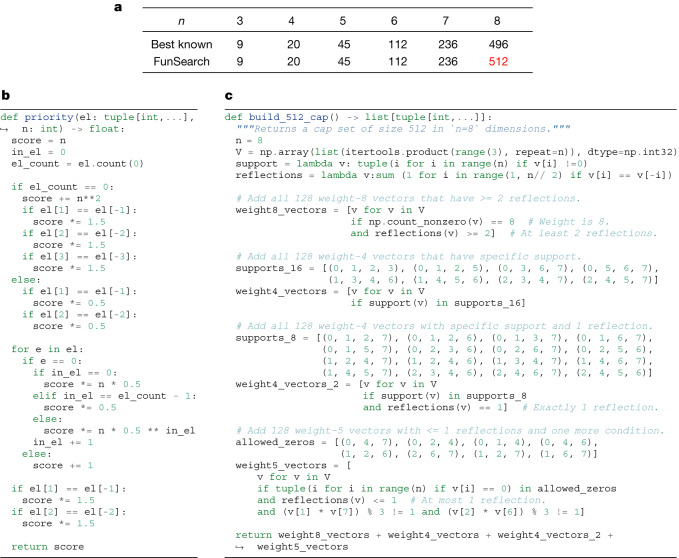
- In the cap set problem, FunSearch found a cap set of size 512 in dimension n = 8, larger than previously known; only 4 out of 140 experiments discovered it. It also discovered a program generating the set, which researchers manually simplified into an explicit construction.
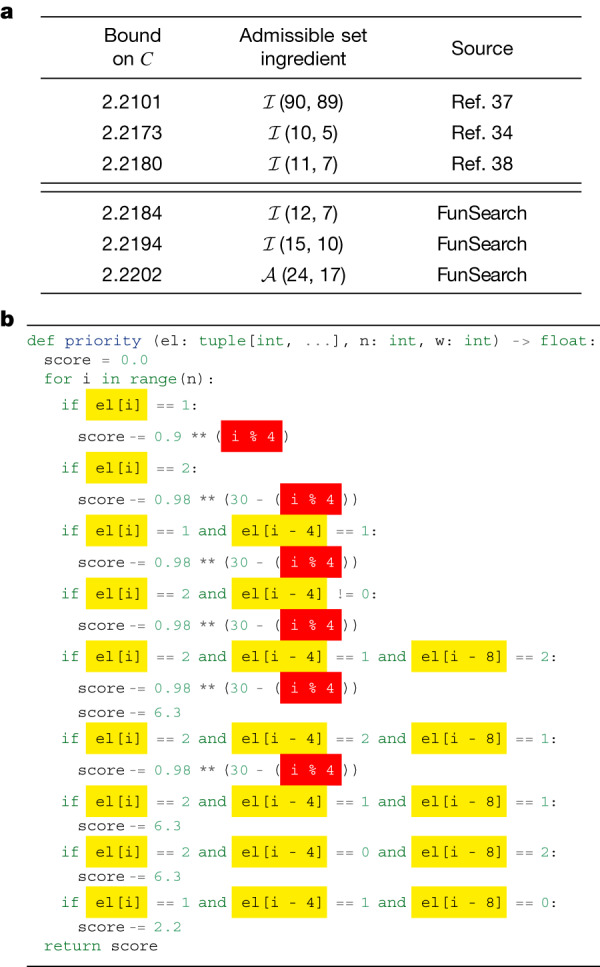
- For admissible sets, FunSearch improved the lower bound on cap set capacity from 2.2180 to 2.2184. After inspecting the discovered program and identifying a new symmetry, it found a full-size admissible set implying C ≥ 2.219486 and a partial admissible set of size 237,984 implying C ≥ 2.2202.
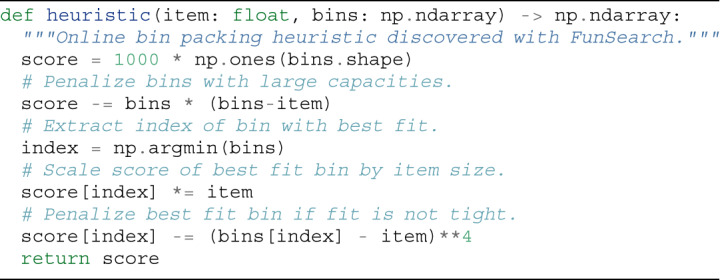
- For online bin packing, FunSearch outperformed first fit and best fit across OR1–OR4 and Weibull datasets. Reported excess-bin fractions: OR1 5.30% vs 6.42% first fit and 5.81% best fit; OR4 2.47% vs 5.23% and 4.94%; Weibull 100k 0.03% vs 4.00% and 3.79%.
- Discovered bin packing heuristics often use a strategy of assigning an item to a least-capacity bin only if the fit is very tight after placement; otherwise they place it elsewhere to avoid leaving small unusable gaps.
Methods
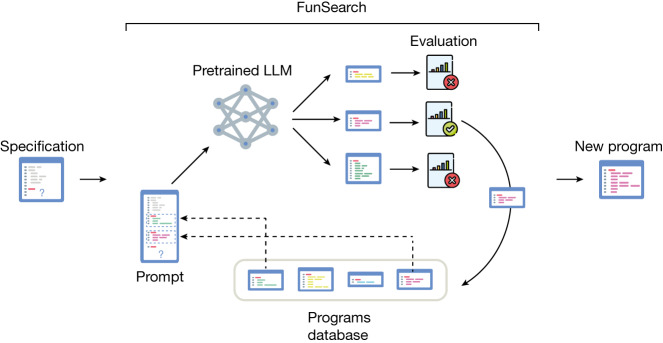
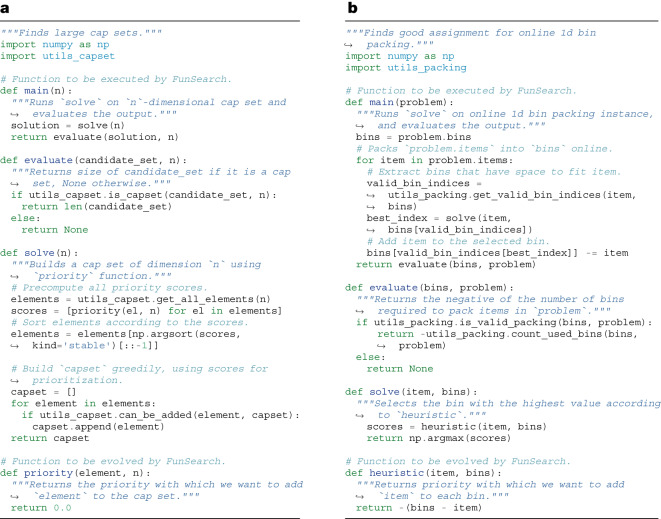
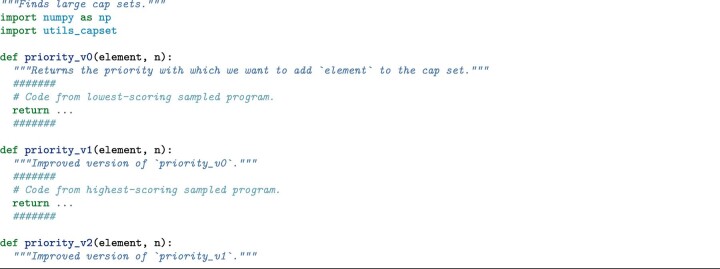
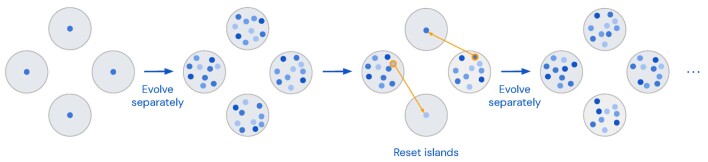
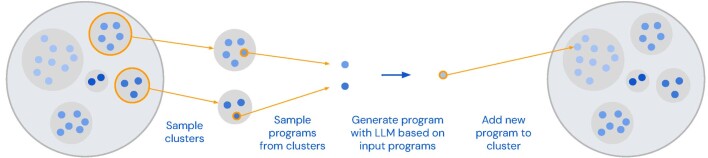
- FunSearch uses a pretrained, frozen LLM (Codey, built on PaLM2) as a mutation/crossover-like operator, paired with an evaluator that scores candidate programs. It uses best-shot prompting with k = 2 sampled programs, a program skeleton where only the critical function is evolved, an island-based evolutionary method, and asynchronous distributed workers (typically 15 samplers and 150 CPU evaluators).
- For cap sets, it evolves a priority function that iteratively grows a cap set; for admissible sets, it evolves a priority function to grow admissible sets; for online bin packing, it evolves a heuristic starting from best fit, evaluated on OR-Library OR1–OR4 and Weibull-distributed instances.
- Performance is measured as the fraction of excess bins over the L2 lower bound for bin packing; the paper reports statistical analyses in the Supplementary Information and notes robustness across runs.
Limitations
- The paper states FunSearch works best for problems with an efficient evaluator, a rich scoring feedback signal, and the ability to provide a skeleton with an isolated part to evolve. It explicitly says generating proofs for theorems falls outside this scope because it is unclear how to provide a rich enough scoring signal.
- The paper states that randomness in LLM sampling and the evolutionary procedure means repeated experiments can differ; some problems require many repetitions, such as the n = 8 cap set result, found in only 4 out of 140 experiments.
- The paper notes a performance tradeoff between LLM sample quality and inference speed, choosing a fast-inference model and using on the order of 10^6 samples; it also says results are not too sensitive to the exact LLM choice as long as it was trained on a large enough code corpus.
Model-written summary. Check it against the paper before relying on it.
Integrity signals
Registry
Cites
Statistics
Figures
Verification
Claims the paper makes
8 Valid · 1 Not valid · 11 Not checked · 67 Own results and interpretations
The cited sources support only part of this claim — read each source’s verdict below.
In the paper
“This is in contrast to traditional genetic programming that does not have this bias (and in addition requires hand-tuning the mutation operators51).”
§ Mathematical discoveries from program search with large language models > Discussion
What the sources say
- Partly supportedcites [51] 51. O’Neill M Vanneschi L Gustafson S Banzhaf W Open issues in genetic programming Genet. Program. Evolvable Mach. 2010 11 339 363 10.1007/s10710-010-9113-2 sourceExperimental — accuracy not yet measured
Section 2.6 (Generalization in GP; page unavailable) describes parsimony pressure as an added method for reducing solution complexity, which supports the narrower point that GP does not necessarily favor parsimonious solutions on its own. The passages do not establish a lack of bias toward symmetry, compare GP with FunSearch, or say that mutation operators require hand-tuning. (LLM, conf=0.73)
plain- Asserted: passes — The authors put it forward as true.
- Checkable: passes — It can be checked against evidence.
- Load-bearing: passes — The paper’s conclusions depend on it.
- Based: passes — The paper gives a reason why it holds.
- Partly supported
The cited sources support only part of this claim — read each source’s verdict below.
In the paper
“For example, the problem of generating proofs for theorems52–54 falls outside this scope, because it is unclear how to provide a rich enough scoring signal.”
§ Mathematical discoveries from program search with large language models > Discussion
What the sources say
- Supportedcites [52] 52. Polu, S. & Sutskever, I. Generative language modeling for automated theorem proving. Preprint at https://arxiv.org/abs/2009.03393 (2020). source
The citation follows “generating proofs for theorems,” identifying this paper as an example of that problem. Appendix B (p. 18) explicitly displays proofs generated by GPT-f. The statement about FunSearch’s scope and scoring signal is the citing authors’ framing, not a finding attributed to this source. (LLM, conf=0.91)
- Partly supportedcites [53] 53. Polu, S. et al. Formal mathematics statement curriculum learning. In International Conference on Learning Representations (2023). sourceExperimental — accuracy not yet measured
Our copy is squarely work on generating proofs for theorems (Abstract, p. 1: expert iteration applied to formal mathematics, state-of-the-art on miniF2F; Introduction, p. 1), so the identification part of the citing sentence holds. But the rationale attributed alongside it — that it is unclear how to provide a rich enough scoring signal — is not what this paper says: the Introduction (p. 1) states that 'formal mathematics has an automated way of determining whether a trajectory (i.e. a proof) is successful (i.e. formally correct)', and Section 4.3.2 (p. 3) builds an explicit proofsize objective/value function to guide search. The difficulties this paper actually names are the infinite action space and absence of a direct self-play setup (Introduction, p. 1) and the inability to chain more than 2-3 non-trivial reasoning steps within its compute horizon (Section 7.2 Limitations, p. 8) — not the unavailability of a scoring signal. (LLM, conf=0.72)
- Could not verifycites [54] 54. Jiang AQ THOR: wielding hammers to integrate language models and automated theorem provers Adv. Neural Info. Process. Syst. 2022 35 8360 8373 sourceExperimental — accuracy not yet measured
Our copy of Thor (Jiang et al., 2022) never addresses FunSearch or the availability of a scoring/fitness signal for evolutionary search: searches for 'FunSearch', 'scoring signal', 'evolutionary search program synthesis', and 'sparse reward / automatic evaluation' returned only Thor's own proof-search machinery (4.1 Experimental Setup, p. 6 — best-first search ordered by accumulated log likelihoods, termination conditions) and its premise-selection scope (Abstract p. 1; 6 Discussion p. 9, which limits Thor to hammer-based premise selection and Isabelle only). Nothing in the paper states or implies that generating theorem proofs lacks a rich enough scoring signal; conversely, it reports concrete proof-success rates (39%→57% on PISA, 29.9% on MiniF2F), so no contrary statement is made either. The cited point therefore cannot be checked against this source. (LLM, conf=0.72)
plain- Asserted: passes — The authors put it forward as true.
- Checkable: passes — It can be checked against evidence.
- Load-bearing: unclear — It is unclear whether the paper’s conclusions depend on it.
- Based: passes — The paper gives a reason why it holds.
- Supported
The sources with a verdict support this claim; the rest weren’t checked yet, have no full text we could read, or their verdicts aren’t rated yet.
In the paper
“However, using an LLM mitigates several issues in traditional genetic programming51, as shown in Supplementary Information Appendix A and discussed in ref. 3.”
§ Mathematical discoveries from program search with large language models > Methods > Related work
What the sources say
- Supportedcites [51] 51. O’Neill M Vanneschi L Gustafson S Banzhaf W Open issues in genetic programming Genet. Program. Evolvable Mach. 2010 11 339 363 10.1007/s10710-010-9113-2 source
Section 2, “Open Issues,” explicitly outlines significant issues in genetic programming and discusses their limitations. The citation supports the existence of those issues; the citing sentence points to its own supplementary appendix and another reference for the claim that an LLM mitigates them. (LLM, conf=0.88)
- Not checked — no full text of the sourcecites [3] 3. Lehman, J. et al. in Handbook of Evolutionary Machine Learning (eds Banzhaf, W. et al.) 331–366 (Springer, 2023). source
plainstates a cause- Asserted: passes — The authors put it forward as true.
- Checkable: passes — It can be checked against evidence.
- Load-bearing: passes — The paper’s conclusions depend on it.
- Based: passes — The paper gives a reason why it holds.
- Supported
A result the paper reports from its own data — it cites no other source for it, so there is none to check. The quote shows it is in the paper.
In the paper
“We demonstrate the effectiveness of this approach to surpass the best-known results in important problems, pushing the boundary of existing LLM-based approaches3.”
§ Mathematical discoveries from program search with large language models > Abstract
boostedstates a cause- Asserted: passes — The authors put it forward as true.
- Checkable: passes — It can be checked against evidence.
- Load-bearing: passes — The paper’s conclusions depend on it.
- Based: passes — The paper gives a reason why it holds.
A result the paper reports from its own data — it cites no other source for it, so there is none to check. The quote shows it is in the paper.
In the paper
“We showcase the generality of FunSearch by applying it to an algorithmic problem, online bin packing, finding new heuristics that improve on widely used baselines.”
§ Mathematical discoveries from program search with large language models > Abstract
plainstates a cause- Asserted: passes — The authors put it forward as true.
- Checkable: passes — It can be checked against evidence.
- Load-bearing: passes — The paper’s conclusions depend on it.
- Based: passes — The paper gives a reason why it holds.
41 more claims
Create a free account to see all 87 claims and to verify the 2 references still open.
- Probably not a substantial claim. 18
- It may state two separate claims as one. 27
- The quote only partly states this claim. 1
Claims other papers make about this one
Each is checked against this paper’s own text: does it say what the citing paper says it does?
The source backs part of the claim, not all of it — or backs it for a different population, condition or comparison.
In the citing paper
“Furthermore, AlphaEvolve discovered novel, provably correct algorithms that surpass state-of-the-art solutions on a spectrum of problems in mathematics and computer science, significantly expanding the scope of prior automated discovery methods (Romera-Paredes et al., 2023).”
From AlphaEvolve: A coding agent for scientific and algorithmic discovery (2025) · cites this paper as Romera-Paredes et al., 2023
Experimental — accuracy not yet measuredThe source backs part of the claim, not all of it — or backs it for a different population, condition or comparison.
In the citing paper
“Applying AlphaEvolve in different ways comes with different biases (for example, finding constructive functions may favor discovering highly symmetric objects [83]) and thus can suit different problems.”
From AlphaEvolve: A coding agent for scientific and algorithmic discovery (2025) · cites this paper as [83]
Experimental — accuracy not yet measuredThe source backs part of the claim, not all of it — or backs it for a different population, condition or comparison.
In the citing paper
“Large language models are most reliable when they are not used as final authorities, but as proposal mechanisms inside systems that can check their outputs.”
From Executable World Models for ARC-AGI-3 in the Era of Coding Agents (2026) · cites this paper as [10]
Experimental — accuracy not yet measuredThe cited source says what the claim attributes to it.
In the citing paper
“Similar architectures have already shown some success [35]”
From On the Self-Verification Limitations of Large Language Models on Reasoning and Planning Tasks (2024) · cites this paper as [35]
The cited source says what the claim attributes to it.
In the citing paper
“In the latter case, discovering the algorithm is only an instrumental goal, but it turns out to be a surprisingly effective strategy compared to searching for the solution directly [83].”
From AlphaEvolve: A coding agent for scientific and algorithmic discovery (2025) · cites this paper as [83]
4 more claims about this paper
Create a free account to see every claim other papers make about this one.
Self-check
Percentages, sums and reported differences re-computed from the paper’s own numbers.
Self-check results appear here once an independent check has confirmed them.
Cited works that were retracted
Works this paper cites that were later retracted, from the retraction notices publishers deposit. Major when the notice came out before this paper was published.
Rated major: it would touch a result — a value a result rests on, reported and recomputed p-values on opposite sides of the significance level, two passages that conflict with no sign which is right, or a cited work retracted before this paper was published.
In the paper
“Yang, F. et al. Launchpad: a programming model for distributed machine learning research. Preprint at https://arxiv.org/abs/2106.04516 (2021).”
Cited work 10.1155/2021/6593438 · retracted 2023-08-02 · notice 10.1155/2023/9790230 · this paper published 2023-12-14
Citations
Cites
1 retracted
Research on Students’ Adaptive Learning System Based on Deep Learning Model
Yang, X., Zhou, Z., & Xiao, Y. (2021) · Scientific Programming · doi:10.1155/2021/6593438 · Cited by 16
RetractedGenetic Algorithms and Machine Learning
Goldberg, D. E., & Holland, J. H. (1988) · Machine Learning · doi:10.1023/a:1022602019183 · Cited by 3,193
Distilling Free-Form Natural Laws from Experimental Data
Schmidt, M., & Lipson, H. (2009) · Science · doi:10.1126/science.1165893 · Cited by 2,890 · cited 1×
“Genetic programming is a subfield of computer science concerned with automatically generating or discovering computer programs using evolutionary methods 15,72,73 and is used for symbolic regression applications 74,75 and discovery of optimization algorithms 76 among others.”
MethodGenerative Agents: Interactive Simulacra of Human Behavior
Park, J. S., O'Brien, J., Cai, C. J., Morris, M. R., Liang, P., & Bernstein, M. S. (2023) · Proceedings of the 36th Annual ACM Symposium on User Interface Software and Technology · doi:10.1145/3586183.3606763 · Cited by 2,187
Generative Agents: Interactive Simulacra of Human Behavior
Park, J. S., O'Brien, J. C., Cai, C. J., Morris, M. R., Liang, P., & Bernstein, M. S. (2023) · arXiv · doi:10.48550/arxiv.2304.03442 · Cited by 2,173
Genetic programming II: Automatic discovery of reusable programs
(1995) · Computers & Mathematics with Applications · doi:10.1016/0898-1221(95)90099-3 · Cited by 1,901
OR-Library: Distributing Test Problems by Electronic Mail
Beasley, J. E. (1990) · Journal of the Operational Research Society · doi:10.1057/jors.1990.166 · Cited by 1,899
Genetic programming as a means for programming computers by natural selection
Koza, J. (1994) · Statistics and Computing · doi:10.1007/bf00175355 · Cited by 1,685 · cited 3×
“To surpass the ‘nominal’ capabilities of LLMs, recent studies 3 have combined them with evolutionary algorithms 14,15 , leading to important improvements on diverse synthetic problems 16 , searching for neural network architectures 17–19 and solving puzzles 20 .”
BackgroundMethodEvaluating Large Language Models Trained on Code
Chen, M., Tworek, J., Jun, H., Yuan, Q., Pinto, H. P. D. O., Kaplan, J., Edwards, H., Burda, Y., Joseph, N., Brockman, G., et al. (2021) · arXiv · doi:10.48550/arxiv.2107.03374 · Cited by 1,436
An Introduction to Kolmogorov Complexity and Its Applications
Li, M., & Vitányi, P. (2008) · Texts in Computer Science · doi:10.1007/978-0-387-49820-1 · Cited by 1,424
Research works printed but not linked: 10
- 27. Tanese, R. Distributed Genetic Algorithms for Function Optimization. PhD thesis, Univ. Michigan (1989).
- 28. Cantú-Paz E A survey of parallel genetic algorithms Calculateurs Paralleles, Reseaux et Systemes Repartis 1998 10 141 171
- 35. Hill R On the largest size of cap in S5,3 Rend Lincei. Sci. Fis. Mat. Nat. 1973 54 378 384
- 59. de la Maza, M. An analysis of selection procedures with particular attention paid to proportional and Boltzmann selection. In Proc. Fifth International Conference on Genetic Algorithms (Morgan Kaufmann, 1993).
- 66. Yao, S. et al. ReAct: dynergizing reasoning and acting in language models. In Proc.International Conference on Learning Representations (2023).
- 67. Zelikman E Wu Y Mu J Goodman N Star: bootstrapping reasoning with reasoning Adv. Neural Info. Process. Syst. 2022 35 15476 15488
- 72. Banzhaf, W., Nordin, P., Keller, R. E. & Francone, F. D. Genetic Programming: An Introduction: On The Automatic Evolution of Computer Programs and its Applications (Morgan Kaufmann, 1998).
- 73. Langdon, W. B. & Poli, R. Foundations of Genetic Programming (Springer Science & Business Media, 2013).
- 79. Burke, E. et al. in Handbook of Metaheuristics (eds Glover, F. & Kochenberger, G. A.) 457–474 (Springer, 2003).
- 80. Ross, P. in Search Methodologies: Introductory Tutorials in Optimization and Decision Support Techniques (eds Burke, E. K. & Kendall, G.) 529–556 (Springer, 2005).
Cited by
Darwin Godel Machine: Open-Ended Evolution of Self-Improving Agents
Zhang, J., Hu, S., Lu, C., Lange, R., & Clune, J. (2025) · arXiv · doi:10.48550/arxiv.2505.22954 · Cited by 344
Human-AI agency in the age of generative AI
Krakowski, S. (2025) · Information and Organization · doi:10.1016/j.infoandorg.2025.100560 · Cited by 162
Bewersdorff, A., Hartmann, C., Hornberger, M., Seßler, K., Bannert, M., Kasneci, E., Kasneci, G., Zhai, X., & Nerdel, C. (2025) · Learning and Individual Differences · doi:10.1016/j.lindif.2024.102601 · Cited by 148
Evolutionary Computation in the Era of Large Language Model: Survey and Roadmap
Wu, X., Wu, S.-H., Wu, J., Feng, L., & Tan, K. C. (2024) · IEEE Transactions on Evolutionary Computation · doi:10.1109/tevc.2024.3506731 · Cited by 333
“…data cleaning methods [53], reward function design in reinforcement learning [52], [114], [115], automated AI accelerator design [54], mathematical and scientific discoveries [21], [117], decision-based adversarial attacks [116], and criticality evaluation of nodes in complex networks [118].”
InfluentialExtending Minds with Generative AI
Clark, A. (2025) · Nature Communications · doi:10.1038/s41467-025-59906-9 · Cited by 174
Materials science in the era of large language models: a perspective
Lei, G., Docherty, R., & Cooper, S. J. (2024) · Digital Discovery · doi:10.1039/d4dd00074a · Cited by 99
“15 Whilst they perform best in work ows with a strong, LLM-independent feedback signal 16 they are capable of automating processes in ambiguous scenarios through trial-and-error.”
LLaMEA: A Large Language Model Evolutionary Algorithm for Automatically Generating Metaheuristics
van Stein, B., & Bäck, T. (2024) · IEEE Transactions on Evolutionary Computation · doi:10.1109/tevc.2024.3497793 · Cited by 289
“Code Generation: The recently proposed FunSearch approach (searching in the function space) [34] closes the loop and combines the LLM with a systematic evaluation of the quality of the generated programs, resulting in new solution algorithms for combinatorial optimization problems (the cap-set…”
Zhang, C., Xu, Q., Yu, Y., Zhou, G., Zeng, K., Chang, F., & Ding, K. (2024) · Robotics and Computer-Integrated Manufacturing · doi:10.1016/j.rcim.2024.102883 · Cited by 124
Language Model Crossover: Variation through Few-Shot Prompting
Meyerson, E., Nelson, M. J., Bradley, H., Gaier, A., Moradi, A., Hoover, A. K., & Lehman, J. (2024) · ACM Transactions on Evolutionary Learning and Optimization · doi:10.1145/3694791 · Cited by 75
Agentic Large Language Models, a Survey
Plaat, A., Van Duijn, M., Van Stein, N., Preuss, M., Van der Putten, P., & Batenburg, K. J. (2025) · Journal of Artificial Intelligence Research · doi:10.1613/jair.1.18675 · Cited by 75
Language model crossover: Variation through few-shot prompting
Meyerson, E., Nelson, M. J., Bradley, H., Gaier, A., Moradi, A., Hoover, A. K., & Lehman, J. (2023) · arXiv · doi:10.48550/arxiv.2302.12170 · Cited by 75
Building machines that learn and think with people
Collins, K. M., Sucholutsky, I., Bhatt, U., Chandra, K., Wong, L., Lee, M., Zhang, C. E., Zhi-Xuan, T., Ho, M., Mansinghka, V., et al. (2024) · Nature Human Behaviour · doi:10.1038/s41562-024-01991-9 · Cited by 73
MRNDR: Multihead Attention-Based Recommendation Network for Drug Repurposing
Feng, X., Ma, Z., Yu, C., & Xin, R. (2024) · Journal of Chemical Information and Modeling · doi:10.1021/acs.jcim.3c01726 · Cited by 68
Advancing mathematics research with AI-driven formal proof search
Tsoukalas, G., Kovsharov, A., Shirobokov, S., Surina, A., Firsching, M., Bérczi, G., Ruiz, F. J. R., Suggala, A., Wagner, A. Z., Wieser, E., et al. (2026) · Science · doi:10.1126/science.aej2213 · Cited by 62
Self-citationScaling hermeneutics: a guide to qualitative coding with LLMs for reflexive content analysis
Dunivin, Z. O. (2025) · EPJ Data Science · doi:10.1140/epjds/s13688-025-00548-8 · Cited by 136
AutoTRIZ: Automating engineering innovation with TRIZ and large language models
Jiang, S., Li, W., Qian, Y., Zhang, Y., & Luo, J. (2025) · Advanced Engineering Informatics · doi:10.1016/j.aei.2025.103312 · Cited by 114
“These capabilities have been applied across various domains, including medicine [17], chemistry [18], mathematics [19], manufacturing [20], robotics [21], and engineering management [22].”
Toward large reasoning models: A survey of reinforced reasoning with large language models
Xu, F., Hao, Q., Shao, C., Zong, Z., Li, Y., Wang, J., Zhang, Y., Wang, J., Lan, X., Gong, J., et al. (2025) · Patterns · doi:10.1016/j.patter.2025.101370 · Cited by 656
“123 Similarly, symbolic regression research treats equations as dynamic constructs, iteratively generating, evaluating, and optimizing mathematical expressions.”
Ahn, S. (2024) · The Korean Journal of Physiology & Pharmacology · doi:10.4196/kjpp.2024.28.5.393 · Cited by 51
“In the field of mathematics, an evolutionary procedure called FunSearch has been developed, which pairs a pretrained LLM with a systematic evaluator to surpass best-known results in complex problems [46].”
MethodA prompt-engineered large language model, deep learning workflow for materials classification
Liu, S., Wen, T., Pattamatta, A. S. L. S., & Srolovitz, D. J. (2024) · Materials Today · doi:10.1016/j.mattod.2024.08.028 · Cited by 67
“The advancement of LLMs, particularly with the advent of ChatGPT, has sparked a surge of interest in distilling knowl-∗ edge from these models through prompt engineering [19– 21].”
BackgroundArtificial intelligence in paleontology
Yu, C., Qin, F., Watanabe, A., Yao, W., Li, Y., Qin, Z., Liu, Y., Wang, H., Jiangzuo, Q., Hsiang, A. Y., et al. (2024) · Earth-Science Reviews · doi:10.1016/j.earscirev.2024.104765 · Cited by 55
Large language models as surrogate models in evolutionary algorithms: A preliminary study
Hao, H., Zhang, X., & Zhou, A. (2024) · Swarm and Evolutionary Computation · doi:10.1016/j.swevo.2024.101741 · Cited by 64
Large language model-based evolutionary optimizer: Reasoning with elitism
Brahmachary, S., Joshi, S. M., Panda, A., Koneripalli, K., Sagotra, A. K., Patel, H., Sharma, A., Jagtap, A. D., & Kalyanaraman, K. (2024) · Neurocomputing · doi:10.1016/j.neucom.2024.129272 · Cited by 95
Lakatos, R., Pollner, P., Hajdú, A., & Joó, T. (2025) · Machine Learning and Knowledge Extraction · doi:10.3390/make7010015 · Cited by 80
Urban planning in the era of large language models
Zheng, Y., Xu, F., Lin, Y., Santi, P., Ratti, C., Wang, Q., & Li, Y. (2025) · Nature Computational Science · doi:10.1038/s43588-025-00846-1 · Cited by 88
Nature-Inspired Intelligent Computing: A Comprehensive Survey
Jiao, L., Zhao, J., Wang, C., Liu, X., Liu, F., Li, L., Shang, R., Li, Y., Ma, W., & Yang, S. (2024) · Research · doi:10.34133/research.0442 · Cited by 51
Enhancing LLMs for Power System Simulations: A Feedback-Driven Multi-Agent Framework
Jia, M., Cui, Z., & Hug, G. (2025) · IEEE Transactions on Smart Grid · doi:10.1109/tsg.2025.3589114 · Cited by 42
“Related advances span the fields of mathematics, chemistry, and clinical research, including mathematical algorithm evolution [2], geometry theorem proving [3], chemical experiment design and execution [1], as well as the development and validation of machine learning approaches for clinical studies…”
Potential to transform words to watts with large language models in battery research
Zhao, S., Chen, S., Zhou, J., Li, C., Tang, T., Harris, S. J., Liu, Y., Wan, J., & Li, X. (2024) · Cell Reports Physical Science · doi:10.1016/j.xcrp.2024.101844 · Cited by 53
A survey on deep learning-based algorithms for the traveling salesman problem
Sui, J., Ding, S., Huang, X., Yu, Y., Liu, R., Xia, B., Ding, Z., Xu, L., Zhang, H., Yu, C., et al. (2024) · Frontiers of Computer Science · doi:10.1007/s11704-024-40490-y · Cited by 54
Baek, J., Jauhar, S. K., Cucerzan, S., & Hwang, S. J. (2025) · Proceedings of the 2025 Conference of the Nations of the Americas Chapter of the Association for Computational Linguistics: Human Language Technologies (Volume 1: Long Papers) · doi:10.18653/v1/2025.naacl-long.342 · Cited by 46
Autonomous LLM-Driven Research — from Data to Human-Verifiable Research Papers
Ifargan, T., Hafner, L., Kern, M., Alcalay, O., & Kishony, R. (2025) · NEJM AI · doi:10.1056/aioa2400555 · Cited by 34
Lu, S., Chen, Y., Chen, Y., Li, P., Sun, J., Zheng, C., Zou, Y., Liang, B., Li, M., Jin, Q., et al. (2025) · Nature Communications · doi:10.1038/s41467-025-57427-z · Cited by 50
“…of natural language processing, large-scale language models have used self-supervised learning methods 8,13 – 15 to learn the intrinsic structural of language from large-scale text corpora, enabling large-scale language models to perform well in multiple natural language processing tasks 16 – 18 .”
Large language models for automatic equation discovery of nonlinear dynamics
Du, M., Chen, Y., Wang, Z., Nie, L., & Zhang, D. (2024) · Physics of Fluids · doi:10.1063/5.0224297 · Cited by 89
Review of Generative AI Methods in Cybersecurity
Yigit, Y., Buchanan, W. J., Tehrani, M. G., & Maglaras, L. (2024) · arXiv · doi:10.48550/arxiv.2403.08701 · Cited by 28
Zhou, J., Yi, J., Yang, Z., Pu, H., Li, X., Luo, J., & Gao, L. (2024) · Swarm and Evolutionary Computation · doi:10.1016/j.swevo.2024.101780 · Cited by 36
When Large Language Models Meet Evolutionary Algorithms: Potential Enhancements and Challenges
Wang, C., Zhao, J., Jiao, L., Li, L., Liu, F., & Yang, S. (2025) · Research · doi:10.34133/research.0646 · Cited by 77
“…99 ], game design [ 100 , 101 ], materials science [ 102 ], image generation [ 41 ], algorithm design [ 103 ] Code generation [ 32 , 33 ], data management [ 104 ], fuzzing [ 105 ] [ 9 ] introduced a program search method for mathematical reasoning, where LLMs create multiple programs from parents.”
Evaluating and enhancing spatial cognition abilities of large language models
Yang, A., Fu, C., Jia, Q., Dong, W., Ma, M., Chen, H., Yang, F., & Wu, H. (2025) · International Journal of Geographical Information Science · doi:10.1080/13658816.2025.2490701 · Cited by 36
A Systematic Literature Review of Hallucinations in Large Language Models
Woesle, C., Fischer-Brandies, L., & Buettner, R. (2025) · IEEE Access · doi:10.1109/access.2025.3601206 · Cited by 40
RePower: An LLM-driven autonomous platform for power system data-guided research
Liu, Y., Jia, M., Zhang, Y., Wang, J., He, G., Zhong, S., & Dang, Z. (2025) · Patterns · doi:10.1016/j.patter.2025.101211 · Cited by 24
“In the field of mathematical computation, scholars have proposed Funsearch, 14 an intelligent agent based on feedback-driven autonomous search heuristics, which is capable of finding superior solutions to combinatorial mathematics problems compared to existing ones.”
Toward Automated Algorithm Design: A Survey and Practical Guide to Meta-Black-Box-Optimization
Ma, Z., Guo, H., Gong, Y., Zhang, J., & Tan, K. C. (2025) · IEEE Transactions on Evolutionary Computation · doi:10.1109/tevc.2025.3568053 · Cited by 104
“Concerning the research focus on the four learning paradigms, we observed that MetaBBO-RL consistently attracts interest from researchers, whereas MetaBBO-ICL is rapidly gaining traction with the advent of LLMs.”
Accelerating process control and optimization via machine learning: a review
Mitrai, I., & Daoutidis, P. (2025) · Reviews in Chemical Engineering · doi:10.1515/revce-2024-0060 · Cited by 28
Streamlining evidence based clinical recommendations with large language models
Li, D., Jiang, N., Huang, K., Tu, R., Ouyang, S., Yu, H., Lin, Q., Chen, Y., Zhou, T., Tong, D., et al. (2025) · npj Digital Medicine · doi:10.1038/s41746-025-02273-y · Cited by 29
“Forinstance,inQuestion1,Quickerrecommendedcombinationtherapy basedsolelyonclinicalevidence,whereastheguideline — while acknowl-edging the superior ef fi cacy of combination therapy — conditionally preferred methotrexate (MTX) monotherapy due to cost and practical considerations (see Supplementary Note 4 for more detail…”
InfluentialIntegration of cognitive tasks into artificial general intelligence test for large models
Qu, Y., Wei, C., Du, P., Che, W., Zhang, C., Ouyang, W., Bian, Y., Xu, F., Hu, B., Du, K., et al. (2024) · iScience · doi:10.1016/j.isci.2024.109550 · Cited by 25
“LLMs have empowered various domains, including mathematics 2 and medicine.”
BackgroundArtificial intelligence as a catalyst for combustion science and engineering
Ihme, M., & Chung, W. T. (2024) · Proceedings of the Combustion Institute · doi:10.1016/j.proci.2024.105730 · Cited by 29
Chen, J., Chen, Y., Pham, D. T., Song, Y., Wu, J. D., Xing, L., & Chen, Y. (2025) · Engineering · doi:10.1016/j.eng.2025.10.027 · Cited by 33
Kaiser, J., Lauscher, A., & Eichler, A. (2025) · Science Advances · doi:10.1126/sciadv.adr4173 · Cited by 36
Digital-Twin-6G Empowered Future Smart Grid Applications
Kharbouch, A., Aghdam, F. H., Gholipoor, N., & Rasti, M. (2025) · IEEE Wireless Communications · doi:10.1109/mwc.001.2400466 · Cited by 20
“For example, FunSearch recently contributed innovative solutions to the cap set problem [13].”
Linguistic Intelligence in Large Language Models for Telecommunications
Ahmed, T., Piovesan, N., Domenico, A. D., & Choudhury, S. (2024) · IEEE International Conference on Communications workshops · doi:10.1109/iccworkshops59551.2024.10615609 · Cited by 24
“Language models have demonstrated state-of-the-art results on various NLP tasks and exhibited significant algorithmic, reasoning, and analytical skills with minimal or no domain-specific adjustments [3].”
BackgroundBlenderAlchemy: Editing 3D Graphics with Vision-Language Models
Huang, I., Yang, G., & Guibas, L. J. (2024) · Lecture notes in computer science · doi:10.1007/978-3-031-73024-5_18 · Cited by 83
Huang, Y., Zhang, W., Feng, L., Wu, X., & Tan, K. C. (2025) · doi:10.1109/mcii64973.2025.11032980 · Cited by 36
“Moreover, Funsearch [14] employed LLMs to discover new mathematical functions that surpass human performance.”
International AI Safety Report
Bengio, Y., Mindermann, S., Privitera, D., Besiroglu, T., Bommasani, R., Casper, S., Choi, Y., Fox, P., Garfinkel, B., Goldfarb, D., et al. (2025) · arXiv · doi:10.48550/arxiv.2501.17805 · Cited by 16
Li, R., Wang, L., Sang, H., Yao, L., & Pan, L. (2025) · IEEE Transactions on Evolutionary Computation · doi:10.1109/tevc.2025.3556186 · Cited by 60
“4) LLM as a Designer: In this capacity, LLMs are employed to generate heuristic rules [28], write reward function code for RL [28], formulate mathematical functions [30], and design mutation and selection strategies for GAs [31].”
Huang, J., Teng, Y., Liu, Q., Gao, L., Li, X., Zhang, C., & Xu, G. (2025) · npj Advanced Manufacturing · doi:10.1038/s44334-025-00061-w · Cited by 22
“Building on recent pioneering work, such as the early 2024 publication in Nature by the Google team, where LLMs combined with evolutionary algorithms achieved a new benchmark in combinatorial optimization 41 , this research explores the transformative potential of LLMs within the domain of FMS.”
Quantum many-body physics calculations with large language models
Pan, H., Mudur, N., Taranto, W., Tikhanovskaya, M., Venugopalan, S., Bahri, Y., Brenner, M. P., & Kim, E.-A. (2025) · Communications Physics · doi:10.1038/s42005-025-01956-y · Cited by 15
“The unique challenge of theoretical physics is that the domain requires inherently multi-faceted reasoning using language with specialized vocabulary, mathematics using symbols carrying specialized meanings, and code for numerical solutions.”
AlphaEvolve: A coding agent for scientific and algorithmic discovery
Novikov, A., Vũ, N., Eisenberger, M., Dupont, E., Huang, P.-S., Wagner, A. Z., Shirobokov, S., Kozlovskii, B., Ruiz, F. J. R., Mehrabian, A., et al. (2025) · arXiv · doi:10.48550/arxiv.2506.13131 · Cited by 15
“In AlphaEvolve , the evolutionary database implements an algorithm that is inspired by a combination of the MAP elites algorithm [74] and island-based population models [83, 97].”
InfluentialSelf-citationUnderwater Mediterranean image analysis based on the compute continuum paradigm
Ferrari, M., D’Agostino, D., Aguzzi, J., & Marini, S. (2024) · Future Generation Computer Systems · doi:10.1016/j.future.2024.107481 · Cited by 15
Yu, W., He, H., Song, S., Zhang, J., Dai, L., Zheng, L., & Letaief, K. B. (2025) · Engineering · doi:10.1016/j.eng.2025.07.032 · Cited by 28
AI-driven research in pure mathematics and theoretical physics
He, Y. (2024) · Nature Reviews Physics · doi:10.1038/s42254-024-00740-1 · Cited by 46
“From the Principia Mathematica to the advancement of computer science, there has been a tradition of viewing mathematics as a language 105 .”
Cai, T., Merz, G. W., Charton, F., Nolte, N. S., Wilhelm, M., Cranmer, K. S., & Dixon, L. J. (2024) · Machine Learning Science and Technology · doi:10.1088/2632-2153/ad743e · Cited by 45
“It has mainly been applied so far to a simpler relative of QCD, called planar N = 4 super-Yang–Mills theory (SYM).”
Zhang, R., Liu, F., Lin, X., Wang, Z., Lu, Z., & Zhang, Q. (2024) · Lecture notes in computer science · doi:10.1007/978-3-031-70068-2_12 · Cited by 68
Barbarroxa, R., Gomes, L., & Vale, Z. (2024) · Lecture notes in computer science · doi:10.1007/978-3-031-70415-4_4 · Cited by 19
Executable World Models for ARC-AGI-3 in the Era of Coding Agents
Rodionov, S. (2026) · arXiv · doi:10.48550/arxiv.2605.05138 · Cited by 14
Huang, J., Li, X., Li, X., Gao, L., & Teng, Y. (2026) · IEEE Transactions on Fuzzy Systems · doi:10.1109/tfuzz.2025.3650586 · Cited by 57
“Therefore, this article proposes a novel LLM-based evolutionary framework for automatic HDRs design in DFJSSP, introducing an innovative population self-evolutionary (SeEvo) method.”
InfluentialReview on Application and Challenges of Large Language Models in Power Grids
Zhang, L., Ji, W., Zhao, Y., Huang, D., & Qian, B. (2025) · IEEE Access · doi:10.1109/access.2025.3580439 · Cited by 19
AI-enabled scientific revolution in the age of generative AI: second NSF workshop report
Karpatne, A., Deshwal, A., Jia, X., Ding, W. Y., Steinbach, M. S., Zhang, A., & Kumar, V. (2025) · npj Artificial Intelligence · doi:10.1038/s44387-025-00018-6 · Cited by 33
“For instance, they have recently been used to generate heuristic functions for solving problems in combinatorics 37 .”
Evaluation of Large Language Models as Solution Generators in Complex Optimization
Huang, B., Wu, X., Zhou, Y. F., Wu, J., Feng, L., Cheng, R., & Tan, K. C. (2025) · IEEE Computational Intelligence Magazine · doi:10.1109/mci.2025.3580520 · Cited by 64
“More speci fi cally, in the fi eld of optimization, the FunSearch approach has made mathematical discoveries by leveraging LLMs to generate code [39].”
Collaborative truck–robot deliveries: challenges, models, and methods
Yu, S., & Puchinger, J. (2024) · Annals of Operations Research · doi:10.1007/s10479-024-06127-w · Cited by 26
Large Language Model Agents for Radio Map Generation and Wireless Network Planning
Quan, H., Ni, W., Zhang, T., Ye, X., Xie, Z., Wang, S., Liu, Y., & Song, H. (2025) · IEEE Networking Letters · doi:10.1109/lnet.2025.3539829 · Cited by 33
“Most recently, the advent of large language model (LLM) has opened new possibilities across various domains, including natural language processing, medicine, and mathematical discoveries [8], [9], [10].”
Zeng, Y., Lou, P., Hu, J., Fan, C., Liu, Q., & Hu, J. (2025) · Machines · doi:10.3390/machines13050361 · Cited by 18
Lessons from complex systems science for AI governance
Kolt, N., Shur‐Ofry, M., & Cohen, R. (2025) · Patterns · doi:10.1016/j.patter.2025.101341 · Cited by 46
Large language model agent as a mechanical designer
Jadhav, Y., & Farimani, A. B. (2026) · Journal of Engineering Design · doi:10.1080/09544828.2026.2624356 · Cited by 32
Large language models help computer programs to evolve
Mouret, J.-B. (2024) · Nature · doi:10.1038/d41586-023-03998-0 · Cited by 14
Xie, L., Jin, Y.-D., Xu, L., Chang, S., & Xu, X. (2025) · Journal of Chemical Theory and Computation · doi:10.1021/acs.jctc.5c00605 · Cited by 17
Evolutionary attraction–repulsion algorithm embedded with LLM for UAV task allocation
Wu, B., & Xiao, R. (2025) · Advanced Engineering Informatics · doi:10.1016/j.aei.2025.103428 · Cited by 12
Large Language Models for Combinatorial Optimization: A Systematic Review
Ros, F. D., Soprano, M., Gaspero, L. D., & Roitero, K. (2026) · ACM Computing Surveys · doi:10.1145/3801961 · Cited by 69
AutoTurb: Using large language models for automatic algebraic turbulence model discovery
Zhang, Y., Zheng, K., Liu, F., Zhang, Q., & Wang, Z. (2025) · Physics of Fluids · doi:10.1063/5.0247759 · Cited by 24
Zhao, J., Wen, T., & Cheong, K. H. (2025) · IEEE Transactions on Network Science and Engineering · doi:10.1109/tnse.2025.3592367 · Cited by 21
“In this section, we will review the existing literature on the synergy of LLMs and optimization, and the application of evolutionary optimization on network-structured problems.”
Automated quantum software engineering
Sarkar, A. (2024) · Automated Software Engineering · doi:10.1007/s10515-024-00436-x · Cited by 26
“More recently, the proliferation of large language models (LLM) for coding is considerably boosting the usability (Cai et al. 2023; Romera-Paredes et al. 2023) and efficiency of software engineering.”
AITurk: Using ChatGPT for Social Science ResearchPreprint
Qin, X., Huang, M., & Ding, J. (2024) · SSRN Electronic Journal · doi:10.2139/ssrn.4922861 · Cited by 25
A Survey on Truth Discovery: Concepts, Methods, Applications, and Opportunities
Wang, S., Zhang, H., Sheng, Q. Z., Li, X., Sun, Z., Cai, T., Zhang, W. E., Yang, J., & Gao, Q. (2025) · IEEE Transactions on Big Data · doi:10.1109/tbdata.2024.3423677 · Cited by 11
“Large-scale knowledge base is crucial especially when the largelanguagemodelshavebeenahotissuecurrently[172]since theyenablethedevelopmentofmoresophisticatedAImodels andserveas“golden”benchmarksforevaluatingtheirperfor-mance[173],[174],[175].”
LLMs Can't Plan, But Can Help Planning in LLM-Modulo Frameworks
Kambhampati, S., Valmeekam, K., Guan, L., Verma, M., Stechly, K., Bhambri, S., Saldyt, L., & Murthy, A. (2024) · arXiv · doi:10.48550/arxiv.2402.01817 · Cited by 237
Barman, K. G., Caron, S., Sullivan, E., de Regt, H. W., de Austri, R. R., Boon, M., Färber, M., Fröse, S., Golling, T., Lopez, L. G., et al. (2025) · The European Physical Journal C · doi:10.1140/epjc/s10052-025-14707-8 · Cited by 47
“…including the design and execution of autonomous experiments, agent-based AI labs, applications to symbolic tasks, and the development of collaborative AI tools known as CoScientists, and the enhancement of capabilities in programming and mathematical proof generation [22, 23, 24, 25, 26, 27, 28].”
Jin, W., Wang, J., Gao, Y., Shi, B., Wang, N., Zhao, B., & Yang, G. (2025) · Computational Intelligence · doi:10.1111/coin.70129 · Cited by 11
Yao, J., & Han, T. (2025) · Renewable and Sustainable Energy Reviews · doi:10.1016/j.rser.2025.116527 · Cited by 13
A survey on large language models driven meta-optimizers for automated intelligent optimization
Zheng, Y., Zhang, L., Li, K., Wang, R., Li, W., Zhang, T., Zhang, Q., & Jin, Y. (2026) · Artificial Intelligence Review · doi:10.1007/s10462-025-11470-w · Cited by 22
Liu, T.-Y., Jiang, Y.-H., Wei, Y., Wang, X., Huang, S., & Dai, L. (2024) · Sustainability · doi:10.3390/su16166871 · Cited by 13
Evolve Cost-Aware Acquisition Functions Using Large Language Models
Yao, Y., Liu, F., Ji, C., & Zhang, Q. (2024) · Lecture notes in computer science · doi:10.1007/978-3-031-70068-2_23 · Cited by 42
Evolving Interpretable Visual Classifiers with Large Language Models
Chiquier, M., Mall, U., & Vondrick, C. (2024) · Lecture notes in computer science · doi:10.1007/978-3-031-73039-9_11 · Cited by 39
Mzwri, K., & Turcsányi-Szabó, M. (2025) · Journal of Computers in Education · doi:10.1007/s40692-025-00367-w · Cited by 34
Chi, M., Pang, W., Wu, X., Zhao, P. Y., Li, Y., Wang, T., Qian, J., Xiao, Y., Wang, L., & Zhou, Y. (2025) · Expert Systems with Applications · doi:10.1016/j.eswa.2025.128876 · Cited by 20
Large Language Model in Materials Science: Roles, Challenges, and Strategic Outlook
Zhang, J., Chen, X., Ye, X., Yang, Y., & Ai, B. (2025) · Advanced Intelligent Discovery · doi:10.1002/aidi.202500085 · Cited by 23
Wu, X., Wang, D., Wu, C., Wen, L., Miao, C., Xiao, Y., & Zhou, Y. (2025) · ACM SIGKDD Conference on Knowledge Discovery and Data Mining (KDD) · doi:10.1145/3711896.3736923 · Cited by 47
Large Language Models are Catalyzing Chemistry EducationPreprint
Du, Y., Duan, C., Bran, A. M., Sotnikova, A., Qu, Y., Kulik, H. J., Bosselut, A., Xu, J., & Schwaller, P. (2024) · ChemRxiv · doi:10.26434/chemrxiv-2024-h722v · Cited by 14
Embracing large language model (LLM) technologies in hydrology research
Ma, Z., Peng, B., Yue, Z., Zeng, H., Pan, M., Wu, X., Yang, J., Mai, L., & Guan, K. (2025) · Environmental Research Water · doi:10.1088/3033-4942/addd43 · Cited by 18
“Then, LLMs can leverage their code generation and mathematical reasoning abilities (Wu et al., 2023b; Cognition Labs, 2024; Huang et al., 2023a; Romera-Paredes et al., 2024) to automatically generate code for each function.”
Automated discovery of algorithms from data
Blazek, P. J., Venkatesh, K., & Lin, M. M. (2024) · Nature Computational Science · doi:10.1038/s43588-024-00593-9 · Cited by 14
“Yet these large language deep learning models (1) are not human-comprehensible, (2) write code based on learning from other programmers’ code, and (3) generate non-functional programs that must be filtered out 5–8 .”
He, C., Tian, Y., & Lu, Z. (2024) · Journal of Membrane Computing · doi:10.1007/s41965-024-00172-x · Cited by 15
“The most representative one was proposed in [70], a pre-trained LLM acts as a pro - grammer to make discoveries for established open problems.”
Artificial Intelligence and Inherent Mathematical Difficulty
Dean, W., & Naibo, A. (2025) · Philosophia Mathematica · doi:10.1093/philmat/nkaf005 · Cited by 10
Ma, C., & Wolfinger, R. D. (2024) · Chemical Research in Toxicology · doi:10.1021/acs.chemrestox.4c00134 · Cited by 10
FlairGPT: Repurposing LLMs for Interior Designs
Littlefair, G., Dutt, N. S., & Mitra, N. J. (2025) · Computer Graphics Forum · doi:10.1111/cgf.70036 · Cited by 38
“…being increasingly used to solve a plethora of complex tasks such as reasoning [MP24], programming [RGG ∗ 23], discovering mathematical concepts [RPBN ∗ 24], conducting scientific research [LLL ∗ 24], etc. Building on this success, the integration of LLMs in scene synthesis offers the ability…”
Beyond the Hype: Benchmarking LLM-Evolved Heuristics for Bin Packing
Sim, K., Renau, Q., & Hart, E. (2025) · Lecture notes in computer science · doi:10.1007/978-3-031-90065-5_24 · Cited by 19
Refining Integration-by-Parts Reduction of Feynman Integrals with Machine Learning
von Hippel, M., & Wilhelm, M. (2025) · Journal of High Energy Physics · doi:10.1007/jhep05(2025)185 · Cited by 28
Metadata
- Authors
- Romera-Paredes, B., Barekatain, M., Novikov, A., Balog, M., Kumar, M. P., Dupont, E., Ruiz, F. J. R., Ellenberg, J. S., Wang, P., Fawzi, O., Kohli, P., & Fawzi, A.
- Affiliations
- Google DeepMind (United Kingdom) (GB)
- University of Wisconsin–Madison (US)
- Lyon 1 Université (FR)
- Corresponding author
- Fawzi, Alhussein
- ORCID
- Venue
- Nature
- Published
- 2023-12-14
- Volume
- 625
- Issue
- 7995
- Pages
- 468-475
- ISSN
- 0028-0836 (ISSN-L)
- 1476-4687
- PMC
- PMC10794145
- OpenAlex
- W4389727268
- Semantic Scholar
- d32ba88571141ed0ebe7aeefbaa4ccaf8cda7be3
- Cited by
- 544
- References
- 73
- Citations by year
- 2026: 273 · 2025: 183 · 2024: 84 · 2023: 3
- FWCI
- 51.05
- Type
- journal article
- Language
- en
- Open access
- hybrid
- doi.org
- Licence
- cc-by
- creativecommons.org/licenses/by/4.0 (tdm)
- creativecommons.org/licenses/by/4.0 (vor)
- Locations
- Nature (publishedVersion, cc-by)
- PubMed Central (publishedVersion, cc-by)
- PubMed (publishedVersion)
- HAL (submittedVersion, cc-by)
- RePEc: Research Papers in Economics (submittedVersion)
- Topics
- Physical Sciences › Computer Science › Artificial Intelligence › Evolutionary Algorithms and Applications
- Physical Sciences › Computer Science › Artificial Intelligence › Artificial Intelligence Applications
- Physical Sciences › Computer Science › Artificial Intelligence › Topic Modeling
- Keywords
- large language models, program search, evolutionary search, extremal combinatorics, online bin packing, heuristics, LLM hallucination
About these checks
Registry, retraction, Cites and statistics results are computed, not judged, with one exception: a printed reference that no index lists is read once by a model before it counts as a citation error. Claims are extracted by a model and kept only when their quote appears verbatim in the text; each cited source is then checked, with a model’s help, for whether it says what the claim relies on. Those verdicts can be wrong — read the claim’s quote and the cited source before relying on one.
The claim verdicts this report counts are experimental: their accuracy is not yet measured.
A language model drew the claims from the paper on 2026-10-11, under version 3 of the claim definition (model deepseek-v4.1-flash, prompt extract-v3).
A second model labelled each claim on 2026-10-11 (model jev-1.13-20260917, definition revision gold-guideline-v0.2).
Cited sources are checked with a language model’s help (gpt-6-sol and qwen3.8-omni-flash).
Statistics and arithmetic are recomputed, not judged.
Confidence bands are shown only for fields calibrated on our annotated test set. None is calibrated yet, so no band is shown.
What counts as a claim ›How we measure confidence ›How we check this ›
Are you an author, or do you see a problem with this page? Request a review
Data sources
Bibliographic data: Semantic Scholar, OpenAlex, Crossref.
Contains information from the Semantic Scholar Academic Graph Datasets, made available under the ODC Attribution License (ODC-BY 1.0).
Semantic Scholar’s data is described in: Kinney, R., et al. (2023). The Semantic Scholar Open Data Platform. arXiv:2301.10140.
