

Transforming a head direction signal into a goal-oriented steering command
Open accessPublished version of a preprint
The DOI matches its Crossref record; 74 of the 74 references it cites were found in a registry or an index.
Abstract
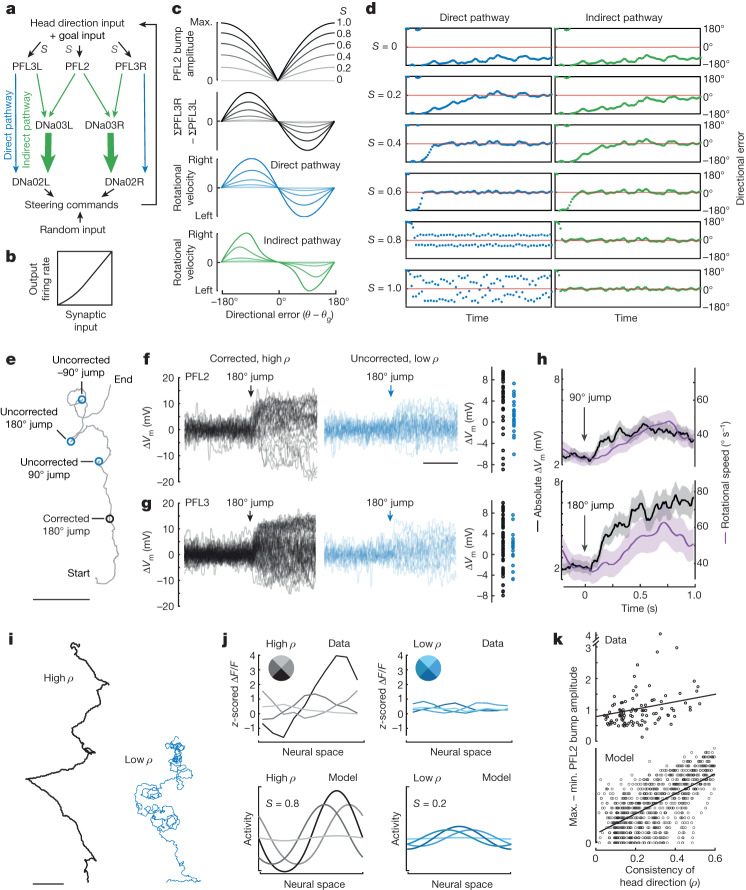
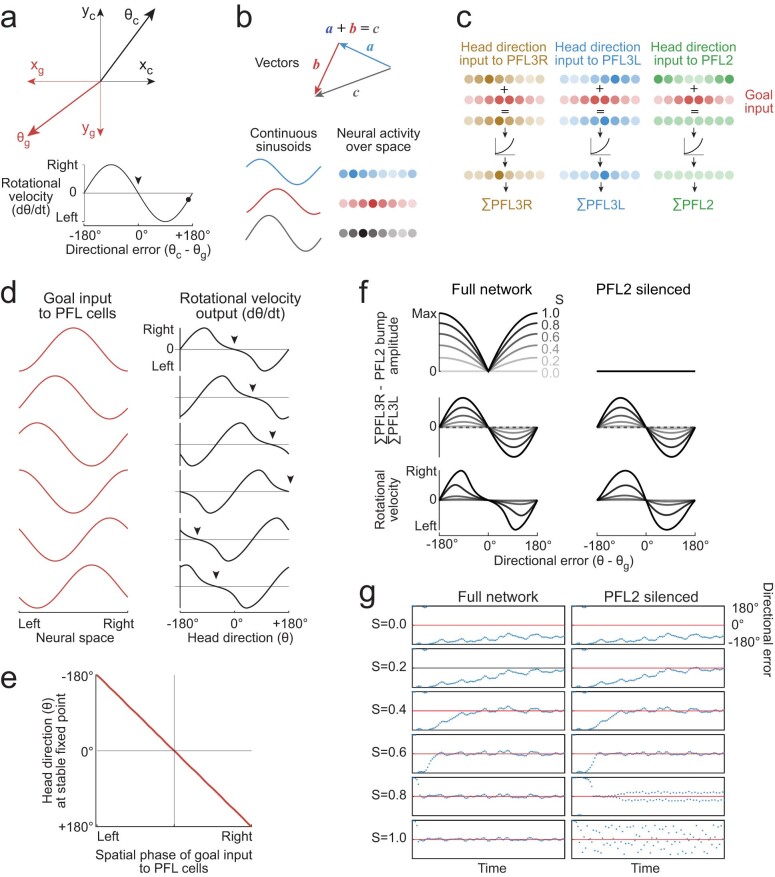
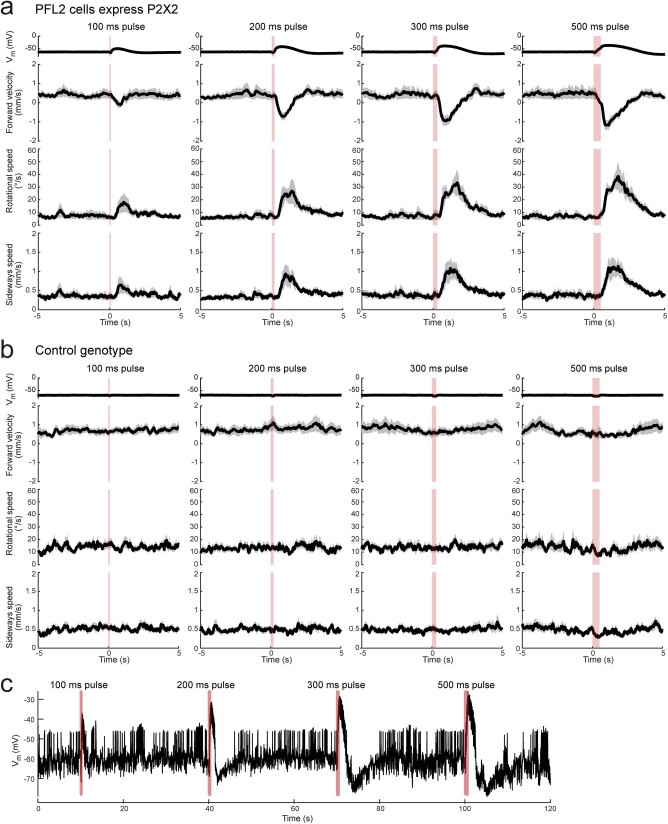
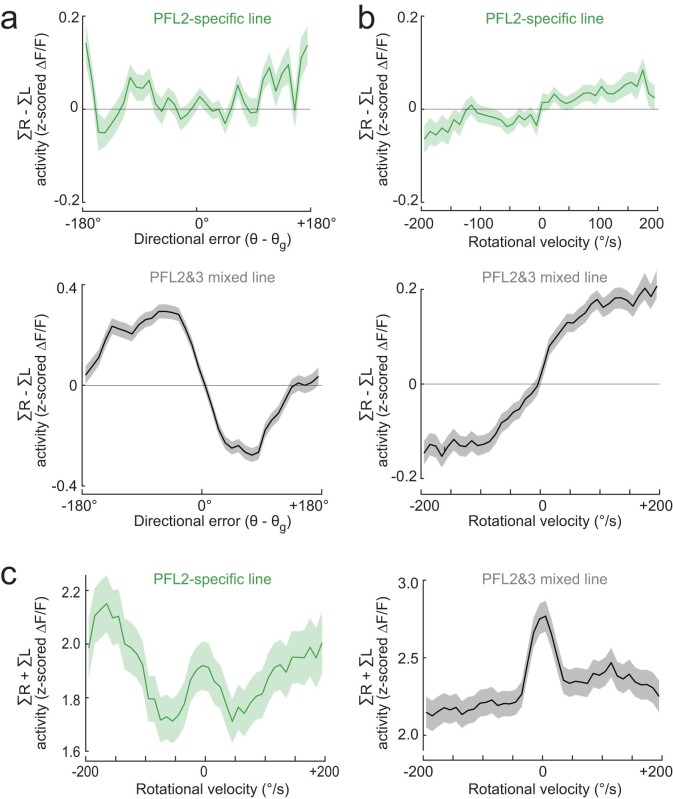
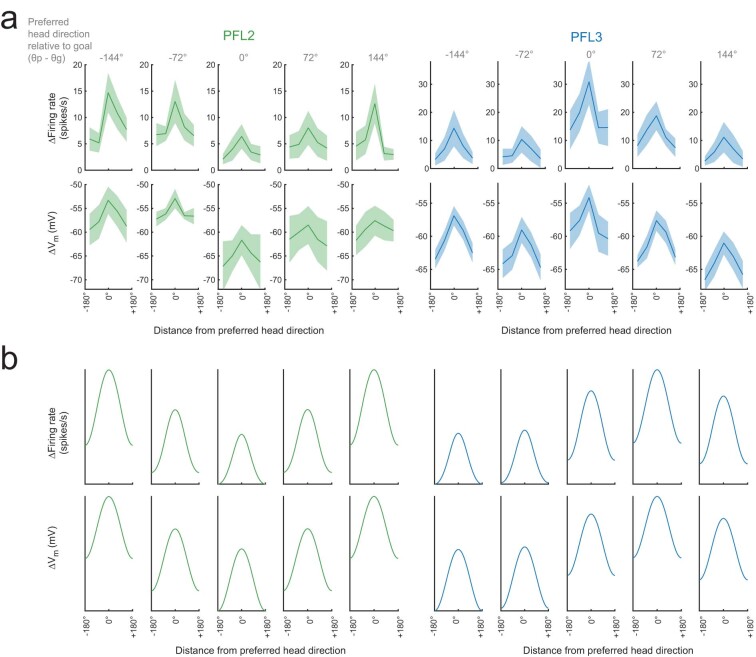
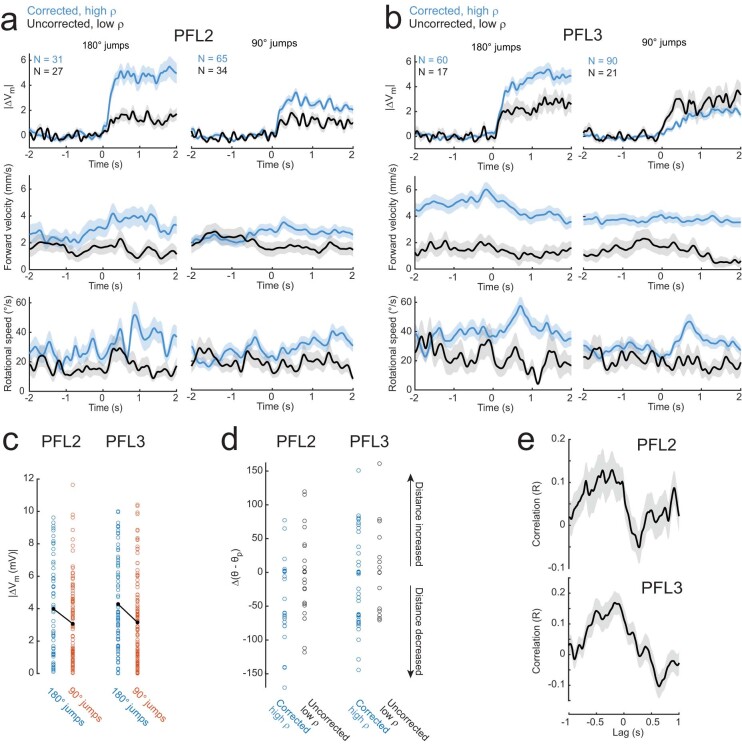
To navigate, we must continuously estimate the direction we are headed in, and we must correct deviations from our goal 1 . Direction estimation is accomplished by ring attractor networks in the head direction system 2,3 . However, we do not fully understand how the sense of direction is used to guide action. Drosophila connectome analyses 4,5 reveal three cell populations (PFL3R, PFL3L and PFL2) that connect the head direction system to the locomotor system. Here we use imaging, electrophysiology and chemogenetic stimulation during navigation to show how these populations function. Each population receives a shifted copy of the head direction vector, such that their three reference frames are shifted approximately 120° relative to each other. Each cell type then compares its own head direction vector with a common goal vector; specifically, it evaluates the congruence of these vectors via a nonlinear transformation. The output of all three cell populations is then combined to generate locomotor commands. PFL3R cells are recruited when the fly is oriented to the left of its goal, and their activity drives rightward turning; the reverse is true for PFL3L. Meanwhile, PFL2 cells increase steering speed, and are recruited when the fly is oriented far from its goal. PFL2 cells adaptively increase the strength of steering as directional error increases, effectively managing the tradeoff between speed and accuracy. Together, our results show how a map of space in the brain can be combined with an internal goal to generate action commands, via a transformation from world-centric coordinates to body-centric coordinates.
Overview
The claims and statistics of this paper haven’t been checked yet.
Free: it reads the open-access text and checks the first 5 claims that cite a source we can check. Create a free account to check every claim.
Integrity signals
Registry
Cites
Statistics
Figures
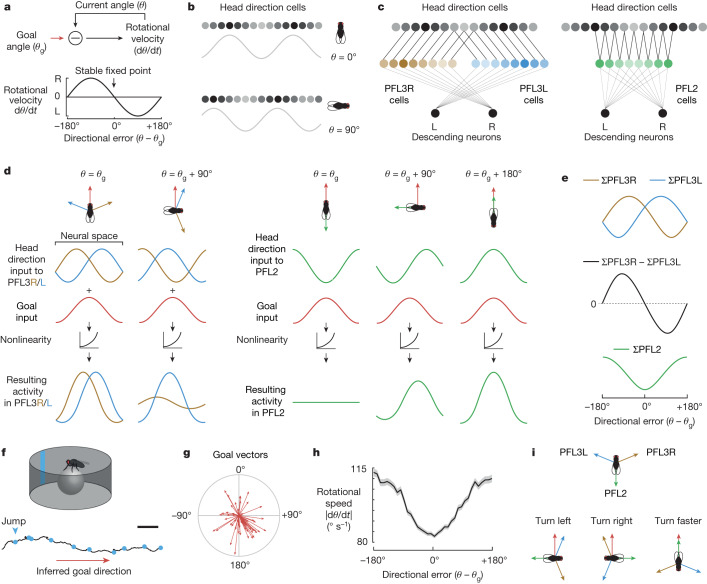
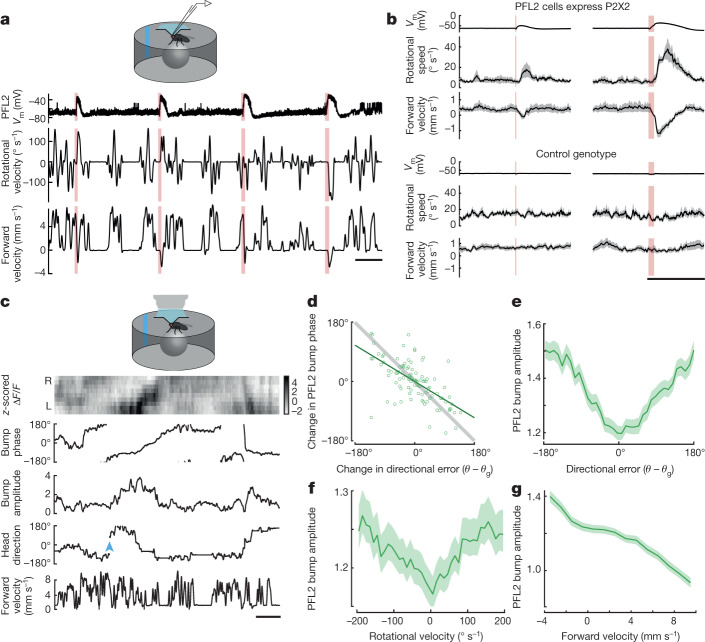
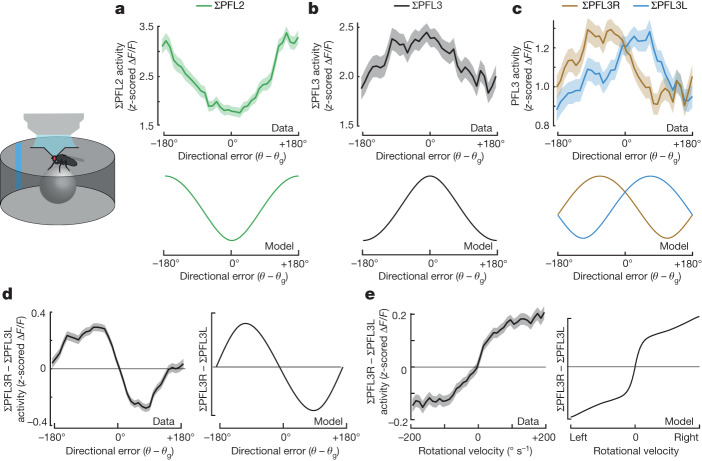
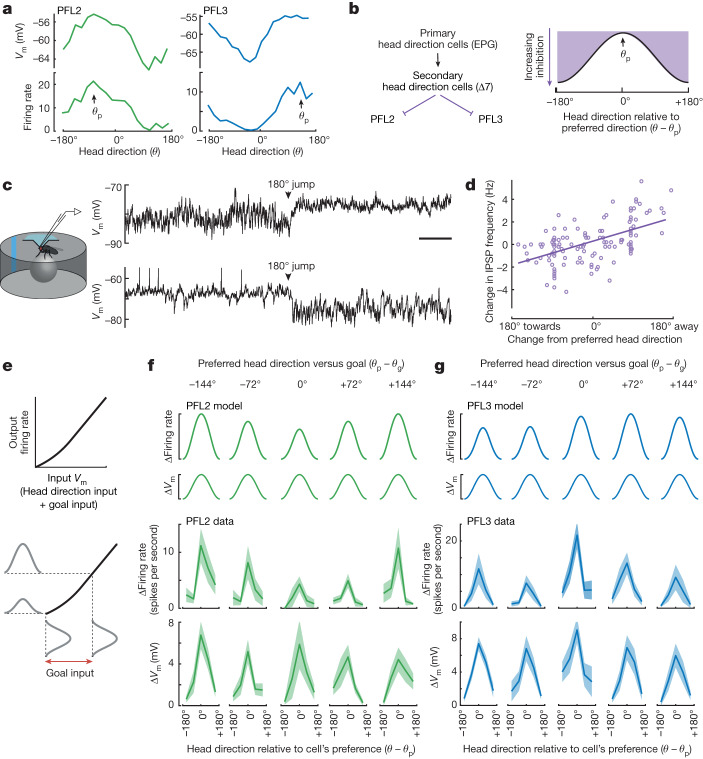
Verification
Claims the paper makes
The claims and statistics of this paper haven’t been checked yet.
Free: it reads the open-access text and checks the first 5 claims that cite a source we can check. Create a free account to check every claim.
Claims other papers make about this one
Each is checked against this paper’s own text: does it say what the citing paper says it does?
The cited source says what the claim attributes to it.
In the citing paper
“DNa02 is directly targeted by central complex output neurons responsible for feedback control of heading32,62–64”
From Fine-grained descending control of steering in walking Drosophila (2024) · cites this paper as [63]
In the citing paper
“PFL2 neurons are recruited when the fly is oriented away from its internal goal, and direct activation of PFL2 neurons increases the overall gain of steering commands, without specifying the direction of turning (Westeinde et al., 2024).”
From Neural circuit mechanisms for steering control in walking Drosophila (2025) · cites this paper as Westeinde et al., 2024
In the citing paper
“When the central complex commands a large change in heading, it also commands a decrease in forward velocity63,80 — i.e., pivoting — which is associated with the leg gestures that DNa02 controls”
From Fine-grained descending control of steering in walking Drosophila (2024) · cites this paper as [63]
Self-check
Percentages, sums and reported differences re-computed from the paper’s own numbers.
The self-check needs the paper’s full text.
Citations
Cites
NoRMCorre: An online algorithm for piecewise rigid motion correction of calcium imaging data
Pnevmatikakis, E. A., & Giovannucci, A. (2017) · Journal of Neuroscience Methods · doi:10.1016/j.jneumeth.2017.07.031 · Cited by 1,007
Neural dynamics for landmark orientation and angular path integration
Seelig, J. D., & Jayaraman, V. (2015) · Nature · doi:10.1038/nature14446 · Cited by 718 · cited 11×
“Data from locusts 17 , zebrafish 18 and Drosophila 19 show that head direction is in fact encoded as a sinusoidal spatial pattern of activity (Fig.”
InfluentialNern, A., Pfeiffer, B. D., & Rubin, G. M. (2015) · Proceedings of the National Academy of Sciences · doi:10.1073/pnas.1506763112 · Cited by 584
Remote Control of Behavior through Genetically Targeted Photostimulation of Neurons
Lima, S. Q., & Miesenböck, G. (2005) · Cell · doi:10.1016/j.cell.2005.02.004 · Cited by 562
Wilson, R. I., & Laurent, G. (2005) · The Journal of Neuroscience · doi:10.1523/jneurosci.2070-05.2005 · Cited by 469
Self-citationDynamic Reorganization of Neuronal Activity Patterns in Parietal Cortex
Driscoll, L. N., Pettit, N. L., Minderer, M., Chettih, S. N., & Harvey, C. D. (2017) · Cell · doi:10.1016/j.cell.2017.07.021 · Cited by 445
The Contribution of Noise to Contrast Invariance of Orientation Tuning in Cat Visual Cortex
Anderson, J. S., Lampl, I., Gillespie, D. C., & Ferster, D. (2000) · Science · doi:10.1126/science.290.5498.1968 · Cited by 422
Hulse, B. K., Haberkern, H., Franconville, R., Turner-Evans, D., Takemura, S.-Y., Wolff, T., Noorman, M., Dreher, M., Dan, C., Parekh, R., et al. (2021) · eLife · doi:10.7554/elife.66039 · Cited by 392
Hulse, B. K., Haberkern, H., Franconville, R., Turner-Evans, D. B., Takemura, S., Wolff, T., Noorman, M., Dreher, M., Dan, C., Parekh, R., et al. (2020) · doi:10.1101/2020.12.08.413955 · Cited by 392 · cited 10×
“Their function is enigmatic, but proposals suggest they increase forward walking speed 5,13 .”
InfluentialThe connectome of the adult Drosophila mushroom body provides insights into function
Li, F., Lindsey, J. W., Marin, E. C., Otto, N., Dreher, M., Dempsey, G., Stark, I., Bates, A. S., Pleijzier, M. W., Schlegel, P., et al. (2020) · eLife · doi:10.7554/elife.62576 · Cited by 388 · cited 1×
“Meanwhile, PFL3 cells also synapse onto DNa03, which is one of the strongest inputs to DNa02 in the brain 4,5,31,32 ; we call this the ‘indirect pathway’ (Fig.”
Research works printed but not linked: 1
- Schöne, H. Spatial Orientation: The Spatial Control of Behavior in Animals and Man (Princeton Univ. Press, 2014).
Cited by
Eckstein, N., Bates, A. S., Champion, A., Du, M., Yin, Y., Schlegel, P., Lu, A. K.-Y., Rymer, T., Finley-May, S., Paterson, T., et al. (2024) · Cell · doi:10.1016/j.cell.2024.03.016 · Cited by 277
“They have already been used by several studies (Lu et al., 2022; Baker et al., 2022; Schlegel et al., 2021; Li et al., 2020a; Engert et al., 2022; Westeinde et al., 2022; Eichler et al., 2023) in order to generate neurobiological hypotheses.”
Eckstein, N., Bates, A. S., Champion, A., Du, M., Yin, Y., Schlegel, P., Lu, A. K.-Y., Rymer, T., Finley-May, S., Paterson, T., et al. (2020) · doi:10.1101/2020.06.12.148775 · Cited by 115
Converting an allocentric goal into an egocentric steering signal
Mussells Pires, P., Zhang, L., Parache, V., Abbott, L. F., & Maimon, G. (2024) · Nature · doi:10.1038/s41586-023-07006-3 · Cited by 110
“The accompanying article provides experimental evidence that PFL2 activity drives increases in rotational speed and decreases in forward velocity when flies are oriented far from their goal angle 50 .”
Converting an allocentric goal into an egocentric steering signal
Pires, P. M., Abbott, L. F., & Maimon, G. (2022) · doi:10.1101/2022.11.10.516026 · Cited by 110
Neural circuit mechanisms for steering control in walking Drosophila
Rayshubskiy, A., Holtz, S. L., Bates, A. S., Vanderbeck, Q. X., Capdevila, L. S., Rockwell, V., & Wilson, R. I. (2020) · doi:10.1101/2020.04.04.024703 · Cited by 64
“PFL2 ( Fig.”
InfluentialSelf-citationFine-grained descending control of steering in walking Drosophila
Yang, H. H., Brezovec, B. E., Serratosa Capdevila, L., Vanderbeck, Q. X., Adachi, A., Mann, R. S., & Wilson, R. I. (2024) · Cell · doi:10.1016/j.cell.2024.08.033 · Cited by 55
Self-citationFine-grained descending control of steering in walking Drosophila
Yang, H. H., Brezovec, L. E., Serratosa Capdevila, L., Vanderbeck, Q. X., Adachi, A., Mann, R. S., & Wilson, R. I. (2023) · doi:10.1101/2023.10.15.562426 · Cited by 55
“Rather, we wondered whether different steering DNs might have specialized roles in fine-grained control of leg movements.”
Self-citationNeural representation of goal direction in the monarch butterfly brain
Beetz, M. J., Kraus, C., & el Jundi, B. (2023) · Nature Communications · doi:10.1038/s41467-023-41526-w · Cited by 65
“Recent fi ndings in Drosophila suggestthatthiscomparison is carried out by two different neurontypes,termedPFL3andPFL2 43,44,59 .”
InfluentialA neural circuit architecture for rapid learning in goal-directed navigation
Dan, C., Hulse, B. K., Kappagantula, R., Jayaraman, V., & Hermundstad, A. M. (2024) · Neuron · doi:10.1016/j.neuron.2024.04.036 · Cited by 51
Bogong moths use a stellar compass for long-distance navigation at night
Dreyer, D., Adden, A. K., Chen, H., Frost, B. J., Mouritsen, H., Xu, J., Green, K., Whitehouse, M., Chahl, J., Wallace, J. R. A., et al. (2025) · Nature · doi:10.1038/s41586-025-09135-3 · Cited by 57
Olfactory navigation in arthropods
Steele, T., Lanz, A. J., & Nagel, K. I. (2023) · Journal of Comparative Physiology A · doi:10.1007/s00359-022-01611-9 · Cited by 50
Neural networks for navigation: From connections to computations
Wilson, R. I. (2023) · Annual Review of Neuroscience · doi:10.1146/annurev-neuro-110920-032645 · Cited by 38
Self-citationPredicting modular functions and neural coding of behavior from a synaptic wiring diagram
Vishwanathan, A., Sood, A., Wu, J., Ramirez, A. D., Yang, R., Kemnitz, N., Ih, D., Turner, N., Lee, K., Tartavull, I., et al. (2024) · Nature Neuroscience · doi:10.1038/s41593-024-01784-3 · Cited by 36
Neural circuits for goal-directed navigation across species
Basu, J., & Nagel, K. I. (2024) · Trends in Neurosciences · doi:10.1016/j.tins.2024.09.005 · Cited by 40
The neuroethology of ant navigation
Collett, T. S., Graham, P., & Heinze, S. (2025) · Current Biology · doi:10.1016/j.cub.2024.12.034 · Cited by 42
Distributed control circuits across a brain-and-cord connectome
Bates, A. S., Phelps, J. S., Kim, M., Yang, H. H., Matsliah, A., Ajabi, Z., Perlman, E., Delgado, K. M., Osman, M. A. M., Salmon, C. K., et al. (2026) · Nature · doi:10.1038/s41586-026-10735-w · Cited by 100
“7, 80,81), but the DN targets of PFL1 have not been fully identifiable until now.”
Neural circuit mechanisms for steering control in walking Drosophila
Rayshubskiy, A., Holtz, S. L., Bates, A. S., Vanderbeck, Q. X., Serratosa Capdevila, L., Rockwell, V., & Wilson, R. (2025) · eLife · doi:10.7554/elife.102230 · Cited by 27
Self-citationVariations on an ancient theme — the central complex across insects
Heinze, S. (2024) · Current Opinion in Behavioral Sciences · doi:10.1016/j.cobeha.2024.101390 · Cited by 36
Emergent spatial goals in an integrative model of the insect central complex
Goulard, R., Heinze, S., & Webb, B. H. (2023) · PLoS Computational Biology · doi:10.1371/journal.pcbi.1011480 · Cited by 27
Insect Flight: State of the Field and Future Directions
Treidel, L. A., Deem, K. D., Salcedo, M. K., Dickinson, M. H., Bruce, H. S., Darveau, C.-A., Dickerson, B. H., Ellers, O., Glass, J. R., Gordon, C. M., et al. (2024) · Integrative and Comparative Biology · doi:10.1093/icb/icae106 · Cited by 25
Feng (2024) · doi:10.1101/2024.06.27.601106 · Cited by 18
A collicular map for touch-guided tongue control
Ito, B. S., Gao, Y., Kardon, B., & Goldberg, J. H. (2025) · Nature · doi:10.1038/s41586-024-08339-3 · Cited by 18
Kathman, N. D., Lanz, A. J., Freed, J. D., & Nagel, K. I. (2026) · Nature Communications · doi:10.1038/s41467-026-75945-2 · Cited by 17
“Using etho-logical tasks to tease apart the nature and causal role of goal representations can provide insight into the structure and organization of navigation circuits across species.”
Neuronal calcium spikes enable vector inversion in the Drosophila brain
Ishida, I. G., Sethi, S., Mohren, T. L., Haraguchi, M., Abbott, L. F., & Maimon, G. (2025) · Cell · doi:10.1016/j.cell.2025.11.040 · Cited by 15
A vector-based strategy for olfactory navigation in Drosophila
Siliciano, A. F., Minni, S., Morton, C., Dowell, C. K., Eghbali, N. B., Busch, S. E., Rhee, J. Y., Abbott, L. F., & Ruta, V. (2026) · Nature · doi:10.1038/s41586-026-10827-7 · Cited by 18
“14a,b) and directly synapse onto PFL3 neurons, an output pathway of the central complex that controls steering by comparing a fly’s current heading with its goal 6,37,38,40 .”
The neurobiology of the Monarch butterfly compass
Beetz, M. J., & el Jundi, B. (2023) · Current Opinion in Insect Science · doi:10.1016/j.cois.2023.101109 · Cited by 11
Zhong, H., Du, Y., Liu, D., Wang, M., Cong, M., & Tian, X. (2025) · Engineering Applications of Artificial Intelligence · doi:10.1016/j.engappai.2025.111250 · Cited by 10
Neural circuit mechanisms for steering control in walking Drosophila
Rayshubskiy, A., Holtz, S. L., Bates, A. S., Vanderbeck, Q. X., Capdevila, L. S., Rockwell, V., & Wilson, R. I. (2025) · eLife · doi:10.7554/elife.102230.3 · Cited by 14
Self-citationSalahshour, M., & Couzin, I. D. (2025) · Nature Communications · doi:10.1038/s41467-025-64676-5 · Cited by 17
From skylight cues to magnetic fields: the toolkit of insect long-distance navigation
Goforth, K. M., & Merlin, C. (2025) · Journal of Comparative Physiology A · doi:10.1007/s00359-025-01770-5 · Cited by 9
Grob, R., Farnworth, M. S., Degen, J., Warrant, E. J., Montgomery, S. H., & el Jundi, B. (2025) · Journal of Comparative Physiology A · doi:10.1007/s00359-025-01780-3 · Cited by 14
Building egocentric models of local space from retinal input
Martins, D. M., Manda, J. M., Goard, M. J., & Parker, P. R. L. (2024) · Current Biology · doi:10.1016/j.cub.2024.10.057 · Cited by 11
A historical perspective on the insect central complex: Anatomy, development, and function
Gillet, V., Kluge, J., & Patel, R. N. (2025) · Molecular Psychology Brain Behavior and Society · doi:10.12688/molpsychol.17564.3 · Cited by 9
Functional independence of entorhinal grid cell modules enables remapping in hippocampal place cellsPreprint
Lykken, C. M., Kanter, B. R., Nagelhus, A., Carpenter, J., Guardamagna, M., Moser, E. I., & Moser, M. (2025) · bioRxiv (Cold Spring Harbor Laboratory) · doi:10.1101/2025.09.24.677985 · Cited by 10
Disinhibition of a recurrent attractor gates a persistent goal signal for navigationPreprint
Lanz, A. J., Kathman, N. D., Hao, E., Ermentrout, B., & Nagel, K. I. (2025) · bioRxiv (Cold Spring Harbor Laboratory) · doi:10.1101/2025.10.07.681003 · Cited by 6
Neural circuit mechanisms for steering control in walking Drosophila
Rayshubskiy, A., Holtz, S. L., Bates, A., Vanderbeck, Q. X., Capdevila, L. S., & Wilson, R. I. (2024) · doi:10.7554/elife.102230.1 · Cited by 5
Self-citationIs this scenery worth exploring? Insight into the visual encoding of navigating ants
Clément, L., Schwarz, S., Mahot‐Castaing, B., & Wystrach, A. (2025) · Journal of Experimental Biology · doi:10.1242/jeb.249935 · Cited by 6
Teach Pendant at Fingertips: Intuitive Vision-Based Gesture-Driven Control of Dexter ER2 Robotic Arm
Abhishek, S., Jogi, Y., Sahu, U. K., Dash, S. K., & Yadav, U. K. (2025) · IEEE Access · doi:10.1109/access.2025.3576693 · Cited by 5
Neural sequences underlying directed turning in Caenorhabditis elegans
Kramer, T. S., Wan, F. K., Pugliese, S. M., Atanas, A. A., Pradhan, S., Hiser, A. W., Godinez, L., Luo, J., Bueno, E., Felt, T. E., et al. (2026) · Nature Neuroscience · doi:10.1038/s41593-026-02257-5 · Cited by 11
Inhibitory control explains locomotor statistics in walking Drosophila
Gattuso, H. C., van Hassel, K. A., Freed, J. D., Nuñez, K. M., de la Rea, B., May, C. E., Ermentrout, B., Victor, J. D., & Nagel, K. I. (2025) · Proceedings of the National Academy of Sciences · doi:10.1073/pnas.2407626122 · Cited by 9
Specialized parallel pathways for adaptive control of visual object pursuit
Collie, M. F., Jin, C., Rockwell, V., Kellogg, E. J., Vanderbeck, Q. X., Hartman, A. K., Holtz, S. L., & Wilson, R. I. (2026) · Neuron · doi:10.1016/j.neuron.2026.01.001 · Cited by 7
Self-citationInhibitory control of locomotor statistics in walking DrosophilaPreprint
Gattuso, H. C., van Hassel, K. A., Freed, J. D., Nuñez, K. M., de la Rea, B., May, C. E., Ermentrout, B., Victor, J. D., & Nagel, K. I. (2024) · bioRxiv (Cold Spring Harbor Laboratory) · doi:10.1101/2024.04.15.589655 · Cited by 4
“…outputs of the Central Complex that have been shown to drive goal-directed steering (PFL3 and PFL2, Stone et al. 2017, Hulse et al. 2020, Mussels Pires et al. 2024, Westeinde et al. 2024), and houses DNs whose activity correlates with and drives turning (Rayshubskiy et al. 2020, Yang et al. 2023).”
InfluentialFarnworth, M. S., Toh, Y. P., Loupasaki, T., Hodge, E. A., el Jundi, B., & Montgomery, S. H. (2026) · eLife · doi:10.7554/elife.107589 · Cited by 12
The sensory and neuronal mechanisms underlying long-distance migration in insects
el Jundi, B., & Warrant, E. J. (2026) · Current Opinion in Neurobiology · doi:10.1016/j.conb.2026.103204 · Cited by 4
Farnworth, M. S., Toh, Y. P., Loupasaki, T., Hodge, E. A., el Jundi, B., & Montgomery, S. H. (2026) · eLife · doi:10.7554/elife.107589.3 · Cited by 4
Neural drift during rest drives walking direction and memory consolidation in DrosophilaPreprint
Flores-Valle, A., Honnef, R., & Seelig, J. D. (2025) · bioRxiv (Cold Spring Harbor Laboratory) · doi:10.1101/2025.03.20.644317 · Cited by 2
How the insect brain keeps track of space
Webb, B. H. (2025) · Trends in Cognitive Sciences · doi:10.1016/j.tics.2025.08.006 · Cited by 2
Flexible circuits for visually guided flight control in Drosophila
Schnell, B. (2026) · Trends in Neurosciences · doi:10.1016/j.tins.2025.12.005 · Cited by 2
Functional Logic of a Cognitive Brain System for Navigation
Maimon, G., & Abbott, L. F. (2026) · Annual Review of Neuroscience · doi:10.1146/annurev-neuro-112723-062711 · Cited by 3
Jahn, S., Althaus, V., Seip, A., Rotella, S., Heckmann, J., Janning, M., Kolano, J., Kaufmann, A., & Homberg, U. (2024) · The Journal of Comparative Neurology · doi:10.1002/cne.70009 · Cited by 2
Neural Sequences Underlying Directed Turning in C. elegansPreprint
Kramer, T. S., Wan, F. K., Pugliese, S. M., Atanas, A. A., Hiser, A. W., Luo, J., Bueno, E., & Flavell, S. W. (2024) · bioRxiv (Cold Spring Harbor Laboratory) · doi:10.1101/2024.08.11.607076 · Cited by 2
Neural circuit mechanisms for steering control in walking DrosophilaPreprint
Rayshubskiy, A., Holtz, S. L., Bates, A. S., Vanderbeck, Q. X., Capdevila, L. S., Rockwell, V., & Wilson, R. I. (2025) · eLife · doi:10.7554/elife.102230.2 · Cited by 2
Self-citationFarnworth, M. S., Toh, Y. P., Loupasaki, T., Hodge, E. A., el Jundi, B., & Montgomery, S. H. (2025) · eLife · doi:10.7554/elife.107589.1 · Cited by 2
Drosophila maintain a consistent navigational goal angle for days to weeksPreprint
Weisman, J. L., Mohren, T. L., Ryu, J. D., Wyse, M. Z., Dias-Ferreira, E., & Maimon, G. (2025) · bioRxiv (Cold Spring Harbor Laboratory) · doi:10.64898/2025.12.09.693277 · Cited by 3
A dedicated brain circuit controls forward walking in DrosophilaPreprint
Dallmann, C. J., Iqbal, F. M., Liebscher, S., Erginkaya, M., Liessem, S., Sauer, E., Soyka, H., Cascino-Milani, F., Goldammer, J., Ito, K., et al. (2026) · bioRxiv (Cold Spring Harbor Laboratory) · doi:10.64898/2026.01.04.697356 · Cited by 3
The neurobiology of bee dance communication
Webb, B. H. (2026) · Current Opinion in Neurobiology · doi:10.1016/j.conb.2026.103176 · Cited by 1
Convergence-divergence circuits for multimodal integration of innate and learned opponent valences
Wang, W., Yang, Y., Liu, Q., Gao, Y., Lv, Q., Zhang, K., Ning, J., & Sun, Y. (2026) · Frontiers in Systems Neuroscience · doi:10.3389/fnsys.2026.1822122 · Cited by 2
“The fan-shaped body (FB) of the central complex (CX) is implicated in goal-directed action selection informed by valence (Cayco-Gajic and Silver, 2019; Shiozaki et al., 2020; Matheson et al., 2022; Ishida et al., 2026; Mussells Pires et al., 2024; Westeinde et al., 2024).”
Collective Motion in Danionella Emerges from Discrete Copying Interactions
Anonymous, Meyerhof, G. T., Napoli, J. L., Zada, D., Lovett-Barron, M., & Aljadeff, J. (2026) · Physical Review Letters · doi:10.1103/rlkf-vwlc · Cited by 2
Review of: "Growing Confidence and Remaining Uncertainty About Animal Consciousness"
Born, R. T. (2024) · Qeios · doi:10.32388/e8jbme
Self-generated cues and learned landmarks support spatial learning in DrosophilaPreprint
Chen, Y., Alfredson, R., Zuo, X., Motevalli, D., Fogleman, S., Stern, U., & Yang, C.-H. (2024) · bioRxiv (Cold Spring Harbor Laboratory) · doi:10.1101/2024.09.28.615625 · Cited by 2
A neural circuit for navigation keeps flies on target
Nagel, K. I. (2024) · Nature · doi:10.1038/d41586-024-00230-5
Continuous integration of heading and goal directions guides steeringPreprint
Crown, A. M., Wu, A. H., Hofflander, L., & Barnea, G. (2024) · bioRxiv (Cold Spring Harbor Laboratory) · doi:10.1101/2024.10.24.620060
Spatial representation: How fish know their place
Cho, F. S., & Giocomo, L. M. (2024) · Current Biology · doi:10.1016/j.cub.2024.09.038
A historical perspective on the insect central complex: Anatomy, development, and function
Gillet, V., Kluge, J., & Patel, R. N. (2023) · Molecular Psychology Brain Behavior and Society · doi:10.12688/molpsychol.17564.1
Buendía, V., Biggiogera, J., & Sanzeni, A. (2024) · bioRxiv (Cold Spring Harbor Laboratory) · doi:10.1101/2024.11.18.624135
Lateralised memory networks explain the use of higher-order visual features in navigating insectsPreprint
Filippi, G., Knight, J. C., Philippides, A. O., & Graham, P. (2024) · bioRxiv (Cold Spring Harbor Laboratory) · doi:10.1101/2024.11.26.625348
Zill, S. N., Chaudhry, S., Chaudhry, H., & Szczecinski, N. S. (2025) · Journal of Neurophysiology · doi:10.1152/jn.00044.2025
CBGAN: Predicting Stock Prices Using Combinatorial Generative Adversarial Networks
Xu, K., Liang, H., Wu, W., Kong, J., & Zheng, M. (2024) · International Conference on Big Data Economy and Information Management (BDEIM) · doi:10.1145/3724154.3724272
Filippi, G., Knight, J. C., Philippides, A. O., & Graham, P. (2025) · PLoS Computational Biology · doi:10.1371/journal.pcbi.1012670
“…similarities with the recently discovered function of PFL2 cells in Drosophila melanogaster , which have been demonstrated to adaptively tune the speed of turns based on the angular difference between a goal direction and the current heading direction maintained within the Central Complex [60].”
Composing trajectories for rapid inference of navigational goals
Abdelrahman, N. Y., Jiang, W.-C., Coddington, L. T., Gong, S., Dudman, J. T., & Hermundstad, A. M. (2026) · Neuron · doi:10.1016/j.neuron.2026.05.030 · Cited by 6
Scanning and active sampling behaviours emerge from conserved insect neural circuits
Freas, C. A., & Wystrach, A. (2026) · eLife · doi:10.1101/2025.10.13.682010
Liao, C.-C., Chang, N., Liu, Y., & Lo, C. (2025) · bioRxiv (Cold Spring Harbor Laboratory) · doi:10.1101/2025.10.19.683286 · Cited by 1
Vector coordinate transformation in the Drosophila navigation systemPreprint
Gorko, B., & Kim, S. S. (2025) · bioRxiv (Cold Spring Harbor Laboratory) · doi:10.64898/2025.12.20.695733
Navigation circuits: Calcium spikes know which way the wind blows
Nguyen, T.-L. L., & Fisher, Y. E. (2026) · Current Biology · doi:10.1016/j.cub.2025.12.031
Updating an allocentric goal from lateralised egocentric visual memories
Wystrach, A., Moël, F. L., Clément, L., & Schwarz, S. (2026) · Nature Communications · doi:10.1038/s41467-025-67545-3 · Cited by 1
“…such asthe ellipsoid body (EB) and protocerebralbridge (PB) 35,38,59,60 ; (2) retaining a goal heading representation for tens of seconds or more in the fan-shaped body (FB) 51,61,62 ; and (3) comparing currentandgoalheadingstoproducecompensatoryleft/rightsteering commands 39,51,60 – 64 .”
Scanning and active sampling behaviours emerge from conserved insect neural circuitsPreprint
Freas, C. A., & Wystrach, A. (2026) · eLife · doi:10.7554/elife.110165.1 · Cited by 1
Scanning and active sampling behaviours emerge from conserved insect neural circuitsPreprint
Freas, C. A., & Wystrach, A. (2026) · eLife · doi:10.7554/elife.110165 · Cited by 1
Head direction and the evolutionary origins of spatial representation
Sayre, M. E., Narendra, A., Heinze, S., & Barron, A. B. (2026) · Trends in Neurosciences · doi:10.1016/j.tins.2026.04.001 · Cited by 3
Ballistic food approaches in Parhyale hawaiensis require the antennaePreprint
Steele, T., & Nagel, K. I. (2026) · bioRxiv (Cold Spring Harbor Laboratory) · doi:10.64898/2026.06.16.732625
“…maintenance of a straight course during olfactory navigation is associated with short term representations of a goal direction relative to global environmental cues in the Central Complex (Kathman et al. 2026; Lanz et al. 2025; Westeinde et al. 2024; Stone et al. 2017; Mussells Pires et al. 2024).”
Neurobiological interfaces connecting environmental change to monarch butterfly migration
Goforth, K. M., Shetty, V., Giannuzzi, M. S., & Merlin, C. (2026) · Current Opinion in Neurobiology · doi:10.1016/j.conb.2026.103240
A robot model of compass cue calibration in the insect brainPreprint
Mitchell, R., Dacke, M., & Webb, B. H. (2026) · bioRxiv (Cold Spring Harbor Laboratory) · doi:10.64898/2026.06.25.734539
“This is sufficiently true to be useful, but is susceptible to ‘false nulling’ [50] (though in practice this was not a problem, see above).”
Scanning and active sampling behaviours emerge from conserved insect neural circuitsPreprint
Freas, C. A., & Wystrach, A. (2026) · eLife · doi:10.7554/elife.110165.3
Connectomes: a re-emerging hub dataset for neuroscience
Kyllmann, S., & Keesey, I. W. (2026) · Frontiers in Neuroscience · doi:10.3389/fnins.2026.1911198 · Cited by 1
“Connectomics have been critical in demonstrating how central complex navigation signals are transformed into steering commands (Mussells Pires et al., 2024; Westeinde et al., 2024).”
InfluentialA split attractor design for rapidly writing a navigational goal
Lanz, A. J., Kathman, N. D., Hao, E., Ermentrout, B., & Nagel, K. I. (2026) · Nature · doi:10.1038/s41586-026-11144-9 · Cited by 8
A network model of path controlPreprint
Osman, M. A. M., Zhang, W., Pehlevan, C., & Wilson, R. I. (2026) · bioRxiv (Cold Spring Harbor Laboratory) · doi:10.64898/2026.10.02.756268
“…control loop, this simplification is unlikely to hold in practice: optogenetically increasing the mean activity of FB output neurons can influence locomotion [19], and several cell types downstream of the FB are well-poised to read out the mean activity of particular FB columnar cell types [3].”
InfluentialSelf-citationUnilateral gene expression via maternally controlled zygotic recombination in DrosophilaPreprint
Currier, T. A., Tadres, D., Troper, J. E., Wang, Y., & Clandinin, T. R. (2026) · bioRxiv (Cold Spring Harbor Laboratory) · doi:10.64898/2026.10.14.759140
“These bilaterally projecting cell types 59 , and other LAL neurons 20,25,60,61 , have recently been implicated in steering control.”
Selective control of course correction over long timescales in the Drosophila central complex
Crown, A. M., Wu, A. H., Hofflander, L., & Barnea, G. (2026) · Current Biology · doi:10.1016/j.cub.2026.09.069 · Cited by 1
Metadata
- Authors
- Westeinde, E. A., Kellogg, E., Dawson, P. M., Lu, J., Hamburg, L., Midler, B., Druckmann, S., & Wilson, R. I.
- Affiliations
- Harvard University (US)
- Stanford Medicine (US)
- Corresponding author
- Wilson, Rachel I.
- Venue
- Nature
- Published
- 2024-02-07
- Volume
- 626
- Issue
- 8000
- Pages
- 819-826
- ISSN
- 0028-0836 (ISSN-L)
- 1476-4687
- PMC
- PMC10881397
- OpenAlex
- W4391597906
- Cited by
- 85
- References
- 69
- Citations by year
- 2026: 29 · 2025: 25 · 2024: 24
- FWCI
- 13.60
- Type
- journal article
- Language
- en
- Update notices
- correction (2025-03-11)
- Open access
- hybrid
- doi.org
- Licence
- cc-by
- creativecommons.org/licenses/by/4.0 (tdm)
- creativecommons.org/licenses/by/4.0 (vor)
- Locations
- Nature (publishedVersion, cc-by)
- bioRxiv (Cold Spring Harbor Laboratory) (acceptedVersion, cc-by-nc-nd)
- PubMed Central (publishedVersion, cc-by)
- PubMed (publishedVersion)
- Digital Access to Scholarship at Harvard (DASH) (Harvard University) (submittedVersion, cc-by)
- RePEc: Research Papers in Economics (submittedVersion)
- Funders
- Howard Hughes Medical Institute
- National Institutes of Health
- National Institute of Neurological Disorders and Stroke (U19NS104655)
- Topics
- Life Sciences › Neuroscience › Cellular and Molecular Neuroscience › Neurobiology and Insect Physiology Research
- Life Sciences › Neuroscience › Cognitive Neuroscience › Memory and Neural Mechanisms
- Social Sciences › Psychology › Experimental and Cognitive Psychology › Spatial Cognition and Navigation
- Keywords
- head direction system, Drosophila, reference frames, locomotion control, navigation, chemogenetic stimulation, speed-accuracy trade-off, brain atlas
- MeSH terms
- Orientation, Spatial, Animals, Brain, Drosophila melanogaster, Goals, Head, Locomotion, Neurons, Time Factors, Connectome, Spatial Navigation
About these checks
Registry, retraction, Cites and statistics results are computed, not judged, with one exception: a printed reference that no index lists is read once by a model before it counts as a citation error. Claims are extracted by a model and kept only when their quote appears verbatim in the text; each cited source is then checked, with a model’s help, for whether it says what the claim relies on. Those verdicts can be wrong — read the claim’s quote and the cited source before relying on one.
Statistics and arithmetic are recomputed, not judged.
Confidence bands are shown only for fields calibrated on our annotated test set. None is calibrated yet, so no band is shown.
What counts as a claim ›How we measure confidence ›How we check this ›
Are you an author, or do you see a problem with this page? Request a review
Data sources
Bibliographic data: Semantic Scholar, OpenAlex, Crossref.
Contains information from the Semantic Scholar Academic Graph Datasets, made available under the ODC Attribution License (ODC-BY 1.0).
Semantic Scholar’s data is described in: Kinney, R., et al. (2023). The Semantic Scholar Open Data Platform. arXiv:2301.10140.
