

Accurate predictions on small data with a tabular foundation model
Open accessThe DOI matches its Crossref record; 64 of the 64 references it cites were found in a registry or an index; 1 of the 31 sources its claims cite were checked for support.
Abstract
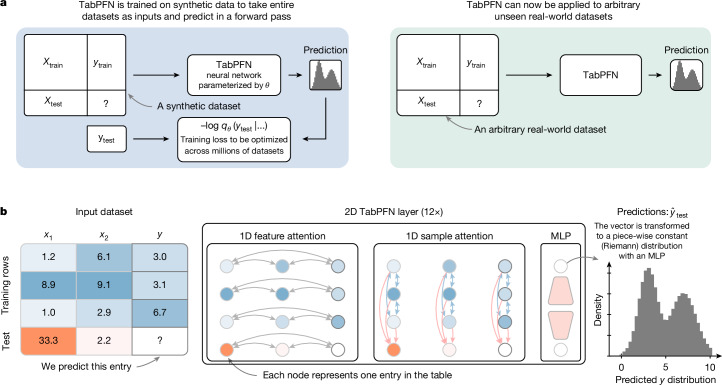
Tabular data, spreadsheets organized in rows and columns, are ubiquitous across scientific fields, from biomedicine to particle physics to economics and climate science 1,2. The fundamental prediction task of filling in missing values of a label column based on the rest of the columns is essential for various applications as diverse as biomedical risk models, drug discovery and materials science. Although deep learning has revolutionized learning from raw data and led to numerous high-profile success stories 3–5, gradient-boosted decision trees 6–9 have dominated tabular data for the past 20 years. Here we present the Tabular Prior-data Fitted Network (TabPFN), a tabular foundation model that outperforms all previous methods on datasets with up to 10,000 samples by a wide margin, using substantially less training time. In 2.8 s, TabPFN outperforms an ensemble of the strongest baselines tuned for 4 h in a classification setting. As a generative transformer-based foundation model, this model also allows fine-tuning, data generation, density estimation and learning reusable embeddings. TabPFN is a learning algorithm that is itself learned across millions of synthetic datasets, demonstrating the power of this approach for algorithm development. By improving modelling abilities across diverse fields, TabPFN has the potential to accelerate scientific discovery and enhance important decision-making in various domains.
Overview
CoChat Summary
TL;DR
TabPFN is a tabular foundation model pretrained on millions of synthetic datasets that uses in-context learning to outperform prior methods on small- to medium-sized tabular data up to 10,000 samples and 500 features. It delivers strong classification and regression performance in a single forward pass and also supports fine-tuning, data generation, density estimation, reusable embeddings, and interpretability.
Key findings
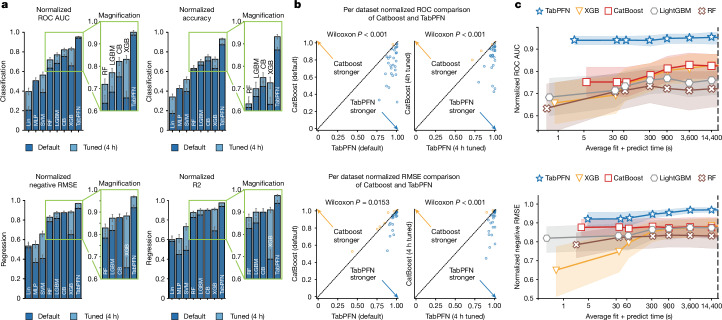
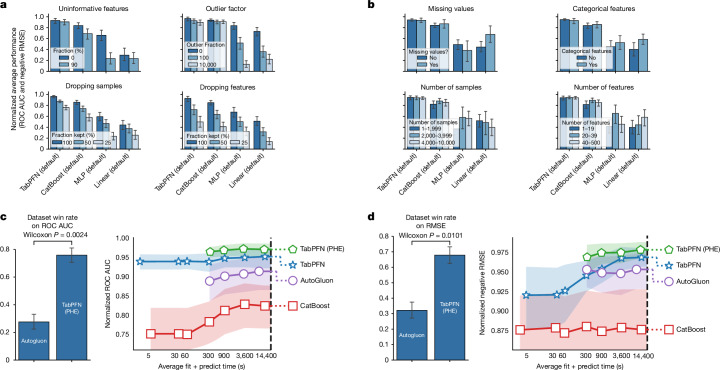
- On benchmarks with 29 classification and 28 regression datasets up to 10,000 samples, 500 features, and 10 classes, TabPFN outperformed tuned baselines. Classification normalized ROC AUC: TabPFN default 0.939 vs CatBoost default 0.752; tuned TabPFN 0.952 vs tuned CatBoost 0.822. Regression normalized RMSE: TabPFN default 0.923 vs CatBoost default 0.872; tuned TabPFN 0.968 vs tuned CatBoost 0.875.
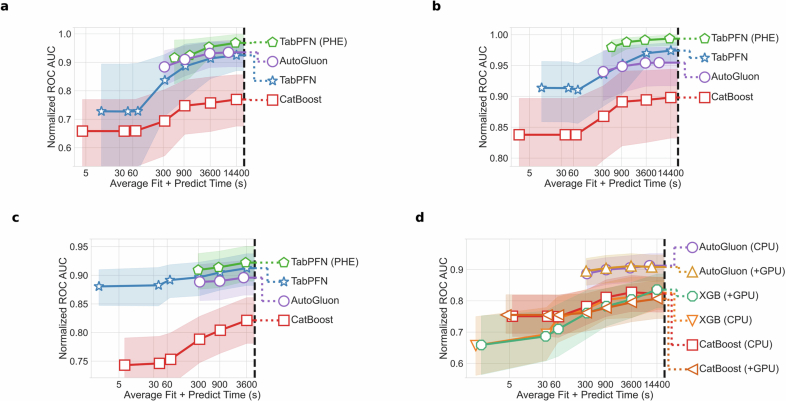
- TabPFN default took 2.8 s for classification and 4.8 s for regression on average, outperforming baselines tuned for 4 h—a speedup of 5,140× for classification and 3,000× for regression. TabPFN (PHE) reached average normalized ROC AUC 0.971 vs 0.939 for TabPFN default and 0.914 for AutoGluon; for regression, TabPFN (PHE) outperformed AutoGluon allowed 4 h after a 300 s tuning budget, a 48× speedup.
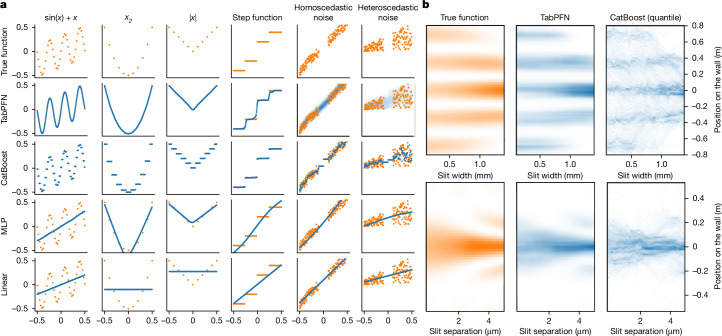
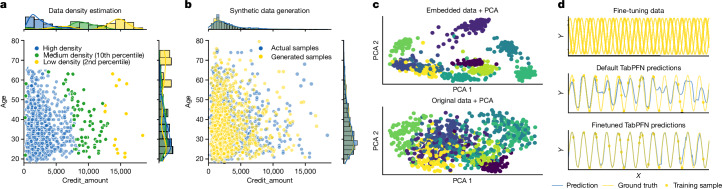
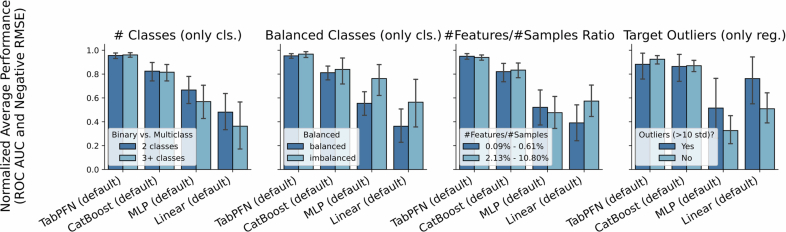
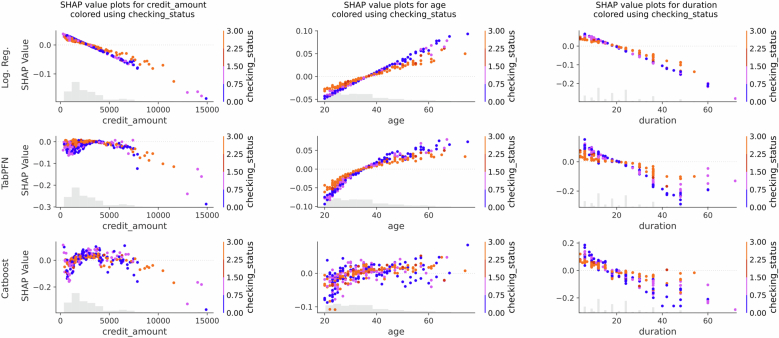
- TabPFN was robust to uninformative features and outliers, and with half the samples it performed as well as the next best method using all samples. It also demonstrated foundation-model abilities including density estimation, synthetic data generation, learned embeddings, fine-tuning, and SHAP-based feature importance.
Methods
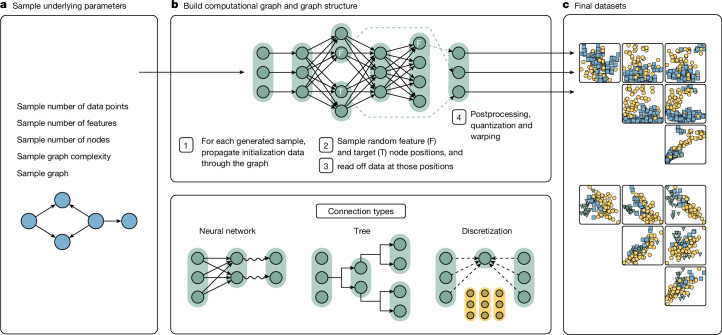
- TabPFN was pretrained on synthetic tabular datasets generated from structural causal models: around 100 million synthetic datasets per model training, with final models trained for approximately 2,000,000 steps at batch size 64 datasets, corresponding to around 130,000,000 synthetically generated datasets each.
- The architecture is a transformer encoder variant that treats each table cell as a separate position and uses two-way attention: each cell attends to other features in its row, then to the same feature across its column. At inference, training samples are provided as context and predictions are made in a single forward pass via in-context learning; train-state caching enables reuse for multiple test inferences.
- Evaluation used the AutoML Benchmark and OpenML-CTR23, with 29 classification and 28 regression datasets up to 10,000 samples, 500 features, and 10 classes. Each dataset and method was run for 10 repetitions with different random seeds and 90% train/10% test splits; hyperparameters were tuned by random search with five-fold cross-validation using time budgets from 30 s to 4 h. Metrics were ROC AUC and accuracy for classification, and R² and negative RMSE for regression, normalized per dataset.
Limitations
- The paper states that TabPFN inference may be slower than highly optimized approaches such as CatBoost; memory usage scales linearly with dataset size and can be prohibitive for very large datasets; and evaluation focused on datasets with up to 10,000 samples and 500 features, so scalability to larger datasets requires further study.
- The paper also states TabPFN is not optimized for real-time inference: for a dataset with 10,000 rows and 10 columns, it requires 0.2 s (0.6 s without GPU) to predict one sample, whereas CatBoost default can do so in 0.0002 s.
- The paper notes that for larger datasets and highly non-smooth regression datasets, CatBoost, XGBoost, or AutoGluon are likely to outperform TabPFN, and that natively the method is limited to predicting at most 10 classes unless pretrained on more classes or adapted with approaches such as one-vs-one, one-vs-rest, or ECOC.
Model-written summary. Check it against the paper before relying on it.
Integrity signals
Registry
Cites
Statistics
Figures
Verification
Claims the paper makes
1 Valid · 6 Not valid · 17 Not checked · 72 Own results and interpretations
The sources with a verdict support this claim; the rest weren’t checked yet, have no full text we could read, or their verdicts aren’t rated yet.
In the paper
“For larger datasets and highly non-smooth regression datasets, approaches such as CatBoost9, XGB7 or AutoGluon40 are likely to outperform TabPFN.”
§ Accurate predictions on small data with a tabular foundation model > Methods > User guide
What the sources say
- Check pendingcites [9] Prokhorenkova, L., Gusev, G., Vorobev, A., Dorogush, A. & Gulin, A. CatBoost: unbiased boosting with categorical features. In Proc. 30th International Conference on Advances in Neural Information Processing Systems (eds Bengio, S. et al.) 6639–6649 (Curran Associates, 2018). source
- Supportedcites [7] Chen, T. & Guestrin, C. Xgboost: A scalable tree boosting system. In Proc. 22nd ACM SIGKDD International Conference on Knowledge Discovery and Data Mining (eds Krishnapuram, B. et al.) 785–794 (ACM Press, 2016). source
The citation is offered to identify the system 'XGB' named in the citing sentence, and our copy is that system's paper: the Abstract and Introduction (KDD '16) describe XGBoost as 'a scalable end-to-end tree boosting system' that 'scales beyond billions of examples using far fewer resources than existing systems', used 'to achieve state-of-the-art results on many machine learning challenges'. The Introduction (p.1) further notes 17 of 29 Kaggle winning solutions in 2015 used XGBoost, and the evaluation sections report it running >10x faster than Spark MLLib/H2O on the 1.7-billion-example Criteo data, consistent with the 'larger datasets' framing. The head-to-head comparison against TabPFN and the 'highly non-smooth regression' qualification are the citing authors' own conclusion (TabPFN postdates this source) and are not attributed to this paper, so nothing here is unsupported for the part this citation carries. (LLM, conf=0.85)
- Check pendingcites [40] Erickson, N. et al. Autogluon-tabular: robust and accurate automl for structured data. Preprint at https://arxiv.org/abs/2003.06505 (2020). source
hedgedstates a possible cause- Asserted: passes — The authors put it forward as true.
- Checkable: passes — It can be checked against evidence.
- Load-bearing: unclear — It is unclear whether the paper’s conclusions depend on it.
- Based: passes — The paper gives a reason why it holds.
A result the paper states — it cites no source for it, so there is none to check. The quote shows it is in the paper.
In the paper
“This new supervised tabular learning method can be applied to any small- to moderate-sized dataset and yields dominant performance for datasets with up to 10,000 samples and 500 features.”
§ Accurate predictions on small data with a tabular foundation model > Main
plainstates a causen = 10,000- Asserted: passes — The authors put it forward as true.
- Checkable: passes — It can be checked against evidence.
- Load-bearing: passes — The paper’s conclusions depend on it.
- Based: passes — The paper gives a reason why it holds.
A result the paper reports from its own data — it cites no other source for it, so there is none to check. The quote shows it is in the paper.
In the paper
“We extract and visualize learned embeddings from the mfeat-factors dataset in Fig. 6c, showing improved class separation compared with the raw data on the first two principal components.”
§ Accurate predictions on small data with a tabular foundation model > Foundation model with interpretability
plainstates a cause- Asserted: passes — The authors put it forward as true.
- Checkable: passes — It can be checked against evidence.
- Load-bearing: unclear — It is unclear whether the paper’s conclusions depend on it.
- Based: passes — The paper gives a reason why it holds.
A result the paper reports from its own data — it cites no other source for it, so there is none to check. The quote shows it is in the paper.
In the paper
“we found that pre-processing inputs can help performance”
§ Accurate predictions on small data with a tabular foundation model > Methods > Details on the neural architecture
plainstates a possible cause- Asserted: passes — The authors put it forward as true.
- Checkable: passes — It can be checked against evidence.
- Load-bearing: unclear — It is unclear whether the paper’s conclusions depend on it.
- Based: passes — The paper gives a reason why it holds.
In the paper
“As our models are not fully permutation invariant, for each ensemble member, we shuffle the feature order, approximating order invariance64.”
§ Accurate predictions on small data with a tabular foundation model > Methods > Inference details
What the sources say
- Not checked yetcites [64] Murphy, R. L., Srinivasan, B., Rao, V. A. & Ribeiro, B. Janossy pooling: learning deep permutation-invariant functions for variable-size inputs. In Proc. 7th International Conference on Learning Representations (ICLR, 2019). source
plain- Asserted: passes — The authors put it forward as true.
- Checkable: passes — It can be checked against evidence.
- Load-bearing: passes — The paper’s conclusions depend on it.
- Based: passes — The paper gives a reason why it holds.
25 more claims
Create a free account to see all 96 claims and to verify the 28 references still open.
- Probably not a substantial claim. 32
- It may state two separate claims as one. 47
Self-check
Percentages, sums and reported differences re-computed from the paper’s own numbers.
Each contradiction between two passages listed here was confirmed by an independent check.
Rated minor: it would not touch a result — a value no result rests on, a p-value that stays on the same side of the significance level, or a conflict that is clerical, resolved elsewhere in the paper, or outside its own findings.
In the paper
§ Accurate predictions on small data with a tabular foundation model > Quantitative analysis > Comparison with tuned ensemble methods
“In just 2.8 s, TabPFN (default) outperforms AutoGluon for classification tasks, even if AutoGluon is allowed up to 4 h, a 5.140× speedup.”
§ Accurate predictions on small data with a tabular foundation model > Quantitative analysis > Comparison with state-of-the-art baselines
“The default of TabPFN, taking 2.8 s on average for classification and 4.8 s for regression, outperforms all baselines, even when tuning them for 4 h—a speedup of 5,140× and 3,000×, respectively.”
Rated minor: it would not touch a result — a value no result rests on, a p-value that stays on the same side of the significance level, or a conflict that is clerical, resolved elsewhere in the paper, or outside its own findings.
In the paper
§ Accurate predictions on small data with a tabular foundation model > Quantitative analysis
“TabPFN was pre-trained once using eight NVIDIA RTX 2080 GPUs over 2 weeks”
§ Accurate predictions on small data with a tabular foundation model > Methods > Training details
“One training run requires around 2 weeks on one node with eight Nvidia RTX 2080 Ti GPUs.”
Rated minor: it would not touch a result — a value no result rests on, a p-value that stays on the same side of the significance level, or a conflict that is clerical, resolved elsewhere in the paper, or outside its own findings.
In the paper
§ Accurate predictions on small data with a tabular foundation model > An architecture designed for tables
“This design enables the architecture to be invariant to the order of both samples and features”
§ Accurate predictions on small data with a tabular foundation model > Methods > Inference details
“As our models are not fully permutation invariant, for each ensemble member, we shuffle the feature order, approximating order invariance64.”
Citations
Cites
Breiman, L. (2001) · Machine Learning · doi:10.1023/a:1010933404324 · Cited by 133,538
Vaswani, A., Shazeer, N., Parmar, N., Uszkoreit, J., Jones, L., Gomez, A. N., Kaiser, L., & Polosukhin, I. (2017) · arXiv · doi:10.48550/arxiv.1706.03762 · Cited by 120,404
Distinctive Image Features from Scale-Invariant Keypoints
Lowe, D. G. (2004) · International Journal of Computer Vision · doi:10.1023/b:visi.0000029664.99615.94 · Cited by 62,647 · cited 2×
“Hand-designed features in computer vision, such as SIFT (Scale Invariant Feature Transform) 10 and HOG (Histogram of Oriented Gradients) 11 , have been replaced by learned convolutions; grammar-based approaches in natural language processing have been replaced by learned transformers 12 ; and the design of customized…”
Cortes, C., & Vapnik, V. (1995) · Machine Learning · doi:10.1007/bf00994018 · Cited by 59,421
XGBoost: A Scalable Tree Boosting System
Chen, T., & Guestrin, C. (2016) · Proceedings of the 22nd ACM SIGKDD International Conference on Knowledge Discovery and Data Mining · doi:10.1145/2939672.2939785 · Cited by 54,569
Highly accurate protein structure prediction with AlphaFold
Jumper, J., Evans, R., Pritzel, A., Green, T., Figurnov, M., Ronneberger, O., Tunyasuvunakool, K., Bates, R., Žídek, A., Potapenko, A., et al. (2021) · Nature · doi:10.1038/s41586-021-03819-2 · Cited by 43,764
Histograms of Oriented Gradients for Human Detection
Dalal, N., & Triggs, B. (2005) · 2005 IEEE Computer Society Conference on Computer Vision and Pattern Recognition (CVPR'05) · doi:10.1109/cvpr.2005.177 · Cited by 33,584
Greedy function approximation: A gradient boosting machine
Friedman, J. H. (2001) · The Annals of Statistics · doi:10.1214/aos/1013203451 · Cited by 30,731 · cited 2×
“The list of development datasets can be found in Supplementary Tables 5 and 6.”
Language Models are Few-Shot Learners
Brown, T. B., Mann, B., Ryder, N., Subbiah, M., Kaplan, J., Dhariwal, P., Neelakantan, A., Shyam, P., Sastry, G., Askell, A., et al. (2020) · arXiv · doi:10.48550/arxiv.2005.14165 · Cited by 23,372 · cited 1×
“We build on a preliminary version of TabPFN 23 , which demonstrated the applicability of in-context-learning 17 for tabular data in principle but had many limitations that rendered it inapplicable in most cases.”
Quinlan, J. R. (1986) · Machine Learning · doi:10.1007/bf00116251 · Cited by 21,439
Research works printed but not linked: 11
- van Breugel, B. & van der Schaar, M. Position: why tabular foundation models should be a research priority. In Proc. 41st International Conference on Machine Learning 48976–48993 (PMLR, 2024).
- Akyürek, E., Schuurmans, D., Andreas, J., Ma, T. & Zhou, D. What learning algorithm is in-context learning? Investigations with linear models. In Proc. The Eleventh International Conference on Learning Representations (ICLR, 2023).
- Müller, S., Hollmann, N., Pineda-Arango, S., Grabocka, J. & Hutter, F. Transformers can do Bayesian inference. In Proc.The Tenth International Conference on Learning Representations (ICLR, 2022).
- Kingma, D. & Ba, J. Adam: A method for stochastic optimization. In Proc. International Conference on Learning Representations (ICLR, 2015).
- Bahdanau, D., Cho, K. & Bengio, Y. Neural machine translation by jointly learning to align and translate. In Proc. 3rd International Conference on Learning Representations (eds Bengio, Y. & LeCun, Y.) (ICLR, 2015).
- Gorishniy, Y., Rubachev, I., Khrulkov, V. & Babenko, A. Revisiting deep learning models for tabular data. In Proc. Advances in Neural Information Processing Systems 34 (eds Ranzato, M. et al.) 18932–18943 (NeurIPS, 2021).
- Fischer, S. F., Feurer, M. & Bischl, B. OpenML-CTR23 – a curated tabular regression benchmarking suite. In Proc. AutoML Conference 2023 (Workshop) (AutoML, 2023).
- Lundberg, S. M. & Lee, S.-I. A unified approach to interpreting model predictions. In Proc.Advances in Neural Information Processing Systems (eds Guyon, I. et al.) Vol. 30, 4765–4774 (Curran Associates, 2017).
- Nagler, T. Statistical foundations of prior-data fitted networks. In Proc. 40th International Conference on Machine Learning (eds Krause, A. et al.) Vol. 202, 25660–25676 (PMLR, 2023).
- Müller, S., Feurer, M., Hollmann, N. & Hutter, F. PFNS4BO: in-context learning for Bayesian optimization. In Proc. 40th International Conference on Machine Learning 25444–25470 (PMLR, 2023).
- Loshchilov, I. & Hutter, F. SGDR: Stochastic gradient descent with warm restarts. In Proc. 5th International Conference on Learning Representations (ICLR, 2017).
Cited by
TabICL: A Tabular Foundation Model for In-Context Learning on Large Data
Qu, J., Holzmüller, D., Varoquaux, G. P., & Morvan, M. L. (2025) · International Conference on Machine Learning · doi:10.48550/arxiv.2502.05564 · Cited by 398
TabPFN-2.5: Advancing the State of the Art in Tabular Foundation ModelsPreprint
Grinsztajn, L., Flöge, K., Key, O., Birkel, F., Jund, P., Roof, B., Jäger, B., Safaric, D., Alessi, S., Hayler, A., et al. (2025) · arXiv (Cornell University) · doi:10.48550/arxiv.2511.08667 · Cited by 271
Self-citationTabArena: A Living Benchmark for Machine Learning on Tabular Data
Erickson, N., Purucker, L., Tschalzev, A., Holzmüller, D., Desai, P., Salinas, D., & Hutter, F. (2025) · neural information processing systems · doi:10.52202/085713-0519 · Cited by 262
Self-citationTabICLv2: A better, faster, scalable, and open tabular foundation model
Qu, J., Holzmüller, D., Varoquaux, G. P., & Morvan, M. L. (2026) · International Conference on Machine Learning · doi:10.48550/arxiv.2602.11139 · Cited by 245
TabDPT: Scaling Tabular Foundation Models on Real Data
Ma, J., Thomas, V., Hosseinzadeh, R., Labach, A., Cresswell, J. C., Golestan, K., Yu, G., Caterini, A. L., & Volkovs, M. (2025) · neural information processing systems · doi:10.52202/085713-5748 · Cited by 213
Training language models to be warm can reduce accuracy and increase sycophancy
Ibrahim, L., Hafner, F. S., & Rocher, L. (2026) · Nature · doi:10.1038/s41586-026-10410-0 · Cited by 176
TiRex: Zero-Shot Forecasting Across Long and Short Horizons with Enhanced In-Context Learning
Auer, A., Podest, P., Klotz, D., Böck, S., Klambauer, G., & Hochreiter, S. (2025) · neural information processing systems · doi:10.52202/085713-1929 · Cited by 176
TabPFN-3: Technical ReportPreprint
Grinsztajn, L., Flöge, K., Key, O., Birkel, F., Jund, P., Roof, B., Manium, M., Hoo, S. B., Bühler, M., Garg, A., et al. (2026) · arXiv (Cornell University) · doi:10.48550/arxiv.2605.13986 · Cited by 161
Self-citationDigital twins in healthcare: a comprehensive review and future directions
Rudsari, H. K., Tseng, B., Zhu, H., Song, L., Gu, C., Roy, A., Irajizad, E., Butner, J. D., Long, J. P., & Do, K.-A. (2025) · Frontiers in Digital Health · doi:10.3389/fdgth.2025.1633539 · Cited by 152
From Tables to Time: Extending TabPFN-v2 to Time Series Forecasting
Hoo, S. B., Müller, S., Salinas, D., & Hutter, F. (2026) · Transactions on machine learning research · doi:10.48550/arxiv.2501.02945 · Cited by 148
Self-citationA Closer Look at Deep Learning Methods on Tabular DatasetsPreprint
Ye, H.-J., Liu, S., Cai, H.-R., Zhou, Q.-L., & Zhan, D. (2024) · arXiv · doi:10.48550/arxiv.2407.00956 · Cited by 141
Mitra: Mixed Synthetic Priors for Enhancing Tabular Foundation Models
Zhang, X., Maddix, D. C., Yin, J., Erickson, N., Ansari, A. F., Han, B., Zhang, S., Akoglu, L., Faloutsos, C., Mahoney, M. W., et al. (2025) · neural information processing systems · doi:10.52202/085713-0535 · Cited by 129
Representation Learning for Tabular Data: A Comprehensive Survey
Jiang, J., Liu, S.-Y., Cai, H.-R., Zhou, Q.-L., & Ye, H.-J. (2026) · IEEE Transactions on Pattern Analysis and Machine Intelligence · doi:10.1109/tpami.2026.3657217 · Cited by 121
LimiX: Unleashing Structured-Data Modeling Capability for Generalist IntelligencePreprint
Zhang, X., Ren, G., Yu, H., Yuan, H., Wang, H., Li, J., Wu, J., Mo, L., Mao, L., Hao, M., et al. (2025) · arXiv (Cornell University) · doi:10.48550/arxiv.2509.03505 · Cited by 108
Simulation-Based Inference: A Practical GuidePreprint
Deistler, M., Boelts, J., Steinbach, P., Moss, G., Moreau, T., Gloeckler, M., Rodrigues, P. L. C., Linhart, J., Lappalainen, J. K., Miller, B., et al. (2025) · HAL · doi:10.15496/publikation-112094 · Cited by 100
A review of machine learning with small and limited data
Naser, M. Z. (2026) · Journal Of Big Data · doi:10.1186/s40537-025-01346-9 · Cited by 98
Ren, F., Wei, J., Chen, Q., Hu, M., Yu, L., Mi, J., Zhou, X., Qin, D., Wu, J., & Wu, A. (2025) · Acta Pharmaceutica Sinica B · doi:10.1016/j.apsb.2025.07.030 · Cited by 97
A Closer Look at TabPFN v2: Understanding Its Strengths and Extending Its Capabilities
Ye, H.-J., Liu, S., & Chao, W.-L. (2025) · neural information processing systems · doi:10.52202/085713-4527 · Cited by 91
Reimagining research papers as interactive and reliable AI agents
Miao, J., Davis, J. R., Zhang, Y., Pritchard, J. K., & Zou, J. (2026) · Nature · doi:10.1038/s41586-026-11044-y · Cited by 88
Integrating explainable AI and causal inference to unveil regional air quality drivers in China
Fu, Z., Xiao, Y., Ma, Y., Sun, Y., & Wang, T. (2025) · Journal of Environmental Management · doi:10.1016/j.jenvman.2025.126270 · Cited by 88
MLE-STAR: Machine Learning Engineering Agent via Search and Targeted Refinement
Nam, J., Yoon, J., Chen, J., Shin, J., Arık, S. Ö., & Pfister, T. (2025) · neural information processing systems · doi:10.52202/085713-3889 · Cited by 80
Time-MQA: Time Series Multi-Task Question Answering with Context EnhancementPreprint
Kong, Y., Yang, Y., Hwang, Y., Du, W., Zohren, S., Wang, Z., Jin, M., & Wen, Q. (2025) · arXiv (Cornell University) · doi:10.48550/arxiv.2503.01875 · Cited by 74
Real-TabPFN: Improving Tabular Foundation Models via Continued Pre-training With Real-World DataPreprint
Garg, A., Ali, M. Z., Hollmann, N., Purucker, L., Müller, S., & Hutter, F. (2025) · arXiv · doi:10.48550/arxiv.2507.03971 · Cited by 72
Self-citationTime-MQA: Time Series Multi-Task Question Answering with Context Enhancement
Kong, Y., Yang, Y., Hwang, Y., Du, W., Zohren, S., Wang, Z., Jin, M., & Wen, Q. (2025) · Proceedings of the conference - Association for Computational Linguistics. Meeting · doi:10.18653/v1/2025.acl-long.1437 · Cited by 70
Ma, Y., Shen, Y., Swatantran, A., & Lobell, D. B. (2026) · International Journal of Applied Earth Observation and Geoinformation · doi:10.1016/j.jag.2026.105258 · Cited by 70
OpenML: Insights from 10 years and more than a thousand papers
Bischl, B., Casalicchio, G., Das, T., Feurer, M., Fischer, S., Gijsbers, P., Mukherjee, S., Müller, A., Németh, L., Oala, L., et al. (2025) · Patterns · doi:10.1016/j.patter.2025.101317 · Cited by 64
Self-citationDo-PFN: In-Context Learning for Causal Effect Estimation
Robertson, J., Reuter, A., Guo, S., Hollmann, N., Hutter, F., & Schölkopf, B. (2025) · neural information processing systems · doi:10.52202/085713-5814 · Cited by 64
Self-citationGrosnit, A., Maraval, A., N, R. S., Zhao, Z., Doran, J. E., Paolo, G., Thomas, A., Gonzalez, J., Kumar, A., Khandelwal, K., et al. (2024) · arXiv (Cornell University) · doi:10.48550/arxiv.2411.03562 · Cited by 61
Graph Neural Networks for Tabular Data Learning: A Survey with Taxonomy and Directions
Li, C., Tsai, Y.-C., Chen, C.-Y., & Liao, J. C. (2025) · ACM Computing Surveys · doi:10.1145/3744918 · Cited by 55
Large language models for travel behavior prediction
Mo, B., Xu, H., Ma, R., Cho, J.-H., Zhuang, D., Guo, X., & Zhao, J. (2026) · Transportation Research Interdisciplinary Perspectives · doi:10.1016/j.trip.2026.102124 · Cited by 53
Stack: In-Context Learning of Single-Cell BiologyPreprint
Dong, M., Adduri, A., Gautam, D., Wu, L., Kernick, C., Coons, M. M., Chih, Y.-C., Carpenter, C., Shah, R. M., Ricci-Tam, C., et al. (2026) · bioRxiv (Cold Spring Harbor Laboratory) · doi:10.64898/2026.01.09.698608 · Cited by 50
TabPFN Unleashed: A Scalable and Effective Solution to Tabular Classification Problems
Liu, S., & Ye, H. (2025) · International Conference on Machine Learning · doi:10.48550/arxiv.2502.02527 · Cited by 50
ConTextTab: A Semantics-Aware Tabular In-Context Learner
Spinaci, M., Polewczyk, M., Schambach, M., & Thelin, S. (2025) · neural information processing systems · doi:10.52202/085713-4918 · Cited by 48
Single-cell foundation models: bringing artificial intelligence into cell biology
Baek, S., Song, K., & Lee, I. (2025) · Experimental & Molecular Medicine · doi:10.1038/s12276-025-01547-5 · Cited by 46
“In several cases, foundation models also leverage data augmentation or synthetic data generation to enrich the training corpus, and they may implicitly model the probability distribution of the data, allowing them to generate new samples 6 .”
Luo, J., Yuan, Y., & Xu, S. (2025) · Neurocomputing · doi:10.1016/j.neucom.2025.129896 · Cited by 46
Distillation of atomistic foundation models across architectures and chemical domainsPreprint
Gardner, J. L. A., du Toit, D. F. T., Mahmoud, C. B., Beaulieu, Z. F., Jurásková, V., Pașca, L.-B., Rosset, L. A. M., Duarte, F., Martelli, F., Pickard, C. J., et al. (2025) · arXiv (Cornell University) · doi:10.48550/arxiv.2506.10956 · Cited by 45
The History, Evolution and Future of Continuous Glucose Monitoring (CGM)
Bender, C., Vestergaard, P., & Cichosz, S. L. (2025) · Diabetology · doi:10.3390/diabetology6030017 · Cited by 43
Tabular Data: Is Deep Learning all you need?Preprint
Zabergja, G., Kadra, A., Frey, C. M. M., & Grabocka, J. (2024) · arXiv · doi:10.48550/arxiv.2402.03970 · Cited by 43
Griffin: Towards a Graph-Centric Relational Database Foundation Model
Wang, Y., Wang, X., Gan, Q., Wang, M., Yang, Q., Wipf, D., & Zhang, M. (2025) · International Conference on Machine Learning · doi:10.48550/arxiv.2505.05568 · Cited by 40
Achieving Time Series Reasoning Requires Rethinking Model Design, Tasks Formulation, and EvaluationPreprint
Kong, Y., Yang, Y., Wang, S., Liu, C., Liang, Y., Jin, M., Zohren, S., Pei, D., Liu, Y., & Wen, Q. (2025) · arXiv (Cornell University) · doi:10.48550/arxiv.2502.01477 · Cited by 38
Foundation Models for Causal Inference via Prior-Data Fitted Networks
Ma, Y., Frauen, D., Javurek, E., & Feuerriegel, S. (2026) · International Conference on Learning Representations · doi:10.48550/arxiv.2506.10914 · Cited by 38
Beyond IID: How General Are Tabular Foundation Models, Really?Preprint
Purucker, L., Tschalzev, A., Erickson, N., Blayer, G., Holzmüller, D., Arazi, A., Pfefferle, A., Tajjar, M., Varoquaux, G. P., & Hutter, F. (2026) · arXiv · doi:10.48550/arxiv.2606.30410 · Cited by 38
Self-citationTurning Tabular Foundation Models into Graph Foundation ModelsPreprint
Eremeev, D., Bazhenov, G., Platonov, O., Babenko, A., & Prokhorenkova, L. (2025) · arXiv (Cornell University) · doi:10.48550/arxiv.2508.20906 · Cited by 38
OmniGeo: Towards a Multimodal Large Language Models for Geospatial Artificial IntelligencePreprint
Yuan, L., Mo, F., Huang, K., Wang, W., Zhai, W., Zhu, X., Li, Y., Xu, J., & Nie, J. (2025) · arXiv (Cornell University) · doi:10.48550/arxiv.2503.16326 · Cited by 38
Wang, S. (2026) · Journal of Computing in Civil Engineering · doi:10.1061/jccee5.cpeng-7242 · Cited by 38
General-Purpose Models for the Chemical Sciences: LLMs and Beyond
Alampara, N., Aneesh, A., Ríos-García, M., Mirza, A., Schilling-Wilhelmi, M., Aghajani, A. A., Sun, M., Prastalo, G., & Jablonka, K. M. (2026) · Chemical Reviews · doi:10.1021/acs.chemrev.5c00583 · Cited by 37
TabPFN-3.5: Technical ReportPreprint
Jäger, B., Erickson, N., Grinsztajn, L., Birkel, F., Flöge, K., Key, O., Kaya, K., Kübler, J., Frankel, A., Schröder, T., et al. (2026) · arXiv (Cornell University) · doi:10.48550/arxiv.2609.17895 · Cited by 36
Self-citationAutomating High Energy Physics Data Analysis with LLM-Powered AgentsPreprint
Gendreau-Distler, E., Ho, J., Kim, D., Pottier, L. T. L., Wang, H., & Yang, C. (2025) · arXiv (Cornell University) · doi:10.48550/arxiv.2512.07785 · Cited by 36
Artificial intelligence technology in environmental research and health: Development and prospects
Guo, Z.-L., Huang, L., Yan, J., Zhang, H. P., Jia, X., Li, M., & Li, H. (2025) · Environment International · doi:10.1016/j.envint.2025.109788 · Cited by 36
CausalPFN: Amortized Causal Effect Estimation via In-Context LearningPreprint
Balazadeh, V., Kamkari, H., Thomas, V., Li, B., Ma, J., Cresswell, J. C., & Krishnan, R. G. (2025) · arXiv (Cornell University) · doi:10.48550/arxiv.2506.07918 · Cited by 34
Stoian, M. C., Giunchiglia, E., & Lukasiewicz, T. (2026) · Transactions on machine learning research · doi:10.48550/arxiv.2503.05954 · Cited by 33
Bollaert, L. (2025) · Education Sciences · doi:10.3390/educsci15060774 · Cited by 32
de la Rosa, E., Su, R., Reyes, M., Riedel, E. O., Baazaoui, H., Baran, T. A., Wiest, R., Kofler, F., Yang, K., Xu, M., et al. (2026) · Medical Image Analysis · doi:10.1016/j.media.2026.104362 · Cited by 32
xRFM: Accurate, scalable, and interpretable feature learning models for tabular data
Beaglehole, D., Holzmüller, D., Radhakrishnan, A., & Belkin, M. (2026) · International Conference on Learning Representations · doi:10.48550/arxiv.2508.10053 · Cited by 31
TempoPFN: Synthetic Pre-training of Linear RNNs for Zero-shot Time Series ForecastingPreprint
Moroshan, V., Siems, J., Zela, A., Carstensen, T., & Hutter, F. (2025) · arXiv (Cornell University) · doi:10.48550/arxiv.2510.25502 · Cited by 30
Self-citationRelBench v2: A Large-Scale Benchmark and Repository for Relational DataPreprint
Gu, J., Ranjan, R., Kanatsoulis, C. I., Tang, H., Jurkovic, M., Hudovernik, V., Znidar, M., Chaturvedi, P., Shroff, P., Li, F., et al. (2026) · arXiv (Cornell University) · doi:10.48550/arxiv.2602.12606 · Cited by 29
TableMind: An Autonomous Programmatic Agent for Tool-Augmented Table Reasoning
Jiang, C., Cheng, M., Tao, X., Mao, Q., Ouyang, J., & Liu, Q. (2026) · ACM International Conference on Web Search and Data Mining (WSDM) · doi:10.1145/3773966.3777932 · Cited by 28
Self-regulated Learning in the Digitally Enhanced Science Classroom: Toward an Early Warning System
Kubsch, M., Strauß, S., Grimm, A., Gombert, S., Drachsler, H., Neumann, K., & Rummel, N. (2025) · Educational Psychology Review · doi:10.1007/s10648-025-10011-9 · Cited by 28
OpenPoly: A Polymer Database Empowering Benchmarking and Multi-property Predictions
Wang, J.-F., Sun, Y.-B., Chen, Q.-T., Ji, F., Song, Y., Ruan, M., & Wang, Y. (2025) · Chinese Journal of Polymer Science · doi:10.1007/s10118-025-3402-y · Cited by 28
Wu, J., Sun, Y., Song, Y., Liu, L., Gao, Z., & Qin, W. (2025) · Advanced Engineering Informatics · doi:10.1016/j.aei.2025.103730 · Cited by 28
Jiang, K., Liang, Z., Jiang, H., Luan, Y., Su, X., Zheng, T., Liu, M., Feng, Y., Li, W., Chen, Y., et al. (2025) · Energy · doi:10.1016/j.energy.2025.138029 · Cited by 28
Relational Transformer: Toward Zero-Shot Foundation Models for Relational Data
Ranjan, R., Hudovernik, V., Znidar, M., Kanatsoulis, C. I., Upendra, R., Mohammadi, M., Meyer, J., Palczewski, T., Guestrin, C., & Leskovec, J. (2026) · International Conference on Learning Representations · doi:10.48550/arxiv.2510.06377 · Cited by 28
nanoTabPFN: A Lightweight and Educational Reimplementation of TabPFNPreprint
Pfefferle, A., Hog, J., Purucker, L., & Hutter, F. (2025) · arXiv (Cornell University) · doi:10.48550/arxiv.2511.03634 · Cited by 28
Self-citationOn Finetuning Tabular Foundation ModelsPreprint
Rubachev, I., Kotelnikov, A., Kartashev, N. K., & Babenko, A. (2025) · arXiv (Cornell University) · doi:10.48550/arxiv.2506.08982 · Cited by 28
Table Foundation Models: on knowledge pre-training for tabular learning
Kim, M. J., Lefebvre, F., Brison, G., Perez-Lebel, A., & Varoquaux, G. P. (2025) · Transactions on machine learning research · doi:10.48550/arxiv.2505.14415 · Cited by 29
Li, Y., Yang, J., Pan, X., Liu, H., Zhou, Y., Yang, X., Chen, G., & Zuo, Z. (2025) · Technology in Cancer Research & Treatment · doi:10.1177/15330338251362050 · Cited by 27
Bringing Graphs to the Table: Zero-shot Node Classification via Tabular Foundation ModelsPreprint
Hayler, A., Huang, X., Ceylan, İ. İ., Bronstein, M. M., & Finkelshtein, B. (2025) · arXiv (Cornell University) · doi:10.48550/arxiv.2509.07143 · Cited by 27
Position: The Future of Bayesian Prediction Is Prior-Fitted
Müller, S., Reuter, A., Hollmann, N., Rügamer, D., & Hutter, F. (2025) · International Conference on Machine Learning · doi:10.48550/arxiv.2505.23947 · Cited by 27
Self-citationOrion-MSP: Multi-Scale Sparse Attention for Tabular In-Context LearningPreprint
Bouadi, M., Seth, P., Tanna, A., & Sankarapu, V. K. (2025) · arXiv (Cornell University) · doi:10.48550/arxiv.2511.02818 · Cited by 27
Fault-class coverage–aligned combined training for AFDD of AHUs across multiple buildings
Wang, S. (2025) · Scientific Reports · doi:10.1038/s41598-025-24959-9 · Cited by 27
Fink, O., Nejjar, I., Sharma, V., Niresi, K. F., Sun, H., Dong, H., Xu, C., Wei, A., Bizzi, A. A. C., Theiler, R., et al. (2026) · Reliability Engineering & System Safety · doi:10.1016/j.ress.2026.112376 · Cited by 26
TabPFN: One Model to Rule Them All?Preprint
Zhang, Q., Yan, T., Tian, Q., & Li, P. (2025) · arXiv (Cornell University) · doi:10.48550/arxiv.2505.20003 · Cited by 26
Lara-Abelenda, F. J., Chushig-Muzo, D., Peiro-Corbacho, P., Gómez-Martínez, V., Wägner, A. M., Granja, C., & Soguero-Ruíz, C. (2025) · Journal of Biomedical Informatics · doi:10.1016/j.jbi.2025.104821 · Cited by 25
Test-Time Training Provably Improves Transformers as In-context Learners
Gozeten, H. A., Ildiz, M. E., Zhang, X., Soltanolkotabi, M., Mondelli, M., & Oymak, S. (2025) · PubMed · doi:10.48550/arxiv.2503.11842 · Cited by 25
Can Transformers Learn Full Bayesian Inference in Context?
Reuter, A., Rudner, T. G. J., Fortuin, V., & Rügamer, D. (2025) · International Conference on Machine Learning · doi:10.48550/arxiv.2501.16825 · Cited by 25
On-device edge learning for IoT data streams: a surveyPreprint
Lourenço, A., Rodrigo, J., da Gama, J. M. P., & Marreiros, G. (2025) · arXiv · doi:10.48550/arxiv.2502.17788 · Cited by 26
GraphLand: Evaluating Graph Machine Learning Models on Diverse Industrial Data
Bazhenov, G., Platonov, O., & Prokhorenkova, L. (2025) · neural information processing systems · doi:10.52202/085713-3321 · Cited by 25
Applying a tabular foundation model to geotechnical site characterization
Saito, T., Otake, Y., & Wu, S. (2025) · Geodata and AI. · doi:10.1016/j.geoai.2025.100040 · Cited by 25
Kriging prior regression: A case for kriging-based spatial features with TabPFN in soil mapping
Schmidinger, J., Barkov, V., Vogel, S., Atzmueller, M., & Heuvelink, G. B. M. (2025) · Computers and Electronics in Agriculture · doi:10.1016/j.compag.2025.111352 · Cited by 24
Benrimoh, D. A., Armstrong, C., Mehltretter, J., Fratila, R., Perlman, K., Israel, S. A., Kapelner, A. D., Parikh, S. V., Karp, J. F., Heller, K., et al. (2025) · npj Mental Health Research · doi:10.1038/s44184-025-00136-8 · Cited by 24
KumoRFM-2: Scaling Foundation Models for Relational LearningPreprint
Hudovernik, V., Lopez, F. E., Kocijan, V., Nitta, A., Lenssen, J. E., Leskovec, J., & Fey, M. (2026) · arXiv (Cornell University) · doi:10.48550/arxiv.2604.12596 · Cited by 24
TabMGP: Martingale Posterior with TabPFN
Ng, K., Fong, E., Frazier, D. T., Knoblauch, J., & Wei, S. (2026) · International Conference on Machine Learning · doi:10.48550/arxiv.2510.25154 · Cited by 24
Wang, P., Liu, H., Shi, Y., Liu, A., Zhu, Q., Albu, I., Pacholec, M., Cheng, L. L., Sun, X. S., & Chi, X. (2025) · Med Research · doi:10.1002/mdr2.70017 · Cited by 23
TabPFN-Wide: Continued Pre-Training for Extreme Feature CountsPreprint
Kolberg, C., Kreuer, J., Huurdeman, J., Ouaari, S., Eggensperger, K., & Pfeifer, N. (2025) · arXiv (Cornell University) · doi:10.48550/arxiv.2510.06162 · Cited by 23
GraphPFN: A Prior-Data Fitted Graph Foundation Model
Eremeev, D., Platonov, O., Bazhenov, G., Babenko, A., & Prokhorenkova, L. (2026) · International Conference on Machine Learning · doi:10.48550/arxiv.2509.21489 · Cited by 23
EXAONE Tabular 1.0 : Technical ReportPreprint
Eo, M., Suh, M.-K., Cho, H.-S., Kim, J., Kim, S., Nam, S., & Lee, S. (2026) · arXiv · doi:10.48550/arxiv.2608.25774 · Cited by 23
Yu, Z., Yu, R., Ge, X., Fu, J., Hu, Y., & Chen, S. (2025) · Sustainable Cities and Society · doi:10.1016/j.scs.2025.106484 · Cited by 23
García, P., de Curtò, J., de Zarzà, I., Cano, J., & Calafate, C. T. (2025) · Electronics · doi:10.3390/electronics14193792 · Cited by 22
2026 roadmap on artificial intelligence and machine learning for smart manufacturing
Lee, J., Su, H., Macchi, M., Polenghi, A., Wu, W. Y., Zhao, Z., Huang, G. Q., Allgood, K., Jain, D., Gieger, B., et al. (2026) · Machine Learning Engineering · doi:10.1088/3049-4761/ae5967 · Cited by 22
Chen, G., Yang, Z., Sun, P., Li, J., Wang, C., Li, J., Yang, G., & Pan, L. (2026) · Journal of Energy Chemistry · doi:10.1016/j.jechem.2026.01.057 · Cited by 22
Decoding complexity through machine learning is redefining scientific discovery
Vinuesa, R., Cinnella, P., Rabault, J., Azizpour, H., Bauer, S., Brunton, B. W., Elofsson, A., Jarlebring, E., Kjellström, H., Markidis, S., et al. (2026) · Communications Physics · doi:10.1038/s42005-026-02676-7 · Cited by 21
Panayides, A. S., Chen, H., Filipović, N., Geroski, T., Hou, J., Lekadir, K., Marias, K., Matsopoulos, G. K., Papanastasiou, G., Sarder, P., et al. (2025) · IEEE Journal of Biomedical and Health Informatics · doi:10.1109/jbhi.2025.3649496 · Cited by 21
Liu, D., Kababji, S. E., Mitsakakis, N., Pilgram, L., Walters, T. D., Clemons, M. J., Pond, G. R., El-Hussuna, A., & Emam, K. E. (2025) · BMC Medical Informatics and Decision Making · doi:10.1186/s12911-025-03266-3 · Cited by 21
Foundation models for time series forecasting and policy evaluation in infectious disease epidemics
Kalahasti, S., Faucher, B., Wang, B., Ascione, C., Carbajal, R., Enault, M., Vincent‐Cassy, C., Launay, T., Guerrisi, C., Boëlle, P., et al. (2026) · Epidemics · doi:10.1016/j.epidem.2026.100916 · Cited by 21
Saves, P., Palar, P. S., Robani, M. D., Verstaevel, N., Garouani, M., Levy, J., Aligon, J., Gaudou, B., Shimoyama, K., & Morlier, J. (2025) · arXiv (Cornell University) · doi:10.48550/arxiv.2510.16742 · Cited by 21
FeRG-LLM : Feature Engineering by Reason Generation Large Language Models
Ko, J., Park, G., Lee, D., & Lee, K. (2025) · Findings of the Association for Computational Linguistics: NAACL · doi:10.18653/v1/2025.findings-naacl.237 · Cited by 21
Common Task Framework For a Critical Evaluation of Scientific Machine Learning Algorithms
Wyder, P. M., Goldfeder, J., Yermakov, A., Zhao, Y., Riva, S., Williams, J., Zoro, D., Rude, A., Tomasetto, M., Germany, J., et al. (2025) · neural information processing systems · doi:10.52202/085713-5677 · Cited by 21
Alshammari, A. H., Bencsik, G., & Ali, A. H. (2026) · Algorithms · doi:10.3390/a19010037 · Cited by 20
Zhu, J., Xiong, P., Wang, W., Lu, T., & Ouyang, D. (2025) · Journal of Controlled Release · doi:10.1016/j.jconrel.2025.114123 · Cited by 20
A Survey on Tabular Data: From Tree-based Methods to Tabular Deep Learning
Somvanshi, S., Das, S., Javed, S. A., Antariksa, G., & Hossain, A. (2026) · ACM Computing Surveys · doi:10.1145/3807777 · Cited by 20
Metadata
- Authors
- Hollmann, N., Müller, S., Purucker, L., Krishnakumar, A., Körfer, M., Hoo, S. B., Schirrmeister, R. T., & Hutter, F.
- Affiliations
- University of Freiburg (DE)
- Corresponding author
- Hollmann, Noah
- Müller, Samuel
- Hutter, Frank
- ORCID
- Venue
- Nature
- Published
- 2025-01-08
- Volume
- 637
- Issue
- 8045
- Pages
- 319-326
- ISSN
- 0028-0836 (ISSN-L)
- 1476-4687
- PMC
- PMC11711098
- OpenAlex
- W4406170795
- Semantic Scholar
- 6b238b17e419c7dd3912b9845449496bfb0a571a
- Cited by
- 2,323
- References
- 63
- Citations by year
- 2026: 1829 · 2025: 487
- FWCI
- 417.80
- Type
- journal article
- Language
- en
- Open access
- hybrid
- doi.org
- Licence
- cc-by
- creativecommons.org/licenses/by/4.0 (tdm)
- creativecommons.org/licenses/by/4.0 (vor)
- Locations
- Nature (publishedVersion, cc-by)
- PubMed Central (publishedVersion, cc-by)
- PubMed (publishedVersion)
- RePEc: Research Papers in Economics (submittedVersion)
- Funders
- European Commission (101045765)
- Deutsche Forschungsgemeinschaft (INST 39/963-1, “INST 39/963-1 FUGG”, SFB1597, 417962828, 39/963-1, 499552394)
- Hector Stiftung
- Topics
- Physical Sciences › Computer Science › Artificial Intelligence › Machine Learning and Data Classification
- Physical Sciences › Computer Science › Artificial Intelligence › Neural Networks and Applications
- Physical Sciences › Computer Science › Artificial Intelligence › Domain Adaptation and Few-Shot Learning
- Keywords
- tabular data, tabular foundation models, TabPFN, missing data estimation, small data, generative transformers, synthetic data, fine-tuning, density estimation, embeddings, gradient boosting decision tree, tabular data classification
About these checks
Registry, retraction, Cites and statistics results are computed, not judged, with one exception: a printed reference that no index lists is read once by a model before it counts as a citation error. Claims are extracted by a model and kept only when their quote appears verbatim in the text; each cited source is then checked, with a model’s help, for whether it says what the claim relies on. Those verdicts can be wrong — read the claim’s quote and the cited source before relying on one.
A language model drew the claims from the paper on 2026-11-24, under version 3 of the claim definition (model deepseek-v4.1-flash, prompt extract-v3).
A second model labelled each claim on 2026-11-24 (model jev-1.13-20260917, definition revision gold-guideline-v0.2).
Cited sources are checked with a language model’s help (qwen3.8-omni-flash).
Statistics and arithmetic are recomputed, not judged.
Confidence bands are shown only for fields calibrated on our annotated test set. None is calibrated yet, so no band is shown.
What counts as a claim ›How we measure confidence ›How we check this ›
Are you an author, or do you see a problem with this page? Request a review
Data sources
Bibliographic data: Semantic Scholar, OpenAlex, Crossref.
Contains information from the Semantic Scholar Academic Graph Datasets, made available under the ODC Attribution License (ODC-BY 1.0).
Semantic Scholar’s data is described in: Kinney, R., et al. (2023). The Semantic Scholar Open Data Platform. arXiv:2301.10140.
