

Accurate predictions on small data with a tabular foundation model
Open accessThe DOI matches its Crossref record; 64 of the 64 references it cites were found in a registry or an index; 1 of the 31 sources its claims cite were checked for support.
Abstract
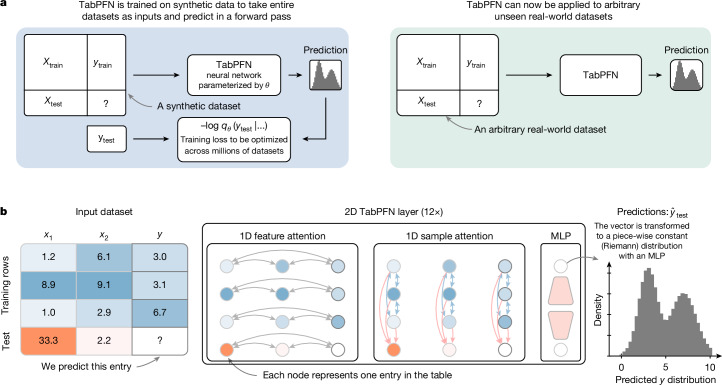
Tabular data, spreadsheets organized in rows and columns, are ubiquitous across scientific fields, from biomedicine to particle physics to economics and climate science 1,2. The fundamental prediction task of filling in missing values of a label column based on the rest of the columns is essential for various applications as diverse as biomedical risk models, drug discovery and materials science. Although deep learning has revolutionized learning from raw data and led to numerous high-profile success stories 3–5, gradient-boosted decision trees 6–9 have dominated tabular data for the past 20 years. Here we present the Tabular Prior-data Fitted Network (TabPFN), a tabular foundation model that outperforms all previous methods on datasets with up to 10,000 samples by a wide margin, using substantially less training time. In 2.8 s, TabPFN outperforms an ensemble of the strongest baselines tuned for 4 h in a classification setting. As a generative transformer-based foundation model, this model also allows fine-tuning, data generation, density estimation and learning reusable embeddings. TabPFN is a learning algorithm that is itself learned across millions of synthetic datasets, demonstrating the power of this approach for algorithm development. By improving modelling abilities across diverse fields, TabPFN has the potential to accelerate scientific discovery and enhance important decision-making in various domains.
Overview
CoChat Summary
TL;DR
TabPFN is a tabular foundation model pretrained on millions of synthetic datasets that uses in-context learning to outperform prior methods on small- to medium-sized tabular data up to 10,000 samples and 500 features. It delivers strong classification and regression performance in a single forward pass and also supports fine-tuning, data generation, density estimation, reusable embeddings, and interpretability.
Key findings
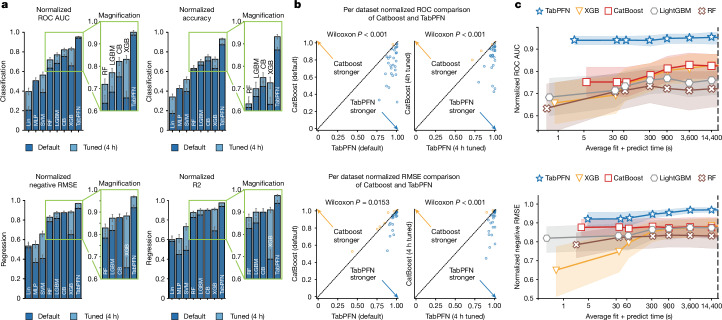
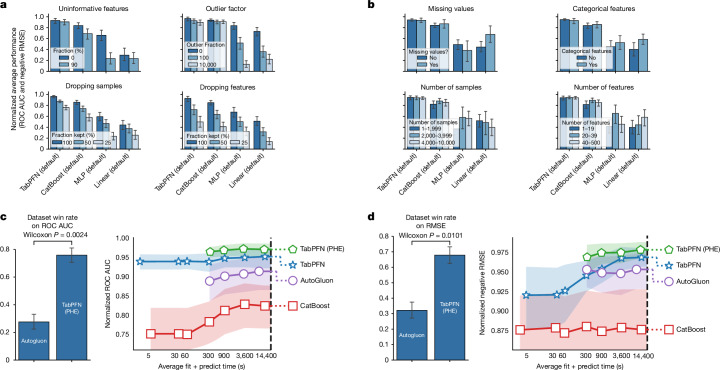
- On benchmarks with 29 classification and 28 regression datasets up to 10,000 samples, 500 features, and 10 classes, TabPFN outperformed tuned baselines. Classification normalized ROC AUC: TabPFN default 0.939 vs CatBoost default 0.752; tuned TabPFN 0.952 vs tuned CatBoost 0.822. Regression normalized RMSE: TabPFN default 0.923 vs CatBoost default 0.872; tuned TabPFN 0.968 vs tuned CatBoost 0.875.
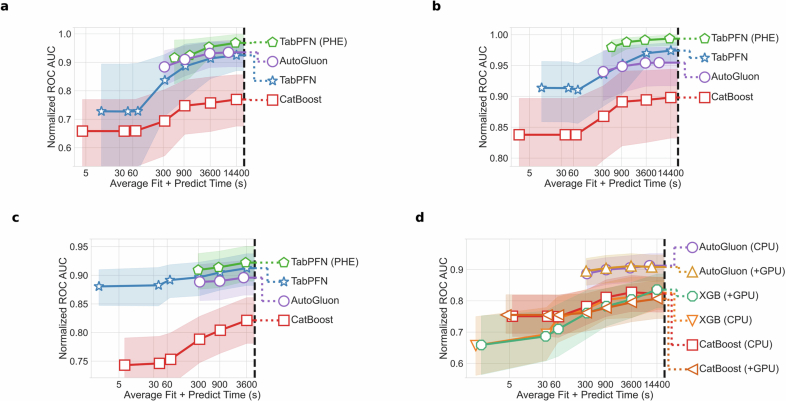
- TabPFN default took 2.8 s for classification and 4.8 s for regression on average, outperforming baselines tuned for 4 h—a speedup of 5,140× for classification and 3,000× for regression. TabPFN (PHE) reached average normalized ROC AUC 0.971 vs 0.939 for TabPFN default and 0.914 for AutoGluon; for regression, TabPFN (PHE) outperformed AutoGluon allowed 4 h after a 300 s tuning budget, a 48× speedup.
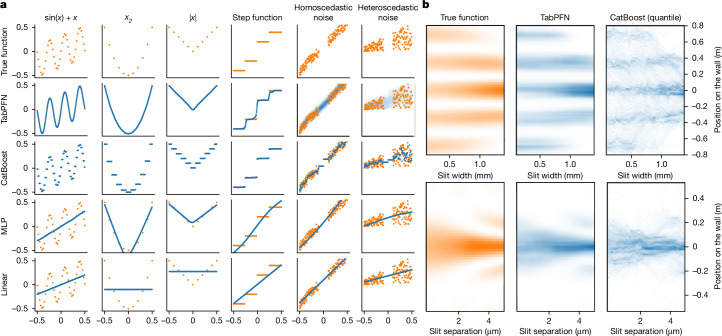
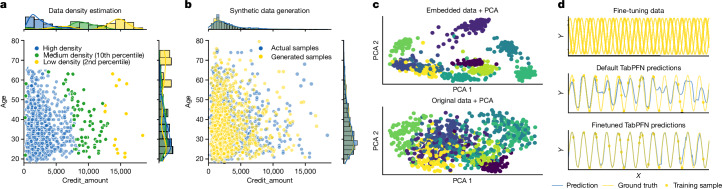
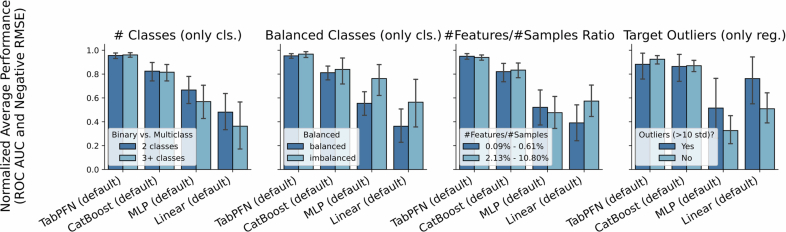
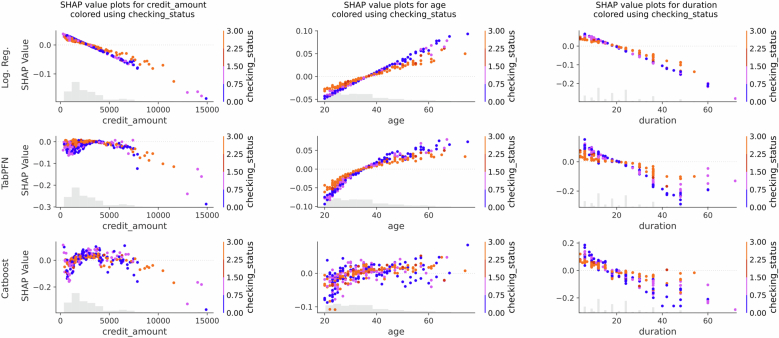
- TabPFN was robust to uninformative features and outliers, and with half the samples it performed as well as the next best method using all samples. It also demonstrated foundation-model abilities including density estimation, synthetic data generation, learned embeddings, fine-tuning, and SHAP-based feature importance.
Methods
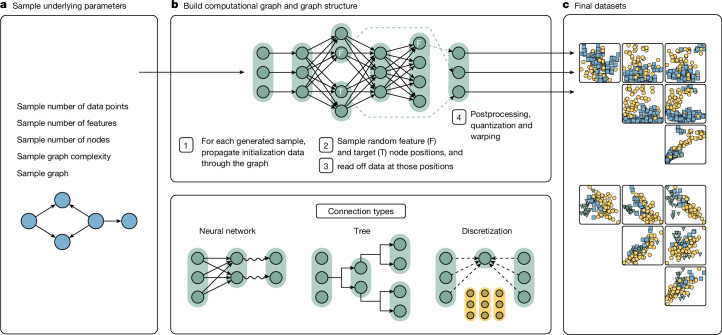
- TabPFN was pretrained on synthetic tabular datasets generated from structural causal models: around 100 million synthetic datasets per model training, with final models trained for approximately 2,000,000 steps at batch size 64 datasets, corresponding to around 130,000,000 synthetically generated datasets each.
- The architecture is a transformer encoder variant that treats each table cell as a separate position and uses two-way attention: each cell attends to other features in its row, then to the same feature across its column. At inference, training samples are provided as context and predictions are made in a single forward pass via in-context learning; train-state caching enables reuse for multiple test inferences.
- Evaluation used the AutoML Benchmark and OpenML-CTR23, with 29 classification and 28 regression datasets up to 10,000 samples, 500 features, and 10 classes. Each dataset and method was run for 10 repetitions with different random seeds and 90% train/10% test splits; hyperparameters were tuned by random search with five-fold cross-validation using time budgets from 30 s to 4 h. Metrics were ROC AUC and accuracy for classification, and R² and negative RMSE for regression, normalized per dataset.
Limitations
- The paper states that TabPFN inference may be slower than highly optimized approaches such as CatBoost; memory usage scales linearly with dataset size and can be prohibitive for very large datasets; and evaluation focused on datasets with up to 10,000 samples and 500 features, so scalability to larger datasets requires further study.
- The paper also states TabPFN is not optimized for real-time inference: for a dataset with 10,000 rows and 10 columns, it requires 0.2 s (0.6 s without GPU) to predict one sample, whereas CatBoost default can do so in 0.0002 s.
- The paper notes that for larger datasets and highly non-smooth regression datasets, CatBoost, XGBoost, or AutoGluon are likely to outperform TabPFN, and that natively the method is limited to predicting at most 10 classes unless pretrained on more classes or adapted with approaches such as one-vs-one, one-vs-rest, or ECOC.
Model-written summary. Check it against the paper before relying on it.
Integrity signals
Registry
Cites
Statistics
Figures
Verification
Claims the paper makes
1 Valid · 6 Not valid · 17 Not checked · 72 Own results and interpretations
The sources with a verdict support this claim; the rest weren’t checked yet, have no full text we could read, or their verdicts aren’t rated yet.
In the paper
“For larger datasets and highly non-smooth regression datasets, approaches such as CatBoost9, XGB7 or AutoGluon40 are likely to outperform TabPFN.”
§ Accurate predictions on small data with a tabular foundation model > Methods > User guide
What the sources say
- Check pendingcites [9] Prokhorenkova, L., Gusev, G., Vorobev, A., Dorogush, A. & Gulin, A. CatBoost: unbiased boosting with categorical features. In Proc. 30th International Conference on Advances in Neural Information Processing Systems (eds Bengio, S. et al.) 6639–6649 (Curran Associates, 2018). source
- Supportedcites [7] Chen, T. & Guestrin, C. Xgboost: A scalable tree boosting system. In Proc. 22nd ACM SIGKDD International Conference on Knowledge Discovery and Data Mining (eds Krishnapuram, B. et al.) 785–794 (ACM Press, 2016). source
The citation is offered to identify the system 'XGB' named in the citing sentence, and our copy is that system's paper: the Abstract and Introduction (KDD '16) describe XGBoost as 'a scalable end-to-end tree boosting system' that 'scales beyond billions of examples using far fewer resources than existing systems', used 'to achieve state-of-the-art results on many machine learning challenges'. The Introduction (p.1) further notes 17 of 29 Kaggle winning solutions in 2015 used XGBoost, and the evaluation sections report it running >10x faster than Spark MLLib/H2O on the 1.7-billion-example Criteo data, consistent with the 'larger datasets' framing. The head-to-head comparison against TabPFN and the 'highly non-smooth regression' qualification are the citing authors' own conclusion (TabPFN postdates this source) and are not attributed to this paper, so nothing here is unsupported for the part this citation carries. (LLM, conf=0.85)
- Check pendingcites [40] Erickson, N. et al. Autogluon-tabular: robust and accurate automl for structured data. Preprint at https://arxiv.org/abs/2003.06505 (2020). source
hedgedstates a possible cause- Asserted: passes — The authors put it forward as true.
- Checkable: passes — It can be checked against evidence.
- Load-bearing: unclear — It is unclear whether the paper’s conclusions depend on it.
- Based: passes — The paper gives a reason why it holds.
A result the paper states — it cites no source for it, so there is none to check. The quote shows it is in the paper.
In the paper
“This new supervised tabular learning method can be applied to any small- to moderate-sized dataset and yields dominant performance for datasets with up to 10,000 samples and 500 features.”
§ Accurate predictions on small data with a tabular foundation model > Main
plainstates a causen = 10,000- Asserted: passes — The authors put it forward as true.
- Checkable: passes — It can be checked against evidence.
- Load-bearing: passes — The paper’s conclusions depend on it.
- Based: passes — The paper gives a reason why it holds.
A result the paper reports from its own data — it cites no other source for it, so there is none to check. The quote shows it is in the paper.
In the paper
“We extract and visualize learned embeddings from the mfeat-factors dataset in Fig. 6c, showing improved class separation compared with the raw data on the first two principal components.”
§ Accurate predictions on small data with a tabular foundation model > Foundation model with interpretability
plainstates a cause- Asserted: passes — The authors put it forward as true.
- Checkable: passes — It can be checked against evidence.
- Load-bearing: unclear — It is unclear whether the paper’s conclusions depend on it.
- Based: passes — The paper gives a reason why it holds.
A result the paper reports from its own data — it cites no other source for it, so there is none to check. The quote shows it is in the paper.
In the paper
“we found that pre-processing inputs can help performance”
§ Accurate predictions on small data with a tabular foundation model > Methods > Details on the neural architecture
plainstates a possible cause- Asserted: passes — The authors put it forward as true.
- Checkable: passes — It can be checked against evidence.
- Load-bearing: unclear — It is unclear whether the paper’s conclusions depend on it.
- Based: passes — The paper gives a reason why it holds.
In the paper
“As our models are not fully permutation invariant, for each ensemble member, we shuffle the feature order, approximating order invariance64.”
§ Accurate predictions on small data with a tabular foundation model > Methods > Inference details
What the sources say
- Not checked yetcites [64] Murphy, R. L., Srinivasan, B., Rao, V. A. & Ribeiro, B. Janossy pooling: learning deep permutation-invariant functions for variable-size inputs. In Proc. 7th International Conference on Learning Representations (ICLR, 2019). source
plain- Asserted: passes — The authors put it forward as true.
- Checkable: passes — It can be checked against evidence.
- Load-bearing: passes — The paper’s conclusions depend on it.
- Based: passes — The paper gives a reason why it holds.
25 more claims
Create a free account to see all 96 claims and to verify the 28 references still open.
- Probably not a substantial claim. 32
- It may state two separate claims as one. 47
Self-check
Percentages, sums and reported differences re-computed from the paper’s own numbers.
Each contradiction between two passages listed here was confirmed by an independent check.
Rated minor: it would not touch a result — a value no result rests on, a p-value that stays on the same side of the significance level, or a conflict that is clerical, resolved elsewhere in the paper, or outside its own findings.
In the paper
§ Accurate predictions on small data with a tabular foundation model > Quantitative analysis > Comparison with tuned ensemble methods
“In just 2.8 s, TabPFN (default) outperforms AutoGluon for classification tasks, even if AutoGluon is allowed up to 4 h, a 5.140× speedup.”
§ Accurate predictions on small data with a tabular foundation model > Quantitative analysis > Comparison with state-of-the-art baselines
“The default of TabPFN, taking 2.8 s on average for classification and 4.8 s for regression, outperforms all baselines, even when tuning them for 4 h—a speedup of 5,140× and 3,000×, respectively.”
Rated minor: it would not touch a result — a value no result rests on, a p-value that stays on the same side of the significance level, or a conflict that is clerical, resolved elsewhere in the paper, or outside its own findings.
In the paper
§ Accurate predictions on small data with a tabular foundation model > Quantitative analysis
“TabPFN was pre-trained once using eight NVIDIA RTX 2080 GPUs over 2 weeks”
§ Accurate predictions on small data with a tabular foundation model > Methods > Training details
“One training run requires around 2 weeks on one node with eight Nvidia RTX 2080 Ti GPUs.”
Rated minor: it would not touch a result — a value no result rests on, a p-value that stays on the same side of the significance level, or a conflict that is clerical, resolved elsewhere in the paper, or outside its own findings.
In the paper
§ Accurate predictions on small data with a tabular foundation model > An architecture designed for tables
“This design enables the architecture to be invariant to the order of both samples and features”
§ Accurate predictions on small data with a tabular foundation model > Methods > Inference details
“As our models are not fully permutation invariant, for each ensemble member, we shuffle the feature order, approximating order invariance64.”
Citations
Cites
Breiman, L. (2001) · Machine Learning · doi:10.1023/a:1010933404324 · Cited by 133,538
Vaswani, A., Shazeer, N., Parmar, N., Uszkoreit, J., Jones, L., Gomez, A. N., Kaiser, L., & Polosukhin, I. (2017) · arXiv · doi:10.48550/arxiv.1706.03762 · Cited by 120,404
Distinctive Image Features from Scale-Invariant Keypoints
Lowe, D. G. (2004) · International Journal of Computer Vision · doi:10.1023/b:visi.0000029664.99615.94 · Cited by 62,647 · cited 2×
“Hand-designed features in computer vision, such as SIFT (Scale Invariant Feature Transform) 10 and HOG (Histogram of Oriented Gradients) 11 , have been replaced by learned convolutions; grammar-based approaches in natural language processing have been replaced by learned transformers 12 ; and the design of customized…”
Cortes, C., & Vapnik, V. (1995) · Machine Learning · doi:10.1007/bf00994018 · Cited by 59,421
XGBoost: A Scalable Tree Boosting System
Chen, T., & Guestrin, C. (2016) · Proceedings of the 22nd ACM SIGKDD International Conference on Knowledge Discovery and Data Mining · doi:10.1145/2939672.2939785 · Cited by 54,569
Highly accurate protein structure prediction with AlphaFold
Jumper, J., Evans, R., Pritzel, A., Green, T., Figurnov, M., Ronneberger, O., Tunyasuvunakool, K., Bates, R., Žídek, A., Potapenko, A., et al. (2021) · Nature · doi:10.1038/s41586-021-03819-2 · Cited by 43,764
Histograms of Oriented Gradients for Human Detection
Dalal, N., & Triggs, B. (2005) · 2005 IEEE Computer Society Conference on Computer Vision and Pattern Recognition (CVPR'05) · doi:10.1109/cvpr.2005.177 · Cited by 33,584
Greedy function approximation: A gradient boosting machine
Friedman, J. H. (2001) · The Annals of Statistics · doi:10.1214/aos/1013203451 · Cited by 30,731 · cited 2×
“The list of development datasets can be found in Supplementary Tables 5 and 6.”
Language Models are Few-Shot Learners
Brown, T. B., Mann, B., Ryder, N., Subbiah, M., Kaplan, J., Dhariwal, P., Neelakantan, A., Shyam, P., Sastry, G., Askell, A., et al. (2020) · arXiv · doi:10.48550/arxiv.2005.14165 · Cited by 23,372 · cited 1×
“We build on a preliminary version of TabPFN 23 , which demonstrated the applicability of in-context-learning 17 for tabular data in principle but had many limitations that rendered it inapplicable in most cases.”
Quinlan, J. R. (1986) · Machine Learning · doi:10.1007/bf00116251 · Cited by 21,439
Research works printed but not linked: 11
- van Breugel, B. & van der Schaar, M. Position: why tabular foundation models should be a research priority. In Proc. 41st International Conference on Machine Learning 48976–48993 (PMLR, 2024).
- Akyürek, E., Schuurmans, D., Andreas, J., Ma, T. & Zhou, D. What learning algorithm is in-context learning? Investigations with linear models. In Proc. The Eleventh International Conference on Learning Representations (ICLR, 2023).
- Müller, S., Hollmann, N., Pineda-Arango, S., Grabocka, J. & Hutter, F. Transformers can do Bayesian inference. In Proc.The Tenth International Conference on Learning Representations (ICLR, 2022).
- Kingma, D. & Ba, J. Adam: A method for stochastic optimization. In Proc. International Conference on Learning Representations (ICLR, 2015).
- Bahdanau, D., Cho, K. & Bengio, Y. Neural machine translation by jointly learning to align and translate. In Proc. 3rd International Conference on Learning Representations (eds Bengio, Y. & LeCun, Y.) (ICLR, 2015).
- Gorishniy, Y., Rubachev, I., Khrulkov, V. & Babenko, A. Revisiting deep learning models for tabular data. In Proc. Advances in Neural Information Processing Systems 34 (eds Ranzato, M. et al.) 18932–18943 (NeurIPS, 2021).
- Fischer, S. F., Feurer, M. & Bischl, B. OpenML-CTR23 – a curated tabular regression benchmarking suite. In Proc. AutoML Conference 2023 (Workshop) (AutoML, 2023).
- Lundberg, S. M. & Lee, S.-I. A unified approach to interpreting model predictions. In Proc.Advances in Neural Information Processing Systems (eds Guyon, I. et al.) Vol. 30, 4765–4774 (Curran Associates, 2017).
- Nagler, T. Statistical foundations of prior-data fitted networks. In Proc. 40th International Conference on Machine Learning (eds Krause, A. et al.) Vol. 202, 25660–25676 (PMLR, 2023).
- Müller, S., Feurer, M., Hollmann, N. & Hutter, F. PFNS4BO: in-context learning for Bayesian optimization. In Proc. 40th International Conference on Machine Learning 25444–25470 (PMLR, 2023).
- Loshchilov, I. & Hutter, F. SGDR: Stochastic gradient descent with warm restarts. In Proc. 5th International Conference on Learning Representations (ICLR, 2017).
Cited by
Items 801–900 of 2,324
Saragih, A., Janjevic, M., Sheffi, Y., & Fransoo, J. C. (2025) · SSRN Electronic Journal · doi:10.2139/ssrn.5226795 · Cited by 2
A Knowledge-Informed Pretrained Model for Causal DiscoveryPreprint
Xu, W., He, Y., Wang, Y., Zhang, X., Kuang, K., Chen, Y., & Cui, P. (2026) · arXiv (Cornell University) · doi:10.48550/arxiv.2603.20842 · Cited by 2
Villines, J., Stirnimann, R., Lukas, L. P., Taran, O., Tuci, M., Li, Y., Jutzeler, C. R., Kramer, J. L. K., Geisler, F. H., Bourbeau, D. J., et al. (2026) · Topics in Spinal Cord Injury Rehabilitation · doi:10.46292/sci25-00137 · Cited by 2
Peng, F., Ning, W., Li, K., Xu, X., Chu, X., & Liu, C. (2026) · Journal of Marine Science and Engineering · doi:10.3390/jmse14080758 · Cited by 2
Billah, M. A. M., & Sarker, T. (2025) · Research Square · doi:10.21203/rs.3.rs-7840588/v1 · Cited by 2
TRL-Bench: Standardizing Cross-Paradigm Representation-Level Evaluation of Tabular EncodersPreprint
Pang, W., Jian, X., Li, H., Yu, Z., Xue, A., Li, J., Dong, Z., Zhao, X., Xu, H., Zhang, C., et al. (2026) · arXiv (Cornell University) · doi:10.48550/arxiv.2606.09323 · Cited by 2
Are Time-Indexed Foundation Models the Future of Time Series Imputation?
Naour, E. L., Nabil, T., Petralia, A., & Agoua, G. (2026) · Transactions on machine learning research · doi:10.48550/arxiv.2511.05980 · Cited by 2
Usdin, M., Kriara, L., & Craveiro, L. (2025) · arXiv (Cornell University) · doi:10.48550/arxiv.2506.14986 · Cited by 2
Analysis of Multi-Omics Data in Breast Cancer Subtype Classification
Zhumagozhayev, K., Zhaksylyk, T., Abdikenov, B., Djansugurova, L., & Zhunussova, G. (2026) · IEEE Access · doi:10.1109/access.2026.3695279 · Cited by 2
TabSurv: Adapting Modern Tabular Neural Networks to Survival AnalysisPreprint
Kirpichenko, S. R., Konstantinov, A., & Utkin, L. V. (2026) · arXiv (Cornell University) · doi:10.48550/arxiv.2605.03944 · Cited by 2
Images as Tables: In-Context Learning with TabPFN for Low-Data Detection of AI-Generated ImagesPreprint
Walter, J. P., Agnihotri, S., & Keuper, M. (2026) · arXiv (Cornell University) · doi:10.48550/arxiv.2606.00872 · Cited by 2
Towards Understanding Layer Contributions in Tabular In-Context Learning ModelsPreprint
Balef, A. R., Koshil, M., & Eggensperger, K. (2025) · arXiv (Cornell University) · doi:10.48550/arxiv.2511.15432 · Cited by 2
A Post-Processing Conformal Prediction Approach for Conditional Coverage via Pivotal ScoresPreprint
Laplante, F. (2026) · arXiv (Cornell University) · doi:10.48550/arxiv.2605.25852 · Cited by 2
Gruyter, C. D., Pemberton, S., Keys, E., Dodson, J., & Renne, J. L. (2025) · Journal of Transport and Land Use · doi:10.5198/jtlu.2025.2667 · Cited by 2
Kim, D., To, M. N. N., Abdalla, S., Tsang, T. S. M., Abolmaesumi, P., & Luong, C. L. (2025) · Lecture notes in computer science · doi:10.1007/978-3-032-06329-8_23 · Cited by 2
Improving LLM-based Global Optimization with Search Space Partitioning
Schwanke, A. M. L., Ivanov, L., Salinas, D., Ferreira, F., Klein, A., Hutter, F., & Zela, A. (2026) · International Conference on Learning Representations · doi:10.48550/arxiv.2505.21372 · Cited by 2
Self-citationA Novel Small Data Prediction Model of Activity for Multiple Slag Systems Based on TabPFN and SHAP
Xin, Z., Zhang, J., Lan, M., & Liu, Q. (2025) · ISIJ International · doi:10.2355/isijinternational.isijint-2025-191 · Cited by 2
Meta simulation approach for evaluating machine learning method selection in data limited settings
Alwash, M., Hajj, G. S. A., Grytten, I., & Sandve, G. K. (2025) · Scientific Reports · doi:10.1038/s41598-025-24627-y · Cited by 2
Liu, T., Xie, D., Liu, T., Shan, J., & Tang, C. (2025) · Traffic Injury Prevention · doi:10.1080/15389588.2025.2577155 · Cited by 2
Exploiting Function-Family Structure in Analog Circuit Optimization
Liu, Z., Huang, K., Mei, Q., Hu, Y., & Xing, W. W. (2026) · ACM/IEEE Design Automation Conference (DAC) · doi:10.1145/3770743.3804069 · Cited by 2
Papadopoulos, G., Espejo-García, B., Zafeiriou, I., Georgiou, E., Oikonomou, A., Mavroeidis, A., Stavropoulos, P., Kakabouki, I. P., Fountas, S., & Bilalis, D. J. (2025) · Smart Agricultural Technology · doi:10.1016/j.atech.2025.101732 · Cited by 2
Tang, Y. A. (2025) · Journal of Nuclear Materials · doi:10.1016/j.jnucmat.2025.156413 · Cited by 2
Causal Pre-training Under the Fairness Lens: An Empirical Study of TabPFN
Liu, Q., Khalil, M., & Goel, N. (2026) · International World Wide Web Conference (WWW) · doi:10.1145/3774904.3792961 · Cited by 2
Xu, J., Wei, X. J., Yu, Y., Yang, L., Zhai, Y., Lv, C., & Song, X. (2026) · Hydrology and earth system sciences · doi:10.5194/hess-30-5647-2026 · Cited by 2
A machine learning pipeline for silicon wafer warpage prediction in diamond coated wire slicing
zavattari, C., Demaria, D., Bonda, F., & Iacca, G. (2026) · Materials Today Communications · doi:10.1016/j.mtcomm.2026.114857 · Cited by 2
Tabular Foundation Models Can Learn Association Rules
Karabulut, E., Daza, D., Groth, P., Schut, M. C., & Degeler, V. (2026) · Transactions on machine learning research · doi:10.48550/arxiv.2602.14622 · Cited by 2
Mao, Y., Li, Y., Lai, Y., & Fan, F. (2026) · Applied Sciences · doi:10.3390/app16042029 · Cited by 2
Hu, X., Han, D., Qin, Q., Que, Y., Wang, H., Feng, D., Chen, R., Duan, J., Li, Y., & Li, F. (2026) · Remote Sensing · doi:10.3390/rs18050671 · Cited by 2
Liang, X., Yang, B., Hao, J., Wu, X., Liu, M., Zhang, X., Wang, Z., & Wu, X. (2026) · Construction and Building Materials · doi:10.1016/j.conbuildmat.2026.145853 · Cited by 2
Improving TabPFN's Synthetic Data Generation by Integrating Causal Structure
Tugnoli, D., Lorenzo, A. D., Virgolin, M., & Cinà, G. (2026) · Uncertainty in Artificial Intelligence · doi:10.48550/arxiv.2603.10254 · Cited by 2
Yin, H., Chen, J., Guo, F., & Yang, J. (2026) · Tribology International · doi:10.1016/j.triboint.2026.111936 · Cited by 2
Zhang, L., Huang, B. Q., Li, Y., Meng, C., & Wu, M. (2026) · Advanced Engineering Informatics · doi:10.1016/j.aei.2026.104615 · Cited by 2
Zhongchang, W., Hu, Z., Yang, Y., & Xiaohang, T. (2026) · Engineering Research Express · doi:10.1088/2631-8695/ae586d · Cited by 2
Zhao, X., Zhang, P.-F., Zhang, J. W., Tuerxunmaimaiti, Y., & Zhao, Q. D. (2026) · Journal of Composite Materials · doi:10.1177/00219983261441175 · Cited by 2
Dong, Z., Liu, P., Cao, S., Zhao, B., Wang, Y., Wang, L., & Li, N. (2026) · Journal of environmental chemical engineering · doi:10.1016/j.jece.2026.122869 · Cited by 2
ITBoost: Information-Theoretic Trust for Robust Boosting
Su, Y., Zhao, L., García‐Gil, D., Guo, J., Zhang, G., Chen, J., & Chen, J. (2026) · International Joint Conference on Artificial Intelligence · doi:10.24963/ijcai.2026/540 · Cited by 2
On the Uncertainty Quantification Ability of Tabular Foundation Models
Johnson, T. B., Ben-Jacob, K., Negarandeh, N., Vendrell-Gallart, O., & Bostanabad, R. (2026) · Computing in Science & Engineering · doi:10.1109/mcse.2026.3701626 · Cited by 2
Lim, E., & Lim, C. E. D. (2026) · AI in Clinical Medicine · doi:10.14740/aicm27 · Cited by 2
Isaev, Y. I., Kovalev, A. E., Ksenofontov, A. A., Makarov, D. M., & Anatolevich, K. I. (2026) · Journal of Chemical Information and Modeling · doi:10.1021/acs.jcim.6c01787 · Cited by 2
A Fair Benchmarking of Deep Relational Database Learning Models
Akhter, K., Samad, M. D., & Ajendla, B. (2026) · International Conference on Machine Learning and Applications · doi:10.1109/icmla69890.2026.00032 · Cited by 2
Chandrinos, S. K., Voulgaris, S., Mitropoulou, C. C., Gkara, M., Georgantzinos, S. K., & Lagaros, N. D. (2026) · Machine learning for computational science and engineering · doi:10.1007/s44379-026-00075-x · Cited by 2
Xiang, Z., Gao, M., Holford, S., King, R., Mildren, S. D., Sage, J., & Oh, J. (2026) · Engineering Geology · doi:10.1016/j.enggeo.2026.108992 · Cited by 2
Machine Learning Framework for Energy Consumption Optimization using the TabPFNRegressor Algorithm
Saleh, H., Baali, Z., & El–Sappagh, S. (2025) · doi:10.1109/iceeng64546.2025.11031306 · Cited by 2
IAR‐Net: Tabular Deep Learning Model for Interventionalist's Action Recognition
Akinyemi, T. O., Omisore, O. M., Du, W., Duan, W., Chen, B., Liu, K., Wang, L., & Wei, M. (2025) · Advanced Intelligent Systems · doi:10.1002/aisy.202500391 · Cited by 2
Automated supervised identification of thunderstorm ground enhancements (TGEs)
Aslanyan, D. (2026) · Journal of Atmospheric and Solar-Terrestrial Physics · doi:10.1016/j.jastp.2026.106862 · Cited by 2
Ramalingam, M. (2025) · arXiv (Cornell University) · doi:10.48550/arxiv.2509.10048 · Cited by 2
AutoML Benchmark with shorter time constraints and early stoppingPreprint
Campero-Jurado, I., Gijsbers, P., & Vanschoren, J. (2025) · arXiv (Cornell University) · doi:10.48550/arxiv.2504.01222 · Cited by 2
Mitigating Model Drift in Developing Economies Using Synthetic Data and OutliersPreprint
Varshavskiy, I., Boboeva, B., Khalilbekov, S., Azimi, A., Shulgin, S., Nizamitdinov, A., & Borde, H. S. D. O. (2025) · arXiv (Cornell University) · doi:10.48550/arxiv.2510.09294 · Cited by 2
Jia, Y., Gao, X., Zhihui, C. A. I., Ji, Y., & He, Q. (2025) · SSRN Electronic Journal · doi:10.2139/ssrn.5616984 · Cited by 2
Transformers can do Bayesian ClusteringPreprint
Bhaskaran, P., & Viering, T. J. (2025) · arXiv (Cornell University) · doi:10.48550/arxiv.2510.24318 · Cited by 2
In-context learning to predict critical transitions in dynamical systemsPreprint
Sevinchan, Y., Nathaniel, J., Ueltzhöffer, K. J., Roesch, C. M., WEBER, T., Laschos, V., Fan, H., Ramien, G., Haux, J., Gentine, P., et al. (2026) · arXiv (Cornell University) · doi:10.48550/arxiv.2605.12308 · Cited by 2
Distilling Tabular Foundation Models for Structured Health DataPreprint
Tanna, A., Bouarour, N., Bouadi, M., Sankarapu, V. K., & Seth, P. (2026) · arXiv (Cornell University) · doi:10.48550/arxiv.2605.18702 · Cited by 2
Speedrunning Tabular Foundation Model PretrainingPreprint
Ozturk, S. B., Pfefferle, A., & Hutter, F. (2026) · arXiv (Cornell University) · doi:10.48550/arxiv.2606.03681 · Cited by 2
Self-citationBounded Context Management for Tabular Foundation Models on Stream LearningPreprint
Lee, J., Choi, D., Choi, M., & Yoo, J. (2026) · arXiv (Cornell University) · doi:10.48550/arxiv.2606.18677 · Cited by 2
Context-Constrained Transfer Learning for Tabular Foundation Models via Data DistillationPreprint
Lin, Y., & Li, S. (2026) · arXiv (Cornell University) · doi:10.48550/arxiv.2607.04809 · Cited by 2
Revisiting data-driven dynamic security assessment with a tabular foundation modelPreprint
Arowolo, O., Yang, M., & Cremer, J. L. (2026) · SSRN Electronic Journal · doi:10.2139/ssrn.7302183 · Cited by 2
In-Context Time Series Classification with Random Convolutional FeaturesPreprint
Cüppers, J., & Vreeken, J. (2026) · arXiv (Cornell University) · doi:10.48550/arxiv.2607.19234 · Cited by 2
Empirical Evaluation of Out-Of-Distribution Performance of Tabular Foundation ModelsPreprint
Loza, M., Chushig-Muzo, D., Milara, E., Bote-Curiel, L., Estrada, L., & Grijalva, F. (2026) · arXiv (Cornell University) · doi:10.48550/arxiv.2607.26000 · Cited by 2
Qin, Q., Zhu, J., Chen, D., Zhang, Y., Han, J.-X., Zhang, P., Yan, Y., Sun, Y., & Su, Y. (2026) · arXiv (Cornell University) · doi:10.48550/arxiv.2608.18849 · Cited by 2
Do Tabular Foundation Models Know Physics? Contamination, Units, and the Deterministic LimitPreprint
Tenachi, W., Hezaveh, Y., Perreault-Levasseur, L., & Bacon, P. (2026) · arXiv (Cornell University) · doi:10.48550/arxiv.2609.02766 · Cited by 2
Learning to Fluctuate: Statistical Foundations for Causal Tabular PretrainingPreprint
Zhang, Z. (2026) · arXiv (Cornell University) · doi:10.48550/arxiv.2609.26290 · Cited by 2
Can Tabular Foundation Models Amortize Statistical Inference?Preprint
Ye, K., Gong, S., Zhou, H., Zangirolami, V., & Shi, C. (2026) · arXiv (Cornell University) · doi:10.48550/arxiv.2609.33114 · Cited by 2
Won, H.-I. (2026) · arXiv (Cornell University) · doi:10.48550/arxiv.2610.08118 · Cited by 2
Liu, A., Kim, G., & Song, H. (2026) · Chemical Engineering Journal · doi:10.1016/j.cej.2026.175701 · Cited by 1
MLE-STAR: Machine Learning Engineering Agent via Search and Targeted Refinement
Nam, J., Yoon, J., Chen, J., Shin, J., Arık, S. Ö., & Pfister, T. (2025) · arXiv · doi:10.48550/arxiv.2506.15692 · Cited by 1
“The proliferation of machine learning (ML) has driven high-performance applications across diverse real-world scenarios, from fundamental tasks like tabular classification [1, 2, 3] to complex ones such as image denoising [4].”
Toward End-to-End Fault Diagnosis: An Adaptive Masked Modeling Framework With Retrieval Augmentation
Cheng, Q., He, W., Wen, Z., Tao, Y., & Feng, C. (2026) · IEEE Sensors Journal · doi:10.1109/jsen.2026.3668793 · Cited by 1
Qiu, Y., Cui, S., Zhang, H., Huang, Y. N., Chen, X., Zhao, Y., Zhuang, S., & Jiang, G. (2026) · Environmental Science & Technology · doi:10.1021/acs.est.5c18135 · Cited by 1
Market analytics beyond big data: pretrained AI models for industrial order forecasting in Germany
Muth, M., Engel, J., & Nufer, G. (2026) · Journal of Marketing Analytics · doi:10.1057/s41270-026-00489-9 · Cited by 1
Olcha, P., Paja, W., Kępski, M., Pancerz, K., Klębowski, B., Nowakowski, Ł., Gałczyński, K., & Depciuch, J. (2026) · Analytical Biochemistry · doi:10.1016/j.ab.2026.116047 · Cited by 1
Huet‐Dastarac, M., Dankar, F. K., Liu, D., Kababji, S. E., Pilgram, L., & Emam, K. E. (2026) · Journal of Medical Internet Research · doi:10.2196/88678 · Cited by 1
Integrating artificial intelligence tools in health research
Postill, G., Sedláková, J., Tancredi, S., Smit, F., Ekongefeyin, S. N. N., Baumer, A. M., Chioléro, A., Bernard, J., Rosella, L. C., & von Wyl, V. (2026) · npj Digital Medicine · doi:10.1038/s41746-026-02739-7 · Cited by 1
Bigan, E., & Dufour, S. (2026) · JMIR AI · doi:10.2196/83853 · Cited by 1
Koufie, A., & Darfor, K. N. (2026) · Food and Humanity · doi:10.2139/ssrn.6439334 · Cited by 1
Hangun, B., Altun, O., & Eyecioğlu, Ö. (2026) · IEEE Access · doi:10.1109/access.2026.3668295 · Cited by 1
Huang, H., Zhang, T., Jiang, Z., Zhang, Z., Jiang, Q., Teng, Y., Zhou, H., Ding, C., Xu, J., Jiang, M., et al. (2026) · European Journal of Nuclear Medicine and Molecular Imaging · doi:10.1007/s00259-026-07838-x · Cited by 1
Gómez-García, J. A., Torres-Pardo, A., Trigo, C., Algaba-Vidoy, M., Navarro‐López, V., Vázquez, D. F., Molero-Mateo, P., Carratalá‐Tejada, M., Rueda, F. M., & Torricelli, D. (2025) · Annual International Conference of the IEEE Engineering in Medicine and Biology Society (EMBC) · doi:10.1109/embc58623.2025.11252917 · Cited by 1
Wang, L., Zhao, X., Fan, Y., Peng, L., Cui, Y., Peng, J., Li, G., Li, X. M., Chen, Y., Wang, L., et al. (2026) · Canadian Journal of Cardiology · doi:10.1016/j.cjca.2026.01.064 · Cited by 1
Li, C., Ma, Z., Zeng, Y., Yang, Z., Li, J., Yang, Z., Xiong, J., Niu, S., Wang, Z., Zhao, H., et al. (2026) · Nature Communications · doi:10.1038/s41467-026-72377-w · Cited by 1
Qi, W., Zhang, Y., Wang, B., Shen, C., & Liu, D. (2026) · International Journal of Gastronomy and Food Science · doi:10.1016/j.ijgfs.2026.101577 · Cited by 1
Varghese, C., Choudhary, A., Starlinger, P., Kendrick, M., Smoot, R., Warner, S. G., Truty, M. J., Habermann, E. B., Salehinejad, H., & Thiels, C. A. (2026) · Surgery · doi:10.1016/j.surg.2025.109976 · Cited by 1
Multimodal multi-instance learning for cardiopulmonary exercise testing performance prediction
Huang, Z., Pan, W., Alishetti, S., Beecy, A., Liu, Z., Gong, A., Shin, S., Clerkin, K. J., Goldsmith, R. L., Majure, D. T., et al. (2026) · npj Digital Medicine · doi:10.1038/s41746-026-02493-w · Cited by 1
Young, J., Nelson, D., Gu, L., & Zhou, R. (2026) · AI Chemistry · doi:10.3390/aichem1020007 · Cited by 1
Liang, Z., Guang, Z. H. U., Li, L., Zhang, T., Zhao, J., & Wangyang (2026) · Precision Engineering · doi:10.1016/j.precisioneng.2026.02.013 · Cited by 1
Wang, M., Wang, T., Wang, X., Liu, C., Gao, F., Qiu, B., Guo, T., & Huang, Y. (2026) · Journal of Translational Medicine · doi:10.1186/s12967-026-07843-6 · Cited by 1
Selim, A. M., Bhatti, O. S., Gomaa, A., Barz, M., & Sonntag, D. (2026) · CHI Conference on Human Factors in Computing Systems · doi:10.1145/3772318.3790594 · Cited by 1
Lv, Y., Zuo, Q., Qian, Y., & Yu, J. (2025) · Physica A Statistical Mechanics and its Applications · doi:10.1016/j.physa.2025.130794 · Cited by 1
ANN-Assisted Switching Loss Prediction for SiC MOSFET Power Module
Wang, Y., Wang, W., Zhu, S., Zhu, H., Zhang, Y., Li, D., Zhu, X., & Gu, W. (2025) · IEEE Transactions on Power Electronics · doi:10.1109/tpel.2025.3642243 · Cited by 1
Jiang, S., Ma, W., Yu, S., Su, C., Yan, R., & Lu, J. (2025) · IEEE International Conference on Bioinformatics and Biomedicine (BIBM) · doi:10.1109/bibm66473.2025.11356564 · Cited by 1
Garst, S. J. F., Kuiper, L. M., van den Akker, E. B., van den Berg, N., Ghanbari, M., Mooijaart, S. P., Beekman, M., Reinders, M. J. T., Slagboom, P. E., & van Meurs, J. B. J. (2026) · Cell Reports Methods · doi:10.1016/j.crmeth.2026.101405 · Cited by 1
Focused PU learning from imbalanced data
Zavitsanos, E., & Παλιούρας, Γ. (2026) · Data Mining and Knowledge Discovery · doi:10.1007/s10618-026-01264-1 · Cited by 1
Generative Data Modelling for Diverse Populations in Africa: Insights from South Africa
Simmons, S. S., Hagan, J. E., & Schack, T. (2025) · Information · doi:10.3390/info16070612 · Cited by 1
Wen, B., Xu, H., Ding, Y., Wang, Q., Zhang, P., Zhang, C., & Wang, W. (2026) · Microsystems & Nanoengineering · doi:10.1038/s41378-026-01164-w · Cited by 1
Fan, W., Zhang, Y., Fu, K., Shen, Z., Li, X., & Li, X. (2026) · Information Sciences · doi:10.1016/j.ins.2026.123429 · Cited by 1
Werling, M., Fuglkjær, A. D., Brown, P., Niemann, C. U., & Agius, R. (2026) · HemaSphere · doi:10.1002/hem3.70336 · Cited by 1
Key operational considerations for biogeographical ancestry prediction capabilities
Poulsen, F., Griffiths, L. R., Haupt, L. M., Hitchcock, C., Wright, K. M., & Daniel, R. (2026) · Forensic Science International · doi:10.1016/j.forsciint.2026.113000 · Cited by 1
Wang, T., Zhang, M., Qu, J., Liu, Z., Li, M., & Wang, X. V. (2026) · Engineering Applications of Artificial Intelligence · doi:10.1016/j.engappai.2026.115061 · Cited by 1
M2FNet: A multimodal fusion network for HAS-negative large vessel occlusion in acute ischemic stroke
Zhu, K., Qu, H., & Zhou, Y. (2026) · Journal of King Saud University - Computer and Information Sciences · doi:10.1007/s44443-026-00709-3 · Cited by 1
Yang, L., Wang, W., Chen, Q., Zeng, Z., & Sun, L. (2025) · ACM SIGKDD Conference on Knowledge Discovery and Data Mining (KDD) · doi:10.1145/3711896.3737180 · Cited by 1
Olcha, P., Kępski, M., Paja, W., Baran, M., Adamczuk, K., Świerszcz, Ł., Gałczyński, K., & Depciuch, J. (2026) · Microchemical Journal · doi:10.1016/j.microc.2026.118821 · Cited by 1
An explainable ensemble learning-based auxiliary diagnosis system for cerebral small vessel disease
Wang, B., Yan, Y., Han, B., Lu, H., Wang, H., Zhang, C., Wang, Z., Zhang, K., Han, X., Wang, C., et al. (2026) · Scientific Reports · doi:10.1038/s41598-026-53171-6 · Cited by 1
Metadata
- Authors
- Hollmann, N., Müller, S., Purucker, L., Krishnakumar, A., Körfer, M., Hoo, S. B., Schirrmeister, R. T., & Hutter, F.
- Affiliations
- University of Freiburg (DE)
- Corresponding author
- Hollmann, Noah
- Müller, Samuel
- Hutter, Frank
- ORCID
- Venue
- Nature
- Published
- 2025-01-08
- Volume
- 637
- Issue
- 8045
- Pages
- 319-326
- ISSN
- 0028-0836 (ISSN-L)
- 1476-4687
- PMC
- PMC11711098
- OpenAlex
- W4406170795
- Semantic Scholar
- 6b238b17e419c7dd3912b9845449496bfb0a571a
- Cited by
- 2,323
- References
- 63
- Citations by year
- 2026: 1829 · 2025: 487
- FWCI
- 417.80
- Type
- journal article
- Language
- en
- Open access
- hybrid
- doi.org
- Licence
- cc-by
- creativecommons.org/licenses/by/4.0 (tdm)
- creativecommons.org/licenses/by/4.0 (vor)
- Locations
- Nature (publishedVersion, cc-by)
- PubMed Central (publishedVersion, cc-by)
- PubMed (publishedVersion)
- RePEc: Research Papers in Economics (submittedVersion)
- Funders
- European Commission (101045765)
- Deutsche Forschungsgemeinschaft (INST 39/963-1, “INST 39/963-1 FUGG”, SFB1597, 417962828, 39/963-1, 499552394)
- Hector Stiftung
- Topics
- Physical Sciences › Computer Science › Artificial Intelligence › Machine Learning and Data Classification
- Physical Sciences › Computer Science › Artificial Intelligence › Neural Networks and Applications
- Physical Sciences › Computer Science › Artificial Intelligence › Domain Adaptation and Few-Shot Learning
- Keywords
- tabular data, tabular foundation models, TabPFN, missing data estimation, small data, generative transformers, synthetic data, fine-tuning, density estimation, embeddings, gradient boosting decision tree, tabular data classification
About these checks
Registry, retraction, Cites and statistics results are computed, not judged, with one exception: a printed reference that no index lists is read once by a model before it counts as a citation error. Claims are extracted by a model and kept only when their quote appears verbatim in the text; each cited source is then checked, with a model’s help, for whether it says what the claim relies on. Those verdicts can be wrong — read the claim’s quote and the cited source before relying on one.
A language model drew the claims from the paper on 2026-11-24, under version 3 of the claim definition (model deepseek-v4.1-flash, prompt extract-v3).
A second model labelled each claim on 2026-11-24 (model jev-1.13-20260917, definition revision gold-guideline-v0.2).
Cited sources are checked with a language model’s help (qwen3.8-omni-flash).
Statistics and arithmetic are recomputed, not judged.
Confidence bands are shown only for fields calibrated on our annotated test set. None is calibrated yet, so no band is shown.
What counts as a claim ›How we measure confidence ›How we check this ›
Are you an author, or do you see a problem with this page? Request a review
Data sources
Bibliographic data: Semantic Scholar, OpenAlex, Crossref.
Contains information from the Semantic Scholar Academic Graph Datasets, made available under the ODC Attribution License (ODC-BY 1.0).
Semantic Scholar’s data is described in: Kinney, R., et al. (2023). The Semantic Scholar Open Data Platform. arXiv:2301.10140.
