

A comprehensive spatio-cellular map of the human hypothalamus
The DOI matches its Crossref record; 45 of the 45 references it cites were found in a registry or an index.
Abstract
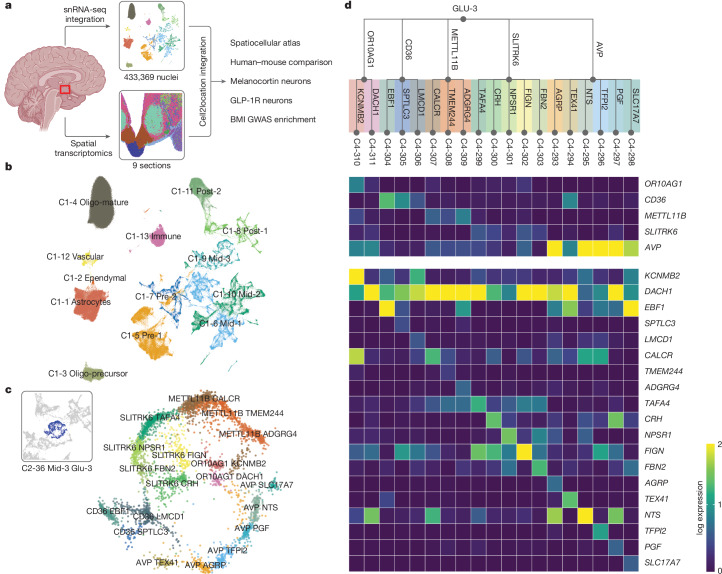
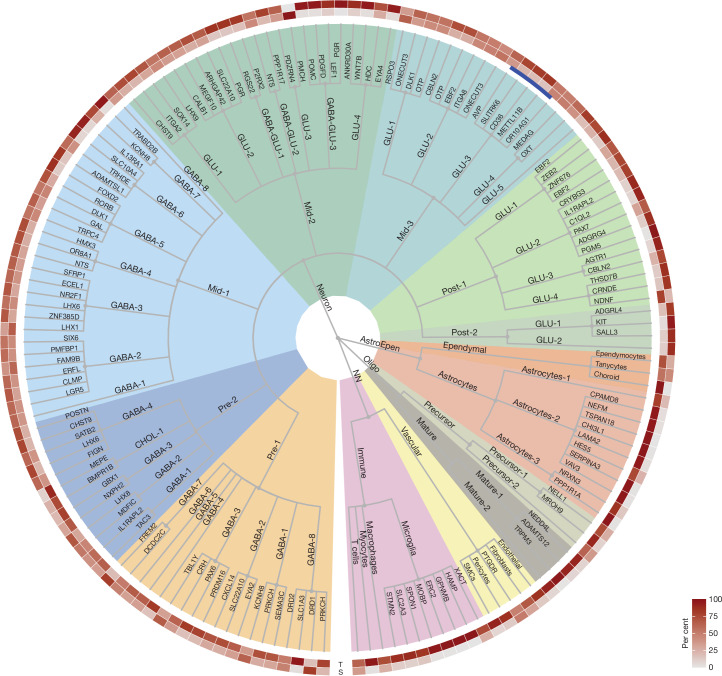
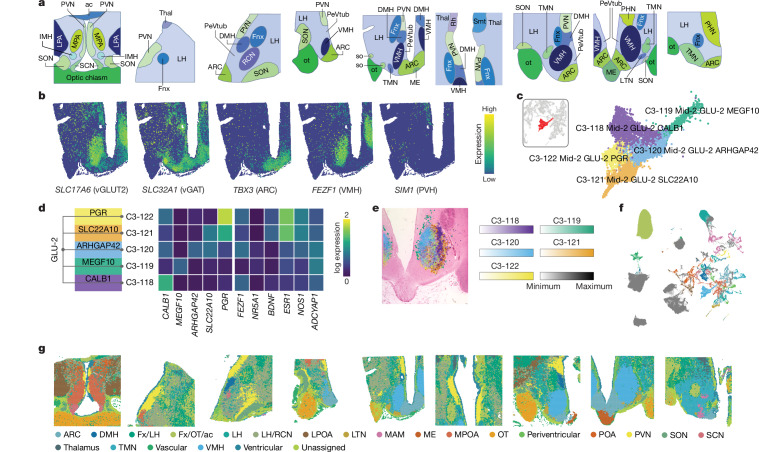
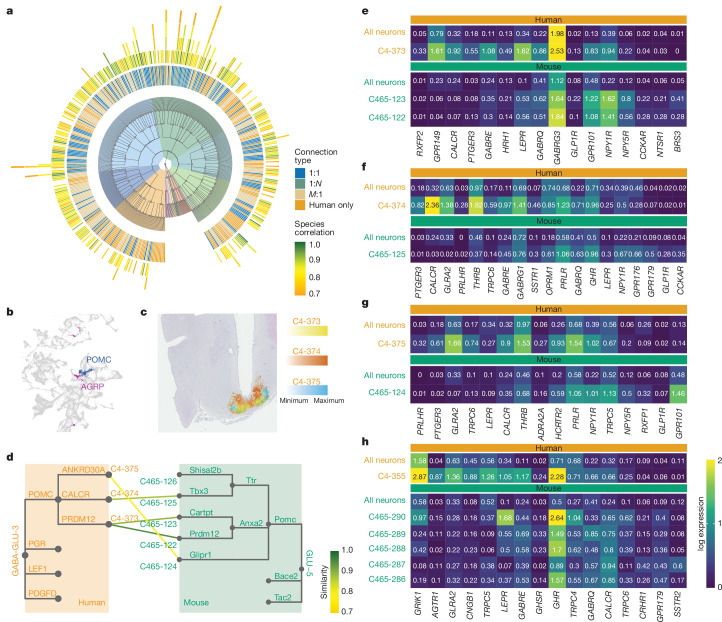
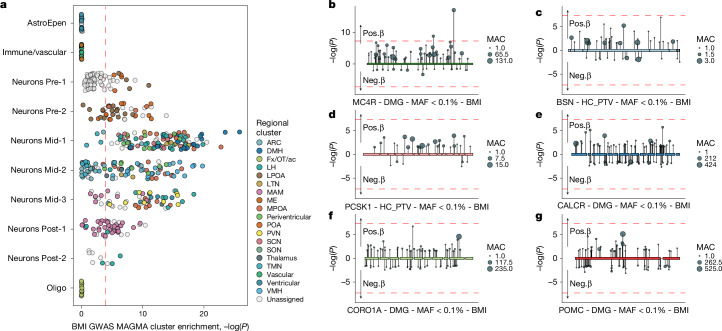
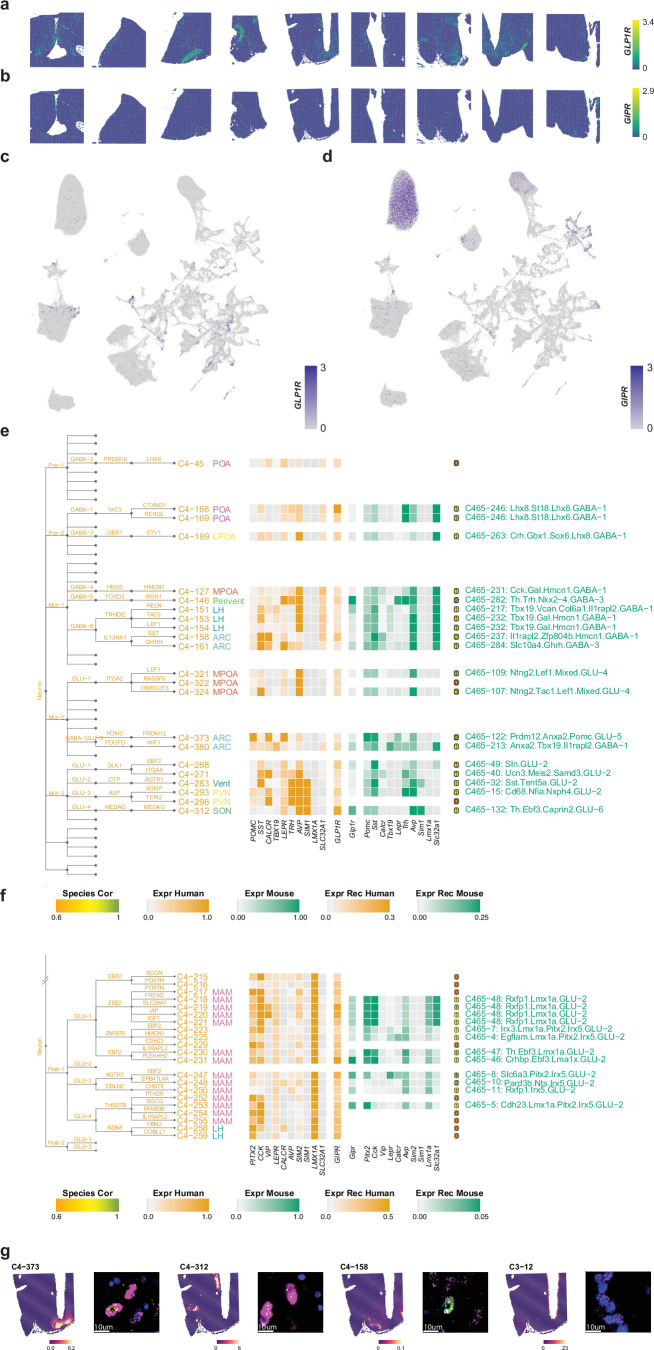
The hypothalamus is a brain region that plays a key role in coordinating fundamental biological functions 1 . However, our understanding of the underlying cellular components and neurocircuitries have, until recently, emerged primarily from rodent studies 2,3 . Here we combine single-nucleus sequencing of 433,369 human hypothalamic cells with spatial transcriptomics, generating a comprehensive spatio-cellular transcriptional map of the hypothalamus, the ‘HYPOMAP’. Although conservation of neuronal cell types between humans and mice, as based on transcriptomic identity, is generally high, there are notable exceptions. Specifically, there are significant disparities in the identity of pro-opiomelanocortin neurons and in the expression levels of G-protein-coupled receptors between the two species that carry direct implications for currently approved obesity treatments. Out of the 452 hypothalamic cell types, we find that 291 neuronal clusters are significantly enriched for expression of body mass index (BMI) genome-wide association study genes. This enrichment is driven by 426 ‘effector’ genes. Rare deleterious variants in six of these ( MC4R , PCSK1 , POMC , CALCR , BSN and CORO1A ) associate with BMI at population level, and CORO1A has not been linked previously to BMI. Thus, HYPOMAP provides a detailed atlas of the human hypothalamus in a spatial context and serves as an important resource to identify new druggable targets for treating a wide range of conditions, including reproductive, circadian and metabolic disorders.
Overview
The claims and statistics of this paper haven’t been checked yet.
Free: it reads the open-access text and checks the first 5 claims that cite a source we can check. Create a free account to check every claim.
Integrity signals
Registry
Cites
Statistics
Figures
Verification
Claims the paper makes
The claims and statistics of this paper haven’t been checked yet.
Free: it reads the open-access text and checks the first 5 claims that cite a source we can check. Create a free account to check every claim.
Claims other papers make about this one
Each is checked against this paper’s own text: does it say what the citing paper says it does?
The source backs part of the claim, not all of it — or backs it for a different population, condition or comparison.
In the citing paper
“This pattern of exclusive microglial C3ar1 expression was also replicated in a scRNAseq dataset performed on isolated human hypothalami[66] (Fig.S2D–F).”
From Complement 3a Receptor mediates high fat diet induced hypothalamic accumulation of lipid associated microglia to regulate neuroinflammation and obesity (2026) · cites this paper as [66]
Experimental — accuracy not yet measured
Self-check
Percentages, sums and reported differences re-computed from the paper’s own numbers.
The self-check needs the paper’s full text.
Citations
Cites
Integrated analysis of multimodal single-cell data
Hao, Y., Hao, S., Andersen-Nissen, E., Mauck, W. M., Zheng, S., Butler, A., Lee, M. J., Wilk, A. J., Darby, C., Zagar, M., et al. (2020) · doi:10.1101/2020.10.12.335331 · Cited by 15,508
The mutational constraint spectrum quantified from variation in 141,456 humans
Karczewski, K. J., Francioli, L. C., Tiao, G., Cummings, B. B., Alföldi, J., Wang, Q., Collins, R. L., Laricchia, K. M., Ganna, A., Birnbaum, D. P., et al. (2020) · Nature · doi:10.1038/s41586-020-2308-7 · Cited by 9,434 · cited 1×
“Variants were then annotated with the ENSEMBL Variant Effect Predictor (VEP) 64 v.10448 with the ‘everything’ flag and the LOFTEE plugin 65 and prioritized a single MANE v.0.97 or VEP canonical ENSEMBL transcript and most damaging consequence as defined by VEP defaults.”
InfluentialGCTA: a tool for genome-wide complex trait analysis
Yang, J., Lee, S. H., Goddard, M. E., & Visscher, P. M. (2011) · The American Journal of Human Genetics · doi:10.1016/j.ajhg.2010.11.011 · Cited by 8,279
The Ensembl Variant Effect Predictor
McLaren, W., Gil, L., Hunt, S. E., Riat, H. S., Ritchie, G. R. S., Thormann, A., Flicek, P., & Cunningham, F. (2016) · Genome Biology · doi:10.1186/s13059-016-0974-4 · Cited by 8,099
UniProt: the universal protein knowledgebase in 2021
The UniProt Consortium, Bateman, A., Martin, M.-J., Orchard, S., Magrane, M., Agivetova, R., Ahmad, S., Alpi, E., Bowler-Barnett, E. H., Britto, R., et al. (2021) · Nucleic Acids Research · doi:10.1093/nar/gkaa1100 · Cited by 6,372
O'Leary, N. A., Wright, M. W., Brister, J. R., Ciufo, S., Haddad, D., McVeigh, R., Rajput, B., Robbertse, B., Smith-White, B., Ako-Adjei, D., et al. (2016) · Nucleic Acids Research · doi:10.1093/nar/gkv1189 · Cited by 6,357
Once-Weekly Semaglutide in Adults with Overweight or Obesity
Wilding, J. P. H., Batterham, R. L., Calanna, S., Davies, M., Van Gaal, L. F., Lingvay, I., McGowan, B. M., Rosenstock, J., Tran, M. T. D., Wadden, T. A., et al. (2021) · New England Journal of Medicine · doi:10.1056/nejmoa2032183 · Cited by 5,205 · cited 1×
“Despite the paucity of human hypothalamic studies, currently licensed therapies for the treatment of obesity and diabetes, including semaglutide 6 and tirzepatide 7 , target the hypothalamus 8 .”
Tirzepatide Once Weekly for the Treatment of Obesity
Jastreboff, A. M., Aronne, L. J., Ahmad, N. N., Wharton, S., Connery, L., Alves, B., Kiyosue, A., Zhang, S., Liu, B., Bunck, M. C., et al. (2022) · New England Journal of Medicine · doi:10.1056/nejmoa2206038 · Cited by 3,838 · cited 7×
“In addition, we extracted the expression matrix for 121,405 nuclei (20,331 ± 55.9 [mean ± s.e.m.] counts detected and 5097 ± 7.1 genes per nucleus) from the hypothalamic regions of three separate donors from a publicly available whole-brain dataset 12 (Supplementary Tables 1 and 2).”
InfluentialCADD: predicting the deleteriousness of variants throughout the human genome
Rentzsch, P., Witten, D., Cooper, G. M., Shendure, J., & Kircher, M. (2019) · Nucleic Acids Research · doi:10.1093/nar/gky1016 · Cited by 3,534 · cited 1×
“All variants were subsequently annotated using CADD (v.1.650) 66 .”
InfluentialTargeted disruption of the melanocortin-4 receptor results in obesity in mice
Huszar, D., Lynch, C. A., Fairchild-Huntress, V., Dunmore, J. H., Fang, Q., Berkemeier, L. R., Gu, W., Kesterson, R. A., Boston, B. A., Cone, R. D., et al. (1997) · Cell · doi:10.1016/s0092-8674(00)81865-6 · Cited by 3,030
Research works printed but not linked: 25
- Fong, H., Zheng, J. & Kurrasch, D. The structural and functional complexity of the integrative hypothalamus. Science 382, 388–394 (2023). 37883552 · DOI
- Yeo, G. S. H. et al. The melanocortin pathway and energy homeostasis: from discovery to obesity therapy. Mol. Metab. 48, 101206 (2021). 33684608 PMC8050006 · DOI · Paper page
- Seminara, S. B. & Topaloglu, A. K. Review of human genetic and clinical studies directly relevant to GnRH signalling. J. Neuroendocrinol. 34, e13080 (2022). 34970798 PMC9299506 · DOI
- Lam, B. Y. H. et al. MC3R links nutritional state to childhood growth and the timing of puberty. Nature 599, 436–441 (2021). 34732894 PMC8819628 · DOI · Paper page
- Herb, B. R. et al. Single-cell genomics reveals region-specific developmental trajectories underlying neuronal diversity in the human hypothalamus. Sci. Adv. 9, eadf6251 (2023). 37939194 PMC10631741 · DOI
- Romanov, R. A., Alpar, A., Hokfelt, T. & Harkany, T. Molecular diversity of corticotropin-releasing hormone mRNA-containing neurons in the hypothalamus. J. Endocrinol. 232, R161–R172 (2017). 28057867 · DOI
- Hatton, I. A. et al. The human cell count and size distribution. Proc. Natl Acad. Sci. USA 120, e2303077120 (2023). 37722043 PMC10523466 · DOI · Paper page
- Khodai, T. & Luckman, S. M. Ventromedial nucleus of the hypothalamus neurons under the magnifying glass. Endocrinology 162, bqab141 (2021). 34265067 PMC8331052 · DOI
- Reitman, M. L. et al. Pharmacokinetics and pharmacodynamics of MK-5046, a bombesin receptor subtype-3 (BRS-3) agonist, in healthy patients. J. Clin. Pharmacol. 52, 1306–1316 (2012). 22162541 PMC5137193 · DOI
- Biglari, N. et al. Functionally distinct POMC-expressing neuron subpopulations in hypothalamus revealed by intersectional targeting. Nat. Neurosci. 24, 913–929 (2021). 34002087 PMC8249241 · DOI · Paper page
- Yengo, L. et al. Meta-analysis of genome-wide association studies for height and body mass index in approximately 700000 individuals of European ancestry. Hum. Mol. Genet. 27, 3641–3649 (2018). 30124842 PMC6488973 · DOI · Paper page
- Timshel, P. N., Thompson, J. J. & Pers, T. H. Genetic mapping of etiologic brain cell types for obesity. eLife 9, e55851 (2020). 32955435 PMC7505664 · DOI · Paper page
- Zhang, L. et al. A genome-wide association study identified new variants associated with mathematical abilities in Chinese children. Genes Brain Behav. 22, e12843 (2023). 36811322 PMC10067424 · DOI
- Luo, S. X. et al. Regulation of feeding by somatostatin neurons in the tuberal nucleus. Science 361, 76–81 (2018). 29976824 · DOI
- Vaisse, C., Clement, K., Guy-Grand, B. & Froguel, P. A frameshift mutation in human MC4R is associated with a dominant form of obesity. Nat. Genet. 20, 113–114 (1998). 9771699 · DOI · Paper page
- Krude, H. et al. Severe early-onset obesity, adrenal insufficiency and red hair pigmentation caused by POMC mutations in humans. Nat. Genet. 19, 155–157 (1998). 9620771 · DOI · Paper page
- Zhao, Y. et al. Protein-truncating variants in BSN are associated with severe adult-onset obesity, type 2 diabetes and fatty liver disease. Nat. Genet. 56, 579–584 (2024). 38575728 PMC11018524 · DOI
- Turcot, V. et al. Protein-altering variants associated with body mass index implicate pathways that control energy intake and expenditure in obesity. Nat. Genet. 50, 26–41 (2018). 29273807 PMC5945951 · DOI · Paper page
- Prevot, V., Nogueiras, R. & Schwaninger, M. Tanycytes in the infundibular nucleus and median eminence and their role in the blood-brain barrier. Handb. Clin. Neurol. 180, 253–273 (2021). 34225934 · DOI
- Schott, M. et al. Open-ST: high-resolution spatial transcriptomics in 3D. Cell 187, 3953–3972 e3926 (2024). 38917789 · DOI · Paper page
- Zhang Fern, X. & Brodley, C. E. Solving cluster ensemble problems by bipartite graph partitioning. ICML ‘04: Proceedings of the Twenty-first International Conference on Machine Learning (eds Greiner, R. & Schuurmans, D.) 36 (ACM, 2004). · DOI · Paper page
- Peng, M. et al. Cell type hierarchy reconstruction via reconciliation of multi-resolution cluster tree. Nucleic Acids Res. 49, e91 (2021). 34125905 PMC8450107 · DOI
- Liang, S., Liang, Q., Chen, R. & Chen, K. Stratified test accurately identifies differentially expressed genes under batch effects in single-cell data. IEEE/ACM Trans. Comput. Biol. Bioinform. 18, 2072–2079 (2021). 34232885 PMC8717684 · DOI
- Yates, A. D. et al. Ensembl 2020. Nucleic Acids Res. 48, D682–D688 (2020). 31691826 PMC7145704 · DOI · Paper page
- Gardner, E. J. et al. Damaging missense variants in IGF1R implicate a role for IGF-1 resistance in the etiology of type 2 diabetes. Cell Genom. 2, None (2022). 36530175 PMC9750938
Cited by
Brain control of energy homeostasis: implications for anti-obesity pharmacotherapy
Johansen, V. B. I., Petersen, J., Lund, J., Mathiesen, C. V., Fenselau, H., & Clemmensen, C. (2025) · Cell · doi:10.1016/j.cell.2025.06.010 · Cited by 53
Pallais, J. P., Razzoli, M., Rodriguez, P., McGonigle, S., Daugherty, A., Hillman, H., Verteramo, L., Schrank, P. R., Parthiban, P., Chang, X., et al. (2026) · doi:10.64898/2026.04.18.719397 · Cited by 1
Metadata
- Authors
- Tadross, J. A., Steuernagel, L., Dowsett, G. K. C., Kentistou, K. A., Lundh, S., Porniece, M., Klemm, P., Rainbow, K., Hvid, H., Kania, K., Polex-Wolf, J., Knudsen, L. B., Pyke, C., Perry, J. R. B., Lam, B. Y. H., Brüning, J. C., & Yeo, G. S. H.
- Venue
- Nature
- Published
- 2025-02-05
- Volume
- 639
- Issue
- 8055
- Pages
- 708-716
- ISSN
- 0028-0836
- 1476-4687
- PMC
- PMC11922758
- Cited by
- 112
- References
- 45
- Language
- en
- Update notices
- correction (2025-02-25)
- Licence
- creativecommons.org/licenses/by/4.0 (tdm)
- creativecommons.org/licenses/by/4.0 (vor)
About these checks
Registry, retraction, Cites and statistics results are computed, not judged, with one exception: a printed reference that no index lists is read once by a model before it counts as a citation error. Claims are extracted by a model and kept only when their quote appears verbatim in the text; each cited source is then checked, with a model’s help, for whether it says what the claim relies on. Those verdicts can be wrong — read the claim’s quote and the cited source before relying on one.
Statistics and arithmetic are recomputed, not judged.
Confidence bands are shown only for fields calibrated on our annotated test set. None is calibrated yet, so no band is shown.
What counts as a claim ›How we measure confidence ›How we check this ›
Are you an author, or do you see a problem with this page? Request a review
Data sources
Bibliographic data: Semantic Scholar, OpenAlex, Crossref.
Contains information from the Semantic Scholar Academic Graph Datasets, made available under the ODC Attribution License (ODC-BY 1.0).
Semantic Scholar’s data is described in: Kinney, R., et al. (2023). The Semantic Scholar Open Data Platform. arXiv:2301.10140.
