

The DOI matches its Crossref record; 64 of the 64 references it cites were found in a registry or an index.
High-throughput microbial culturomics using automation and machine learning
Open accessAbstract
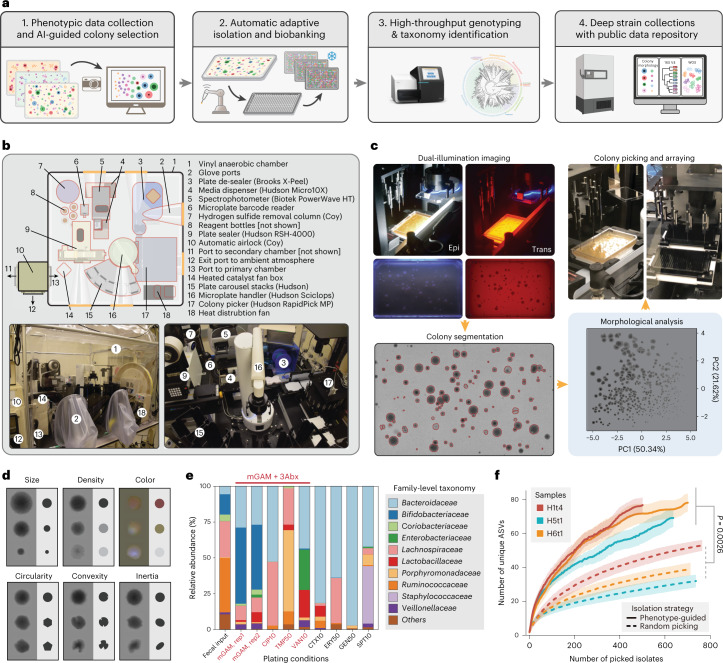
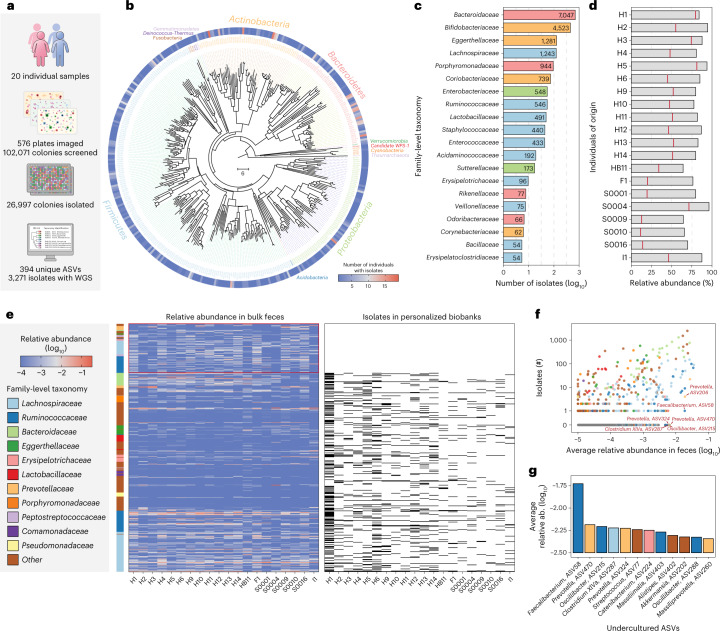
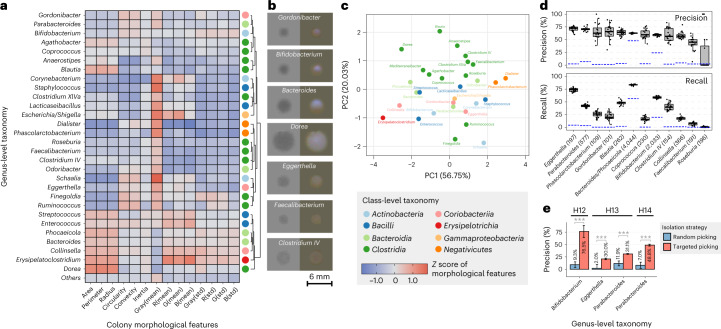
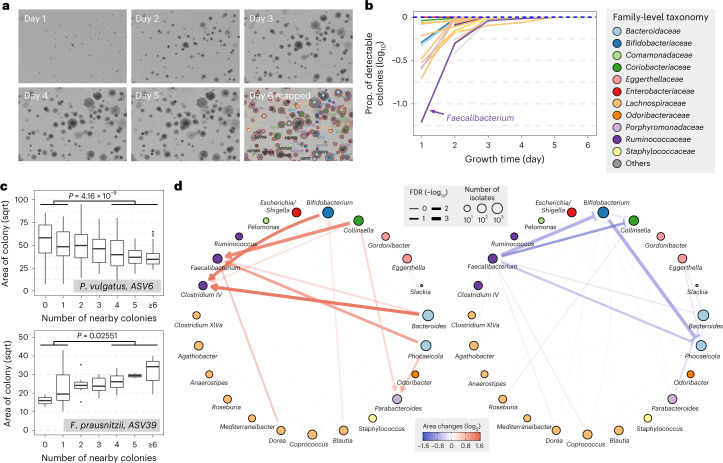
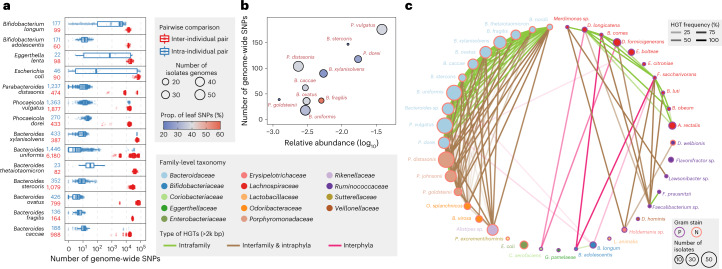
Pure bacterial cultures remain essential for detailed experimental and mechanistic studies in microbiome research, and traditional methods to isolate individual bacteria from complex microbial ecosystems are labor-intensive, difficult-to-scale and lack phenotype-genotype integration. Here we describe an open-source high-throughput robotic strain isolation platform for the rapid generation of isolates on demand. We develop a machine learning approach that leverages colony morphology and genomic data to maximize the diversity of microbes isolated and enable targeted picking of specific genera. Application of this platform on fecal samples from 20 humans yields personalized gut microbiome biobanks totaling 26,997 isolates that represented >80% of all abundant taxa. Spatial analysis on >100,000 visually captured colonies reveals cogrowth patterns between Ruminococcaceae, Bacteroidaceae, Coriobacteriaceae and Bifidobacteriaceae families that suggest important microbial interactions. Comparative analysis of 1,197 high-quality genomes from these biobanks shows interesting intra- and interpersonal strain evolution, selection and horizontal gene transfer. This culturomics framework should empower new research efforts to systematize the collection and quantitative analysis of imaging-based phenotypes with high-resolution genomics data for many emerging microbiome studies.
Overview
The claims and statistics of this paper haven’t been checked yet.
Run the check — free, no account needed. It reads the open-access text and checks the sources it cites.
Integrity signals
Registry
Cites
Statistics
Figures
Verification
Claims the paper makes
The claims and statistics of this paper haven’t been checked yet.
Run the check — free, no account needed. It reads the open-access text and checks the sources it cites.
Claims other papers make about this one
Each is checked against this paper’s own text: does it say what the citing paper says it does?
In the citing paper
“However, particularly for the gut microbiome, largescale cultivation projects 134 and massive metagenomic assembly efforts 135 are quickly expanding and completing reference databases needed for taxonomic profiling tools. 136”
From Key determinants of success in fecal microbiota transplantation: From microbiome to clinic (2023) · cites this paper as [134]
Self-check
Percentages, sums and reported differences re-computed from the paper’s own numbers.
The self-check needs the paper’s full text.
Citations
Cites
The Sequence Alignment/Map format and SAMtools
Li, H., Handsaker, B., Wysoker, A., Fennell, T., Ruan, J., Homer, N., Marth, G., Abecasis, G., Durbin, R., & 1000 Genome Project Data Processing Subgroup (2009) · Bioinformatics · doi:10.1093/bioinformatics/btp352 · Cited by 62,041
Fast gapped-read alignment with Bowtie 2
Langmead, B., & Salzberg, S. L. (2012) · Nature Methods · doi:10.1038/nmeth.1923 · Cited by 56,400
MUSCLE: multiple sequence alignment with high accuracy and high throughput
Edgar, R. C. (2004) · Nucleic Acids Research · doi:10.1093/nar/gkh340 · Cited by 44,662
MEGA X: Molecular Evolutionary Genetics Analysis across Computing Platforms
Kumar, S., Stecher, G., Li, M., Knyaz, C., & Tamura, K. (2018) · Molecular Biology and Evolution · doi:10.1093/molbev/msy096 · Cited by 37,683
BLAST+: architecture and applications
Camacho, C., Coulouris, G., Avagyan, V., Ma, N., Papadopoulos, J., Bealer, K., & Madden, T. L. (2009) · BMC Bioinformatics · doi:10.1186/1471-2105-10-421 · Cited by 22,074
Search and clustering orders of magnitude faster than BLAST
Edgar, R. C. (2010) · Bioinformatics · doi:10.1093/bioinformatics/btq461 · Cited by 21,098
Naive Bayesian Classifier for Rapid Assignment of rRNA Sequences into the New Bacterial Taxonomy
Wang, Q., Garrity, G. M., Tiedje, J. M., & Cole, J. R. (2007) · Applied and Environmental Microbiology · doi:10.1128/aem.00062-07 · Cited by 20,145
Prokka: rapid prokaryotic genome annotation
Seemann, T. (2014) · Bioinformatics · doi:10.1093/bioinformatics/btu153 · Cited by 18,937
Parks, D. H., Imelfort, M., Skennerton, C. T., Hugenholtz, P., & Tyson, G. W. (2015) · Genome Research · doi:10.1101/gr.186072.114 · Cited by 12,496
QUAST: quality assessment tool for genome assemblies
Gurevich, A., Saveliev, V., Vyahhi, N., & Tesler, G. (2013) · Bioinformatics · doi:10.1093/bioinformatics/btt086 · Cited by 11,172
Research works printed but not linked: 1
- Huang, Y. et al. High-throughput microbial culturomics using automation and machine learning. WGS of isolates collection. Sequence Read Archive. https://www.ncbi.nlm.nih.gov/bioproject/PRJNA745993 (2023).
Cited by
Sorted by citations
Probiotics, prebiotics, and postbiotics in health and disease
Ji, J., Jin, W., Liu, S., Jiao, Z., & Li, X. (2023) · MedComm · doi:10.1002/mco2.420 · Cited by 449
Key determinants of success in fecal microbiota transplantation: From microbiome to clinic
Porcari, S., Benech, N., Valles-Colomer, M., Segata, N., Gasbarrini, A., Cammarota, G., Sokol, H., & Ianiro, G. (2023) · Cell Host & Microbe · doi:10.1016/j.chom.2023.03.020 · Cited by 331
Soil microbiome engineering for sustainability in a changing environment
Jansson, J. K., McClure, R., & Egbert, R. G. (2023) · Nature Biotechnology · doi:10.1038/s41587-023-01932-3 · Cited by 274
AGILE platform: a deep learning powered approach to accelerate LNP development for mRNA delivery
Xu, Y., Ma, S., Cui, H., Chen, J., Xu, S., Gong, F., Golubovic, A., Zhou, M., Wang, K. C., Varley, A., et al. (2024) · Nature Communications · doi:10.1038/s41467-024-50619-z · Cited by 285
Intestinal colonization resistance in the context of environmental, host, and microbial determinants
Woelfel, S., Silva, M. S., & Stecher, B. (2024) · Cell Host & Microbe · doi:10.1016/j.chom.2024.05.002 · Cited by 151
Metadata
- Authors
- Huang, Y., Sheth, R. U., Zhao, S., Cohen, L. A., Dabaghi, K., Moody, T., Sun, Y., Ricaurte, D., Richardson, M., Velez-Cortes, F., Blazejewski, T., Kaufman, A., Ronda, C., & Wang, H. H.
- Affiliations
- Columbia University (US)
- Corresponding author
- Wang, Harris H.
- ORCID
- Venue
- Nature Biotechnology
- Published
- 2023-02-20
- Volume
- 41
- Issue
- 10
- Pages
- 1424-1433
- ISSN
- 0733-222X (ISSN-L)
- 1087-0156
- 1546-1696
- PMC
- PMC10567565
- OpenAlex
- W4321369770
- Cited by
- 283
- References
- 63
- Citations by year
- 2026: 95 · 2025: 94 · 2024: 62 · 2023: 29
- FWCI
- 24.73
- Type
- journal article
- Language
- en
- Open access
- hybrid
- doi.org
- Locations
- Nature Biotechnology (publishedVersion, cc-by)
- PubMed Central (publishedVersion, cc-by)
- PubMed (publishedVersion)
- Funders
- National Science Foundation (MCB-2025515, DGE-1644869)
- U.S. Department of Health & Human Services | National Institutes of Health (1R01AI132403, 1R21AI146817, T32GM007367)
- United States Department of Defense | United States Navy | Office of Naval Research (N00014-18-1-2237, N00014-17-1-2353)
- Burroughs Wellcome Fund (1016691)
- Irma T. Hirschl Trust (NA)
- Schaefer Research Award
- Hertz Foundation (NA)
- Junior Fellows Scholarship from the Simons Society of Fellows
- Topics
- Life Sciences › Biochemistry, Genetics and Molecular Biology › Molecular Biology › Gut microbiota and health
- Life Sciences › Biochemistry, Genetics and Molecular Biology › Molecular Biology › Genomics and Phylogenetic Studies
- Health Sciences › Medicine › Microbiology (medical) › Bacterial Identification and Susceptibility Testing
- Keywords
- culturomics, colony morphology, fecal microbiota, microbial co-culture, Ruminococcaceae, Bacteroidaceae, Coriobacteriaceae, Bifidobacteriaceae, strain evolution, horizontal gene transfer
- MeSH terms
- Machine Learning, Automation, Bacteria, Humans, Genomics, Microbiota
About these checks
Registry, retraction, Cites and statistics results are computed, not judged, with one exception: a printed reference that no index lists is read once by a model before it counts as a citation error. Claims are extracted by a model and kept only when their quote appears verbatim in the text; each cited source is then checked, with a model’s help, for whether it says what the claim relies on. Those verdicts can be wrong — read the claim’s quote and the cited source before relying on one.
Statistics and arithmetic are recomputed, not judged.
Confidence bands are shown only for fields calibrated on our annotated test set. None is calibrated yet, so no band is shown.
What counts as a claim ›How we measure confidence ›How we check this ›
Are you an author, or do you see a problem with this page? Request a review
